Japan Advanced Institute of Science and Technology
JAIST Repository
https://dspace.jaist.ac.jp/Title
Elliptic curves with a pre-determined embedding
degree
Author(s)
Hirasawa, Shoujirou; Miyaji, Atsuko
Citation
IEEE International Symposium on Information
Theory, 2009. ISIT 2009.: 2391-2395
Issue Date
2009
Type
Conference Paper
Text version
publisher
URL
http://hdl.handle.net/10119/9095
Rights
Copyright (C) 2009 IEEE. Reprinted from IEEE
International Symposium on Information Theory,
2009. ISIT 2009., 2009, 2391-2395. This material
is posted here with permission of the IEEE. Such
permission of the IEEE does not in any way imply
IEEE endorsement of any of JAIST's products or
services. Internal or personal use of this
material is permitted. However, permission to
reprint/republish this material for advertising
or promotional purposes or for creating new
collective works for resale or redistribution
must be obtained from the IEEE by writing to
[email protected]. By choosing to view
this document, you agree to all provisions of the
copyright laws protecting it.
Elliptic Curves with a Pre-determined Embedding
Degree
Shoujirou Hirasawa Japan Advanced Institute of
Science and Technology
1-1 Asahidai, Nomi, Ishikawa 923-1292 Japan
Abstract-A pairing over an elliptic curve E(lFpm ) to an ex-tension field oflFpmk has begun to be attractive in cryptosystems, where k is called the embedding degree. The cryptosystems using a pairing are called the pairing-based cryptosystems. The embedding degree k is also an indicator of the relationship between the elliptic curve Discrete Logarithm Problem (ECDLP) and the Discrete Logarithm Problem (DLP), where ECDLP over
E(lFpm) is reduced to DLP over lFpmk. An elliptic curve is determined by j-invariant or order, however the explicit condition between these parameters and an embedding degree has been described only in some degrees. In this paper, we investigate a new condition of the existence of elliptic curves with pre-determined embedding degrees, and present some examples of the elliptic curves over 160-bit, 192-bit and 224-bit lFpm •
I. INTRODUCTION
A pairing over an elliptic curveE(IFpm )to an extension field ofIFpmk is originally used to solve the Elliptic Curve Discrete Logarithm Problem (ECDLP) by reducing ECDLP onE(IFpm ) to Discrete Logarithm Problem (DLP) on IFpmk [7], where k
is called the embedding degree. The embedding degreek is an indicator of the security of ECDLP, where the security level of ECDLP over E(IFpm) is the same as that of DLP over IFpmk. Recently, the pairing over an elliptic curveE(IFpm)has begun to be attractive in cryptosystems since it can achieve an ID-based cryptosystem [3] or etc. The cryptosystems using a pairing are called the pairing-based cryptosystems.
The elliptic curve E(IFpm) is determined by j-invariant or order ~E(IFpm). The relationship, however, between j, ~E(IFtr")and the embedding degreekhas been described only in some degrees such as k
==
3, 4, 6, 10, or 12. Generally, the embedding degree k for a prime-order elliptic curve is k ~nwhere n
==
~E(IFpm) [1].A lot of studies to construct elliptic curves having small embedding degrees, such as k
==
2, 3, 4, 5, 6, 10 and 12, have been investigated. Miyaji, Nakabayashi and Takano [8] have proposed ordinary elliptic curves with embedding degreesk
==
3, 4 and 6. Galbraith, Valenca, Mackee [5] have presented the factorization of cyclotomic polynomials with degrees 5, 10 and 12, and applied the results [8] to a hyperelliptic curve. Freeman [4] and Barretto and Naehrig [2] have constructed ordinary elliptic curves with embedding degree k==
10 andk
==
12 using [5], respectively. In addition, Hitt [6] has investigated a Jacobian of hyperelliptic curve Jc IIF2m and discussed the way to decide the embedding degree k ofAtsuko Miyaji Japan Advanced Institute of
Science and Technology
1-1 Asahidai, Nomi, Ishikawa 923-1292 Japan Email: [email protected]
Jc(IF2m) from the order of p in ;En, where n is the largest prime divisor of ~Jc(IF2m). Hitt also gave some examples of ~Jc(IF2m) with the embedding degree k
<
(10gpm)2, but did not give concrete JcIIF2m themselves This result cannot construct ~Jc(IF2m) with p==
~Jc ~2m) ~ 1. Because this results restrict the relation between trace, definition field, and the largest prime divisor. Furthermore, this result suffers from reduction to the actual minimum embedding degree. As a result, the actual security level of all this results is reduced to 2~ - ~ of their original security level.In this paper, we apply [6] to the case of elliptic curves, and prove the existence of elliptic curves with pre-determined embedding degrees and resolves the above problem. In fact, we improve Hitt's results from the point of view of p-value and the actual minimum security. As for p-value, we do not place any restrictions on the relation between trace and definition field. As a result, we can construct elliptic curves with p
==
1. Furthermore, we can enjoy the case of prime field IFp , and, thus, our results do not suffer from reduction to the minimum embedding degree. We also present some examples of prime orders of elliptic curves over 160-bit, 192-bit and 224-bit IFpand embedding degrees.
This paper is organized as follows. Section II summarizes known facts on elliptic curves. In Section III, we review the previous results. Our main contribution appears in Section IV, where we show how to give orders of elliptic curves with pre-determined embedding degree. with pre-determined em-bedding degree. In Section V, we present some experimental results based on Section IV. Section VI compares our results with Hitt's results. Conclusion follows in Section VII.
II. PREPARATION
This section summarizes the known facts on elliptic curves. Letpbe a prime, m be a positive integer, andE be an elliptic curve defined over a finite field IFpm, where the trace t is defined t
==
p'"+
1 - ~E(IFpm ). The embedding degree is defined as follows.Definition 1: Let E be an elliptic curve over a finite field IFpm with~E(IFpm),where n is set to the largest prime divisor of ~E(IFpm ). The embedding degree of E is the smallest positive integer k such that n
I
pmk - 1.In other words, k is the minimal integer such that n
I
<Pk(pm),where <Pk(X)is the k-th cyclotomic polynomial. Asfor the embedding degree k of E, the following 4 conditions are equivalent to each other:
1) ECDLP over E(FpTn) reduces to DLP over FpTnk .
2) k is the smallest positive integer such that n
I
pmk- 1.3) <Pk(pm)
==
0 (mod n).4) <Pk(t- 1)
==
0 (mod n).Waterhouse's theorem [9] shows that an elliptic curve defined over FpTn of order p'"
+
1 - t exists if and only if one of the following conditions holds:1) t:t 0 (mod p) and t2 :s;4pm .
2) m is odd and one of the following holds:
t
==
0,- t2
==
2pm and p==
2,- t2
==
3pm andp==
3.3) m is even and one of the following holds:
t2
==
4pm ,t2
==
pmand p :t 1 (mod 3), t==
0 and p:t 1 (mod 4).III. PREVIOUS RESEARCH
We summarize previous results that determine the embed-ding degree explicitly by trace [8], [4], [2] and Hitt's results [6] in detail. Table 1presents traces t of elliptic curves over
FpTn with embedding degree k, where x are integers.
A. The hyperelliptic curve of k
<
(log pm)2[6JHitt investigates Jacobians of genus 2curves Jc overF2Tn . Hitt has shown that the embedding degree k of Jc(F2Tn) is
decided from the order of 2 in Zn (where n is the largest
prime divisor of~JC(F2Tn)), and that k
<
(log 2m) 2 .Here wepresent Hitt's results.
Theorem 1 ([6]): Let n
=
22~rL-:;1
be prime for 3r2:
0, let L ~ 5 be odd, and letk be the embedding degree of Jc(F2Tn )with respect to the largest prime divisorn of~JC(F2Tn ),where 1 :s; m :s; 2r(L - 1) - 1or (m, r)
==
(Lt1, 0). Then, k==
2r+1 -i when gcd(ordn(2), m)
==
2iL (0 :s;:3 i :s; r - 1),andk
==
2r+1 -iL when gcd(ordn(2), m)
==
2i (0 :s;:3i :s;r+
1).Let us present Lemma shown in [6] that we will use later.
Lemma 1 ([6J): Let m be a positive integer, p and n
i-
pbe primes, and let k be the smallest positive integer such that mk- 1 ( d ) Th k - ordn(p)
p
==
rna n. en - gcd(ordn(p),m). IV. THE PROPOSED METHODWe propose a method to construct an elliptic curve with a pre-determined embedding degree k. The embedding degree of E(FpTn) is determined by order of p in Zn, where n
==
~E(FpTn) is prime. We will show that order of p in Zn is determined when n
=
.x(~~t~)
for r, a, A E Z (r, A2:
0) and an odd prime L. We will seta==
por a== t -
1 when we apply the following lemmas to decide the order of an elliptic curve.The following lemma determines the order of a prime p over Zn.
Lemma 2: Let r, a, A E Z (r, A ~ 0) and L be an
. _ a2TL+1 2T d ( )
odd prime. If n - A(a2T+1) and a F -1 mod n , then ord.,(a)
==
2r+1L.a2TL+1 '( 2T ) 2TL
Proof: From n
==
A(a2T+1)'we have A a+
1 n==
a+
1.Thus, we get a2TL
==
-1 (modn). This implies a2T+1L==
1 (mod n), and, thus, ordn(a)
I
2r+1L. Since L is prime,we get that either ord.,(a)
==
21 or ord.,(a)==
21L (0 :s;:3j
<
r+
1). Suppose ordn(a)==
21L (0 :s;:3 j<
r). Then,a2j L
==
1 (mod n), so a(2jL)2T- j==
1 (mod n) and, thus, a2TL==
1 (mod n). However, this contradicts the above factthat a2TL
==
-1 (modn). Therefore, ordn(a)i-
21L (0 :s;vj :s;r). Similarly, we easily getord.,(a)
i-
21(0 :s; vj :s;r). Suppose thatordn(a)==
2r+1 .From the above fact thata2TL==
-1 (modn), we get the following sequences: -1==
a2TL==
a2T+1 a2T(L-2)==
a2T(L-2)==
a2T+1 a2T(L-4)== ... ==
a 2T(mod n) since L is an odd prime. However this contradicts a2T :t -1 (mod n). Therefore, we have proved ordn(a) 2r+1L. I
From Lemmas 1 and 2, we get the following Lemma.
Lemma 3: Let r, m, A, and a E Z (r, m, A ~ 0), let L andn be odd primes, and let k be the smallest positive integer
mk_ ( ) _ a2TL+ 1 2T d
such that a
==
1 mod n . If n - A(a2T+1) and a F-1(mod n), then k
==
2r+1-i when gcd(ordn(a),m)==
2iL(0:s;:3 i :s;r+1), and k
==
2r+1 -iLwhen gcd(ordn(a), m)==
2i (0 :s;:3i
<
r+
1).f a2TL+1
Proo: From the assumption of n A(a 2T+1) and a2T :t -1 (mod n), we get ordn(a) 2r+1L by
Lemma 2. Thus, gcd(ordn(a), m)
I
ordn(a) and, therefore, gcd(ordn(a), m)==
2iL or 2i (0 :s;:3 i :s; r+
1).Lemma 1says that k
==
ordn(a) .Therefore, we get k==
2r+1 -igcdrord,(a), m)
ifgcd(ordn(a),m)
==
2iL (0 :s;:3i :s;r+1); andk==
2r+1 -iLelse if gcd(ordn(a), m)
==
2i (0 :s;:3 i :s;r+
1). IApplying Lemmas 2 and 3 on a
==
p, t - 1 we prove the following theorem that describes the relation between embedding degree and order.Theorem 2: Let r, m, A, a E Z (r, m, A ~ 0), let L be an odd prime, D
==
gcd( ord.,(p),m), and let k be embedding degree of E(FpTn). Then, the following two results hold:1) Embedding degree k of E(FpTn) is k
==
2r+ 1-iL when D==
2i (0 :s; i :s; r+
1) or k==
2r+1- i when D==
2iL (0
:S
i:S
r+
1) if~E(lFp=)
=
{(~~~~)
=
n is prime and p2T:t -1 (modn);
2) The embedding degree k of E(FpTn) is k
==
2r+ 1L if_ (t_1)2 TL+ 1 _ 2T
~E(FpTn) - A((t-1)2T+1) - nand (t - 1) :t-1
(modn).
Proof: (1). Apply a
=
p and~E(lFp=
)=
n=
{(;2~~~)
to Lemma 3. Then k in Lemma 3 is the smallest positive integer such that pmk==
1 (mod n). Therefore, embedding degree k of E(FpTn) is k==
2r+ 1-iL when D==
2i , and k==
2r+ 1-iwhen D
==
2iL. T_ _ _ (t-1)2 L+ 1
(2). Apply a -
t
-
1, and ~E(FpTn) - n - A((t-1)2T+1)to Lemma 2. In this case,
t
==
p'"+
1 - n, and, thust
-1
==
p'" (mod n), which implies that (t - l)k==
pmk==
1 2392TABLEI
ELLIPTIC CURVES WITH SMALL EMBEDDING DEGREES
k pm t 3 12x:l - 1 -1 ±6x MNT-Curve[8] 4 x~+X +1 -xorx+1 6 4x~+1 1±2x Freeman]4] 10 25x4+25x;1+25x~+lOx+3 10x:l+5x+3 BN-Curve[2] 12 36x4+36x;1+24x:l+6x+1 6x:l +1
(modn). Thus, we get embedding degree k
==
ordn(pm)==
ordn(t - 1)==
2T+ 1L. IIn the next section, we give two algorithms to find elliptic curve parameters such as a definition field JFp , order of ~E(JFp)
==
n, and trace t, which have a pre-determined em-bedding degrees by using Theorem 2 and satisfy Waterhouse's theorem.v.
CONSTRUCTIONS OFE /JFprnWe give two algorithms to find some of elliptic-curve parameters and experimental results. All experiments were done by using MATHEMATICA on a PC with pentium D
3.0 GHz and memory of 1.0 GB.
A. The Basic Algorithm
) p2T'L+1 . h d L
Let n
==
~E(JFprn==
A(p2T'+1) be a prime, w ~reI!
an are odd primes, and r, m and A are non negative integers.2T'L
This means that n is a factor of
r
==
Pp2T':11 .A non-negative integerm can be restricted by the following Proposition.Proposition 1: Letn
==
~E(JFprn) for an odd primep and a positive integerm. IfItI
satisfies the condition of Waterhouse, then m==
LlogpnJ or LlogpnJ+
1.Proof: Let m'
==
LlogpnJ. Ifm>
m'+
1,then ItI
==
p'"+
I-n
2:
pm-v::'
==
(p_l)pm-1>
2#.
Ifm<
m',
thenI I 1 I 1
It
I
==
n - (pm+
1)>
pm - pm - - 1==
(p - l)pm - - 1>
2#.
This contradict the condition of Waterhouse. From this, we get m==
m' or m'+
1.IHere we present Algorithm 1, which applies a
==
p to Theorem 2.Algorithm1: • •
Input: An odd prime
L
and a non negative integer r.Output: The embedding degree
k,
order n, definition field pm, and the tracet.
1. Set an odd prime p.
_ p2T'L+1 2. Set
r -
p2T'+1 .3. Set a large prime factor of
r
to n.2T' _ ( )
4. If P
==
-1 mod n, then return toStep 1.
5. Set m'
==
LlogpnJ .6. If m'+1/2<logpn, then m==m'+I.
Else m
==
m'.7. Set t
==
pm+
1 - n.8. If (pm,n) does not satisfy the
condition of Waterhouse, then return to Step 1.
2T'+1 L
9. Set k
==
gcd(2T'+lL,m) .10. Output {k, n, p'"; t}.
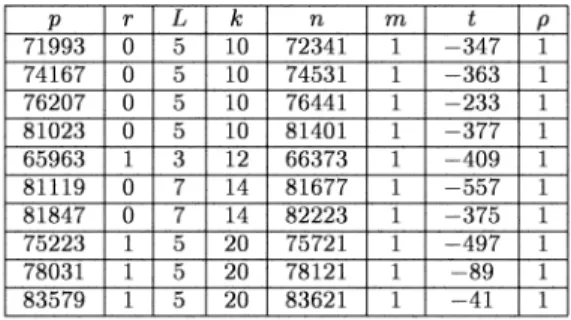
Table II presents elliptic-curve parameters ofpm, n,twhich satisfy Theorem 2 and the condition of Waterhouse. They are constructed by Algorithm 1 for 0
<
r<
1, 3<
L<
7 and all 16-bit primesp.Algorithm 1 does not work well, since it often fails in Step 8 for the following reason: In order to execute Step 3,
r
==
p2:
rL:
11=
p2 r(L-l)_ p2r(L-2)
+ ... +
1 has to be almost p;ime with a prime factor n, which implies that n~
r.
On the other hand,pm ~ n due to the condition of Waterhouse. Therefore, 2T(L - 1) ~ m. By combining these facts that n ~r
and p'" ~p2T' (L-1), we get that ItI
==
Ipm+
1 -nl
~L-2 L-3 2
pL-1m
+
O(pL-1 m), which inducest>
4pm if p'" is large.Therefore, it fails in Step 8. As a result, only small pm can be constructed, as we have shown in Table II.
TABLEII
THE ELLIPTIC-CURVE PARAMETERS ANDk(ALGORITHM1)
p r L k n m t p 71993 0 5 10 72341 1 -347 1 74167 0 5 10 74531 1 -363 1 76207 0 5 10 76441 1 -233 1 81023 0 5 10 81401 1 -377 1 65963 1 3 12 66373 1 -409 1 81119 0 7 14 81677 1 -557 1 81847 0 7 14 82223 1 -375 1 75223 1 5 20 75721 1 -497 1 78031 1 5 20 78121 1 -89 1 83579 1 5 20 83621 1 -41 1
B. The Improved Algorithm
In order to resolve the problem of Algorithm 1, we apply
a
==
t - 1 to Theorem 2. Then, the condition of Waterhouse usually holds for the following reason. In this case, logn ~logt 2T'(L-1), thus any n,pm and t satisfy n ~ t 2T'(L-1)
2:
t
2, which implies that2Vii
>
Vii
2:
t,
where equality in t 2T'(L-1)2:
t 2holds if and only if (r, L)==
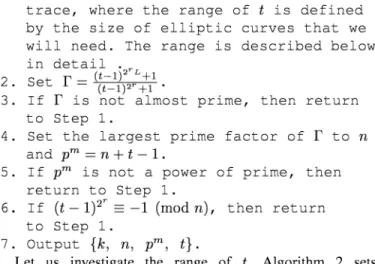
(0, 3).Algorithm 2: • •
Input: An odd prime L and a non negative
integer r. (i.e. an embedding degree
k
==
2T+1L.)Output: Order n, a power of prime pm, and trace
t.
1. Set an odd integer t as a candidate of
trace, where the range of t is defined by the size of elliptic curves that we will need. The range is described below in detail . T
_ (t-1)2 L+1
2. Set
r -
(t_1)2T+1 ·3. If
r
is not almost prime, then return to Step 1.4. Set the largest prime factor of
r
to n and p'"==
n+
t - 1 .5. If pm is not a power of prime, then return to Step 1.
6. If (t- 1)2T
==
-1 (modn), then return to Step 1.7. Output {k, n, p'"; t}.
Let us investigate the range of
t.
Algorithm 2 sets UE(JFp= ) = n =.S(~~~2):~~~),
and, thus, log p'"~
2T(L-1) log
t.
Therefore,t
is set to 2T(1~1) bits when we construct160-bit elliptic curves.
c.
Experimental resultsExperiments are executed for m
==
1 and (r, L) as shown in Table III. Here we set m==
1 since an elliptic curve over a prime field lFp do not suffer from reduction to the minimumembedding degree.
Then, the range oft is determined by the above discussion in Section 5.2, where t runs over 100,000 kinds of random
2}(t~1) -bit integers. We constructed examples with 160, 192,
224-bitp.
Table III shows the total number of elliptic-curve param-eters constructed by Algorithm 2. The following are some examples. 160-bitaelliptic curves (1) k
==
10, t==
1285693206491 q==
273243221 2182434088 1531032711 6177600129 4482681101 r==
273243221 2182434088 1531032711 6177600000 8789474611 p==l (2) k==
20, t==
1712607 q==
180499429 2421198963 8284539265 0495241704 2967749987 r==
180499429 2421198963 8284539265 0495241704 2966037381 p==l 192-bitaelliptic curves (1) k==
14t==
7223820963 q==
1912551 0159002005 2219431877 1995972452 4321251430 5346292063 r==
1912551 0159002005 2219431877 1995972452 4321251429 8122471101 p==l (2) k==
28t==
-66881 q==
24447 5068599953 5868940457 2401483697 7022909801 1541952959 r==
24447 5068599953 5868940457 2401483697 7022909801 1542019841 p==l 224-bitaelliptic curves (1) k==
12,t==
-9924312 9329168669 q==
1328859 1151679357 6485698850 6600860828 7715683196 7144571636 9719292167 r==
1328859 1151679357 6485698850 6600860828 7715683196 7154495949 9048460837 p==l (2) k==
20,t==
-419108453 q==
15605638 2326675970 2773190814 4467543753 5277124105 2130428296 5529550667 r==
15605638 2326675970 2773190814 4467543753 5277124105 2130428296 5948659121 p==lVI. COMPARISON BETWEEN OUR RESULTS AND HITT' S RESULTS.
Let us compare our results with Hitt's results. Table IV shows the comparison between our results and [6]. Hitt has investigated Jacobians of genus 2 curves Jc over lF2rn and
some examples of the parameters for such curves over lF2rn
with embedding degrees k
==
8,13,16,23,26,37,46 and 52. However, Hitt's result cannot construct p==
1 because the results restrict the relation between trace, definition field, and the largest prime divisor. Furthermore, the result suffers from reduction to the actual minimum embedding degree. As a result, the actual security level of all results is reduced to213- ~ of the original security level.
On the other hand, we improve on Hitt's ideas from the point of view of p-value and the actual minimum security. As for p-value, we do not place any restrictions on the relation between trace and definition field. As a result, we can construct elliptic curves withp
==
1. Furthermore, we can enjoy the case of prime field IFv> and, thus, our results do not suffer from reduction to the minimum embedding degree.VII. CONCLUSION
We have proposed a method to construct elliptic curves with pre-determined embedding degrees. We also gave some examples of 160-bit, 192-bit and 224-bit elliptic curves.
ACKNOWLEDGMENT
This study is partly supported by Grant-in-Aid for Scientific Research (B)e \9650002) and the Mitsubishi Foundation. The authors express gratitude to anonymous referees for invaluable comments.
REFERENCES
[1] R. Balasubramanian and N. Koblitz, "The Improbability That an Elliptic Curve Has Subexponential Discrete Log Problem under the Menezes-Okamoto-Vanstone Algorithm", Journal of CRYPTOLOGY, 11 (1998), 141-145.
TABLE III
THE NUMBER OF ELLIPTIC CURVES WITH A PRE-DETERMINED EMBEDDING DEGREEk(ALGORITHM2) pis 160-bit P is 192-bit P is 224-bit
r L k the total numbers r L k the total numbers r L k the total numbers
1 3 12 136 1 3 12 91 1 3 12 73 2 3 24 84 2 3 24 57 2 3 24 41 0 5 10 225 0 5 10 154 0 5 10 112 1 5 20 180 1 5 20 119 1 5 20 85 0 7 14 135 0 7 14 90 0 7 14 75 0 11 22 91 1 7 28 62 0 11 22 70 TABLE IV
COMPARISON OF[6] AND OUR RESULTS
[6] Ours
genus 2 1
definition field JFq q==2m q==pm(p : aprime)
largest prime divisor of ~Jc(JF2m )or ~E(JFpm ) 22T22T +1L+1 ).((t_l)2(t-1)2 L+ 1T+1) trace (-1, 2m +22m +22m- 2 L) V
It 1<
q1/2T(L-1)p-value 3(i~f) :Sp:S2 - 2T
Ti-
f) 1constructed embedding degreek 8 I 13 I 16 I 23 I 26 I 37 I 46 I 52 10
I
12I
14I
20 I 22 I 24 I 28actual embedding degree (highest case) ~ I¥I¥I¥I~I~I~I Q2 10
I
12I
14
I
20I
22I
24I
28~ "D-}
[2] P.S. L. M. Barreto and M. Naehrig, "Pairing-friendly elliptic curves of
prime order", In Proceedings of SAC'05, LNCS 3897(2005), 319-331, Springer-Verlag.
[3] D. Boneh and M. Franklin, "Identity based encryption from the Weil pairing", SIAM 1. of Computing, Vol. 32, No.3 (2003), 586-615. [4] D.Freeman,"Constructing Pairing-Friendly Elliptic Curves with
Embed-ding Degree 10", Algorithmic Number Theory Symposium- ANTS VII, LNCS 4076 (2006), 452-465, Springer-Verlag.
[5] S. Galbraith, J. McKee, and P. Valenca, "Ordinary abelian varieties having small embedding degree", Cryptology ePrint Archive, Report 2004/365, 2004. Available from http://eprint.iacr.org/2004/365.
[6] L. Hitt, "On the Minimal Embedding Field", 4575, Pairing 2007, LNCS 4575, 294-301, Springer-Verlag.
[7] A. Menezes, T. Okamoto and S. Vanstone, "Reducing elliptic curve loga-rithms to logaloga-rithms in a finite field", IEEE Transactions on Information
Theory, 39(1993), 1639-1646.
[8] A. Miyaji, M. Nakabayashi and S. Takano, "New explicit conditions of Elliptic Curve Traces under FR-reduction", IEICE Trans., Fundamentals. vol. E84-A, No.5(2001), 1234-1243.
[9] E. Waterhouse, "Abelian vaieties over finite fields", Ann. Sci. EcoleNorm,