Japan Advanced Institute of Science and Technology
https://dspace.jaist.ac.jp/
Title
iDAF-drum: Supporting Everyday Practice of Drum
by Adding an Unperceivable Factor
Author(s)
Nishimoto, Kazushi; Ikenoue, Akari; Unoki,
Masashi
Citation
Proceedings of 9th International Conference on
Knowledge, Information and Creativity Support
Systems: 384-395
Issue Date
2014
Type
Conference Paper
Text version
author
URL
http://hdl.handle.net/10119/14745
Rights
Kazushi Nishimoto, Akari Ikenoue and Masashi
Unoki, Proceedings of 9th International
Conference on Knowledge, Information and
Creativity Support Systems, 2014, pp.384-395.
http://kicss2014.cs.ucy.ac.cy/index.php
Description
Drum by Adding an Unperceivable Factor
Kazushi Nishimoto, Akari Ikenoue⋆, and Masashi UnokiJapan Advanced Institute of Science and Technology
[email protected],[email protected],[email protected] http://www.jaist.ac.jp/ks/labs/knishi/
Abstract. To achieve excellent drum performances, sufficient use of the
extensor muscles of the wrists is important. However, it is actually very difficult and there have been no efficient methods and tools to train them. This paper proposes iDAF-drum, which is a novel training sys-tem of the extensor muscles in everyday drum practice. “iDAF” is an acronym of “insignificantly delayed auditory feedback” and usual people cannot perceive such a very slight delay. We found an interesting phe-nomenon that drummers raise the drumsticks higher than usual by in-serting the unperceivable delay between impact and sound. By exploiting this phenomenon, iDAF-drum can efficiently train the drummers’ exten-sor muscles without giving them any unusual feeling. We demonstrate the efficiency of iDAF-drum based on user studies and discuss possibili-ties of exploiting unperceivable factors like iDAF for effectively bringing out and fostering buried creative abilities.
Keywords: Unperceivable factors, drum practice, delayed auditory
feed-back, illusory feelings.
1
Introduction
Good control of drumsticks is very important in drum performance. A drummer must not only drum at accurate tempo with adequate strength but also control the tone of the drum through the motion of the sticks. Wrist motion is the key to stick control. The flexor muscle, which contracts to cock the wrist, and the extensor muscle, which contracts to extend the wrist, govern the wrists’ motion. Balanced usage of both muscles allows the drummer to drum fast for a long period as well as to improve the tone of the drum[1–4].
However, it is generally difficult to master the technique of stick control where the extensor muscle is sufficiently used. Special heavy sticks have often been used for practicing the intentional use of the extensor muscle in traditional drum training methods. However, using such heavy sticks causes damage to wrists due to overload. A new method for training the dominant use of the extensor muscle has recently been developed [5]. In this method, a special drumming form that
⋆
forces the drummer to use the extensor muscle is proposed. However, this form is quite different from normal ones. The drummer has to master the special form only for training the extensor muscle. Thus, this method is not so efficient because it requires extra training time.
This paper proposes a novel method exploiting an “insignificantly delayed auditory feedback (iDAF)” for training drum stick control and a support system for drumming practice named iDAF-drum [6]. Here, insignificantly delayed audi-tory feedback means a very short time delay between the impact of the stick with the drumhead and the emission of sound. Typically, humans cannot recognize the existence of iDAF: iDAF is unperceivable. Different from the conventional methods, drummers will not find any difference between drumming under our method and the conventional one. Nonetheless, it allows drummers to efficiently train in a way where the extensor muscle is sufficiently used.
2
Related Works
Several support and augmenting systems for drum performance have been stud-ied so far. Jam-O-Drum [7] is a collaborative multimedia percussion system for performing interactive improvisations. Voice Drummer [8] is a system for in-putting a percussion score by so-called “voice percussion.” Many such systems focusing on drumming performance have been proposed, created and studied. However, they did not support practice while training how to use the extensor muscle of the wrists.
In contrast to performance training, there have not been so many attempts to support practice of the drum. Iwami and Miura [9] studied a computer system to help drummers practice loop patterns of the drum. It visualizes situations of drumming such as fluctuation of timing and impact strength to allow drummers to self-check their performances. This system shows where mistakes are made, but it does not tell the drummer how to practice to correct them. Beatback [10] is a system for supporting rhythm practice. However, “practice” here means “exploration” or “creation” of novel rhythmic patterns. The system encourages such generating processes of rhythm by working as a virtual partner of musical performance. Thus, this system does not truly focus on correction of the wrong drumming form.
Tsuji and Nishitaka [11] developed a system to improve drumming form. By showing rhythm lapses, drum-form lapses, hand-stroke amplitude, and striking strength, it leads the drummer to correcting his/her wrong form. This objective of that study is quite similar to ours. However, the way to correct the wrong form is indirect: No concrete instructions are provided. In contrast, we attempt to directly correct wrong usage of the muscles.
Several patents to improve drumming form have been applied for. “Practice aid device for percussionists” [12] proposed a small spacer for correcting the way of holding the drumsticks. “Muscle control development system and kit therefor” [13] proposed drum pads made of elastic materials. By preparing multiple pads whose degree of rebounding are different and by drumming on those pads, users
can train in ways of stick control while hitting drums having different rebounding features. They aimed at improving drumming form, but they did not focus on training the extensor muscle.
“Drummer stick control up-stroke practice method and device” [14] proposed a special attachment that is mounted over a drumhead: A horizontal bar is set tens of centimeters above the drumhead. By intentionally hitting the bar by the up-stroke of the sticks just after hitting the drumhead, users can learn ways to intentionally raise the sticks after impact. The objective of this patent is similar to ours: It focuses on the up-stroke that requires the drummer to use the extensor muscle. However, it also imposes special and unusual ways of performance on the drummer. There is the risk of he/she adopting the bad habit of excessively raising the sticks.
Consequently, although various systems for supporting the practice of drum-ming performance have been proposed, created and studied, no system has fo-cused on training the extensor muscle. Furthermore, there has been no attempt to exploit the effects of unperceivable factors like iDAF.
3
Proposed Method and System
3.1 Definition of iDAF and Method
Delayed auditory feedback (DAF) usually means a feedback of voice to its speaker with a 100∼200 msec delay. It is well known that such a DAF pre-vents the speaker from smoothly speaking, since it leads to the phenomena of repeating syllables and stuttering [15].
If a DAF is applied to the performance of a musical instrument, behaviors in the performance change. In the case where a person repeatedly taps using his/her forefinger, the raising height of the forefinger tends to increase if the tapping sounds are delayed [16]. Therefore, by applying this result to drumming, we can expect that the raising height of the drumsticks will increase and that this will in turn provoke a motion that makes much greater use of the extensor muscle. However, such a large delay as 100∼200 msec makes it difficult for people to play musical instruments, and they became unable to keep accurate rhythm [17]. As a result, it becomes practically impossible to practice drumming.
Insignificantly delayed auditory feedback (iDAF) is an auditory feedback with a very short delay that people normally cannot perceive. It is known that people can usually perceive a time lag between an event and its sound if it is longer than 20∼30 msec [18, 19]. Therefore, we define iDAF, in this paper, as an auditory feedback with a delay not exceeding 30 msec.
We propose a novel method for drumming practice that exploits iDAF. It provides an unperceivable delay between the impact of the stick and the sound emission from the impact. If it can change a drummer’s motion similar to the behavior change of the forefinger tapping with a long delay [16], the extensor muscle would come to be used much more without obstructing the drumming.
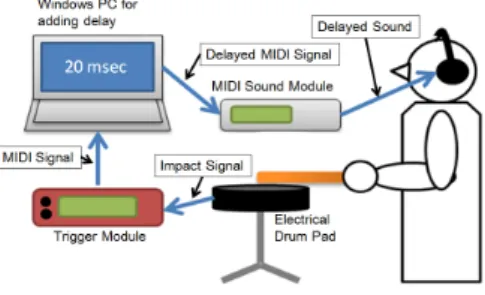
Fig. 1. System setup of iDAF drum
3.2 System Setup
Figure 1 illustrates the system setup of iDAF-drum. iDAF-drum consists of an electrical drum pad (YAMAHA TPS80S), a trigger module (YAMAHA DTX-PRESS), a MIDI sound module (Roland SD-50), a USB-MIDI interface (YAMAHA UX-16), and a Windows PC (Windows VISTA). An impact signal from the elec-trical drum pad is input to the trigger module and then converted to a MIDI signal. The MIDI signal is input to the Windows PC. After a given time (shorter than 30 msec) passes, the PC inputs the signal into the MIDI sound module. Finally, a hitting sound is emitted with an insignificant delay.
For convenience of data analysis, when the Windows PC receives the MIDI signal from the trigger module, the PC outputs a pulse signal from its serial port that is used for synchronizing with the myoelectric potential data of the extensor muscles (we call this pulse signal “synchronization signal” hereafter). We implemented the software runs on the PC for adding the delay while using C♯. In order to achieve 1-msec-order resolution for adding the delay, we used the Windows API functions. All of the sounds of the performance and a metronome are output from a headphone. We assigned a snare drum tone as the performance sound.
4
Estimating Effects of iDAF on Drumming
To the best of the authors’ knowledge, there has been no study on estimating the effects of such a very slightly delayed auditory feedback as iDAF. Therefore, this section investigates the effects of iDAF on drumming performance. First, we confirm that iDAF produces no negative effects, and then we investigate whether iDAF changes the drumming behavior so that the drummer begins to use the extensor muscle to a much greater extent.
4.1 Experimental Procedure
We employed 12 subjects (Sex: 7 males and 5 females; Age: Average 20.67 y/o, STDV 3.94; Drum experience: Average 5.78 years, STDV 3.67, Max 13.0 years,
Min 0.5 years). We asked them to hit the electrical drum pad using sticks held by the right and left hands alternatively along with a metronome sound that ticks every 250 msec. We instructed them to hold the sticks in a matched-grip manner.
Before starting experimental drum performances, we measured the maxi-mum voluntary contraction (MVC) of the radial extensor muscle of the wrist three times for each of the subjects. In the experiment, we asked each subject to conduct four performance sessions whose delay times changed in the order of 0, 20, 10 and 30 msec. The subjects were asked to perform for 90 sec in each ses-sion. How they synchronized with the metronome was individually different, e.g., some subjects attempted to set the timing of sound emission to the metronome sound while others attempted to set the timing of impact to the metronome. Therefore, to standardize the way of synchronization, we asked the subjects to wear an eye mask and to attempt to set the timing of the sound emission to the metronome as much as possible. No warm-up was permitted. During each session, the myoelectric potential data of the extensor musclewere measured us-ing electromyography (TEAC Polymate AP1532). In addition, we recorded the performances using a high-speed video camera. After finishing each session, we asked the subject whether he/she felt or found anything unusual.
To increase the signal-to-noise ratio of the myoelectric potential data be-tween the synchronization signal and 250 msec before that, we applied a signal-averaging method to the obtained data, and the root mean square (RMS) of the cleaned data was calculated. Then, the data were normalized using the MVC of each muscle so that the MVC value was set to 100 percent.
4.2 Results
The ANOVA for average IOI values of all subjects showed no significant main effect with or without delay (F (3, 44) = 0.4, p < 0.754). In the previous stud-ies on DAF with 100∼200 msec delay, an expansive speaking phenomenon was observed. However, such an expansive phenomenon does not arise under the iDAF condition. We also calculated the coefficient of variation (CV), which is usually used as an indicator of confusion caused by DAF. As a result, we could not find any significant difference between with and without insignificant delay (F (3, 44) = 0.436, p < 0.728). From these results, we can conclude that iDAF does not at all cause the confusion that arises in DAF. From the inquiry results obtained after each session, only one subject reported that he felt a slightly strange feeling when delay was given. However, he did not become unable to perform drumming and he could play as usual. None of the other subjects felt any difference or strangeness.
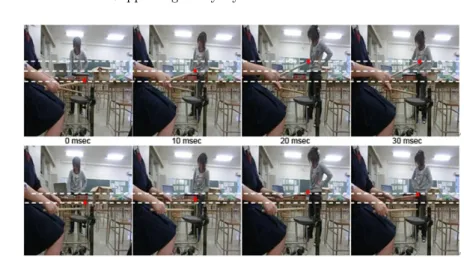
Figure 2 shows snapshots taken with the high-speed camera at one minute from the beginning of each session. The small red circle in each picture shows the head of the stick. The upper row shows the top reach point of the stick held by the right hand and the lower row shows that of the left hand. The delay times were 0, 10, 20 and 30 msec from the leftmost to the rightmost pictures. It can
Fig. 2. Top reach points of the stick for 4 delay times. Upper row: Right hand, Lower
row: Left hand
be seen that the more the delay time increases, the higher the stick is raised. This tendency was observed for most of the subjects.
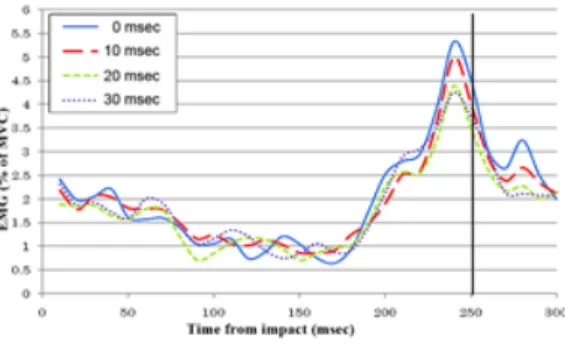
Figures 3 and 4 show average electromyograms (EMGs) of the extensor mus-cle of the left and right wrists, respectively, for each delay time. The vertical line drawn at 250 msec shows the impact timing. Figure 3 shows that the peak value of EMG with no delay (blue line) is smaller than the other peak values with delays. In particular, the peak value with 10 msec delay (broken red line) is about 0.6% larger than that with no delay. In contrast, Figure 4 shows that the peak value of EMG with no delay is larger than those with delays. We calcu-lated gross value of EMG for each delay and compared the gross value with no delay to the gross value with each delay by the t-test. As a result, the difference between the gross value with 10 msec delay and that with no delay for the left hand is marginally significant (t(11) = 1.892, p < 0.085). However, no significant difference could be found in all other combinations. As shown in Figure 2, the subjects raised the sticks higher under the iDAF conditions. Although this sug-gests that they used the extensor muscle much more, it was not supported by the electromyograms.
4.3 Discussion
From the results shown in Figure 2 and responses to inquiries after each session, we obtained very interesting findings: The motions of drumming performance changed due to iDAF and the subjects tended to raise the sticks much higher than usual (with no delay), although they were not aware of the delays. This suggests that iDAF can successfully induce the performer to sufficiently use the extensor muscle in drumming performance without perceiving differences. It remains unrevealed why humans react to such unperceivable auditory delays. This is a very interesting research issue, but it is out of the scope of this paper;
Fig. 3. Electromyograms of extensor muscle of left hand for each delay time
Fig. 4. Electromyograms of extensor muscle of right hand for each delay time
the objective of this paper is to create a useful support system for practicing drum performance. We only apply this phenomenon to the support system in this paper; elucidating its mechanism remains a future work.
Although iDAF may be able to provoke dominant use of the extensor muscle, the results shown in Figures 3 and 4 do not support the idea that the subjects came to use the extensor muscle more than usual when iDAF was given. Rather, although no significance was obtained, the longer the delays were, the less the extensor muscle was used for the right hand. For the left hand, the extensor muscle was mostly used with 10 msec delay, and then the longer the delays became, the less the extensor muscle was used.
It can be assumed that the reason why the sticks were raised higher when the delays were given is that the subjects unconsciously control the impact timing. However, to do so, they probably use not only their wrists but also their elbows. It becomes impossible to effectively make subjects use their wrist extensor muscle if their elbows move. A possible method of making their elbows not move is to immobilize their upper arms. However, such a method imposes too great a load on the extensor muscle, and it can damage the extensor muscle in a similar way to the method using heavy sticks. Therefore, we think a better method is to make the impact-impact interval so short (namely, to make play faster) that the drummers need not move their elbow to raise the sticks higher
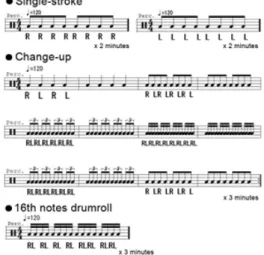
Fig. 5. Test pieces
for adjusting the impact-impact interval. As a result, we can expect iDAF to effectively make them use the extensor muscle. Conversely, it becomes difficult for them to greatly exercise the extensor muscle. However, people usually cannot immediately master such ways of using the extensor muscle: Long-term training is required. Therefore, it is preferable, from a safety viewpoint, to make them use this muscle little by little.
5
Estimating Efficiency of iDAF-Drum
In the previous section, we showed the possibility that iDAF-drum leads the drummer to sufficiently use the extensor muscle. This section investigates whether the drummer can eventually master the correct drumming way of sufficiently us-ing the extensor muscle by continually usus-ing iDAF-drum. If this can be achieved, the myoelectric potential of the extensor muscle without delay will increase along with the progress of training and finally become as strong as that with delay.
5.1 Experimental Procedure
In this experiment, we employed five subjects who are members of a brass band of a high school and are included in the 12 subjects of the experiment shown in the previous section. We asked them to perform a 10-minute practice session every day, which includes 2-minute single-stroke practices for the left and right hands, a 3-minute change-up practice, and a 3-minute drumroll of 16th notes (Figure 5). Before starting this session, each subject was allowed a warm-up performance.
We set the metronome to a 500 msec interval. In the previous section, we pointed out that it is preferable to set the performance speed relatively fast.
However, some subjects did not have so much experience. If we set the perfor-mance speed too fast, they might not have been able to perform the test pieces. Therefore, we examined maximum speed for each subject before the experiment and set the speed as fast as all of the subjects could perform the test pieces. Under this metronome interval, the speed when 8th notes were performed was the same as in the experiment conducted in the previous section, and it became faster when shorter notes like 16th notes were performed. Therefore, the overall performance speeds of this experiment are faster than those in the experiment of the previous section.
The system setup of iDAF-drum is the same as that used in the previous section. However, in this experiment, we used two sets of iDAF-drum.
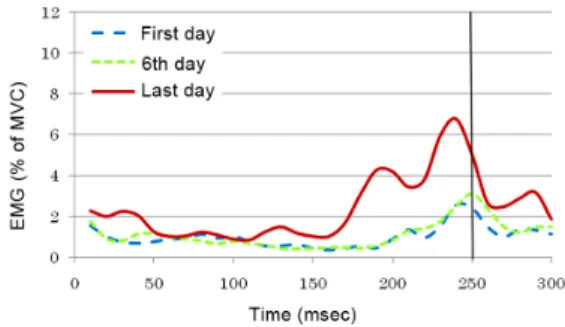
Each subject practiced 10 minutes every day using the iDAF-drum with a 20 msec delay for twelve days. On the first day, the sixth day, and the last day, we measured the MVC of the extensor muscleof each subject three times, and then we asked each subject to continue drumming along with the metronome at 250 msec intervals for 1.5 minutes using iDAF-drum with no delay and with 20 msec delay. During these performances, we measured electromyogram of the extensor muscle of both arms together with synchronization signals.
We applied the signal-averaging method to the obtained data to reduce noise and calculated the root mean square (RMS) of the cleaned myoelectric potential data between the synchronization signal and 250 msec before that. Then the data were normalized using the MVC of each muscle so that the MVC value was set to 100 percent. In addition, for each muscle and for each delay time, we calculated the accumulated electromyogram data between 30 and 90 seconds from the beginning and the average of the gross amount of muscle activities of all subjects.
5.2 Results
Figures 6 and 7 show the averaged electromyograms of the extensor muscles of both hands of all subjects with no delay on the three measuring days. In the figures, vertical black lines drawn at 250 msec show the impact timing.
From these figures, we can see that the peak values became higher day by day. We calculated the averages of the myoelectric potential data between the synchronization signal and 250 msec before that. The ANOVA for the averaged myoelectric potential data showed a significant main effect of the measuring day for the left hand (F (2, 12) = 4.815, p < 0.029). However, no such significance was shown for the right hand (F (2, 12) = 2.062, p < 0.170).
A supervisor of the brass band of the high school pointed out that one of the subject’s drumming sound changed during the experiment: The sound became sharp and clear.
5.3 Discussions
If the drummer learns how to use the extensor muscle while being forced to use it by iDAF-drum, we can expect that the extensor muscle will come to be
Fig. 6. Electromyogram of the extensor muscle of the left arm without delay
Fig. 7. Electromyogram of the extensor muscle of the right arm without delay
used even without delay day by day. From the results shown in Figures 6 and 7, although no significance could be obtained for the right hand, a day-by-day tendency for the extensor muscle to be used more without delay was observed.
We should conduct a control experiment by preparing a control group whose subjects practice using only a normal drum without delay. This time, unfortu-nately, we could not do so due to the lack of experimental equipment. However, most of the subjects we employed have practiced the drum for a long time (Av-erage: 4.71 years, STDV: 3.29). If such experienced drummers can immediately master techniques for using the extensor muscle in only 12 days’ practice, we can assume that they have already mastered the techniques. Therefore, it is unlikely that a control group would show changes within these 12 days. In contrast, we obtained some evident changes in this experiment. This fact supports the idea that iDAF-drum is effective for improving the use of the extensor muscle.
All of the subjects were right-handed, and they could use the right hand at will. From this, we can infer that they already had some skill in using the extensor muscle of the right hand. This is likely a reason why no significance was obtained for the right hand’s myoelectric potential data (Figure 7). On the contrary, they could not use the left hand at will in the same manner as the right hand, and they did not have enough skill to use the extensor muscle of the left hand. As a result, the effect of training by using iDAF-drum clearly appeared.
This implication was supported by the result that significance was obtained for the left hand’s myoelectric potential data (Figure 6).
6
Conclusions
In this paper, we proposed iDAF-drum to exploit the effects of insignificantly de-layed auditory feedback in human behavior. Our purpose was to support drum-mers in mastering the sufficient use of the extensor muscle in controlling the drumsticks. Using iDAF-drum, we conducted user studies and investigated its efficiency. As a result, we found that the subjects came to raise the sticks higher than usual and that iDAF did not confuse the drummers in their performance. Furthermore, by continually using iDAF-drum, the myoelectric potential of the extensor muscle became stronger day by day. Consequently, we could confirm the usefulness of iDAF-drum.
In the case of iDAF-drum, the drummers’ actions changed although they could not perceive the existence of the delay. We have applied iDAF to a key-board such as a piano. Similar to the drum cases, performers could not perceive the delay. However, they reported that its keys were heavier when iDAF is in-serted between key-touch and sound emission than those without delay. Thus, people involuntarily react to the unperceivable factors and they perceived them as a different feeling. These phenomena are very interesting. It suggest possibili-ties of the unperceivable factors that people’s behaviors can be changed without being realized the existence of the factors by them and we can provide some different feelings without actually changing structure of an object (such as the keyboard) to provide the feelings. In future, we will further explore other cases that provide such illusory feelings and apply them for effectively bringing out and fostering buried creative abilities.
Acknowledgments
We thank the members of the light-music circle of Miyazaki University and the brass band of the high school associated with Kumamoto Gakuen University for their kind cooperation to our experiments. We also thank Dr. Kohei Matsumura of Ristumeikan University for his valuable advices on measuring electromyogram.
References
1. Fujii, S., Kudo, K., Shinya, M., Ohtsuki, T. and Oda, S.: Wrist Muscle Activity Dur-ing Rapid Unimanual TappDur-ing With a Drumstick in Drummers and Nondrummers, Motor Control, Vol. 13, pp. 237-250 (2009).
2. Osu, R., Franklin, D. W., Kato, H., Gomi, H., Domen, K., Yoshioka, T. and Kawato, M.: Shortand long-term changes in joint co-contraction associated with motor learn-ing as revealed from surface EMG, J. of Neurophysiology, 88(2), 991-1004, 2002.
3. Fujii, S. and Moritani, T.: Rise rate and timing variability of surface electromyo-graphic activity during rhythmic drumming movements in the world’s fastest drum-mer, Journal of Electromyography and Kinesiology, Vol. 22, pp.60-66 (2012). 4. Fujii, S. and Moritani, T.: Spike shape analysis of surface electromyographic activity
in wrist flexor and extensor muscles of the world’s fastest drummer, Neuroscience Letters, Vol. 514, pp.185-188 (2012).
5. Nagano, Y., Relax! Physical Drumming -An American way of stroke enables clear, fast and loud performance, Ritto Music (2011). (in Japanese)
6. Ikenoue, A., Ogura, K., Unoki, M., and Nishimoto K., A supporting system to improve drumming form by applying insignificantly-delayed auditory feedback,The Transactions of Human Interface Society, Vol.15, No.1, pp.1-14 (2013). (in Japanese) 7. Blaine, T., and Perkis, T. The Jam-O-Drum Interactive Music System: A Study in Interaction Design, Proc. The 3rd conference on Designing Interactive Systems: Processes, Practices, Methods, and techniques, ACM Press (2000), 165-173. 8. Nakano, T., Goto, M., Ogata, J., and Hiraga, Y. Voice Drummer: A Music Notation
Interface of Drum Sounds Using Voice Percussion Input, Proc. the 18th Annual ACM Symposium on User Interface Software and Technology, ACM Press (2005), 49-50.
9. Iwami, N., and Miura, M., A Support System for Basic Practice of Playing the Drums, Proc. International Computer Music Conference, pp.364-367 (2007). 10. Hawryshkewich, A., Pasquier, P., and Eigenfeldt, A., Beatback: A Real-time
In-teractive Percussion System for Rhythmic Practise and Exploration, Proc. 2010 Conference on New Interfaces for Musical Expression, pp.100-105 (2010).
11. Tsuji, Y., and Nishitaka, A., Development and evaluation of drum learning support system based on rhythm and drumming form, Electronics and Communications in Japan (Part III: Fundamental Electronic Science), Vol. 89, Issue 9, pp. 11-21 (2006).Anderson, R.E. Social impacts of computing: Codes of professional ethics. Social Science Computing Review 10, 2 (1992), 453-469.
12. Barke, S. J., Practice aid device for percussionists, United States Patent, US 7,473,836 B2 (Jan. 6, 2009).
13. Carter, D., Muscle control development system and kit therefor, United States Patent, US 5,744,737 (Apr. 28, 1998).
14. Bennett, H., Drummer stick control up-stroke practice method and device, United States Patent, US 2004/0025664 A1 (Feb. 12, 2004).
15. Lee, B. S., Effects of Delayed Speech Feedback, Journal of the Acoustical Society of America, Vol.22, Issue 6, pp.824-826 (1950).
16. Pfordresher, P. Q., and Bella, S. D., Delayed Auditory Feedback and Movement, Journal of Experimental Psychology: Human Perception and Performance, Vol.37, No.2, pp.566-579 (2011).
17. Pfordresher, P. Q., and Palmer, C., Effects of delayed auditory feedback on timing of music performance, Psychological Research, Vol.16, pp.71-79 (2002).
18. Cox, J., The minimum detectable delay of speech and music, Proc. Acoustics, Speech, and Signal Processing, IEEE International Conference on ICASSP ’84, pp. 136-139 (1984).
19. Nishibori, Y., Tada, Y., and Sone, T., Study and Experiment of Recognition of the Delay in Musical Performance with Delay, IPSJ SIG Notes, Vol.2003-MUS-53, No.9, pp.37-42 (2003). (in Japanese)