Modern Physics Letters B
World Scientific Publishing Company
1
EXTRACTION OF CELLULOSE NANOFIBER FROM PARENCHYMA CELLS OF AGRICULTURAL RESIDUES
ANTONIO NORIO NAKAGAITO
Graduate School of Technology, Industrial and Social Sciences, Tokushima University Minami Josanjima-cho 2-1, Tokushima, 770-8506 Tokushima, Japan
[email protected] YUSUKE KATSUMOTO
Graduate School of Advanced Technology and Science, Tokushima University Minami Josanjima-cho 2-1, Tokushima, 770-8506 Tokushima, Japan
[email protected] HITOSHI TAKAGI
Graduate School of Technology, Industrial and Social Sciences, Tokushima University Minami Josanjima-cho 2-1, Tokushima, 770-8506 Tokushima, Japan
[email protected] Received Day Month Day Revised Day Month Day
Cellulose nanofiber is an environmentally friendly reinforcing phase extractable from plants, with potential application in composites. Due to the cell wall structure differences, plant parenchyma cells might be easier to nanofibrillate than sclerenchyma cells of wood pulp fibers, resulting in lower extraction costs. This study assessed the extraction of nanofibers from residues like corn husk, banana peel, cabbage leaf, and taro leaf using a kitchen blender. Fibrillation was evaluated based on the strength of paper-like sheets produced from the nanofibers. Corn husk was nanofibrillated by the shortest blending time among the sources considered, and delivered the highest sheet strength. The blending time needed was significantly shorter than that needed to fibrillate hardwood pulp fibers. Keywords: Cellulose; nanofiber; blender; parenchyma cell.
1. Introduction
Cellulose is a biopolymer photosynthesized from carbon dioxide and water and later naturally decomposed in a perfectly sustainable carbon neutral process. Cellulose is the most abundant polysaccharide on earth and mostly found in the cell wall of plant cells, in which the smallest element called nanofiber is a few nanometers in diameter and made up of a bundle of long cellulose molecular chains forming a semi-crystalline structure. The tensile modulus and strength are comparable to those of aramid fibers.1 The Young’s modulus of crystalline portions of cellulose was measured to be 138 GPa,2 while the tensile strength of nanofibers is estimated to be in the range of 1.6 to 3 GPa.3
Extraction of nanofibers is mostly based on mechanical nanofibrillation processes that rely on expensive devices, with high energy demand but low production yields. A more affordable mechanical extraction of cellulose nanofibers by a kitchen blender was
Electronic version of an article published as Modern Physics Letters B, Vol. 33, No. 14n15, 2019, 1940012, 10.1142/S0217984919400128 © World Scientific Publishing Company https://www.worldscientific.com/worldscinet/mplb
2 Author’s Names
demonstrated by Uetani et al.4 Kitchen blender is an appliance intended to disrupt parenchyma cells to extract nutrients from edible plants. Hence, during blending, the impact with the blender blades would be able to break up the cell walls and ultimately produce nanofibrillation. The fibrillation by a blender is a simple and straightforward means to produce small amounts of cellulose nanofibers at laboratory scale.
This study explores cost-effective ways to extract cellulose nanofibers by using an affordable kitchen blender while looking for more suitable raw materials than the conventional wood pulp fibers. Among the various plant cells available, parenchyma cells seem to be the easiest to fibrillate due to their simpler cell wall structure compared to sclerenchyma cells of fibers. Parenchyma cells are intended for storage of nutrients and are made up of thin and flexible cell walls while sclerenchyma cells are responsible for the mechanical support of the plant or tree. And even among parenchyma cells of different sources, there are conspicuous differences in required fibrillation intensity. Among some agricultural residues considered in this study, corn husk delivered the shortest nanofiber extraction time while producing the strongest paper-like sheets.
2. Experimental
The starting material for the extraction of nanofibers consisted of corn husk (150 g), banana peel (300 g), discarded cabbage leaf (300 g), taro leaf (300 g), and hardwood kraft pulp, the latter adopted as a reference material. Initially the above mentioned amounts of each raw material was blended for 10 seconds and washed with water. A mixture of 1 L of distilled water, 7 g of sodium chlorite, and 1.5 mL of acetic acid was prepared, in which each raw material was immersed and stirred at 75°C. The same amounts of sodium chlorite and acetic acid were added to the mixture every 1 hour of treatment, totalizing 3 hours of treatment to remove lignin. Obtained pulps were rinsed with running water until pH became neutral through vacuum filtration. Then each type of pulp was dipped in 1 L aqueous solution of 6 wt% potassium hydroxide at ambient temperature and left immersed for 12 hours for hemicelluloses removal. After treatment, pulps were washed by running water until pH became neutral using vacuum filtration.
The mechanical fibrillation was performed by a household blender Vitamix TNC 5200 (Vitamix Corporation, USA), with a modified bottle. Aqueous suspensions of 1 wt.% pulp from corn husk, banana peel, cabbage leaf, taro leaf, in addition to hardwood kraft pulp, were blended at 37,000 rpm for 0.5, 5, 20, and 80 minutes. Next, the suspensions were filtered to produce thin paper-like sheets by oven-drying for 24 hours at 30°C.
Ribbon-shaped test pieces 60 mm x 10 mm were cut from the sheets and subjected to tensile test with an Instron 5567 universal materials testing machine at a strain rate of 1 mm/min and a gage length of 30 mm. All samples were oven-dried at 105°C for 1 hour prior to testing.
The surfaces of the sheets were observed by a field emission scanning microscope S-4700 (Hitachi High-Technologies Corporation, Japan). The accelerating voltage was set to 1.5 kV and the samples were coated with platinum to avoid specimen charging.
Instructions for Typing Manuscripts (Paper’s Title) 3 3. Results and discussion
The raw materials for cellulose nanofiber extraction were selected considering crops that produce high amount of disposed byproducts. They consisted of corn husk, banana peel, discarded cabbage leaf, and taro leaf. Hardwood kraft pulp, representative of sclerenchyma cell type fiber, was used as reference.
Fig. 2. Tensile properties of sheets made of banana peel pulp against blending time.
Fig. 1. Tensile properties of sheets made of corn husk pulp against blending time.
Fig. 4. Tensile properties of sheets made of taro leaf pulp against blending time.
Fig. 5. Tensile properties of sheets made of hardwood pulp fiber against blending time.
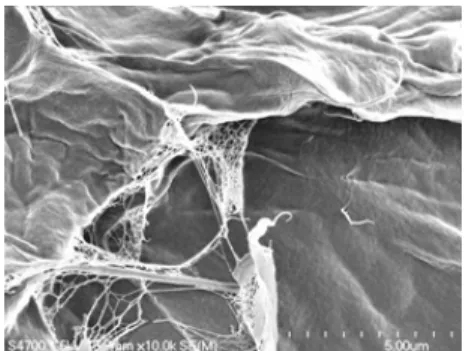
Fig. 6. Scanning electron micrograph of corn husk pulp blended for 30 seconds.
Fig. 3. Tensile properties of sheets made of cabbage leaf pulp against blending time.
4 Author’s Names
The tensile strengths and moduli of sheets made of pulp from different sources blended for different times are shown in Figs. 1-5. After only 30 seconds of blending, pulps from corn husk, banana peel, cabbage leaf, and taro leaf produced sheets with strengths of 152 MPa, 119 MPa, 115 MPa, and 46.2 MPa, respectively. Meanwhile, hardwood pulp fibers blended for the same 30 seconds achieved only 7.69 MPa. A longer blending time of 5 minutes increased the strengths of sheets up to 170 MPa, 155 MPa, 124 MPa, and 82.4 MPa respectively, while hardwood pulp fiber reached 44.1 MPa, indicating fibrillation progress with blending time. The highest strength was delivered by sheets from corn husk at 221 MPa, after 20 minutes blending. The ultimate mechanical properties of sheets from the various sources differed probably due to non-cellulosic substances like pectin present in the pulp, that decreased sheet strength. However, the differences in sheet strength produced after very short blending time indicate the ease of fibrillation of some nanofiber sources, directly affecting the energy consumption of treatment and consequent cost of extraction. Figure 6 shows the scanning electron microscopy image of nanofibers obtained from corn husk pulp after 30 seconds blending.
The yields of pulp in dry weight basis from taro leaf, cabbage leaf, corn husk, and banana peel were 15.7%, 12.2%, 10.3%, and 2.54% respectively. Banana peel showed a significantly lower pulp yield compared to the other sources.
4. Conclusion
This study demonstrated the possibility to extract cellulose nanofiber from agricultural residues at lower cost if the cellulose source is properly chosen. Here four nanofiber sources were considered, namely corn husk, banana peel, cabbage leaf, and taro leaf. All sources showed easier nanofiber extraction compared to the traditional hardwood pulp fiber, with best results delivered by corn husk pulp nanofibrillated by the shortest blending time and delivered the highest sheet strength. It all translates into lower energy consumption and consequent lower cost in the cellulose nanofiber production.
Acknowledgments
This study was partially supported by JSPS KAKENHI Grant Number 15K04624 and by the Collaboration Program between Tokushima University and National Taiwan University of Science and Technology.
References
1. J. E. Gordon, The New Science of Strong Materials (Princeton University Press, Princeton, 1976). 2. T. Nishino, K. Takano and K. Nakamae, J. Polym. Sci. Pol. Phys. 33 (1995) 1647.
3. T. Saito, R. Kuramae, J. Wohlert, L. A. Berglund and A. Isogai, Biomacromolecules 14 (2013) 248.