
Two-Stage Blind Source Separation Based on ICA and Binary Masking for Real-Time Robot Audition System
6
0
0
全文
(2) C. Conventional Binary-Mask-Based BSS. 刊百少シ. Binary mask processing [12], [13), [14) is one of the aト temative approach which is aim巴d to solve the BSS problem, but is not based on ICA. This method is basically introducing the auditory masking effect which tells that the stronger signal masks the weaker one. We estimate a binary mask by comparing the amplitudes of山e observed (binaural) signals, and pick up the target sound component which arrives at the better ear (better microphon巴) closer to the target speech. This procedure is performed in time-frequency regions, and is to pass the sp巴cific regions where target speech is dominant and mask the other regions. Under the assumption that the l-th sound source is close to the l-th microphone and L = 2, the I-th separated signal is given by. ト~1 ぐ令ミ切. S…. M. A之. Head 01 humanoid robot Fig. 1. Con自guration of a multi-microphone system in robot head and source signals. 日(J,t) = TnI(f,t)XI(f,t),. where X(f) = [X1(J), ー,XK(J)]T is the observed signal vector, and S(f) = [Sl(J),・ ,SL(J)]T is the source signal vector. Also, A(J) [Akl(J)]kl is the mixing matrix, where [X]ij denotes the matrix which incJudes the element X in the 'i-th row and th巴j-th column. The m凶昭matrix A(J) is assumed to be complex-valued because we introduce a model to deal with the arrival lags among each of the elements of lhe microphone a汀ay and room reverberations. where Tn[ (J, t) is the binary mask operation which is defined as TnI(J,t) = 1 if Xl(f,t) > Xk(f, t) (k =1= 1); otherwise. =. ml(f, t) = O.. This method requires very few computational complexities, and this property is well applicable to real-time processing The method, however, assumes the sparsen巴ss in the spectral components of the sound sources, which is often introduced in Computational Auditory Scene Analysis (CASA)-based BSS That is, in binary mask processing, it should be assumed that there are no overlaps in time-仕equency components of the sources, but the assumption does not hold in an usual application to the acoustic sound separation (indeed, e.g., a mixture of sp巴ech and common broadband stationary noise has many overlaps).. B. Conventional ICA-Based BSS. In the frequency-domain ICA (FDICA), first, the short-time analysis of obs巴rv巴d signals is conducted by frame-by-frame discrete Fourier transform (DFT). By plotting the spectral values in a frequency bin for each microphone input frame by frame, we consider them as a time series. Hereafter, we des ignate the time series as X(J,t) =[X1(J,t)γ・白、XK(f,t)JT. Next, we perform signal separation using the complex valued unmixing matrix, W(J) = [W1k(f)]Ik. so that the L time-series output Y(J,t)=出(J, t), YL(f,t)JT becomes mutually independent; this proc巴dure can be given as. III. PROPOSED TWO-STAGE BSS ALGOR汀HM A. Motivation and Strategy. •••,. Y(f,t). W(J)X(J, t). (2). We perform this procedure with respect to all frequency bins. The optimal W(J) is obtained by, for example, the following iterative updating equation:. WIi+ll(J). η 1一(φ(Y(J,t))yH(J,t))t w1il(J) (3) + Wlil(J),. [. ]. 、‘,J A斗 ,,‘、 T ]) t FJ ( L Y ( go r a 内,d ρし. ) ) t gtd ( Y ( σo r a qJ ρu rti-L. where 1 is the ident町matrix, Ot denotes the time引eraging ope削or, [ i ] is us巴d to express the value of the i th step in the iterations, and ηis the step-size parameter. In our research, we d巴自ne the nonlinear vector function φ(・) as [15):. φ(Y(J,t)). (5). where arg [.] represents an operation to take the argument of the complex value. After the iterations, the permutation problem, i.e., indeterminacy in ordering sources, can be solved by, e.g., [8], [16).. In the previous research, SIMO-model-based ICA was proposed by, e.g., Takatani et al. [10], [11], and they showed that SIMO-model-based ICA can sep釦ヨte the mixed signals into SIMO-model-based signals at the microphone points. This finding has motivated us to combine出e SIMO-model based ICA and binary mask processing. That is, the binary mask techniqu巴 can be applied to the SIMO components of each source obtained from SIMO-model-based ICA. The configuration of lhe proposed method is d巴picted in Fig. 2(a). Binary mask processing which follows SIMO-model-based ICA can remove the residual component of the interference effectively without adding huge computational complexities. It is worth mentioning that the novelty of this strategy mainly lies in the two-stage idea of the unique combination of SIMO-mode-based ICA and the SIMO-model-based binary mask. To illustrate the novelty of the proposed method, we hereinafter compare the proposed combination with a simple two-stage combination of a conventional monauraトoutput ICA and binary mask processing (see Fig. 2(b)) [17). In general, the conventional ICAs can only supply the source signals }í(J,t) BI(J)SI(fぅt) + EI(J, t) (1 = 1, . ・・, L), where BI(J) is an unknown a出trary distortion 日ト ter and El(f,t) is a residual separation error which is mainly. =. 210. nhu nRU --ム.
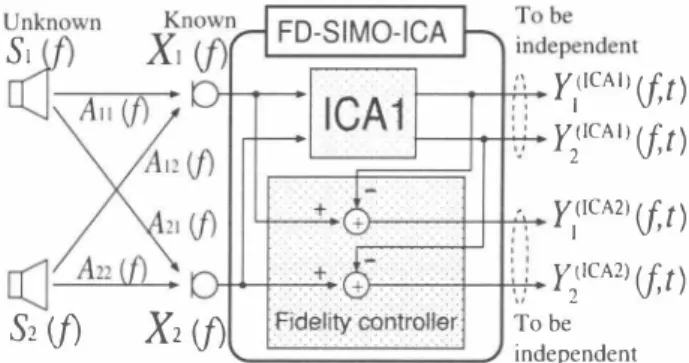
(3) (a) Proposed two-sta2e BSS. �の XI LlJにZ巧了フ. 51. Y (lCAI) (j,t) I ηCAI)ぱt) Y/1CA2) (j,t) 円ICA2)ぱ t). 口j 辿� S2 (j). (b) Simple combination of conventional ICA and binary mask. Fig. 3.. K. X2 (j). Tob巴 independent. Input and output relations in the proposed FD-SIMO-ICA. where. =L=2. B. Algorithm. Time-domain SIMO-ICA [10] has recently been proposed by one of the authors as a means of obtaining SIMO-model based signals directly in the ICA updating. In this paper, we extend the time-domain SIMO-ICA to frequency-domain SIMO-ICA (FD-SIMO-ICA). FD-SIMO-ICA is conducted for extracting the SIMO-model-based signals corresponding to each of sources. The FD-SIMO-ICA consists of (L - 1) FmCA parts and a fidelity cOl1troller, and each ICA runs in parallel under the白delity control of the entire separation system (see Fig. 3). The separated signals of the l-th ICA 1, . . L - 1) in FD-SIMO-ICA are defìned by (1. Y2び:t) Fig. 2. Input and output relations in (a) proposed two-stage BSS and (b) simple combination of conventional ICA and binary mask processing. This L coπesponds to the case of K 2. = =. caused by an insuffìcient convergence in ICA. The residual error EI (f, t) should be remov巴d by binary mask processing in the next post-processing stage. However, the combination is very probl巴matic and cannot function well b巴cause of the existence of the spectral overlaps in the time-fr巴quency domain. For instance, if all sources have nonzero spectral components (i.e., sparseness assumption does not hold) in the specifìc frequency subband and these are comparable, the decision in binary mask processing for Y1 (f, t) and 九(f, t) is vague and th巴 output results in a ravaged signal. Thus the simpl巴 combination of the conventional ICA and binary mask processing is not valid for solving the BSS problem.. = •. Y(問。(1,t). =. [y�. ICAI) (f, t)]kl. = W(ICAI)(f)X(f, t)ヲ. (6). A) whm W( m l)(f) = lwr I (f)lzJ IS thE S巴 阿ation fìlter. matrix in the l-th ICA. Regarding the fìdelity controller, we calculat巴 the following signal vector Y(ICAL)(J,t) , in which the all elements are to be mutually independent,. Y(ICAL)(μ). On th巴 other hand, our proposed combination contains the special SIMO-model-based ICA in the fìrst stage. The aim of the SIMO-model-based ICA is to supply the speci自c SIMO signals with respect to each of sources, Akl(f)SI(f,t) , up to the possible delay of the fìlters and the residual e汀or. Needless to say, the obtained SIMO components is well applicable to binary mask processing because of the spatial properties that the separated SIMO component at the specifìc microphone closer to the target sound still maintains the large gain. Thus, after having th巴 SIMO components, we can introduce the binary mask for the effìcient reduction of the remaining eηor in ICA, even when the sparseness assumption does not hold.. =. L-I X(f, t) - LY(ICAI)(f, t). 1=1. (7). Hereafter, we regard Y (ICAL)(f司t) as an output of a vir tual“L-th" ICA. The reason we use the word“virtuaf' here is that the L-th ICA does not have own separation 日lters u凶ke th巴 other ICAs, and Y(lCAL)(f、t) is sub ject to W(ICAI)(f) (1 - 1 ,..., L - 1). By transposing. ι. the second term (- ε 1 Y(ICAI)(f. t)) in the right-hand side into the left-hand side, we can show that (7) means a constraint to force the sum of all ICAs' output vectors "Lt=1 Y(ICA/)(J,t) to be the sum of all SIMO components. ["L�=l Akl (f)Sl (f, t)]kl(= X(J, t)).. If the independent sound sources are separated by (6), and simultan巴ously the signals obtained by (7) are also mutually independent, then the output signals converge on unique solutions, up to the permutation, as. In summary, the novelty of th巴 proposed two-stage idea is due to the introduction of SIMO-model-based framework into both separation and post processes, and this offers a realization of the robust BSS. The detailed process of using the proposed algorithm is as follows.. Y(ICAl)(f, t). 211. = d時[A(f)PT]P1S(f,t) ,. (8). 月' ' oo.
(4) g寸 ト . 0 m { 叶ls. Pl. 1,... ,L) are exclusively-selected p巴rmu where (1 tation matrices which satisfy [l]ij. Rega凶ng a proof of this, see [10 ] with an appropriate modi自cation into the frequency-domain repres巴ntation. Obviously the so lutions given by ( 8) provide necessary and sufficient SIMO components, for each l-th source. Thus, the separated signals of SIMO-ICA can maintain the spatial qualities of each sound source. For example in the case of L K 2, one possibility is given by. 4.25 m. "Ef=1 Pl =. Loudspeakers. , , Akl(1)Sl(1t). (Height: 1.17m). = = [円I( CA1)(f,t),九(ICAl)(ft, )]T [All(J)SI(ft) , , A22(J)S2(f,t)fう ( 9) [九(ICA幻(Jt, ), y}ICA2)(f,t)]T [A12(f)S2(J,t), A21(J)SI(J,t)]T, where P1 = 1 and P2 = [1]り一I In order to obtain ( 8), the natural gradient of Kullback l)(f) should Leibler divergence of (7) with respect to W (ICAleaming be added to the existing nonholonomic iterative rule [5 ] of the separation filter in the l-th ICA (1 = 1, ・ぅL1). The new iterative algorithm of the l-th ICA part (l = 1,・・・,L - 1) in FD-SIMO-ICA is given as. 1 . 50 m \ ' 、 恥1icrophones (Height:1.l7m). :. θ、 'ノ. おι. . gm N 寸. 円(t)ちγγ-...... .... 、ず52(t) 、 e, 'I 2. 04 m. ) nu l. �". (. ('l. HATS. Reverberation Time: 2 00 ms Fi呂4. Layout of reverberant room used in experiments. W. wb)(ベ{o制時 (伊何仲争到<Þ(Y仔胤Y. Y吋叫胤臥恥i込LμμμLいいい川Al州川Iり川)バ(川 t}.W川札叫i込LLμLふいいAl州lり) ω. {o山(φ(X(ft)24AI)(ft)). ,, . 目 、、. l l (. (X(ft)-Z4Al)(ft))な). (1 -乞whl)(f. Fig.5. whereαis the step-size parameter, and we define the nonlin as [15]: ear vector function. t ). T )7] ' t r J El - J ( ( 1 Y ' L σb r z af,、 H & 内J E 3 \hノ E | ) 、、, ,,11 11 t ) 4'む F l ' ぃr'J i f 日以 7ハU (司hu n hu a n t a rlL 4EU. φ(Y(f,t)). φ(-). (JCAl)(J). ( 12). Also, the initial values of W for all 1 should be di仔erent. After FD-SIMO-ICA, binary masking processing is ap plied. For example in the case of ( 9) and (10), the resultant output signal co汀esponding to the source 1 is obtained as follows:. (13) ml(ft)y , 1(ICAl)(J,t), 日(f,t) wher.巴ml (J,t) is the binary mask operation which is defined as ml (ft) , is greater than 九�(ICA2)(f,t); , = 1 if y1(ICA1)(Jt). Head and torso simulator used in experiment. ml(1,t) =. otherwise O. Also, the resultant output signal co汀esponding to the source 2 is given by. (14) m2(f,t)Y2(ICA1)(Jt) , , ち(f,t) where m2(J,t) is the binary mask operation which is defined as m2(f,t) = 1 i九 f (ICA1)(fj)ls greater than R(ICA2)(f,t); otherwise m2(Jt) , = O. The extension to the general case of L = K > 2 can be easily implemented in the same manner. rv. EXPERIMENT UNDER REAL ACOUSTlc ENVIRONMENT. A. Conditions for Experiments. We carried out binaural-sound-separation experiments us ing acoustical source signals recorded in the experimental. 212. - 188-.
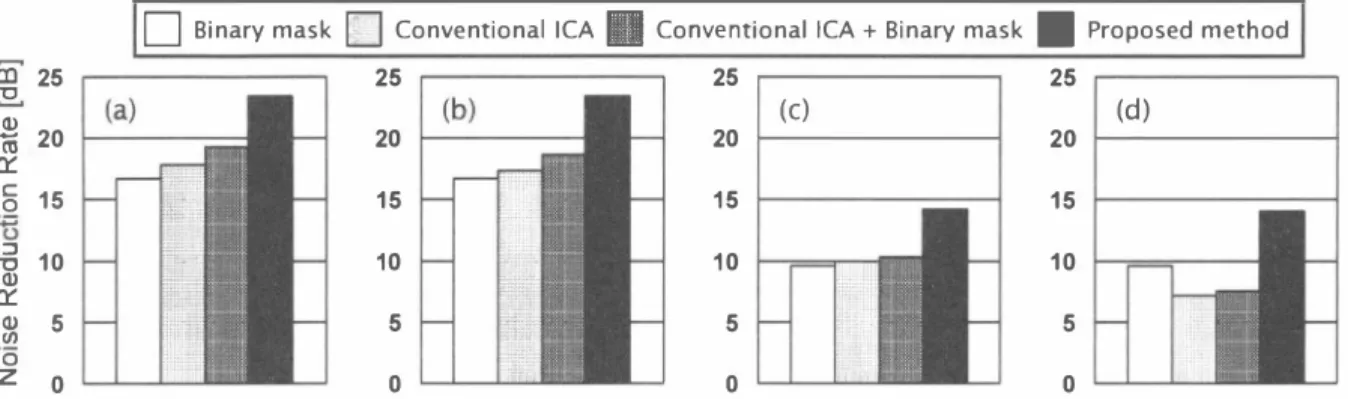
(5) 口. ∞ てヨ 25. Binary mask. 口 Conventional ICA 圏 Cor附ltional ICA + Binary mask • Proposed method 25 25 25 (c). 20. 20. 15. 15. 15. 号Eピ 10 5. 10. 10. 10. 5. 5. 5. 0. 。. 。. 。. 者20 4同5a 15. Eピ. o. 3l. 0 z. 20. (d). Fig. 6.. Results of NRR in speech-sp田ch mixing: (a) source DOAs are (-600,600) and initial value DOAs a問(-300,300), (b) source DOAs are (-600,600) and initial value DOAs are (ー150,150), (c) sour回DOAs are (_600,00) and initial value DOAs are (-300守300), and (d) source DOAs are (_600,00) and initial value DOAs are (-150,150). ∞25. ;Eピ | 。. 5 t2. 口 何). 15|. 号Eピ 10 H g. 。 z. Binary mask. F,積極 !':::隠窓. 5ト斗 。I. I. t. SZS蕊翠翠. 口 Conventional ICA 圏 Conventional ICA + Binary mask • Proposed method 25 25 25 I (d) 20 15. 15. 15. 10ト寸. 10. 10. 5ト→. 5 トーイ. 。. 。. E. 5 。. Fig. 7. Results of NRR in speech-noise mixing: (a) source DOAs are (-600,600) and initial value DOAs are (-300,300). (b) source DOAs are (-600,600) and initial value DOAs are (ー150,150). (c) source DOAs 町e (_600,00) and initial value DOAs are (-300,300), and (d) source DOAs are (-600,00) and initial value DOAs are (ー150,150). transfer functions, positions of microphones, and acoustic characteristics of HATS (the robot head) in the separation procedure of each method. These information can not be used, especially for the robot which moves around the user.. room illustrated in Fig. 4, where two sources and two mi crophones are set. The reverberation tim巴 in this room is 200 ms. A head and torso simulator (HATS; se巴 Fig. 5) by Brüel & Kjær is used as lhe recording apparatus, which simulates a robot auditory system. Two acoustic signals are assumed lo arriv巴 from differenl dir氏tions, 81 and 82, where we pr巴pare two kinds of sourc巴 direction pattems as follows; (-600,600), or (-600,00). We used the speech (81,82) signals spoken by two male and two female speakers, and. Noise reduction rate (NRR ) [8], de自n巴d as the output signaトto-noise ratio (SNR ) in dB minus the input SNR in dB, is used as the objective indication of separation performance The SNRs are calculated under th巴 assumption that the speech signal of the undesired sp巴aker is regarded as noise.. =. human-speech-colored stationary nois巴as the source samples.. Figure 6 show the results of NRR for speech-speech mlXlng under different speaker allocations and initial value conditions. These scores are the averages of 12 speaker combinations. AIso, Fig. 7 shows the results of NRR for the mixing of speech and stationary noise; this corresponds to the case in that the spectral sparseness assumption does not hold. From the results, we can contìrm that the proposed two-stage BSS can consistently and signitìcantly improve the separation performance regardless the speaker directions, noise and initial value conditions. It is also worth mentioning that the proposed method can provide the improvements even under unsparse-source mlxmg conditions, unlike the conventional binary mask processing. This fact is a promising evidence. Th巴 sampling frequency is 8 kHz and the length of each speech sample is liπ川ed to 3 seconds. The D円size ofW(f) in each method is 1024. We use two lypes of initial values which are given by th巴 HRTF-based null beamformers [8] whos巴 dir巴ctions of sources are (-150,150), or (-300,300). B. Experimental Results. We compare four methods as follows: (A) the conventional binary-mask-based BSS given by (5), (B) the conventional ICA-based BSS given by (2), (C) simple combination of the conventional ICA and binary mask processing, and (D) the proposed two-stage BSS method. Here we did not use any a priori infolτnation on the true DOA of sources, room. 213. nHU 00.
(6) on the feasibility of the proposed combination technique of SIMO-model-based ICA and binary mask processing V.. RE AL-TIME IMPLEMENTATION. We have already built a real-time two-stage BSS d巴mo system running on a very light palmtop PC (SONY VAIO type-U with Pentium-M 1.1 GHz processoに550 g weight). Figure 8 shows a con自guration of a real-tim巴 implementation for the proposed two-stage BSS. Signal processing in this implementation is performed as the following instructions 1) Inputted binaural signals ar巴 converted to time frequency series by using frame-by-frame fast Fourier transfoml (FFf). 2) SIMO-ICA is conducted using a cu汀ent 3 s-duration data for estimating the separation matrix which is applied to the next (nol currenl) 3 s samples. This stag gered relation is due to th巴 fact that the fìlter update in SIMO-ICA requires huge computational complexities and cannot provide the optimal separation白lter for the current 3 s data. 3) Binary mask proc巴ssing is applied to the separat巴d signals obtain巴d by the previous STMO-ICA. Unlike SIMO-ICA, binary masking can be conducted just in the current segment. 4) The output signals from binary mask processing are converted to the resultant time-domain waveforms by using an inverse FFf Although the separation白lter update in SIMO-ICA part is not real-time processing but includes a 3 s latency, the whole two-stage system still seems r巴al-time because the binary masking can work in the current segment with no delay. Generally the latency in the conventional ICAs is problematic and reduces the applicability of the m巴thods to real-time systems. In th巴 proposed method, however, the performance deterioration du巴 to the latency problem in SIMO-ICA can be mitigated by introducing real-time binary mask processing. VI.. CONCLUSION. We proposed a new BSS framework in which the SIMO model-based ICA and binary mask processing are efficiently combined. In order to evaluat巴 its effectiveness, a separation experiment was carried out under a reverberant condition. The experimental results revealed that the NRR can be considerably improved by using the proposed two-stage BSS algorithm. In addition, we could find the fact that the proposed method outperforms the combination of the conventional ICA and binary mask processing as well as the simple ICA and binary mask processing. REFERENCES [1 J K. Nakadai, D. Matsuura. H. Okuno, and H. Kitano,‘'Applying scattering theory to robot audition system: robust sound source localization and extraction," Proc. IROS・2003, pp.1147-1152, 2∞3 [2J R. Nishimura. T. Uchida, A. Lee‘ H. Saruwatari. K. Shikano, and Y Matsumoto, "ASKA: Receptionist robot with speech dialogue system." Proc. IROS-2002. pp.1314-1317. 2002 [3J R. Prasad, H. Saruwatari, and K. Shikano, "Robots that can hear, understand and talk," Admn. Fig. 8.. Signal日ow in real-time implementation of proposed method. [4] P. Comon,“Independent component analysis. a new concept打,. Sigl悶l. vol.36, pp.287-314. 1994 [5J N. Murata and S. lkeda,“An on-line algorithm for blind source separa tion on speech signals:' Proc. NOLTA 98, vol.3, pp.923-926. 1998 [6] P. Smaragdis,“Blind separation of convolved mixtures in the frequency domain," NeurocolllpUlillg, vo1.22, pp.21-34. 1998 [7J L. Parra and C. Spence. "Convolutive blind sep町ation of non-stationary sources." IEEE Trans. Speech & Audio Processing, vol.8. pp.320-327. 2000 [8J H. Saruwatari‘S. Kurita. K. Takeda, F. ltakura, T. Nishikawa, and K Shikano‘“Blind source separation combining independent component analysis and beamfonning." EURASIP JOllmal Oll Applied Signal Pro cessillg, vo1.2003, pp.1135-1146. 2003 [9J S. F. BolI,‘Suppression of acoustic noise in speech using sp配tral subtraction," IEEE Trans. ACOllSI., Speech & Sigllal Process., vol.ASSP 27, no.2, pp.113ー120. 1979 [IOJ T. Takatani, T. Nishikawa, H. Saruwatari, and K. Shikano,“High 自delity blind sep訂ation of acoustic signals using SIMO-model-based ICA with information-geometric leaming." Proc. IWAENC2003, pp.251254, 2003 Processing,. [11 J. T. Takatani, T. Nishikawa, H. Saruwatari, and K. Shikano, "High. 日delity blind separation of acoustic signals using 引MO-model-based independent component analysis." IEICE TI即日Flllldamelllals, vol.E87 A宇nO.8, pp.2063-2072, 2004 [12J R. Lyon,“A computational model of binaural localization and separa tion," Proc. ICASSP83, pp.1148-115I, 1983 [I3J N. Roman, D. Wang, and G. Brown, "Speech segregation based on sound localizat旧n," Proc. IJCNNO人pp.2861-2866, 2001 [I4J M. Aoki, M. Okamoto, S. Aoki, H. Matsui, T. Sakurai, and Y Kaneda, "Sound source segregation based on estimating incident angle of each frequency ∞mponent of input signals acquired by multiple microphones," ACollslical Science alld Technology. vol.22, no.2, pp.149157, 2001 [15] H. Sawada, R. Mukai. S. Araki, and S. Makino, "Polar coordinate based nonlinear function for frequency domain blind source separation," IEICE Tralls. FUlldamel1fals, voI.E86-A, nO.3, pp.590-596, 2∞3 [16J H. Sawada, R. Mukai, S. Araki, and S. Makino, "A robust and precise method for solving the permutation problem of f肥quency-domain blind source separation," Proc. IIlI. Sympo. Oll ICA alld BSS, pp.505-510, 2003 [17J M. Aoki and K. Furuya, "Using spatial inforrnation for speech enhance ment," Techllical Repor1 oI IEICE, voI.EA2002-11, pp.23-30, 2002 (in Japanese). 214. - 190-.
(7)
図

関連したドキュメント
Segmentation along the time axis for fast response, nonlinear normalization for emphasizing important information with small magnitude, averaging samples of the brain waves
The classical Ehresmann-Bruhat order describes the possible degenerations of a pair of flags in a linear space V under linear transformations of V ; or equivalently, it describes
Then optimal control theory is applied to investigate optimal strategies for controlling the spread of malaria disease using treatment, insecticide treated bed nets and spray
Bae, “Blind grasp and manipulation of a rigid object by a pair of robot fingers with soft tips,” in Proceedings of the IEEE International Conference on Robotics and Automation
In Section 4, we prove a stronger version of the Cli¤ord inequality for real hyper- elliptic curves, which sharpen Huisman’s general result for real curves [8]: if X is a
— Real quadratic extension, continued fraction expansion algorithm, regulator, ideal class number.... give some geometric approach of the continued fraction expansion
In Section 3 we study the current time correlations for stationary lattice gases and in Section 4 we report on Monte-Carlo simulations of the TASEP in support of our
A three-stage room thermostat is modeled to output three on/off control functions that can be used to control a system having a solar heat source, an auxiliary heater, and a
