INTRODUCTION
Except for the pseudoautosomal region, all other Y-linked loci on the non-recombining part of the
Y-chromosome are haploid and paternally inherited (1).Thus, Y-chromosome markers are transmitted as haplotypes from fathers to sons throughout generations establishing patrilineages (2).These characteristics should render the Y-linked polymorphisms extremely useful as genetic tools for human evolution, forensic and other population genetic studies (3 -6).
In 1996, Nakahori hypothesized that during the evolution of sex chromosomes, only the genes that are preferable to the male phenotype migrated to the
ORIGINAL
Linkage between prostate cancer incidence and different
alleles of the human Y-linked tetranucleotide polymorphism
DYS19
Ashraf A Ewis
1&5, Juwon Lee
1, Takushi Naroda
2, Kenji Sasahara
1, Toshiaki Sano
3,
Susumu Kagawa
2,
Teruaki Iwamoto
4and Yutaka Nakahori
1 1Department of Public Health,2Department of Urology,3Department of Pathology, The University of Tokushima, School of Medicine, Tokushima, Japan ;
4
Department of Urology, School of Medicine, St. Marianna University, Kawasaki, Japan ; and
5
Department of Public Health and Occupational Medicine, School of Medicine, El-Minia University, El -Minia, Egypt
Abstract : We studied the allele frequency distribution of the Y-chromosome linked tetranucleotide polymorphic microsatellite locus DYS19 in 90 prostate cancer Japanese patients from both Tokushima University hospital (Tokushima) and Saint Marianna University hospital (Kawasaki), Japan, comparing them to 99 matched male controls. Y-chromosomes from Japan as well as others from different geographical regions worldwide showed the five different alleles (A-E) with sizes varying from 186-202 bp, respectively. Comparison between DYS19 allelic frequency distribution among Japanese patients with prostate cancer and that of normal controls revealed significant differences regarding susceptibility or resistance to prostate cancer. We found that males with allele C of DYS19 are more susceptible to develop prostate cancer than males with other alleles (p=0.02). The Odds Ratio was 2.04 with a 95% confidence interval (0.75-2.42), compared with males having other alleles. In contrast, males with the D allele of DYS19 were less exposed to prostate cancer than other males (p=0.002); the Odds Ratio was 0.26 with a 95% confidence interval of (0.65-3.71). These findings support our hypothesis that male descendants from different Y-chromosomal origins are different regarding their susceptibility or resistance to develop prostate cancer (as a male-specific cancer). J. Med. Invest. 49 : 56-60, 2002
Keywords : prostate cancer, haplotypes, Y-chromosome, Japanese, DYS19, susceptibility
Received for publication November 7, 2001 ; accepted December 20, 2001.
Address correspondence and reprint requests to Prof. Yutaka Nakahori, Department of Public Health, The University of Tokushima, School of Medicine, Kuramoto-cho, Tokushima 770-8503, Japan and Fax : +81-88-633-7453.
The Journal of Medical Investigation Vol. 49 2002 56
Y-chromosome. These are suggested to be the genes and factors specific for growth advantage and sperm-atogenesis (7). Since then, many studies were conducted to verify this hypothesis and clarify the male phenotypes that are associated with specific Y-chromosomal geno-types. Many studies correlated adult stature and male infertility phenotypes to the Y-chromosomal structural variations (8 -10). Kuroki et al., (1999), reported that the spermatogenic ability varies among males from different Y-chromosomal lineages (11). Another study is being prepared by the same research group suggesting a relation between variations in the body mass index (BMI) among males and different human Y-chromosomal haplotypes (12).
In the present study we investigated whether there are differences among males from different Y-chromosomal lineages regarding their susceptibility or resistance to prostate cancer.
The human Y-chromosome shares with both testicular and prostate cancers the criterion of being male specific; and there are no studies that correlate Y-chromosomal genotypes with the incidence of male specific cancers (13).
We used a previously reported Y-linked tetranucleotide polymorphic microsatellite marker DYS19, which is known for its five different alleles among populations (14) to classify Japanese prostate cancer patients and normal control males residing in the same geographical areas. The section of results of this paper presents the frequency distribution of DYS19 alleles among males from different populations including Japanese males. In addition, these findings show a significant difference, using the chi-Squared test, between prostate cancer Japanese cases and normal controls indicating variations of susceptibility or resistance for having prostate cancer among males with specific alleles of the DYS19 marker.
MATERIALS AND METHODS
DNA samples. Genomic DNA was prepared from the available prostate cancer specimens according to the standard method (15). From both the urology and pathology departments of Tokushima University,73 prostate cancer tissue specimens were obtained from frozen samples or paraffin embedded samples. From Saint Marianna University hospital, 24 DNA samples were provided by Prof. T. Iwamoto. Seven samples were difficult to amplify because of the poor condition of the DNA, so the study was based on 90 Japanese prostate cancer samples. The ages of the patients ranged from 52 years to 88 years with a mean and standard deviation
of 70.9+9.2 years.
For controls, DNA was prepared from peripheral leucocytes of healthy blood donors. Eighty controls were from Tokushima while 19 were from St. Marianna University hospital, Kawasaki, Japan. Hence, a total of 99 Japanese healthy control males were studied. The ethical committee of the University of Tokushima, School of Medicine, approved this study.
DNA from the above Japanese samples were geno-typed for their alleles of a Y-chromosomal specific microsatellite marker DYS19. In addition, DNA samples were available for 71 Bolivian high altitude, 99 Bolivian low altitude, and 99 Asian males for comparison purposes regarding DYS19 allelic distribution. All samples had been offered by collaborators and were collected according to approved human subject protocols.
DYS19 microsatellite genotyping. Genotyping of Y-chromosomes from different populations for DYS19 was done using an ABI 377 sequencer. The PCR reaction contained a primer pair, one of which was end-labeled with a fluorescent dye, TET. DNA samples were amplified by PCR in a volume of 10µl containing 66 ng genomic DNA, 67 mM tris-HCl (pH 8.3), 3mM MgCl2, 16.6 mM (NH4) SO4, 0.1 mM dNTPs, 0.25µM of each primer and 1U Taq Gold DNA polymerase. Thermocycling was performed using a PE 9600 thermocycler under the following conditions : Initial denaturation at 95℃ for 14 mins, followed by 30 cycles of denaturation at 94℃ for 1 min, annealing at 54℃ for1 min, and extension at 72℃ for 30 secs. The final extension step was at 72℃ for 10 mins. PCR products were resolved with urea denaturing polyacrylamide gels on the ABI sequencer using an internal size standard in each lane. Raw geno-type data were collected using GENESCAN software (ABI), and gel files were analyzed with the GENOTYPER software package (ABI).
The following primer set was used for PCR, the forward primer was labeled with TET :
DYS 19-F : 5’-CTACTGAGTTTCTGTTATAGT-3’ DYS 19-R : 5’-ATGGCATGTAGTGA GGACA-3’
RESULTS AND DISCUSSION
Roewer et al. (1992) reported the first human Y-linked polymorphic microsatellite, DYS19, containing a (GATA)nmotif (16). Santos et al. (1993) found five
different alleles (A-E) with sizes varying from 186 to 202 bp, respectively. They estimated the gene diversity as 0.66 among the Brazilian population with no mutations detected in 100 father and son pairs (17). DYS19 has been used in crime investigations and paternity testings
57
The Journal of Medical Investigation Vol. 49 2002 57
(18,19).
In 1996 Santos et al. reported the striking geographical differences in the distribution of allele frequencies of DYS19 microsatellite polymorphism with the detection of three new alleles. They reported that Amerindians showed an overwhelming predominance of the A allele, while in Caucasians the B allele was most common, and in Asians and Africans allele C was predominant (14).
Kayser et al. 1997, evaluated the Y-chromosomal short tandem repeats (STRs) in a multi-center study and showed that DYS19 is a very useful marker for forensic and population genetic studies. They presented the full data about many STRs including the DYS19, with its repeated motif (GATA)n, and the number of
repeats ranging from 10 to 19 with ten alleles ranging in size from 174 to 210 bp and a gene diversity of 0.72 (20).
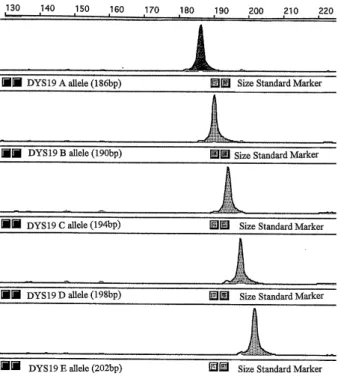
In the present study, we found only five alleles among all Japanese males. They were the famous five alleles (A-E) with sizes varying from 186-202 bp (Figure 1). The frequency distributions of the alleles of the Y-linked microsatellite polymorphic marker DYS19 among males from different populations including Japanese males are presented in Table 1. Then, we studied the Japanese patients with prostate cancer for the DYS19 allelic distribution. We detected different frequencies for each DYS19 allele among these patients. On comparing DYS19 allele frequencies
between prostate cancer patients and normal controls we found that Japanese males with the D allele of DYS19 have a significantly lower incidence of prostate cancer than males with other alleles of DYS19 (p = 0.002); the Odds Ratio was 0.26 with a 95 % confidence interval of (0.65-3.71). On the other hand, males who had DYS19 allele C showed a significantly higher risk to develop prostate cancer, which was obvious from the significant difference when comparing the frequency of this C allele between patients and control subjects (p=0.02). The Odds Ratio was 2.04 with a 95% confidence interval of (0.75-2.42), compared with males having other alleles (Table 2). These findings support our hypothesis that
Table 1. Frequency distribution of the alleles of the Y-linked microsatellite polymorphic marker DYS19 among males from different populations DYS 19 allele A (186bp) % B (190bp) % C (194bp) % D (198bp) % E (202bp) % Other alleles % Japanesea 7.1 3.0 49.5 24.2 16.2 0 Asiansa 4 21 45 20 9 1 Africansb 6 20 31 26 14 3 N. Americansc 57 32 11 0 0 0 Caucasiansd 6 40 27 20 7 0 Bolivians H. A.a 75 25 0 0 0 0 Bolivians L. A.a 71 22 4 1 2 0
N. Americans =Native Americans. Bolivians H.A=Bolivian high altitude. Bolivians L.A =Bolivian low altitude. a
represents the present findings of this investigation b, c and d
represents findings from Santos et al ., 1996. Table 2. Frequency distribution of the alleles of the Y-linked microsatellite polymorphic marker DYS19 among Japanese males with prostate cancer and their matched controls
DYS 19 alleles Prostate cancer Patients Normal controls
Odds Ratio (O.R.) (95% Confidence Interval) A allele (186 bp) 3 7 N.S B allele (190 bp) 6 3 N.S C allele (194 bp) 60* 49 2.04 (0.75-2.42) D allele (198 bp) 7** 24 0.26 (0.65-3.71) E allele (202 bp) 14 16 N.S Totals 90 99 N.S.= non significant. * p =0.02 ** p =0.002 Fig.1. GeneScan results for the Y-linked tetranucleotide
micro-satellite DYS19 polymorphism. Five alleles were detected in Japanese males. A, B, C, D, and E alleles with sizes186, 190, 194, 198 and 202 bp, are presented respectively.
A. A. Ewis et al. Prostate cancer & DYS 19 polymorphism
58 A. A. Ewis et al. Prostate cancer & DYS 19 polymorphism
male descendants from different Y-chromosomal origins are different regarding their susceptibility or resistance to develop prostate cancer, as a male-specific cancer. The well documented familial clustering of prostate cancer and the significance of familial factors that were emphasized by many studies support the present findings (21-24). Steinberg et al. (1990) investigated the frequency of prostate cancer in the relatives of 691 males with prostate cancer and 640 of their spouses. In 15% of the cases, it was a father or brother affected with prostate cancer (P > 0.001). Males with a father or brother affected were twice as likely to develop prostate cancer as men with no relatives affected. Moreover, twin studies support the existence of a significant genetic factor. They also found a trend of increasing risk with increasing number of affected family members, such that males with 2 or 3 first-degree relatives affected had a 5-and 11-fold increased risk of developing prostate cancer, respectively (25).
Among the unselected group of 6,390 males, in the region of Quebec City, Narod et al. (1995) found that the prevalence of prostate cancer was increased in those males with any first-degree relative affected (prevalence= 6.7% ; relative risk=1.72 as compared with those men with no first-degree relative affected. The increase in the relative risk was mostly contributed by affected brothers (prevalence=10.2% ; relative risk=2.62 ; P=0.0002) (26). All these studies emphasized the sharing of the first-degree relatives, especially fathers and brothers in the risk of prostate cancer. Any prostate cancer affected patient shares the same genetic background with his father and brothers, especially the Y-chromosome, which is transmitted exclusively from fathers to sons without any recombination events. We hypothesized that the Y-chromosomal genes and loci may act as a determinant in the process of inherited vulnerability to prostate cancer.
These findings do not represent a causal relationship between the DYS19 allelic frequency and incidence of prostate cancer, but rather it supports the hypothesis that males from different Y-chromosomal lineages are different regarding their phenotypes including their susceptibility or resistance for male specific cancers.
ACKNOWLEDGEMENTS
This work was supported by grants from the Min-istry of Health and Welfare, and from the MinMin-istry of Education, Science and Culture, Japan. Ashraf A. Ewis was supported by an Egyptian government
scholar-ship offered by the Ministry of Higher Education, Egypt. The authors are grateful for the excellent technical assistance of Miss A. Endo, Y. Unemi and K. Tsuji.
REFERENCESE
1. Wolf U, Schempp W, Scherer G : Molecular biology of the human Y chromosome. Rev Physiol Biochem Pharmacol 121 : 147-213, 1992
2. Jobling M, Tyler-Smith C : Father and sons-the Y chromosome and human evolution. Trends Genet 11 : 449-456, 1995
3. Whitfield LS, Sulston JE, Goodfellow PN : Se-quence variation of the human Y chromosome. Nature 378 : 379-380, 1995
4. Underhill PA, Jin L, Zemans R, Oefner PJ, Cavalli-Sforza LL : A pre-Columbian Y chromosome-specific transition and its implications for human evolutionary history. Proc Natl Acad Sci USA 93 : 196 -200, 1996
5. Underhill PA, Shen P, Lin AA, Jin L, Passarino G, Yang WH, Kauffman E, Tamir BB, Bertranpetit J, Francalacci P, Ibrahim M, Jenkins T, Kidd JR, Mehdi Q, Seielstad MT, Wells RS, Piazza A, Davis RW, Feldman MW, Cavalli-Sforza LL, Oefner PJ : Y chromosome sequence variation and the history of human population. Nature genet 26 : 358-361, 2000
6. Shen P, Wang F, Underhill PA, Franco C, Yang W-H, Roxas A, Sung R, Lin AA, Hyman RW, Vollrath D, Davis RW, Cavalli-Sforza LL, Oefner PJ : Population genetic implications from sequence variation in four Y chromosome genes. Proc Natl Acad Sci USA 97 (13) : 7354-7359, 2000 7. Nakahori Y : A Hypothesis on the Evolution of
Sex Chromosomes. Frontiers in Endocrinology 17 : 1-14, 1996
8. Ogata T, Matsuo N : Sex chromosome aberrations and stature : deduction of the principal factors involved in the determination of adult height. Hum Genet 91(6) : 551-562, 1993
9. De-Rosa M, De-Brasi D, Zarrilli S, Paesano L, Pivonello R, D‘Agostino A, Longobardi S, Merola B, Lupoli G, Ogata T, Lombardi G : Short stature and azoospermia in a patient with Y chromosome long arm deletion. J Endocrinol Invest 20 (10) : 623 -628, 1997
10. Vogt PH : Human Y chromosome deletions in Yq 11 and male fertility. Adv Exp Med Biol 424 : 17-30, 1997
11. Kuroki Y, Iwamoto T, Lee JW, Yoshike M, Nozawa 59
The Journal of Medical Investigation Vol. 49 2002 59
S, Nishida T, Ewis AA, Nakamura H, Toda T, Tokunaga K, Kotliarova S, Kondoh N, Koh E, Namiki M, Shinka T, Nakahori Y : Spermatogenic ability is different among males in different Y- chromosome lineage. J Hum Genet 44:289-292, 1999
12. Lee J, Ewis AA, Shinka T, Nakahori Y : The Body Mass Index is different among Japanese males in different Y- chromosome lineages. (in prepa-ration).
13. Jobling MA, Tyler-Smith C : New uses for new haplotypes the human Y chromosome, disease and selection. Trends Genet 16 : 356-362, 2000 14. Santos FR, Gerelsaikhan T, Munkhtuja B, Oyunsuren
T, Epplen JT, Pena SD : Geographic differences in the allele frequencies of the human Y-linked tetranucleotide polymorphism DYS19. Hum Genet 97 : 309-313, 1996
15. Sambrook F, Fritsch EF, Maniathis T : Molecular cloning : a laboratoty manual. 2nd
edn. Cold Spring Harbor Laboratory Press, New York, 1989 16. Roewer L, Epplen JT : Rapid and sensitive typing of
forensic stains by PCR amplification of polymorphic simple repeat sequences in case work. Forensic Sci Int 53 : 163-171, 1992
17. Santos FR, Pena SDJ, Epplen JT : Genetic and population study of a Y-linked tetranucleotide repeat DNA polymorphism with a simple non-isotopic technique. Hum Genet 90 : 655-656, 1993 18. Roewer L, Nagy M, Schmidt P, Epplen JT,
Herzog-Schroder G : Microsatellite and HLA class II oligonucleotide repeat polymorphism. In : Pena SDJ, Chakraborty R, Epplen JT, Jeffreys AJ (eds) DNA fingerprinting : state of science. Birkhauser Verlag, Basel, pp 221-230, 1993
19. Santos FR, Epplen JT, Pena SDJ : Testing deficiency paternity cases with a Y-linked tetranucleotide repeat DNA polymorphism. In : Pena SDJ, Chakraborty R, Epplen JT, Jeffreys AJ (eds) DNA fingerprinting :
state of science. Birkhauser Verlag, Basel, pp 261-265, 1993
20. Kayser M, Caglia A, Corach D, Fretwell N, Gehrig C, Graziosi G, Heidorn F, Herrmann S, Herzog B, Hidding M, Honda K, Jobling M, Krawczak M, Leim K, Meuser S, Meyer E, Oesterreich W, Pandya A, Parson W, Penacino G, Perez-Lezaun A, Piccinini A, Prinz M, Schmitt C, Schnider PM, Szibor R, Teifel-Gerding J, Weichhold G, de Knijff P, Roewer L : Evaluation of Y chromosomal STRs : a multicenter study. Int J Legal Med 110 : 125-133, 1997
21. Cannon L, Bishop DT, Skolnick M, Hunt S, Lyon JL, Smart CR, : Genetic epidemiology of prostate cancer in the Utah Mormon genealogy. Cancer Surv 1 : 47-69, 1982
22. Carter BS, Beaty TH, Steinberg GD, Childs B, Walsh PC : Mendelian inheritance of familial prostate cancer. Proc Nat Acad Sci 89 : 3367-3371, 1992
23. Whittemore AS, Wu AH, Kolonel LN, John EM, Gallagher RP, Howe GR, West DW, The CZ, Stamey T : Family history and prostate cancer risk in black, white, and Asian men in the united states and Canada. Am J Epidemiol 141 : 732-740, 1995
24. Cui J, Staples MP, Hopper JL, English DR, McCredie MRE, Giles GG : Segregation analyses of 1,476 population-based Australian families affected by prostate cancer. Am J Hum Genet 68 : 1207-1218, 2001
25. Steinberg GD, Carter BS, Beaty TH, Childs B, Walsh PC : Family history and the risk of prostate cancer. Prostate 17 : 337-347, 1990
26. Narod SA, Dupont A, Cusan L, Diamond P, Gomez J-L, Suburu R, Labrie F : The impact of family history on early detection of prostate cancer. (Letter) Nature Med 1 : 99-101, 1995
A. A. Ewis et al. Prostate cancer & DYS 19 polymorphism
60 A. A. Ewis et al. Prostate cancer & DYS 19 polymorphism