217
Available online at www.jstage.jst.go.jp/browse/jjshs JSHS © 2007
Improvement of Graft Development in Tomato and Eggplant Grafted Cuttings
by Supplying Warmed Water to Graft Union during Low-air-temperature
Storage
Toshio Shibuya
1*, Haruka Nakashima
2, Kaori Shimizu-Maruo
3and Tomoko Kawara
31Graduate School of Life and Environmental Science, Osaka Prefecture University, Gakuen-cho, Naka-ku, Sakai 599–8531, Japan 2College of Agriculture, Osaka Prefecture University, Gakuen-cho, Naka-ku, Sakai 599–8531, Japan
3Bergearth Co., Ltd., Tsushima-cho, Uwajima 798–3361, Japan
We investigated the effects of supplying warmed water to the graft union of tomato and eggplant grafted cuttings during low-air-temperature storage on graft development and plant growth after storage. The scions of grafted cuttings were held at an air temperature of 9 to 12°C, while the region from the cut end of the rootstock cuttings to the graft union was held at 12 to 37°C in water during 4 days’ storage. The tensile strength of some cuttings’ graft union was measured as an index of graft development. The tensile strength of the tomato graft union was much improved when the graft union temperature ranged from 23 to 27°C. That of the eggplant graft union increased as the temperature rose up to 29°C. After 4 days’ storage, the remaining cuttings were planted in vermiculite medium and grown in a growth chamber. Cuttings from the temperatures that gave a higher tensile strength tended to grow larger. We also investigated the effects of supplying the water at 28°C to the graft union on the storage quality of cuttings by measuring the water status, gas exchange, and chlorophyll fluorescence parameters after 4 days’ storage at an air temperature of 9 to 11°C. The leaf water potential and leaf conductance of scions with warmed graft unions were significantly higher than those with unwarmed graft unions. The chlorophyll fluorescence parameters ΦPSII and the electron transfer rate were maintained with warmed water during storage, but were significantly decreased without warmed water application. These results indicate that keeping the graft union warm during low-air-temperature storage can improve graft development, storage quality, and plant growth after storage.
Key Words: chlorophyll fluorescence, cutting grafting, leaf conductance, leaf water potential, tensile strength.
Introduction
In transplant production, demands for growing area and labor fluctuate with seasonal variations in demand for transplants. If these fluctuations could be smoothed out throughout the year by the storage of transplants, production efficiency would be improved. To this end, many studies on environmental control technology for maintaining the quality of transplants during storage have been carried out (Fujiwara et al., 1997, 2001, 2003; Heins et al., 1994; Kozai et al., 1996; Kubota et al., 1995; Paton and Schwabe, 1987).
Previously, we reported that bottom-heat treatment,
which involves soaking the cut end of the cuttings in warmed nutrient solution at a low air temperature, can improve rooting after storage (Maruo et al., 2004, 2005; Shibuya et al., 2007; Terakura et al., 2004). This storage technology improves the quality of the rooting site of cuttings by localized temperature control, while storing most of each cutting at low air temperature. Localized temperature control at a low air temperature is also effective immediately after grafting: callusing of the graft union is improved when the graft union is kept warm with warmed pipes in which the graft union is placed (Hartmann et al., 2002).
The cutting grafting method is often used in the production of fruit vegetables, particularly among the Cucurbitaceae and Solanaceae. In this technique, grafted cuttings are obtained by grafting scions on rootstock cuttings harvested from seedlings, and are then planted in growing medium for rooting. Graft development of
Received; October 6, 2006. Accepted; January 26, 2007.
A part of this study was supported by the Research Project for Utiliz-ing Advanced Technologies in Agriculture, Forestry and Fisheries. * Corresponding author (E-mail: [email protected]).
the cuttings affects the storage quality and growth of the cuttings after storage. Shiraki et al. (1999) reported that the storage quality and growth of grafted cucumber cuttings were improved by keeping them at 28°C for 1 day after grafting to improve graft development. In this study, we tried to improve the graft development of cuttings, their storage quality, and their growth after storage by localized temperature control via supplying warmed water from the bottom end of the rootstock to the graft union while the scions were kept at a low air temperature. Applying such localized temperature control is relatively easy, because unrooted cuttings are easy to handle. If grafted cuttings with improved graft development and growth ability after storage could be supplied stably, the labor requirements of transplant growers during the acclimatization phase would be much reduced.
Supplying nutrient solution to cuttings during storage can improve the storage quality of the harvested cuttings (Fujiwara et al., 1997, 1999). Previously, we reported that supplying warmed water to the bottom end of the cuttings during low-air-temperature storage improved the water absorption rate of the cuttings and reduced water stress at the beginning of storage (Shibuya et al., 2007; Terakura et al., 2004; Tokuda et al., 2006). However, if water were supplied to the rootstock only, it would not reach the scion, which would then be exposed to water stress, because the vascular tissues are not connected between the rootstock and scion immediately after grafting. If the water absorption rate of the scion can be improved by supplying water to the graft union directly, water stress at the beginning of storage would be reduced. Further, reducing water stress during storage would permit storage at a lower relative humidity (RH). This would be an advantage, because the storage of transplant at a high RH to reduce water stress causes the elongation of plants and the development of mold diseases (Heins et al., 1994).
In this study, we investigated the effects of the temperature of water supplied to the graft union of tomato and eggplant grafted cuttings during low-air-temperature storage on graft development, on the cuttings’ storage quality such as photosynthetic activity, gas exchange and water status, and on plant growth after storage. We measured tensile strength as an index of the development of the graft union (Lindsay et al., 1974; Moore, 1982; Pedersen, 2005). We also measured leaf water potential and leaf conductance after storage, which indicate water status and gas exchange of cuttings, respectively, and chlorophyll fluorescence parameters during storage, which indicate photosynthetic activity (Kubota et al., 1995), as indexes of storage quality.
Materials and Methods
Effects of water temperature during storage on graft development and plant growth after storage (Experi-ment 1)
We grew grafted cuttings of tomato and eggplant. Tomato (Lycopersicon esculentum Mill.) varieties ‘Hausu-momotaro’ and ‘Ganbarune-sangou’ were used as scion and rootstock, respectively. Eggplant (Solanum melongena L.) varieties ‘Senryou-nigou’ and S. torvum Sw. ‘Torubamu-biga’ were used as scion and rootstock, respectively. All plants were grown in a greenhouse of Bergearth Co., Ltd. (Ehime, Japan). Using the splice grafting method, we grafted scion cuttings onto rootstock cuttings. A grafting tube (inner diameter 1.7 mm, Nasunics Co., Ltd., Japan) was used to hold the graft union. Leaves of rootstock cuttings were removed after grafting. Experiments were conducted the next day, after the cuttings were transported to our laboratory at Osaka Prefecture University (Sakai, Japan).
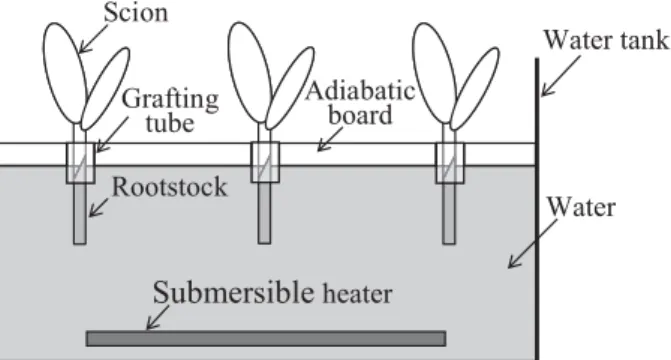
The grafted cuttings were stored for 4 days in warmed or unwarmed water. We stored the cuttings for a relatively short duration to investigate the effects of supplying warmed water at the beginning of storage, although several weeks’ storage is likely in practice. The 4-day duration was determined from a preliminary experiment, in which roots appeared at the cut end of the rootstock cuttings at 5 days in warmed water. The cuttings were stored in a refrigerated chamber to control air temperature at 9 to 12°C. RH was not controlled. White fluorescent lamps were used for continuous illumination at a photosynthetic photon flux density (PPFD) of 10µmol·m−2·s−1. The grafted cuttings were soaked in the water from the cut end of the rootstock to the graft union at six different water temperatures (Tw: 12, 16, 21, 27, 32, and 37°C for tomato; 13, 16, 21, 26, 31, and 35°C for eggplant). The vertical slit in the grafting tube allowed water to reach the graft union. The cuttings were supported by insertion up to the graft union in a hole (ϕ = 6 mm) in an adiabatic board (5-mm thickness) floating on the water (Fig. 1). Tw was controlled with electric heaters regulated by thermostats. Tw and the temperature of the graft union (Tg) were
Fig. 1. Schematic diagram of experimental setup to supply warmed water to graft union.
measured with thermocouples (type T) of ϕ0.32 mm and ϕ0.1 mm, respectively. Air temperature and RH were measured with temperature and humidity recorders (RS-12, Espec Mic Co., Ltd., Japan). The vapor pressure deficit was estimated from the air temperature and RH. After 4 days of storage, we measured the fresh and dry weights of the scions, and the tensile strength of the graft union (TS). We defined TS as the force required to pull the graft union apart. To measure TS, we hung a vessel from the rootstock, held the scion, and then slowly introduced water into the vessel until the graft union broke. We calculated TS from the weights of the vessel, the added water, and the rootstock. We estimated the water content of the scion from the fresh and dry weights.
The cuttings were planted in vermiculite medium, and then grown in a growth chamber (Ikeya Co., Ltd., Japan) maintained at an air temperature of 27°C, an RH of 94%, and a PPFD of 100µmol·m−2·s−1 with a photoperiod of 12 h. White fluorescent lamps were used for illumination. Control grafted cuttings without storage at low air temperature were also grown in the growth chamber for 4 days. Total weight, root fresh weight, and TS were measured 4 days after planting.
Effects of supplying warmed water on storage quality of grafted cuttings (Experiment 2)
The grafted cuttings were stored at a low air temperature for 4 days, as in Experiment 1, in warmed water at 28°C or unwarmed water. TS was measured every 24 h during storage. The leaf water potential of the scion was measured with a dewpoint water potential meter (WP4T, Decagon Devices, Inc., Pullman, WA, USA) at 4 days according to the manufacturer’s recommendations (Decagon Devices Inc., 1999). The water content of the scion was estimated from the fresh and dry weights. The chlorophyll fluorescence parame-ters Fv/Fm, ΦPSII, and the electron transfer rate (ETR) were measured with a leaf chamber fluorometer (LI-6400-40, LI-COR Inc., Lincoln, NE, USA) before storage and at 4 days. Fv/Fm and ΦPSII indicate the
maximum and effective quantum yields, respectively, of photosystem II. PPFD of actinic light for measuring ΦPSII and ETR was 500µmol·m−2·s−1. The leaf
conductance of the tomato scion was measured with a leaf porometer (SC-1, Decagon Devices, Inc.) at 4 days.
Results
Temperature and humidity during storage
The relationship between Tw and Tg of tomato cuttings in Experiment 1 is shown in Figure 2. Tg was 1 to 6°C lower than Tw when Tw was 16 to 37°C, and air temperature around the scion was increased by 1 to 3°C. RH around the scion was 60% to 70%. The vapor pressure deficit at Tw = 32°C was 1.7 times that at Tw = 12°C in Experiment 1. The eggplant results were almost the same. The environmental conditions in each treatment in Experiment 2 are shown in Table 1. RH was higher in Experiment 2, conducted in winter, than in Experiment 1, conducted in summer, because of the lower cooling load on the refrigeration chamber in winter.
Effects of water temperature during storage on graft development and plant growth after storage (Experi-ment 1)
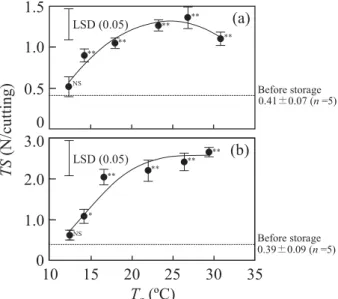
TS of the tomato graft union after 4 days of storage showed high values with Tg ranging from 23 to 27°C (Fig. 3a), and was significantly larger after storage with Tg at 14°C or above than before storage. TS of the eggplant graft union increased as Tg rose up to 29°C (Fig. 3b), and was significantly larger after storage than
Table 1. Environmental conditions of each treatment in Experiment 2.
Average environmental parameters are shown.
Air temperature, relative humidity, and vapor pressure were measured around the scions.
Plant material Treatment Air temp.
(°C) Water temp. (°C) Graft-union temp. (°C) Relative humidity (%) Vapor pressure deficit (kPa)
Tomato Warmed water 11.2 27.7 24.6 84 0.21
Unwarmed water 10.0 10.7 10.5 92 0.10
Eggplant Warmed water 10.6 28.2 25.6 79 0.27
Unwarmed water 9.0 10.3 10.1 90 0.11
Fig. 2. Relationship between water temperature (Tw) and tomato graft union temperature (Tg) in Experiment 1.
the value at Tg = 14°C or above than before storage. The water content of the tomato scion increased with Tg (Fig. 4a). The water content after storage was significantly lower at Tg = 12 and 14°C than before storage. The water content of the eggplant scion also increased with Tg, and was lower at almost all
temperatures after than before storage (Fig. 4b). TS of tomato plants 4 days after planting increased as Tg during storage rose up to 23°C, then decreased at a higher Tg (Fig. 5a). Tomato plants stored at Tg = 23°C
Fig. 4. Effects of graft union temperature (Tg) during low-air-temperature storage on water content of tomato (a) and eggplant (b) scions after 4 days of storage (Experiment 1). Vertical bars indicate SE of the means (n = 6). Broken lines show the water content of cuttings before storage. NS, *, ** indicate non-significant, significantly different from the value before storage at P = 0.05 and P = 0.01, according to the t-test, respectively. Fig. 3. Effects of graft union temperature (Tg) during
low-air-temperature storage on tensile strength of graft union (TS) of tomato (a) and eggplant (b) cuttings after 4 days of storage (Experiment 1). Vertical bars indicate SE of the means (n = 6). Broken lines show TS of the cuttings before storage. NS, *, ** indicate non-significant, significantly different from the value before storage at P = 0.05 and P = 0.01, according to the t-test, respectively.
Fig. 6. Effects of graft union temperature (Tg) during low-air-temperature storage on total fresh weight of tomato (a) and eggplant (b) plants 4 days after planting following storage (Experiment 1). Vertical bars indicate SE of the means (n = 6). Broken lines show the total fresh weight of plants 4 days after planting following grafting without storage. NS, *, ** indicate non-significant, significantly different from the value of plants not stored at P = 0.05 and P = 0.01, according to the t-test, respectively.
Fig. 5. Effects of graft union temperature (Tg) during low-air-temperature storage on tensile strength of graft union (TS) of tomato (a) and eggplant (b) cuttings 4 days after planting following storage (Experiment 1). Vertical bars indicate SE of the means (n = 6). Broken lines show TS of plants 4 days after planting following grafting without storage. NS, *, ** indicate non-significant, significantly different from the value of plants not stored at P = 0.05 and P = 0.01, according to the t-test, respectively.
showed a significantly larger TS 4 days after planting than those not stored. TS of eggplant plants 4 days after planting increased as Tg during storage rose up to 29°C (Fig. 5b). Eggplant plants stored at Tg = 27 and 29°C showed a significantly larger TS 4 days after planting than those not stored.
The total fresh weight of tomato plants 4 days after planting following storage at Tg = 18 to 27°C was significantly larger than those not stored (Fig. 6a). The total fresh weight of eggplant plants 4 days after planting following storage at Tg = 17 and 27–29°C was significantly larger than those not stored (Fig. 6b). Cuttings of both tomato and eggplant stored at temperatures that gave a higher tensile strength at the end of storage tended to grow larger after planting. The root fresh weight of tomato plants 4 days after planting increased with increasing Tw during storage up to 27°C, then decreased at a higher Tw (Fig. 7a). The root fresh
weight of tomato plants stored at Tw = 21 to 37°C was significantly larger than those not stored. On the other hand, the root fresh weight of plants stored at Tw = 12°C was significantly lower than those not stored. The effects of Tw on the root fresh weight of eggplant plants were similar to those in tomato (Fig. 7b). The root fresh weight of eggplant plants stored at Tw = 22 to 35°C was significantly larger than those not stored.
Effects of supplying warmed water on storage quality of grafted cuttings (Experiment 2)
TS increased linearly in the course of storage (Fig. 8). TS increased faster with warmed water than with unwarmed water. TS 4 days after storage with warmed water was 2.2 times that with unwarmed water in tomato and 5.7 times in eggplant. Leaf water potential, water content, and leaf conductance of the scions with warmed water were significantly higher than those with
Table 2. Leaf water potential, water content, and leaf conductance of scions 4 days after storage (Experiment 2).
Means ± SE (n = 5)
* Leaf conductance of eggplants was not measured.
Plant material Treatment Leaf water potential
(MPa) Water content (%) Leaf conductance (cm·s−1) Tomato Warmed water −0.70 ± 0.10 90.7 ± 0.3 2.64 ± 0.54 Unwarmed water −1.07 ± 0.08 80.4 ± 0.3 0.55 ± 0.10
Significance of difference (t-test) P = 0.05 P = 0.01 P = 0.05
Eggplant
Warmed water −0.78 ± 0.11 89.4 ± 0.9 —*
Unwarmed water −1.48 ± 0.22 86.1 ± 0.6 —
Significance of difference (t-test) P = 0.01 P = 0.01 —
Fig. 7. Effects of water temperature (Tw) during low-air-temperature storage on root fresh weight of tomato (a) and eggplant (b) plants 4 days after planting following storage (Experiment 1). Vertical bars indicate SE of the means (n = 6). Broken lines show the root fresh weight of plants 4 days after planting following grafting without storage. NS, *, ** indicate non-significant, significantly different from the value of plants not stored at P = 0.05 and P = 0.01, according to the t-test, respectively.
Fig. 8. Time courses of tensile strength of graft union (TS) of tomato (a) and eggplant (b) cuttings with and without warm water at graft union (Experiment 2). Vertical bars indicate SE of the means (n = 5).
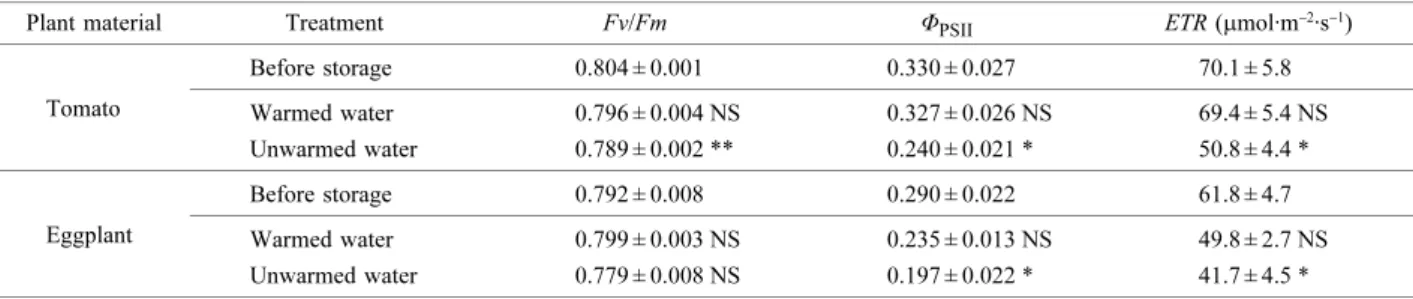
unwarmed water (Table 2). Four days after storage, Fv/Fm of tomato scions with warmed water was not significantly different from that before storage, while that with unwarmed water decreased significantly during storage (Table 3). Four days after storage, Fv/Fm values of eggplant scions with warmed and unwarmed water were not significantly different from those before storage. ΦPSII and ETR of tomato and eggplant scions were maintained by supplying warmed water during storage, but were significantly decreased with unwarmed water.
Discussion
The increase in growth after planting following storage in warmed water seems be caused by increased graft development at planting, because cuttings from the temperatures that gave higher tensile strengths at the end of storage grew larger after planting. The improvement of rooting after planting by supplying warmed water during storage is due to improvement of the quality of the rooting site of cuttings. This rooting improvement with warming is similar to the results of our previous studies in which we supplied warmed water only to the cut end of cuttings (Maruo et al., 2004, 2005; Shibuya et al., 2007; Terakura et al., 2004). The improvement of a cutting’s primary-growth after planting following storage would contribute to reducing the labor requirements of transplant growers, because the acclimatization phase for developing graft-union and rooting would be shortened. In the tomato, the optimum temperature for improving graft development and rooting of grafted cuttings is approximately 25°C from our present results. In the eggplant, the optimum temperature for improving graft development is above 30°C, and for improving rooting is approximately 25°C. The poorer rooting of tomato cuttings stored at Tw = 12°C than that of cuttings not stored indicates a reduction in the storage quality of the rootstock, probably as a result of the exposure of most of the rootstock to an anaerobic environment in the water. This situation differs from our previous studies, in which warmed water was supplied only to the cut end of the cuttings (Maruo et al., 2004, 2005; Shibuya et al., 2007; Terakura et al., 2004); this will require future attention. To avoid root damage
during planting, it is desirable to end the supply of warmed water just before the cuttings begin to root, as damage to the root system during transplanting may delay subsequent growth of the root system and allow the entry of root rot fungi (Styer and Koranski, 1997). The results of our preliminary experiment show that the optimum duration for supplying warmed water during storage is 4 days, because roots appeared at the cut end of rootstock cuttings at 5 days.
The decrease in the water content of the scion at a low Tg indicates that lower temperatures decrease the rate of water absorption by the scion, and the water absorption rate became lower than the transpiration rate. The water status of tomato scions seems to have been maintained by the supply of warmed water at a relatively low RH of 60 to 70% for the grafted cuttings, because there was no significant difference between water contents before and after storage at Tg = 18 to 31°C in Experiment 1. On the other hand, grafted eggplant cuttings should be stored at a higher RH than in tomato, because the water content after storage became lower than that before storage at all values of Tg. The difference in the change in water content between the tomato and eggplant is probably due to differences in the transpiration rate of the scions. The rate of water absorption by cuttings is increased at a higher Tw (Terakura et al., 2004; Tokuda et al., 2006). We also assume that the higher water content after storage at a higher Tw and Tg is due to higher water absorption at the graft union in addition to an increased transport of water from the rootstock to the scion with improved graft development. More detailed analyses of water absorption, the transpiration rate, and water conductance of the graft union are necessary to elucidate this.
The decrease in leaf water potential and leaf conductance in unwarmed water in Experiment 2 indicates that the stomata closed in response to the reduced leaf water status. The higher leaf conductance in warmed water indicates that normal gas exchange by leaves was maintained as a result of the reduced water stress at the beginning of storage. Supplying warmed water for a short duration probably improves long-term storage quality after that, because reducing water stress at the beginning of storage improves the storage quality
Table 3. Chlorophyll fluorescence parameters Fv/Fm, ΦPSII, and electron transfer rate (ETR) 4 days after storage (Experiment 2).
Means ± SE (n = 5).
NS, *, ** indicate non-significant, significantly different from the value before storage at P = 0.05 and P = 0.01, according to the t-test, respectively.
Plant material Treatment Fv/Fm ΦPSII ETR (µmol·m−2·s−1)
Tomato Before storage 0.804 ± 0.001 0.330 ± 0.027 70.1 ± 5.8 Warmed water 0.796 ± 0.004 NS 0.327 ± 0.026 NS 69.4 ± 5.4 NS Unwarmed water 0.789 ± 0.002 ** 0.240 ± 0.021 * 50.8 ± 4.4 * Eggplant Before storage 0.792 ± 0.008 0.290 ± 0.022 61.8 ± 4.7 Warmed water 0.799 ± 0.003 NS 0.235 ± 0.013 NS 49.8 ± 2.7 NS Unwarmed water 0.779 ± 0.008 NS 0.197 ± 0.022 * 41.7 ± 4.5 *
(Terakura et al., 2003, 2004). The decreases in Fv/Fm, ΦPSII, and ETR in unwarmed water in Experiment 2
indicate the decline of the electron transport system for photosynthesis. Generally, decreases in chlorophyll fluorescence parameters are caused by water stress in addition to light inhibition. Therefore, the maintenance of the chlorophyll fluorescence parameters by the supply of warmed water is probably due to the support of the electron transport system through reduced water stress caused by improved water absorption by the scion.
In conclusion, supplying warmed water to the graft union of grafted cuttings during low-air-temperature storage improved graft development and the quality of the rooting site of the rootstock during storage, and consequently the cuttings’ growth after planting compared with those not stored. In addition, supplying warmed water possibly improved the storage quality by reducing water stress at the beginning of storage through the improvement of water absorption. As well as improving storage, this technology is also effective in acclimatization, because graft development and the quality of the rooting site of the rootstock can be improved stably with a minimal loss of biomass. If this technology can provide grafted cuttings in which graft development and rooting preparation are well advanced, the acclimatization stage after planting would be greatly shortened. At low air temperature, high light intensity to enhance photosynthesis is not necessary, because the loss of cutting biomass is reduced. High humidification to reduce transpiration is not necessary either, because a low air temperature effectively maintains a low vapor pressure deficit. Therefore, a simpler and more effective acclimatization system than conventional ones can be developed using this technology.
Literature Cited
Decagon Devices Inc. 1999. Measurement of leaf water potential using the WP4. Decagon Device Inc., Pullman, Washington. Fujiwara, K., K. Takaku and M. Iimoto. 1997. Low light irradiation using red light emitting diodes and nutrient gel application for low temperature storage of postharvest chervil (Anthriscus cerefolium L.). Environ. Control Biol. 35: 135–138 (In Japanese with English abstract).
Fujiwara, K., K. Takaku and M. Iimoto. 1999. Availabilities of red light-emitting diodes as light source for low light irradiation and mineral nutrient supply using nutrient gel during low temperature storage of postharvest chervil (Anthriscus cerefolium L.). Environ. Control Biol. 37: 137– 141 (Japanese with English abstract).
Fujiwara, K., S. Isobe and M. Iimoto. 2001. Optimum conditions of low light irradiation–CA storage for quality preservation of grafted tomato plug seedlings. Environ. Control Biol. 39: 111–120 (In Japanese with English abstract).
Fujiwara, K., Y. Kimura and K. Kurata. 2003. Effect on the quality of grafted tomato plug seedlings of blue-light PPFD percentage during red and blue LEDs low light irradiation storage. Environ. Control Biol. 41: 361–368 (In Japanese with English abstract).
Hartmann, H. T., D. E. Kester, F. T. Davies Jr. and R. L. Geneve. 2002. Plant propagation, 7th ed. Pearson Education, Upper Saddle River.
Heins, R., N. Lange, T. F. Wallace Jr. and W. Carlson. 1994. Plug storage. Greenhouse Grower, Willoughby.
Kozai, T., C. Kubota, K. Sakami, K. Fujiwara and Y. Kitaya. 1996. Growth suppression and quality preservation of eggplant plug seedlings by low temperature storage under dim light. Environ. Control Biol. 34: 135–139 (In Japanese with English abstract).
Kubota, C., G. Niu and T. Kozai. 1995. Low temperature storage for production management of in vitro plants: effects of air temperature and light intensity on preservation of plantlet dry weight and quality during storage. Acta Hort. 393: 89–96. Lindsay, D. W., M. M. Yeoman and R. Brown. 1974. An analysis
of the development of the graft union in Lycopersicon esculentum. Ann. Bot. 38: 639–646.
Maruo, K., H. Sugiwaki and T. Shibuya. 2004. Effects of 24 hours bottom-heat treatment after start of low-temperature storage on rooting of grafted cuttings of tomato and eggplant after storage. J. Japan. Soc. Hort. Sci. 73 (Suppl. 2): 399 (In Japanese).
Maruo, K., T. Kawara, T. Shibuya and A. Tokuda. 2005. Effects of temperature and period of bottom-heat treatment after start of low-temperature storage on rooting of grafted eggplant cuttings after storage. J. Japan. Soc. Hort. Sci. 74 (Suppl. 2): 417 (In Japanese).
Moore, R. 1982. Graft formation in Kalanchoe blossfeldiana. J. Exp. Bot. 33: 533–540.
Paton, F. and W. W. Schwabe. 1987. Storage of cuttings of Pelargonium × hortorum Bailey. J. Hort. Sci. 62: 79–87. Pedersen, B. H. 2005. Development of tensile strength in
compatible and incompatible sweet cherry graftings. Can. J. Bot. 83: 202–210.
Shiraki, M., H. Kushima, K. Koiwasaki, H. Noma, T. Iwashita and T. Eto. 1999. The distribution of tomato (Lycopersicon esculentum) and cucumber (Cucumis sativus) cutting grafting before rooted nursery plant. Bull. Miyazaki Agric. Exp. Sta. 34: 25–31 (In Japanese with English abstract).
Shibuya, T., A. Tokuda, R. Terakura, K. Shimizu-Maruo, H. Sugiwaki, Y. Kitaya and M. Kiyota. 2007. Short-term bottom-heat treatment during low-air-temperature storage improves rooting in squash (Cucurbita moschata Duch.) cuttings used for rootstock of cucumber (Cucumis sativus L.). J. Japan. Soc. Hort. Sci. In press.
Styer, R. C. and D. S. Koranski. 1997. Plug and transplant production: a grower’s guide. Ball Publishing, Batavia. Terakura, R., T. Shibuya, Y. Kitaya and M. Kiyota. 2003. Effect
of low relative humidity during tomato seedling growth on quality of cuttings under low-temperature and dim-light storage. Environ. Control Biol. 41: 381–385 (In Japanese with English abstract).
Terakura, R., T. Shibuya, Y. Kitaya and M. Kiyota. 2004. Effects of short-term treatment of warming nutrient-solution during low air temperature storage of cucumber cuttings on their storage quality and rooting after storage. Environ. Control Biol. 42: 331–337 (In Japanese with English abstract). Tokuda, A., T. Shibuya, Y. Kitaya and M. Kiyota. 2006. Bottom
heat treatment reduces water stress of Cucurbitaceae and Solanaceae stock-plant cuttings during low air temperature storage. J. Japan. Soc. Hort. Sci. 75 (Suppl. 2): 285 (In Japanese).