[Technical Report]
Homogenizing Effect of Ethers Added to Immiscible
Methanol/Oil Binary Mixtures
Rikio YAGINUMA†1), Shinji MORIYA†2), Yoshikazu SATO†1), Daisuke KODAMA†1), Hiroyuki TANAKA†1), and Masahiro KATO†1)*
†1) Dept. of Materials Chemistry and Engineering, College of Engineering, Nihon University, Koriyama, Fukushima 963 -8642, JAPAN †2) Dept. of Mechanical Engineering, College of Engineering, Nihon University, Koriyama, Fukushima 963-8642, JAPAN
(Received March 12, 2001)
Immiscible binary liquid mixtures consisting of methanol and diesel fuel, soybean oil, or rapeseed oil were homogenized by addition of methyl t-butyl ether, ethyl t-butyl ether, t-amyl methyl ether, tetrahydrofuran, tetrahydropyran, or 1,4-dioxane. Liquid-liquid solubility curves for the ternary systems of ether, methanol, and oil were obtained at 298.15K. The ignition behaviors were further observed for ether/alcohol/diesel fuel mix-tures. Tetrahydrofuran mixtures had the best characteristics for use as alternative fuels in diesel engines.
1. Introduction
Ethers have a homogenization effect on Immiscible binary-liquid mixtures. Our previous investigation of the boiling points and liquid densities of alcohol and diesel fuel mixtures found an Immiscible composition range for alcohol/diesel fuel mixtures, and that addition of ethers homogenized these Immiscible mixtures1),2). Homogenization is important for developing alternative automobile fuels based on mixtures of alcohols with diesel fuel or seed oils. In the previous study3), the homogenizing effect of six ethers: methyl t-butyl ether (MTBE), ethyl t-butyl ether (ETBE), t-amyl methyl ether (TAME), tetrahydrofuran (THF), tetrahydropyran (THP), or 1,4-dioxane were investigated for immiscible binary mixtures, in which ethanol was mixed with diesel fuel, with soybean oil, and with rapeseed oil, at 298.15K. In the present study, the homogenizing effect of the six ethers was investigated for immiscible binary mixtures based on methanol instead of ethanol. The ignition behaviors were observed for these ether/ alcohol/diesel fuel mixtures.
2. Experimental
An immiscible mixture of the desired composition of methanol and oil was prepared in a glass flask with a stopper by precisely weighing each component using a syringe and an electronic balance. The flask was shaken and placed in a water bath controlled at 298.15±0.01K. The temperature was measured by a
Hewlett-Packard 2804A quartz thermometer. Two liquid phases were first observed. Ether was added as
a third component to the immiscible mixture while shaking the flask using a syringe until the interface of the two liquid phases disappeared. The amount of ether added was calculated from the weight remaining in the syringe. The uncertainty of solubility
measure-ments was about±0.001 weight fraction.
The ignition behaviors for ether/alcohol/diesel fuel mixtures were observed with the conventional ASTM equipment made from Yoshida Seisakusho Co., Ltd.
Special grade MTBE and ETBE reagents were sup-plied by Tokyo Kasei Co., Ltd. Special grade THF, THP, 1,4-dioxane, methanol, and ethanol were supplied by Wako Pure Chemical Industries, Ltd. TAME with a guarantee of 97% purity was supplied by Aldrich Chemical Co., Inc. The commercial diesel fuel was sup-plied by Cosmo Oil Co., Ltd. Soybean oil and rape-seed oil were supplied by Honen Corp., and Mashiko Oil Co., respectively. All reagents were used as re-ceived. The physical properties of the materials used are listed in Table 1.
3. Results and Discussion
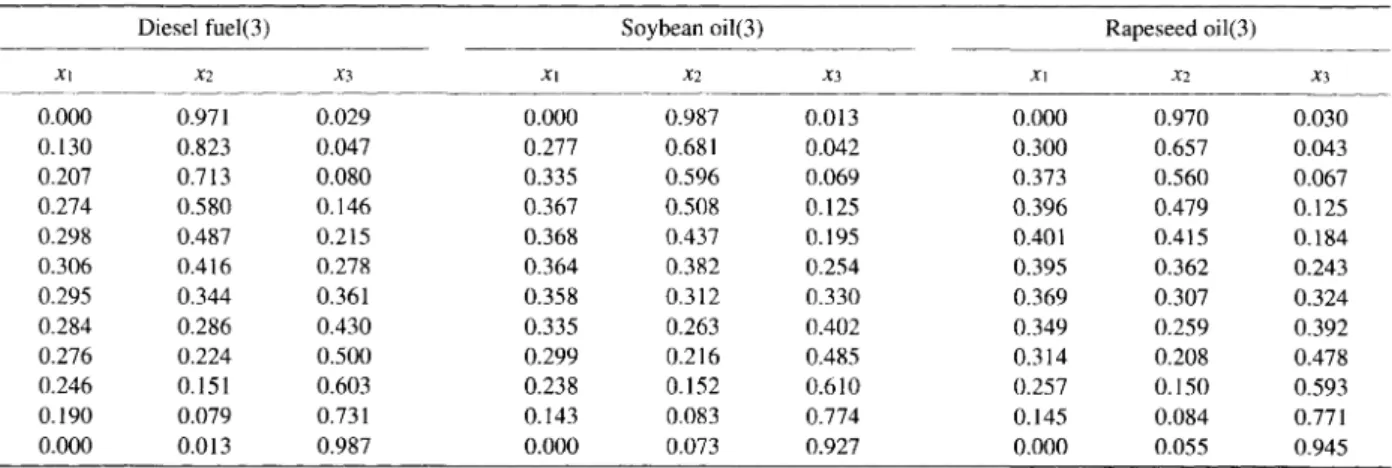
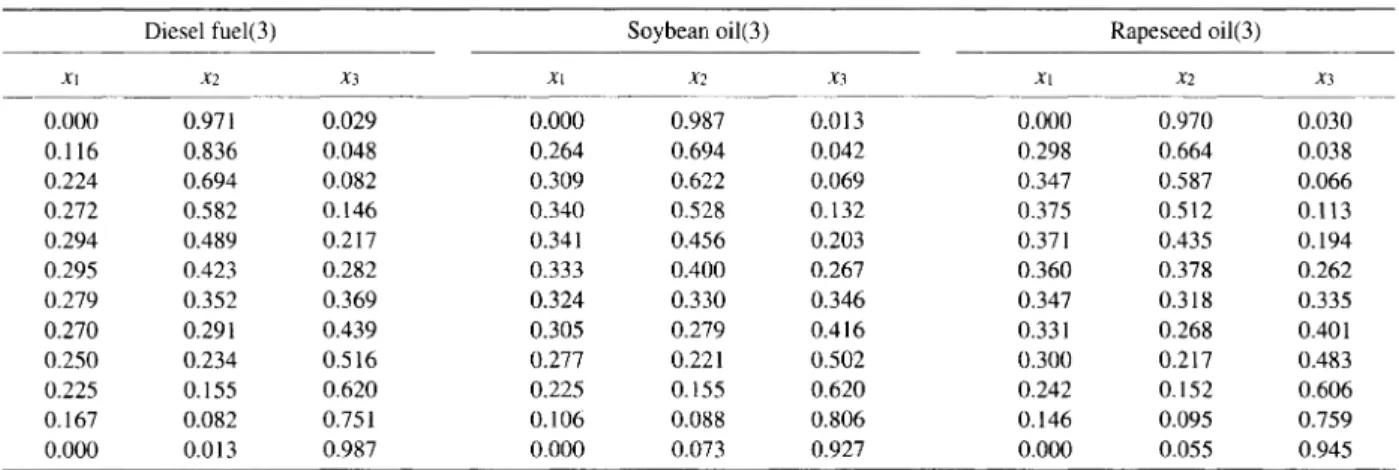
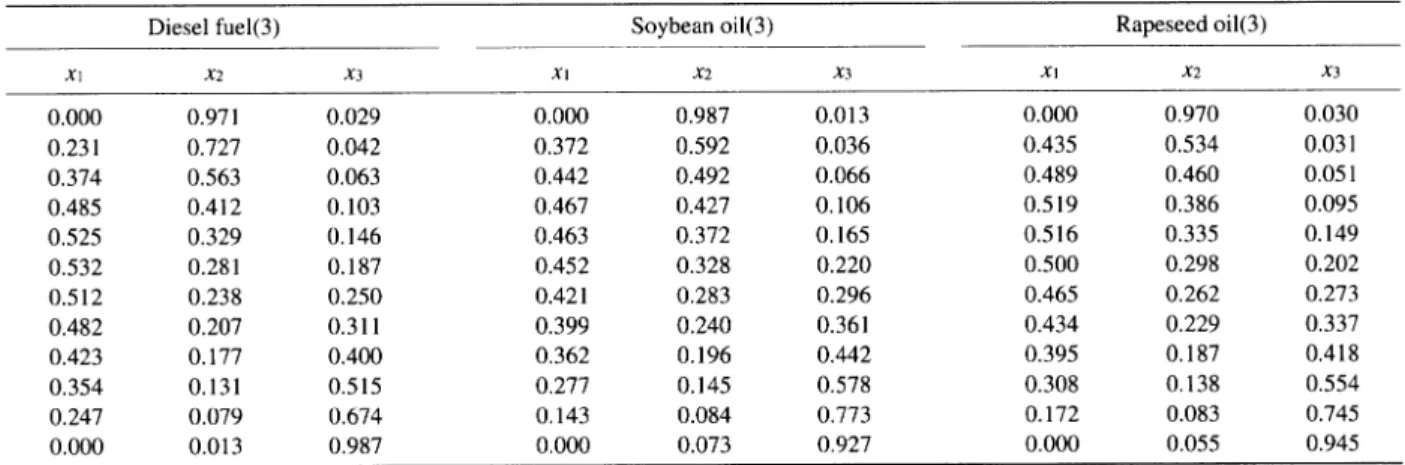
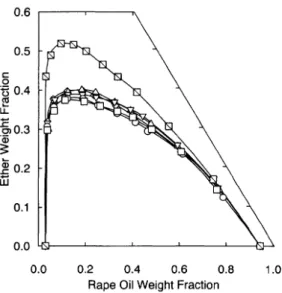
Experimental solubility data obtained in the present study at 298.15K for ether/methanol/oil mixtures are shown in Tables 2 to 7 and Figs. 1 to 3. The bound-ary of the two-liquid phases of methanol/diesel fuel, methanol/soybean oil, or methanollrapeseed oil disap-peared after adding any of the ethers: MTBE, ETBE, TAME, THF, THP, or 1,4-dioxane. Liquid homoge-nization was observed always by adding 40% of ether, except 1,4-dioxane, to the methanolldiesel fuel mixture.
The dipole moments of the ethers are listed in Table 1. The largest value, 1.7 Debye, was assigned to THF and THP, and the smallest value, 0.4 Debye, to
dioxane, and 1.2 Debye to MTBE, ETBE, and TAME. Comparison of the dipole moments of the ethers and the experimental results shown in Figs. 1 to 3, the magnitude of dipole moments of the ethers correspond-ed to the homogenizing abilities observed in this study, similar to the previous work3).
The ignition behaviors were observed for the mix-tures of ether/methanol/diesel fuel as shown in Fig. 4. MTBE, THF, and 1,4-dioxane were used as the ethers. The weight fractions of ether, methanol, and diesel fuel, respectively, were 0.375, 0.188, and 0.437. The experimental ignition temperatures for ether/ethanol/
Table 1 Physical Properties of Materials Used at 298.15K
Table 2 Liquid Solubility Compositions of Weight Fraction (x) at 298.15K for Mixtures of MTBE(1)/Methanol(2)/Oil(3)
diesel fuel mixtures are shown in Fig. 5. The ethers are the same as used for the methanol system3). The weight fractions of ether, ethanol, and diesel fuel, respectively, were 0.091, 0.273, and 0.636. In Figs. 4 and 5, the ignition behavior of diesel fuel is shown for
reference. A high temperature was required for the ignition of MTBE mixtures, as shown in Figs. 4 and 5. Experimental ignition behaviors were similar to that of the diesel fuel for THE and 1,4-dioxane mixtures.
Table 4 Liquid Solubility Compositions Weight Fraction (x) at 298.15K for Mixtures of TAME(1)/Methanol(2)/Oil(3)
Table 5 Liquid Solubility Compositions Weight Fraction (x) at 298.15K for Mixtures of THF(1)/Methanol(2)/Oil(3)
4. Conclusions
Homogenization was observed in immiscible mix-tures prepared from methanol with diesel fuel, soybean oil, or rapeseed oil, with the addition of the ethers: MTBE, ETBE, TAME, THF, THP, or 1,4-dioxane. Ternary solubility curves were obtained at 298.15K for these ether/methanol/oil mixtures. However, the ho-mogenization effect was poor with 1,4-dioxane.
A higher temperature was required for ignition of MTBE mixtures, as shown in Figs. 4 and 5. Experi-mental ignition behaviors were similar to those of diesel fuel for THE and 1,4-dioxnae mixtures.
Based on the experimental homogenization effect and ignition behavior results, THE is recommended for homogenization of alcohol/oil fuels for use in the diesel
engine.
Acknowledgment
We thank Messrs. Tomoaki Kimura and Masaru
Nara for their help in the present experiment. Table 7 Liquid Solubility Compositions Weight Fraction (x) at 298.15K for Mixtures of 1,4-Dioxane(1)/Methanol(2)/Oil(3)
Fig. 1 Experimental Solubility Curves at 298.15K for Mix-tures of Diesel Fuel, Methanol, and Ether
◇: MTBE,△: ETBE, ▽ TAME, ○: THF, □: THP, □: 1,4-Dioxane.
Fig. 2 Experimental Solubility Curves at 298.15K for Mix-tures of Soybean Oil, Methanol, and Ether
◇: MTBE,△: ETBE, ▽ TAME, ○: THF, □: THP, □: 1,4-Dioxane.
Fig. 3 Experimental Solubility Curves at 298.15K for Mix-tures of Rapeseed Oil, Methanol, and Ether
◇: MTBE, △: ETBE, ▽ TAME, ○: THF, □: THP,□: 1,4-Dioxane.
Fig. 4 Experimental Ignition Behaviors for Mixtures of Ether(1)/Methanol(2)/Diesel Fuel(3): xi=0.375, x2= 0.188, x3=0.437
Ether
◇: MTBE, ○: THF, □: 1,4-Dioxane. Standard
●: Diesel fuel only.
Fig. 5 Experimental Ignition Behaviors for Mixtures of Ether(1)/Ethanol(2)/Diesel Fuel(3): x1=0.091, x2= 0.273, x3=0.636 Ether ◇: MTBE, ○: THF, □: 1,4-Dioxane. Standard ●: Dieselfuelonly. References
1) Kato, M., Yoshikawa, Y., Moriya, S., Lu, B. C.-Y., Sekiyu Gakkaishi, 31, (3), 258 (1988).
2) Kato, M., Muramatsu, T., Tanaka, H., Moriya, S., Yaginuma, F., Isshiki, N., Sekiyu Gakkaishi, 34, (2), 186 (1991).
3) Yaginuma, R., Moriya, S., Sato, Y., Sako, T., Kodama, D., Tanaka, H., Kato, M., Sekiyu Gakkaishi, 42, (3), 173 (1999). 4) TRC-Thermodynamics Tables-Non-Hydrocarbons,
Thermody-namics Research Center, The Texas A&M University System, College Station, TX (1995).
5) Kato, M., Konishi, H., Sato, T., Hirata, M., Katayama, T., J. Chem. Eng. Jpn., 5, (1), 1(1972).
6) Reid, R. C., Prausnitz, J. M., Poling, B. E., "The Properties of Gases & Liquids," 4th Ed., McGraw-Hill, NY (1987).
要 旨 メ タ ノ ー ル/油2成 分 系 不 均 一 溶 液 の 均 相 化 に 対 す る 各 種 エ ー テ ル の 添 加 効 果 柳 沼 力 夫 †1), 森 谷 信 次 †2), 佐 藤 良 和 †1), 児 玉 大 輔 †1), 田 中 裕 之 †1), 加 藤 昌 弘 †1) †1) 日本大 学 工 学 部 物 質化 学 工 学 科, 963-8642福 島 県 郡 山 市 田 村 町 徳 定 中 河 原1番 地 †2) 日本 大 学 工 学 部 機 械 工 学 科, 963-8642福 島 県 郡 山 市 田 村 町 徳 定 中 河 原1番 地 メ タ ノ ー ル と 油 か ら な る2成 分 系 不 均 一 溶 液 に エ ー テ ル を 添 加 す る こ と で 均 相 化 で き た。 エ ー テ ル と し て は, メ チ ル タ ー シ ャ リ ー ブ チ ル エ ー テ ル (MTBE), エ チ ル タ ー シ ャ リ ー ブ チ ル エ ー テ ル (ETBE), タ ー シ ャ リ ー ア ミ ル メ チ ル エ ー テ ル (TAME), テ ト ラ ヒ ド ロ フ ラ ン (THF), テ ト ラ ヒ ド ロ ピ ラ ン (THP), お よ び1,4-ジ オ キ サ ン の6種 を 選 び, エ ー テ ル/メ タ ノー ル/軽 油, エ ー テ ル/メ タ ノ ー ル/大 豆 油, お よ び エ ー テ ル/メ タ ノ ー ル/菜 種 油 系 混 合 物 に つ い て298.15Kで の 溶 解 度 曲 線 を得 た。 さ ら に, エ ー テ ル/ア ル コ ー ル/軽 油 系 混 合 物 の 着 火 温 度 挙 動 を観 察 した。 デ ィー ゼ ルエ ンジ ン用 の代 替 燃 料 には, テ トラ ヒ ドロ フ ラ ン (THF) 混 合 物 が 最 も優 れ た性 能 を 示 した。 Keywords