Title
English Bisyllable Word Recognition Process of Japanese
Listeners
Author(s)
Nakamura, Jinsei; Fewell, Norman
Citation
沖縄大学紀要 = OKINAWA DAIGAKU KIYO(15): 161-180
Issue Date
1998-03-01
URL
http://hdl.handle.net/20.500.12001/5845
(1998^)
English Bisyllable Word Recognition Process
of Japanese Listeners
Jinsei Nakamura
Norman Fewell
This paper deals with the recognition of English bisyllable words by Japanese listeners at the low intermediate level of English. Our hypothesis is that English bisyllable words beginning with a strong stress are much easier to recognize than those beginning with a weak stress for these Japanese listeners of English. This assumption is based upon an analysis of statistical studies of English vocabulary and experiments performed by the authors of this paper and other researchers.
Our experiment supported the hypotheses. In addition, it was discovered in the experiment that a relative frequency of occurrence of the words affected identification of the words beginning with a weak syllable. These observed variations may have been the result of a recognition processing need to obtain alternative cues of information in situations that lacked a suitable amount of information cues necessary for word identification. English bisyllable words beginning with a strong stress may require less information for identification, whereas English bisyllable words beginning with a weak stress may require alternative cues of information for identification, i.e. word frequency.
1. Introduction
Before discussing the results of our experiment, we will review the structure of a syllable and the effects of a strong stress in English words which might influence the recognition of bisyllable vocabulary items in the
-161-(1998^)
language. Furthermore, phonological expectation and a relative frequency of occurrence of English bisyllable words will also be discussed.
1.1. Syllable Structure of English
According to one perspective on word recognition, a listener's utilization of syllables would be an effective means to rely on. Stored representations in syllabic form would allow one to construct a prelexical representation of the signal as a sequence of specific syllables, and lexical access could be accessed from input beginning with each syllable. This process would be effective since a comparatively low proportion of wasted access attempts would result. (Cutler, Anne and Norris, Dennis, p. 113)
In addition, there is conclusive evidence indicating that human listeners divide speech input into syllables. Experimentation conducted by Mehler and others (1981) on word recognition revealed that detection of syllable-sized targets were significantly faster in the instance the target matched the actual syllabification of the speech input, (p. 113)
Several other researchers stress the importance for a detailed knowledge of the syllable's internal structure since syllable structure may provide a critical function in several domains; one of which is speech perception. Some have suggested that spoken words are segmented into syllables and that these syllable units are utilized in lexical access (e.g., Mehler, Dommergues, Frauenfelder, & Segui, 1981; Segui, 1984). (Treiman, Rebecca, p. 490)
In order to more clearly understand the function that a syllable may have in the listener's word recognition process, we shall more precisely examine and identify phonemes within an English syllable exhibiting related yet distinct qualities. In the examination of the organization of phonemes within an English syllable, one may categorize these phonemes at one level into three distinct groups-an onset, a peak (also called a
nucleus), and a coda. The peak is given its name because it is the peak
162-of sonority within the syllable. The onset is referred to the consonant or
consonants that precede(s) the peak and the coda is referred to the consonant or consonants that follow(s) it. An example may include the following: the onset of state is/st/, the peak is/e/, and the coda is/t/. (p. 221)
Although the vast majority of theories tend to agree that the peak contains the vowel or syllabic consonant of a syllable, there is some
disagreement between scholars on whether other consonants can belong to the peak. Clemants and Keyser(1983) define a peak with the potential of consisting of a long vowel alone, or a short vowel, and any following
consonant.
In the French language, the syllable structure is relatively regular, and
the speakers'intuitions about syllable boundaries are clear. In the English
language, in comparison, a stress language, there is an enormous range of syllable structures (the words a and scrounged, for example, are both monosyllables), a large difference in perceptibility between stressed and unstressed syllables, and speakers are often unclear about where to place boundaries between syllables. These various factors combine to make the syllable per se an unsatisfactory segmentation unit for the English language. (Cutler, Anne and Dennis, Norris, p. 113)
The syllabification of the English language is relatively ambiguous in comparison to that of several other languages, (p. 119)
1.2. Lexical Access from a Stressed Syllable
Since English is a stress language, the most obvious structural characteristic is that it has two extremely different categories of a syllable: strong and weak. Strong syllables include full vowels; such as, the words 6^0, pill, crypt, and scrounge which are all strong monosyllables. Weak syllables consist of "reduced" vowels. In most cases this is the vowel schwa, as in the second syllable of ion; but it may also refer to a
-163-very short form of another vowel, as in the second syllable of pillow or
cryptic (p. 114 )
Cutler and Dennis present a model of speech segmentation in their
attempt to gain further understanding of the influence of speech segmentation in a stress language. Their model suggests that a strong
syllable stimulates segmentation of the speech signal, as opposed to the occurrence of a weak syllable which does not stimulate segmentation, (p. 113)
According to this proposed model, these results are due to the effect of segmentation. In the instance a second syllable is strong, it is segmented from the first syllable, and detection of the embedded word therefore
relies on the assembly of speech material across a segmentation position.
Segmentation at strong syllables in continuous speech recognition assists detection of the most efficient locations to initiate lexical access, (p. 113) In the instance a division has been made in the speech signal, detection of a word that occurs partly on either side of this division may be rendered difficult by the necessity of reassembling speech material that has been divided. However, the primary motivation for postulating divisions in a continuous speech signal is the search for suitable points to initiate lexical access, (p. 120)
In the experiment conducted by Cutler and Dennis, listeners were presented with mint embedded either in mintayve or mintesh In the word
mintayve, the second syllable, tayve, is strong.
According to the strong syllable segmentation hypothesis, the string will be segmented and a lexical access retrieval would be initiated at tayva Detection of the word mint, which belongs partly to both syllables, would be affected by this inappropriate intersyllabic segmentation because detection should require assembly of material across a point at which the signal has been segmented. However, in the event the second syllable is
-164-(199840
weak (as in mmtesh), the hypothesis predicts no segmentation and hence no interference. In short, mint should be detected faster in mmtesh than in mintayva (p. 114)
The data from the experiment of Cutler and Dennis supports their assumption that speech recognition involves a process of segmentation that is stimulated by the occurrence of a strong syllable. This form of segmentation is motivated by the need to find the most efficient starting points for lexical access retrieval, (p. 120)
1.3. Relative Frequency of Occurrence and Expectancy
1.3.1. Phonological Patterns
The processing of the phonological structure of a word must take place before lexical access can occur. During this early stage, facilitation could occur and promote faster responses even if those responses may be delayed until lexical access has already taken place, (p. 481)
It has been suggested that some phonological patterns may be easier to process than others. Alternating sequences of vowels and consonants may be easier to recognize according to research that has revealed that vowels
are more easily identified if they are bounded by consonants (Strange,
Verbrugge, Shankweiler & Edman, 1976), and consonants are more easily identified if they are bounded by vowels (Liberman, Delattre, Cooper & Gerstman, 1954). Therefore, words beginning with a pattern of CVCV-, such as talon, would be more easily identified than words beginning with a pattern of CVCC-, such as talcum, (Cutler A.,Norris D., and Willliams, J.N., p. 481)
Observation of monolingual English listeners revealed a response time advantage for CVCV- patterns over CVCC- patterns even when the stimuli were French words, or nonsense words, (p. 55)
In another experiment, it was revealed that listeners that anticipated clusters detected phonemes faster in clusters, as listeners that expected CV
-165-(199830
patterns detected phonemes faster in CV sequences, (p. 418)
In syllable detection experiments, listeners that form expectations on the phonological structure of the stimuli should more easily find stimuli which conform to those expectations than stimuli which do not. Therefore, one
perspective of the Cutler, Mehler, Norris, and Segui proposal would view
words beginning with a CVCV- pattern as easier to detect than words beginning with a CVCC- pattern because words beginning with a CVCV-pattern are what the listener is expecting to hear. (p. 481)
Cutler, Mehler, Norris, and Segui found that subjects tended to think of CVCV- word patterns rather than CVCC- word patterns when they were presented with syllable targets, (p. 486) The higher level of expectation of CVCV- word patterns may be due to the higher probability of frequency of occurrence. There are more words in the English language with a CVCV- word pattern than a CVCC- word pattern. A researcher at the University of Cambridge Computer Laboratory examined a computerized dictionary of 38,400 English words. The results of this examination concluded that there were 11,026 polysyllables beginning with a CVCV-word pattern, compared to 8,330 polysyllables beginning with a CVCC-word pattern. Further examination revealed that there was a higher frequency of occurrence for words with a CVCV- word pattern, (p. 486)
The phonological expectations which the subjects construct on the basis of their experience with the language result in increased perceptibility, (p. 487)
Listeners utilized their knowledge of the language to construct expectations about the phonological structure of the stimuli in target detection experiments. These expectations must be considered in evaluation of the prediction and explanation of experimental effects, (p. 487)
166-(1998^)
1.3.2. Syllables Beginning with a Strong Stress
Statistical studies of vocabulary in the English language have revealed
that the number of lexical words (i.e., content words, excluding functors)
beginning with strong syllables is approximately three times the number as
those beginning with weak syllables. In addition, lexical words beginning
with strong syllables occur twice as frequent as those beginning with weak
syllables (Cutler & Carter). Therefore, on average, we hear six times as many lexical items beginning with strong syllables than weak syllables. This may imply that a listener starting with strong syllables would have a high rate of accuracy in the recognition of word beginnings, (p. 114)
1.3.3. Number of Bisyliable Words in New Horizon I & II
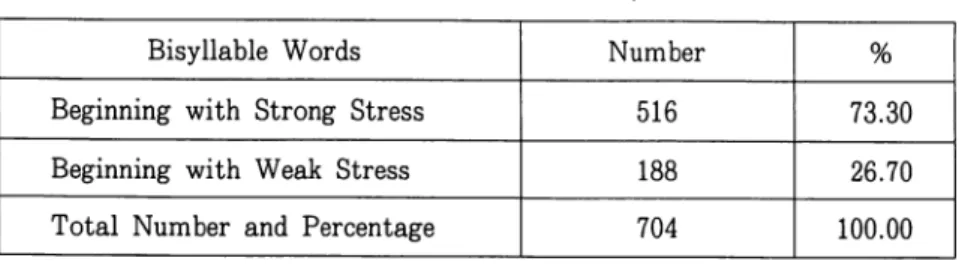
An examination of the standard English textbooks (New Horizon I & II) used in Japanese high schools provided vital information on specific words that our subjects, sophomore college students enrolled in the Junior College Division of the University of Okinawa, have been exposed to. Out of the total number of 2,101 words, 704 English bisyliable words are included in the textbook. An analysis of the vocabulary in the textbook revealed that bisyliable words beginning with strong stress syllables consisted of 516 words (73.30%), including function words. This implies that our subjects have learned approximately three times as many bisyllable words beginning with a strong stress syllable as those beginning with a weak syllable.
Table 1 Number and Rate of Bisyllable Words in the Total of 2,101 Words
Total Number of Words 2,101 # of Bisyllable Words 704 % 33.5
-167-(1998*)
Table 2 Number and Rate of Bisyllable Words by the Stress
Bisyllable Words Beginning with Strong Stress Beginning with Weak Stress Total Number and Percentage
Number 516 188 704 % 73.30 26.70 100.00 1.4. Detectability
We shall attempt to add insight into the array of possible influential factors that affect the identification of words through the examination of research data and analysis collected from experiments on the detectability of mispronunciation of stressed and unstressed syllables along with first and second syllable variables.
The results of an experiment conducted by R.A. Cole and J. Jakimik indicate two main points. First, mispronunciation is detected more often in stressed than in unstressed syllables. Secondly, mispronunciation present in the second syllable of a word is detected faster than mispronunciation in the first syllable of a word. (Cole and Jakimik, p. 967)
In cases of either stressed or unstressed syllables, detection of
mispronunciation was faster in the second syllable of a word. This
occurrence supports the hypothesis that word candidates are accessed from
the sounds which begin a word. According to this perspective, the increased reaction time for mispronounced second syllables occurred because the intended word has been accessed as one of a set of word candidates from information revealed from its (correct) first syllable. In this situation, mispronunciation is detected as a phonetic mismatch between an expected second syllable and its mispronunciation, (p. 968)
Accordingly, a mispronounced first syllable provides misleading information because the listener will access word candidates beginning with
-168-(1998*)
the mispronounced syllable. Moreover, the second syllable will not confirm any of the word candidates suggested by the mispronounced first syllable. The subject will therefore initiate a detection response when the second syllable fails to confirm any of the word candidates inferred by the first syllable, (p. 968)
Considerable research has yielded evidence that suggests that acoustic features are more prominent in stressed syllables (Umeda, 1977), and that listeners detect target phonemes faster in stressed syllables than in unstressed syllables (Shields, McHugh, and Martin, 1974; Cutler and Foss, 1977), and in syllables in which emphatic stress is predicted by the prosodic structure of a sentence, (p. 965)
Mispronunciation is more often detected in stressed syllables, rather than unstressed syllables. The process of detection of a mispronunciation requires the listener to make a decision about the phonetic structure of a
syllable. As mentioned earlier, acoutic features are more prominent in
stressed syllables than in unstressed syllables. (Lisker and Abramson, 1967; Umeda, 1977; Klatt, 1975). (p. 968)
2. Experiment
The subjects were tested in an experiment that attempted to measure
their aural recognition of a selected group of words that consisted of two sets of bisyllable words in context, each of which included 20 words, thus totaling 40. One set consisted of a group of 20 words beginning with a strong stress in the first syllable, and the another set consisted of a group of 20 words beginning with a weak stress in the first syllable. The reading speed of the sentences used in the experiment was at a speed of
197 words per minute. In addition, sentence content had a normal level of
semantic constraints.
Of interest was whether bisyllable words beginning with a strong stress would be easier to recognize than those with a weak stress.
169-2.1. Method 2.1.1. Stimuli
The two sets of bisyllable vocabulary items in Table 3 and Table 2 were selected from a word list in Japanese high school textbooks, New Horizon I and II. Compound words were excluded in this experiment.
Word frequency of each of the bisyllable words used in the experiment is included in Tables 3 and 4. The source of information cited for word frequency included the Computational Analysis of Present-Day American
English (Kucera and Francis, 1967), and the Konpyuta No Mita Gendai
Eigo (Takefuta, Yukio, 1981). Both of these statistical word frequency
lists are considered authoritative guides in their respective fields. Word frequency of all the words tested in the experiment was cited and analyzed from both sources. All of the bisyllable words used in the experiment had a relatively high frequency rating in both statistical word frequency lists. The bisyllable words used in the experiment had a high correlation in both statistical word frequency lists at 0.92 for the group of words in Table 3 and 0.88 for those in Table 4.
The tape of the aural recognition test was recorded by an native speaker of American English. A professional microphone and tape recorder were
used for recording. 2.1.2. Procedure
Listening tests for the bisyllable vocabulary items in Tables 3 and 4 were administered to the subjects who were instructed to fill in the blanks of a sentence with the correct words as they listened. The average number of words was 6.70 for each sentence with normal semantic constraints in Test 1 for which the words in Table 3 were utilized. The average number of words utilized for Test 2 was 5.85 for each sentence with normal semantic constraint.
-170-(1998^)
2.1.3. Subjects
Seventeen sophomores from the Department of English, Junior College Division, University of Okinawa, served as subjects in the experiment. Among the total of 17 subjects that participated in the experiment,
individual English level proficiency was determined by their score on a test given by Nihon Eigo Kentei Kyokai. Nine of the subjects held the third
grade level certification of English proficiency, five of the subjects held
the pre-second grade level certification of English proficiency, and three of
the subjects held the fourth grade level certification of the Standard Test
of English Proficiency (STEP).
3. Results
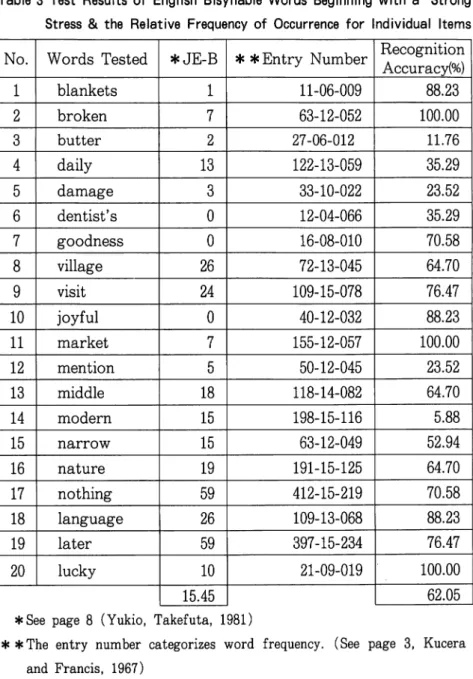
As shown in Table 3, an average of 10.54 subjects or 62.05% out of 17
subjects were able to recognize each vocabulary item in the table, whereas an average of 8.99 subjects or 52.94% of the same number of subjects were able to recognize each vocabulary item in Table 4. The difference is 9.11% between the two figures.
Afterwards a post-listening written examination was conducted on the words marked with boldface in Tables 3 and 4. These words were
recognized only by a limited number of the subjects, 8.50 in average (less than 50% of the 17 subjects); however, it was discovered that the word,
mention, in Table 3 was recognized by only 3 subjects or 18.75% of the 16 subjects who took the written examination, whereas only 3 other subjects recognized the words, amount and promote, 4 or 25.00% of them recognized the word, ignored, and 7 or 43.75% recognized the words, suggests and announced in Table 4. In short, those words were unfamiliar to a large number of the subjects. Therefore, those six vocabulary items marked in both boldface and italics in Tables 3 and 4, were finally deleted from the two tables since one will be less likely to recognize a word that he or she is unfamiliar with.
-(199830
The words, daily, damage, and dentist in Table 3, on the other hand, were recognized by relatively a large number of the subjects: 9 subjects for daily, 12 for damage, and 14 for dentist Therefore, these words would remain on the list. However, the words, butter and modern, were recognized by a very small number of the subjects as shown in the table. This is probably because the subjects have been exposed to the Japanese pronunciation of English loan words which is different. The two vocabulary items were also left in the table. On the other hand, 16 subjects recognized produced, 13 recognized agreed, and 10 recognized
connects in Table 4. Those words were left in the table, too.
-172-(1998*)
Table 3 Test Results of English Bisyllable Words Beginning with a Strong
Stress & the Relative Frequency of Occurrence for Individual Items
No. 1 2 3 4 5 6 7 8 9 10 11 12 13 14 15 16 17 18 19 20 Words Tested blankets broken butter daily damage dentist's goodness village visit joyful market mention middle modern narrow nature nothing language later lucky *JE-B 1 7 2 13 3 0 0 26 24 0 7 5 18 15 15 19 59 26 59 10 15.45 * * Entry Number 11-06-009 63-12-052 27-06-012 122-13-059 33-10-022 12-04-066 16-08-010 72-13-045 109-15-078 40-12-032 155-12-057 50-12-045 118-14-082 198-15-116 63-12-049 191-15-125 412-15-219 109-13-068 397-15-234 21-09-019 Recognition Accuracy(%) 88.23 100.00 11.76 35.29 23.52 35.29 70.58 64.70 76.47 88.23 100.00 23.52 64.70 5.88 52.94 64.70 70.58 88.23 76.47 100.00 62.05 *See page 8 (Yukio, Takefuta,
* * The entry number categorizes and Francis, 1967)
1981)
word frequency. (See page 3, Kucera
-173-(1998^)
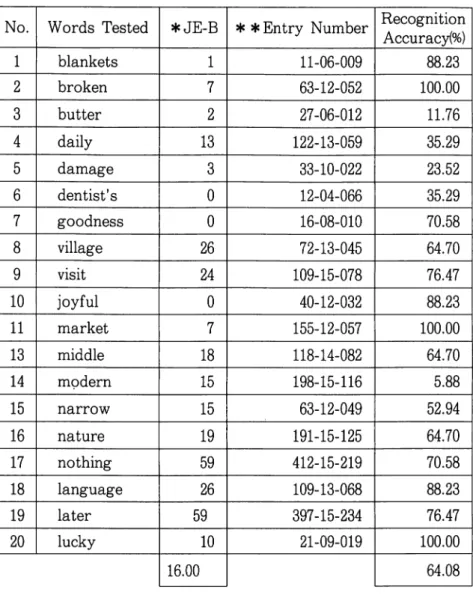
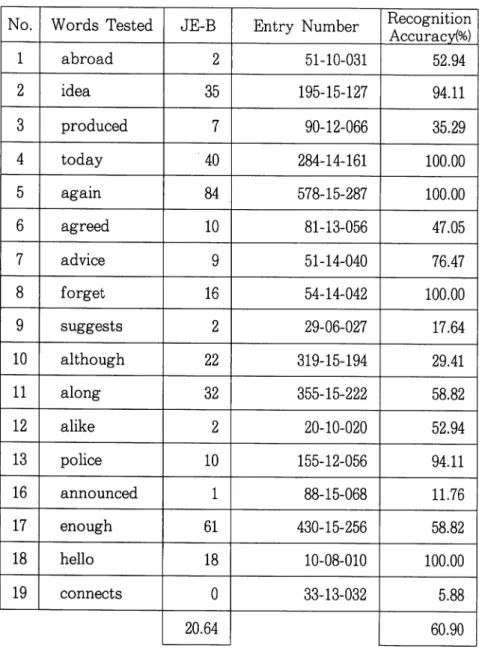
Table 4 Test Results of English Bisyllable Words Beginning with a Strong Stress & the Relative Frequency of Occurrence for Individual Items No. 1 2 3 4 5 6 7 8 9 10 11 12 13 14 15 16 17 18 19 20 Words Tested abroad idea produced today again agreed advice forget suggests although along alike police amount promote announced enough hello connects ignored JE-B 2 35 7 40 84 10 9 16 2 22 32 2 10 10 0 1 61 18 0 0 18.05 Entry Number 51-10-031 195-15-127 90-12-066 284-14-161 578-15-287 81-13-056 51-14-040 54-14-042 29-06-027 319-15-194 355-15-222 20-10-020 155-12-056 172-15-099 32-08-023 88-15-068 430-15-256 10-08-010 33-13-032 29-13-028 Recognition Accuracy(%) 52.94 94.11 35.29 100.00 100.00 47.05 76.47 100.00 17.64 29.41 58.82 52.94 94.11 11.76 0.00 11.76 58.82 100.00 5.88 11.76 52.94 In comparison of the two revised tables, the average number of subjects correctly identifying the bisyllable words in Table 5 revised from Table 3 was 10.89 subjects in average or 64.08% out of 17, whereas that for Table 6 revised from Table 4 was 11.40 subjects in average or 67.06%. The difference is only 0.51 subjects in average or 2.98% between the two
174-figures.
Table 5 Revised List of the English Bisyllable Words Beginning with a
Strong Stress No. 1 2 3 4 5 6 7 8 9 10 11 13 14 15 16 17 18 19 20 Words Tested blankets broken butter daily-damage dentist's goodness village visit joyful market middle modern narrow nature nothing language later lucky *JE-B 1 7 2 13 3 0 0 26 24 0 7 18 15 15 19 59 26 59 10 16.00 * * Entry Number 11-06-009 63-12-052 27-06-012 122-13-059 33-10-022 12-04-066 16-08-010 72-13-045 109-15-078 40-12-032 155-12-057 118-14-082 198-15-116 63-12-049 191-15-125 412-15-219 109-13-068 397-15-234 21-09-019 Recognition Accuracy(%) 88.23 100.00 11.76 35.29 23.52 35.29 70.58 64.70 76.47 88.23 100.00 64.70 5.88 52.94 64.70 70.58 88.23 76.47 100.00 64.08
-175-(1998*0
Table 6 Revised List of English Bisyllable Words Beginning with a Strong
2nd Syllable No. 1 2 3 4 5 6 7 8 9 10 11 12 13 16 17 18 19 Words Tested abroad idea
produced
today again agreed advice forget suggests although along alike police announced enough hello connects JE-B 2 35 7 40 84 10 9 16 2 22 32 2 10 1 61 18 0 20.64 Entry Number 51-10-031 195-15-127 90-12-066 284-14-161 578-15-287 81-13-056 51-14-040 54-14-042 29-06-027 319-15-194 355-15-222 20-10-020 155-12-056 88-15-068 430-15-256 10-08-010 33-13-032 Recognition Accuracy(%) 52.94 94.11 35.29 100.00 100.00 47.05 76.47 100.00 17.64 29.41 58.82 52.94 94.11 11.76 58.82 100.00 5.88 60.90-176-The same tendency was observed between the results of the other two
sets of bisyliable vocabulary items (0.20 points for vocabulary items
beginning with a strong stress and 0.46 points for those beginning with a
weak stress). This particular test was conducted for another experiment,
however. 4. Discussion
Our assumption was that bisyllable words beginning with a strong stress
should be easier for the low-intermediate Japanese listeners to understand than those beginning with a weak stress.
As shown in Tables 5 and 6, however, no significant difference was observed between the results of the tests for both types of bisyllable
vocabulary item.
Accordingly, we have been tempted to believe that our assumption was
not supported by the present experiment.
Nevertheless, it was discovered that there was only a slight correlation between the relative frequency of occurrence of the vocabulary items and the recognition rate for the two sets of vocabulary items in Table 3, whereas a moderate correlation of the relative frequency of occurrence of the vocabulary items and the recognition rate for the two sets of
vocabulary items in Table 4 was observed.
The coefficient of correlation was approximately 0.20 for Table 3 and 0.57 for Table 4. This tendency was also observed in the results of other tests, in the coefficient of correlation of Table 5 at 0.20 and that of Table
6 at 0.46.
Incidentally, the average relative frequency of occurrence of the vocabulary items was 15 for Table 3 and 18 for Table 4. That of the vocabulary items for the results of other tests was 13 and 14 respectively. As far as the relative frequency of occurrence was concerned, there was no significant difference between the types of bisyllable words utilized in the
-177-experiment, the first syllable beginning with a strong stress and the first
syllable beginning with a weak stress in Tables 3 and 4.
We will try to analyze below the difference in the coefficient of correlation revealed in the experiment.
Researchers have argued that the aural retrieval of words is considerably more effective in the initial portion of the word including a syllable as
opposed to the final portion of the word. The advantage of word retrieval in lexical items exist due to factors such as: (1) in the initial portion of a word, more relevant information exists, (2) there is a smaller selection of compatible words in the initial fragment in comparison to the final fragment, (3) the word-initial consonants are substantially longer than the consonants in the word-medial and word-final positions of equivalent proportion, (4) assimilation and coarticulation rules have a greater effect on the final phonemes than the word initial phonemes, and (5) the activation level of the initial fragment is higher than that of the final fragment. (Nakamura, Jinsei, p. 22)
However, the advantage of word retrieval discussed above would be lost
without a clear perception of the first syllable which the strong stress
affects. In other word, the strong stress placed on the first syllable in the
bisyllable vocabulary item would increase perceptibility of the first syllable with which the factors listed above would function in its fullness, stimulating faster and easier retrieval of bisyllable vocabulary items
questioned. In this case, less information would be necessary and a relative
frequency of occurrence might not be employed in the identification of the
word.
On the other hand, the first syllable beginning with a weak stress in the bisyllable vocabulary items is less perceptible and the subjects might try to rely on the second syllable beginning with a strong stress in the bisyllable vocabulary items for the recognition of the word. In this case,
178-(199830
however, we assume that the subjects might have relied on some other cues such as a relative frequency of occurrence of each vocabulary item which might have been effective as one of implements for the retrieval of the bisyllable vocabulary items under such relatively difficult conditions.
In conclusion, the relative frequency of occurrence of the words affected the identification of the words beginning with a weak syllable. Vocabulary items displaying this characteristic may have required more information in the identification of the words, such as a relative frequency of occurrence of the words, which has been argued to be less effective in the recognition of words in context, as opposed to those in isolation.
It seems that such deference existing in the two types of bisyllable vocabulary items might affect the coefficient of correlation.
As a consequence, our assumption was supported by the present experiment. In addition, it was fruitful to have been able to make a hypothetical assumption in the process of identification of the two types of bisyllable vocabulary items. More studies are needed to verify our tentative assumption.
References
Cole, Ronald A. and Jakimik, Jola. (1979). How are syllables used to recognize words? Journal of Acoustic Society of America 67(3):965-970. Cole, Ronald A., Jakimik, Jola and Cooper, William E.. (1987).
Receptibility of phonetic features in fluent speech. Journal of Acoustic
Society of America 64. (1): 44-56.
Cutler, Anne and Norris, Dennis. (1988). The Role of Strong Syllables in
Segmentation for Lexical Access. Journal of Experimental Psychology: Human perception and Performance 14. No.l: 113- 121.
Cuter, Anne, Norris, Dennis, and Williams, John N.. (1987). A Note on
the Role of Phonological Expectations in Speech Segmentation. Journal of Memory and Language 26: 480-487.
-179-(1998*0
Kucera, Henry and Francis, W. Nelson. (1967). Computational Analysis of
Present-Day American English. Providence, Rhode Island: Brown University Press.
Nakamura, Jinsei (1994) The Complex Interactive Process of the Initial
Fragment in Aural Word Retrieval. Tandai Ronso 8. No.l: 15- 23.
Taft, Marcus and Forster, Kenneth I. (1976) Lexical Storage and Retrieval of Polymorphemic and Polysyllabic Words. Journal of Verbal Learning and Verbal Behavior 15: 607-620.
Takefuta, Yukio. (1981). Konpyuta No Mita Gendai Eigo. Tokyo: Eduka Treiman, Rebecca. (1986). The Division between Onsets and Rimes in
English Syllables. Journal of Memory and Language. 25:476- 491. Treiman, Rebecca. (1988). Distributional constraints and syllable structure
in English. Journal of Phonetics 16: 221-229.
Van den Berg, R.J.H. and Slis, I.H. (1987). Phonetic context effects in the perception of voicing in C1C2 sequences. Journal of Phonetics 15:39-46.