
近畿大学学術情報リポジトリ
8
0
0
全文
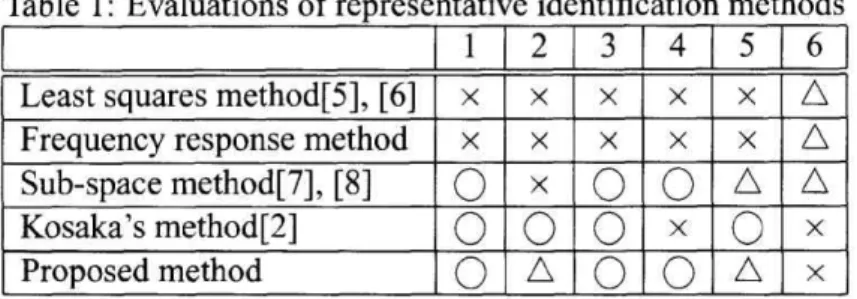
(2) Table 1: Evaluations. of representative. identification. 1. 3. 4. 5. x. x. x. x. 0. Frequency. x. x. x. x. x. 0. 0 0 0. x. 0 0 0. 0. A. A. x. 0. x. 0. A. x. response. method. method. sampling period required in using an M series signal. A conventional least squares method employing a step response restricts the order of an identified model [5]. In the case of servo system, it is desirable that the modelling error is small in low frequency range [4], but least squares methods have a tendency to reduce the error in high frequency range [6]. Sub-space based methods [7, 8] need to obtain a sufficiently large size of, for example, Hankel matrix before deriving its reduced order model, and also use a least squares method in obtaining some system parameters. The method [2] zeroing the 0 N-tuple integral values of output error of single-input singleoutput model has the properties 1, 2, 3, 5 but derives transfer function model.. In this paper, we propose a deterministic off-line identification method [1] that obtains a state-space model by using input and output data with steady state values. The method is composed of the methoc [2] zeroing the 0 N-tuple integral values of outpul error of single-input single-output transfer function model and Ho-Kalman's method [3]. The methoc has an assumptionthat plant system matrix A satisfies ~A < 1 because the method utilizes the Taylor series We prove that the method. car. 0 A. 2.1. Plant. feature. emphasized. is that the derived in low frequency. The paper. is organized. state-space. x (t) = Ax (t) + Bu (t) y (t) = C (t) + Du (t). as follows.. are made. for a plant,. tion method. is stated.. In section. the identified. model. tiveness. are stated.. are illustrated. of the proposed. (1). where t is time and x(t) E RnA, y(t) E RnYand u(t) E Rnu are the state, input and output vector, respectively. 2.2. Assumptions. We make the following assumptions. Al: det (A) A2:. for the system:. 0. C and A satisfy. where det (A) denotes the determinant of A and ay is the integer that satisfies nA+1<a. y<nA+2. ny. (3). model. is. In section. 2. 2.3. oi. The number of acquired input and output data with steady state is nu where those data are denoted as. ny—. range.. assumptions. ical simulations. to be identified. The plant to be identified is represented by the following linear continuous-time nu-input nu-output state-space system:. be applied to plants without the assumption 1A1< 1 The. 6. x. Proposed. of the plant.. 2. Least squares method[5], [6] Sub-space method[7], [8] Kosaka's method[2]. expansion. methods. Identification. algorithm. and the identifica3, the properties. In section. 4, numer-. to indicate. the effec-. method.. ui (t) and yi(t) (i = 1, 2, • • • , nu), respectively, and ui (t)'s satisfy det qui (00) u2 (oo) ... unu (oo)]). 0- (4). From input and output data, U(t) and po(t) are defined as. 2. Identification. algorithm. In this section, assumptions are made for a plant, ant the identification algorithm [1] is stated..
(3) The integer an and np are defined so as to satisfy n<au. < n. nunu. np=. ay+au—. 2.4. + 1 ,(7). Another. identification. algorithm. Another algorithm to identify A by using C0 instead of 0 is stated here.. 1(8). A2' is assumed instead of A2.. where n means the order of the system matrix A in the model. po is derived as. Po = Po(x) •(9). A2':A and B satisfies. pi's (i = 1, 2, • • • , np) are derived as the following equations: _4. where. au is the integer. n. that satisfies. dn. A. Instead of (3), (20), (21) and (22), we respectively use. By using the singular value decomposition, H is decomposed as H. =. By using through. UEVT(17). this algorithm,. the same results. the same procedure. are derived. as the next section.. where E is the diagonal matrix of which elements are. the singular values of H. (ayny x n) matrix 0 and (n x aunu) matrix Co are defined as 3. Properties. In this section,. ,,. of the model. it is shown that the model. corresponds. where MATLABnotation[8] is used. According to with the plant if n = nA without assumption IAl< 1. this notation, A(ai : a2, b1 : b2) means the matrix of As U(t) has steady state from (4) and (5), by uswhich elements the b1. are those in the a1 N a2 columns. and. The estimated system parameter (A, B, C, D) is obtained. ing the final value theorem,. it follows. that. b2 rows in A. by the following. calculations:. det(lirn U(t)) = t—oc. det. limsU( s—o. s)). 0 (32). where s is a complexvariableand x(s) means the Laplacetransformationof x(t). Therefore,using a matrix Ua(s) (det (U,(0)) 0) of whichelements arerationalfunctionsof s, U(s) can be expressedas. where t denotes pseudo inverse matrix..
(4) From (5), (32) and (33), we obtain. where. 6 denotes. yielded. as m.. -. 1. ,.,. 1,_.,1. if). \J. By using the final-value —. a differential. theorem,. we obtain. • • 1 /nl. and then pi+i is yield ed as. P1 is obtained. in the same way as. =. m,(. _. —CA `B.. )(111. •••)(34). Assume that pi(t) (i > 1) satisfies. operator.. pi+i(t) is.
(5) From (25), (35), (47), (48) and (49), we obtain. 0). vliL.,•. Therefore, (37) and (38) follow in ductively. stituting (38) for (16), we get. By sub-. u—. From the above, the model corresponds with the plant. Next we consider that the mothod emphasizes low frequencies. By using the Taylor series expansion around s = 0, the plant (1) is expressed as. If n = nA, from (3), (7), (8), (17), (18), (19), Al , A2 and [3], it follows that. The coefficientsin (51) are derived from low to high order (0 np) in turn, from which A, B, C and D are obtained.. That is, the coefficeients. higher. than n,. are ignored. This leads to emphasize low frequencies because low order coefficients represent the characteristics. in low frequency. range.. From (20), (21) and (43), we get Od =. O„,A-'.. (45). From (45), the pseudo inverse matrix Odt is defined ae. From. Al. 4. Numerical. simulations. In this section, the proposed method is applied to identify 2-input and 2-output system by using step responses of the system. The model is compared with conventional sub-space method [8].. , A2, (22) and (46), we derive 4.1. System. and. simulation. setting. The plant to be identified is as follows:. From Al. , (7), (23), (44) and (47), we obtain. The order of this system nA = 5 and max jAf > 1. ;48). The simulator. is set up as follows:. Sampling. From (3), (24), (43) and (47), we derive. time: 0.01. Data length Input. 49) —31—. signal. step signal. :. 60[s] for. identification. : the. following.
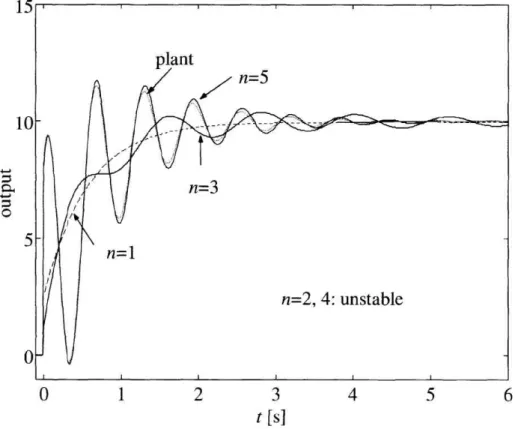
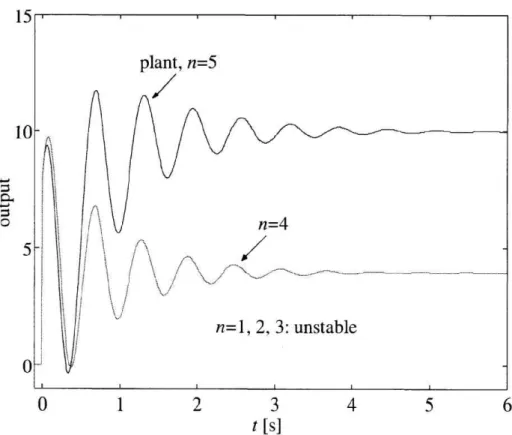
(6) ul (t) _ 212(t) =. (s (t) 0)T (0 s (t) )T. (53). is used. for identification.. The step response. of this. (1 x 1) element of the model is shown in Fig. 2. From Fig. 2, the model. is not good even if n = nA. When. where s(t) is a step function. M series input is used, the models become stable with In the case of the sub-spacemethod, both step sig- Ti= 4, 5. The step responses of these (1 x 1) element nal (54) and M series signal (55) are used for identi- of the models are shown in Fig. 3. From Fig. 3, the fication sub-space method does not emphasize low frequen-. u (t) _(s. (0 (t) 0)T,0 < t <60[s](54) s (t))T, 60 < t < 120[s] u (t) = (ml (t) m2(t))T , 0 < t < 120[455). cies.. wherem(t) is a M series functionwith amplitude1 5. Conclusion. and the minimumperiod 11 samples. The assumption. 4.2. Results. The plant is identified for each n(= 1, 2, • - • , 5). The model stable. identified with. n =. by the proposed 1, 3, 5.. The. method. becomes. step responses. of the. (1 x 1) elements of these models are shown in Fig. 1. From Fig. 1, the proposed method emphasizes low frequencies. In the case of the sub-space method, the model becomes stable only with n = 5 when step input. Figure. 1:. as plant. system. matrix. A satisfies. ~A < 1 of the deterministic off-line state-space model identification method [1] has been taken off. The method can obtain the model from input and output data with constant steady state. It has been verified by numerical simulations that the proposed method emphasizes low frequencies. This method is suitable to identify mechanical systems without genarating noise or vibration because the method can identify MIMO system by using step responce.. Step responses (proposed meth.).
(7) t [sJ Figure. 2:. Step responses (sub-space meth. with step input). 15. Figure. 3:. Step responses (sub-space meth. with M series input).
(8) References [1] M. Kosaka, H. Uda, E. Bamba and H. Shibata: State-spacemodel identificationusing input and output data with steady state values, Proc. of 6th InternationalConference on MechatronicsTechnology(ICMT 2002), pp. 150/155(2002) [2] M. Kosaka, K. Koizumi and H. Shibata: An identification method for a reduced model with zeroing 0 N N-tuple integral values of output error, T. SICE, 36-4, pp. 319/327 (2000) [3] H. P.Zeiger and A. J. McEwen: Approximate linear realization of given dimension via Ho's algorithm, IEEE trans. on Automatic Control, AC-19-2, p. 153, (1974) [4] Z. Zang, R. R. Bitmead and M. Gevers: Iterative weighted least-squares identificationand weighted LQG control design,Automatica, 31-11, pp. 1577/1594,(1995) [5] T. Soderstrom and P. Stoica: System Identification,Prentice-Hall, (1989) [6] B. Wahlberg and L. Ljung: Design variables for bias distribution in transfer function estimation, IEEE trans. on Automatic Control, 31-2, pp. 134/144, (1986) [7] P. Van Overschee and B. De Moor: Subspace identification for linear systems, Kluwer Academic, (1996) [8] L. Ljung: System IdentificationToolbox, The MathWorks, Inc., (1997).
(9)
図
関連したドキュメント
Taking a partially penetrating vertical well as a uniform line sink in three-dimensional space, by developing necessary mathematical analysis, this paper presents steady
Then, we prove the model admits periodic traveling wave solutions connect- ing this periodic steady state to the uniform steady state u = 1 by applying center manifold reduction and
In Figure 6.2, we show the same state and observation process realisation, but in this case, the estimated filter probabilities have been computed using the robust recursion at
Condition (1.2) and especially the monotonicity property of K suggest that both the above steady-state problems are equivalent with respect to the existence and to the multiplicity
Using a step-like approximation of the initial profile and a fragmentation principle for the scattering data, we obtain an explicit procedure for computing the bound state data..
[Mag3] , Painlev´ e-type differential equations for the recurrence coefficients of semi- classical orthogonal polynomials, J. Zaslavsky , Asymptotic expansions of ratios of
As an alternative, here we consider a fluid queue in which the input is characterized by a BDP with alternating positive and negative flow rates on a finite state space.. Also, the
Interestingly, in preliminary experiment with the embedded deterministic model, it was observed that if the values of the matrix
