Laboring to Learn: Cross-Cultural Adjustment
of Foreign Hospitality Workers in Australia
著者(英)
Kate Inyoung Yoo
journal or
publication title
Journal of Inquiry and Research
volume
113
page range
231-244
year
2021-03
Labouring to learn:
Cross-cultural adjustment of foreign hospitality workers in Australia
YOO, Kate Inyoung
Abstract
The issue of labor shortage has become a significant challenge, especially for the hospitality sector, which heavily relies on human interaction to satisfy its customers in Australia. Recruitment of foreign workforces has become a solution to fill the labor shortage in the industry. Nevertheless, hospitality work experience and its impact on the workers’ cross-cultural adjustment has not been discussed enough. Therefore, this research attempt to examine perceived employment experience and cross-cultural adjustment of foreign hospitality workers. The findings revealed that employment experience could influence on the general living adjustment of foreign workers. Meanwhile, strong job attachment can improve the workers’ workplace adjustment. The findings of this research add values to human resource management and practices to care for foreign workers in the hospitality sector so that it improves overall employment experience and adjustment in the new culture.
Keywords: Foreign workers, hospitality work experience, cross-cultural adjustment, Australia
Introduction
In Australia, under the temporary migration scheme, the government introduced a skilled migration scheme in response to the recent economic challenges in the country. The focus is on ‘demand-driven’ migration, such as employer and government-sponsored (state, territory, and regional nomination) skilled migration, which enables the programme to better target the skills needed for the economy, especially within the industries that have the highest labour demand. While there are discussions on supplying needed labour forces for businesses, concerns about foreign workers’ well-being has not been discussed in detail. Unlike host nationals, many foreign workers are unable to enjoy the benefits of supportive trade union representation due to different employment arrangements and circumstances (Baum, 2012). Hence, the majority remain in low-paid jobs after several years of employment
| 232 |
compared with host nationals (International Labor Organization, 2010). This may lead to disadvantageous employment experience and further lead to negative job satisfaction and work performance. In fact, migrant workers’ turnover rates were found to be 20% higher than those of local-born workers in Australia (Shah, 2009).
This research examines foreign workers’ cross-cultural adjustment (CCA) via employment experience in Australia. This study focuses on foreign workers in the hospitality sector, in which there is a great demand for foreign workforces to offset labour shortages. This research first examines CCA in terms of specific work adjustment and general living adjustment to determine how well foreign workers are adjusted to the host culture. This research also investigates hospitality work experience by considering individuals’ perceived nature of such work, work attachment, work benefit, workplace socialisation, and interactions with home nationals to comprehend whether perceived employment experience has an association with cultural adjustment.
Defining Cross-Cultural Adjustment
Experiencing a new culture and learning unfamiliar social norms are always tricky and often associated with social and psychological distress. Meanwhile, it is widely acknowledged that the process of adjustment to a new culture by learning and adopting appropriate behaviours mediates these stresses. Many researchers have attempted to explore various aspects of CCA. Adjustment is defined as ‘the degree of a person’s psychological comfort with various aspects of a new setting’ (Black & Gregersen, 1991, p. 498). According to Black and Gregersen (1991), the theoretical framework for CCA stems primarily from a culture shock (Oberg, 1960, based on Lysgaard, 1955). ‘Culture shock’ explains that when individuals enter a foreign country, they experience cultural differences such as understanding appropriate behaviours, which may be acceptable within their culture but not in a foreign culture. Consequently, this creates a feeling of negative emotional state in individuals, such as anxiety and frustration due to the uncertain experience.
A comprehensive understanding of the ‘culture shock’ process can be illustrated using ‘U-curve adjustment theory’, which explains individuals’ cultural adjustment via four different phases: Honeymoon stage, culture shock stage, adjustment stage, and mastery
(Lysgaard, 1955). According to the theory, in the first stage, individuals tend to experience an excitement phase with the experience of a new culture. However, culture shock stage is activated when the reality of the new culture occurs, which can be overcome through gradual adoption and learning how to behave appropriately in the new culture. Each stage develops according to the duration of exposure to a new culture. Bandura and Walters’ (1977) social learning theory (SLT) explains cultural adjustment through direct experience or observing others’ behaviours (Bandura, 1971). Bandura and Walters (1997) argue that individuals learn appropriate behaviour through repeated reinforcement processes, while individuals’ cognitive skills can enable them to profit extensively from experience (Bandura, 1971).
On the other hand, Searle and Ward (1990) highlight the distinction between the cultural adjustment process within psychological (emotional/affective) and sociocultural (behavioural) adjustment aspects. The culture shock concept suggests that intensified uncertainties and unfamiliarity experienced during cross-cultural transitions enhance individuals’ social difficulties, which may further affect their psychological well-being. From this perspective, CCA was considered in the relationship with individuals’ acculturation processes through an understanding of their feelings and social abilities. Even though psychological and sociocultural adjustment are interrelated, they are conceptually and empirically distinct (Ward & Kennedy, 1999). Therefore, previous empirical research highlights that these two can be anticipated separately by distinct antecedent factors. For instance, factors related to emotional changes such as individuals perceived cultural distance and personality can predict their psychological adjustment. In contrast, other factors such as culture learning and social skills can predict individuals’ sociocultural adjustment in a host nation (Ward & Searle, 1991).
Cross-Cultural Adjustment of Foreign Workers
The CCA model developed by Black (1988) considers foreign workers’ degree of psychological comfort and familiarity in a new cultural environment. The model comprises three individual factors: (i) work adjustment, (ii) interaction adjustment (with host nationals), and (iii) general adjustment (general living environment) (Black, 1988; Black & Stephens, 1989; Black & Mendenhall, 1991). The ‘Work Adjustment’ factor refers to the degree of comfort concerning job and performance expectations while ‘Interaction Adjustment’
| 234 |
refers to that associated with interaction and socialising with host nationals at/outside work. ‘General Adjustment’ refers to the comfort associated with living in a foreign environment by considering conditions of living, housing, food, shopping, and others. Since CCA is a multifaceted conceptual model, individuals or environmental factors may have different influences on the degree of cultural adjustment (Black, 1988). For instance, work-related factors tend to have strong relationships with the degree of an individual’s work adjustment rather than with non-work adjustment.
Previously, the CCA model was adopted to investigate the cross-cultural adjustment of organisational and self-initiated expatriates. Peltokorpi and Fabian (2009) attempted comparative research between these expatriates to examine potential differences in their CCA. Their findings revealed that these two groups indicated slightly different outcomes. For instance, self-initiated expatriates tend to show better engagement with host nationals, which results in better cultural adjustment than organisational expatriates. This research finding was well supported by similar research conducted in various studies (Inkson et al., 1997; Suutari and Brewster, 2000). Froese et al. (2012) tested the CCA of 125 English language teachers working in various establishments, including a private language institute in Seoul. Similarly, Cao et al. (2013) examined the CCA model for 132 self-initiated expatriates in Germany without limiting their jobs or employment contract types. Previous research findings have thus proved that the application of the CCA model with various types of foreign workers can be supported, but different outcomes can be expected. Various outcomes would be caused depending on individual foreign workers’ different levels of cultural experiences or circumstances. Hence, CCA aims to test a foreign worker’s degree of psychological comfort and familiarity in a new cultural environment, via work and non-work experience in a foreign cultural environment (Black, 1988). The current research examines the CCA of temporary migrants who are currently working in the hospitality industry in Australia.
Working in the Hospitality Industry for Foreign Workers
In general, hospitality jobs are known as demanding and stressful, which creates negative job factors. Previous research argues that the nature of occupations could lead to workers’ emotional exhaustion (Hochschild, 1979). Occupations that require frequent and
intensive interactions with people, such as hospitality work, are more likely to cause higher levels of emotional strain. There are a few stress factors that hospitality workers experience in their daily work tasks. Emotional work is the major cause of workers’ burnout, low commitment, demotivation, and leaving intention. Since the major job tasks of the workforce involve conducting interactions with customers, which are directly related to customers’ service transactions, workers are asked to manage their emotions by being positive towards the receivers regardless of their true feelings. Hochschild (1979) categorised types of work that often involve managing an individual’s emotions during the work process under the policies of organisations as emotional labour. The workers involved in heavy emotional duties are the so-called emotional labourers, such as hospitality workers (Hochschild, 1979; Kinman, 2009).
A significant number of research studies have addressed the unfavourable consequences of emotional labour (O’Neill et al., 2010; Heuven & Bakker, 2003; Kim, 2008), which may influence work life and that outside of work. Thus, emotional dissonance is a major cause of burnout among hospitality workers. For instance, flight service attendants are expected to be cheerful and friendly to the public (Ashforth & Humphrey, 1993), although they may not have such a cheerful day. When workers perceive that emotional exhaustion is enhanced, the gap between felt and expressed emotion is significant (Kim, 2008). Unfortunately, many emotional labourers tend to hide their true emotions while dealing with customers to make the customers feel satisfied; consequently, it causes emotional exhaustion. However, some workers with strong intrinsic motivations tend to manage these emotional work stressors better than others. According to Herzberg (1966), workers’ growth needs (intrinsic motivation) can improve job satisfaction and enhance work motivation even though work is demanding and stressful. Moreover, support from organisations can moderate the negative aspects of emotional stress, and can further increase intrinsic motivation (Sparrowe, 1994; Babakus et al., 2008; Chiang et al., 2014).
Although hospitality jobs are highly demanding, foreign workers perceive such jobs as an opportunity rather than a challenge. Many roles in the hospitality sector offer lower entry-level positions with a chance to engage with host nationals than other sectors such as the manufacturing and agriculture sectors. The major motivation for foreign workers to take up hospitality jobs is a self-development opportunity through employment experience (Janta
| 236 |
et al., 2011). Janta et al. (2011) argue that foreign workers have a better chance of improving their language skills while interacting with co-workers, co-nationals, and customers, which in turn has a positive effect on their cultural adjustment in the host nation (Froese et al., 2012). Moreover, foreign workers’ CCA happens not only via active experimentation but also via collective experiences that are mediated by others through social interactions in the workplace (Janta et al., 2012).
According to Ward and Searle (1991), individuals’ culture shock stage during cultural transitions could be mediated by frequent socialisation and interactions with people. Although previous research highlighted that socialisation with host nationals at work has a strong association with outside work adjustment, it could also have a positive association with workplace adjustment (Ross, 1994; Bauer et al., 2007; Morrison, 2002). Aryee and Stone (1996) suggested that workplace social support has a positive association with foreign workers’ workplace adjustment. Therefore, the current study proposes the following model.
Figure 1. Proposed Model
Research Methodology
The primary research objective is to examine the association between foreign
6
social interactions in the workplace (Janta et al., 2012).
According to Ward and Searle (1991), individuals' culture shock stage during
cultural transitions could be mediated by frequent socialization and interactions with
people. Although previous research highlighted that socialization at work with host
nationals has a strong association with outside work adjustment, socialization could also
have positive association with workplace adjustment (Ross, 1994; Bauer et al., 2007;
Morrison, 2002). Aryee and Stone (1996) mentioned that workplace social support has a
positive association with foreign workers' workplace adjustment. Therefore, this research
proposes a model below.
Figure 1. Proposed Model
Nature of work
Work attachment
Workplace socialization Work benefit
Interactions with home nationals Non-work Adjustment Work Adjustment + + + + + + + + -Employment Experience Cross-cultural Adjustment
hospitality workers’ perceived employment experiences and their CCA in Australia. A set of research variables is established to test the proposed model. Foreign workers’ employment experiences in the hospitality industry are conceptualised as the following independent variables: ‘nature of work’, ‘work attachment’, ‘work benefit’, ‘workplace socialisation’, and ‘interaction with home nationals’. A total of two factors from the concept of CCA are used
as dependent variables: ‘non-work adjustment’ and ‘work adjustment’.
A quantitative research design is chosen as a suitable method because it is adequate when attempting to explain or predict a social phenomenon in relation to the causes of variation in explanatory variables (Neuman, 2014). It also favours gathering a large sample, which in turn allows the generalisation of the research outcomes (Neuman, 2014). As the quantitative research method is theory-laden or hypothesis-driven and relies on statistical techniques from collected numerical data, it is also useful when formulating general laws. Therefore, it is believed that the chosen research method would be able to explain the impact of the chosen variables based on the theoretical understanding derived from the literature review.
The quantitative data collection was completed using a survey questionnaire with a series of closed- and open-ended questions administered to two groups of respondents, tested using seven-point Likert scale questions. Survey research is useful, especially when data collection is required for the numeric description of trends, attitudes, or opinions of the population of interest (Edmonds & Kennedy, 2013).
Most questions for the demographic and employment experience sections were created using closed-ended items, which allowed the researcher to manage the participants’ responses or data (Privitera, 2017). The major benefit of such questions is that the collected responses can be easily entered or coded for statistical analysis (Privitera, 2017). However, they tend to restrict the respondents’ answers (Privitera, 2017); thus, this research added a category ‘other’, which allows participants to respond in their own words in case the provided choices do not fit with their circumstances. The research measurement was adapted from Black (1988) and Richardson (2010).
| 238 |
Research Findings
A total of 205 foreign workers aged between 18 and 45 who are currently employed in hotels in Darwin, Australia, participated in this research (Table 1). They were originally from the South Asia region (39.30%), which included India (21.97%), Sri Lanka (15.03%), Pakistan (1.16%), and Bangladesh (0.58%). The primary purposes of working in the hotel sector were career development (44.50%), experience (25.36%), financial support (24.88%), and visa (5.26%). The majority of the participants were working in the Food and Beverage department (43.81%), followed by House Keeping (20.62%), Front Office (13.92%), Kitchen (13.92%), and Conference & Events (7.73%).
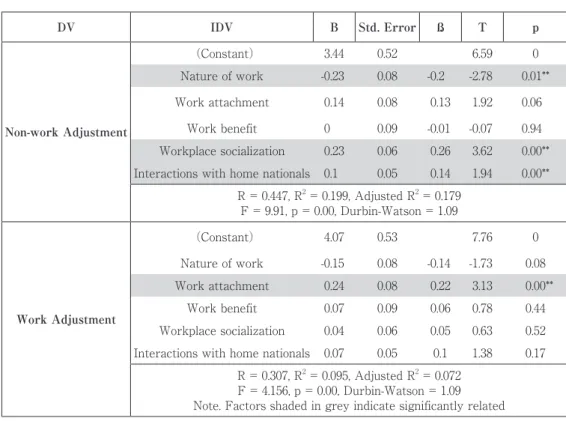
The findings reveal that ‘non-work adjustment’ is explained by 17.9% of the total variance in employment experience (R2 = 0.199, F (5, 199) = 9.91, p = 0.00). The most significant
association factors were with ‘nature of work’ (p = 0.01), ‘workplace socialisation’ (p = 0.00), and ‘interactions with home nationals’ (p = 0.00). Among these factors, ‘workplace socialisation’ (β = 0.26) had by far the greatest positive association with the ‘non-work adjustment’ factor followed by ‘interactions with home nationals’ (β= 0.14). In contrast, the ‘nature of work’ (β =-0.2) showed a significantly negative association with ‘non-work adjustment’ (see Table 2). However, other employment experience factors such as ‘work attachment’ and ‘work benefit’ had little associations with ‘non-work adjustment’; thus, these did not explain any correlations with general adjustment. Meanwhile, ‘work adjustment’ shows 9% of the total variance in employment experience (R2 = 0.09, F (5, 199)
= 4.156, p = 0.00). Only the ‘work attachment’ factor showed a significant and positive association with ‘work adjustment’ (p = 0.00) (Table 2).
Table 1. Demographic Profile of the Participants Gender N % Female 98 47.8% Male 107 52.2% Visa status N % International student 63 30.7% Working holiday 15 7.3% Expatriate 2 1.0% Skilled migrant 60 29.3% Permanent migrant 65 31.7% Age N % 18–25 35 17.1% 26–30 90 43.9% 31–35 58 28.3% 36–40 15 7.3% 40 and above 7 3.4% Education N % Secondary/High school 15 7.3% Diploma/College 73 35.6% Bachelor’s degree 100 48.8% Master’s or PhD. 17 8.3%
English language level N %
Poor 0 0% Below average 1 0.5% Average 29 14.1% Above average 72 35.1% Excellent 93 45.9% Native speaker 10 4.9%
| 240 |
Table 2 Multiple Regression Test: Employment Experience on CCA
Discussion and Conclusion
Most foreign workers in Australia tend to migrate with limited cross-cultural knowledge and receive limited support in settling in a new environment. Meanwhile, these workers are often exposed to gruelling work demands to survive. The hospitality industry is a labour-intensive sector, which requires cheap foreign workforces to maintain its businesses. Therefore, the industry offers easy entry positions to prospective workers, and it becomes an opportunity for low-skilled short-term migrants. However, despite the growing number of foreign workers in the sector, employers ignore the new phase of landscape change and need procedure for them. Therefore, more attention should be paid to this vulnerable group in society to help their assimilation process to a new culture as well as to a new work environment.
Previous research highlighted that the better foreign workers adapt to work adjustment regarding CCA, the more satisfied they are with their job (Aryee & Stone, 1996).
DV IDV B Std. Error ß T p Non-work Adjustment (Constant) 3.44 0.52 6.59 0 Nature of work -0.23 0.08 -0.2 -2.78 0.01** Work attachment 0.14 0.08 0.13 1.92 0.06** Work benefit 0 0.09 -0.01 -0.07 0.94** Workplace socialization 0.23 0.06 0.26 3.62 0.00** Interactions with home nationals 0.1 0.05 0.14 1.94 0.00**
R = 0.447, R2 = 0.199, Adjusted R2 = 0.179 F = 9.91, p = 0.00, Durbin-Watson = 1.09 Work Adjustment (Constant) 4.07 0.53 7.76 0 Nature of work -0.15 0.08 -0.14 -1.73 0.08 Work attachment 0.24 0.08 0.22 3.13 **0.00** Work benefit 0.07 0.09 0.06 0.78 0.44 Workplace socialization 0.04 0.06 0.05 0.63 0.52 Interactions with home nationals 0.07 0.05 0.1 1.38 0.17
R = 0.307, R2 = 0.095, Adjusted R2 = 0.072 F = 4.156, p = 0.00, Durbin-Watson = 1.09 Note. Factors shaded in grey indicate significantly related
Unfortunately, this research finding indicates that the nature of work in the hospitality industry interrupts workers’ general cultural adjustment. This finding offers insight that depending on employment experience, foreign workers may struggle to adapt to a new culture; unfavourable employment experience can be a hindrance when adjusting. For instance, negative employment experiences such as chronic exhaustion, loss of social status, and long hours of labour work, may interrupt individuals’ general living adjustment (Liu-Farrer, 2011). In contrast, foreign workers’ positive employment experience could cause practical effects on general living adjustments (Liu-Farrer, 2011).
The findings from this study have raised the possibility of considering job characteristics and perceived work experience as an impact factor for foreign workers’ overall cultural adaptation apart from attained cultural knowledge. Therefore, the outcomes can add value to studies concerning short-term migrant workers and their cultural adjustment in a host nation. Culturally well-adjusted foreign workers will benefit host nations by plugging the void in labour markets with an engaged workforce who would contribute to the host nation’s economy, societal enhancement, political stability, and cultural harmony. In terms of practical implications, this research highlights that organisational support is critical when considering the well-being of the foreign workforce. Therefore, organisations should establish human resource practices for their foreign employees. In addition, in the recruitment process, hiring new foreign employees with a strong commitment to the industry will demonstrate better adjustment, which in turn will benefit both the workforce and the organisation.
References
Ashforth, B. E., & Humphrey, R. H. (1993). Emotional labor in service roles: The influence of identity. Academy of Management Review, 18(1), 88–115.
Aryee, S., & Stone, R. J. (1996). Work experiences, work adjustment and psychological well-being of expatriate employees in Hong Kong. International Journal of Human Resource Management, 7(1), 150-164.
Babakus, E., Yavas, U., & Karatepe, O. M. (2008). The effects of job demands, job resources and intrinsic motivation on emotional exhaustion and turnover intentions: A study in the Turkish hotel industry. International Journal of Hospitality & Tourism Administration, 9(4), 384-404.
| 242 |
organizational socialization: a meta-analytic review of antecedents, outcomes, and methods. Journal of applied psychology, 92(3), 707.
Bandura, A. (1971). Social learning theory. New York City: General learning press. Bandura, A., & Walters, R. H. (1977). Social learning theory. United States: Prentice Hall.
Baum, T. (2012). Migrant workers in the international hotel industry. International Migration Branch, Sectoral Activities Department. Geneva, Switzerland: International Labour Office.
Black, J. S. (1988). Work role transitions: A study of American expatriate managers in Japan. Journal of International Business Studies, 19(2), 277-294.
Black, J. S., & Gregersen, H. B. (1991). Antecedents to cross-cultural adjustment for expatriates in Pacific Rim assignments. Human relations, 44(5), 497-515.
Black, J. S., & Mendenhall, M. (1991). The U-curve adjustment hypothesis revisited: A review and theoretical framework. Journal of International Business Studies, 22(2), 225-247.
Black, J. S., & Stephens, G. K. (1989). The influence of the spouse on American expatriate adjustment and intent to stay in Pacific Rim overseas assignments. Journal of management, 15(4), 529-544.
Cao, L., Hirschi, A., & Deller, J. (2013). The positive effects of a protean career attitude for self-initiated expatriates: Cultural adjustment as a mediator. Career Development International, 18(1), 56-77. Chiang, F. F., Birtch, T. A., & Cai, Z. (2014). Front-line service employees’ job satisfaction in the
hospitality industry: The influence of job demand variability and the moderating roles of job content and job context factors. Cornell Hospitality Quarterly, 55(4), 398-407.
Edmonds, W. A., & Kennedy, T. D. (2012). An Applied Reference Guide to Research Designs: Quantitative, Qualitative, and Mixed Methods: Quantitative, Qualitative, and Mixed Methods. London: Sage. Froese, F. J., Peltokorpi, V., & Ko, K. A. (2012). The influence of intercultural communication on
cross-cultural adjustment and work attitudes: Foreign workers in South Korea. International Journal of Intercultural Relations, 36(3), 331-342.
Herzberg, F. I. (1966). Work and the nature of man. United States: World Pub. Co.,
Heuven, E., & Bakker, A. (2003). Emotional dissonance and burnout among cabin attendants. European Journal of Work and Organizational Psychology, 12(1), 81-100.
Hochschild, A. R. (1979). Emotion work, feeling rules, and social structure. American journal of sociology, 85(3), 551-575.
International Labour Organization. (2010). International labour migration: A rights-based approach. Geneva, Switzerland: International Labour Office.
Inkson, K., Arthur, M.B., Pringle, J., and Barry, S. (1997), Expatriate Assignment versus Overseas Experience: International human resource development, Journal of World Business, 2, 351–368. Janta, H., Brown, L., Lugosi, P., & Ladkin, A. (2011). Migrant relationships and tourism employment.
Janta, H., Ladkin, A., Brown, L., & Lugosi, P. (2011). Employment experiences of Polish migrant workers in the UK hospitality sector. Tourism Management, 32(5), 1006-1019.
Janta, H., Lugosi, P., Brown, L., & Ladkin, A. (2012). Migrant networks, language learning and tourism employment. Tourism Management, 33(2), 431-439.
Kinman, G. (2009). Emotional labour and strain in “front-line” service employees: Does mode of delivery matter?. Journal of Managerial Psychology, 24(2), 118-135.
Kim, H. J. (2008). Hotel service providers’ emotional labor: The antecedents and effects on burnout. International Journal of Hospitality Management, 27(2), 151-161.
Liu-Farrer, G. (2011). Labor migration from China to Japan: International students, transnational migrants. England: Routledge.
Lysgaard, S. (1955). Adjustment in a foreign society: Norwegian Fulbright grantees visiting the United States. International Social Science Bulletin.
Morrison, E. W. (2002). Newcomers’ relationships: The role of social network ties during socialization. Academy of management Journal, 45(6), 1149-1160.
Neuman, W. L. (2014). Social research methods: Qualitative and quantitative approaches (7th ed.). England: Pearson Education Limited.
Oberg, K. (1960). Cultural shock: Adjustment to new cultural environments. Practical anthropology, 7(4), 177-182.
O’Neill, J. W., & Xiao, Q. (2010). Effects of organizational/occupational characteristics and personality traits on hotel manager emotional exhaustion. International Journal of Hospitality Management, 29(4), 652-658.
Peltokorpi, V., & Fabian, J, F. (2009). Organizational expatriates and self-initiated expatriates: who adjusts better to work and life in Japan?. The International Journal of Human Resource Management, 20(5), 1096-1112.
Privitera, G. J. (2017). Research methods for the behavioral sciences. USA: Sage Publications.
Richardson, S. (2010). Tourism and hospitality students’ perceptions of a career in the industry: a comparison of domestic (Australian) students and international students studying in Australia. Journal of Hospitality and Tourism Management, 17(1), 1-11.
Ross, L. E., & Boles, J. S. (1994). Exploring the influence of workplace relationships on work-related attitudes and behaviors in the hospitality work environment. International Journal of Hospitality Management, 13(2), 155-171.
Searle, W., & Ward, C. (1990). The prediction of psychological and sociocultural adjustment during cross-cultural transitions. International journal of intercross-cultural relations, 14(4), 449-464.
Shah, C. (2009). Determinants of job separation and occupational mobility in Australia. Pater resented at Centre for the Economics of Education and Training (CEET), Monash University, Victoria.
| 244 |
Sparrowe, R. T. (1994). Empowerment in the hospitality industry: An exploration of antecedents and outcomes. Journal of Hospitality & Tourism Research, 17(3), 51-73.
Suutari, V., and Brewster, C. (2000), Making their Own Way: International experience throughself-initiated foreign assignments, Journal of World Business, 35, 417–436.
Ward, C., & Kennedy, A. (1999). The measurement of sociocultural adaptation. International journal of intercultural relations, 23(4), 659-677.
Ward, C., & Searle, W. (1991). The impact of value discrepancies and cultural identity on psychological and sociocultural adjustment of sojourners. International Journal of Intercultural Relations, 15(2), 209-224.