Study on magneto-structural relationship of 4f-2p heterospin molecules
Takuya Kanetomo
The University of Electro-Communications Department of Engineering Science
Doctor of Science
MARCH, 2017
Study on magneto-structural relationship of 4f-2p heterospin molecules
Approved by Supervisory Committee:
Chairperson: Prof. Takayuki Ishida Member: Prof. Yoshio Kobayashi Member: Assoc. Prof. Jin Nakamura
Member: Assoc. Prof. Kazuyuki Matsubayashi
Member: Prof. Takashi Hirano
Copyright © 2017 by Takuya Kanetomo
和文要旨
本論文は、分子性磁性体、特に単分子磁石(SMM)の開発に向けた研究成果について 述べたものである。筆者はランタノイド(希土類; Ln)−ラジカル化合物 (4f-2pヘテロスピ ン系化合物) に着目し、分子性固体を形成する単核錯体を対象として研究を行った。本 研究の目的は次の通りである。
(i) Ln−ラジカル間の磁気的性質と構造の相関を明らかにする。
(ii) 本来弱いと考えられる4fスピンの関わる交換相互作用を増大させるような分子
を設計し、合成開発を実践する。
(iii) 4f-2pヘテロスピン系単分子磁石の挙動を明らかにする。
(iv) SMMにおける交換相互作用の役割等を検証する。
本論文は全10章から構成されている。第1章では、分子性磁性体の歴史およびSMM について述べている。SMMは磁気ヒステリシスが分子1個に帰属されるという新しい 概念に基づく磁石である。そのため、高密度情報記録媒体や分子コンピューティングへ の応用などが検討されており、近年注目を集めている材料群である。
第2章では本論文に関係する磁性の基礎的な理論やLnイオンの基礎知識について述 べている。Lnイオンはスピンを内殻4f軌道に有するために磁気的相互作用は一般に弱い。
そこへ強い相互作用を与えるために、本研究ではスピン局在性の高い有機ラジカルの直 接的配位を利用する手法を採用している。また、三価のガドリニウムイオン (Gd3+) は 磁気異方性が無いため、磁気的相互作用の調査に向いているが、磁気異方性の導入のた めにはテルビウムイオン (Tb3+) などの利用が求められることなどが説明されている
第3章および第6章は、文献調査から構造磁性相関を抽出しその法則を導き出すこと、
またその法則の適用性を証明することが研究の理念として提示されている。比較的強い 反強磁性的あるいは強磁性的磁気結合 (カップリング) を示す化合物の開発には、相関 図を外挿して特徴的かつ極端な構造を有す有機ラジカルを合成手法によって創出する ことが重要である。具体的には、Lnイオンと有機ラジカル間の共平面性がカップリング を制御する鍵であると予想した。そこで、第3章では、Ln−ニトロキシド間で共平面性 の最も高いGd-6bpyNO錯体を合成し、実際にこれまでで最大の反強磁性的カップリン グを得た。一方で、第6章では、立体反発を巧みに利用してLn−ラジカル間で平面から 大きく逸脱した構造を有するGd-phNO錯体を合成し、ここでも従前に知られていたい ずれのものよりも強い強磁性的カップリングを得ることに成功した。
第4章では、Gd-6bpyNO錯体に関して、65-Tの高磁場パルス磁化測定の結果につい て述べている。本測定により、Ln-ニトロキシド間に働く最強の交換相互作用が認めら れた (2J/kB = –17.4 K)。また、高周波EPR測定の結果と解析に基づき、異方的交換相互 作用のモデルから、Gd-6bpyNO錯体に見られた磁気ヒステリシスの発現機構を説明し た。
第5章では、本来的に磁気異方性を有するLn3+イオン (Ln = Tb, Dy) に置き換えた Ln-6bpyNO錯体 (Ln = Tb, Dy) に関して、SMMとしての性能を評価した。また、対応 するケトン錯体であるLn-6bpyCO錯体 (Ln = Tb, Dy) のSMM性能と比較することによ り、配位子にあるスピンの役割と基底スピン量子数がSMM挙動に与える偶奇効果を調 査した。また、本章では4fスピンや2pスピンをマスクした同形化合物との磁性を比較す ることでLnイオン (Ln = Tb, Dy) とラジカル間に反強磁性的カップリングが働くこと を明らかにした。
第7章では、Tb-phNO錯体を例にとり、これがSMMとして挙動することが示された。
本研究では、第5章の成果を併せると、Ln-ラジカル間に強磁性的、反強磁性的いずれの 相互作用を導入した場合でもSMMの開発に成功した。また、対応するDy-phNO錯体は SMM挙動が乏しいことから、配位子にあるラジカルスピンが、Kramersの定理に関連し て偶奇効果を基調としてSMM挙動に影響を及ぼしている可能性が示唆された。
第8章では、嵩高い置換基を有する単座配位子による4f-2pヘテロスピン系化合物お よび単核4f化合物の合成開発を目指した。嵩高い置換基として三級ブチル基やフェニル 基が適用された。このような置換基を有する化合物が配位子として機能することには意 外性が認められ、単純な組み合わせによる錯体ではあるが、ここで得た物質はすべて新 規であった。ケトン配位子を持つ錯化合物についてはフォトルミネッセンス性能が調査 された。
第9章では、フェナントリジンを骨格に有する新規なビラジカル (BPDO) の合成お よび特異的な磁性について述べている。新たな有機ラジカル分子の開発は、4f-2pヘテ ロスピン系錯体の発展に不可欠である。BPDO分子は当初副生成物として単離されたも のではあるが、特異的な構造を有し、極めて強い反強磁性的カップリングを示すことが わかり、興味を引くこととなった。結晶構造解析より分子内の2か所のNO部位が二量化 していることがわかり、化学結合と反強磁性的結合との中間の性格が明らかにされた。
第10章では、以上の研究成果が総括されている。本研究は、希土類イオンと有機ラ ジカルという無機化学と有機化学の学際的な化合物が対象であった。分子構造から物性 を予測する、さらには制御するという構造有機化学的なアプローチは、磁性材料分野に おいては極めて独創性に富み、この分野の研究指針、材料設計指針の一つを提供するも のである。また、物性研究には最先端の装置 (高磁場パルス磁化測定や高周波EPR測定) が利用され、化学と物理の協働の取り組みが成功した好例と位置付けられる。これらの 研究成果が今後の分子性磁性体の飛躍的な進歩への一歩になることが期待される。
英文要旨
The present thesis describes the development of single-molecule magnets (SMMs) on the basis of 4f-2p heterospin systems. A SMM shows a magnetic hysteresis at the single-molecular level. The author has focused his attention on compounds consisting of lanthanoid (Ln) ions and organic nitroxide radicals and studied the molecular design, synthesis, crystallographic analysis, and physical properties of the heterospin compounds. Considerably strong 4f-2p exchange couplings were realized because the radical oxygen atom is directly coordinated to a Ln ion. The following items have been written. (1) 4f-2p Heterospin molecules were designed according to the magneto-structural relationship proposed after the data were collected from the literature. It reads that a planar coordination structure would favor antiferromagnetic coupling whilst an out-of-plane distorted structure ferromagnetic one. (2) Both record gadolinium(III)-nitroxide ferro- and antiferromagnetic exchange couplings were obtained in Gd-nitroxide compounds. Namely, antiferromagnetic 2J/kB = –17.4 K was recorded for the 2,2’-bipyridin-6-yl tert-butyl nitroxide complex, and ferromagnetic 2J/kB = +18.0 K for the tert-butyl phenyl nitroxide complex, where the exchange coupling constant is defined as H = –2JSGd·Srad. (3) It should be noted that antiferromagnetic 2J/kB = –17.4 K was characterized in the magnetization curve measured on a 65-T pulsed-field magnet facility. (4) The corresponding terbium(III) analogues behaved as a SMM. The slow magnetization reversal was evaluated with alternating-current magnetic susceptibility and pulsed-field magnetization. (5) Isomorphous model compounds involving diamagnetic ketones as a ligand have been prepared. The crystal field is not a decisive factor for SMM behavior in the present series. Their photoluminescence ability has also been investigated in the solid form at room temperature. (6) The experimental results are totally compatible with the spin-parity effect, probably related to the Kramers theorem, when the molecular total ground spin is applied since the coupling is strong enough. In conclusion, through the present study the author has proposed a plausible magneto-structural relationship and demonstrated its validity for novel molecular magnets. The present results may provide valuable information and methodology on designing and developing new magnet-based functional materials.
Contents
Contents ... 7
Abbreviations ... 11
Chapter 1 ... 12
General Introduction ... 12
1.1. The Outline of Molecular Magnets ... 12
1.1.1. Organic Radicals ... 12
1.1.2. Metal Complexes ... 13
1.1.3. Single-Molecule Magnets (SMMs) ... 14
1.1.4. 4f-2p Heterospin Systems ... 17
1.2. Scope of This Thesis ... 20
1.3. References ... 21
Chapter 2 ... 24
2.1. Theoretical Section ... 24
2.1.1. Magnetic Susceptibility ... 24
2.1.2. Magnetization ... 26
2.1.3. Spin Hamiltonian ... 27
2.1.4. Intermolecular Interaction: Molecular Field ... 28
2.1.5. Isotropic Interaction in Two-Spin System (S = 7/2 and S = 1/2) ... 29
2.1.6. Ac Magnetic Susceptibility ... 30
2.1.7. Lanthanoid Ions ... 33
2.1.8. Superexchange Coupling ... 34
2.2. General Experimental Section ... 37
2.2.1. Analytical Instruments ... 37
2.2.2. Single Crystal X-ray Diffraction ... 38
2.2.3. Magnetic Measurements ... 38
2.3. References ... 38
Chapter 3 ... 40
Strongest Antiferromagnetically Coupled Gd-Nitroxide Compound ... 40
Abstract ... 40
3.1. Introduction ... 40
3.2. Results ... 42
3.2.1. Preparation and Crystal Structure ... 42
3.2.2. Magnetic Properties ... 44
3.2.3. Magneto-Structural Relationship ... 46
3.3. Discussion ... 48
3.4. Conclusion ... 50
3.5. Experimental Section ... 50
3.6. References and Notes ... 51
Chapter 4 ... 57
Exchange Coupling Evidenced with a Magnetization Jump by Using a Pulsed-Field Facility ... 57
Abstract ... 57
4.1. Introduction ... 57
4.2. Results ... 58
4.2.1. Pulsed-Field Magnetization ... 58
4.2.2. Dynamic Magnetic Properties ... 59
4.2.3. High-Frequency Electron Paramagnetic Resonance (HF-EPR) ... 62
4.3. Discussion ... 65
4.4. Conclusion ... 66
4.5. Experimental Section ... 66
4.6. References and Notes ... 67
Chapter 5 ... 70
Single-Molecule Magnet Involving Strong Antiferromagnetic Coupling ... 70
Abstract ... 70
5.1. Introduction ... 70
5.2. Results ... 71
5.2.1. Preparation and Crystal Structures ... 71
5.2.2. Magnetic Properties ... 74
5.2.3. Dynamic Magnetic Properties ... 77
5.3. Discussion ... 80
5.4. Conclusion ... 82
5.5. Experimental Section ... 82
5.6. References and Notes ... 84
Chapter 6 ... 87
Strongest Ferromagnetic Coupling in Gd-Nitroxide Compounds... 87
Abstract ... 87
6.1. Introduction ... 87
6.2. Results ... 88
6.2.1. Ligand Design and Preparation ... 88
6.2.2. Crystal Structures ... 89
6.2.3. Magnetic Properties ... 92
6.3. Discussion ... 94
6.4. Conclusion ... 96
6.5. Experimental Section ... 96
6.6. References and Notes ... 98
Chapter 7 ... 100
Single-Molecule Magnet Involving Strong Ferromagnetic Coupling ... 100
Abstract ... 100
7.1. Introduction ... 100
7.2. Results ... 101
7.2.1. Preparation and Characterization ... 101
7.2.2. Magnetic Properties ... 104
7.2.3. Dynamic Magnetic Properties ... 105
7.3. Discussion ... 107
7.4. Conclusion ... 107
7.5. Experimental Section ... 108
7.6. References and Notes ... 109
Chapter 8 ... 110
Nitroxide and Ketone Ligands Having Extremely Bulky Substituents ... 110
Abstract ... 110
8.1. Introduction ... 110
8.2. Results and Discussion ... 111
8.2.1. Preparation and Crystal Structures ... 111
8.2.2. Magnetic Properties ... 116
8.2.3. Dynamic Magnetic Properties ... 120
8.2.4. Photoluminescence Properties ... 123
8.3. Conclusion ... 125
8.4. Experimental Section ... 126
8.5. References and Notes ... 128
Chapter 9 ... 131
Biradical Compound with Notably Strong Antiferromagnetic Interaction ... 131
Abstract ... 131
9.1. Introduction ... 131
9.2. Results and Discussion ... 133
9.2.1. Preparation and Crystal Structure ... 133
9.2.2. Magnetic Study ... 136
9.2.3. DFT Calculation Study ... 137
9.2.4. Discussion ... 138
9.3. Conclusion ... 139
9.4. Experimental Section ... 139
9.5. References ... 140
Chapter 10 ... 143
Concluding Remarks ... 143
References... 147
Abbreviations
(General)
Ac Alternating current
ATR Attenuated total reflection
BTPR Biaugmented trigonal prism
CSAPR Capped-square antiprism
Dc Direct current
DFT Density functional theory
EA Elemental analysis
ESR (or EPR) Electron spin (or paramagnetic) resonance
Ln Lanthanoid (or Lanthanide)
NMR Nuclear magnetic resonance
PPMS Physical properties measurement system
SIM Single-ion magnet
SMM Single-molecule magnet
SQUID Superconducting quantum interference device
TDD Triangular dodecahedron
QTM Quantum tunneling of magnetization
(Compounds)
2pyNO tert-Butyl 2-pyridyl nitroxide
6bpyNO 2,2’-Bipyridin-6-yl tert-butyl nitroxide
BP Benzophenone
DTBK Di-tert-butyl ketone
DTBN Di-tert-butyl nitroxide
Hhfac 1,1,1,5,5,5-Hexafluoropentane-2,4-dione NN (or NIT) Nitronyl nitroxide
NO tert-Butyl nitroxide phNO tert-Butyl phenyl nitroxide
Chapter 1
General Introduction
1.1. The Outline of Molecular Magnets
It is well-known that familiar magnets are made of metal oxides and intermetallic compounds;
e.g. ferrites and rare-earth magnets (samarium-cobalt and neodymium magnets). On the other hand, most of molecule-based compounds show diamagnetism. However, molecule-based compounds have attracted much interest in the development of materials with functionality including various magnetic properties. In this section, the history of molecule-based magnetism will be described in brief.
1.1.1. Organic Radicals
a) b) c) d)
Scheme 1.1. Structural formulas of (a) triphenylmethyl (R = H, Ph),1,2 (b) galvinoxyl,3 (c) TEMPO,4 and (d) p-NPNN.5
First of all, organic compounds usually possess the ground singlet state (S = 0, S is the spin quantum number); namely, they show diamagnetism. Since Gomberg reported the observation of a triphenylmethyl (Scheme 1.1a, R = H),1 organic radical compounds have been studied in organic chemistry. Various organic radicals having the stability against air, solvents, and/or temperature were reported owing to a steric effect and a spin delocalization; e.g.
triphenylmethyl (Scheme 1.1a),2 galvinoxyl (Scheme 1.1b),3 and 2,2,6,6-tetramehtylpiperidin-1-oxyl (TEMPO, Scheme 1.1c).4
In 1991, Kinoshita and co-workers reported the first organic ferromagnetic material, p-nitrophenyl nitronyl nitroxide (p-NPNN; NN = 4,4,5,5-tetramethylimidazolin-1-oxyl 3-oxide;
Scheme 1.1d), with the transition phenomenon towards the ferromagnetically ordered state (TC
= 0.60 K) in a -phase crystal.5 Since the report, several organic radical ferromagnets have been characterized; TEMPO radicals6 and verdazyl derivatives,7 for instance.
1.1.2. Metal Complexes
a) b)
c)
Scheme 1.2. Structural formulas of (a) [FeIII{C5(CH3)5}2][TCNE],8 (b) [MnIICuII(pbaOH)(H2O)3]n,9 and (c) [MnII(hfac)2(iPrNN)]n.10
Complex [FeIII{C5(CH3)5}2][TCNE] (TCNE = tetracyanoethylene; Scheme 1.2a) reported by Millar and co-workers in 1987 is well-known as the first bulk ferromagnetism in molecular compound.8 The discovery shocked all chemists working in the field of molecular magnetism.
In the next year, Kahn et al. succeeded in preparing the first ferrimagnetic chain compound
showing ferromagnetic transition, [MnIICuII(pbaOH)(H2O)3]n (Scheme 1.2b) with pbaOH = 2-hydroxy-1,3-propylenebis(oxamato).9 Furthermore, in 1989, Gatteschi et al. also reported the ferrimagnetic chain compound [MnII(hfac)2(iPrNN)]n (Hhfac = 1,1,1,5,5,5-hexafluoropentane-2,4-dione; iPrNN = 2-isopropyl-4,4,5,5-tetramethylimidazolin-1- oxyl 3-oxide; Scheme 1.2c) showing the ferromagnetic transition from the ferrimagnetic chains.10 The investigation of molecule-based magnets including organic radicals has made remarkable progress since the above three studies.
However, many chemists have encountered the difficulty that molecules are not easy to organize in a three-dimensional network of strong magnetic interactions like metal oxides. On the other hand, it is easy to prepare a compound with the low symmetry and low dimensionality by using molecular building blocks such as organic radicals and metal complexes.
Single-molecule magnets (SMMs) are known as a typical low-dimensional magnet, and have attracted much attention of many researchers involved in molecular magnets. Since the discovery of SMMs,11 molecule-based magnets have been intensively investigated in the various compounds from zero- to three-dimensionality.
1.1.3. Single-Molecule Magnets (SMMs)
a) b)
Scheme 1.3. (a) Sketch of structure of Mn12 complex. Green, orange, and red spheres correspond to MnIII, MnII ions, and O atom, respectively.11 (b) Structural formula of [Pc2Tb]-.17
Complex [MnII/III12O12(CH3CO2)16(H2O)4]·2(CH3CO2H)·4H2O (abbreviated as Mn12; Scheme 1.3a) for the first time exhibits the slow relaxation of magnetization on the single-molecule
level,11 which is called as a SMM. The SMMs have emerged as perspective components for information storage,12 quantum computing,13 and spintronics.14 The SMM behavior stems from a negative uniaxial magnetic anisotropy (D) and a high-spin ground state (S) defined as U = |D|S2 (or for non-integer S, U = |D|(S2 – 1/4)). The U is the anisotropy barrier as defined by the Arrhenius relationship for the relaxation time, = 0exp(U/kBT) (Figure 1.1a, see also Section 2.1.6). In a SMM, there are major two relaxation processes: one is a thermal process, and the other is a process of quantum tunneling of magnetization (QTM). It is necessary to suppress these relaxation processes for the development of a practical information storage. In order to suppress a thermal process, an anisotropy barrier U has to be large due to a large total spin number S like the Mn12 complex and/or a strong magnetic anisotropy like a Ln-based complex (see below). Alternatively, the QTM process can be suppressed by an applied direct current (dc) bias field (Figure 1.1b).15 The molecular design involving as “exchange-bias field” has often been used to the investigation of SMMs. Namely, an exchange coupling may play a role of a bias field.
Figure 1.1. Energy levels for a spin state S with magnetic uniaxial anisotropy in zero field (a) and an applied dc bias field (b). The +MS levels are located in the left well and the –MS levels in the right well. The QTM occurs when the energy levels come to the same level between the two wells.
In the early stage, many efforts have been focused to obtain the large total spin number by using polynuclear transition-metal complexes like the Mn12 complex; e.g. tetranuclear vanadium(III) complexes15 and eight-nuclear iron(III) complexes.16 Transition metal complexes have been subjected to considerable research; thus, relatively strong intramolecular exchange
coupling can easily be introduced into the spin system. However, the conditions for a SMM with both high-spin ground state and magnetic anisotropy are achieved not so easily.
In 2003, Ishikawa et al. first reported that [Pc2Tb]– (Pc = a dianion of phthalocyanine;
Scheme 1.3b) as a mononuclear lanthanoid (Ln) complex shows the slow relaxation of magnetization with the effective energy barrier Ueff = 230 cm-1.17 This compound is later named as a single-ion magnet (SIM), and the SIM behavior could be attributed to the crystal-field splitting of the lowest Jz multiplet, where each Jz level is called the Stark level. We can consider the type of crystal field that will lead to a highly magnetic anisotropy of a Ln ion. There are two optimum coordination environments depending on whether the basic overall shape of free-ion electron density is oblate as for a Dy3+ ion or prolate as for an Er3+ ion.18 To maximize the anisotropy of an oblate ion (Tb3+ and Dy3+), we should assume that a ligand is placed above and below the xy plane in a crystal field (Figure 1.2a); like the double-decker complexes [Pc2Ln]
(Scheme 1.3b), for instance. On the other hand, for a prolate ion, an equatorially-coordinating geometry is preferable to obtain the highly magnetic anisotropy of a Ln3+ ion (Figure 1.2b).
According to the molecular design, the Ln-based SIMs have been expected to improve the blocking temperature, and in fact hundreds of Ln-based SMMs have been reported to date.19
a) b)
Figure 1.2. Depictions of low- and high-energy configurations of the f-orbital electron density with respect to the crystal field environment for a 4f ion of (a) oblate and (b) prolate electron density. The green arrow represents the orientation of the spin angular momentum coupled to the orbital moment.
Figure 1.3. Molecular structure and formula of [DyIII(bbpen)Br].20
The Dy-based SIM [DyIII(bbpen)Br] with H2bbpen =
N,N’-bis(2-hydroxybenzyl)-N,N’-bis(2-methylpyridyl)ethylenediamine (Figure 1.3) reported by Liu and co-workers has shown the largest effective energy barrier (Ueff = 1025 K) and the magnetic hysteresis loop up to 14 K.20 Although many SMM compounds show the effective high energy barrier,18,21 rational molecular designs to improve SMM properties remain challenging; namely, the molecular design is needed to improve the hysteresis with suppressed QTM and the high blocking temperature. To establish an alternative synthetic design of SMMs, several types of compounds have been investigated in details: polynuclear homometallic 4f complexes,22 heterometallic 3d-4f complexes,23 and Ln-radical (4f-2p heterospin) compounds.24
1.1.4. 4f-2p Heterospin Systems
Figure 1.4. Molecular structure and formula of [GdIII(hfac)3(phNN)]n.25 A [GdIII(hfac)3(phNN)2] moiety is shown.
The 4f-2p heterospin compounds consist of a lanthanoid ion and an organic radical as a paramagnetic ligand. Most important characteristics of 4f-2p heterospin compounds originate in strong exchange coupling between Ln and radical spins when an organic radical ligate at the spin-carrying atom. The introduction of strong exchange coupling is essential to the control of spin alignment and an exchange-bias for SMMs.
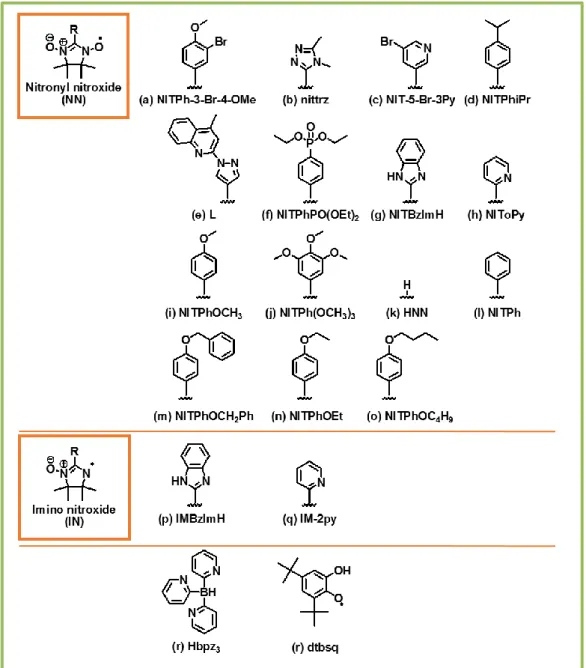
The first 4f-2p heterospin compound [GdIII(hfac)3(phNN)]n (phNN = 2-phenyl-4,4,5,5-tetramethylimidazolin-1-oxyl 3-oxide; Figure 1.4) is reported by Gatteschi and co-workers in 1988,25 which was prepared in order to show the ferromagnetic transition like the ferrimagnetic chain compound [MnII(hfac)2(iPrNN)]n (Scheme 1.2c). Here, NN compounds have been often used as a paramagnetic ligand for the development of 4f-2p heterospin compounds,24 because the radical compounds can be easily obtained by preparing an aldehyde having an appropriate substituent.26 Owing to the easily accessible and handling nature, the Ln-NN compounds account for the majority of the 4f-2p heterospin compounds, and have often formed the one-dimensional chain structure where two NO moieties serve as a coordinated site like [GdIII(hfac)3(phNN)]n (Figure 1.4).25 In addition, an imino nitroxide (IN;
4,4,5,5-tetramethylimidazolin-3-oxyl) compound, which can be easily prepared by reduction of a NN compound, is also utilized as a paramagnetic ligand.27
Figure 1.5. Molecular structure and formula of [GdIII(Hbpz3)2(dtbsq)].28a
It is known that using 3,5-di-tert-butyl-o-semiquinone (dtbsq) as a ligand is an effective approach to the formation of a zero-dimensional architecture for 4f-2p heterospin compounds;28
[GdIII(Hbpz3)2(dtbsq)]·2CHCl3 with Hbpz3 = hydrotris(pyrazolyl)borate shows the zero-dimensional structure (Figure 1.5) and strong antiferromagnetic coupling (2J/kB = –16.4 K, H = –2JGd-radSGd·Srad). Furthermore, the dinuclear Dy complex with the semiqunonate ligand reported by Vallejo et al. behaves as a SMM.28d
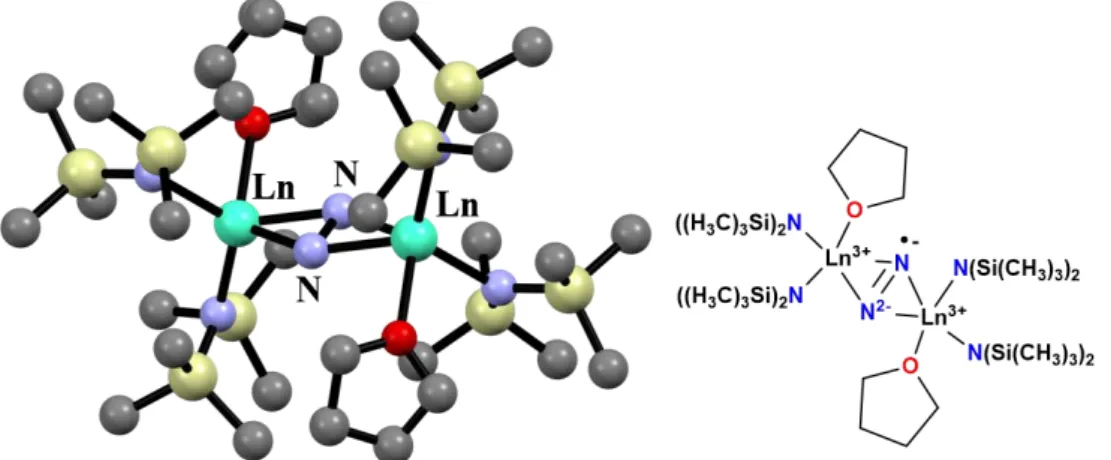
In 2011, Long et al. reported that the N23– radical-bridged Ln complexes (Figure 1.6) showed the extremely strong antiferromagnetic coupling (2J/kB = –38.8 K) and the hysteresis up to 14 K, which is the highest observed for single-molecule magnets.29 This work is known as a milestone in the roadmap of molecule-based magnets. However, this Ln-N23- compounds are generally not easy to be synthesized and are also unstable under ambient conditions.
Figure 1.6. Crystal structure and formula of an N23– radical-bridged Ln complex.29
Little is known so far about guiding principle for constructing exchange coupling in relation to the coordination structures in 4f-2p heterospin compounds. The chemical and structural diversity in these classes of the organic compounds requires a great deal of fundamental efforts to better understand new generations of molecule-based magnets. This thesis will mainly describe relationship between the molecular structure and the exchange coupling of 4f-2p heterospin compounds.
1.2. Scope of This Thesis
Determination of magnetic exchange coupling is one of the most important issues in the study of molecular magnetism. Exchange coupling could give indispensable information for the development of not only SMMs but also other molecular magnets.
This thesis consists of ten chapters. In Chapter 2, the background theories about molecule-based magnetism will be introduced in order to comprehend the following studies.
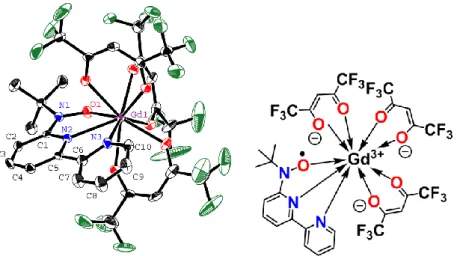
In Chapter 3, a 4f-2p heterospin complex [GdIII(hfac)3(6bpyNO)] (Gd-6bpyNO; 6bpyNO = 2,2’-bipyridin-6-yl tert-butyl nitroxide) will be reported. This molecule was designed according to the empirical relation: more planar chelates favor stronger antiferromagnetic couplings.
According to the molecular design, the largest antiferromagnetic coupling constant in Gd-nitroxide compounds was characterized to be 2J/kB = –15.9(2) K. This study has demonstrated the successful application of the proposed magneto-structure relationship for the 4f-2p heterospin compound.
Chapter 4 describes a magnetization jump at 52 T observed to Gd-6bpyNO on a facility of a very high magnetic field of a 65-T class, assignable to a radical spin-flip at the highest field ever known in 4f-2p heterospin compounds. The exchange coupling constant 2J/kB is revised as –17.4 K from –15.9(2) K. The present value is assumed to be more reliable than the analysis of the magnetic susceptibility in Chapter 3.
Chapter 5 involves two subjects; (i) the magnetic properties as a SMM of [LnIII(hfac)3(6bpyNO)] (Ln-6bpyNO, Ln = Tb, Dy), the corresponding of Tb and Dy analogues of Gd-6bpyNO, will be investigated. The role of the ligand spin introduced in SMMs can also be understood from the experiments using a diamagnetic ligand as a reference. (ii) Using the
(mT) method as a conventional qualitative analysis will clarify the nature of Ln-radical exchange coupling in Ln-6bpyNO (Ln = Tb, Dy).
Chapter 6 deals with three 4f-2p heterospin complexes [GdIII(hfac)3(L)(H2O)] (Gd-L; L = tert-butyl phenyl nitroxide (phNO) and its derivatives (tert-butyl 3-tolyl nitroxide (3tolNO) and tert-butyl 4-tert-butylphenyl nitroxide (4tbphNO))). These molecules were designed according to the empirical relation: out-of-plane coordination of the Gd3+ ion from the radical system favors ferromagnetic coupling. The three Gd compounds showed large ferromagnetic coupling.
The value 2J/kB = +18.0(4) K for Gd-phNO is the record magnitude of Gd-nitroxide systems.
This study has also demonstrated the successful application of the proposed magneto-structure relationship as well as that in Chapter 3.
In Chapter 7, the magnetic properties as a SMM of [LnIII(hfac)3(phNO)(H2O)] (Ln-phNO;
Ln = Tb, Dy), the corresponding Tb and Dy analogues of Gd-phNO, will be investigated, demonstrating the successful development of the SMM by introduction of strong ferromagnetic coupling.
In Chapter 8, one nitroxide (DTBN = di-tert-butyl nitroxide) and two ketones (DTBK = di-tert-butyl ketone and BP = benzophenone) having a bulky substituent are applied to synthesis of Ln complexes. In addition to exchange coupling between Gd and nitroxide, the SMM properties and photoluminescence will be investigated.
In Chapter 9, a novel biradical compound having a ground singlet state will be described.
This biradical was unexpectedly obtained as a by-product in the preparation of nitroxide-based ligands. However, the specific structure (a “pseudo-ipso” pancake-like dimer) and extremely strong intramolecular antiferromagnetic coupling will attract much interest.
Finally, the results and discussion are overviewed in Chapter 10.
1.3. References
1. Gomberg, M. J. Am. Chem. Soc. 1900, 22, 752.
2. Schlenk, W.; Weickel, T.; Herzenstein, A. Justus Liebigs Ann. Chem. 1910, 372, 1.
3. Bartlett, P. D.; Funahashi, T. J. Am. Chem. Soc. 1962, 84, 2596.
4. Lebelev, O. L.; Kazarnovskii, S. N. Zhur. Obshch. Khim. 1960, 30, 1631.
5. Tamura, M.; Nakazawa, Y.; Shiomi, D.; Nozawa, K.; Hosokoshi, Y.; Ishikawa, M.;
Takahashi, M.; Kinoshita, M. Chem. Phys. Lett. 1991, 186, 401.
6. (a) Nogami, T.; Tomioka, K.; Ishida, T.; Yoshikawa, H.; Yasui, M.; Iwasaki, F.;
Iwamura, H.; Takeda, N.; Ishikawa, M. Chem. Lett. 1994, 29. (b) Nogami, T.; Ishida, T.
Yasui, M.; Iwasaki, F.; Takeda, N.; Ishikawa, M.; Kawakami, T.; Yamaguchi, K. Bull.
Chem. Soc. Jpn. 1996, 69, 1841.
7. (a) Mukai, K.; Konishi, K.; Nedachi, K.; Takeda, K. J. Magn. Magn. Mater. 1995, 140-144, 1449. (b) Mukai, K.; Nedachi, K.; Takiguchi, M.; Kobayashi, T.; Amaya, K.
Chem. Phys. Lett. 1995, 238, 61. (c) Mukai, K.; Konishi, K.; Nedachi, K.; Takeda, K. J.
Phys. Chem. 1996, 100, 9658.
8. Chittapeddi, S.; Cromack, K. R.; Miller, J. S.; Epstein, A. J. Phys. Rev. Lett. 1987, 58, 2695.
9. Kahn, O.; Pei, Y.; Verdaguer, M.; Renard, J. P.; Sletten, J. J. Am. Chem. Soc. 1988, 110, 782.
10. (a) Caneschi, A.; Gatteschi, D.; Renard, J. P.; Rey, P.; Sessoli, R. Inorg. Chem. 1989, 28, 1976. (b) Caneschi, A.; Gatteschi, D.; Sessoli, R.; Rey, P. Acc. Chem. Res. 1989, 22, 392.
11. Sessoli, R.; Tsai, H. L.; Schake, A. R.; Wang, S.; Vincent, J. B.; Folting, K.; Gatteschi, D.; Christou, G.; Hendrickson, D. N. J. Am. Chem. Soc. 1993, 115, 1804.
12. Gatteschi, D.; Sessoli, R.; Villain, J. Molecular Nanomagnets; Oxford University Press:
Oxford, UK, 2006.
13. Clemente-Juan, J. M.; Coronado, E.; Gaita-Arino, A. Chem. Soc. Rev. 2012, 41, 7464.
14. Sanvitro, S. Chem. Soc. Rev. 2011, 40, 3336.
15. Castro, S. L.; Sun, Z.; Grant, C. M.; Bollinger, J. C.; Hendrickson, D. N.; Christou, G.;
J. Am. Chem. Soc. 1998, 120, 2997.
16. Sangregorio, C.; Ohm, T.; Paulsen, C.; Sessoli, R.; Gatteschi, D. Phys. Rev. Lett. 1997, 78, 4645.
17. Ishikawa, N.; Sugita, M.; Ishikawa, T.; Koshihara, S.; Kaizu, Y. J. Am. Chem. Soc.
2003, 125, 8694.
18. Rinehart, J. D.; Long, J. R. Chem. Sci. 2011, 2, 2078.
19. (a) Woodruff, D. N.; Winpenny, R. E. P.; Layfield, R. A. Chem. Rev. 2003, 113, 5110.
(b) Feltham, H. L. C.; Brooker, S. Coord. Chem. Rev. 2014, 276, 1.
20. Liu, J.; Chen, Y. -C.; Liu, J. -L.; Vieru, V.; Ungur, L.; Kia, J. -H.; Chibotaru, L. F.; Lan, Y.; Wernsdorfer, W.; Gao, S.; Chen, X. -M.; Tong, M. -L. J. Am. Chem. Soc. 2016, 138, 5441.
21. Gupta, S. K.; Rajeshkumar, T.; Rajaraman, G.; Murugavel, R. Chem. Sci. 2016, 7, 5181.
22. (a) Sorace, L.; Benelli, C.; Gatteschi, D. Chem. Soc. Rev. 2011, 40, 3092. (b) Woodruff, D. N.; Winpenny, R. E. P.; Layfield, R. A. Chem. Rev. 2013, 113, 5110.
23. (a) Osa, S.; Kido, T.; Matsumoto, N.; Re, N.; Pochaba, A.; Mrozinski, J. J. Am. Chem.
Soc. 2003, 126, 420. (b) Mori, F.; Nyui, T.; Ishida, T.; Nogami, T.; Choi, K. -Y.; Nojiri, H. J. Am. Chem. Soc. 2006, 128, 1440.
24. Demir, S.; Jeon, l. –R.; Long, J. R.; Harris, T. D. Coord. Chem. Rev. 2015, 289-290, 149.
25. Benelli, C.; Caneschi, A.; Gatteschi, D.; Laugier, J.; Rey, P. Angew. Chem. Int. Ed.
1987, 26, 913.
26. Ullman, E. F.; Call, L.; Osiecki, H. J. Org. Chem. 1970, 35, 3623.
27. (a) Lescop, C.; Luneau, D.; Rey, P.; Bussière, G.; Reber, C. Inorg. Chem. 2002, 41, 5566. (b) Tsukuda, T.; Suzuki, T.; Kaizaki, S. J. Chem. Soc., Dalton Trans. 2002, 1721.
28. (a) Caneschi, A.; Dei, A.; Gatteschi, D.; Sorace, L.; Vostrikova, K. Angew. Chem. Int.
Ed. 2000, 39, 246. (b) Dei, A.; Gatteschi, D.; Massa, C. A.; Pardi, L. A.; Poussereau, S.; Sorace, L. Chem. Eur. J. 2000, 24, 4580. (c) Caneschi, A.; Dei, A.; Gatteschi, D.;
Poussereau, S.; Sorace, L. Dalton Trans. 2004, 1048. (d) Vallejo, J.; Cano, J.; Castro, I.; Julve, M.; Lloret, F.; Fabelo, O.; Cañadillas-Delgadocd, L.; Pardo, E. Chem.
Commun. 2012, 48, 7726.
29. (a) Rinehart, J. D.; Fang, M.; Evans, W. J.; Long, J. R. Nat. Chem. 2011, 3, 538. (b) Rinehart, J. D.; Fang, M.; Evans, W. J.; Long, J. R. J. Am. Chem. Soc. 2011, 133, 14236.
Chapter 2
2.1. Theoretical Section
2.1.1. Magnetic Susceptibility1,2
A molar magnetic susceptibility m is described as follows, H
M
m
- (2.1)
where M is a molar magnetization, and H is an external field. In principal, the molar magnetic susceptibility m is the algebraic sum of a molar diamagnetic susceptibility mD and a molar paramagnetic susceptibility mP (eq. (2.2)).
P m D m
m
- (2.2)
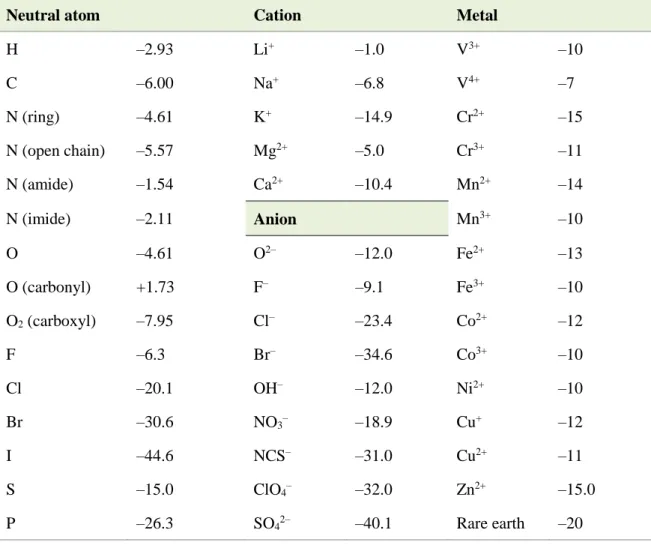
When the mD term dominates, the sample is said to be diamagnetic; namely, it is repelled by an external magnetic field. On the other hand, when the mP term dominates, the sample is said to be paramagnetic; it is attracted by an external magnetic field. It is sufficient to specify that the mD term is independent of a temperature (T) and an external field. ThemD term is always present in an experimental data obs, and the negative value of mD can be estimated from Pascal’s constants. Some of these data are shown in Table 2.1.1,2
The molar paramagnetic susceptibility mP is dependent of a temperature, and that value shows positive. To understanding details of the mP, a general theory for a paramagnetic susceptibility will be described. When an external field is present, an energy spectrum En (n = 1, 2, …) represents as the following:
E(0) E(1)H E(2)H2
En n n n - (2.3)
where En(0) is the energy of level n in zero field. En(1)H and En(2)H2 are called first- and second-order Zeeman energies, respectively. For each energy level, a microscopic magnetization n can be defined as
En H En En H
n
(2) (1) 2
- (2.4)
Table 2.1. Diamagnetic susceptibilities (in 10–6 cm3 mol–1) as the Pascal constants.
Neutral atom Cation Metal
H –2.93 Li+ –1.0 V3+ –10
C –6.00 Na+ –6.8 V4+ –7
N (ring) –4.61 K+ –14.9 Cr2+ –15
N (open chain) –5.57 Mg2+ –5.0 Cr3+ –11
N (amide) –1.54 Ca2+ –10.4 Mn2+ –14
N (imide) –2.11 Anion Mn3+ –10
O –4.61 O2– –12.0 Fe2+ –13
O (carbonyl) +1.73 F– –9.1 Fe3+ –10
O2 (carboxyl) –7.95 Cl– –23.4 Co2+ –12
F –6.3 Br– –34.6 Co3+ –10
Cl –20.1 OH– –12.0 Ni2+ –10
Br –30.6 NO3– –18.9 Cu+ –12
I –44.6 NCS– –31.0 Cu2+ –11
S –15.0 ClO4– –32.0 Zn2+ –15.0
P –26.3 SO42– –40.1 Rare earth –20
The approximation is that H/kBT is small with respect to unity. The macroscopic molar magnetization M is obtained by the sum of the microscopic magnetization considering the Boltzmann distribution low.
n n
n n n
T k E
T k E H
E M N
B
B A
exp
exp - (2.5)
The exponential in eq. (2.5) could be approximated as the following
/
exp
/
(1 / )exp En kBT En(0) kBT En(1)H kBT - (2.6) From eqs. (2.4), (2.5), and (2.6), molar magnetization M can be written as
n n n
n n n n n
T k E T
k H E
T k E T
k H E H E E M N
B ) 0 ( B
) 1 (
B ) 0 ( B
) 1 ( )
2 ( ) 1 ( A
exp /
1
exp /
1
2 - (2.7)
When H is zero, the magnetization vanishes, hence eq. (2.7) becomes
n n
n n n n
T k E
T k E E
T k E H N M
B ) 0 (
B ) 0 ( )
2 ( B )2 1 ( A
exp
exp 2
/
- (2.8) From eq. (2.1), the magnetic susceptibilities m lead to
n n
n n n n
T k E
T k E E
T k E N
B ) 0 (
B ) 0 ( )
2 ( B )2 1 ( A
m exp
exp 2
/ - (2.9)
which is called the van Vleck formula.3 When all energies En are linear in magnetic field H, the second order Zeeman coefficients En(2) vanish, and eq. (2.9) is written as
n n
n n n
T k E T
k
T k E E
N
B ) 0 ( B
B ) 0 2 (
) 1 ( A
m exp
exp - (2.10)
2.1.2. Magnetization1,4
The simplest situation in molecular magnetism is that of molecules in which the ground state has a large separation in energy from the low-lying excited states, such that any kind of coupling between the ground and excited states may be disregarded.
When a field H is applied, the energy En is given by H g M
En J B - (2.11)
which MJ is the magnetic quantum number and varies an integer value from –J to +J. The g factor is principal isotropic and equal to ge = 2.0023. When H/kBT is small, magnetic susceptibilities obey Curie’s law (eq. (2.12)).
T J C
T J k
g
N
( 1)
3 B
2 B 2 A m
- (2.12)
On the other hand, when H/kBT becomes large, the molar magnetization M could be written from eqs. (2.5) and (2.11) as the following
)
B (
Ag JB y
N
M J - (2.13)
where y = gBJH/kBT. BJ(y) is the Brillouin function defined by
y
J y J
J J J
y J BJ
2 coth 1 2
1 2
1 coth 2
2 1 ) 2
( - (2.14)
When we deal with spin-only ions (organic radicals, a Gd3+ ion, and some transition metal ions), the orbital quantum number L can be approximately zero; namely, it is assumed that J (defined as J = L + S) is equal to S in eq. (2.12).
The variations of molecular magnetization M in NAB units for g = 2 and T = 1.8 K for several J values are shown in Figure 2.1.
Figure 2.1. The magnetization curves calculated with eq. (2.13).
2.1.3. Spin Hamiltonian5
In general, a vector coupling scheme5 may be used to model the quantitative behavior of the system with exchange-coupled spins with the Heisenberg−Dirac−van Vleck (HDvV) spin Hamiltonian,6,7
ij JijSi Sj
Hˆ 2 ˆ ˆ - (2.15)
where the subscripts i and j correspond to the two different spins between nearest-neighbor sites.
Jij is the exchange coupling constant and is a function of the relatively separation between the magnetic moments. In the Hamiltonian eq. (2.15), J > 0 corresponds to ferromagnetic interaction, and J < 0 corresponds to antiferromagnetic interaction.
For the exchange coupling constant, several conflicting conventions have been in use in the literature: Hˆ 2JijSˆiSˆj, Hˆ JijSˆiSˆj, and Hˆ JijSˆiSˆj. In this thesis, the first one
will be used. We have to make sure to understand which convention was used in each reference in the literature.
2.1.4. Intermolecular Interaction: Molecular Field1,4
Most magnetic measurements are carried out in the solid state and the molecular magnetic species are rarely perfectly isolated from a magnetic viewpoint. In the molecular field approximation where a perturbation is added to the Zeeman term, the perturbation takes the form zJ Sz Sˆz where z is the number of nearest neighbors around a given magnetic molecule in the crystal lattice, and <Sz> is the mean value of the Sˆz component, the spin operator. J is the exchange coupling constant between two nearest neighbor spin centers and z is the number of nearest neighbors around the given molecule in a crystal lattice. The total spin Hamiltonian is
z z
zH zJ S S
S g
Hˆ ˆ ˆ
B
- (2.16)
where the magnetic field is assumed to be along the z direction and the g tensor to be isotropic.
<Sz> is given through the Boltzmann distribution law as ) 1 ( 3
) 1 (
B
B
S zJS T k
H g S
Sz S
- (2.17) The molar magnetization may be expressed as
Sz
g N
M A B - (2.18)
such that the molar paramagnetic susceptibility at low fields and high temperatures is )
1 ( 3
) 1 (
B 2 B 2 A
m
S zJS T k
S S g
N
- (2.19)
From eq. (2.19) and the Curie-Weiss low, = C/(T – ), the Weiss constant defined by
3 B
) 1 (
k S zJS
- (2.20)
To emphasize low-temperature behavior, calculated magnetic data are represented in the form of a mT vs. T plot (Figure 2.2).
Figure 2.2. mT vs. T plot for an assembly of molecules obeying the Curie-Weiss law with the Curie constant C = 0.375 cm3 K mol-1 and Weiss constants = +5 (a red curve), 0 (a green line), and –5 K (a blue curve).
2.1.5. Isotropic Interaction in Two-Spin System (S = 7/2 and S = 1/2)
In the two-spin system, the HDvV spin Hamiltonian is written as
B
A ˆ
2 ˆ
ˆ JS S
H - (2.21)
where SˆAandSˆBare the local spin operator, and J is exchange coupling between SA and SB. Since SˆT SˆA SˆB, hence SˆT2SˆA2 2SˆASˆBSˆB2. The spin Hamiltonian is rewritten as
B2
2 A 2
T ˆ ˆ
ˆ
ˆ J S S S
H - (2.22)
the eigenvalues of which are
ST,SA,SB
JST(ST 1)JSA(SA1)JSB(SB1)E - (2.23)
which, after a change of origin, can be rewritten as
ST JST(ST 1)E - (2.24)
The local spins are SA = 7/2 and SB = 1/2. If the low-spin state (S1 = 3) is taken as the origin, the relative energies of the states are E1(3) = 0 and E2(4) = –8J (S2 = 4).
The spectrum of the low-lying state and the first order Zeeman coefficients associated with the Zeeman perturbation are shown in Figure 2.3a. The molar magnetic susceptibility m is given by eq. (2.10) and above the energy states as the following
2
1 B
2
1 B
B 2 B A
m 2 1exp
exp 1 2 1
3 n n n
n n n n n
T k E S
T k E S
S S T
k g N
- (2.25)
and
J k T
T k
T k J g
N
B B
B 2
B A
m 7 9exp8
8 exp 15 7 4
- (2.26)
If the intermolecular coupling is analyzed from magnetic susceptibility, we can use the following expression from eq. (2.26) and Curie-Weiss low, = C/(T – ).
T T k J k
T k J g
N 1
8 exp 9 7
8 exp 15 7 4
B B
B 2
B A
m - (2.27)
a) b)
Figure 2.3. (a) Zeeman diagram for a two-spin system with S = 7/2 and S = 1/2 in the case of antiferromagnetic coupling (J < 0). (b) mT vs. T curves describing eq. (2.26) with g = 2.0 and 2J/kB = +20, 0, and –20 K.
2.1.6. Ac Magnetic Susceptibility9
Since Gorter and Brons first reported in 1937,8 it has been known that the alternating current (ac) magnetic susceptibility measurement is good approach to the observation of the spin dynamics. The ac magnetic field is given by
t hc H
H 0 cos - (2.28)
where h and c are the Planck constant and speed of light, respectively, and is the angular frequency. If the frequency of the external field H is slower than the relaxation time of the
magnetization (), i.e. << 1, the measured susceptibility is the same as the static susceptibility which is called the isothermal susceptibility (T). On the other hand, if the frequency of the external field H is faster than the , i.e. 1 << , the magnetic system is effectively isolated from the surroundings and an adiabatic susceptibility (S) is measured. In an intermediate regime, the magnetic susceptibility can be represented as the following equation.
i
1
S T
S - (2.29)
This equation is well-known as the Debye relaxation, which has the single-relaxation time. If the isothermal and adiabatic susceptibilities are real, the real and imaginary components of the susceptibility () are given by
2 S 2
S T
' 1
- (2.30)
2 2
S T
" 1
- (2.31)
The frequency dependence of the ’ and the ” are shown in Figure 2.4. The ” goes through a maximum when = 1, while it goes to zero for → 0 and → ∞, contrary to the ’ which has the limiting values T and S.
Figure 2.4. Theoretical frequency-dependence of the real and imaginary components of the magnetic susceptibility () in a semi-log scale. The T and the S are the isothermal and adiabatic limit of the susceptibilities, respectively.
The Cole-Cole plot where ’ vs. ” is used to understanding the relaxation process. Based on a distribution of a relaxation time, eq. (2.29) can be written as
S 1
T 1Sα
i - (2.32)
and
1 α
2 2αα 1 S
T
S 1 2 sin πα 2
πα 2 sin
' 1
- (2.33)
1 α
2 2αα 1 S
T 1 2 sin πα 2
πα 2
" cos
- (2.34)
Figure 2.5. The Cole-Cole plot where at a given temperature the ” is plotted versus the ’, for each frequency. Solid line: no distribution in relaxation time; broken, a distribution in according to eqs. (2.33) and (2.34).
When the distribution in the relaxation time is wide, is large. The parameter can be easily estimated by the Cole-Cole plot from the experimental ac data. The semicircle derived from eq. (2.32) is shown in Figure 2.5, and the angle that subtends the arc is given by (1 – ).
When the relaxation is so slow that the decay of magnetization can be directly measured, the relaxation time can often be represented by the Arrhenius equation,
T k
U
B 0exp
- (2.35)
where 0 is a pre-exponential factor and U is an energy barrier. These parameters are important to assess the properties of SMMs. When the U/kB is larger than the cryogenic temperature, the
spin can hardly get out of its half-potential well to go into the other one. On the other hand, when the temperature is higher, the spin can climb to the top of the energy barrier and then go down on the other side. These processes are called the thermal activation (Figure 1.1a).
When the relaxation time is equal to 1/ (= 1/2) at the temperature T, the T is called the blocking temperature TB. The TB can also be expressed by the Arrhenius equation (eq.
(2.35)), and the equation can be written as
T k U B ln 0
π ln 2
ln 1
- (2.36)
The effective energy barrier and the pre-exponential factor can be estimated by the Arrhenius plots from the TB and the measuring frequency .
2.1.7. Lanthanoid Ions1
The lanthanoid (also called lanthanide and abbreviated as Ln) series comprises fifteen chemical elements with the atomic number 57 through 71 (Table 2.2). These fifteen elements, along with the chemically similar elements scandium (21Sc) and yttrium (39Y), are often collectively known as the rare-earth elements.
The ground configuration of the Ln elements is [Xe]4fn5d16s2. Generally, the Ln ions are that a trivalent state is chemically stable; they can be divalent (Sm2+, Eu2+, and Yb2+) or tetravalent Ce4+ when the 4f0, 4f7, or 4f14 configurations are attained as [Xe]4fn. The thirteen Ln3+ ions from 56Ce to 70Yb have unpaired electrons in the 4f orbitals (abbreviated as a 4f spin), which are lower in the energy than the unfilled 5d and 6s orbitals; namely, the 4f spins are very efficiently shielded by the outer orbitals. The 4f spins are almost uninvolved in the bonds between a Ln ion and a ligand, thus the magnitude of the spin-orbit coupling (LS coupling) is much larger than that of a transition metal (3d) ion. This spin-orbit coupling partially removes the degeneracy of the 2S+1 ground term, where is an irreducible representation of a point group. This gives 2S+1J states, with J varying by an integer value from |L – S|, |L – S + 1|, … L + S. The J is the quantum number associated with the total angular momentum J defined as J = L + S. The Landé gJ factor of a given J multiplet is expressed by
) 1 ( 2
) 1 ( ) 1 ( 2 3
J J
L L S
gJ S - (2.37)