Kyushu University Institutional Repository
木材細胞壁を構成するポリマー間の相溶性
重松, 幹二
九州大学農学研究科林産学専攻
https://doi.org/10.11501/3086537
出版情報:Kyushu University, 1991, 博士(農学), 課程博士 バージョン:
権利関係:
Mikiji Shigematsu
1991
Kyushu University
Contents
Page General Introduction -------- ---
1
Chapter 1
Interfacial Adhesion between Woody Polyaers
1.1 Introduction ------------ 5 1.2 Experimental ------------- 8 1.3 Results and Discussion
1.3.1 Characteristics of materials --- 12 1.3.2 Interlaminar bond strength between cellulose
and lignin ------------ 17
1.3.3 1.3.4 1.3.5 1.3.6
Comparison of pairs in interface --- - ----
Effect of lignin-carbohydrate complex (LCC) ---
Comparison of adhesion with different LCCs ---
Surface analysis of spread LCC --- 22 25 30 33 1.4 Conclusion --------------------- 37
Chapter 2
Differential Scanning Calori•etry Studies on Miscibility of He•icellulose and Lignin Blends, and Effect of Adding of Lignin-Carbohydrate Co•plex
2.1 Introduction ----------------- 38 2.2 Experimental --------------- 40 2.3 Results and Discussion
2.3.1 Glass transition temperature of isolated polymers ---- 41 2.3.2 Binary-blends system of hemicellulose and lignin ----- 46 2.3.3 Thermodynamic analysis of binary-blends system --- 50 2.3.4 Effect of addition of LCC on miscibility of
hemicellulose and lignin ------------ 59 2.3.5 Effect of quenching on miscibility --- --- 61 2.3.6 Enhancement of miscibility by addition of
other LCCs ---------- ----- 66
2.3.7 2.3.8 2.3.9
Glass transition temperatures of miscible blends ----
Phase diagram of blends system --- Thermodynamic analysis of enhancement of miscibility by addition of LCC ---
Page
68 70
79
2.4 Conclusion ------------------------------------------- 88
Chapter 3 Vapor Pressure Os•o•etry Studies on Solution Properties of He•icellulose, Lignin and Their Mixture 3.1 Introduction -------------------------- 91
3.2 Experimental --------------- ---- 93
3.3 Results and Discussion 3.3.1 Thermodynamic parameters of dilution ----------- 95
3.3.2 3.3.3 Interaction parameters between solvent and solute 100 Interaction parameter between hemicellulose and lignin (x12) ----------- 104
3.4 Conclusion -------------------------------- 110
Chapter 4 Surface Tension Studies on He•icellulose and Lignin Blends 4.1 Introduction ---------------------- 111
4.2 Experimental --------- - ----------------- 113
4.3 Results and Discussion 4.3.1 Critical surface tension ------------ 114
4.3.2 Surface tension of solid (Ys) ------ 120
4.3.3 Dynamic contact angles --------------------------- 124
4.4 Conclusion ----------------------------------- 132
Suaaary --------------------------------------- 133
Acknowledgment ------------------- 137
References --- 138
No•enclature ------------------------------------ 141
General Introduction
Wood is a composite material containing mainly three polymers, i.e., cellulose, hemicellulose and lignin. Cellulose and hemicellulose are polymers comprising carbohydrate units, and are generally called
polysaccharides. Lignin is a polymer comprising phenylpropane units, and quite different from polysaccharides. As a main characteristic, a
carbohydrate molecule has many hydroxyl groups and is therefore a
hydrophilic polymer. Conversely, lignin is a hydrophobic polymer with fewer hydroxyl groups compared with carbohydrates.
These polymers comprise the wood cell wall as laminated structures.
Some wood cell wall models were proposed after observation with an electron microscope
[1-3].
For example, Frey-Wyssling[1]
has shown that the wood cell wall started ontogenetically as an isotropic gel also termed "matrix"which was later reinforced by elementary fibrils of cellulose and finally encrusted with lignin. He stated that the ultrastructure of a lignified cell wall could be compared to reinforced concrete. That is, in analogy to the reinforcing iron bars the cellulose fibrils are endowed with lignin tensile strength and their bending or bulging out under axial pressure. is prevented by the encrusted lignin. As a result the wood cell wall possesses both high tensile and high compressive strength. Goring et al.
[2,3]
haveproposed two models for the ultrastructural arrangement of these polymers;
(a) the hemicellulose is associated entirely with the cellulose microfibrils, (b) the hemicellulose is distributed throughout the
3-
dimensional lignin network. These models are different on the point of miscibility between hemicellulose and lignin. Erins e t a l. have shown a
-1-
model for the structure of the amorphous ligna-carbohydrate matrix of wood [ 4]; the amorphous matrix is a crosslinked polymer system in which both covalent and hydrogen bonds form cross-linkages; the matrix is heterogeneous in physical density as well as in the cross-linking density, which is
generally determined by the globular structure of lignin; chain-like
molecules of carbohydrates intersect the globules and are linked covalently with lignin, to a large extent by ester linkages. The structures mentioned above are generally accepted. However, little has been reported about the interaction of three polymers (5-7].
Most pairs of polymers do not show mutual miscibility due to the small entropy of mixing for long polymer chains and positive energy of mixing usually observed between polymers. Ordinary polymers are immiscible without specific interaction between the segments of a polymer and other one, such as a hydrogen bond [8,9]. While a polymer pair is not miscible in general conditions, there are many reports about its miscibility, by changing the temperature or by adding a compatibilizer [10].
For woody polymers, it is expected that, as described above, it will be difficult for hemicellulose and lignin to be miscible because of their
difference of chemical composition and/or the hydrophobicity of lignin.
However, three components are mixed well in wood cell wall and comprise a strong material.
While two polymers are thermodynamically immiscible, enhancement in the degree of miscibility can be afforded by addition of a third component which reduces the number of unfavorable contacts between the segments of the two polymers. Addition of a mutual solvent usually results in such a beneficial effect. It will be more useful if a similar enhancement of miscibility can be achieved by the addition of a polymeric component. A copolymer would be
-2-
Introduction a natural candidate for such a purpose. In fact, many reports about
enhancement of miscibility by the addition of random-, block- or graft
copolymers are published. Such species, as a consequence, are often
referred to as "compatibilizer", which is analogous to the term "surfactant"
used in the colloid field.
It is thought that hemicellulose and lignin are partially covalent
bonded; this copolymer is called lignin-carbohydrate complex (LCC) [11-15] a small amount of which is the component extracted by an organic solvent from milled wood. Since a LCC is copolymer, it is expected to work as a
compatibilizer. There is only one report about it; it has been found that the LCC works as a compatibilizer between cellulose and lignin, because the addition of LCC in small amounts could enhance the tensile strength of the composite [16].
The purpose of this research is to estimate the degree of interaction between cellulose, hemicellulose and lignin isolated from wood cell wall and also the effect of LCC on the interaction. If they are elucidated, the structure of wood cell wall can be expressed clearly as the molecular level from the polymer science viewpoint, and the knowledge contributes to
advancing wood science and the application of woody biomass recently
attempted by many researchers [16-21]. For these purposes, the interfacial adhesion of woody polymer layers were primarily described in Chapter 1.
Further the miscibility of polymer blends and the effect of LCC on it were dealt with in Chapter 2 by means of the observation of their glass
transition temperatures, and discussed from the thermodynamic analysis of polymer blend [22,23]. This discussion was carried out from the viewpoint of the Flory polymer-polymer interaction parameter [24] between
polysaccharide and lignin. In Chapter 3, the solution properties of
-3-
hemicellulose and lignin in dimethylsulfoxide which is a common solvent for two polymers were accounted for in terms of free energy of dilution [25].
Also from this result, the interaction parameter between them was discussed.
In Chapter 4, the miscibility in the surface of blends were investigated by measurement of surface tension derived from contact angle of some liquids.
-4-
Chapter 1
Interfacial Adhesion between Woody Polymers
1.1 Introduction
Many plastics producers and compounders are developing products with new blends because blends offer a convenient, less expensive alternative to developing totally new polymers. Blends can be tailored to meet the
requirements of specific applications. They can be developed much more quickly than new synthetic polymers and require much less capital
investment. The ability to produce blends that have a better combination of properties than that of the individual components depends on the miscibility of the system. However, ordinarily two or more polymers are immiscible without specific interaction between the segments of both polymers, such as a hydrogen bond. Blends of immiscible polymers may assume phase
morphologies ranging from random dispersions to the highly structured
laminates of films. In extreme cases, dispersed mixtures of two immiscible polymers are weak and brittle and are frequently described as cheesy, e. g., blends of polystyrene and polyethylene. On these blends, fracture may initiate at the blend interface, and in any case the fracture path would be expected to follow preferentially the weak interface between two polymers.
The mechanical properties of immiscible mixtures are related not only to those of the separate phases but also to the degree of adhesion between the phases.
As described in General Introduction, it is thought that the three
-5-
woody polymers, cellulose, hemicellulose and lignin, have a laminated
structure in wood cell wall. That is, these polymers form their own domain and these domains contact other polymer domains. This situation is similar to the blends of polystyrene and polyethylene. Hence the investigation of inter-adhesion between polymers is important and gives the information of interaction between them. If polymers have little affinity, the adhesion should be weak.
The quantitative influence of interfacial adhesion on the mechanical responses of dispersed blends is complex and not well understood. However, laminates of two polymers assume a series arrangement of phases in which direct stressing of the interface may occur and the strength of the composite in certain modes of testing is not greater than the adhesive
forces between the two phases. Because different types of polymers often do not adhere well to one another, adhesives that adhere to both polymers are needed. In some cases a homogeneous polymer may be a mutual adhesive for these two polymers, but clearly the possible interfacial activity of block and graft copolymers may be advantageous for this purpose. It is widely known that the presence of certain polymeric species, usually block or graft copolymers suitably chosen, can alleviate to some degree the problems
mentioned above, and it is generally believed that this is a result of their ability to alter the interfacial situation. Such species, as a consequence, are often referred to as a "compa ti bil i zer", which is analogous to the term
"solubilization" used in the colloid field to describe the surfactant effect on the ability to mix oil and water.
Noteworthily in woody polymers, it is thought that parts of
hemicellulose and lignin are partially covalent bonded in wood cell wall;
this copolymer is called lignin-carbohydrate complex (LCC). The LCC is
-6-
extracted from wood cell wall and yields only several percent. As described above, a copolymer has ability to adhere to its homopolymers. Therefore the LCC is expected to work as an adhesive to polysaccharide and lignin. In fact, it was found that the LCC works as a compatibilizer between cellulose and lignin, because the addition of LCC in small amounts could enhance the tensile strength of the composite prepared by solution casting
[16].
However, it is difficult to analyze the influence from the mechanical properties of dispersed blends, cellulose and lignin.
In this chapter, the interfacial adhesion between laminas of woody polymers is discussed. To observe it, an
interlaminar bond strength (cr)
which is tensile detachment strength was measured. First, the
j
ustice of this measurement was examined for the thicknesses of lamina and the used spreading solvents. Second, the strength of each pair of three polymers was discussed. Finally, an effect of LCC on adhesion between cellulose and lignin was discussed and explained in terms of a surface change observed by contact angle of liquid.-7-
1.2 Experimental 1.2.1 Materials
A commercial cellulosic film (thickness of 18 �-tm, Fukui Kagaku Kogyo, Co., Ltd.) was used for a cellulose sample. Hemicellulose, lignin and LCCs were prepared from wood meal of beech (Fagus crenata Bl.) by the following methods.
One of the hemicelluloses of hardwood, 0-acetyl-4-0-methyl
glucuronoxylan [26,27] was extracted by dimethylsulfoxide (DMSO) from the holocellulose prepared by the Wize's method [28]. The DMSO extract was poured into acidic ethanol containing a small amount of acetic acid, and then hemicellulose was precipitated. The precipitate was washed by pure ethanol and finally by ether, and dried.
Lignin was extracted from wood meal by refluxing with 1,4-dioxane containing 3% HCl for 8 hours [29]. The sample was precipitated and washed by water. For further purification, it was dissolved in dioxane and
reprecipitated into ether. This lignin is widely called Dioxane Lignin.
The LCCs were extracted from wood meal with following methods [30].
Wood meal was milled by ball mill in toluene for 72 hours at room
temperature. Milled wood lignin (MWL) was extracted from milled wood by dioxane containing 20 % water. After this, the remainder was extracted with water. The extracted substance is LCC-W. Furthermore the remainder was extracted with DMF. It was LCC-DMF. The MWL was successively fractionated by dioxane:water = 0:100, 10:90, 20:80, 30:70 and 40:60; these are
designated as LCC-0, 1, 2, 3 and 4, respectively. A lignin content in each LCC was determined by an absorptivity at 280nm in water or DMF solution, while referring to the standard lignin content of crude MWL as determined by the Klasen's method [31].
-8-
1.2.2 Preparation of samples for interlaminar bond strength
Typical method of preparation of samples for detaching test is
described as follows. First, wet cellophane was put on flat glass, dried and cleaned by ethanol. The 10 % of sample solution was spread onto cellophane surface using DMSO, DMF, 1,4-dioxane or acetone containing 5 % water as a solvent; 0.5 ml of the solution was spread into an area of 6 em x
6 em. By evaporating the solvent we obtained the double-layer film. Then, the concentration of samples on surface was 1.4 mg/cm2, and the thickness of the second layer was calculated as ca. 10 �-tm from their density data.
For multilayer system, e. g., cellulose/hemicellulose/lignin or
cellulose/LCC/lignin, no perturbing sol vent was chosen. That is, the former was prepared by first spreading a hemicellulose in DMSO solution on a
cellulosic film, and secondly spreading a lignin in DMF or acetone solution on hemicellulose surface after drying. The latter was prepared by a spread of LCC in dioxane solution, and secondly a lignin in acetone solution after drying.
1.2.3 Measurement of molecular weight
The number average and viscosity average molecular weights
(M
n and Mv,respectively) were measured by vapor pressure osmometry and intrinsic viscometry, respectively. Details are ·shown in Section 3.2.2.
1.2.4 Measurement of interlaminar bond strength
An adhesion in interface between two polymers was measured as an
interlaminar bond strength
(o-)
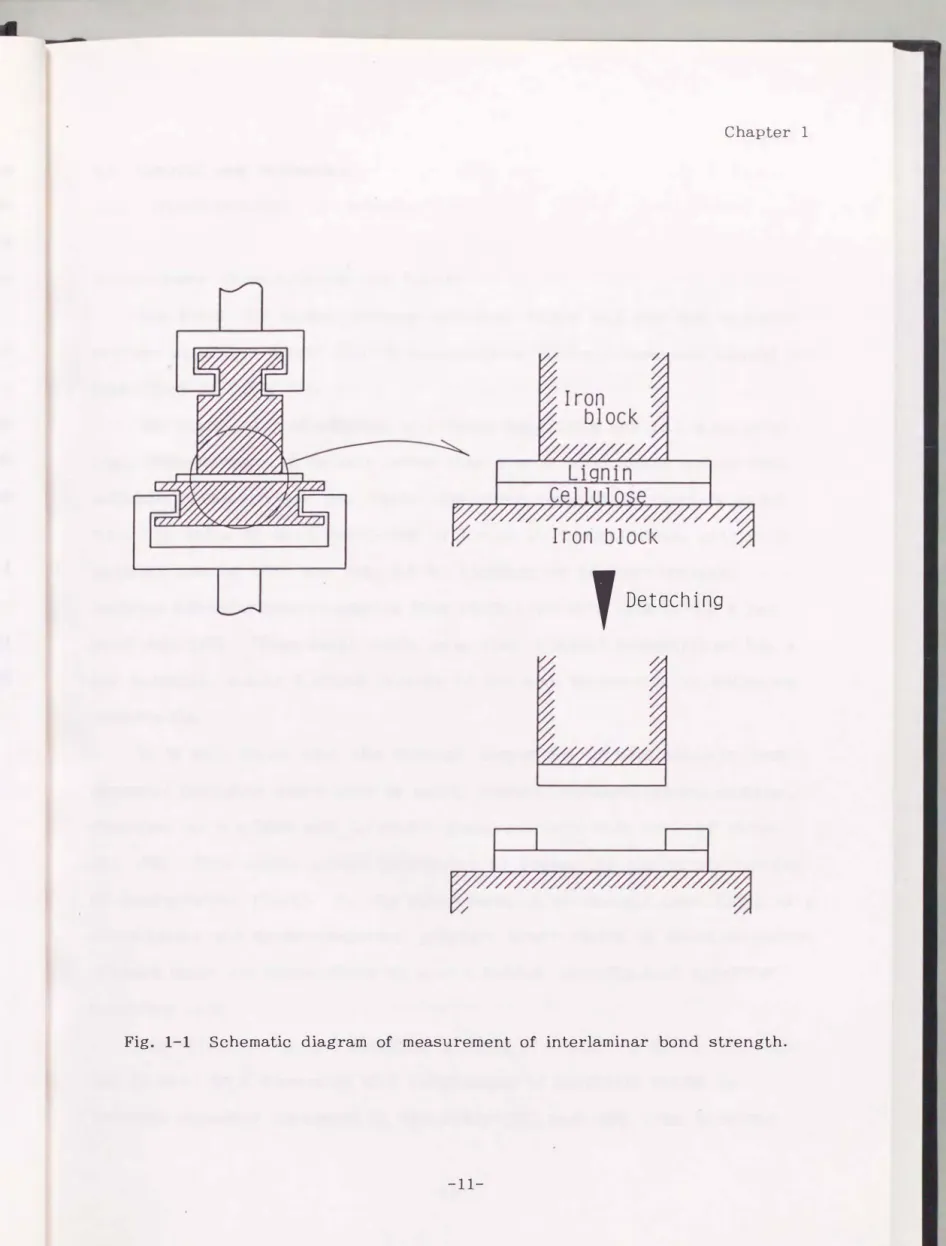
by a tensile detachment test. The schematic diagram of this test was shown in Fig. 1-1. The cellulose side of laminated film was adhered to a large iron block by an adhesive (cyanoacrylate) and a-9-
small iron block was adhered on the other side by the adhesive for 2 em x 2 em area. The test was carried out with 1.0 mm/min of drawing speed and at room temperature by using TENSILON/UTM-1-2500 made by To yo Baldwin Co., Ltd.
(Japan). The values were averaged from 4 - 8 pieces.
1.2.5 Remaining 1 i g ni n on de tac hi ng surface
The remaining lignin on the detaching surface of the cellulose/lignin system was evaluated by UV absorption. The lignin on cellulose side of the detaching surface was dissolved in dioxane, and the UV absorbancy was
measured at 280 nm.
1.2.6 Contact angle
To obtain hydrophobicity of a spread LCC surface on cellulose or lignin, the contact angle of a glycerol drop on the surface was measured.
Detail is shown in Section 4.2.3.
-10-
Chapter 1
' Detaching
Fig. 1-1 Schematic diagram of measurement of interlaminar bond strength.
-11-
1.3 Results and Discussion
1.3.1 Characteristics of materials
Homopolymers (hemicellulose and lignin)
The yield, the number-average molecular weight
(Mn)
and the viscosityaverage molecular weight
(Mv)
of homopolymers(
hemicellulose and lignin)
are summarized in Table 1-1.The yields of hemicellulose and lignin were 0.6 % and 13.1 % on wood meal, respectively. It is well known that a wood is composed mainly with cellulose, hemicellulose and lignin, and their composition ratio is about 2:1:1. In spite of wood consisting of about 1
/
4 hemicellulose, extracted hemicellulose by DMSO was only 0.6 %. Lindberg e t al. have obtained 0-acetyl-4 -0-methylglucuronoxylan from birch wood at a rate of 0.8 % per wood mass[
32]
. These small yields mean that obtained hemicellulose has a low molecular weight fraction because of the high interaction to cellulose microfibrils.It is well known that the chemical composition of hemicellulose from hardwood including beech wood is mainly 0-acetyl-4-0-methylglucuronoxylan, comprised by a xylose unit to methyl glucuronic acid unit ratio of about
10:1
[
33]
. This acetyl group contributes to preventing the crystallization of hemicellulose[
34,35]
. On the other hand, it is thought that lignin is a cross-linked and three-dimensional polymer; linear chains of about 20 phenyl propane units are cross-linked to give a netted, approximately spherical structure[
36]
.The values of
Mn
were measured by using of a vapor pressure osmometer, andMv
were by a viscometer with relationship of molecular weight tointrinsic viscosity expressed in literature
[
37]
and[
38]
. The observed-12-
molecular weights were
M n=4120
andMv=22000
for the hemicellulose,M 0=871
and
M v=l2000
for the lignin, respectively. For both polymers,M n
was considerably smaller thanMv.
The ratio,Mv!Mn,
is5.3
for thehemicellulose and
14
for the lignin. These values indicate that the samples are widely poly-dispersed.The densities
(p)
of homopolymers have been reported in literature[39].
The values ofp
were1.5
for hemicellulose and 1.2 for lignin. The molecular length(m)
was calculated fromm = M/PVo
whereM
is molecularweight,
Vo
is molar volume of their segment. In this research,Vo
isdefined to molar volume of dimethylsulfoxide (71.1 ml/mol) which is a good solvent for both hemicellulose and lignin, because the segments of two polymers were different from each other. The values of m were not used in this chapter, but used for the calculation of interaction parameter in Chapters
2
and3.
Lignin-carbohydrate complexes (LCCs)
Some characteristical data, the yield, the absorptivity at
280
nm, thelignin content, and the
M n
of LCCs, are summarized in Table1-2.
The yields were from
0.13
% to3.67
%.All samples include both components of lignin and carbohydrate, and their lignin content were calculated by absorptivity at
280
nm; theabsorption at this wave length is usually utilized for quantity of lignin.
LCC-W and LCC-0 are soluble in water. LCC-DMF and LCC-0,
1, 2, 3
and4
are soluble in DMF. Water soluble substances, LCC-W and LCC-0, have a high content of carbohydrates. Therefore, it is thought that a content of the hydroxyl group in the molecules influences its solubility in water.
Kosikova et al. have shown a structural model of LCC from electron
-13-
Chapter
1
microscopy that the lignin portion isolated from wood as a complex is bonded to the surface of the hemicelluloses, forming the saccharidic portion of the complex
[ 40].
Brownell has shown the degree of linkage betweenpolysaccharides and lignin in LCC molecules from the Mark-Houwink equation of their solutions
[ 41].
Yaku e t a l. have shown a LCC behavior as asurfactant; the micelles or the hydrophobic aggregates were formed in the aqueous solution of LCC
[42]
and the conformational change of the LCC molecules in the solution is caused by the hydrophobic solute[43].
Allabove results show the evidence of covalent bonding between polysaccharides and lignin in LCC molecules.
The solubility of polymers in various organic solvents is summarized in Table
1-3.
These data are important for solution-spreading to form the multilayer of two or more polymers. It is known that the LCC containing lignin at a rate of more than half of the molecules is insoluble in water[42,43].
As shown in Table1-2,
the solubility of obtained LCCs in water agreed with this concept.-14-
Table 1-1 Characteristics of homopolymers
(
hemicellulose and lignin)
.Yields Hn*1 �-2 m*3
(% on wood)(g/mol) (g/mol) From Hn*4 From �-5
Hemicellulose Lignin
0.6 13.1
22000*8 12000*9
38.6 9.42
206 140
*1 number-average molecular weight obtained by vapor pressure osmometer.
*2 viscosity-average molecular weight obtained by intrinsic viscosity.
*3 molecular length based on solvent molecular size.
*4 calculated from m = Mn/ p Vo.
*5 calculated from m = Mv/ p Vo.
*6 measured in DMSO at 60 o C.
*7 measured in DMF at 60 o C.
*8 measured in DMSO at 25 o C.
*9 measured in pyridine at 25 o C.
Table 1-2 Characteristics of copolymers
(
LCCs)
.Absorptivity*6(l/g·cm)
Yields*5 Lignin*7 Hn*8
Samples (%) In DMF In water (%) (g/mol)
Crude MWL*1 3.58 7.37 insol. 53.5
LCC-0*2 1.43 3.65 3.61 26.5 1800
LCC-1*2 0.29 9.46 insol. 68.6 1200 LCC-2*2 0.29 10.89 insol. 79.0 2500 LCC-3*2 0.45 12.11 insol. 87.8 1800 LCC-4*2 0.36 13.53 insol. 98.1 48
0
0LCC-W*3 3.67 insol. 2.13 15.6 insol.
LCC-DMF*4 0.13 4.99 insol. 36.8 6900
*1 milled wood lignin.
*2 LCCs extracted from crude MWL with mixed solvents of 1,4-dioxane and water successively.
*3 water soluble fraction of LCC.
*4 N,N-dimethylformamide soluble fraction of LCC.
*5 per weight of wood meal.
*6 at 280 nm.
*7 obtained from absorptivity with standard of MWL.
*8 number-average molecular weight obtained by vapor pressure osmometer in DMF solution.
- 15-
Table 1-3 Solubility of materials to some organic solvents.
Water DMSO DMF Dioxane Acetone*1
Cellulose insol. swell insol. insol. insol.
Hemicellulose swell sol. insol. insol. insol.
Lignin insol. sol. sol. sol. sol.
LCC insol. ... 2 sol. ... 3 sol.*3 sol. ...3 insol.
*1 containing 5 % of water
*2 except for LCC-W and LCC-0
*3 except for LCC-W
-16-
1.3.2 Interlaminar bond strength between cellulose and lignin
Commonly, researchers for polymer-polymer adhesion employ a go· or 1so·
peeling test at interface between two polymer films
[ 44].
However, one of the materials in this system, lignin, being rigid and non elastic polymer cannot form a film structure. So, instead of the peeling test, a tensile detachment test at plane interface was performed in this work.Some effects of experimental conditions were confirmed, e. g., the effects of spreading concentration and of spreading solvent used. These pretests were performed for double-layer of cellulose and lignin.
Effect of spreading concentration
In this experiment, both the outer sides of double-layer were adhered to the surface of iron block by a cyanoacrylate adhesive. The adhesive is low-viscous liquid before polymerization by a little water presented in surface and air. If the adhesive invades the interface of two polymers, apparent bond strength should increase and the experiment becomes useless.
Then, the effect of spreading concentration was confirmed and the experimental condition was estimated.
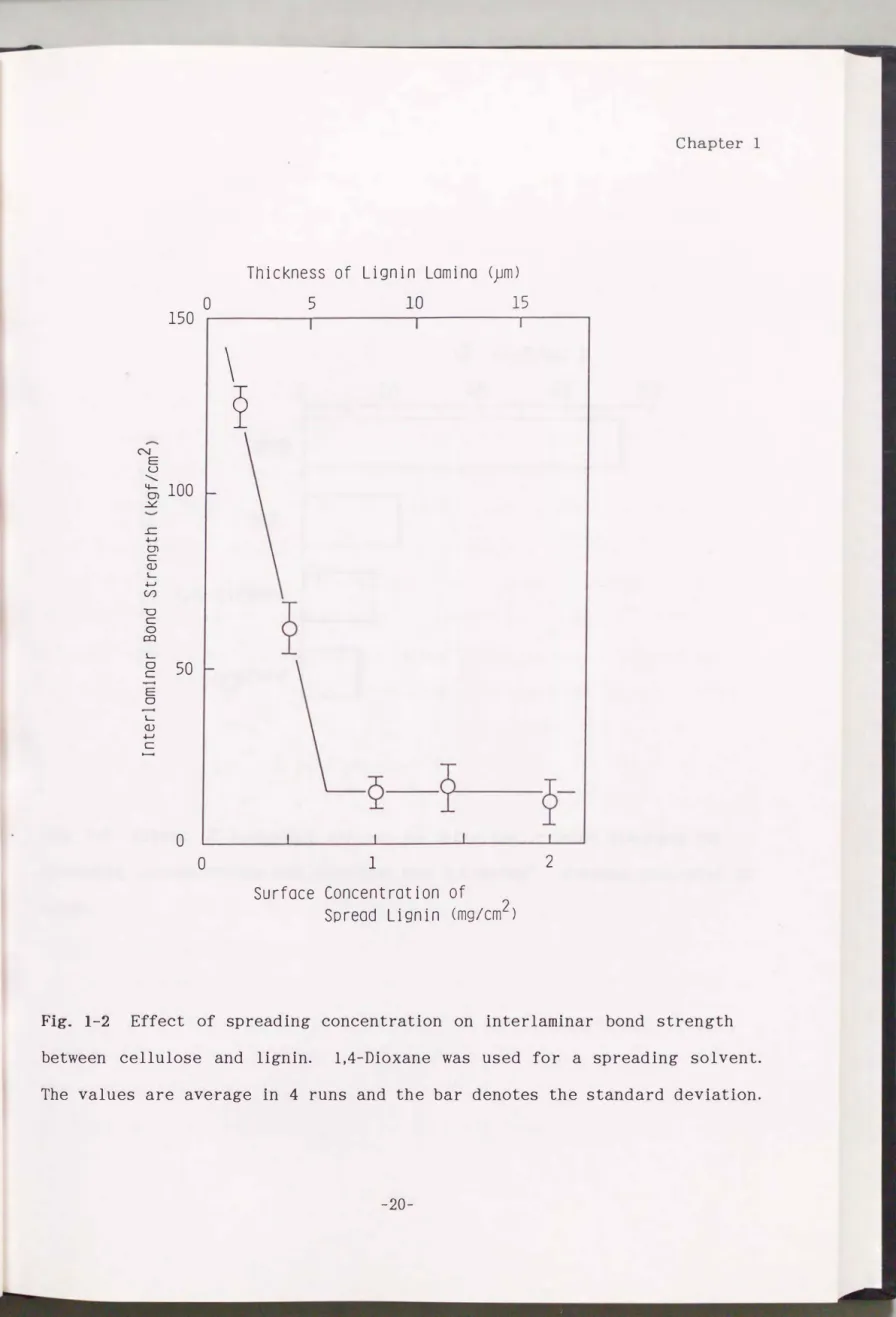
Figure 1-2 shows the apparent values of interlaminar bond strength
(a)
for lignin spread on cellulose surface at various spreading concentrations
(C).
The measurement error was within 7-10 kgf/cm2 as a standard deviation.It shows this method has a high reproducibility.
Double-layer was exactly decomposed at interface between cellulose and lignin above C = 1.0 rng/cm2• In consideration to decreasing in
C,
a wasindependent of spreading concentration from C 2.0 to 1.0 mg/cm2 while the detaching occurred at the interface. However,
a
suddenly increased with a decreasing in C. Consequently the cellulose film was destroyed at C = 0.2-17-
mg/cm2• This increase may be caused by invasion of the adhesive into
interface of the two polymers. Therefore, it was found that it is necessary to perform this experiment with C above 0.7 mg/cm2• The bending point, c = 0. 7 mg/cm2, is corresponding to about 6 �-tm of thickness estimated from the density data.
Therefore, following experiments were performed at C
Effect of solvent used for spreading
A check on any influence the solvent used for spreading has, is necessary for proceeding the following experiments. Figure 1-3 shows the value of CJ between cellulose and lignin spread by various sol vents, DMSO, DMF, 1,4-dioxane and acetone. Lignin is soluble in all solvents, but cellulose is not for all (See Table 1-3). The spreading concentration was identical and 1.4 mg/cm2 for all solvents.
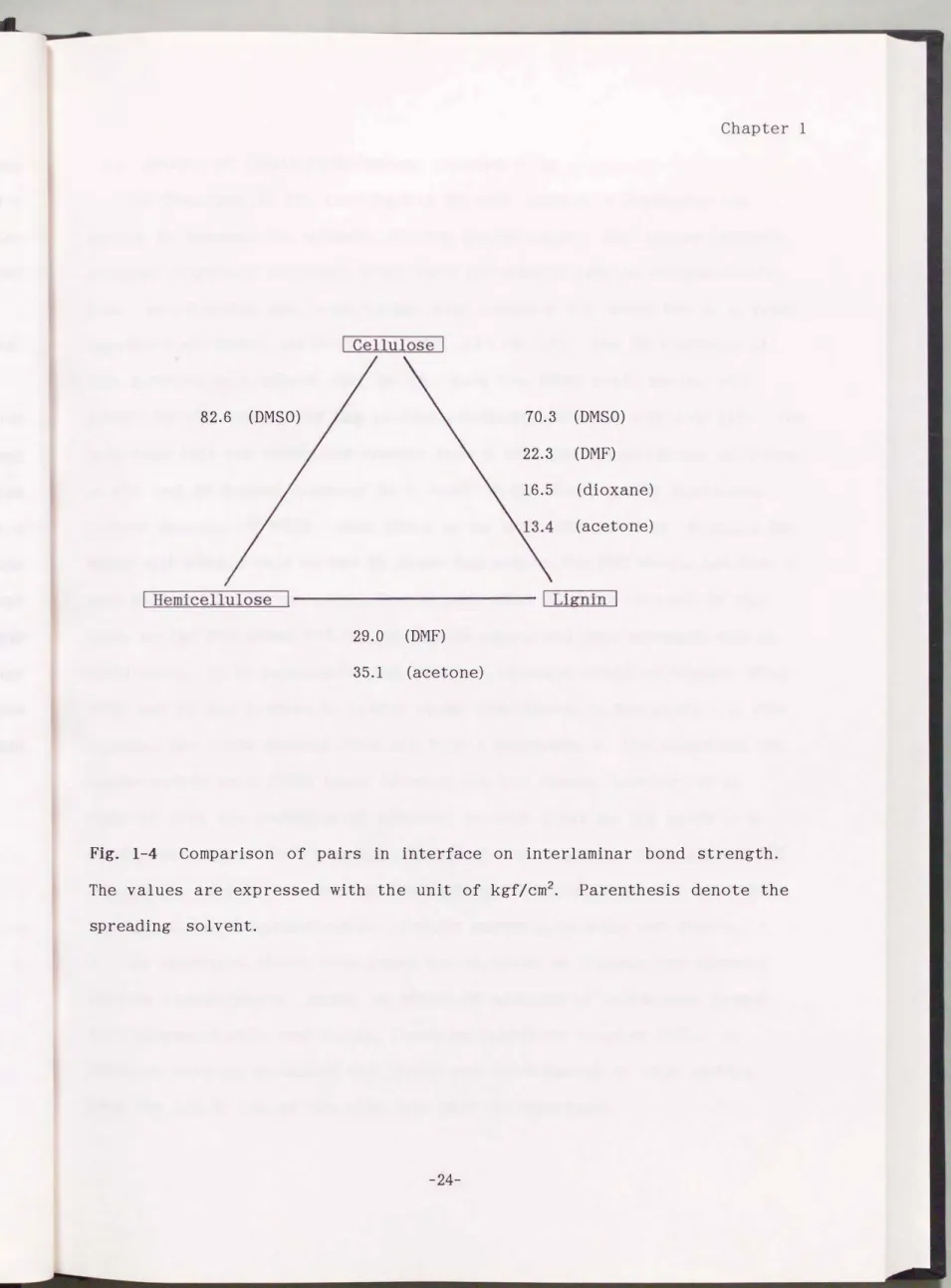
The obtained values of CJ were 70.3, 22.3, 16.5, 13.4 kgf/cm2 by DMSO, DMF, dioxane and acetone containing 5 % of water, respectively. The value of CJ was larger in DMSO than in other solvents. This cause is thought to be that the lignin penetrated in cellulose lamina since cellulose swells in DMSO. For other sol vents, the difference was little.
By this result, DMF, dioxane and acetone are selected for spreading solvents except when polymer is not soluble to these solvents and/or when the solvents perturb a primary lamina.
Chemical analysis of the detaching surface
The amount of lignin remaining on cellulose surface after detaching was examined by absorption at 280 nm. It was found that 0.16 mg/cm2 of lignin remained on cellulose side. As the lignin of 1.4 mg/cm2 was spread, the
-18-
remainder corresponded to 12 % on total lignin. The small amount of remainder indicates that the interlaminar bond strength can be in accord with the interfacial adhesion.
-19-
Thickness of Lignin Lamina <)Jm)
0 5 10 15
150
\ 2
N E u ...
�
100�
..c +.J CJ) c
<1.) L +.J (/) D c co 0 L 0 50
c 0 E L
<1.) +.J c
0
2-
0 1 2
Surface Concentration of Spread Lignin <mg/cm2)
Fig. 1-2 Effect of spreading concentration on interlaminar bond strength between cellulose and lignin. 1,4-Dioxane was used for a spreading solvent.
The values are average in 4 runs and the bar denotes the standard deviation.
-20-
0 20 80
I I I I l I I I
(J)
DMSO
c
• .---i
u 0 Q) L
0.
DMF
(/) L 4-0
+-'
1_,4-dioxone
c Q)
>
(/) 0
acetone
Fig. 1-3
Effect of spreading solvent on interlaminar bond strength (a).
Spreading concentration was identical and
1.4mg/cm2• Acetone contained
5%water.
-21-
1. 3. 3
Comparison of pairs in interfaceTo determine the influence of spreading solvents, u between cellulose and lignin was measured in Section
1.3. 2.
In this section, the other pairs are described. The values of u in different pairs are summarized in Fig.1-4.
In t e rf ace of c e l l u l o s e a n d li g n i n
As shown in Section
1.3. 2,
the a between cellulose and lignin was ca.20 kgf/cm2 except for samples prepared by DMSO solution.
Gupta e t a l. have shown the adhesion of lignin between two pieces of paper laminated by hot pressing
[45];
it was small at pressing temperatures below the glass transition temperature (Tg) of lignin, and increased above Tg. But its highest value was about1. 5
kgf/cm2 yet. This lower value, compared with present results may be caused by the surface roughness of cellulose, because paper surface is so rough compared to cellulosic film.Interface of cellulose and hemicellulose
Cellulose and hemicellulose have similar chemical structure with many hydroxyl groups. Therefore, it is expected that these polymers have strong adhesive force with each other. In fact, it is well known that a
hemicellulose contributes to the strength between pulp fibers in a paper sheet. Moreover, Marchessault et al. have shown the crystallinity of native and deacetylated xylan in the presence of cellulose by X-ray diffractometry, and expressed the deacetylated xylan oriented closely parallel to the
cellulose fiber axis
[35].
This behavior shows the high interaction between cellulose and hemicellulose.The value of a between cellulose and hemicellulose reached
82. 6
kgf/cm2-22-
and was the largest in this study. The cause may be large attractive
interaction, such as a hydrogen bond. But, we cannot know the influence of swollen cellulose on the adhesion, since hemicellulose is only soluble in DMSO and cellulose swells in this sol vent.
Interface of hemicellulose a.nd lignin
To measure the a between hemicellulose and lignin, a multilayer was formed by cellulose, hemicellulose and lignin, and tested. DMSO solution of hemicellulose was first spread on cellulose surface, and then DMF or acetone solution of lignin was spread on hemicellulose surface. The values of a
were 29.0 kgf/cm2 in DMF and 35.1 kgf/cm2 in acetone, respectively. Since the adhesion between cellulose and hemicellulose was strong, multilayer was detached at interface of hemicellulose and lignin. Hence, the a in this system refers to the adhesion between hemicellulose and lignin. In spite of various sol vents used for spreading, the a between hemicellulose and lignin was larger than between cellulose and lignin. Therefore, it was found that the affinity of lignin to hemicellulose is larger than to cellulose.
-23-
82.6 (DMSO) 70.3 (DMSO) 22.3 (DMF) 16.5
(dioxane)(acetone)
I
HemicelluloseI
LigninI
29.0 (DMF) 35.1
(acetone)Fig. 1-4 Comparison of pairs in interface on interlaminar bond strength.
The values are expressed with the unit of kgf/crn2• Parenthesis denote the spreading sol vent.
-24-
1.3.4 Effect of lignin-carbohydrate complex (LCC)
As described in the introduction of this chapter, a copolymer has ability to enhance the adhesion for its homopolymers. For rather obvious reasons, poly(vinyl chloride) (PVC) does not adhere well to natural rubber (NR). An effective and commercially used adhesive for these two is a graft copolymer of methyl methacrylate (MMA) onto NR [46]. The NR backbone of this material will adhere well to NR, while the PMMA graft chains will
adhere to PVC because of the partial miscibility of PMMA with PVC [ 47]. The reference [ 46] has shown the results from a 180" peel strength on laminates of PVC and NR bonded together by a layer of the above grafts containing various amounts of PMMA. When there is no PMMA, the adhesive is simply NR, which will adhere well to the NR sheet but not to the PVC sheet, and the peel strength would be zero. When a pure PMMA adhesive is used, it will stick to the PVC sheet but not to the NR sheet, and peel strength will be again zero. It is reasonable that the peel strength would be highest when PMMA and NR are present in nearly equal proportions in the graft. In this example, the graft clearly does not form a monolayer at the interface, but rather exists as a third phase between the two sheets; however, it is believed that the mechanism of adhesion to each sheet by the graft is a simple extension of this concept. The graft can adhere to both NR and PVC because its surface can present two different kinds of segments to promote wetting and/or interpenetration of chain segments between two phases.
As mentioned above, copolymers are expected to enhance the adhesion between homopolymers. Hence, an effect of addition of copolymers formed from polysaccharide and lignin, lignin-carbohydrate complex (LCC), on adhesion between cellulose and lignin was investigated in this section.
Here the LCC-2, one of the LCCs, was used to experiment.
-25-
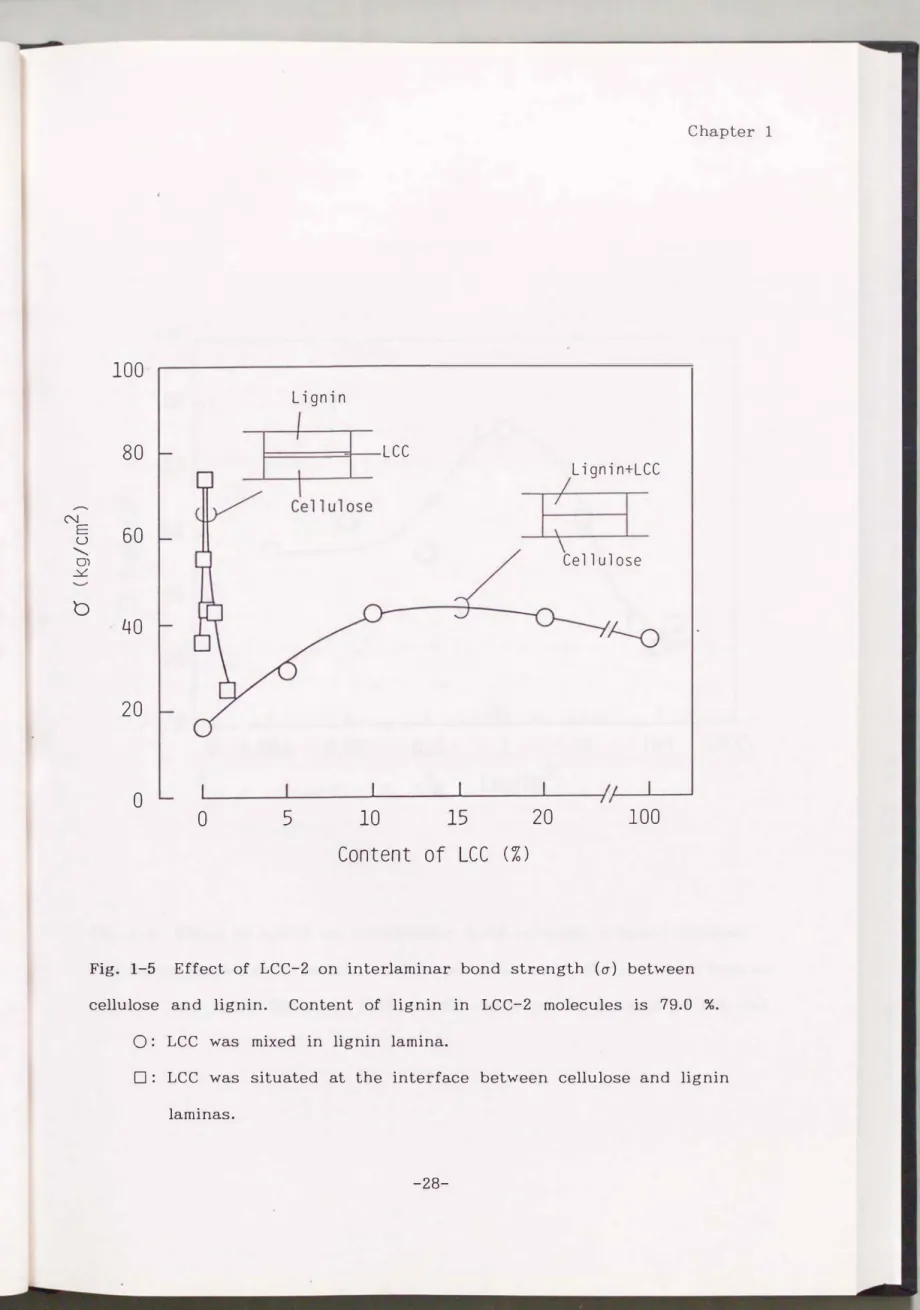
By these results, the a between cellulose and lignin was enhanced by the addition of LCC. Further, it was stronger with LCC situated at
interface than with that mixed in lignin lamina. It shows that the LCC works as a compatibilizer, such as an adhesive or a surfactant, between polysaccharides and lignin. Detail is shown in the following.
Effect of mixing of LCC in lignin lamina
Figure 1-5 shows the effect of the addition of LCC-2 on interlaminar bond strength between cellulose and lignin. Circles denote the results that LCC-2 was spread on cellulose surface by mixing with dioxane solution of lignin; surface concentration was identical to 1.4 mg/cm2• At no addition of LCC, a was ca. 15 kgf/cm2 as predescribed. However, a was increased with increase in LCC content up to 10 wt%. This increase of a may be caused by growing of affinity due to hydroxyl groups in LCC. However, a arrived at the limit of maximum, ca. 40 kg/cm2, at 10 % of LCC and not increased above this point. The cause of this limitation is thought to be the breaking of
mixing lamina of lignin and LCC based on the occurrence of micro phase separation in this lamina.
Effect of situated LCC at interface between cellulose and lignin
Next, the effect of situated LCC at interface between cellulose and lignin is described. For the purpose of enhancement of adhesion between two polymer laminas, it is enough for an adhesive to exist in only their
interface. If this situation develops, a small amount of the adhesive is necessary yet. To examine this image, a multilayer sample as sandwich
structure was observed; LCC was first spread on cellulose surface by dioxane containing 20 % water, and secondly lignin was spread on LCC surface by
-26-
acetone containing 5 % water. Since LCCs are insoluble in acetone, the spreading of lignin solution should not perturb the LCC lamina.
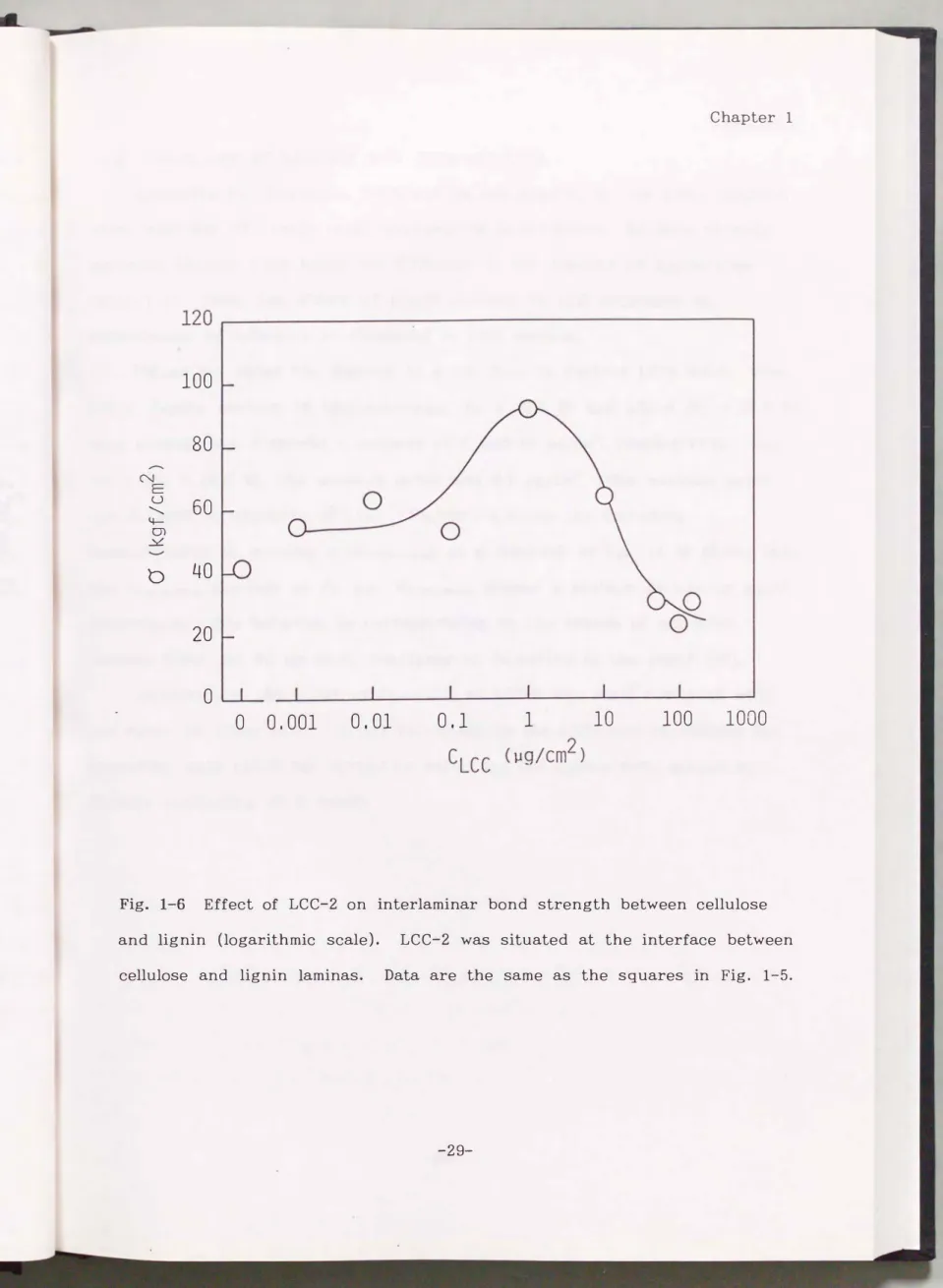
As the squares show in Fig. 1-5, the a increased with increase in LCC situated at the interface as it was when mixed into lignin lamina. However, it reached a maximum point at much smaller amount of LCC than when mixed into lignin lamina. It denotes the copolymer is effective for enhancement of adhesion with situating at interface of its homopolymers. Figure 1-6 shows the a as a function of spreading concentration of LCC
(CLcc);
data areexactly the same as squares in Fig. 1-5. The enhancement of CJ was
insignificant below
CLcc
= 0.1 11g/cm2• However, it increased atCLcc
= 1 tJg/cm2• It indicates the LCC works as an adhesive between cellulose and lignin which are homopolymers of LCC. From the enhancement of adhesion by LCC, it is expected that the LCC works as a compatibilizer betweenpolysaccharides and lignin.
-27-
100
80
N E u
60
'-..., ..Y 0)
b
. 40
20
0
0 5
Lignin
LCC
I I
10 15 20
Content of LCC (%)
Lignin+LCC
Cellulose
100
Fig. 1-5 Effect of LCC-2 on inter laminar bond strength (a) between cellulose and lignin. Content of lignin in LCC-2 molecules is 79.0 %.
0: LCC was mixed in lignin lamina.
0 : LCC was situated at the interface between cellulose and lignin laminas.
-28-
N E
100 80
� 60
4-CJ) .::L.
b 40 20
0
0 0.001 0.01 0.1 1 10 100 1000
Fig. 1-6 Effect of LCC-2 on interlaminar bond strength between cellulose and lignin
(
logarithmic scale)
. LCC-2 was situated at the interface between cellulose and lignin laminas. Data are the same as the squares in Fig. 1-5.-29-
1.3.5
Comparison of adhesion with different LCCsAccording to literature,
PMMAand
NRare adhered by the graft polymer, while only one of nearly equal proportions is effective. We have already prepared various LCCs which are different in the content of lignin (See Table
1-2).Thus, the effect of lignin content in LCC molecules on enhancement of adhesion is discussed in this section.
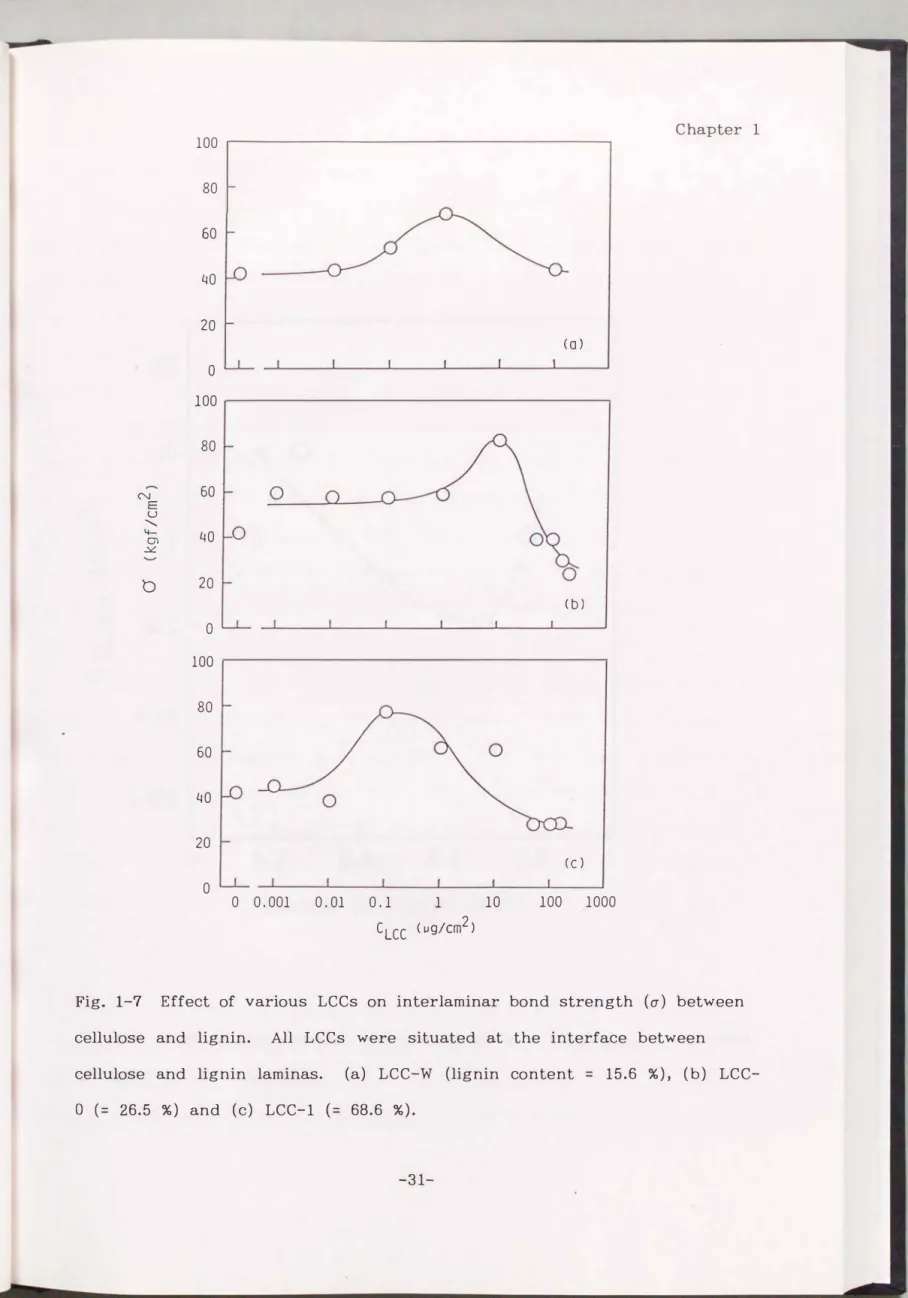
Figure 1-7 shows the diagram of
a us. CLccin various LCCs used. When LCC-W (lignin content in LCC molecules,
f2 =15.6 %) and LCC-0
(f2 =26.5 %) were spread, the
ashowed a maximum at 1 and 10 1Jg/cm2, respectively. For LCC-1
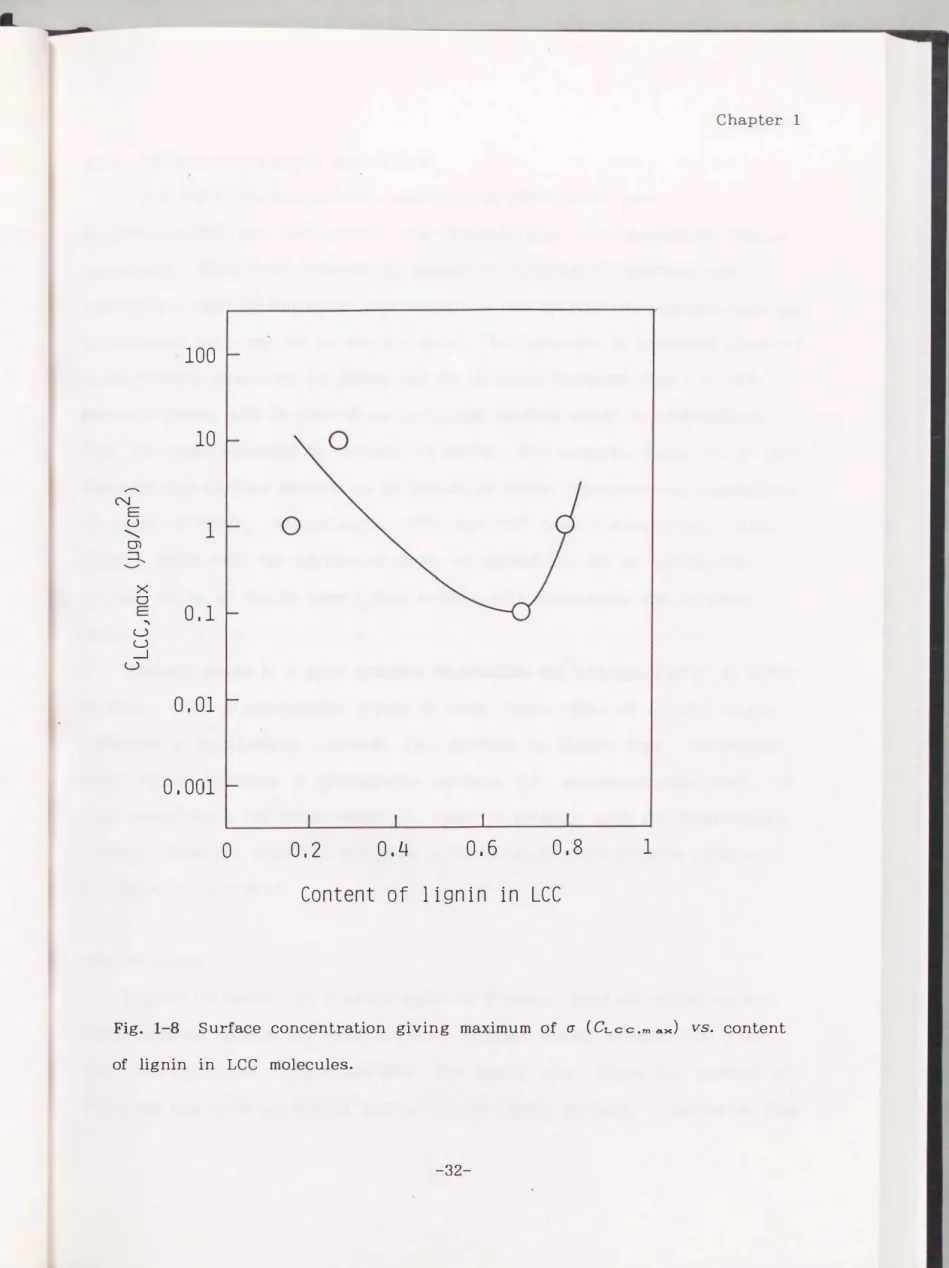
(f2 =68.6 %), the maximum point was 0.1 tJg/cm2• The maximum point was changed by changing of LCCs. Figure 1-8 shows the spreading
concentration at maximum
a ( CLcc.max)as a function of
f2.It is shown that the
CLcc.maxdepends on
f2, i.e., CLcc.maxshowed a minimum at nearly equal proportion. This behavior is corresponding to the system of adhesion
between
PMMAand
NRby their copolymer as described in the paper [46].
Incidentally, the point of
CLcc.maxat LCC-W was small compared with the curve by other LCCs. It may be caused by the influence of solvent for spreading; only LCC-W was spread by water and the others were spread by dioxane containing
20 % water.
-30-
80 60 40
20
(a) 0
100 80
N 60
u E ...
4-(j) 40
..::.:::.
b 20
(b) 0
100 80 60 40
20
(C) 0 0 0.001 0.01 0.1 1 10 100 1000
CLCC (1Jg/cm2)
Fig. 1-7 Effect of various LCCs on inter laminar bond strength
(
a)
betweencellulose and lignin. All LCCs were situated at the interface between
cellulose and lignin laminas. (a) LCC-W (lignin content = 15.6 %), (b) LCC- 0
(
= 26.5 %) and (c) LCC-1(
= 68.6 %).-31-
100
10
,-....
N E
u
1
...
(J) =t..
..., X 0
E "'\
0.1
u u u _j
0.01
0.001
0 0.2 0.4 0.6 0.8 1
Content of lignin in LCC
Fig. 1-8 Surface concentration giving maximum of a
( CL
c c .ma.x)
vs. content of lignin in LCC molecules.-3 2-
1.3.6 Surface analysis of spread LCC
Since LCCs are copolymers comprising of hydrophilic part
(polysaccharide) and hydrophobic one (lignin), they are amphiphilic like a surfactant. When such material is spread on hydrophilic surface, the
hydrophilic part of molecules may orient to the hydrophilic surface side and hydrophobic part may do to the air side. This behavior is commonly observed in surfactant molecules on water and in Langmuir-Blodgett film. In the present system, LCC is spread on cellulose surface which is hydrophilic.
Thus, the same behavior is thought to occur. For example, Inoue e t al. have observed the surface properties of blends of block copolymer and homopolymer by means of FT- IR, con tact angle, ESCA and 180' peel strength [ 49]. This section deals with the surface analysis of spread LCC by measuring the contact angle of liquid drop. This method well represents the surface state.
Contact angle is a good measure to examine the hydrophobicity of given surface. When a hydrophilic liquid is used, large value of contact angle
indicates a hydrophobic surface, i.e., surface is lignin rich. Conversely, small value indicates a hydrophilic surface, i.e., polysaccharide rich. In many researchers for measurement it, water is usually used for hydrophilic solvent. However, glycerol was used in the present work because LCCs are
insoluble to glycerol.
Contact angle
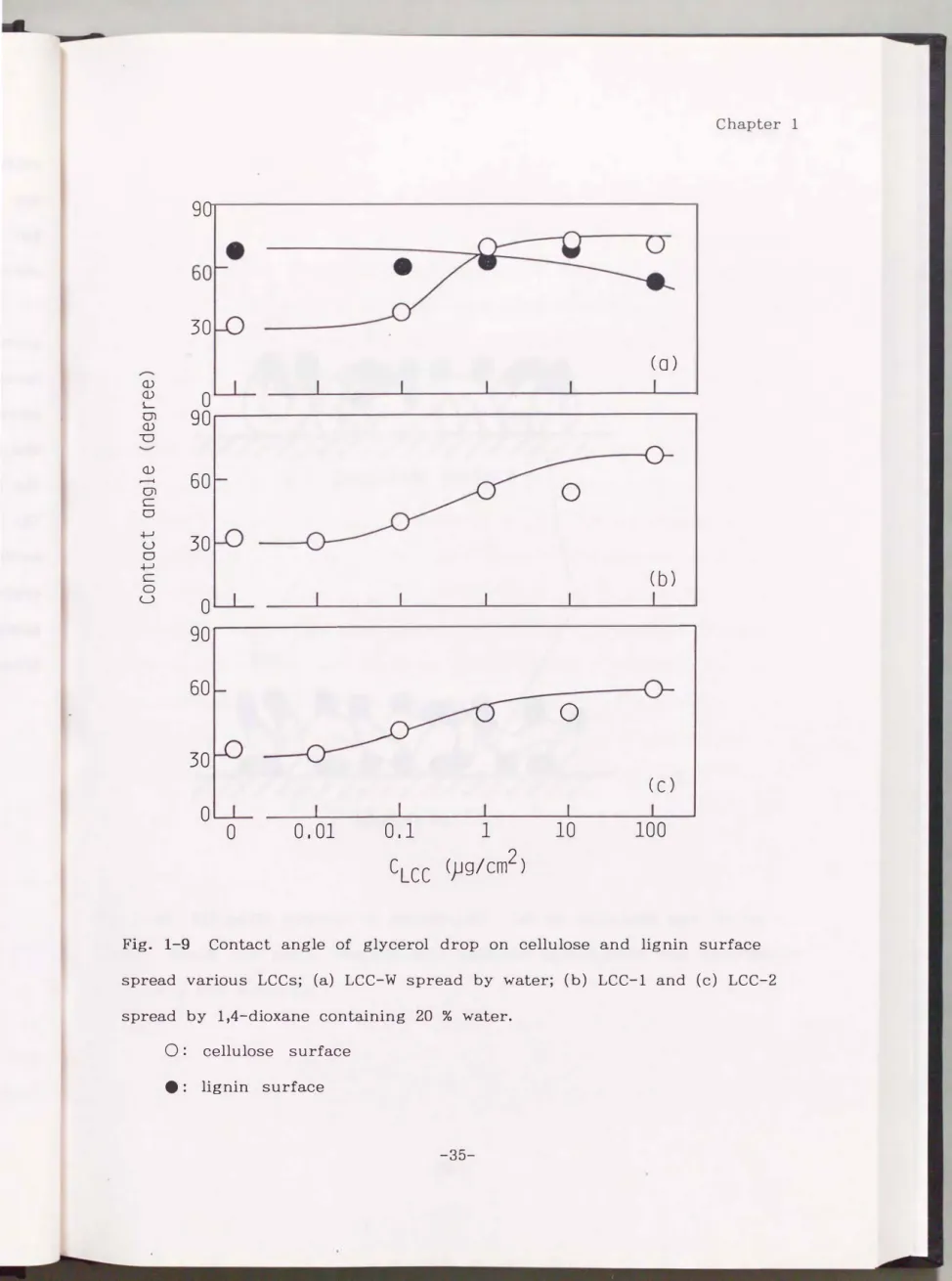
Figure 1-9 shows the contact angle of glycerol drop on cellulose and lignin surface spread the various LCCs. Contact angles without LCC were
32.5' for cellulose surface and 68.0' for lignin one. Since the surface of cellulose was more wetted by glycerol than lignin surface, it indicates that
-33-
cellulose is more hydrophilic than lignin. The contact angle of cellulose was changed insignificantly with spreading of LCC below CLcc = 0.01 1Jg/cm2, but increased at the region of CLcc from 0.1 to 1.0 1Jg/cm2• This region corresponds to the CLcc giving the increase of a shown to Fig. 1-6 and 7.
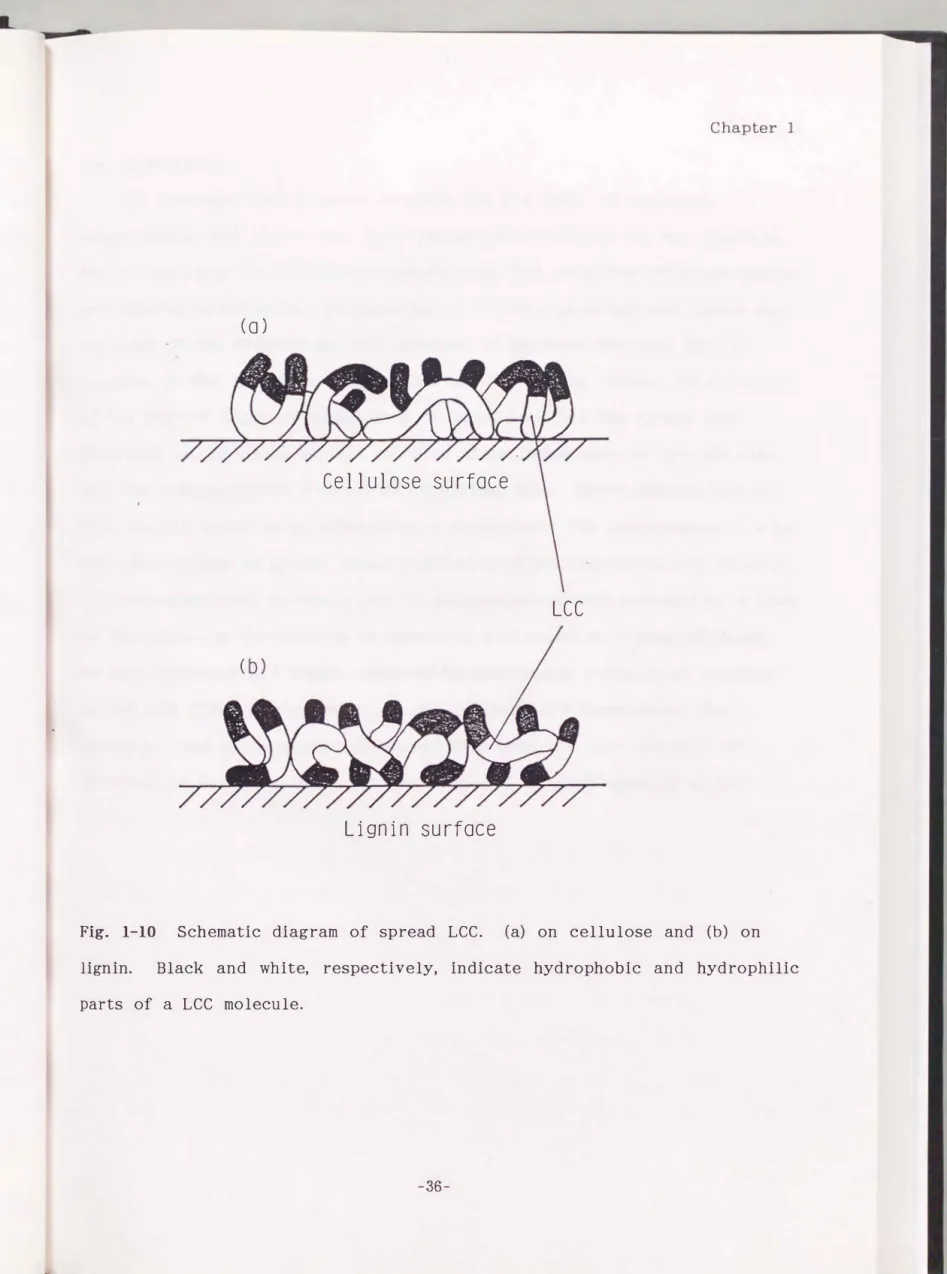
The increased values of contact angle were similar to that of lignin surface. Therefore, it was found that the hydrophilic surface of cellulose became a hydrophobic surface by spreading LCC. Since the steady values of increased contact angle were corresponding to the value of lignin surface, the surface of spread LCC was similar to the lignin surface. It means that the hydrophilic part in LCC molecules oriented onto the cellulose side and the hydrophobic part oriented to the air side. On the other hand, lignin surface was not changed to hydrophilic by spreading LCC, because the contact angles did not decrease. It may be caused by both lignin and air sides being hydrophobic, i.e., the hydrophobic part of LCC oriented to both sides.
Schematic diagram of this concept is shown in Fig. 1-10.
-34-
90
30
Co)
(])
(])
0
L
(J)
90
(]) -o
(])
60
�
en c 0
+-' u 0
30
+-' c 0
(b)
u
0
90
60
0
30
(C)
0 0 0.01 0.1 1 10 100
CLCC C)Jg/ cm2)
Fig. 1-9 Contact angle of glycerol drop on cellulose and lignin surface spread various LCCs; (a) LCC-W spread by water; (b) LCC-1 and (c) LCC-2 spread by 1,4-dioxane containing 20 % water.
0: cellulose surface e: lignin surface
-35-
(a)
Cellulose surface
LCC
Lignin surface
Fig. 1-10 Schematic diagram of spread LCC. (a) on cellulose and
(b)
on lignin. Black and white, respectively, indicate hydrophobic and hydrophilic parts of a LCC molecule.-36-
1.4 Conclusion
To determine the adhesive strength for the pairs of cellulose,
hemicellulose and lignin, the interlaminar bond strength (a) was measured.
The a was large for cellulose/hemicellulose, but small for cellulose/lignin and hemicellulose/lignin. Further, the a between cellulose and lignin was enhanced by the addition of LCC. However, it was more enhanced by LCC situated at the interface than by LCC mixed in lignin lamina. As a result of the contact angle of liquid drop, it was found that the spread LCC molecules on cellulose surface oriented their lignin part to the air side and the polysaccharide part to the cellulose side. These results indicate that the LCC works as an adhesive or a surfactant. The enhancement of a by LCC was stronger at nearly equal proportion of polysaccharide and lignin in LCC molecules than at lignin-rich or polysaccharide-rich proportion in LCCs.
As introduced in the General Introduction, LCC works as a compatibilizer between cellulose and lignin observed by the tensile strength of solution casted film [16]. In the report, a small amount of LCC enhanced the strength. The present results proved this behavior, i.e., adhesion of interface of cellulose and lignin was enhanced by small amounts of LCC .
-37-
Chapter 2
Differential Scanning Calorimetry Studies on Miscibility of Hemicellulose and Lignin Blends, and Effect of Adding of
Lignin-Carbohydrate Complex
2.1 Introduction
In Chapter 1, it was found that the adhesion between polysaccharides and lignin is weak. Immiscibility of these polymers in the interface region is considered to be the cause.
Most polymer pairs do not show mutual miscibility due to the small entropy change of mixing for long polymer chains and the change in positive energy of mixing as is usually observed between polymers. Ordinary polymers are immiscible without specific interaction between segments of polymers such as a hydrogen bond [50-52].
Numerous techniques are used to determine whether single phase or multiphase polymers are formed. For example, thermal analysis, morphology and spectroscopy [52,53]. A quick, but not totally reliable method is by transparency. Discontinuous domains in polymer blends are often large enough to refract light, forming a translucent or opaque blend when two transparent polymers are mixed. In a miscible one-phase blend of two amorphous polymers, no domains are present to refract light, and hence the blend may be transparent. However, lignin is colored with deep brown, so the transparency is not useful to this work.
The most commonly used method for establishing miscibility in polymer-
-38-
polymer blends or partial phase mixing in such blends is through
determination of the glass transition (or transitions) in the blend vs.
those of the unblended constituents [50-52]. The glass transition temperature (Tg) of a polymer is the temperature at which the molecular chains have sufficient energy to overcome attractive forces and move vibrationally, and translationally. The number and location of the Tgs provide much insight into the nature of a polymer blend. For example, a miscible one-phase blend should have only one Tg, whereas a two-phase blend should have two glass transitions, one for each phase. The Tg is usually determined by differential scanning calorimetry (DSC).
On the other hand, while even a polymer pair is not miscible in general conditions, there are many reports for miscibility of it, by changing the temperature and by adding a compatibilizer. In this chapter, the
miscibility between hemicellulose and lignin, and the effect of adding of LCC on it by the data of Tg observed by DSC were discussed. Furthermore, the degree of miscibility is estimated by thermodynamical analysis, namely, the calculation of composition ratio in each phase, and the estimation of the Flory polymer-polymer interaction parameter (X12) [24] between them.
-39-
2.2 Experimental 2.2. 1 Materials
Hemicellulose, lignin and LCCs were prepared from wood meal of beech (Fagus crenata Bl.) as described in Chapter 1.
2.2.2 Preparation of blend film
A 20 �1 solution of 5 wt% polymer in DMSO was put in an aluminium pan and vacuum dried for 3 days at 60 · C.
2.2.3 Determination of miscibility
A differential scanning calorimetric (DSC) measurement was adopted to evaluate the glass transition temperature (Tg) of binary or ternary polymer blends. Tgs were measured by using SSC-5000 made by Seiko Industry Co., Ltd. (Japan) at a constant heating rate of 20 · C/min.
Some samples were annealed before measurement to be equilibrated;
sealed aluminium pan was incubated at 220 · C for 3 minutes in an oven and slowly cooled to room temperature.
To determine the phase diagram, the quenching method [ 54,55] was used.
Sealed aluminium pan was incubated at prescribed temperature for 30 min and quickly cooled to -25 · C. By this method, samples were frozen keeping the state at high temperature.
-40-
2.3 Results and Discussion
2.3.1 Glass transition temperature of isolated polymers
concept of glass transition temperature
When a polymeric material is cooled from the liquid or rubbery state, it becomes much stiffer as it goes through a certain temperature range.
This stiffening is the result of one of two possible events: crystallization or glass transition. For crystallization to occur, the polymer molecules must be sufficiently regular along their length to allow formation of
crystalline lattices, and the cooling rate must be slow enough for the crystallization process to take place before the molecular motions become too sluggish. When the polymer fails to crystallize for either reason, the amorphous, liquid-like structure of the polymer is retained, but the
molecular motion becomes frozen and the material turns into a glass. The melting temperature (Tm) and the glass transition temperature (Tg) are the two most important parameters of a given polymer which characterize its properties over a wide temperature range [56].
Glass transition phenomena are generally believed to be associated with rotational or translational motions of polymer segments which are either directly thermally activated or made possible by the removal of existing restraining bonds [57,58]. Lignin, hemicellulose, and the amorphous component of wood cellulose are all viscoelastic materials and can be expected to exhibit a glass transition and possibly other transitions
[59,60]. However, their Tm are not observable because decomposition occurs.
Homopolymers (hemicellulose and lignin)
Thermal behavior of original samples was characterized in this section.
-41-
As hemicellulose and lignin are amorphous polymer [34], glass transition behavior appears in some thermal analysis. Tg is usually measured by using differential scanning calorimetry (DSC) utilizing the thermal change of volume expansion coefficient. However, measurement of Tg, in particular for hemicellulose, is difficult because of its little change of volume
expansion. Thus, the differential value on temperature of DSC curve is applied in this experiment. A differential DSC (D-DSC) is defined as dQ/dT where Q is quantity of exo- or endo-thermic calory and T is temperature. D
DSC chart is good for appearance of Tg of polymer [54].
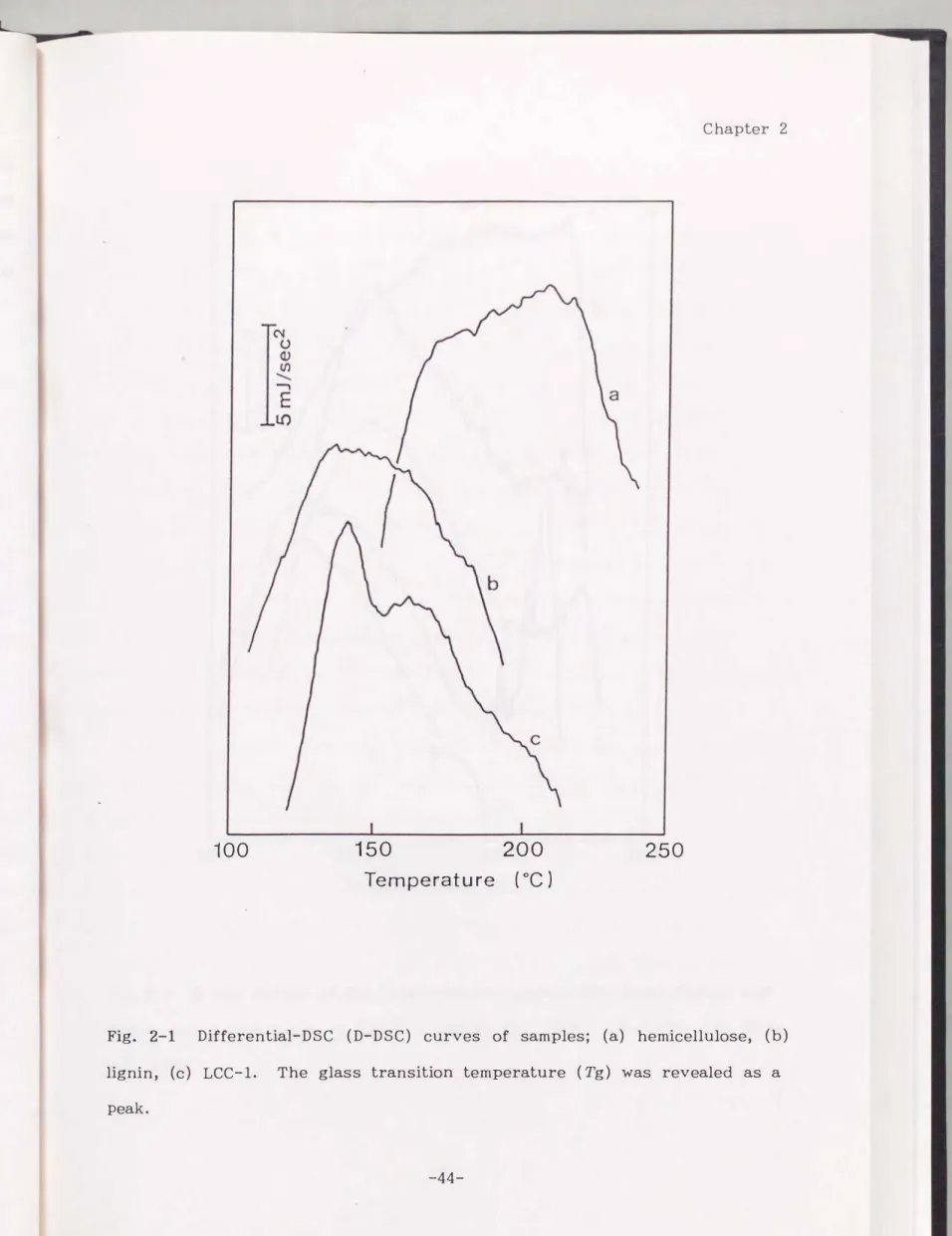
The D-DSC curves of hemicellulose and lignin are shown in Fig. 2-1a and b. As both hemicellulose and lignin are amorphous polymers, one Tg was observed in D-DSC curve, i.e., only one peak appeared. The values of Tg were 209 · C for hemicellulose, and 131 · C for lignin. Observed values of Tg are corresponding to those in literature [61,62]. Transition temperature regions were so wide. It may be caused by its wide polydispersi ty.
Lignin-carbohydrate complex (LCC)
The D-DSC curve of LCC-1 (Fig. 2-1c) shows three peaks, i.e., at 141, 162 and 205 · C. The lowest and highest values are corresponding to lignin and hemicellulose, respectively. The middle value, 162 · C, may be of
miscible domain, because the value is middle of its homopolymers. Graft and block copolymers easily form the micro phase separation, and consequently micro domain structure. Hence, these three Tgs will denote the domain of lignin, mixture and hemicellulose. As shown in later (Section 2.3.5), this micro phase separation was disappeared by heat treatment.
Several reports concerning the thermal behavior of LCC were published.
Tanahashi et al. [63] have shown the thermal softening temperature (Ts) of
-42-
synthetic LCC from coniferyl alcohol, and mannan or xylan by dialysis membrane method with peroxidase. The Ts corresponds to Tg. In their
results, it was found that the synthetic LCCs have double Ts based on lignin and polysaccharides.
-43-
100 150 200 Temperature ( oc)
250
Fig. 2-1 Differential-DSC (D-DSC) curves of samples; (a) hemicellulose,
(b)
lignin, (c) LCC-1. The glass transition temperature ( Tg) was revealed as a peak.
-44-
100 150 200 250 Temperature { oc)
Fig. 2-2 D-DSC curves of the binary-blends system with hemicellulose and lignin;
(
a)
hemicellulose : lignin = 90:10,(
b)
75:25,(
c)
50:50,(
d)
25:75,(
e)
10:90.-45-
2.3.2 Binary-blends system of hemicellulose a.nd lignin
As described in Chapter 1, the adhesion between polysaccharides and
lignin was weak. It is thought that these polymers are not miscible because of their small affinity.
In a simple and usually reliable method for determining whether a blend system is miscible, the glass-transition behavior is examined by thermal, mechanical, dielectric, or similar techniques. As the glass transition value is inherent in the property characteristics (e. g., viscosity,
crystallization kinetics, thermomechanical properties) of a material, the existence of a single and sharp, single and broad, shifted, or individual transition for a blend reveals the macroscopic property of the blend. Thus, while there may exist debate concerning the level of molecular mixing, the glass transition behavior of the blend will remain an extremely important character. Miscible blends show a single, composition-dependent glass
transition, reflecting the mixed environment of the blend; two-phase blends, on the other hand, show two characteristic Tgs of each phase.
Numerous experimental studies of phase behavior using bulk properties such as glass-transition have demonstrated that many polymer blends exhibit neither true two-phase behavior nor single-phase behavior. From these
intermediate cases, two classes of behavior can usually be constructed: two
phase structure where both phases con tain different and finite concentrations of each component, as revealed by Tg values shifted
significantly from the pure-component values. This intermediate behavior is well known as a "partial miscibility" in which polymers mutually dissolved in other polymer-rich phase while the Tgs approach each other but do not become identical [64].
-46-