Organizing Information Transmission with Multiple Agents
March 9, 2009
Kazumi Hori (WIAS, Waseda University)
Waseda Institute for Advanced Study (WIAS) 1-6-1 Nishiwaseda, Shinjuku-ku, Tokyo 169-8050, Japan Tel: +81-3-5286-2460 ; Fax: +81-3-5286-2470
Abstract
Information is indispensable for making good decisions. Although agents are pri- vately informed, each agent knows only a fraction of the total information. This paper analyzes the decision and communication procedures in a multi-agent situation. For most of the paper, I compare two procedures, Hierarchical Communication and Hori- zontal Communication. In an environment where the principal cannot commit to her de- cision rule, Hierarchical Communication dominates Horizontal, since the latter induces agents to manipulate large amounts of information. A comparison with Delegation, another type of procedure, is also provided.
KEYWORDS: Information transmission, Commitment, Multiagent, Hierarchy.
JEL Classification:D23, D82, L22
Tel: +81-3-5286-2105
Email address: [email protected]
1 Introduction
This paper deals with the issue of optimal procedure for information transmission in a multiagent situation. Much of the information used in decision making is dispersed within agents and they are often much better informed than a principal. However, each agent knows only a fraction of the relevant information. I study what kind of communication procedure induces good decision making under such environment. This paper develops an economic theory of strategic information transmission within the multiagent framework.
Consider the executive of a video game machine company such as Play Station, X-box and Nintendo, who has to make a decision about the quality of new model. She has a variety of projects, from a very simple model, which can play only the game, to a high-grade model, such as one can be used as DVD player or Internet. Yet she can choose only one project because of the cost of development. The profit from each project depends on the needs of consumers worldwide. There are several regional subsidiaries. Each regional subsidiary is informed about the needs of its own market but not about others. When the executive collects information form the subsidiaries, there is the problem that she cannot elicit true information because of the existence of an incentive conflict. Even when consumers prefers the simple model, there is a possibility that the manager report untruthfully, because, for example, their pay is increasing in not only the profit of the entire firm, but also the sales in their own market, and the high-grade model is easy to market so his expected profit is higher when he report untruthfully than when he report truthfully. When such an incentive conflict exists, how should the executive design the communication procedure in order to collect information from the subsidiaries?
To study the problem of strategic information transmission, I adopt a simple model, an extension of Crawford and Sobel (1982). Specifically, I consider the two-agent1 situation.
Each agent observes different and independent information. Each observation partially informs about the realization of the state of nature. An agent sends a message about his observation to the principal following a predetermined procedure. The principal then makes a decision. The agents have an incentive to manipulate information because their objectives
1‘She’ refers to the principal and ‘he’ refers to the agents.
are different from that of the principal. The difference in objectives between the principal and the agents is systematic and predictable. This difference is called bias and is common knowledge for all parties. Since the agents manipulate messages, the principal will not rubberstamp the agents’ message but try to correct for the bias in objectives. When agents anticipate this, the information transmission becomes strategic: each agent manipulates information to achieve his self-interest by sending virtually the same message for different observations, the agents partition the support of the state of nature. By communication, the principal cannot identify the true state of nature, but he can identify a partition in which the true state of nature lies.
For most of the paper, two different procedures,Horizontal CommunicationandHierar- chical Communication, are compared. In Horizontal Communication, all agents send their messages directly and independently to the principal. In both Communication procedures, the principal makes a decision. In Hierarchical Communication, an agent in a lower tier of the hierarchy sends messages to the agent in an upper tier of the hierarchy, then the agent in an upper tier of the hierarchy sends message to the principal. Each agent manipulates messages anticipating not only the principal’s reaction but also another agent’s manipula- tion. The difference between the two procedures arises from the difference in agent’s beliefs about another agent’s and the principal’s behavior.
P
A B
P P
A A
B B
Horizontal Communication
Hierarchical Communication Delegation Figure 1:
In this paper, I assume that the principal cannot commit to her decision rule as a function of any message from the agent. The lack of commitment would result from the difficulty with contracting on action or messages. Non commitment implies ‘the ex-post optimality’: the principal will take action that would be in her best interest ex-post. The agents anticipate the ex-post optimality and send the message. The ex-post optimal behavior does not always motivate the agents to send message truthfully. This contrasts with the Revelation Principle setting in which the principal can commit to her decision rule. In the Revelation Principle, the principal commits and chooses the decision rule which is optimal ex-ante, although it is not optimal ex-post.
I show that Hierarchical Communication dominates Horizontal Communication. The key to the analysis is that how the agent anticipates the principal’s ex-post optimal behavior.
When the agent believe that the principal reacts in a way that the agent prefers, the agent does not need to curve his report to shift the principal’s behavior. Thus, the principal can receive accurate information.
In Hierarchical Communication, the principal communicates with only one agent. The agent, to achieve his self-interest, partitions the support of the state of nature. The dis- advantage is that the principal cannot directly communicate with the agent in the lower tier, so she can only receive aggregated messages about the state of nature and there is distortion in the quality of information due to the communication between the agents. Yet an advantage is that the intermediate agent internalizes all agents’ manipulation; the agent gathers valuable information, so the principal reacts well to the agent’s message. The agent can achieve his self-interest by modest level of information manipulation.
Horizontal Communication has the advantage in that the principal can receive separately identified messages about the state of nature. However, this advantage is outweighed by the disadvantage that the agents manipulate information more than in Hierarchical Communi- cation. The information of one agent has only a fraction of importance for the principal and the effect of manipulation is proportional to its importance because of the principal’s ex-post optimality. Then, in order to achieve his optimal objective, an agent needs to ma- nipulate information largely. When an agent manipulates information, he anticipates the
effect from another agent’s manipulation. However, an agent does not know about another agent’s observation, he does not expect any effect form another agent’ manipulation. There- fore he tries to achieve his self-interest entirely through his own manipulation. The agents tend to over-exaggerate.
Another topic related to information transmission concernsDelegationas an alternative procedure to Communication. In Delegation, the principal neither communicates with the agents nor makes the decision, but delegates her decision rights to one of the agents, so the agent makes the decision after he communicates with the other agent. The advantage of delegation is that there is no distortion of information by communication between the principal and the agent. So the information is fully utilized. The disadvantage is that the agent’s decision is biased. Dessein (2002) shows that Delegation dominates Communication as long as bias is small. Although his model assumes that there is only one agent, I apply his analysis in my model and shows Hierarchical Communication dominates Delegation for large bias.2
There are three types in literatures studying the design of communication channel.
The first approach assumes the commitment of the principal and applies the framework of the Revelation Principle.3 Under a certain set of assumptions, this principle implies that Horizontal Communication cannot be strictly dominated by Hierarchical Communication, because the outcome of hierarchy can be replicated by commitment in Horizontal Communi- cation. McAfee and McMillan (1995) provide an example where Hierarchy is never optimal, due to a double marginalization of information rent, which arises from the monopoly power of the intermediate agent over their information. This is often referred as ‘loss of control.’
In contrast, Gilbert and Riordan (1995), Melumad, Mookherjee, and Reichelstein (1995) and Severinov (2003) provide conditions under which Hierarchy is an optimal procedure. In their paper, when agents are providing complementary inputs and the principal can design the sequence of contracting, Hierarchical structure is optimal. The second approach as-
2When the bias is large enough, Communication is uninformative but dominates Delegation.
3See Mookherjee (2003) for overview. This paper precludes the use of side payments by the nature of the model. See Laffont and Martimort (1998) and Baliga and Sj¨ostr¨om (1998) for models of collusion and organizational structure.
sumes non-commitment of the principal. Krishna and Morgan (2001) and Battaglini (2002) consider a situation in which the agents observe the same information. Wolinsky (2002) studies a model with two agents who possess different and independent information, which is the closest to my scenario. However, the problem of designing an optimal communica- tion channel is not studied. Bester and Strausz (2001) extend the revelation principle to environments in which the principal cannot fully commit to the mechanism. However, their result is restricted to the single agent situation. The example that a direct mechanism may no longer be optimal with multi-agents is discussed in Bester and Strausz (2000). The third approach is different from the other two approaches. This approach assumes no incentive conflicts between the principal and the agents, but that there exits information processing costs. This approach has been pursued by Radner (1993), Bolton and Dewatripont (1994), van Zandt (1997) and Garicano (2000) among others.
The paper is organized as follows: Section 2 describes the model. Section 3 analyzes the case in which the principal can commit to her action as a benchmark. Section 4 characterizes the equilibrium for both Hierarchical and Horizontal Communication. Section 5 analyzes the optimal procedure for communication when the agents are homogeneous. Section 6 discusses the case where the agents are heterogeneous. Section 7 compares Communication and Delegation and Section 8 concludes. All proofs are in the appendix.
2 The Model
My model has one principal,P, and two agents,AandB. The principal has the opportunity to select a project. There are infinitely many potential projects, but only one project can be undertaken. Each project can be represented by a real number y ∈ R. The value of a project depends on the state of nature, θ, which P cannot observe. A observes a signal α and B observes a signal β. α and β represent some partial amount of information of θ, say θ=θ(α, β). θ: [0,1]2 → [0,1] is increasing and continuous in bothα and β. I assume thatα (β) has a distribution function F(α) (G(β)), differentiable almost everywhere, with support [0,1]. α is A’s private information andB cannot observe this and vice versa.
Preferences. P has a von Neumann-Morgenstern utility function UP(y, θ) =−(y−θ)2.
P has an unique utility maximizer at y=θ.
The agent l’s (l = A, B) preference is represented by the von Neumann-Morgenstern utility function
Ul(y, θ, cl) =−(y−(θ+cl))2, cl>0.
whereclis a parameter of dissonance betweenP andl, in other wordscl may be thought of as the bias of the agent.4 The utility function of agentl is maximized fory =θ+cl. There are no monetary transfers between P and the agents.
cA and cB are assumed to be greater than zero in order to capture the idea that agents have similar biases because they are in a similar environment.5 Recall the example of the video game machine maker, where both regional subsidiaries prefer the high-grade model. The utility functions and distribution functions of the random variables are common knowledge.
The timing of the decision making process is as follows:
1. The principal chooses a decision/communication procedure from Hierarchical Com- munication,Horizontal Communication andDelegation.
2. The agents learnα andβ and send a message to the higher rank following the proce- dure chosen by the principal.
3. The player who holds decision rights chooses the project.
The equilibrium concept used is Perfect Bayesian Equilibrium.
4It is worth noting that biases are often endogenous. They arise as a result of incentive schemes under imperfect and incomplete information. The wage of the regional subsidiary, for example, is contingent on the sales on his own market and not on the profit of entire firm, because his effort level is unobservable.
However, in order to simplify the analysis, I assume that the bias is exogenous.
5The results of this analysis also hold whencl<0.
3 Benchmark: the Principal can commit to a decision rule
In this section, I consider the benchmark case that the principal can commit to a decision rule.
Proposition 1. When the principal can commit to a decision rule, Horizontal Communi- cation dominates Hierarchical Communication and Delegation.
Proof. All the proofs are in the appendix.
The implication is that, under Horizontal Communication, the principal can implement the outcome of Hierarchical Communication and Delegation. In general, Hierarchical Com- munication and Delegation are strictly dominated by Horizontal Communication, because the principal loses control over the agent.
4 Equilibrium
In this section, the equilibrium of both Horizontal and Hierarchical Communication is char- acterized. When no commitment, P always undertakes the project which maximizes her expected utility conditional on her beliefs about the state of nature. Hence, agents achieve manipulation by changing the beliefs of the principal. Crawford and Sobel (1982) first stud- ied this problem. They show that, in a single agent and single information model, the agent sends virtually the same message for different observations, so partitions the support of the state of nature in the equilibrium. I follow their work and investigate how each procedure affects the beliefs and incentives for manipulation.
4.1 Hierarchical Communication
Assume cA = cB = c for simplicity.6 Under this assumption, the agents communicate truthfully. Hence the model is equivalent to the single agent model. Consider that A observes private informationθwhose distribution function isH(θ) and that the equilibrium is characterized by a message ruleµ(k|θ) for the agent, where for every θ∈[0,1], µ(k|θ) is
6Heterogeneous case will be discussed later in this paper.
the conditional probability of sending messagek given stateθ, and a decision ruley(k) for P.
Crawford and Sobel show that each Bayesian equilibrium has the following structure.
The state space is partitioned into K intervals T ≡(t0 = 0, t1, . . . , tK−1, tK = 1). Define ex-post optimality ofP,
y(ti−1, ti)≡
arg max∫ti
ti−1UP(y, θ)dH(θ) if ti−1 < ti,
ti if ti−1 =ti.
Proposition 2. (Crawford and Sobel: Theorem 1) If c ̸= 0, then a positive integer K(c) exists such that, for every K with 1 ≤ K ≤ K(c), at least one equilibrium (y(k), µ(k|θ)) exists,
µ(k|θ) = 1 if θ∈(ti−1, ti) f or some k∈(ti−1, ti),
UA(y(ti, ti+1), ti) = UA(y(ti−1, ti), ti) (i= 1, . . . , N−1), (1) y(k) = y(ti−1, ti) if k∈(ti−1, ti).
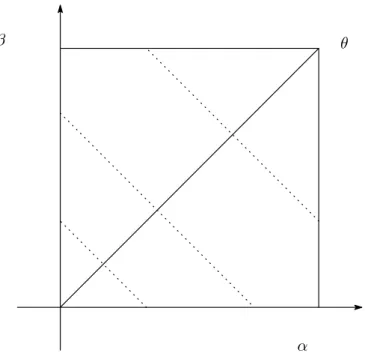
Figure 2 demonstrates the idea of information partition. The information partitions are given by contour lines. A partition equilibrium is due toA’s effort to shiftP’s choice of the project by c. Since P chooses project ex-post optimally, A can achieve his manipulation by sending virtually the same message for different observations and changing the beliefs of the principal so changingy(ti−1, ti).
In general, there are multiple equilibria. In this paper, I often refer to the equilibrium with the largest partition elements.7 The level of manipulation is increasing in bias,c. When bias is sufficiently large, the unique equilibrium has single information partition element, thus the communication is ‘uninformative’. The smaller bias is, the more ‘informative’
communication becomes. Spector (2000) shows that, in the limit, the largest number of partition elements goes to infinity, so communication is perfect for any distribution.
7Kartik (2005) considers the “almost” cheap talk game in which there is the cost of misreporting. His equilibrium converges to the equilibrium with the largest partition elements in CS when this cost goes to zero. The equilibrium with the largest partition elements can satisfies his “No Incentive to Separate (NITS)”
condition.
θ
α β
Figure 2: Information Partition in Hierarchical Communication.
4.2 Horizontal Communication
When considering the case of Horizontal Communication, the assumption that cl > 0 is reapplied.8 A message rule forAis denoted byµA(n|α), where for everyα ∈[0,1],µA(n|α) is the conditional probability of sending messagengiven stateα. ForB, the corresponding conditional probability is µB(m|β). The principal’s decision rule is given by ¯y(n, m).
The Bayesian equilibrium of this model is also a partition equilibrium. Let A ≡(a0 = 0, . . . , aN = 1) andB ≡(b0= 0, . . . , bM = 1). Define the ex-post optimality ofP such that,
¯
y((ai−1, ai),(bj−1, bj))
≡
arg max∫ai
ai−1
∫bj
bj−1UP(y, θ(α, β))dG(β)dF(α) if ai−1 < ai and bj−1< bj, arg max∫bj
bj−1UP(y, θ(ai, β))dG(β) if ai−1 =ai and bj−1< bj, arg max∫ai
ai−1UP(y, θ(α, bj))dF(α) if ai−1 < ai and bj−1=bj,
θ(ai, bi) if ai−1 =ai and bj−1=bj.
8AssumingcA=cB=cmay simplify the problem and does not lose the implication.
The proposition 3 characterizes the equilibrium.
Proposition 3. (The equilibrium of Horizontal Communication Model) If cl ̸= 0, then there exists an equilibrium(¯y(n, m), µA(n|α)), µB(m|β) with some positive integers (N, M) where,
µA(n|α) = 1 if α∈(ai−1, ai) f or some n∈(ai−1, ai), µB(m|β) = 1 if β∈(bj−1, bj) f or some m∈(bj−1, bj),
−∑M
j {G(bj)−G(bj−1)}∫bj
bj−1UA{y((a¯ i−1, ai),(bj−1, bj)), θ(ai, β)}dG(β)
=−∑M
j {G(bj)−G(bj−1)}∫bj
bj−1UA{y((a¯ i, ai+1),(bj−1, bj)), θ(ai, β)}dG(β) (i= 1, . . . N−1),(2)
−∑N
i {F(ai)−F(ai−1)}∫ai
ai−1UB{y((a¯ i−1, ai),(bj−1, bj)), θ(α, bj)}dF(α)
=−∑N
i {F(ai)−F(ai−1)}∫ai
ai−1UB{y((a¯ i, ai+1),(bj−1, bj)), θ(α, bj)}dF(α) (j = 1, . . . M−1),(3)
¯
y(n, m) = ¯y((ai−1, ai),(bj−1, bj)) if n∈(ai−1, ai), m∈(bj−1, bj).
At least one equilibrium withN =M = 1 exist.
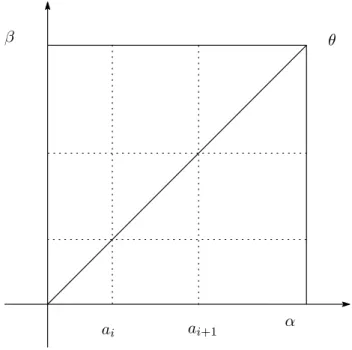
θ
ai ai+1 α β
Figure 3: Information Partition in Horizontal Communication.
Figure 3 illustrates a typical of the equilibrium information partitions. (2) is the in- centive compatible condition of A and (3) is that of B. In Horizontal Communication, since each agent’s incentive compatible condition depends on another agent’s behavior, the number of partition elements of each agent generally depends on that of the other agent.
Considerθ=δAα+δBβ (0< δA+δB ≤1, 0< δl <1 (l=A, B)).9 In this case, δl can be interpreted as theimportance of agentl’s information. When the state of nature is a linear function of the agents’ information, the inter-dependence between the agents vanishes, and also this case helps clarify our understanding. Here are two key observations. First, an agent’s manipulation has a fraction of effect on P’s choice. Since the utility functions of the principal is quadratic, P chooses the project as follows,
¯
y((ai−1, ai),(bj−1, bj)) =δAα(a¯ i−1, ai) +δBβ(b¯ j−1, bj), (4) where ¯α(ai−1, ai)≡E(α|(ai−1, ai)), ¯β(bj−1, bj)≡E(β|(bj−1, bj)). (4) shows thatA’s manip- ulation has an effect through δAα(a¯ i−1, ai): A’s information manipulation can change P’s belief aboutA’s information, thenP reacts proportionally to the importance of information A possessing.
Second, the incentive compatible condition of A is independent from B’s behavior.
Lemma 1. If θ=δAα+δBβ (0< δA+δB ≤1, 0< δl <1 (l=A, B)), given the ex-post optimality of P, each agent’s incentive compatible condition is independent from the other agent’s choice of information partition.
Corollary 1. Ifθ=δAα+δBβ (0< δA+δB ≤1, 0< δl<1 (l=A, B)), positive integers, N(cA) and M(cB), exist such that for every 1 ≤ N ≤ N(cA) and 1 ≤ M ≤ M(cB), an equilibrium described in Proposition 3 exists.
The Lemma 1 shows that when the state of nature is a linear function of the agents’
information and the principal chooses the project ex-post optimally, an agent’s incentive compatible condition is independent from another agent’s choice of information partitions:
number of partition elements of each agent does not depend on that of the other agent.
9The results hold for a linear function such thatθ =δAα+δBβ+γ (0 < δA+δB+γ ≤1, 0< δl<
1 (l=A, B), 0< γ <1). Without loss of generality, I proceed my analysis with a linear function above.
The intuition is as follows. P learns the information partition in which the true state of nature lies and chooses the project ex-post optimally for every information partition.
Meanwhile A does not know about B’s information, it is as if P elicited true information and B did not successfully manipulate any information. Now, in order to archive his self- interest, he tries to shift the choice ofP all through his manipulation. The same is true for B, thus both agents try to shiftP’s choice by c.
In summary, both agents manipulate information by δc
l in order to shift c, because one unit of manipulation hasδl of effect. In fact, (2) can be written as
¯
α(ai−1, ai) + ¯α(ai, ai+1) = 2 (
ai+cA δA
)
. (5)
This equation shows that A behaves as if his bias was cδA
A.
Next, I provide an example for when random variables have a uniform distribution.
Example 1. SupposecA =cB =c,θ=δAα+δBβ, (0< δA+δB≤1, 0< δl <1 (l= A, B)) andα, β∼U(0,1). Then compute
¯
y((ai, ai+1),(bj, bj+1)) =δAai+ai+1
2 +δBbj +bj+1
2 ,
i= 0, . . . , N−1, j = 0, . . . , M −1.
The incentive compatible condition (2) is
−
∑M j
{G(bj)−G(bj−1)}
∫ bj
bj−1
(
δAai+ai+1
2 +δBbj−1+bj
2 −(δAα+δBβ+c) )2
dβ
=−
∑M j
{G(bj)−G(bj−1)}
∫ bj
bj−1
(
δAai−1+ai
2 +δBbj−1+bj
2 −(δAα+δBβ+c) )2
dβ, i= 0, . . . , N−1, which implies that
ai=a1i+ 2i(i−1) c δA
, i= 0, . . . , N.
Similarly
bj =b1j+ 2j(j−1) c
δB, j = 0, . . . , M.
These equations reveal a key point of the model. A(B) behaves like an agent with bias δc
A
(δc
B) in the Crawford and Sobel model.
The largest numbers of partition elements are N(c) =
⟨
−1 2 +1
2 (
1 +2δA c
)1
2
⟩
, M(c) =
⟨
−1 2 +1
2 (
1 +2δB c
)1
2
⟩ , where⟨z⟩ denotes the smallest integer greater than or equal toz. If δc
A > 14 thenN(c) = 1 and P cannot get any information fromA. If δc
B > 14 thenM(c) = 1 andP cannot get any information fromB. In sum, if 14max{δA, δB}< c,P is uninformed about both agents. On the other hand, in Hierarchical Communication case, Crawford and Sobel Corollary 1 shows that an informative equilibrium exists ifc < 14. So, if 14max{δA, δB}< c < 14, Hierarchical Communication dominates Horizontal. The next section generalizes this result and develops the intuition.
Notice that the sequential consulting rule is also analyzed in this framework. Suppose B andA sequentially report toP, andA can observeB’s message as Krishna and Morgan (2001). When θ = δAα+δBβ (0 < δA+δB ≤1, 0 < δl < 1 (l = A, B)), A learns some information about β, which is equivalent to updating a subjective distribution of β. In this analysis, the change of distribution G(β) has no effect on A’s incentive compatible condition, then no effect onA’s behavior given best responses ofP and B as before. Given this, B faces exactly the same situation as Horizontal Communication. In summary, the equilibrium under the sequential rule is also characterized by Proposition 3.
5 Optimal Communication Procedure
Large Bias
For sufficiently large bias, no informative communication occurs, andP’s utility is equivalent in both procedures. Thus in this section, I focus on the level of bias c = cA = cB that causes communication to be informative in only one procedure. In the previous section, an example was given where Hierarchical Communication dominates Horizontal when random variables are uniformly distributed. Now this result and intuition are generalized to other
distributions. From here on, assume thatθ=δAα+δBβ (0< δA+δB≤1, 0< δl <1 (l= A, B)).
Hierarchical Communication.
Lemma 2. If 12E(δAα+δBβ)< c, the unique equilibrium is uninformative.
Suppose an informative equilibrium exists. Proposition 2 says that in such a case an equilibrium with two partition elements also exists. To show that the unique the equilibrium of Hierarchical Communication is uninformative, it is sufficient to show that an equilibrium with two partition elements does not exist. The above lemma gives the condition.
Horizontal Communication.
Lemma 3. If 12δAE(α)< c, the communication with agent A is uninformative.
From Corollary 1, since the number of information partitions of each agent is inde- pendent, attention may be restricted to only one agent. I exploit the fact, again, that an equilibrium with two partition elements does not exist when communication with an agent is uninformative.
Since E(δBβ) > 0, a case may occur where it is impossible for the principal to com- municate informatively with an agent in Horizontal Communication, while it is possible for her to do so with an agent in Hierarchical Communication. These results are summarized in the next Proposition.
Proposition 4. If 12max{δAE(α), δBE(β)}< c < 12E(δAα+δBβ), Hierarchical Commu- nication dominates Horizontal Communication.
Corollary 2. There exists some ¯c ∈ [0,12max{δAE(α), δBE(β)}), such that for all c ∈ (¯c,12E(δAα+δBβ)) Hierarchical Communication dominates Horizontal Communication.
Since P’s equilibrium utility is continuous in c and converges to zero asc goes to zero, some threshold value ¯cexists such that, for allc >¯c, Hierarchical Communication is superior as long as it is informative.
Comparative Statics
The above result is due to the principal’s non-commitment power. In Horizontal Com- munication, as seen in the previous section, an agent expects no effect of another agent’s manipulation on his incentive compatible condition, because P chooses project ex-post optimal. Then both agents exercise high levels of manipulation because P reacts propor- tionally to the importance of their information. This implies that the level of information manipulation decreases when P reacts more than before.
Corollary 3. When the importance of information, δl, increases, agent l’s incentive to manipulate his information declines.
This result is obtained from incentive compatible condition (5). Agent l manipulates information by δc
l. This level of manipulation is decreasing in δl, because P reacts pro- portionally to δl and l can achieve his self-interest at low level of manipulation when δl is large.
Corollary 4. When bias is large, the probability that Hierarchical Communication domi- nates Horizontal Communication increases in the importance of information, δl.
From Proposition 4, since 12max{δAE(α), δBE(β)} is weakly increasing in δA and δB, and 12E(δAα+δBβ) is strictly increasing, the interval of bias where Hierarchical Commu- nication is superior increases in the importance of information.
Small Bias
When bias is large, whether communication is informative or not depends on relative size of bias and support of state of nature, and it is independent from their distribution. For small c, the principal’s expected utility is determined also by distribution functions. It is difficult to compare analytically between Horizontal and Hierarchical Communication. Here, P’s utility level is calculated numerically. Figure 0a shows utility of the principal against the level of agents’ bias, when θ = 12α+ 12β, α, β ∼ U[0,1] and Figure 0b shows when the
distribution ofα andβ are triangle distribution.10 Solid, dots and dashes, and short dashes lines stand for Hierarchical Communication, Horizontal Communication and Delegation (I will discuss about this procedure below. ), respectively.
[Figure 0 (attached in the last page). ]
The results suggest that, in Horizontal Communication, the cost of ‘double marginal- ization’ overweigh the advantage of receiving separately identified message about the state of nature, even for small bias in these cases. Hierarchical Communication is better than Horizontal.
Remarks
In Hierarchical Communication, there is only one agent who communicates with P and he internalizes all the agents’ manipulations. Then P only faces the problem in which an agent, who gathers information, tries to shiftP’s choice as much asc, but his manipulation is modest because he possesses valuable information. So even if there is some distortion in the quality of information when the lower agent communicates with the intermediate agent, as long as this level of distortion is low, Hierarchical Communication is desirable. This is discussed in more detail in the next section.
A few comments are in order regarding an extension of the model with three or more agents. When the number of the agents increases, the importance of the information that each agent possesses decreases. So each agent exerts high level of information manipulation when directly communicating between the principal. In Hierarchical Communication, it may increase distortion of information quality by adding additional layer of communication between agents. This information distortion completely vanishes when the agents have the same bias; it is always optimal for the principal that one agent collects information from all other agents and then communicates with her. This result is in contrast with Wolinsky (2002), that the extent of information revealed does not necessarily increased with the size of
10f(α) = 4αif 0≤ α < 12 and = 4(1−α) if 12 ≤ α≤1. g(β) = 4β if 0≤β < 12 and = 4(1−β) if
1
2 ≤β≤1.
information which the agent collects. When the agents’ preferences are heterogeneous, some combination of Hierarchical Communication with Horizontal Communication, also with Delegation another procedure discussed below, may be the optimal. Because of technical difficulty, however, I do not explore further about this point in this paper.
6 Heterogeneous Agents
The preference of each agent is usually different from the other. However, it is not hard to imagine individuals whose backgrounds are similar so that they share some similarity in their preference. Thus this section considers the case when the bias of the agents are heterogeneous,cB > cA>0.
The equilibrium of Horizontal Communication is characterized in Proposition 3. Each agent behaves as if his bias is cδA
A (cδB
B). In Hierarchical Communication, two procedures are considered, Hierarchy P-A-B and P-B-A. In Hierarchy P-A-B, agentA is the intermediate agent and in P-B-ABis the intermediate. First, consider Hierarchy P-A-B. Applying Craw- ford and Sobel Theorem 1, the equilibrium is again to partition the set of the state of nature.
Suppose there is information transmission between agentAandB,B ≡(b0 = 0, bi, bM = 1).
Then the incentive compatible condition of agentAsending different messagesnandn′after he receives message from agent B is,
−Eβ
[{y(n)−(δAα+δBβ+cA)}2|bi−1≤β≤bi
]
=−Eβ[{
y(n′)−(δAα+δBβ+cA)}2
|bi−1≤β≤bi ]
⇔y(n) +y(n′) = 2 [δAα+δBE(β|bi−1 ≤β≤bi) +cA],
which implies that the message game between the principal and agent A is as if agent A’s private information was his subjective belief about θ, ˜θ ≡ δAα+δBE(β|bi−1 ≤ β ≤ bi), the probability density of α is f(α) and E(β|bi−1 ≤ β ≤ bi) distributes discretely with probability G(bi)−G(bi−1).
Let ˜T ≡(˜t0,˜t1, . . . ,˜tK−1,˜tK) be a partition on ˜θwithK elements. ThenP who received message (˜ti,˜ti+1) chooses project y which is ex-post optimal. Now the problem may be
b1
4
1+b1
4
1
2+ b41 12 +1+b41 θ˜ 2
2(1−b1) 2b1
Figure 4: pdf of ˜θ simplified as follows.
y(˜ti,˜ti+1) +y(˜ti−1,˜ti) = 2˜ti+ 2cA. (6) (6) shows that the agent’s information manipulation has an effect throughy(˜ti,˜ti+1). The level of information manipulation depends on how P evaluates information which A pos- sesses; the importance of information ˜θ.
Proposition 5. In Hierarchy P-A-B, informative equilibrium does not exist if 12E(δAα+ δBβ)< cA.
Similar condition can be obtained for Hierarchy P-B-A. An interesting question is which Hierarchy transmits more information.
Corollary 5. Suppose cA< cB. IfcA < 21E(δAα+δBβ) < cB, Hierarchy P-A-B (weakly) dominates Hierarchy P-B-A.
When cB is sufficiently large, communication is not informative in Hierarchy P-B-A, while it may be informative in Hierarchy P-A-B. A comment regarding general compar- ison. Length of information partition B is generally increasing in Hierarchy P-A-B, but decreasing in Hierarchy P-B-A. The latter may induce more information transmission when Ais communicating with P. There is a possibility that Hierarchy P-B-A is desirable. Also, because there often exists multiple equilibria, it is hard to say which equilibrium is the most
desirable. This problem generally makes comparison between Hierarchical and Horizontal Communication difficult.
Corollary 6. If (12δAE(α),21δBE(β)) ≪ (cA, cB) and min{cA, cB} < 12E(δAα +δBβ), Hierarchical Communication (weakly) dominates Horizontal Communication.
Example 2. Consider δAδB = 12, α, β ∼ U(0,1), cA = 18 and cB = 15. Then there is no information transmission in Horizontal Communication. On the other hand, under Hierarchical Communication, an informative equilibrium exists.11 Thus communication between the principal and agents is informative.
In Hierarchical Communication, even in heterogeneous agents case, P still faces the problem in which onlyA manipulates information to shift P’s choice bycA. The only dif- ference from identical agents case is that distortion of information quality in communication between agents increases the level of information manipulation byA. When there is distor- tion, the information of A become less important. P always behaves ex-post optimally, so one unit of manipulation induces less than one unit of effect when the information is less important. To achieve his self-interest, A increasingly manipulates information. In the ex- treme, when no information transmission occurs betweenAandB,Abehaves as if cδA
A. The example shows the case when distortion in the quality of information is smaller than the cost of double marginalization of information manipulation in Horizontal Communication.
7 Delegation
In this section, I consider Delegation of authority. When an agent is delegated a decision rights from the principal, he chooses a project which maximizes his utility. This type of procedure in the cheap talk model was studied by Dessein (2002). Throughout this section, I assume cA = cB = c. The advantage of delegation is that there is no distortion of information by communication. The disadvantage is that the agent’s decision is biased.
Desirability of Delegation depends on the trade off between above two effects.
11See Appendix.
Example 3. Supposeθ= 12α+12β andα, β ∼U(0,1). When authority is delegated to agentA, he will choosey=θ+c, then the utility of the principal is−c2. In both Commu- nication procedures, P’s expected utility is at least−241 =−V ar(θ), when communication is uninformative. Then ifc >
√6
12, Communication procedure dominate Delegation. In this example, the expected utility of the principal under Horizontal Communication is
EUPHo=−
∑N i=1
∑M j=1
∫ bj
bj−1
∫ ai
ai−1
(ai+ai−1
4 +bj+bj−i 4 −(α
2 + β 2)
)2 dαdβ
=−1 48
∑N i=1
(ai−ai−1)3+
∑M j=1
(bj−bj−1)3
=−1 48
{ 1
N2 + 16c2(N2−1) }
+ 1 48
{ 1
M2 + 16c2(M2−1) }
.
One can verify that for N, M ≥ 2, EUPHo < −c2, thus Delegation dominates Horizontal Communication whenever informative communication is possible. Horizontal Communica- tion is also dominated by Hierarchical when informative communication is not possible in Horizontal. This example shows thee case that Horizontal Communication is dominated by other procedures for all level of bias. See Figure 0a for the results.
In general, in Communication procedures,P’s utility has the lower bound, while it kept decreasing with bias in Delegation. The worstP’s utility level is archived when communica- tion is uninformative, and is the negative of variance of the state of nature. Communication is more desirable whenF(α) andG(β) have low variance. Figure 0b shows the result when the distributions ofαandβ are triangle distribution, thus the variance is smaller than that of Example 3. Communication dominates Delegation even for smaller bias.
Proposition 6. Both Communication procedures dominate Delegation when
√
δA2V ar(α) +δ2BV ar(β)< c.
Corollary 7. There exist some ˜c >0, such that for allc >˜c, one form of Communication procedure dominates Delegation.
δ2AV ar(α) +δ2BV ar(β) is increasing in δl. The implication is that, when the impor- tance of agent’s information, δl, increases, the relative gain in information utilization by
Delegation increases. Though, as seen in Corollary 3, the agent’s information manipulation becomes moderate and communication becomes more informative whenδlincreases, for suf- ficient large bias such that satisfying Proposition 6, since communication is uninformative at all, there is no gain form less manipulation: when the importance of agents’ information increases, P’s willingness to delegate increases. This result is consistent with Harris and Raviv (2005).12
When bias converges to zero and P’s utility converges to zero, Dessein shows that, the order of convergence is higher in Delegation than in Communication. This result implies that Delegation dominates Communication for a sufficiently small bias. Figure 5 summarize the result when the variances of the random variables are small enough.
Uninformative (Communication) Hierarchical
Delegation 0−→
Bias
Figure 5:
8 Conclusion
This paper discussed the issue of decision/communication procedures in a situation where the principal elicits information from multiple agents when an incentive conflict exists.
When the principal can commit to her action, the benchmark case, Horizontal Communi- cation is superior to other procedures. Horizontal Communication is superior because the principal can always design an incentive scheme that induces better information transmis- sion.
In a no commitment environment, this result no longer holds. The principal’s ex-post optimal behavior induces more manipulation in Horizontal Communication. First, because ex-post optimality neutralizes manipulation of another agent in the expected terms, both
12Their model has one agent and one principal, each player observes the independent private information.
agents manipulate more information to shift the principal’s choice as much as their bias.
Second, because the principal reacts only proportional to the importance of the agent’s information, the level of manipulation is an inverse of the importance. Since Hierarchical Communication internalizes all agents’ manipulation, communication becomes more infor- mative. Finally, Delegation is desirable when bias is small and the variance of the state of nature is high.
These results have potentially important implications for the design of organization.
This paper suggest that commitment power can be a factor that determines the shape of the optimal organization structure.13
A Proofs
Proof. (of Proposition 1) Show that the solution for Hierarchical Communication is imple- mentable in Horizontal Communication, when the principal can to commit her action.
The problem is a choice of P’s decision rule as a function of receiving message(s) from her agents,y(·). A message rule for agentlis denoted byµl(n|·), the conditional probability of sending message ngiven the information about the state of nature.
Horizontal Communication. Let nho(α) be the message sent by agentA who observes α,nHo(α) ∈ {n|µA(n|α)>0}, and mho(β) respectively for B. Then the principal chooses a decision rule, yho(·,·), a function of two messages, which solves the following problem,
max
yho(·,·)EUP(y, α, β)
s.t. nho(α)∈arg maxEβUA(y, α, β), mho(β)∈arg maxEαUB(y, α, β).
Hierarchical Communication. In this case,A’s message rule is a function of his obser- vation and the message received from B, thus the message sent by A who observes α and receives message m is nhi(α, m). B’s rule is a function of his observation, mhi, and P’s decision rule is a function of the single message,yhi(·). Consider two cases: whenA cannot
13Brusco and Panunzi (2005) and Mailath, Nocke, and Postlewaite (2002) discuss the subject of organi- zational design in light of commitment.