W
hy br eakup? : l ooki ng i nt o uns uc c es s f ul f r ee
t r ade agr eem
ent negot i at i ons
著者
H
am
anaka Shi nt ar o
権利
Copyr i ght s 日本貿易振興機構(ジェトロ)アジア
経済研究所 / I ns t i t ut e of D
evel opi ng
Ec onom
i es , J apan Ext er nal Tr ade O
r gani z at i on
( I D
E- J ETRO
) ht t p: / / w
w
w
. i de. go. j p
j our nal or
publ i c at i on t i t l e
I D
E D
i s c us s i on Paper
vol um
e
697
year
2018- 02
INSTITUTE OF DEVELOPING ECONOMIES
IDE Discussion Papers are preliminary materials circulated to stimulate discussions and critical comments
Keywords: FTA, negotiations, mediations, unsuccessful negotiations, determinants of FTAs
* Research Fellow, Institute of Developing Economies (IDE-JETRO). Corresponding author ([email protected]).
IDE DISCUSSION PAPER No. 697
Why Breakup?
Looking into Unsuccessful Free Trade Agreement
Negotiations
Shintaro Hamanaka*
February 2018
Abstract
The Institute of Developing Economies (IDE) is a semigovernmental,
nonpartisan, nonprofit research institute, founded in 1958. The Institute
merged with the Japan External Trade Organization (JETRO) on July 1, 1998.
The Institute conducts basic and comprehensive studies on economic and
related affairs in all developing countries and regions, including Asia, the
Middle East, Africa, Latin America, Oceania, and Eastern Europe.
The views expressed in this publication are those of the author(s). Publication does
not imply endorsement by the Institute of Developing Economies of any of the views
expressed within.
INSTITUTE OF DEVELOPING ECONOMIES (IDE), JETRO
3-2-2, WAKABA,MIHAMA-KU,CHIBA-SHI
CHIBA 261-8545, JAPAN
©2016 by Institute of Developing Economies, JETRO
1
Why Breakup?
Looking into Unsuccessful Free Trade Agreement Negotiations
Shintaro Hamanaka
February, 2018
Abstract
In this first attempt to systematically analyze both successful and unsuccessful free trade agreement (FTA) negotiations, we differentiate between country pairs that initiated negotiations but did not reach conclusion from pairs that did not initiate negotiations, though previous studies treat the two groups equally as “absence of FTA”. By comparing successful and unsuccessful negotiations, certain factors associated that may affect the negotiation outcomes are revealed. We examined three factors associated with negotiations: (i) the existence of a diplomatic mission in negotiating partners; (ii) reciprocity of tariff cut under free trade agreements; and (iii) the number of negotiations conducted in parallel by one country. While our sample size is small - only 25 free trade agreement negotiations were conducted by Singapore (17 successful and 8 unsuccessful cases) - the following can be asserted based on comparison between the two groups. First, when negotiating parties have diplomatic missions in the partner country, they are more likely to conclude free trade agreement negotiations between the two. Second, when the level of “most favored nation (MFN)” rates between negotiating parties are similar, they are more likely to conclude FTA negotiations between the two. Finally, when one country conducts multiple parallel free trade agreement negotiations, the (less important) early-comer negotiating partners may be crowded by a new, more important negotiating partner.
2
Why Breakup?
Looking into Unsuccessful FTA Negotiations
Shintaro Hamanaka
February, 2018
1. Introduction
Why some free trade agreement (FTA) negotiations succeed in delivering an agreement, while others fail, is an important but neglected question for almost all scholars, including economists, political scientists and international relations experts (Genna 2010). Previous research tends to focus on the question regarding either (i) why FTA, or regional cooperation in general, is in place or proliferating; and/or (ii) what are the unique characteristics held by groups or pairs of countries that have FTA vis-a-vis those that do not. Situations in which negotiation was launched but never concluded and in which negotiation was never even launched are treated equally as “absence of FTA.” In my view, however, the two scenarios are totally different (only the former should be labeled as unsuccessful “negotiations”), and in this paper, I offer a fresh insight into trade negotiations, by setting my analytical focus on the unsuccessful negotiations.
Countries can freely select favorable potential FTA partners and voluntarily decide whether or not to engage in negotiations, usually after conducting feasibility studies. In fact, countries sometimes decide against initiating negotiations based on the unfavorable results of such studies. Hence, once officials confirm the desirability of the FTA and launch negotiation, it usually, but not always, brings an output: namely, a signed FTA, which is different from negotiations in other fields.1 The fundamental puzzle, therefore, is why some countries that voluntarily decide to pursue an FTA later cease that pursuit.
To answer this question, this paper will compare successful and unsuccessful negotiations, which sounds straightforward, but actually entails complicated research design, because defining and finding unsuccessful negotiations is not easy. In identifying factors that affect negotiation outcomes, we put special emphasis on factors closely related to the negotiation process, such as the existence of diplomatic missions. The rationale behind this is that critical variables that are usually considered “determinants” of FTAs, such as each country’s economic size and distance from one another (Baier and Bergstrad 2004), are already considered when countries decide to initiate negotiations. In other words, we can reasonably infer that proposals that enter the negotiation stage are more or less “qualified” in terms of critical variables - but something went wrong during the negotiations process.2 I do not deny the possibility that critical determinants also affect
1 In the case of conflict resolution negotiations or mediations, there are urgent problems to be settled, which implies
that conflict resolution negotiations sometimes (or often) fail (Kleiboer 1996).
2 There is a possibility that countries launch “unqualified” negotiations in terms of the critical determinants of FTA
3
the outcome of negotiations, but establishing negotiation-related factors as our analytical focus is justifiable, because these factors have been largely neglected in the literature thus far.
This paper is structured as follows. The next section reviews related literature on the formation of FTAs and regional cooperation in general, as well as the economic literature on the “determinants” of FTAs. We will also review the limited number of papers that examine unsuccessful negotiations. Then, we will present three hypotheses regarding the factors related to the negotiation process: (i) existence of foreign missions; (ii) reciprocity in tariff reduction; and (iii) domino effect and crowding-out effect. Some explanations on the definition of unsuccessful FTA negotiations and methodology to examine hypotheses follow. After that, we will examine the hypotheses by considering 25 FTA negotiations conducted by Singapore, which, to our knowledge, has the largest number of unsuccessful negotiations in the world.
2. Literature
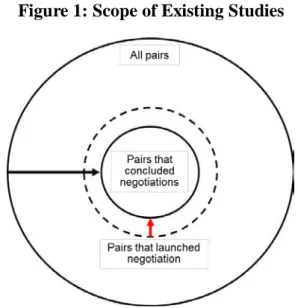
Above all, it is important to note that there are two stages necessary for an FTA to be signed: the launch of negotiations and the conclusion of negotiations (Figure 1). Not all country pairs launch negotiations and not all negotiations are successfully concluded.
Figure 1: Scope of Existing Studies
Source: Author’s compilation
Why states compete and cooperate is one of the central research questions of international relations (Grieco 1990). Realists argue that states form alliances or associations to balance external power, or at least to cope with external threats (Walt 1985). Liberalists posit that states cooperate because cooperation is beneficial, putting emphasis on the establishment of institutions that facilitate cooperation, drawing insights from game theory’s prisoners’ dilemma (Mattli 1999). Constructivists emphasize the significance of shared norm and
4
identity in explaining why states collaborate and form regional groups (Acharya 2001).
There are also several other possible explanations as to why countries pursue FTAs. Some argue that countries’ motivations to pursue FTAs cannot be fully understood without considering geo-political and security factors, in line with the realist perspective (Mochizuki 2009). Others emphasize the significance of economic motivations such as better market access brought about by FTAs (Urata 2009). There is also an argument that competition over the setting of international norms and rules is the essence of FTA games (Nakagawa 2009). As Solis and Katada (2009) rightly point out, the proliferation of FTAs is brought about by complex competition among countries that have mixed motivations.
The principal concerns in international relations literature on FTAs are limited to why states cooperate or sign FTAs, and very little attention has been paid to why negotiations sometimes failed. One of few exceptions is Genna (2010), who compared successful negotiations (US-Caribbean; US-Central America; and EU-Caribbean) and unsuccessful negotiations (EU-MERCOSUR and Free Trade Area of Americas [FTAA]). He argues that power asymmetry and external power (e.g., the rise of China) are the keys to understanding differences in negotiation outcomes. Robles (2008) examined EU-MERCOSUR FTA and found that the EU’s strong quest for reciprocity in the negotiation process was one of the critical obstacles, implying that negotiation processes matter. Antkiewicz and Momani (2009) found that the motivation for proposing an FTA between the EU and GCC, which was then being negotiated, was geopolitical, with little economic impact. Interestingly enough, the EU-GCC negotiations eventually failed, after their analysis. It is important to note that all studies on unsuccessful FTAs thus far deal with group-to-group FTAs, such as the EU-MERCOSUR negotiations.
Economic studies do not distinguish the two stages mentioned above (the launch of negotiations and the conclusion of negotiations). They treat equally pairs that started negotiations but did not reach conclusion, and pairs that did not even start negotiations as “absence of FTA,” or “zero” in terms of codifying. Their concern is limited to pairs that concluded negotiations: pairs having an FTA. Economists have successfully identified unique characteristics held by pairs that successfully concluded negotiations and signed FTAs, vis-à-vis pairs without FTAs. Baier and Bergstrad (2004)’s pioneering study examines the explanatory power of various economic variables, such as each country’s economic size and distance from one another, which is proxy to transport cost. They find country pairs that are close to each other and isolated from the rest of the world tend to sign FTAs. The same study also finds that larger economies tend to sign more FTAs and similarity in terms of economic sizes positively affect the likelihood of signing FTAs between the two.
5
signed an FTA with a third party, but also when FTAs were signed by non-parties3 – another form of the domino effect. This explains the pursuit of the US-Canada FTA after Europe’s regionalism. “Triadic closure” discussed by Manger et al. (2012) is an interesting extension of Baldwin’s domino effect theory - they theoretically and empirically show that “triadic closure” happens if countries A and B as well as A and C have FTAs, then, ceteris paribus, B and C are likely to also form an FTA. Further, they found that “triadic closure” tends to happen among developed countries, implying the risk of leaving the most vulnerable countries in the international trade regime behind.
It can thus be seen that in international relations, there have been some, albeit very limited, attempts to look into unsuccessful FTA negotiations, but virtually no systematic analysis regarding why negotiations fail has yet been conducted. Economists have identified the determinants which lead to the establishment of FTAs, but they have treated unsuccessful negotiations and the absence of negotiations as equivalent. Moreover, economists only analyze “economic determinants,” the term used by Baier and Bergstrad (2004), such as each country’s economic size and distance from its potential partner. It does not seem that economists consider the actual negotiations as significantly impacting the successful conclusion of an FTA.
3. Hypotheses
3.1. Negotiation costs
Any negotiation entails material costs. In fact, in the context of conflict resolution negotiations, Ghosn (2010, 1058) argues that preparation for negotiations and travelling to the location of the negotiations could affect the negotiation’s outcome, though his empirical exercise does not actually test the explanatory power of negotiation-related variables. The negotiation costs seem to be especially important in trade negotiations. Officials are preoccupied with the economic costs and benefits of FTAs during the feasibility study stage, underestimating the negotiation cost: they suddenly encounter various costs and obstacles associated with negotiations once the negotiations get started.
In economic literature, distance between negotiating countries is included as a proxy for transport cost. The shorter the distance, the lower the transport cost: a large if expected impact of potential FTAs, increasing the incentive to start negotiations. One could argue that distance can also be a proxy of travelling cost. The logic here is that the farther the distance, the longer the travel time and greater the price of a ticket becomes. While I concede that a five-hour flight is “easier” than an eight-hour flight, the differences in travel time and ticket costs do not seem critical.
A more critical factor affecting the negotiation costs would be the existence of diplomatic missions. The existence of diplomatic missions is critical because trade negotiations are often conducted in the “home and away” style. While meetings for conflict resolution (both negotiations and mediations) tend to be held in a neutral place, say Geneva, shuttle diplomacy between capitals is often the mode of negotiations for FTAs. The logistical
3 The former are called “own-FTA interdependence,” which is the effect of the quantity of FTAs signed by a potential
6
support of diplomatic missions seems to make physical traveling burdens light, perhaps lighter than saving three hours on flight. Moreover, the existence of diplomatic missions simplifies both the preparation for negotiations and follow-up of any outstanding issues.
Surprisingly, the role of Foreign Service is limited in empirical literature. Thus far, no study has evaluated the impact of existing diplomatic missions on FTA conclusion. There are, however, some studies that examine the impact of Foreign Services on trade, with the majority confirming a positive effect (Rose 2005). While trade flows, FTAs and diplomatic missions are inter-related, impacting one another (pairs that have strong ties tend to exchange foreign missions and sign an FTA), and there is little room to doubt that the existence of diplomatic missions increases the likelihood of the potential partners successfully concluding FTA negotiations. Anecdotally, several former diplomats who were engaged in recent FTA negotiations confirmed the critical role played by diplomatic missions during FTA negotiations. In one case, the former Indian Ambassador writes “[i]ndian embassies have been closely involved in the drafting and negotiations of single-country and regional free-trade agreements” (Rana, 2011, 9). Chan Heng Chee, Singaporean Ambassador to the US involved in the US-Singapore FTA, also admits that lobbying conducted by embassies plays an important role in successful conclusion of FTAs (Chan 2004).
Hypothesis 1: When negotiating parties have diplomatic missions in the partner country, the two countries are more likely to conclude FTA negotiations.
3.2. Reciprocity in tariff concession
The balance does matter. Economic research finds that countries whose economic sizes are similar are more likely to sign FTAs (Baier and Bergstrand 2004). In terms of the level of economic development, FTAs between developed countries tend to be realized, while those between developed and developing countries are less likely to be realized (Manger et al 2012). While debatable, the majority of scholars are of the view that balance of power positively affects the likelihood of successful negotiations or mediations in the field of conflict resolution (Kleiboer 1996).
Reciprocity, one of core concepts in international relations, is also related to the idea of balance. Reciprocity is based on contingency and equivalence (Keohane 1986). Reciprocity implies actions are contingent on rewarding reactions from others. For exchange to be reciprocal, the benefits must be equivalent. In the case of diffuse reciprocity, the definition of equivalence is less precise: one’s partners may be viewed as a group rather than as particular actors (ibid.). The central value of the multilateral trading system, the World Trade Organization (formerly known as General Agreements on Tariffs and Trade, or GATT), is diffused reciprocity (Keohane 1986; Finger 2005). In contrast, In the case of specific reciprocity, the simultaneous balancing of specific quid-pro-quos by each party is required (Keohane 1986; Ruggie 1992). It is widely argued that bilateral FTA negotiations are based on specific reciprocity, meaning that the two parties exchange roughly the same amount of privileges (Solis and Katada 2009).
7
eliminate, or at least reduce, tariffs. Even though non-tariff issues are increasing in importance, preferential market access continues to be one of the critical motivations to pursue FTAs (Urata 2009).
Suppose that two countries are negotiating an FTA with one party having low most favored nation (MFN) tariffs (for example, 5% on average), while the other party imposes high MFN tariffs (perhaps 20% on average). Because FTA parties, in general, need to eliminate tariffs for intra-FTA trade due to GATT Article XXIV (see below for details), the magnitude of tariff cuts differs significantly between the high and low MFN countries. Moreover, it is not reasonable for the high-MFN party to cut tariffs under such an FTA, because access to the markets of the low-MFN party is already a given, irrespective of whether it is signed. This in turn means the low-MFN country does not have the bargaining power to request a tariff cut from a high-MFN potential FTA partner. Hence, similarity in tariff levels seems to be critical for reciprocal tariff concession exchange to happen under an FTA.
Hypothesis 2: When the levels of MFN rates between negotiating parties are similar, they are more likely to conclude FTA negotiations.
3.3. Domino effect and crowd-out effect
Domino effect theory well explains the proliferation of FTAs. The micro-foundation of the theory is that, economically speaking, FTAs are demanded by exporting industries in one country once they are disadvantaged by an FTA signed by a competitor country’s government (Baldwin 1993). There is also a political domino effect, with a governments’ primary concern being its potential exclusion from a new dimension of regional economic diplomacy (Ravenhill 2010). Both economic factors (market access) and diplomatic factors (avoidance of diplomatic isolation) constitute motivations for pursuing FTAs (Solis and Katada 2009).
If the domino effect is very powerful, the number of negotiations increases. That is, the more FTA negotiations one country has, the more attractive it becomes as a negotiating partner for others. Note, however, that this only explains the incentive or motivation to request or propose negotiations. A party already involved in a large number of on-going negotiations may accept the launch of additional negotiations, despite its resource constraint, when the new proposer is important (or more important than the incumbent partners).
8
important player arrives. The crowding-out effect seems to be particularly significant for capacity-constrained small countries.
Hypothesis 3: When one country conducts a large number of parallel negotiations, FTAs are less likely to be concluded.
4. Definition and Methodology
4.1. Definition of Unsuccessful FTA Negotiations
There are multiple varieties of trade agreements. We will only analyze agreements to liberalize trade, not those to facilitate trade (e.g., cooperation on trade exhibition). Agreements to liberalize trade usually include tariff reduction. There are mainly two types of agreements to reduce tariff. The first is the free trade agreement (FTA), which is based on GATT Article XXIV. Members of FTA are expected to eliminate tariffs for substantially all intra-FTA trade. The second type is the so-called partial scope agreement (PSA) based on the WTO Enabling Clause, wherein members can freely decide product coverage in agreements. The coverage can be very narrow; for example, the agreement may only cover agricultural products. Under the WTO rules, only developing countries are entitled to sign these Enabling Clause-based agreements. The focus of our analysis is on FTA negotiations. This is because the negotiations for PSAs are often concluded in a timely manner, after excluding all sensitive sectors.4
Successful negotiations mean negotiations that result in a signed FTA, irrespective of time required, without need for ratification. Unsuccessful negotiations mean negotiations launched some time ago but failing to deliver an FTA - the X-year rule. The X-year rule is not ideal, but it is necessary, because it is difficult to determine whether prolonged negotiations are ongoing or temporarily suspended; hence both are treated as unsuccessful negotiations in this study. When negotiations were launched more than X year ago and then suspended for some reasons, those are certainly unsuccessful negotiations. Alternatively, ongoing negotiation above X-year(s) old are regarded as unsuccessful. Therefore, unsuccessful negotiations are negotiations launched more than X year ago, which may or may not be ongoing. Unconcluded negotiations less than X-year(s) old are outside the scope of our analysis, because it is too premature to judge their final negotiation outcome. As a result, “unsuccessful negotiations” in this paper may include “marathon” negotiations (lasting beyond X years) but which might later be concluded. We will use a 10-year rule to determine unsuccessful negotiations in this paper. 10 years can be said to be long enough for viable FTA projects to be concluded. When obtaining the data regarding when the parties launched official negotiations is difficult, the date of the first round of negotiations is regarded as the launch date. This means that the phase in which a party conducts a feasibility study to make a decision whether to pursue an FTA is not included in the negotiation period, unless the feasibility study is conducted after the launch of formal negotiations.
Some may argue that FTA projects that do not lead to the negotiation stage should be
4 Nevertheless, there are cases of unsuccessful negotiations for partial scope agreements, such as between India and
9
included in the category of unsuccessful negotiations. This may well be true for some country relationship such as China-Japan, where negotiations were not launched despite the conduct of several rounds of feasibility studies. However, because it is very difficult to produce a list of this type of unsuccessful negotiation (potential negotiations that never come to a reality), this paper only analyzes negotiations formally launched but not concluded.
We analyze only bilateral FTAs, excluding multi-party FTAs from the analysis (with some exceptions 5 ), because negotiation dynamics of multi-party FTAs are extremely complicated. However, the issue arises when prolonged bilateral negotiation is “absorbed” into another multi-party FTA. For example, Singapore-Canada FTA negotiations were launched in 2000 but as yet, have not been concluded: this should be considered an unsuccessful negotiation. Meanwhile, the TPP, including both Singapore and Canada, was signed in 2010. Hence, one may argue that the bilateral negotiation between the two countries should no longer be considered unsuccessful. While it is true that there is no incentive to pursue a Singapore-Canada FTA after the conclusion of the TPP, we regard Singapore-Canada negotiations as unsuccessful. This is because the negotiation dynamics between Singapore and Canada, and those involved in the TPP, are totally different. That the two countries were unable to conclude their own negotiations is significant. In short, just because unsuccessful bilateral negotiations are absorbed into a successful multi-party negotiations, we do not regard the former as successful.
There is no comprehensive database covering unsuccessful FTA negotiations. Databases typically include only successfully concluded FTAs. However, because of the proliferation of FTAs after 2000 in the Asian region, there are now several databases monitoring FTA development, naturally including information on ongoing negotiations. These databases are very useful in tracking unsuccessful negotiations, defined as negotiations lasting over 10 years. In addition to the three global FTA databases below, whose coverage of unsuccessful negotiations is limited, there are four Asian databases that include some information on unsuccessful negotiations (the latter four in the list below).
WTO Regional Trade Agreements Information System (RTA-IS) (available at: http://rtais.wto.org/UI/PublicMaintainRTAHome.aspx)
Bilaterals.org (available at: https://www.bilaterals.org/?lang=en)
World Bank Global Preferential Trade Agreements Database (available at: https://www.bilaterals.org/?lang=en)
Asian Development Bank (ADB), Asia Regional Integration Center, Free Trade Agreement Database (ARIC Database) (available at: https://aric.adb.org/fta) United Nations Economic and Social Commission for Asia and the Pacific
(UNESCAP), Asia-Pacific Trade and Investment Agreement Database (APTIAD) (available at: http://www.unescap.org/content/aptiad/)
Japan External Trade Organization (JETRO) Database Appendix 1 in Dent (2006)
5 One exception is TPSEP (among Singapore, Brunei, New Zealand and Chile), which is regarded as a bilateral
10 4.2. Methodology
There are two reasonable methodologies used to look into the factors that affect the outcome of FTA negotiations, although this study employs neither of them. First, an in-depth case study is certainly useful in understanding the motivations and driving sources behind the pursuit of FTAs. This is especially true for successfully concluded FTAs. It is, however, problematic to use case studies to identify why negotiations are unsuccessful. In-depth case studies may enable the identification of difficulties that negotiators face, but pinpointing them as critical factors that prevent the signing of an FTA is unwarranted. There are always difficulties in the course of negotiations, and the real question is why the difficulties weren’t overcome. In-depth case studies are powerless to provide an answer to this question. We should not pay too much attention to immediate obstacles to negotiations, when a more systematic explanation is necessary.
The second methodology to identify the factors for negotiation success or failure is a quantitative approach to the conclusion of FTA negotiations. The explanatory power of quantitative models should be examined by the global data of both successful and unsuccessful FTA negotiations. However, at this stage, such an exercise is difficult for one simple reason: the coverage of unsuccessful negotiations in existing databases is regionally biased, which is an obstacle to quantitatively examining the model’s fit. Thus, there is a strong Asian bias in the Asian databases, due to the number of such databases, and the relatively short history of FTAs.
This study considers a more intermediate area. More specifically, we will conduct a systemic comparison of a mid-size number (25 cases) of successful and unsuccessful FTA negotiations. With a mid-size number of samples, despite the difficulty of conducting a rigorous quantitative analysis, it is still possible to conduct some systematic comparison, allowing us to generalize the findings, departing from small-number-specific case analysis. Qualitative examination of the explanatory power of negotiation-related factors, such as the number of FTA negotiations conducted in parallel at a particular point of time, is also manageable using a mid-size number of cases.
This study compares successful and unsuccessful FTA negotiations conducted by one country. A casual comparison among several unsuccessful negotiations in different parts of the world, for example, among the Canada-Central American Common Market (CACM), Japan-Korea and EU-India, will not tell us much. By selecting one country, we can control several variables which may affect the negotiation outcomes.
11
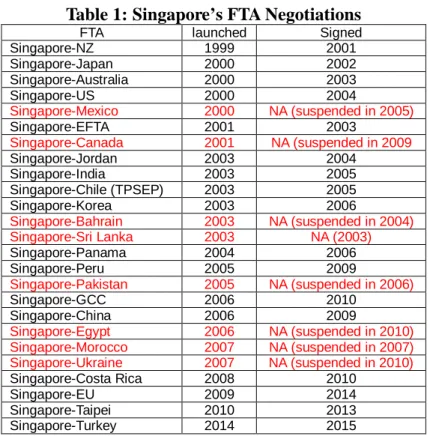
Table 1: Singapore’s FTA Negotiations
FTA launched Signed
Singapore-NZ 1999 2001
Singapore-Japan 2000 2002 Singapore-Australia 2000 2003
Singapore-US 2000 2004
Singapore-Mexico 2000 NA (suspended in 2005)
Singapore-EFTA 2001 2003
Singapore-Canada 2001 NA (suspended in 2009
Singapore-Jordan 2003 2004 Singapore-India 2003 2005 Singapore-Chile (TPSEP) 2003 2005 Singapore-Korea 2003 2006
Singapore-Bahrain 2003 NA (suspended in 2004)
Singapore-Sri Lanka 2003 NA (2003)
Singapore-Panama 2004 2006
Singapore-Peru 2005 2009
Singapore-Pakistan 2005 NA (suspended in 2006)
Singapore-GCC 2006 2010
Singapore-China 2006 2009
Singapore-Egypt 2006 NA (suspended in 2010)
Singapore-Morocco 2007 NA (suspended in 2007)
Singapore-Ukraine 2007 NA (suspended in 2010)
Singapore-Costa Rica 2008 2010
Singapore-EU 2009 2014
Singapore-Taipei 2010 2013 Singapore-Turkey 2014 2015
Source: Author’s compilation
5. Discussions
5.1. Diplomatic Missions
Foreign missions of Singapore are classified as “Embassies,” “High Commissions,” “Permanent Missions,” “Consulate-Generals and Consulates” (Appendix 2).6 Among these, the first three can be substantially used as negotiations tools, including during FTA negotiations (hereafter, “diplomatic missions”). Singapore has permanent missions in Brussels for the European Union (EU) and in Geneva for the United Nations and World Trade Organization (WTO). It is assumed that the latter can be used for FTA negotiations with the European Free Trade Association (EFTA),7 because the EFTA Secretariat is located in Geneva (in fact, meetings between the two are sometimes held in Geneva). We regard the Singaporean Embassy in Saudi Arabia as its diplomatic mission to GCC, which has its Secretariat in Riyadh. Among 25 FTA partners, Singapore has diplomatic missions in 12, and no such office in the other 13.
We use data on Singapore’s diplomatic missions in its partner countries in order to examine the relationship between diplomatic missions and negotiation outcomes. This is because Singapore’s external diplomatic missions vary more so than those in Singapore. In fact, almost all countries have a diplomatic mission in Singapore (Appendix 2). In addition, as discussed, nearly equal distribution between FTA negotiating partners with and without diplomatic missions with Singapore provide us with a good opportunity to
12
compare the two groups. As Table 2 shows, when there is a diplomatic mission, FTA negotiations are likely to be successful, with a probability of 91.7%. The only case where negotiations were unsuccessful despite the existence of a diplomatic mission was with Egypt. When there is no diplomatic mission, the probability of success or failure of negotiations is almost the same.
Table 2: Diplomatic Missions and Negotiation Outcomes
Unsuccessful Successful With diplomatic
missions (12 cases)
1 case (8.3%) (Egypt)
11 cases (91.7%)
(NZ; Japan; Australia; US; EFTA; India; Korea; GCC; China; EU; Turkey) Without diplomatic
missions (13 cases)
7 cases (53.8%)
(Mexico; Canada; Bahrain; Sri Lanka; Pakistan; Morocco; Ukraine)
6 cases (46.2%) (Jordan; Chile; Panama; Peru; Costa Rica; Taiwan)
Source: Author’s compilation
5.2. Reciprocity in Tariff Concession
There are two possible indicators to measure the level of tariff prior to FTA negotiations: (i) MFN simple average applied tariff, and (ii) MFN weighted average applied tariff. They are both a type of ad-valorem tariff average applied to fellow WTO Members. In calculating an MFN simple average, the same weight is given to all products, without taking into account how frequently the products are traded. In contrast, in calculating an MFN weighted average, more emphasis is given to products having larger import flows. The two types of tariff level are often very different, which can be partially explained by political economy of trade policies. Countries tend to impose high tariffs on sensitive products, leading to less trade in that sector. When this is the case, high tariffs in the sensitive sector are not reflected in the weighted average. For example, Mexico’s MFN weighted average from Singapore is only at 8.7%, while its MFN simple average is as high as 16.2%. We will use MFN simple average, because negotiators have strong incentive to cut tariff on products having less trade flow thanks to high tariffs.
Note that the MFN simple average should be computed on a bilateral basis. In other words, the issue is not Mexico’s MFN simple average for imports from the world, but from Singapore. Data on bilateral MFN simple averages are available at the World Integrated Trade Solution (WITS) database. We use Singapore’s negotiating partners’ MFN simple average tariffs from 2000. Because of unavailability, data in 2002, 2003 and 2005 is used for Ukraine, Pakistan and the United Arab Emirates (UAE). Because WITS does not include MFN data for the EU and Taipei, we use an MFN average tariff for them found in the 2006 World Tariff Profile data (oldest issue).8 When Singapore’s FTA partners are a group of countries (EFTA and GCC), a simple average of major trading partners in the groups is used for the group’s MFN for Singaporean imports. In the case of the EFTA, a simple average of the MFN simple average for Switzerland and Norway is used (in the case of the GCC, a simple average for Saudi Arabia and the UAE is used).
8 The data in the World Tariff Profile does not show bilateral basis. It reflects the MFN simple average tariff from the
13
We classify the samples into two groups (high and low MFN tariff). We will regard MFN tariffs higher than 10% as high tariffs. Table 3 compares success and failure of negotiations in each group. When a negotiating partner’s MFN tariff is high (above 10%), Singapore’s negotiations may or may not be successful (44.5% of success). However, when a partner’s MFN tariff is low (below 10%), negotiations tend to be successful. Among 16 such cases, 13 cases were successful (82.2%).
Table 3: Tariffs and Negotiations
Unsuccessful Successful Tariff Higher than 10% (9 cases) 5 cases (55.5%) 4 cases (44.5%) Tariff Lower than 10% (16 cases) 3 cases (18.8%) 13 cases (82.2%) Total (25 cases) 8 cases (32.0%) 17 cases (68.0%)
Source: Author’s compilation
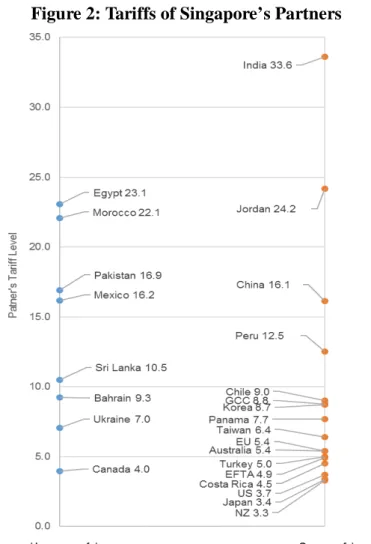
Figure 2 provides actual MFN tariff levels of Singapore’s FTA negotiating partners, country by country. The unsuccessful partners are on the left and the successful partners are on the right. It is interesting to note that two of Singapore’s negotiation partners that successfully concluded negotiations despite their very high tariffs are India and China, which have huge domestic markets. This implies that the size of a market can compensate for the size of a tariff cut in an FTA: a small tariff cut, if in a large market, can have a great impact, which make the condition of reciprocity satisfied.
Figure 2: Tariffs of Singapore’s Partners
14 5.3. Domino and Crowding-out Effect
We conducted our preliminary examination regarding the validity of crowding-out effect, using only Singapore-side data. This is because we only have the data on unsuccessful negotiations of Singapore. We do not have readily available data on FTA negotiations of Egypt, for example, especially its unsuccessful negotiations. In order to examine crowding-out, competition among all negotiations, not just successful negotiations, should be considered.
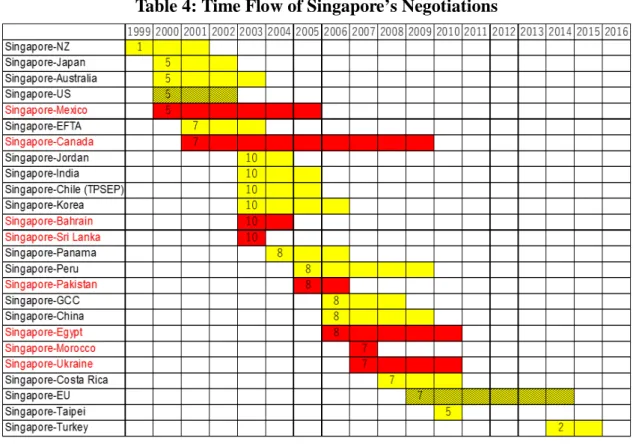
Table 4 provides an overview of the time frames of Singapore’s FTA negotiations, both successful (yellow) and unsuccessful (red). In the case of successful FTA negotiations, the years in the negotiations were launched and concluded are coded. In the unsuccessful notations, the year when the negotiations were launched and suspended is included. Based on a simple analysis of this chart, we cannot confirm the crowding-out effect.
Table 4: Time Flow of Singapore’s Negotiations
Source: Author’s complication
15
September 1999, Singapore had already proposed FTAs to Mexico, Chile and Korea9 (Munakata 2001, 18), and Mexico had agreed to begin negotiations. The first round of negotiations between Singapore and Mexico occurred in July 2000 (Dent 265). After four rounds of negotiations, the two countries adopted the Joint Declaration on November 13, 2000. After this, negotiations slowed down significantly, partly because of the installation of Mexico’s new administration, though this does not seem to be the only reason.
It is also interesting to note that Singapore suddenly proposed an FTA with Canada, which led to the announcement on June 5, 2000, that the two countries were exploring an FTA. The launch of these negotiations was agreed upon in October 2001. However, it was not until January 2003 when the first round of negotiations was held. After this, additional meetings were held, but the negotiations for the FTA drifted.
It seems that both the Singapore-Canada and Singapore-Mexico negotiations were on hold while the US-Singapore FTA negotiation was at a critical stage. Singapore’s negotiations with Canada and Mexico stagnated when Singapore started negotiations with the US, implying resource constraints on the Singaporean government. In fact, Singapore launched no new negotiations until 2003, after the conclusion of the US-Singapore negotiations. Soon after this conclusion, Singapore’s negotiations with Canada and Mexico resumed, but gaining momentum was difficult.
6. Conclusion
This is an initial attempt to begin systematically analyzing FTA negotiations, both successful and unsuccessful. We differentiate country pairs that started but did not conclude negotiations, from pairs that did not start negotiations, though previous studies treat the two groups equally as “absent of FTA.” By comparing successful and unsuccessful negotiations, we can observe some factors associated with the negotiation process that may affect negotiation outcomes. We examined three factors associated with nagotiations: (i) the existence of a diplomatic mission between negotiating partners; (ii) reciprocity of tariff cuts under FTAs; and (iii) the number of parallel negotiations conducted by one country. While our sample size is small - 25 FTA negotiations conducted by Singapore (17 successful and 8 unsuccessful cases) - the following conclusions can be drawn based on comparing the two groups. First, when negotiating parties have diplomatic missions in the partner country, they are more likely to conclude FTA negotiations. Second, when the levels of MFN tariff rates between negotiating parties are similar, the countries are more likely to conclude FTA negotiations. Third, when one country is conducting too many parallel FTA negotiations, its (less important) pre-existing negotiating partners may be crowded out by its new, more important negotiating partner.
16
Appendix 1: List of Unsuccessful Negotiations of Singapore10
The US unofficially floated the idea of a “Pacific 5,” or “P5,” FTA in November 1997 (Munakata 2001, 13). At the margin of the APEC Summit in November 1998, the P5 FTA was discussed among the five countries present. However, the likelihood of successfully concluding P5 had diminished by the middle of 1998.11 In June 1999, New Zealand proposed an FTA with Singapore12 . New Zealand was an APEC chair in 1999, and intended to promote the new WTO negotiations and APEC Bogor goal (Munakata, 2001, 18). After being approached by New Zealand in June 1999, Singapore decided to actively pursue FTAs with various partners, which led to its involvement in a large number of both successful and unsuccessful FTA negotiations.
Singapore-Mexico (unsuccessful)
At the APEC Summit in September 1999, Singapore proposed FTA negotiations to Mexico, Chile and Korea13 (Munakata 2001, 18); Mexico agreed. The first round of negotiations between Singapore and Mexico started in July 2000 (Dent 2006, 265). After four rounds, the two countries adopted the Joint Declaration on November 13, 2000. In the following month, Vicente Fox assumed Mexico’s presidency, which may have had some impact on Mexico’s FTA policy. However, it should be noted that bilateral negotiations continued even under this new administration. After the adoption of the Joint Declaration, six more rounds of negotiations were held by the end of 2003 (Low, 2003). However, no negotiations have been held since then. By 2005, the Singaporean government was of the view that negotiations were no longer active (Spring Singapore 2005).
In the following month, a new president, Vicente Fox assumed presidential office, which may have some impact on Mexico’s FTA policy. The fifth and sixth rounds of negotiations were held in July and September 2003 respectively. However, no negotiations held since the sixth rounds in late 2003. At least by 2005, the Singapore government was of the view that the negotiating was no longer active (Spring Singapore 2005).
Singapore-Canada (unsuccessful)
Singapore also approached Canada and proposed an FTA.14 On June 5, 2000, the two parties released an announcement stating that the two countries would begin exploring the possibility of negotiating an FTA.15 On October 21, 2001, on the margins of the meeting of the Asia-Pacific Economic Co-operation (APEC) economic leaders in China, Singapore and Canada announced the official launch of negotiations towards a bilateral
10 Singapore’s FTA negotiations with Japan began in 2000, and resulted in an FTA in 2002. Singapore approached a
cautious Japan in October 1999. (Munakata 2001, 20).Singapore’s negotiations with Australia were launched in 2000 and the FTA was signed in 2003.
11 P5 was discussed at the margin of the APEC Summit in September 1999, though it did not reach any conclusion
(Dent 2006, 46).
12 At the 1999 APEC Summit held in Auckland (September 1999), Singapore and New Zealand agreed to pursue a
bilateral FTA, partly because the P5 FTA, which was also discussed alongside the Summit, turned out to be difficult to achieve in the short run. The Singapore-New Zealand FTA was signed in November 2000.
13 Singapore also approached Chile (ibid.), but this bilateral FTA with was ultimately not pursued.
14
http://www.international.gc.ca/trade-agreements-accords-commerciaux/agr-acc/singapore-singapour/singapore-ea-singapour.aspx?lang=eng
17
free trade agreement. Formal negotiations commenced in January, 2002. Six rounds of negotiations were held by October 2003, but the negotiations stagnated thereafter. At the APEC ministerial in 2006, the two parties agreed to resume negotiations, and a seventh round was held in late February 2007.16 After this meeting, Canada issued a press release stating that it was not yet prepared to conclude this FTA. Another round of negotiations was held in 2007, but no further progress has been made since.17 Negotiations have been on hold by mutual agreement since November 2009.18
Singapore-Bahrain (unsuccessful)
The Prime Minister of Bahrain visited Singapore in October 2003, and the leaders of the two countries agreed to pursue an FTA (Feng 2004, 211). Primary discussion on this FTA was held when Singaporean Prime Minister Goh visited Bahrain on February 17, 2004.
Singapore-US (successful)
At the margin of the APEC Summit held in Brunei, on November 14, 2000, Singapore PM Goh persuaded President Clinton regarding the significance of a US-Singapore FTA (Khaw, 2011, xvi). On November 16, the two sides formally agreed to launch the negotiations which started in December 2000. Intensive negotiations occurred in 2001 and 2002, and were concluded in the eleventh round, in November 2002.
Singapore-India (successful)
Singapore also approached India in 2000. When Prime Minister Goh visited Delhi in January 2000, the two parties agreed to set up a task force on bilateral economic cooperation, including a study on a possible FTA. The progress of the study was slow, but Indian officials appreciated that an economic partnership agreement that covers not only goods but also services would be more beneficial. At an April, 2002, meeting between the two countries’ leaders, India accepted Singapore’s position that a Singapore-India FTA would be useful, although India proposed a Comprehensive Economic Cooperation Agreement (CECA) covering services to be studied by the task force. India seemingly valued the tie with Singapore as a stepping stone towards India-ASEAN cooperation. The launch of the Singapore-India FTA negotiations followed the signing of the Declaration of Intent on April 8, 2003, witnessed by Goh Chok Tong (Singapore Prime Minister) and Shri Atal Bihari Vajpayee (Indian Prime Minister)in which a joint study group report on economic cooperation was presented.19 The Singapore-India CECA was signed on June 29, 2005 after 13 rounds of negotiations.
Singapore-Sri Lanka (unsuccessful)
Singapore and Sri Lanka agreed to launch FTA negotiations on August 29, 2003, soon
16 http://www.sice.oas.org/TPD/CAN_SGP/Negotiations/7R_e.pdf 17
http://www.asiapacific.ca/sites/default/files/internal/backgrounder_2_-__canadas_trade_negotiations_with_asia_final.pdf
18 http://international.gc.ca/trade-commerce/trade-agreements-accords-commerciaux/agr-acc/singapore-singapour/fta-ale/background-contexte.aspx?lang=eng
19 During the Indian Prime Minister Vajpayee’s visit to Singapore in April 2002, the formation of study groups was
18
after the signing of the Declaration of Interest between India and Singapore. The inaugural discussions, concerning the Comprehensive Economic Partnership Agreement, were held on October 20, 2003, in Colombo; this negotiation has not yet been concluded.
Singapore-Pakistan (unsuccessful)
The first meeting of the joint study group between Singapore and Pakistan was held at Islamabad in February 2005.20 At this stage, the parties had already agreed to negotiate an FTA at their next meeting. The first round of negotiations between Singapore and Pakistan was actually held August 24 through 26, 2005. By June 2006, four rounds of negotiations had been held. However, since then, no further negotiations have occurred, despite Pakistan’s efforts in June 2011 to resume them.
Singapore-Egypt (unsuccessful)
The Singaporean Prime Minister visited Egypt on February 11, 2004, and he and Egyptian leaders agreed to launch FTA negotiations at this time (Low 2009, 51; Feng 2004, 211). The two countries signed a Declaration of Intent regarding this FTA on November 14, 2006. In March 2010, two Egyptian ministers visited Singapore and reviewed the progress of negotiation with the Senior Minister of Singapore. The Singaporean government secured the budget to negotiate this FTA for FY 2010 (April 2010-March 2011);21 in contrast, Singapore’s FY 2011 budget does not include costs associated with negotiating an FTA with Egypt.22
Singapore-Morocco (unsuccessful)
Moroccan King Mohammed VI was in Singapore on April 29, 2005. The statement issued during his visit mentions the commencement of FTA negotiations. Negotiations were launched in 2007 (Low, 2009, 57); however, it appears that negotiations encountered problems soon after this.23
Singapore-Ukraine (unsuccessful)
On May 8, 2008, Singapore and Ukraine launched FTA negotiations. Material from Singapore’s Trade Policy Review prepared by the WTO Secretariat in 2008 mentions that Singapore was negotiating an FTA with Ukraine (WT/TPR/S/202). Singapore’s budget for FY 2008 (April 2008-March 2009) and FY 2009 (April 2009-March 2010) include the Singapore-Ukraine FTA, but the FY 2010 budget does not.
20 At almost the same time, during the visit of the Malaysian Prime Minister to Pakistan (February 15-18, 2005), the
two countries agreed to negotiate an FTA (the first meeting was held in April 2005).
19
Appendix 2: Table of Diplomatic Missions of/in Singapore
Of Singapore In Singapore Singapore-NZ High Commission High Commission
Singapore-Japan Embassy Embassy
Singapore-Australia High Commission High Commission
Singapore-US Embassy Embassy
Singapore-Mexico No Embassy
Singapore-EFTA Permanent Mission (Geneva) Several Embassies
Singapore-Canada No High Commission
Singapore-Jordan No No
Singapore-India High Commission High Commission
Singapore-Chile (TPSEP) No Embassy
Singapore-Korea Embassy Embassy
Singapore-Bahrain No No
Singapore-Sri Lanka No High Commission
Singapore-Panama No Embassy
Singapore-Peru No Embassy
Singapore-Pakistan No High Commission
Singapore-GCC Embassy (Riyadh) Several Embassies
Singapore-China Embassy Embassy
Singapore-Egypt Embassy Embassy
Singapore-Morocco No No
Singapore-Ukraine No Embassy
Singapore-Costa Rica No Embassy
Singapore-Taipei Trade Office Representative Office Singapore-EU Permanent Mission (Brussels) Permanent Delegation
Singapore-Turkey Embassy Embassy
20 References
Antkiewicz, Agata, and Bessma Momani (2009). "Pursuing geopolitical stability through interregional trade: the EU’s motives for negotiating with the gulf cooperation council." European Integration 31.2: 217-235.
Baier, Scott L., and Jeffrey H. Bergstrand (2004). "Economic determinants of free trade agreements." Journal of international Economics 64.1: 29-63.
Baier, Scott L., Jeffrey H. Bergstrand, and Ronald Mariutto (2014). "Economic determinants of free trade agreements revisited: Distinguishing sources of interdependence." Review of International Economics 22.1: 31-58.
Baldwin, Richard (1993). A domino theory of regionalism. No. w4465. National bureau of economic research.
Baldwin, Richard, and Dany Jaimovich (2012). "Are free trade agreements contagious?." Journal of international Economics 88.1: 1-16.
Chan, Heng Chee (2004). "Lobbying for the United States-Singapore Free Trade Agreement." in Koh, Tommy Thong Bee, and Li Lin Chang (eds). The United States Singapore Free Trade Agreement: Highlights and Insights. World Scientific. .
Finger, J. Michael (2005). "A diplomat's economics: reciprocity in the Uruguay Round negotiations." World Trade Review 4.1: 27-40.
Genna, Gaspare M (2010). "Economic size and the changing international political economy of trade: The development of western hemispheric FTAs." International Politics 47.6: 638-658.
Dent, Christopher M, (2006). New free trade agreements in the Asia-Pacific. Basingstoke: Palgrave Macmillan
Feng, Cheng Pei (2004) Recent Developments in Singapore on International Law, Singapore Year Book of International Law and Contributors, 8.
Khaw Boon Wan (2011) Foreword, in CL Lim and Margaret Liang (eds) Economic Diplomacy: Essays and Reflections by Singapore’s Negotiations, World Scientific
Ghosn, Faten (2010). "Getting to the table and getting to yes: An analysis of international negotiations." International Studies Quarterly 54.4: 1055-1072.
Grieco, Joseph M (1990). Cooperation among nations: Europe, America, and non-tariff barriers to trade. Cornell University Press.
21
Kleiboer, Marieke (1996). "Understanding success and failure of international mediation." Journal of Conflict resolution 40.2: 360-389.
Krueger, Anne (1995). American trade policy: a tragedy in the making. American Enterprise Institute,
Low, Linda (2008), A Case Study of Singapore’s Bilateral and Cross-Regional Free Trade Agreements, in Katada, Saori and Mireya Solis (eds) Cross Regional Trade Agreements: Understanding Permeated Regionalism in East Asia, Springer
Manger, Mark S., Mark A. Pickup, and Tom AB Snijders (2012). "A hierarchy of preferences: a longitudinal network analysis approach to PTA formation." Journal of Conflict resolution 56.5: 853-878.
Mattli, Walter. (1999). The logic of regional integration: Europe and beyond. Cambridge University Press.
Mochizuki, Mike M (2009). Political Security Competition and the FTA Movement: Motivation and Consequences, in Solís, Mireya, Barbara Stallings, and Saori Katada (eds). Competitive regionalism: FTA diffusion in the Pacific Rim. Springer.
Munakata, Naoko (2001). Evolution of Japan's policy toward economic integration. Brookings Institution Center for Northeast Asian Policy Studies
Nakagawa, Junji (2009), Competitive Regionalism through Bilateral and Regional Rule-making: Standard Setting and Locking-in, in Solís, Mireya, Barbara Stallings, and Saori Katada (eds). Competitive regionalism: FTA diffusion in the Pacific Rim. Springer.
Rana, Kishan S (2011). "Economic diplomacy: the experience of developing countries", in Bayne, Nicholas, and Stephen Woolcock (eds). The new economic diplomacy: decision-making and negotiation in international economic relations. Ashgate Publishing, Ltd., 2011.
Ravenhill, John (2010). "The ‘new East Asian regionalism’: A political domino effect." Review of International Political Economy 17.2: 178-208.
Robles Jr, Alfredo. C. (2008). The EU and ASEAN: Learning from the failed EU-Mercosur FTA Negotiations. ASEAN Economic Bulletin, 25(3), 334-344.
Rose, Andrew K (2007). "The foreign service and foreign trade: embassies as export promotion." The World Economy 30.1: 22-38.
Ruggie, John Gerard (1992). "Multilateralism: the anatomy of an institution." International organization 46.3: 561-598.
22
Solís, Mireya and Saori Katada (2009). Explaining FTA Proliferation: A Policy Diffusion Framework, in Solís, Mireya, Barbara Stallings, and Saori Katada (eds). Competitive regionalism: FTA diffusion in the Pacific Rim. Springer.
Spring Singapore (2005), Free Trade Agreements (Trade in Goods), Guide for SMEs.
Urata, Shujiro (2009). Exclusion Fears and Competitive Regionalism in East Asia, In Solís, Mireya, Barbara Stallings, and Saori Katada (eds). Competitive regionalism: FTA diffusion in the Pacific Rim. Springer.