Corresponding author: Ayako Yamashita [email protected]
Received 2016 September 14 Accepted 2016 October 20
Abbreviations: AI, awareness of illness; ARRS, Alcohol Relapse Risk Scale; AUD, alcohol use disorders; CA, compulsivity for alco- hol; CI, confidence interval; EP, emotionality problems; NE, lack of negative expectancy for alcohol; OR, odds ratio; PE, positive expec- tancy for alcohol; SV, stimulus-induced vulnerability; Z, Z-score
Resilience Associated with Self-Disclosure and Relapse Risks in Patients with Alcohol Use Disorders
Ayako Yamashita*† and Shin-ichi Yoshioka‡
*Graduate School of Medical Sciences, Tottori University, Yonago 683-8503, Japan, †Department of Nursing, Niimi College, Niimi 718- 8585, Japan and ‡Department of Nursing Care Environment and Mental Health, School of Health Science, Tottori University Faculty of Medicine, Yonago 683-8503, Japan
ABSTRACT
Background The aim of this study was to clarify the self-disclosure and risks of relapse associated with pro- moting resilience of patients with alcohol use disorders (AUD) and participating in self-help groups.
Methods An anonymous, self-administered question- naire survey was administered to 48 patients with AUD and participating in self-help groups; this questionnaire consisted of basic attributes, a bidimensional resilience scale to assess both innate and acquired resilience fac- tors, a scale to assess depth of self-disclosure, and a scale assessing relapse risks. We conducted an evalua- tion by dividing the respondents into a high group and low group based on their median values for both innate and acquired resilience.
Results Innate/acquired resilience had a mutually re- inforcing relationship, and, compared with the low resil- ience group, the high resilience group had significantly reduced risks for relapses and resulted in deeper self-dis- closure.
Conclusion Patients with high resilience had lower risk of alcohol relapse and deeper self-disclosure. The results suggest that one way of supporting patients with AUD in recovery is assisting them in building personal relationships with others and in deepening self-disclo- sure in a setting where they can relax, thus promoting their natural ability to recover.
Key words alcohol-related disorders; self-disclosure;
self-help groups; recurrence; rehabilitation
Harmful use of alcohol causes biological, social, and psychological damages. It is one of the greatest risk fac- tors for health disorders across the globe. In May 2010, the 63rd World Health Assembly adopted “Global Strate- gies to Reduce the Harmful Use of Alcohol,” leading to prevention measures against alcohol-related problems on a global level.1
At present, the estimated number of people with alcohol use disorders (AUD) in Japan is approximately 570,000, and the estimated number with scores of 20 points or higher on the Alcohol Use Disorders Identifi-
cation Test (AUDIT)2 is 1.07 million.3 However, accord- ing to a 2014 survey, an estimated 49,000 patients with alcohol dependency were in psychiatric hospitals4; this seems to indicate that many patients with AUD did not receive the required treatment. AUD requires an extend- ed period of time before a patient can obtain intervention treatment. These problems were part of the context in which the Basic Act on Measures Against Alcohol-re- lated Health Harm to prevent damage to health due to alcohol was enacted in June 2014 in Japan.
The biopsychosocial model5 is often utilized when discussing factors influencing AUD.6, 7 As for the cogni- tive-behavioral model8 that attempts to prevent relapses of AUD, some have reported on influencing factors, such as individual factors, coping skills for mental anguish, and a variety of environmental factors, like the means of acquiring alcohol and interpersonal relationships. As a treatment for AUD, people receive medical treatment for physical complications caused by alcohol and are assist- ed in being re-socialized through regular life experienc- es in rehabilitation facilities.9
One treatment for AUD is participation in self-help groups, which is empirically proven as one of the effec- tive recovery methods.10 An assessment of relapse risk with a consideration of a variety of factors was conduct- ed to indicate recovery from AUD, and rehabilitation was offered to improve people’s quality of life.
Resiliencehas been noticed as individually differing among those with AUD, chemical dependency, or in recovery from these conditions.11 Resilience is the phe- nomenon whereby individuals attempt to adapt, regard- less of serious risks.12–14 Indeed, psychiatry has begun to use resilience as a recovery concept. More specifically, resilience refers to the ability to recover psychologically even if one is temporarily faced with adversity and mal-
adapted to the situation. Resilience includes a variety of individual inherent factors and environmental factors ac- quired in various circumstances.15 Therefore, this study investigated changes in resilience of patients with AUD who participated in self-help groups and effects that the changes have on relapse risk and self-disclosure. We conducted this investigation with the objective of pro- moting support to reduce risk of relapse in patients with AUD.
SUBJECTS AND METHODS Study samples
An anonymous, self-administered questionnaire survey was given to 135 AUD patients who participated in self- help group meetings across Japan and who agreed with the study’s objective. The area of the survey covers Tot- tori, Shimane and Okayama Prefectures.
Measures
The study used an anonymous, self-administered ques- tionnaire survey. It was conducted from February to April 2015. The questionnaire consisted of demograph- ics of participants, resilience scale, self-disclosure scale, and alcohol relapse risk scale.
Demographics
Demographic features constituting the questionnaire were as follows: age, gender, whether or not they lived with another person or had a key person with whom to consult in their lives, employment status, age when di- agnosed with AUD, treatment time period, abstinence period, number of sessions and time period participating in self-help groups, other psychological disorders, and physical disorders.
Resilience scale
Resilience is a term used to describe relative resistance to psychosocial risk experiences.16 Dynamic processes with positive changes are defined in inconvenient situ- ations clarified by resilience definition.17 Inherent resil- ience factors which are inherited effects and biological effects are difficult to change.18 However, resilience is formed into an interaction between an environment and a growth.19 This study used the bidimensional resilience scale developed in Japan.20, 21 This scale is comprised of innate-resilience factors (12 questions related to individ- ual factors) and acquired-resilience factors (9 questions related to environmental factors). The innate resilience factors indicate those that are strongly related to the individual’s inherent nature; acquired factors indicate learned methods of resilience. This scale uses a five- point rating for the questionnaire with higher total scores
indicating greater resilience. In this study, the Cron- bach’s Į coefficient for the bidimensional resilience scale was 0.910; thus, internal consistency was maintained.
Self-disclosure scale
The scale to assess depth of self-disclosure22 was cre- ated based on the social penetration theory. This scale consists of 24 items on four levels: hobbies (level 1), dif- ficult experiences (level 2), foibles (level 3), and inferior personality characteristics and abilities (level 4). The evaluation uses a seven-point scale, and higher scores indicate a greater extent of self-disclosure. The evalua- tion uses a seven-point scale, and higher scores indicate a greater extent of self-disclosure. For the scale to assess the depth of self-disclosure in this study, the Cronbach’s Į coefficient was 0.957; thus, internal consistency was maintained.
Alcohol relapse risk scale
To measure risk of AUD relapse, we used the Alcohol Relapse Risk Scale (ARRS).23 This scale consists of 32 items on five sub-scales as follows: stimulus-induced vulnerability (SV); emotionality problems (EP); compul- sivity for alcohol (CA); lack of negative expectancy for alcohol (NE); and positive expectancy for alcohol (PE).
The ARRS includes 5 items to measure insight into mental condition: awareness of illness (AI). The ARRS total score is the average score from the five sub-scales (or their total score). When five supplementary items in- dicating the respondent’s intensity of awareness of their illness were included, this scale consisted of a total of 32 items. The evaluation uses a three-point scale, and higher scores indicate greater risk for alcohol relapse. In this study, the Cronbach’s Į coefficient for the 32 items in the ARRS was 0.915; thus, internal consistency was maintained.
Statistical analysis
The target group’s resilience scores were divided into two groups based on median scores from their innate- and acquired-resilience factors. The cut-off point of resilience scales was not established. The number of the sample is small, and the scores of the resilience scales exhibited a non-normal distribution. Hence, to clarify the characteristics of the resilience, the target groups were divided into two groups depending on the both median innate and acquired resilience scores. Then, a comparison descriptive test was performed by dividing these two groups into a high and low group. Spearman’s rank correlation coefficient analysis was used to assess the correlation relationships among resilience, ARRS, and self-disclosure scale.
The Mann-Whitney U test was used on each quan- titative factor from all scales. A multiple logistic regres- sion analysis (maximum likelihood method) was per- formed by setting the high and low group of both innate- and acquired- resilience factors as dependent variables and by using as independent variables the items which the comparison test’s results indicated as having a signif- icant difference. We measured the variance inflation fac- tor of the variables used in logistics analysis and studied multicollinearity. We conducted analysis of missing val- ues data. We conducted missing values pattern analysis for data.
Statistical analyses were performed using IBM SPSS 24.0 J for Windows (SPSS, Chicago, IL), and the significance level was set at 5% for all tests.
Ethical considerations
After receiving approval from the Tottori University Faculty of Medicine Ethics Review Committee (approval number 2646), this study was conducted in accordance with the fundamental principles set forth in the Helsinki Declaration. Informed consent was obtained from each participant after the procedure(s) had been fully ex- plained.
RESULTS
A total of 86 questionnaires were collected (a collection rate of 63.7%) from the participants, and 48 question- naires had valid responses (a valid response rate of 35.6%). Table 1 displays the basic demographic fea- tures. The study sampled 86 subjects. After eliminating missing values, 48 were eliminated so the respondents’
percentage was 55.8%. Therefore, by eliminating all missing values, there is possibility for bias to occur. The analysis results judged the “missing completely at ran- dom” and used the list-wise case deletion.
The sample group’s average age was 60.1, s = 10.5 years old (29–75), and the average age was 4 years younger than the age group (65–69 years old),4 with the highest AUD rate in Japan. Based on the average length of treatment, assumingly 14.7 years based on average age and average age of diagnosis [45.4, s = 10.7 years old (27–70)] , it was found that diagnosing people with AUD typically took a long period.
The average number of self-help group meetings that respondents attended per week was 2.6, s = 2.9, and these respondents participated regularly and were able to continue participating.
The target group’s average period of abstinence from drinking alcohol was 133.1, s = 114.8 months. Due to the fact that the average number of weekly self-help group sessions attended (2.6) and that approximately 70% were
employed and 90% married, the target group for this study not only had favorable treatment results, but they had continued abstaining from alcohol for a long period through continued treatment.
Table 1. Demographic characteristics of the sample
Items Values M ± SD
Number of participants 48
Gender (% male) 97.9
Age (years) 60.1 ± 10.5
Employment status (% work) 68.8 Presence of key person (% yes) 85.4 Living with someone (% yes) 89.6 Treatment state (n)
Outpatient 17
Inpatient 4
Untreated 7
Cessation of treatment 10
Unknown 10
Age when diagnosed with AUD (years) 45.4 ± 10.7 Treatment time period (months) 39.6 ± 57.6
Abstinence period (months) 133.1 ± 114.8
Number of sessions and time period
participating in self-help groups (weekly) 2.6 ± 2.9 Ther psychological disorders (n) 12
Physical disorders (n) 18
Bidimensional resilience scale
Innate-resilience factors 38.2 ± 8.1
Acquired-resilience factors 30.1 ± 5.5 Self-disclosure scale (A scale to assess
depth of self- disclosure)
Level 1 (hobbies) 31.7 ± 9.5
Level 2 (difficult experiences) 18.6 ± 4.9
Level 3 (foibles) 24.5 ± 7.7
Level 4 (inferior personality character-
istics and abilities) 28.5 ± 9.1
Total 103.3 ± 26.9
Alcohol Relapse Risk Scale
Stimulus-induced vulnerability 11.7 ± 4.7
Emotionality problems 12.3 ± 3.7
Compulsivity for alcohol 3.8 ± 1.5
Lack of negative expectancy for alcohol 6.5 ± 2.2 Positive expectancy for alcohol 4.3 ± 2.1
Awareness of illness 10. 6 ± 2.8
Total 38.5 ± 10.5
AUD, alcohol use disorders; M, mean; n, number of participants.
The histograms of the total scores of each scale are shown in the Fig. 1 (innate-resilience scores: Fig. 1a, ac- quired-resilience scores: Fig. 1b, Alcohol Relapse Risk
B C
D E
*OOBUFSFTJMJFODFTDPSF
"MDPIPM3FMBQTF3JTL4DBMFTDPSF
"DRVJSFESFTJMJFODFTDPSF
4FMGEJTDMPTVSFTDBMFTDPSF
/VNCFSPGQBUJFOUT /VNCFSPGQBUJFOUT /VNCFSPGQBUJFOUT /VNCFSPGQBUJFOUT
Fig. 1. Histograms of the total scores of each scale. (a) Innate-resilience scores. (b) Acquired-resilience scores. (c) Alcohol Relapse Risk Scale scores. (d) Self-disclosure scale scores.
Scale scores: Fig. 1c, self-disclosure scale scores: Fig. 1d).
The target group’s median values of innate-, and acquired-resilience scores were 37.0, 30.0, respectively.
A comparison test was conducted on the target group’s attributes-after dividing them into high (37 ≤ ) and low (36
≥) groups based on their innate-resilience scores (Table 2). There were 21 subjects (43.8%) in the high category for both innate-resilience and acquired-resilience, and 14 subjects (29.2%) in both the high and the low categories.
The subjects of this study were irregularly distributed.
Therefore, the 2 categories did not show same numbers because the samples were concentrated in the middle.
The results indicated that the high innate-resilience group had significantly low ARRS scores for PE [Z-score (Z) = –2.884 P = 0.004], SV (Z = –2.566, P = 0.010), and EP (Z = –3.294, P = 0.001); additionally, the results show that this group had high acquired-resilience scores (Z = 3.106, P < 0.001) and also that this group had deep
self-disclosure for level 1 (Z = 2.560, P = 0.010), and lev- el 2 (Z = 2.627, P = 0.009).
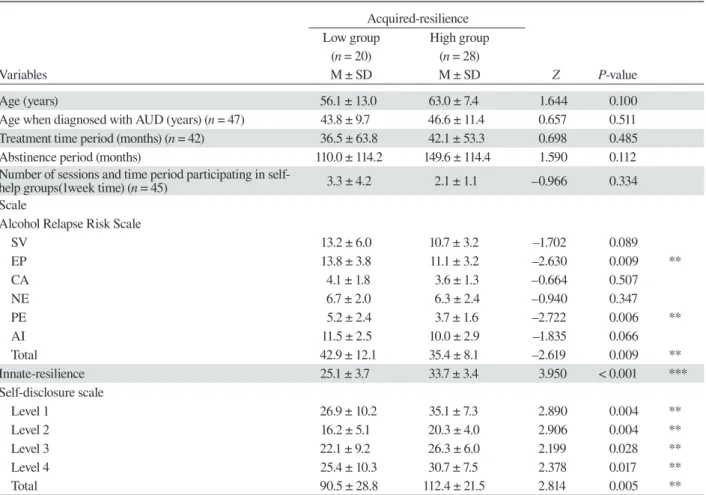
A comparison test was conducted on the target group’s attributes after dividing them into high (30 ≤ ) and low (29 ≥ ) groups based on their acquired-resilience scores (Table 3).
The results indicated that the high acquired-resil- ience group had significantly low ARRS scores for PE (Z = –2.722, P = 0.006) and EP (Z = –2.630, P = 0.009);
this group also had significantly high innate-resilience scores (Z = 3.950, P < 0.001). The results further indi- cated that this group had deep self-disclosure at all four levels: level 1 (Z = 2.890, P = 0.004); level 2 (Z = 2.906, P = 0.004); level 3 (Z = 2.199, P = 0.028); and level 4 (Z
= 2.378, P = 0.017).
Table 4 shows the correlations among resilience, ARRS, and self-disclosure scale. Negative correlations were found between both innate and acquired resilience,
Table 2. Comparison of variables between high and low groups based on innate-resilience scores Innate-resilience
Low group High group
( n = 21) ( n = 27)
Variables M ± SD M ± SD Z P-value
Age (years) 56.6 ± 13.2 62.9 ± 7.0 1.540 0.124
Age when diagnosed with AUD (years) ( n = 47) 44.3 ± 11.1 46.2 ± 10.4 0.482 0.630 Treatment time period (months) ( n = 42) 45.6 ± 67.9 34.1 ± 47.3 –0.620 0.536
Abstinence period (months) 103.4 ± 98.1 156.2 ± 123.1 1.434 0.151
Number of sessions and time period participating in self-
help groups (1week time) ( n = 45) 3.0 ± 4.2 2.3 ± 1.1 0.367 0.713
Scale
Alcohol Relapse Risk Scale
SV 13.4 ± 5.9 10.4 ± 3.0 –2.566 0.010 **
EP 14.1 ± 3.6 10.8 ± 3.0 –3.294 0.001 ***
CA 4.2 ± 2.0 3.5 ± 0.8 –1.104 0.270
NE 6.8 ± 2.1 6.2 ± 2.3 –1.073 0.283
PE 5.4 ± 2.5 3.5 ± 1.3 –2.884 0.004 **
AI 11.6 ± 2.7 9.9 ± 2.7 –1.929 0.054
Total 43.9 ± 12.2 34.4 ± 6.6 –3.186 0.001 ***
Acquired-resilience 27.2 ± 5.2 32.3 ± 4.9 3.106 < 0.001 ***
Self-disclosure scale
Level 1 27.9 ± 8.9 34.6 ± 9.0 2.560 0.010 **
Level 2 16.6 ± 5.0 20.1 ± 4.2 2.627 0.009 **
Level 3 23.9 ± 8.6 25.0 ± 7.0 0.853 0.393
Level 4 27.8 ± 9.2 29.1 ± 9.1 0.864 0.388
Total 96.1 ± 27.1 108.8 ± 25.8 1.819 0.069
Statistical evaluation is performed by the Mann-Whitney U test. **P < 0.01, ***P < 0.001.
The Self-disclosure scale assesses the depth of how much a person reveals about him- or herself. AI , awareness of illness; CA, compul- sivity for alcohol; EP, emotionality problems; Level 1, hobbies; Level 2, difficult experiences; Level 3, foibles; Level 4, inferior personality characteristics and abilities; M, mean; n, number of participants; NE, lack of negative expectancy for alcohol; PE, positive expectancy for alcohol; SV, stimulus-induced vulnerability; Z, Z-score.
and ARRS, while positive correlations between both in- nate and acquired resilience, and self-disclosure scale.
The variable we used to analyze the logistics is the variance inflation factor. The VIF value was less than 2.2.
Because we took multicollinearity into consideration as the variable for logistics analysis, we did not use a sub scale but rather used the total score and the variables that showed the significant difference.
A multiple logistic regression analysis (maximum likelihood method; results shown in Table 5) was per- formed by setting the high and low groups of innate-re- silience factors as dependent variables and by using the three items (ARRS scores; acquired resilience; self-dis- closure) as independent variables which the comparison test’s results indicated as having a significant difference.
The results indicated that the factors significantly cor- related with the high innate-resilience group were ARRS score [OR (odds ratio) = 0.918, 95% confidence interval
(CI) (0.846–0.997); P = 0.042] and the acquired-re- silience score [OR = 1.200, 95% CI (1.017–1.415); P = 0.031].
Another multiple logistic regression analysis (max- imum likelihood method) was performed by setting the high and low groups for acquired-resilience factors as dependent variables and by using the three items (ARRS scores; innate-resilience; and self-disclosure) as inde- pendent variables which the comparison test’s results indicated as having a significant difference. The results indicated that the factor significantly correlated with the high acquired-resilience group was the innate-resilience score [OR = 1.289, 95% CI (1.095–1.517); P = 0.002].
DISCUSSION
Upon clarifying attributes and characteristics of innate and acquired resilience of AUD patients who participate in self-help groups, we now examine factors associated
Table 3. Comparison of variables between high and low groups based on acquired-resilience scores Acquired-resilience
Low group High group
(n = 20) (n = 28)
Variables M ± SD M ± SD Z P-value
Age (years) 56.1 ± 13.0 63.0 ± 7.4 1.644 0.100
Age when diagnosed with AUD (years) (n = 47) 43.8 ± 9.7 46.6 ± 11.4 0.657 0.511 Treatment time period (months) (n = 42) 36.5 ± 63.8 42.1 ± 53.3 0.698 0.485
Abstinence period (months) 110.0 ± 114.2 149.6 ± 114.4 1.590 0.112
Number of sessions and time period participating in self-
help groups(1week time) (n = 45) 3.3 ± 4.2 2.1 ± 1.1 –0.966 0.334
Scale
Alcohol Relapse Risk Scale
SV 13.2 ± 6.0 10.7 ± 3.2 –1.702 0.089
EP 13.8 ± 3.8 11.1 ± 3.2 –2.630 0.009 **
CA 4.1 ± 1.8 3.6 ± 1.3 –0.664 0.507
NE 6.7 ± 2.0 6.3 ± 2.4 –0.940 0.347
PE 5.2 ± 2.4 3.7 ± 1.6 –2.722 0.006 **
AI 11.5 ± 2.5 10.0 ± 2.9 –1.835 0.066
Total 42.9 ± 12.1 35.4 ± 8.1 –2.619 0.009 **
Innate-resilience 25.1 ± 3.7 33.7 ± 3.4 3.950 < 0.001 ***
Self-disclosure scale
Level 1 26.9 ± 10.2 35.1 ± 7.3 2.890 0.004 **
Level 2 16.2 ± 5.1 20.3 ± 4.0 2.906 0.004 **
Level 3 22.1 ± 9.2 26.3 ± 6.0 2.199 0.028 **
Level 4 25.4 ± 10.3 30.7 ± 7.5 2.378 0.017 **
Total 90.5 ± 28.8 112.4 ± 21.5 2.814 0.005 **
Statistical evaluation is performed by the Mann-Whitney U test. *P < 0.05, **P < 0.01, ***P < 0.001.The Self-disclosure scale assesses the depth of how much a person reveals about him- or herself. AI , awareness of illness; CA, compulsivity for alcohol; EP, emotionality problems; Level 1, hobbies; Level 2, difficult experiences; Level 3, foibles; Level 4, inferior personality characteristics and abilities; M, mean; n, number of participants; NE, lack of negative expectancy for alcohol; PE, positive expectancy for alcohol; SV, stimulus-induced vulnerability; Z, Z-score.
Table 4. Bivariate correlations among variable 2 vs. variable 2’s resilience Innate-
resilience
Alcohol Relapse Risk Scale Self-disclosure scale
SV EP CA NE PE AI Total Level 1 Level 2 Level 3 Level 4 Total
Innate-resilience 1.000 –0.528 ** –0.572 ** –0.219 –0.294 * –0.507 ** –0.413 ** –0.629 ** 0.532 ** 0.584 ** 0.282 0.311 * 0.458 **
Acquired-resilience 0.653 ** –0.400 ** –0.477 ** –0.003 –0.275 –0.244 –0.193 –0.461 ** 0.468 ** 0.493 ** 0.390 ** 0.432 ** 0.497 **
Values are expressed as Spearman’s ȡ. *P < 0.05, **P < 0.01.
The Self-disclosure scale assesses the depth of how much a person reveals about him- or herself. AI , awareness of illness; CA, compul- sivity for alcohol; EP, emotionality problems; Level 1, hobbies; Level 2, difficult experiences; Level 3, foibles; Level 4, inferior personality characteristics and abilities; NE, lack of negative expectancy for alcohol; PE, positive expectancy for alcohol; SV, stimulus-induced vul- nerability.
with self-disclosure and relapse risks.
The target group’s resilience scores were nearly the same values as those obtained from prior research with university students using the same scale 24; their innate-resilience scores were 38.6, s = 6.9, and ac- quired-resilience scores were 29.9, s = 4.7. Considering the fact that the target group voluntarily works toward
their recovery while maintaining interpersonal rela- tionships within their families and self-help groups, presumably, the target group originally had both high innate and acquired resilience. This could potentially have been influenced by the fact that the target group be- ing members of self-help groups. This could have been influenced by the fact that the target group already had
Table 5. Summary of logistic regression analysis for variables contributing to high and low groups of innate- and acquired-resilience factors
ȕ SE Wald df P-value OR (95% CI)
Innate-resilience
ARRS –0.085 0.042 4.154 1 0.042* 0.918 (0.846–0.997)
Acquired-resilience 0.182 0.084 4.654 1 0.031* 1.200 (1.017–1.415)
Acquired-resilience
Innate-resilience 0.254 0.083 9.266 1 0.002** 1.289 (1.095–1.517)
OR and 95% CI were calculated with the use of logistic regression analysis. *P < 0.05, **P < 0.01.
ARRS, Alcohol Relapse Risk Scale; CI, confidence interval; df, degrees of freedom; OR, odds ratio; SE, standard error.
a support system; the respondents already belonged to self-help groups and approximately half of them contin- ued with treatment.
The comparison of the high resilience group with the low resilience group made it clear that patients with high resilience had deeper levels of self-disclosure.
Self-disclosure is defined as the method of conveying one’s own thoughts, emotions, or feelings to other people using linguistic communication.
In this study, self-disclosure levels of patients with high innate-resilience were significantly deeper for such items as level 1 and level 2. Approximately similar re- sults were obtained in the correlation analysis. Self-dis- closure levels for patients with high acquired-resilience were significantly deeper for all items. It can be said that the level of self-disclosure deepens alongside the recov- ery process from the fact that high resilience patients had deeper self-disclosure for acquired-resilience than for innate-resilience.
Self-disclosure of patients with AUD relates their own experiences in self-help groups, but disclosing in these settings is different from self-disclosure that happens in daily life with friends and families. These groups aim at a curative effect and are also a means of empowerment.25 Moreover, the participants of self-help groups disclose themselves26 so that they can gain spir- itual experiences, which leads to their recovery.27 This apparently indicate that patients deepen their levels of self-disclosure by participating in self-help groups and that being more empowered plays a part in increasing resilience.
The comparison of the high resilience group with the low resilience group made it clear that patients had reduced risks of relapse. The correlation analysis showed same similar results. Patients with high innate-resilience had significantly lower scores on the three items—
SV, EP, and PE. They also tended to score significantly lower on one item—intensity of AI. Patients with high acquired resilience had significantly lower scores on two items such as EP and PE. Also, it was shown that they
had a tendency to have significantly lower scores on such an item as intensity of AI.
These results indicate that relapse risks for patients with high resilience were reduced by the following four items: SV, EP, PE, and intensity of AI. Furthermore, the two items among those concerned with relapse risks that did not have significant differences were NE and CA;
however, average scores for these items were low for patients with high resilience. Having considered these results, patients with high resilience had reduced risks of alcohol relapses.
The results of the logistic regression analysis indi- cated that innate-and acquired-resilience factors were mutually reinforcing, which is a factor for the one with high innate-resilience to lower the ARRS score of posi- tive expectancy for alcohol.
In supporting people’s recovery from AUD, the va- lidity28 of an approach that utilizes intervention under the transtheoretical model,29 which shows the process of behavior modification, has been demonstrated. Based on positive expectancy decreasing in patients with high resilience, intervention that corresponds with stages of behavior modification, seems to increase resilience ef- fectively.
This study’s results suggested the following char- acteristics of resilience in patients with AUD who participate in self-help groups: high resilience patients deepened their acquired-resilience more than their in- nate one through self-disclosure, and this reduced risk of relapse. In fact, some have reported that the concept of resilience, as the natural ability to recover intrinsic to patients, must be considered in connection with recovery from AUD.30 Patients’ participation in self-help groups allows them to acquire sociality31 and deepen self-dis- closure32; a degree of accomplishing these can be an indicator of recovery from dependency. Since this study suggested that patients’ participation in self-help groups deepened acquired-resilience and reduce relapse risks, it is required to lead those with AUD to attend self-help groups as a measure to enhance their self-disclosure.
Because innate- and acquired-resilience factors are mutually reinforcing, it is essential to mutually improve both individual and environmental factors as a way of supporting patients with AUD for their resilience en- hancement.
It was reported that traumatic experiences, including abuse during childhood, can be one of the factors that reduce resilience.33 One proven method for improving the resilience of teenagers at high risk for alcohol or drug dependency is improving the family’s resilience through intervention in a form of community-based programs.6, 34 This suggests the necessity of intervention during childhood or with families to improve resilience.
This study has clarified that patients with high resil- ience have reduced risk of relapsing, and the resilience of patients faces traumatic growth35 due to recovery.
The results suggest that one way of supporting patients for their recovery is to assist them in building personal relationships and provide support that allows them to disclose deeply in a setting where they can relax, thus promoting their natural ability to recover.
Self-disclosure is to know oneself and is an element necessary to build close relations with others.36 The help seeking skill is a means of self-disclosure and is an important early intervention for AUD.37 The need to ac- quire help seeking skills for early intervention of AUD was suggested.
This study has several limitations. First, the study obtained valuable data from the small target group.
Thus, there were limitations to generalizing the findings and sampling bias in the target group cannot be denied.
Second, this was a cross-sectional study. Conducting further studies with larger target groups is necessary.
In conclusion, AUD patients with high resilience had reduced risks for relapsing and self-disclosure was deepened during the recovery process as acquired-re- silience increased. The preparing for an environment conductive to promoting natural ability of patients with AUD to recover is necessary.
Acknowledgments: We would like to express our sincerest, heart- felt gratitude to everyone who has cooperated with this study. Ad- ditionally, this study was completed as part of research conducted via the Grant-in-Aid for Scientific Research (C) (Grant Number 15K11835).
7KHDXWKRUVGHFODUHQRFRQÁLFWRILQWHUHVW
REFERENCES
1 World Health Organization. Global strategy to reduce harmful use of alcohol [Internet]. Geneva: WHO Press; 2010 [cited 2016 May 21]. Available from: http://www.who.int/substance_
abuse/msbalcstragegy.pdf
2 Babor TF, Higgins-Biddle JC, Saunders JB, Monteiro MG.
AUDIT. The alcohol use disorders. Identification test. guide- lines for use in primary care [Internet]. 2nd ed. Geneva: World Health Organization; 2006 [cited 2016 May 21]. Available from: http://apps.who.int/iris/bitstream/10665/67205/1/WHO_
MSD_MSB_01.6a.pdf
3 Osaki Y, Kinjo A, Higuchi S, Matsumoto H, Yuzuriha T, Horie Y, et al. Prevalence and Trends in Alcohol Dependence and Alcohol Use Disorders in Japanese Adults; Results from Periodical Nationwide Surveys. Alcohol Alcohol. 2016;51:465- 73. PMID: 26873982.
4 Ministry of Health, Labour and Welfare. Patient Survey 2014 (Disease and Injury) [Internet]. Tokyo: Ministry of Health, La- bour and Welfare; 2014 [cited 2016 May 21]. Available from:
http://www.mhlw.go.jp/toukei/saikin/hw/kanja/10syoubyo/dl/
h26syobyo.pdf
5 Engel GL. The need for a new medical model: a challenge for biomedicine. Science. 1977;196:129-36. PMID: 847460.
6 Johnson K, Bryant DD, Collins DA, Noe TD, Strader TN, Berbaum M. Preventing and Reducing Alcohol and Other Drug Use among High-Risk Youths by Increasing Family Re- silience. Soc Work. 1998;43:297-308. PMID: 9663000.
7 Corrêa Filho JM, Baltieri DA. Psychosocial and clinical pre- dictors of retention in outpatient alcoholism treatment. Rev Bras Psiquiatr. 2012;34:413-21. PMID: 23429812.
8 Witkiewitz K, Marlatt GA. Relapse prevention for alcohol and drug problems: that was Zen, this is Tao. Am Psychol.
2004;59:224-35. PMID: 15149263.
9 Eriksen L, Björnstad S, Götestam KG. Social skills training in groups for alcoholics: one-year treatment outcome for groups and individuals. Addict Behav. 1986;11:309-29. PMID:
3739817.
10 Kownacki RJ, Shadish WR. Does Alcoholics Anonymous work? The results from a meta-analysis of controlled ex- periments. Subst Use Misuse. 1999;34:1897-916. PMID:
10540977.
11 Bartone PT, Hystad SW, Eid J, Brevik JI. Psychological har- diness and coping style as risk/resilience factors for alcohol abuse. Mil Med. 2012;177:517-24. PMID: 22645877.
12 Rutter M. Resilience, competence, and coping. Child Abuse Negl. 2007;31:205-9. PMID: 17408738.
13 Collishaw S, Pickles A, Messer J, Rutter M, Shearer C, Maughan B. Resilience to adult psychopathology following childhood maltreatment: Evidence from a community sample.
Child Abuse Negl. 2007;31:211-29. PMID: 17399786.
14 Dyer JG, McGuiness TM. Resilience: Analysis of the concept.
Arch Psychiatr Nurs. 1996;10:276-82. PMID: 8897710.
15 Luthar S, Cicchetti D, Becker B. The construct of resilience: a critical evaluation and guidelines for future work. Child Dev.
2000;71:543-62. PMID: 10953923.
16 Rutter M. Resilience in the face of adversity. Protective fac- tors and resistance to psychiatric disorder. Br J Psychiatry.
1985;147:598-611. PMID: 3830321.
17 Masten AS. Ordinary magic: Resilience processes in develop- ment. Am Psychol. 2001:227-38. PMID: 11315249.
18 Hirano M. Review of resilience from the viewpoints of its innate and acquired aspects. Bulletin of the Graduate School of Education, the University of Tokyo. 2012;52:411-7. DOI:
10.2132/personality.19.94. Japanese with English abstract.
19 Luthar SS, Cicchetti D, Becker B. The construct of resilience:
a critical evaluation and guidelines for future work. Child Dev.
2000;543-62. PMID: 10953923.
20 Hirano M. Validity of the bidimensional resilience scale for junior high and high school students: An analysis using the twin
method. The Japanese Journal of Personality. 2011;20:50-2.
DOI: 10.2132/personality.20.50. Japanese with English abstract.
21 Hirano M. A Study of the Classification of Resilience Factors:
Development of the Bidimensional Resilience Scale (BRS).
The Japanese Journal of Personality. 2010;19:94-106. DOI:
10.2132/personality.19.94. Japanese with English abstract.
22 Niwa S, Maruno S. Development of a Scale to Assess the Depth of Self-disclosure. The Japanese Journal of Personality.
2010;8:196-209. DOI: org/10.2132/personality.18.196. Japanese with English abstract.
23 Ogai Y, Yamashita M, Endo K, Haraguchi A, Ishibashi Y, Kurokawa T, et al. Application of the relapse risk scale to al- cohol-dependent individuals in Japan: comparison with stim- ulant abusers. Drug Alcohol Depend. 2009;101:20-6. PMID:
19084356.
24 Haga S, Ishizu K. The effects of environmental-factors and personal-factors on the resilience. Kyoiku jissen kenkyu:
bulletin of the Center of Educational Research and Practice University of Toyama. 2014;8:7-12. Japanese.
25 Hatzidimitriadou E. Political ideology, helping mechanisms and empowerment of mental health self-help/mutual aid groups. J Community Appl Soc Psychol. 2002;12:271-85.
DOI: 10.1002/casp.681.
26 Mallow AJ. Self-disclosure. Reconciling psychoanalytic psy- chotherapy and alcoholics anonymous philosophy. J. Subst.
Abuse Treat. J Subst Abuse Treat. 1998;15:493-8. PMID:
9845862.
27 Galanter M, Dermatis H, Post S, Sampson C. Spirituali- ty-based recovery from drug addiction in the twelve-step fellowship of narcotics anonymous. J Addict Med. 2013;7:189- 95. PMID: 23609211.
28 DiClemente CC, Prochaska JO, Fairhurst SK, Velicer WF, Velasquez MM, Rossi JS. The process of smoking cessation:
an analysis of precontemplation, contemplation, and prepa- ration stages of change. J Consult Clin Psychol. 1991;59:295-
304. PMID: 2030191.
29 Peteet JR, Brenner S, Curtiss D, Ferrigno M, Kauffman J. A stage of change approach to addiction in the medical setting.
Gen Hosp Psychiatry. 1998;20:267-73. PMID: 9788026.
30 Alim TN, Lawson WB, Feder A, Iacoviello BM, Saxena S, Bailey CR, et al. Resilience to meet the challenge of addiction:
psychobiology and clinical considerations. Alcohol Res. Alco- hol Res. 2012;34:506-15. PMID: 23584116.
31 Humphreys K, Wing S, McCarty D, Chappel J, Gallant L, Haberle B, et al. Self-help organizations for alcohol and drug problems: toward evidence-based practice and policy. J Subst Abuse Treat. 2004;26:151-8; discussion 159-65. PMID:
15063905.
32 Dilts SL, Clark CA, Harmon RJ. Self-disclosure and the treat- ment of substance abuse. J Subst Abuse Treat. 1997;14:67-70.
PMID: 9218239.
33 Wingo AP, Ressler KJ, Bradley B. Resilience characteristics mitigate tendency for harmful alcohol and illicit drug use in adults with a history of childhood abuse: A cross-sectional study of 2024 inner-city men and women. J Psychiatr Res.
2014;51:93-9. PMID: 24485848.
34 Johnson K, Bryant DD, Collins DA, Noe TD, Strader TN, Berbaum M. Preventing and reducing alcohol and other drug use among high-risk youths by increasing family resilience.
Soc Work. 1998;43:297-308. PMID: 9663000.
35 Ishii K. A Review and Perspective of Resilience. The Japanese journal of health behavioral science. 2011;26:179-86. Japanese.
36 Sokabe Y, Koseki S. Extent of self-disclosure to university friends: Relationship between depth of self-disclosure, degree of familiarity, subjective similarity, sense of trust, and favor- ableness. Stress Science Research. 2015:30;77-82. Japanese.
37 Korcha R, Polcin DL, Kerr WC, Greenfield TK, Bond J.
Pressure and help seeking for alcohol problems: trends and correlates from 1984 to 2005. Addict Behav: 2013:1740-6.
PMID: 23261492.