JAIST Repository
https://dspace.jaist.ac.jp/
Title 臨床物語からの時間情報の抽出
Author(s) Moharasan, Gandhimathi Citation
Issue Date 2019‑03
Type Thesis or Dissertation Text version ETD
URL http://hdl.handle.net/10119/15784 Rights
Description Supervisor:Dam Hieu Chi, 知識科学研究科, 博士
Doctoral Dissertation
EXTRACTION OF TEMPORAL INFORMATION FROM CLINICAL NARRATIVES
MOHARASAN Gandhimathi s1460012
submitted to
Japan Advanced Institute of Science and Technology in partial fulfillment of the requirements
for the degree of Doctor of Philosophy
Main Supervisor: Professor Tu-Bao Ho Co-Supervisor: Associate Professor Dam Hieu Chi
School of Knowledge Science
Japan Advanced Institute of Science and Technology
March, 2019
Abstract
Keywords: Temporal information extraction, electronic medical records, clinical narratives, conditional Random fields, semi-supervised learning, Naive Bayes classi- fier.
The Electronic Medical Records (EMRs), is a digital version of patient med- ical history written and stored by medical professionals at the hospital. It has many components such clinical narratives, radiology reports, laboratory results and etc.
Among these components, text data describing medical observation of patients by doctor’s and nurse’s known as clinical narratives and it covers the most significant information about patient health status. EMR clinical narratives consists with large unstructured data become promising resources to support advancement and enhance- ment of clinical studies as it obtained by doctor’s and nurse’s with their medical expertise and observing on each individual patient for one medical practice during treatment activities. One perspective of the exploiting the potential clinical narratives in EMRs is clinical decision support systems, can vary in the areas include prognosis, disease monitoring, adverse drug effects and drug development, etc.
In spite of having many advantages, EMR clinical narratives remain with many challenges for exploitation. One major problem is structured representation of longitudinal clinical narrative of patients for further utilization in medical care. As all the significant medical information of patient’s have noted with the notion of time,
temporal reasoning plays a key role in structured representation. Temporal reasoning is a fundamental, yet vital skill that requires the understanding of natural language text. Therefore temporal reasoning is key task for temporal information extraction.
Temporal information in clinical text perform the crucial role in interpretation of the patient clinical information such as progress of disease, frequencies of medication information, to detect treatment pattern and adverse drug events.
The dissertation studies for basic steps on reconstructing clinical narratives to structured representation. In other words, the thesis studies to propose meth- ods that most appropriately extract temporal information from clinical narratives by utilizing annotated and unannotated data. To this end, the thesis systematically approaches the three fundamental problems: extraction of implicit and explicit tem- poral expressions, extraction of temporal events by using annotated data along with the support of unannotated data and detection of temporal relation and classification.
Our main targets are to seek provably stable and reliable models that can effectively extracts information from clinical narratives.
The first contribution comes from temporal expression extraction. A novel feature set has been proposed to address the problem of temporal expressions ex- traction. Our proposed framework has following key theoretical properties: (1) new proposed feature set is obtained from raw clinical text and (2) adopted HeidelTime features that are appropriate for temporal expressions extraction from clinical narra- tives. Existing methods are either having the advantage of HeidelTime or developing rules/ machine learning models, but not the integrated components of both. Those properties helps to extract temporal expressions effectively.
The second contribution is stemming from temporal event extraction from clinical narratives. The introduction of a novel semi-supervised framework to exploit abundant unannotated data for extracting temporal events from clinical narratives.
To best of our knowledge and survey from literature, this work is the first to propose semi-supervised method for extracting temporal event from clinical text. This ap- proach innovated the novel idea of gradually extending the training corpus by adding annotated data obtaining from unannotated clinical narratives. When working with very high dimensional medical data, our proposed method effectively extracts tem- poral events. The main result of this study is a novel semi-supervised method that can reach state-of-art performance with stable improvement than existing methods.
The third contribution is from temporal relation identification and classifi- cation. We formulated a new assumption on generating and identifying the potential candidate pairs from list of temporal events or expressions that can appropriately relate events/expressions in clinical narratives based on their attributes. Moreover, to address the problem of temporal relation detection, we exploited Naive Bayesian Classifier to detect the temporal relationship among the identified pair’s. The effective candidate pair’s generation helps to improve the relation classification performance.
In conclusion, our proposed method with novel feature sets can effectively extract temporal expression in clinical narratives. A proposed novel semi-supervised framework for temporal events extraction successfully utilized unannotated clinical narratives along with annotated data and enhanced event extraction performance.
In case of temporal relation detection, novel assumption for candidate generation pairs along with adopted dependency parsing approach can improve the quality of candidate pairs and consequently temporal relation classification with Naive Bayesian classification. Finally, this study accomplishes our objectives prosperously as stated.
ACKNOWLEDGMENT
This dissertation would not have been possible without the help, support, guidance and effort of a lot of people. It gives me immense pleasure to express my sincere thanks to whom I am greatly indebted.
First and foremost, I am very grateful to the MEXT (Ministry of Educa- tion, Culture, Sports, Science and Technology) Scholarship and Doctoral Research Fellowship of JAIST for its support during the period of study.
I owe my deepest gratitude to my former supervisor, Professor Tu-Bao Ho for his encouragement and continuous support during my study period. His advices and valuable comments helped me to become more mature in both academic and the daily life.
Special thanks to my current supervisor, Associate Professor Dam Hieu Chi for all his generosity and patience. I will always be indebted for his continuous support and kindness.
Also, I would like to express my gratitude to my committee chair, Professor Mitsuru Ikeda (JAIST), Professor Tsutomu Fujinami (JAIST), Associate Professor Hyunh Van-Nam (JAIST) and Professor Satou Kenji (Kanazawa University) who read and give useful comments to improve this dissertation.
I would like to express my thanks to my friends and especially all members
in Ho laboratory and Dam laboratory for their support and encouragement in my study period. I have learned a lot through the discussion with them.
Last but not least, I would like to express my gratitude to my family mem- bers, who always stay by my side during my hard time and encourage me during my study period at JAIST.
Contents
Abstract i
ACKNOWLEDGMENT iv
List of Figures ix
List of Tables xi
1 Introduction 1
1.1 Introduction to temporal information extraction . . . 1
1.1.1 Temporal information extraction from newswire text . . . 2
1.1.2 Temporal information extraction from clinical text . . . 3
1.2 Introduction to electronic medical records . . . 5
1.2.1 Clinical narratives . . . 7
1.2.2 Opportunities and challenges . . . 11
1.3 Representation of text data . . . 17
1.3.1 Vector space model . . . 17
1.3.2 Topic model . . . 18
1.3.3 Temporal information . . . 20
1.4 Problem and objective of our study . . . 23
1.4.1 Motivation and problem formulation . . . 23
1.4.2 Scope of our study . . . 24
1.4.3 Major contributions . . . 24
1.4.4 Thesis structure . . . 25
2 A brief history of Temporal Information Extraction (TIE) 28 2.1 Introduction to TIE in clinical narratives . . . 29
2.2 Temporal information annotation in clinical narratives . . . 33
2.2.1 Motivation . . . 33
2.2.2 Annotation of events in clinical narratives . . . 37
2.2.3 Annotation of temporal expressions in clinical narratives . . . 38
2.2.4 Annotation of temporal relations in clinical narratives . . . 39
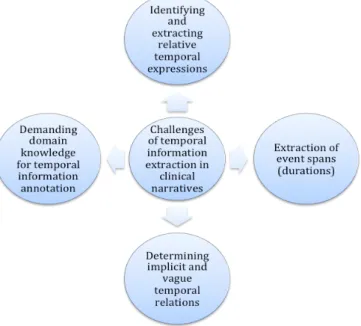
2.3 Challenges of temporal information extraction in clinical narratives . 40 2.4 Current status of temporal information extraction in clinical narratives 42 2.5 Summary . . . 46
3 Temporal Expression Extraction from Clinical Narratives 47 3.1 Temporal expression in clinical text . . . 48 3.2 Background of temporal expressions extraction in clinical narratives . 49
3.3 Proposed method for temporal expressions extraction . . . 51
3.4 Experimental evaluation . . . 54
3.4.1 Data sets . . . 54
3.4.2 Baselines . . . 55
3.4.3 Evaluation metrics and results . . . 55
3.4.4 Error analysis . . . 56
3.5 Summary . . . 57
4 Temporal Event Extraction 58 4.1 Structured sequential labeling . . . 60
4.1.1 Conditional random fields . . . 60
4.1.2 Conditional random fields on text processing . . . 61
4.1.3 Conditional random fields for temporal information extraction 62 4.2 Temporal event extraction in clinical narratives . . . 63
4.3 Semi-supervised learning . . . 64
4.3.1 Self-learning (self-training or bootstrapping) . . . 65
4.3.2 Semi-supervised CRF for information extraction . . . 66
4.4 Semi-supervised framework for temporal event extraction . . . 67
4.4.1 Selection of unannotated training data . . . 70
4.4.2 Feature generation and mapping . . . 71
4.5 Experimental evaluation . . . 72
4.5.1 Data sets . . . 72
4.5.2 Experimental design . . . 74
4.5.3 Experiment results . . . 75
4.5.4 Error analysis . . . 77
4.6 Summary . . . 78
5 Temporal Relation Detection 80 5.1 Temporal relations in clinical narratives . . . 81
5.2 Background of temporal relation identification and classification . . . 84
5.3 Proposed method for temporal relations detection and classification in clinical narratives . . . 85
5.3.1 Candidate pairs generation . . . 87
5.3.2 Temporal relation classification . . . 90
5.4 Experimental evaluation . . . 91
5.4.1 Evaluation metrics . . . 92
5.4.2 Experimental results . . . 92
5.4.3 Error analysis . . . 93
5.5 Summary . . . 93
6 Conclusion and future research 94
Publications during my doctor course
List of Figures
1.1 Electronic Medical Records: An Example . . . 6
1.2 A clinical narrative from EMR . . . 9
1.3 Matrix of word representation with binary weights . . . 18
1.4 Matrix of sentence representation with binary weights . . . 19
1.5 Topic model representation for a clinical narrative . . . 20
1.6 A clinical narrative: Temporal information representation . . . 22
1.7 Elements of temporal information extraction . . . 23
1.8 Graphical Representation of our Dissertation . . . 26
2.1 Key components of temporal information in clinical text . . . 31
2.2 Generating chronological order of temporal expressions and events: an example . . . 32
2.3 Illustration of a patient discharge summary . . . 36
2.4 Challenges of temporal information detection and extraction . . . 40
3.1 Objective of temporal expressions extraction in clinical narratives . . 50
3.2 Architecture for temporal expression extraction . . . 52
4.1 Diagram of Conditional Random Fields: Linear-chain CRF and Gen- eral CRF . . . 62 4.2 Problem space and overview . . . 64 4.3 Overview of the proposed architecture for temporal event extraction. 68 4.4 Example of feature mapping based on semantic group from UMLS. . 73 4.5 Performance of temporal event extraction from proposed semi-supervised
CRF model (a) Random selection and (b) K-means clustering. . . . 77
5.1 Allen’s temporal relations . . . 83 5.2 Framework for temporal relation classification . . . 86 5.3 An example of candidate pair generation for intra-sentence temporal
relation classification. . . 88 5.4 An example of candidate pair generation for inter-sentence and section-
cross temporal relation classification (Highlighted the pairs generated by proposed hypothesis). . . 89
List of Tables
3.1 Types of temporal expressions in clinical text . . . 51
3.2 Features for temporal expressions extraction . . . 54
3.3 Results from temporal expression extraction . . . 56
4.1 Features for temporal event extraction . . . 69
4.2 Evaluation results of temporal event extraction. . . 75
4.3 Experimental settings for temporal event extraction and evaluation. . 76
5.1 Evaluation results of temporal relation classification . . . 92
List of Abbreviations
CDS- Clinical Decision Support
CNLP- Clinical Natural language Processing CRF - Conditional Random Fields
DSS- Decision Support System EMR - Electronic Medical Records NLP - Natural Language processing NER- Named Entity Recognition
TIE - Temporal Information Extraction TRC - Temporal Relation Classification SVM -Support Vector Machine
Chapter 1
Introduction
This chapter first introduces the temporal information extraction, Electronic Medi- cal Records (EMRs) and clinical narratives. Then the various representation of text data are presented. The next part provides a concise view of our research problem, objectives and major contributions. Last part have shown structure of this thesis.
1.1 Introduction to temporal information extrac- tion
Automatic recognition and extraction of information from natural language text has become an active area of research in computational linguistics. Especially Temporal Information Extraction (TIE) has transformed vital area for researchers from the in- troduction of TimeML corpus [1]. Understanding the temporal information from text is unavoidable for several natural language processing applications such as Informa- tion retrieval, Question answering, Temporal intent classification, Query processing and various text mining tasks. To accomplish the goal of temporal information ex- traction tasks from text, it is important to develop strong annotation standards and
corpora for temporal information [2], where the large corpora is available for newswire text1. A numerous number of works has been established in TIE systems based on these available corpora [3], [4], [5].
1.1.1 Temporal information extraction from newswire text
Temporal information extraction task initially started with temporal representation in early 1980’s. The interval-based algebra has been proposed for representing these temporal information in natural language [6]. Most importantly these temporal rep- resentation demanded creation of annotated corpora to advance the Natural Lan- guage Processing (NLP) for general text which includes Named Entity Recognition (NER) and temporal information extraction, etc., These advancement along with the Message Understanding Conferences (MUC-6, MUC-7) initiated and introduced the extraction of absolute and relative time informations. This primitive work paves the significant path for temporal information extraction from general text and added the valuable contributions.
In early 2000’s rapid development of temporal reasoning and temporal infor- mation extraction (TIE) methods accelerated with the creation of TimeBank corpus for general newswire text [1], [7]. TimeBank corpus annotated a temporal reasoning elements by using TimeML specifications and guidelines2. This corpora have three types of temporal information: temporal expressions, events and temporal relations.
It is a typical and most popular corpus for temporal reasoning and relation learning in the natural language text.
To advance the temporal information extraction research works in general domain, series of TempEval Challenge proposed and added the significant contribu-
1http://timeml.org/
2https://catalog.ldc.upenn.edu/docs/LDC2006T08/timemlannguide1.2.1.pdf
tions. The state-of-art contributions for temporal information extraction in newswire text from various research groups are summarized 3. Later in 2000’s the availabil- ity of massive quantity of clinical text from Electronic Med- ical Records (EMRs) has created significant demand for clinical text processing and temporal information extraction in the field of health care and medical research.
1.1.2 Temporal information extraction from clinical text
In recent days, the interest of temporal information extraction from domain-specific clinical text has received great attention due to richness of temporality in clinical text, significance of temporal information exploitation in medical care and availability of clinical text. Medical doctors and nurse notes their diagnosis about the patient symptoms, disease, disease progress, occurrence and treatments details in the form on unstructured clinical text with implicit temporal information. The produced huge collection of clinical text from EMRs provides a vast but still underutilized rich source of patient medical information in the real world. Exploiting clinical text in EMR is very challenging due to implicit expression of temporal information, heterogeneity nature, lack of structure and writing quality [8], [9]. Clinical text is special kind of text, rich in temporality and ambiguous in nature compared to general newswire text. Natural Language Processing (NLP) and machine learning perform a significant role in converting unstructured clinical text into structured representation which is inevitable. This structured illustration of text is easily accessible and understandable by machines.
Many researchers worked on various topics of temporal representation and reasoning with clincal data [10], [11], [12] [13]. A few researches in NLP over clinical text have been opened to address different exploitation strategies of extracted tempo-
3https://aclweb.org/aclwiki/T emporalInf ormationExtraction(Stateoftheart)
ral information in medical care and research (develop applications by using temporal informations) [14], [15], [16]. Some of the applications, such as clinical decision sup- port systems are exploiting temporal information [16].
To accelerate the temporal information extraction research works in clinical domain, I2B24 (Informatics for Integrating Biology and the Bedside) challenge [17], [18] provided an annotated corpora on temporal relations in the year 2012. The I2B2 workshop was the first pioneer along the collaboration of Mayo-Clinic generated the set of annotated and unannotated, deidentified patient discharge summaries for pub- licly available clinical dataset for research, which was the biggest barrier for NLP in clinical data [19]. This process made the preprocessed dataset available to interested research groups and submit their research findings and contributions in the I2B2-NLP challenge. Further they extended the dataset and challenges for interested researchers such as Obesity Challenge, Medication Challenge, Relations Challenge, Coreference Challenge, temporal Relations Challenge, and De-identification and Heart Disease Risk Factors Challenge. Consequently various research groups such as SemEval 2015 [20] and SemEval 2016 [21] contributed an annotated corpora on temporal relations and entities to develop the temporal information extraction methods. Bethard et al.
adopted the temporal annotation guidelines from ISO-TimeML [22] and developed domain specific guidelines for the clinical domain, which is called THYME-Guidelines to ISO-TimeML (THYME-TimeML)5, where THYME stands for Temporal Histories of Your Medical Events.
On the other hand, following with I2B2, ShARe CLEF 2013/2014 eHealth challenges from Physionet, Clinical TempEval 2015 [20] and Clincial TempEval 2016 [21] also provided annotated data for temporal information from clinical text. In japan, NII Testbeds and Community for Information access Research (NTCIR-MedNLP)
4https://www.i2b2.org/NLP/TemporalRelations/
5http://clear.colorado.edu/compsem/documents/THYME guidelines.pdf
provided the text for various topics of medical data exploitation [23], [24]. With avail- able of all these resources, much effort has been done to develop different methods to extract temporal information from clinical narratives [17], [18].
1.2 Introduction to electronic medical records
The use of information and communication technologies is fundamental to accessing and helping health problems and challenges faced by patients. One of such recent emerged technology in health care is Electronic Medical Records (EMRs). EMR includes both hardware and software solutions and services, electronic devices such as mobile phones and applications, text messages, and clinic or remote monitoring sensors to note about the observation of patients.
Over the past decade, the implementation of Electronic Medical Records (EMRs) in hospitals has made the job easier for doctors to store and manage the patient medical history in one place. EMRs are digital version of paper documents that contains the clinical observation of a patient described by doctors and nurses.
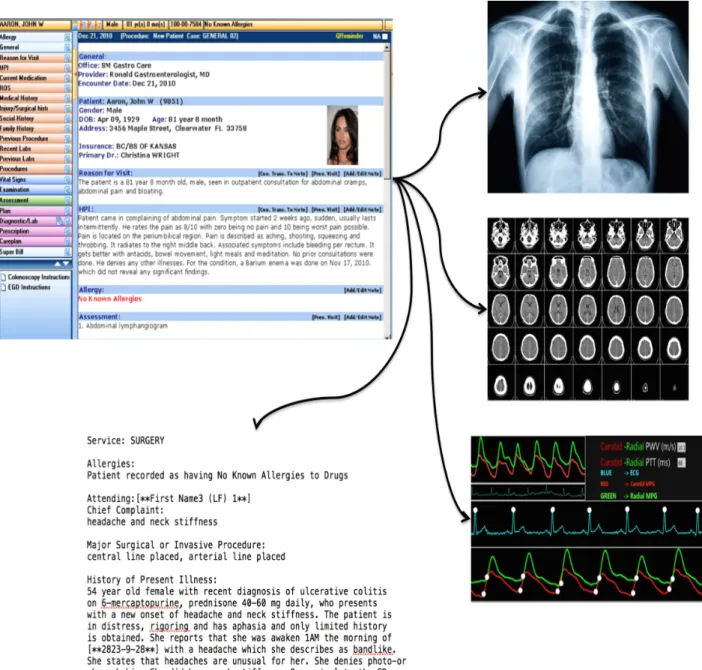
This evolution of EMRs has brought an abundant amount of digitalized longitudinal patient clinical records, which is considered one of the valuable asset affecting the success and progress of medical care and patient treatments in health care [8]. EMRs contains various informations such as clinical text, test reports, digitized images, X- Ray, and etc., among these information, the clinical text in EMRs are believed to be rich resource for major advancement to provide better treatment for patients in hospitals. Figure 1.1 shows an example of clinical observation of a patient in EMR noted by various departments. Especially, EMR contains the longitudinal information that describes about symptoms, disease, treatment and medication of an individual patient. Basically, this information composed of five main data components, which is explained below.
Figure 1.1: Electronic Medical Records: An Example
1. Demographic Information (or) Patient personal information such as patient name, gender, martial status and etc.
2. Physiological measurement (or) body function measurements. This includes two types of data
(a) Numerical measurements such as body temperature and blood pressure (b) Signal measurements such as pulse rate, respiration rate and etc.
3. Laboratory test results such as blood test, urine analysis, etc.
4. Radiology images such as X-Ray, CT-Scan and MRI-Scan reports etc.
5. Clinical notes observed and noted by doctors and nurse which is known as clinical narratives
Although the development of EMRs has already provided an refined solution for efficient storage and data management, it just only reflects the primary usage which is data saving. The stored data from EMRs open new opportunities to support clinical studies for enhancing patient treatment methods and health care innovation.
However, the exploitation is still in its infancy stage due to characteristics of clinical text in EMR.
1.2.1 Clinical narratives
Clinical narratives (or) clinical text in EMRs is a special kind of text that contains a lot of medical knowledge. This clinical narratives in EMR almost comes from notes of nurse and narratives of doctor daily assessments during their patient treatment. This clinical text is written in unstructured format using natural language which is con- sists of abbreviations, short forms and poor writing quality[]. One of the perspectives in clinical text exploitation is to analyze and evaluate patient health status through
symptoms, disease, treat offered and conditions observed by a doctor analysis view which are collected and noted in the clinical text during the course of patient admis- sion at hospital. Clinical text analysis demands to develop domain dependent natural language processing techniques to process due to several special characteristic of such text. Figure 1.2 shows clinical observation of a patient noted in EMR by doctor and nurse.
EMR data exploitation, especially clinical text exploitation is important to reduce medical errors through improving the patient treatment patterns. Clinical text is a large, rich and esteemed resource that contains information of patient’s symp- toms, disease, treatment observations known as phenotype informations. Doctors and nurses who have medical knowledge and experience in patient treatment note this clinical narratives. Therefore, credibility of the information in clinical narratives appeared EMR is more abundant and believable as well. Thus, these clinical nar- ratives serve greatly promising resources to improve the patient health status and reduce cost through the effective treatments.
Discharge summary
Generally, discharge summary contains all the details such as patient previous his- tory, current problems, medications used when he stayed at the hospital, what are the medications should be continued after discharging from the hospital and etc. But these details are written in concise (not explanatory) in contrast to the doctor daily notes and nurse narratives. Hence the step-by-step improvement of treatment effects and the disease progressions will not explained in detail as shown in figure 1.2. The content of a patient discharge summary is usually consist of multiple sections that describe the patient history of illness, chief complaint, social and family history, hos- pital course, allergies, and plan after discharge. Moreover the discharge summaries
Figure 1.2: A clinical narrative from EMR
tend to be little bit structured narratives with mostly complete sentences, rich in medical terminologies and multiple temporal expressions.
Doctor notes and nurse narratives
Diagnosis of patients in digital medicine by doctor’s based on detection of physio- logical positions and monitoring is the most important event. These positional and monitoring information sometimes gathered with the help of sensor or sensory device.
One of the key features of these sensor device is that patients can wear any part of the body and it regularly monitors the physiology of the organs in that area. Doctor’s analyze the collected information and describes the health status as clinical narratives from their medical knowledge and experience. Moreover patients are treated based on collected and compiled information. For example electrolytes (or) sensors are used to monitor the health status of patients who are in the tumor or intensive care unit.
Doctor’s summarize the current status and decide the right treatment procedure for patient’s from recorded electronic signals.
In other hand, It is the nurses who regularly care for the prescriptions given by the doctors and take care of their patients at the right time intervals. A nurse observes the intensive care unit patient with a intermittent (occurring at random or scheduled intervals of time) or constant time interval and write their observed information in EMR, which is called nurse narratives.
Doctor’s noted and nurse narratives contains the text rich in temporal infor- mation yet to exploit in medical care for diagnose a disease, predict drug side effects and etc. Nurse will note down all the events like improvements of the treatments and progression of disease effects in constant time interval. Hence it has more valuable and significant temporal information, which is related to development of disease and symptoms. More importantly nurse will note down the treatment effect in patients, what kind of effect the patient has after using the particular drug. Detecting these information is unavoidable to exploit the EMR data in various medical care research and very useful for medical professionals to provide the treatment to the patients.
Also disease progressions and treatment improvement details will help to predict the adverse drug reactions and post market surveillances. Since the drug are perfected based on the clinical trials.
At the same time, doctors conclude their diagnosis from their own obser-
vation, analysis from various tests and test reports, finally provide the appropriate treatment (prescribe medications and necessary test). Hence the clinical narrative contains the both frequent observation of nurse narrative and deepest analysis of doctor notes.
1.2.2 Opportunities and challenges
The opportunities and challenges on exploiting EMR clinical narratives are diverse.
Some of the significant opportunists are described in below.
Opportunities
Clinical narratives in EMRs stored as a longitudinal observation of each patients that contains all medical details and treatment informations. The clinical narrative is con- sidering as a promising sources that can help health providers as well as medical care researchers to understand more about nature of diseases, medical treatment effects and other significant insights to support health care development and innovation.
In one perspective of exploiting clinical narratives for the purpose on treat- ment improvements of patients. The key opportunity of utilizing the clinical nar- ratives from EMRs is to analyses the effectiveness of treatment effect and discover drug side effects. Moreover this reliable clinical narratives has the potential infor- mations that helps to discover the new usage indication of existing drugs or drug repositioning [25].
Another important opportunity of exploiting clinical narratives from EMRs is sentiment analysis and opinion mining. To answer the following questions“What is the patinet health status now? or How effective of an ongoing treatment? ”, sentiment analysis is important for the clinical domain.
Sentiment analysis in clinical narratives has the purposes to support the as- sessment of patient status as well as assessment of treatment activities and courses.
Thus, sentiment analysis play the rules in identify whether the treatment gives nega- tive effect, positive effect, neutral outcomes or determine if patient status is improved or worsen or neutral conditions [26]. Sentiment analysis task is also remained with key challenges because of sudden sentiment shifter expressions. As mentioned in [27]
clinical narratives contains plenty of negation statements such as “The patient did not report back pain”, or “No evidence of edema or erythema”, uncertain statements, example that “She is not sure if she really ready for chemotheraphy at this time ”, etc. Thus natural language processing techniques found difficulty in analyzing these kind of sentiment expressions in clinical narratives.
One another significant chance of utilizing the clinical narratives from EMRs in temporal reasoning and temporal information extraction. The clinical narratives embedded with critical, precise and massive amount of temporal information de- scribed by doctors and nurses. Also it has a potential time orientation in through out the description. Moreover, this temporal information is crucial for constructing the patient similarity based on relation-based information from the medical database. In the work of [28] have developed a time-sensitive cancer tissue information retrieval system that helps to construct and answer user questions. Yet, the developed system is totally based on structured data (i.e.) the data consist of time-related informa- tion to determine the relation between the records. The usage of unstructured data with temporal information for temporal retrieval system is yet to considered in future research.
Applications of temporal reasoning in medicine
Temporal reasoning helps to nurture a wide range of NLP applications in medicine.
For example, information extraction, question answering and information retrieval most widely developed tasks based on temporal reasoning. Basically, information extraction denotes task of identifying crucial information in natural language text, whereas question answering aims to respond of humans questions with appropriate answer. In case of information retrieval searches for similar patient record from stored electronic medical records in database. We will discuss each applications in detail below.
1. Medical information extraction
As previously mentioned, EMRs contain massive amount of valuable informa- tions in the form of unstructured clinical narratives which is distinct from gen- eral standard literature. Natural language processing technologies has been de- veloped to extract key information from such clinical narratives such as Named Entity Recognition (NER) [29], medication information extraction [12], [30], relation extraction [31]. As all the information in clinical narratives have tem- poral boundaries, temporal reasoning emerged one of most challenging task for extraction of temporal information.
2. Clinical question answering
• How the patient should be treated now?
• what is the best medicine to cure migraines?
• What does the patient experience after taking Naproxen ?
Most of the questions have the temporal dimension. To answer such above questions, clinical information retrieval systems allow physician to quickly lo- cate similar patient records that are specific to their information need from the
available rich resources of clinical narratives in EMRs. The time-oriented in- formation retrieval system demands new approaches to query and select most similar records for delivering higher quality care with short span of time and reduced cost. Various study has been conducted to meet the need of clinical query answering [32], [33]. Trivedi et al., have developed a visualization tool with various components that helps to analyze the clinical records for domain experts and end users [34]. Also this tool allows to send the feedback if the correction is necessary for analyzed data.
3. Temporal information retrieval
Information retrieval is a task of searching a relevant record from a collection of available documents. Traditional information retrieval used a group of key words to search relevant records, but it do not use time or temporal relation information. In recent times, temporal information based search has emerged one way of information retrieval system that satisfies the user needs more ac- curately. The central idea of temporal information based information retrieval utilizes temporal expressions along with the keyword indexing method to re- trieve the more accurate and relevant documents [35]. Moreover, temporal information in clinical text is significant and important which is useful for tem- poral relation based information retrieval. Therefore, temporal reasoning is key task for temporal information retrieval applications in clinical domain.
Challenges
Though clinical narratives have many advantages and opportunities, exploiting the clinical narratives in EMR poses many challenges [36], but promising to make an innovation in health care. It is worth noting that the clinical text in EMRs is usually unstructured and written in ungrammatical way with full of shorthand and abbrevi-
ations that makes the process of exploiting clinical text is very different, even much more difficult, from standard text from the literature. As mentioned in previous section, EMR exploitation including various tasks:
1. Patient De-identification 2. Medical phrases identification 3. Abbreviation Disambiguation 4. Named Entity Recognition 5. Temporal information extraction 6. Data Representation
7. Sentiment analysis and opinion mining
Several domain-specific characteristics of clinical text makes the exploiting task more challenging. To promote and accelerate the development of techniques to solve the tasks in analyzing clinical text, shared tasks such as I2B2 challenges, ClinicalTempEval-2015 ClinicalTempEval-2016 for english since 2006 and NTCIR challenges for Japanese since 2013 have opened the stage for researchers. The char- acteristics of the clinical text are analyzed below in detail.
The clinical text is not followed grammatical structure as such general text and it composed of lot of abbreviations, short forms that makes the syntactic parsing and concept recognition more difficult and challenging task. As the clinical text is written quickly by the doctors and nurse, the structure and grammar is not consid- ered carefully during the writing. Additionally, medical professionals note the patient clinical observation with lot of abbreviations due to time constraint. This abbrevi- ations in clinical narratives rise the problem of abbreviation disambiguation and its
restoration [37]. Abbreviation disambiguation from clinical narratives have to handle problem of sense inventories, which is considered two types. They are multiple ab- breviation with one sense and one abbreviation with multiple sense. For example the abbreviation ARF have three expansions; Acute renal failure, Acute rheumatic fever and Acute respiratory failure. Unlocking the right expansion for the abbreviation is totally depends on the medical dictionary such as MetaMap, Mesh, UMLS and etc., in the existing study, various methods have been developed to deal with this problem [38].
Another challenge of utilizing the clinical narrative in EMRs is sentiment analysis and opinion mining. It is significant to understand the reaction of patients for the given treatment (i.e.) the effect of the treatment is reflected as a patient opinions. Hence, analyzing these opinions and sentiments will help to improve the quality of the treatment patterns.
Yet another crucial challenge in exploiting clinical narratives is detecting and extracting the implicit and vague time-oriented expression of medical concepts and temporal events.
Besides these above challenges, data representation is another challenge due to the short clinical text. This characteristic makes the task representation is difficult with lack of enough information.
Another significant characteristic of clinical text is comes from longitudinal, which is strongly related to time. As the clinical text is created by doctors or health care provider when the patients visits hospitals. Therefore, clinical narratives consists of patient health information over the time. This quality and quantity of time-series clinical information poses the challenge of temporal reasoning and temporal informa- tion extraction.
The last challenge in exploiting clinical narratives is its domain-specific na- ture. As the identified and processed information will be utilized to improve the medical and patient care, developing basic representation method is supposed to bring more accurate and meaningful results from medical domain knowledge than the normal text representation.
1.3 Representation of text data
To reconstruct the clinical narratives for further usage in clinical applications, the effective learning representations are required. Patient-level representation of clinical narratives helps to cohort patient records for wide range of tasks [39]. Some of the well-known representations for text data is discussed precisely in next subsections 1.3.1, 1.3.2 and 1.3.3.
1.3.1 Vector space model
In vector space models (VSM), each word represented by a feature. Therefore, the text is encoded by a vector, is having the equivalent length of the vocabulary count in the corpus of a domain. For clinical domain, as the number of terminologies is up millions, thus the length of vector representation will be tremendous. This limitation leads to the problem of dealing with high dimensional data, a very challenging in text mining. Moreover, representing a piece of short clinical text in vector space models will result in a vector with many zero values. Dealing with sparse vectors is another challenge that we have to encounter when applying vector space models [40].
Let us consider the following example sentences from clinical narrative to understand the traditional vector space representation with binary weights for each term.
1. Sentence 1: The patient reports nausea and vomiting.
2. Sentence 2: The patient complained vomiting and headache.
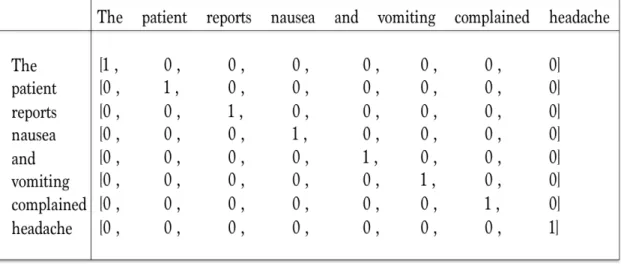
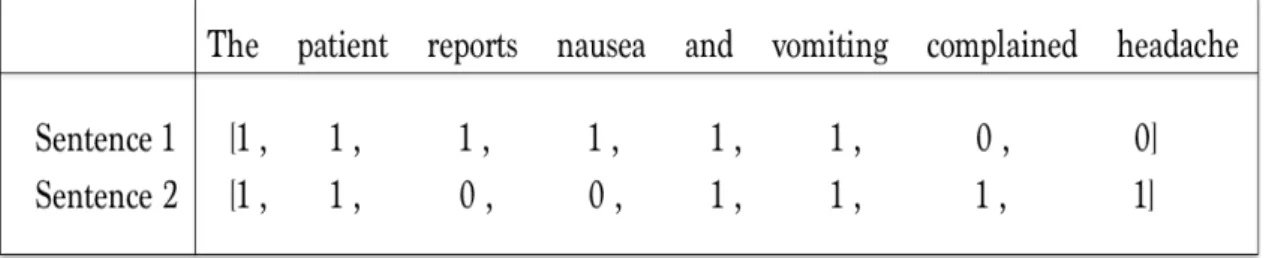
The traditional vector space representation learns from all given words in the sentence, and each unique word represents a binary value based on co-occurrence as shown in figure 1.3. In case of sentence level, all the words in each sentence are concatenated and represented with binary weights as shown in figure 1.4.
Figure 1.3: Matrix of word representation with binary weights
1.3.2 Topic model
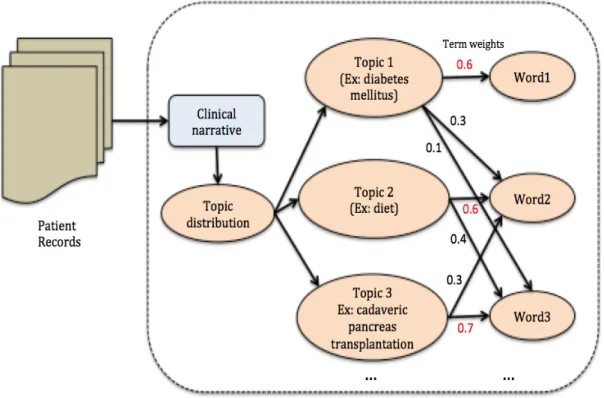
Due to several limitations in traditional representation techniques that work on gen- eral text such as vector space models seem not work with clinical text. In search of other representation for clinical text in EMRs data, topic models have some advan- tages to deal with the problem. Basically topic models are assuming a patient record with a mixture of topics, and a topic is a mixture of words. The concept of topic
Figure 1.4: Matrix of sentence representation with binary weights
model is to represent the words in a hierarchical structure like the way human imag- ine based on the distribution weights of each word in the document. The graphical representation of topic model for clinical narratives is shown in figure 1.5.
Several works on exploiting clinical text in EMR using topic models with different level of domain incorporation have been studied in the past history. Sarioglu etal. have developed a disease-medicine topic model to discover insight knowledge about diseases and medicines [41]. In the study [42], employed a topic model to identify patterns of clinical events in a cohort of brain cancer patients. Though, above works achieved some impressive results, almost little or no medical domain knowledge was embedded in the developed model. However this works considered as the first attempt to bring medical knowledge incorporation to represent the clinical text in the form of topic model.
Even though, it represent the text in hierarchical structures, it misses to discover a temporal information (i.e.time-orientation) which is significant in medical care for disease diagnosis and proposing treatments. Thus, the clinical text demands another powerful representation that depicting time information with hierarchical structure to understand the longitudinal nature of clinical narratives.
Figure 1.5: Topic model representation for a clinical narrative
1.3.3 Temporal information
The patient clinical information in EMRs have mainly been stored in the discharge summaries, doctor daily notes and nurse narratives, in natural language text. Clinical text contains the patient disease symptoms and disease progress, doctors notes and treatments [43], [13]. In the above sources, most events happened during the patient stay at the hospital are associated with notion of time (dates and time) that linked to the patient disease signs and symptoms and treatments. Therefore, processing of temporal information in clinical text plays a potential role in exploiting clinical text in EMR and medical care to support and develop disease-diagnosing system [16]. For these reasons, there is an increasing interest in temporal information extraction over the clinical text. However the exploitation of clinical text in NLP is still in early stage due to several difficulties in processing the clinical text [44]. Also the utilization of
clinical text in EMR is complex task due to the nature of the data.
Temporal information performs the crucial role in interpretation of the pa- tient clinical information such as progress of disease and frequencies of medication information. Though the human can able to understand the temporal information such as events and temporal relations between the events efficiently to interpret the progression of disease status and prognosis, temporal information extraction remains the non-trivial task in NLP.
Basically temporal information in clinical narratives consist of three com- ponents. The first and foremost element of temporal information is temporal expres- sions. Temporal expressions in clinical narratives such as “admitted on Friday”, “7 weeks prior to admission”, “Twice a day” and a special pre-post expression of “four months post transplantation”. Let us also observe this expressions in an history of illness portion from a sample discharge summary have shown in Figure 1.2.
The second element of temporal information is temporal events. In the context of clinical setting, the disguising terms for describing the patient health status with occurring incidents, activities, entities with states are considered as medical events. Moreover events in the clinical narratives are restricted to noun phrase or clinical concept such as laboratory tests, medical problems, proposed treatments, diagnoses, patients complaints among others [45], [46]. In other simple words, any diseases, symptoms, tests, medications and conditions related to the patients health status is considered a medical event.
Let is consider the example discharge summary from figure 1.6 to examine the temporal expressions and events as highlighted.
The third element of temporal information is determining temporal rela- tions with expressions and temporal boundaries of events. This relationship can be classified one among the 13 types of interval algebra proposed by Allen’s [6]. The
Figure 1.6: A clinical narrative: Temporal information representation
event from the example “cadaveric kidney transplantation” has been occured BE- FORE entering the hospital for admission, whereas the event “cadaveric pancreas transplantation” is AFTER the event of ADMISSION.
From the above figure, the clinical narratives have the following temporal ex- pressions: “four months”, “twice a day” and “2016-08-08” and “2016-08-15”. Among these, “2016-08-08” and “2016-08-15” can be classified to two types of expressions:
(1) it can be considered DATE expressions, (2) on the other hand it is considered SECTIME expressions as ADMISSION and DISCHARGE expressions.
The medical problems, diagnosis, treatment, medication information in clin- ical narratives considered as temporal events. For example “type 1 diabeted mellitus”
considered as diagnosis event, “cadaveric kidney transplantation” considered as treat- ment event, and “14 units of NPH insulin” considered as medication event. However all these events are covered with temporal boundaries as we explained in temporal expressions.
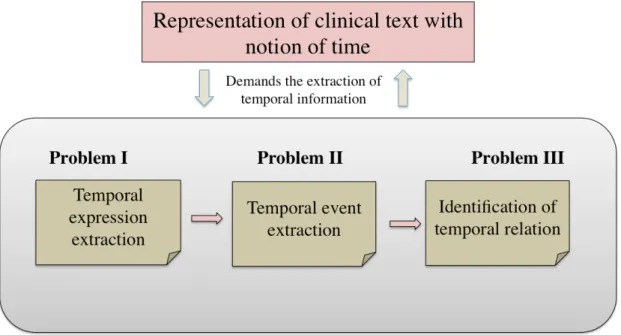
Therefore, it is obvious to solve the problem of temporal information ex- traction demands the following sequential tasks which is shown in figure 1.7. Finally
these extracted temporal informations are exploited to generate the chronological or- der of events and expressions, consequently visualization tool such as SMILE tool for visualizing of clinical events and expressions 6
Figure 1.7: Elements of temporal information extraction
1.4 Problem and objective of our study
1.4.1 Motivation and problem formulation
Data representation of clinical text with notion of time, demands to extract temporal expressions, events and temporal relations. Temporal expression is a fundamental element to represent rest of the temporal informations. Moreover, temporal events extraction and temporal relation detection are challenging task and basis for temporal ordering of events in clinical timeline. Especially, discovering the temporal order between the clinical events and expressions from raw clinical text is a crucial part
6http://www.simile−widgets.org/timeline/
of temporal information extraction. Therefore in this thesis we address the following problems.
1. Extracting absolute and relative temporal expressions from raw clinical text 2. Extraction of temporal events by exploiting unannotated data using semi-supervised
methods
3. Discover the temporal relations between temporal expressions and events
1.4.2 Scope of our study
Our work has target to support a study area on automatic reconstruction of clinical text from electronic medical records toward structured representation of unstructured clinical text. In the temporal information extraction, main challenge is to recognize and extraction of clinical events with time expressions, then confirm and classify the crucial relationships among them. Therefore, in this study, we focus to extract temporal expressions, events and classify the relationships among expressions and events.
1.4.3 Major contributions
The main contributions of our thesis have been discussed in this section. We fragment the task of temporal information extraction into multiple sub tasks and solve the problems by developing new methods.
• The first contribution comes from temporal expression extraction. A novel feature set has been proposed to address the problem of temporal expressions extraction. New proposed feature set is obtained from raw clinical text and
adopted HeidelTime features that are appropriate for temporal expressions ex- traction from clinical text.
• The second contribution stemming from temporal event extraction from clinical text. We established a novel semi-supervised framework to exploit abundant unannotated data for extracting temporal events from clinical text. To best of our knowledge and survey from literature, this work is the first to propose semi-supervised method for extracting temporal event from clinical text. This approach innovated the novel idea of gradually extending the training corpus by adding annotated data obtaining from unannotated clinical text. This is the most significant contribution of the thesis to overcome the limitations of the general methods when being applied to the clinical text.
• The third contribution is from temporal relation identification and classification.
We formulated a new assumption on generating and identifying the potential candidate pairs from list of temporal events or expressions that can appro- priately relate events/expressions in clinical text. Moreover, to address the problem of temporal relation detection, we exploited Naive Bayesian Classifier to detect the temporal relationship among the identified pair’s. The effective candidate pair’s generation helps to improve the relation classification perfor- mance.
1.4.4 Thesis structure
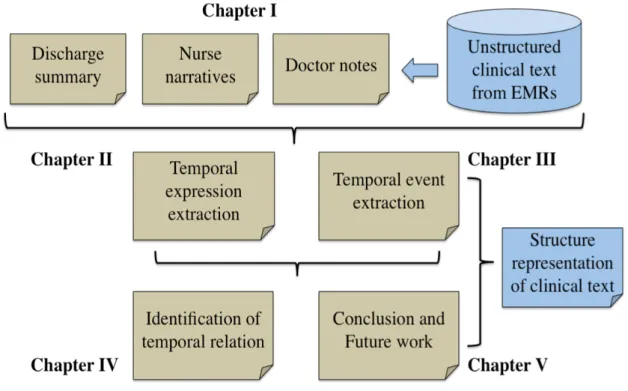
Our thesis consists of 6 chapters. Figure 1.8 shows the graphical representation of our dissertation. The first chapter introduces about the clinical text in EMRs and its challenges, the problem and objective of our research.
In Chapter 2, we give introduction to temporal information extraction, dis- cuss about the importance of TIE and benefits of TI exploitation in medical care and
Figure 1.8: Graphical Representation of our Dissertation
research. Then, we will discuss the similarities and differences of temporal information in general and clinical text.
Chapter 3, gives the overview of temporal information and three keys tasks of our research; temporal expression, temporal event extraction and temporal relation classification. Also this chapter focuses to discuss about temporal expression extrac- tion from clinical text by using proposed method with exploiting different combination of feature sets.
Chapter 4, discuss about the extraction of temporal events extraction in clinical text from EMR. Firstly, we have done the deep literature review for the task and moved to the problem formulation and later we discussed about the proposed method to solve the problem. Especially, we described the proposed semi-supervised framework method to extract the temporal events by exploiting abundant amount of
unannotated clinical text.
Chapter 5, discusses and establishes the methods for detecting temporal relation between pair of events or expressions. This chapter focuses on methods to generate the candidate pair’s from extracted temporal expressions and events. At the end, we will discuss about the temporal relation identification and classification task for temporal relation detection.
In last chapter, we present the detail discussion of our study on temporal information extraction from clinical text and conclusion. Later we discuss future research aspects to our study to develop representation and visualization techniques and applications by exploiting the temporal information.
Chapter 2
A brief history of Temporal Information Extraction (TIE)
This chapter first introduces the temporal information in clinical narratives and its significance. Then, the requirement of annotated copora for temporal information ex- traction and difficulties in obtaining them. The next part provides a challenges in extracting temporal information from clinical narratives. Last part discusses about the current status of temporal information extraction in clinical narratives.
Temporal reasoning is a very basic yet vital ability of humans to understand the information that we are speaking. [47] temporal reasoning methods to represent the events, state and its positions in their flow of time. Moreover, temporal reasoning is very important for clinical narratives to know and understand the clinical events happened in the patient medical history. General text like newswire articles use the features like tense and aspect to encode temporal information. However, the importance of these features are depends on specific domains. One such area with distinct characteristic of domain-specific text and temporal information is medicine,
especially clinical narratives from EMRs.
The central usage of clinical narrative in medicine is to reason the time- oriented data. Continuously observing the clinical events over time with frequently distribute the informations that are required for clinical decision making system, in- cluding diagnosis, prognosis, treatment regimen recommendation [48] and planning for patients [49], [16]. The clinical decision support systems aims to help the health- care provider by seeking knowledge from stored clinical data whenever it required [50].
2.1 Introduction to TIE in clinical narratives
Understanding temporal information has become most significant for several language processing applications such as information retrieval, query processing, text process- ing and various text-mining tasks. To accomplish temporal information processing tasks in NLP, it is important to develop strong annotation standards and corpora for temporal information. Automatic recognition and extraction of essential time- oriented information from clinical text in natural language have become an active area of research in computational linguistics from past decade. Moreover the recent prevalence of clinical text in Electronic Medical Records (EMRs) receives a great at- tention from researchers due to its significance and rich patient clinical information.
The huge collection of EMRs provides a vast but still a underutilized rich source of patient medical information in the real world. However exploiting clinical text from EMR is very challenging due to its heterogeneity nature, lack of structure and writing quality [8], [44], [9].
One major side of exploiting clinical text EMR data is clinical natural lan- guage processing and temporal information extraction (TIE). Temporal information extraction indicates the crucial dimension of time-related information extraction from
clinical text, which is different from general newswire text [9]. In EMR data, most events happened during the patient stay at the hospital are associated with time stamps (date and time). Basically the clinical text data is unstructured, ungrammat- ical and medical practitioners represent the temporal information directly or indirectly in clinical text when they explain the symptoms, disease, disease progress, occurrence and treatments.
Most importantly the clinical text is usually written in natural language with unstructured format that contains lot of abbreviations and short forms. As most of the valuable information in EMRs exists in clinical text, encoding such text is intrinsically challenged by issues of text representation [51]. Therefore, it is necessary to represent EMRs into computable forms before using them for further applications in medical care [52]. It is worth noting that clinical text from EMRs is distinguished from non-clinical texts by its domain-specific nature, abbreviations and short forms, which makes the problem of data representation much more difficult [51].
Several computable forms has been developed to reconstruct the clinical patient records [17], [45], [53]. Among these various techniques and data represen- tations, temporal information representation emerges as the most important form since all the clinical events and medical information are noted with time-stamp and indirectly follow a temporal order in the nurse narratives, doctor daily notes and dis- charge summaries [45]. Thus, the lose of chronological order of clinical events could cause negative effect in disease diagnosing and lead to serious medical errors as well as affect the patient treatment procedure and results [54].
“Is there any improvement in the patient status? ”
This question can only be answered after identifying and extracting the temporal events and relationships from clinical text related to the patients. Therefore, being able to identify and extract temporal information is a very crucial phase and
Figure 2.1: Key components of temporal information in clinical text
it becomes the priority task for structured representation of clinical narratives from EMRs.
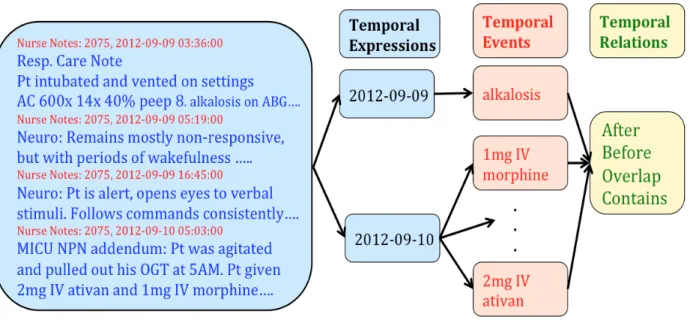
Temporal information extraction consists of three key components. These are extraction of temporal expressions, temporal events and temporal relations which clearly shown in figure 2.1. Temporal expressions are sequence of words and phrases that expresses a point of time or spans on a timeline such as date, duration, time and frequency. Temporal expression is a fundamental element for the rest of the temporal informations. Temporal events in clinical text is medical incidents that happened in a patient medical history which can be related to clinical timeline. Temporal relations denote the relationship among the pair of temporal events or temporal expressions.
Automatic recognition and extraction of temporal information extraction demand to extract those three elements. Among them temporal expressions are basis to represent other two temporal elements.
Let us consider the following sentence and the list of events and expressions
Figure 2.2: Generating chronological order of temporal expressions and events: an example
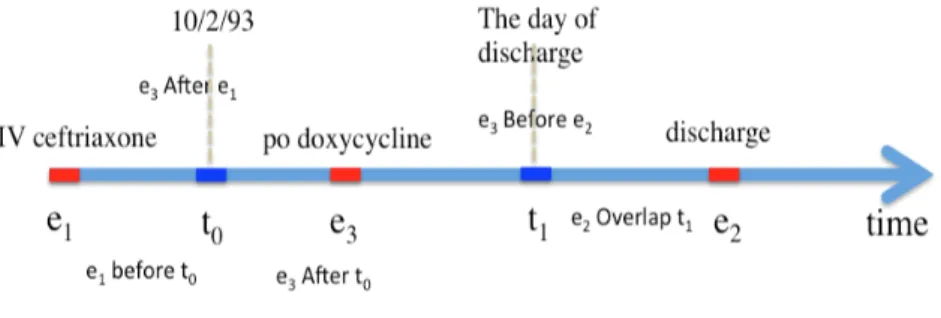
extracted from the sentence. The patient was started empirically IV ceftriaxone on 10/2/93, which was changed to po doxycycline on the day of discharge. The list of temporal expressions and events are the followings, accordingly:
– {10/2/93, the day of discharge}
– {IV ceftriaxone, po doxycycline, discharge}
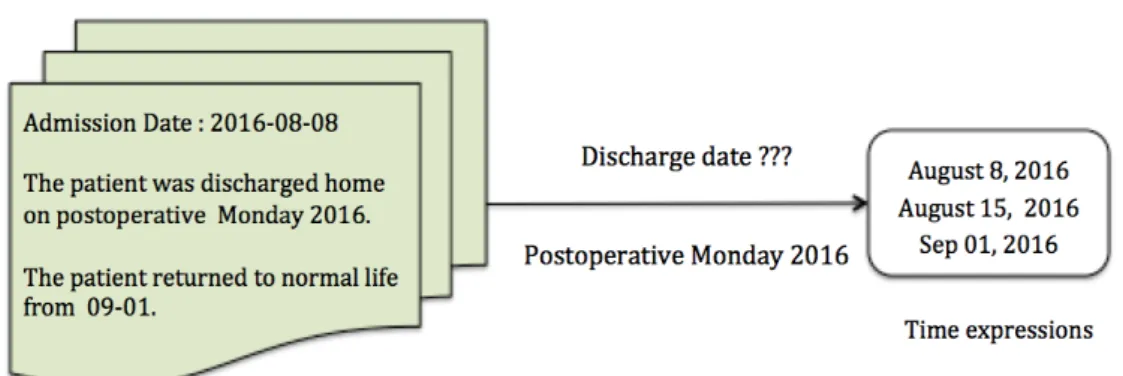
To chronologically arrange all clinical events as shown in figure 2.2, all the clinical events and expressions should be grounded from the raw clinical text. The expressions are often mentioned in clinical text with the usage of relative time. Also the clinical events and relations often mentioned without referring/specifying of the time and order, respectively. For instance, consider the following sentences:
• “The patient was transferred to the hospital for surgical intervention on 2016- 06-11. The next day she administrated a drug one hour before the surgery.”
• “The patient consulted the toxicologist and he felt that most likely had benzo overdose.”
• “The patient has been admitted to the hospital with frequent severe cold, fever and cough.”
The above examples show that the temporal expressions, events and rela- tions have often written with relative time, implicit durations and order. To auto- matically understand this temporal medical concepts from clinical text by machines, it requires the considerable medical domain knowledge.
Though the human can be able to understand the temporal information such as events and relations between the events, whereas it remains the non-trivial task in machine learning and clinical natural language processing. Despite of these difficulties, the existing works [17], [18], [55] established various methods to extract temporal information with the help of annotated corpora. But all of these works were established with the available small number of annotated temporal corpora, whereas lot of unannotated clinical text are available compared to annotated clinical data.
2.2 Temporal information annotation in clinical nar- ratives
As explained in the previous section, addressing the problem of temporal relation learning with temporal reasoning by machine learning methods demands annotated corpora for training models and evaluating results. However, creating such temporal information annotated corpora from clinical narratives is tedious, expensive and re- quires much more manual effort with medical domain knowledge. At the same time using doctor’s expertise to create annotated corpora is cost expensive.
2.2.1 Motivation
Clinical text annotation is an important task for information extraction [46]. Annota- tion of clinical text adds more semantic information to the original text document [43],
[56], which can be used later for some kind of temporal information tasks . Temporal annotation plays a significant role in natural language processing and computational linguistics. Successful annotated corpus enables the researchers to perform many tasks such as information extraction, Named Entity Recognition, relation extraction and etc., in many domains such as social media and medical domain. The created corpus addresses the problems such as processing and ordering temporal events, determining temporal relations between the events and temporal expressions.
Rapid development of temporal reasoning and temporal information extrac- tion (TIE) methods initially started with the creation of TimeBank corpus for general newswire text [1], [7]. TimeBank corpus annotated a temporal reasoning elements by using TimeML specifications and guidelines1. It is a typical and most popular corpus for temporal reasoning and relation learning in the natural language text. However, temporal reasoning and annotation process can vary newswire domain to clinical domain because of nature of data. Therefore, it is difficult to use the TimeBank guidelines as exactly to annotate the clinical narratives from EMRs. the differences in the nature of data between Timebank and clinical text make it difficult to use Timebank for temporal relation learning in the clinical domain.
The events in linguistics are tuned to be verb tenses and aspects, standard form of some verbs, certain proper names. Sometimes the state of events that are changed by verbs. For example, the events in TimeBank from newswire domain, relies on tense and aspect are to temporally order events, which are used as a key feature to detect them by machine learning methods [57]. In contrast, events in clinical domain need not be verbs and are in fact in most cases noun phrases as all the diagnosis details noted as noun phrases. Therefore, the annotation of temporal events in clinical domain and newswire domain are quite different [45], [56].
1https://catalog.ldc.upenn.edu/docs/LDC2006T08/timemlannguide1.2.1.pdf
In recent days, the interest of temporal reasoning and temporal information extraction from domain-specific clinical narratives has received great attention due to richness of temporality in clinical narratives, significance of temporal information exploitation in medical care and availability of clinical text. Recently, Temporal His- tories of Your Medical Events Time Markup Language (THYME-TimeML) project extended the standard text annotation work and created guidelines specifically for clinical domain text. Also they have created the corpus for clinical text. Recently I2B2 created the clinical temporal information corpus with 310 de-identified discharge summaries. There are two methods available to annotate the clinical text data. First is annotate the clinical text manually which is based on the domain knowledge of annotators. Yet, considerable manpower is often required to annotate the corpus manually. This manual annotation process usually involves multiple groups and fi- nally we get the error-pruned corpus. Second is automatic annotation, which is based on the annotation tools developed by various research group. However, accuracy of the annotation tool is very important to annotate temporal information in clinical narratives. Manual intervention and correction is required along with the accuracy of the annotation tool.
Due to this difficulties, only very little amount records annotated records with temporal information such as I2B2 (Informatics for Integrating Biology and the Bedside) dataset (Has 310 patient discharge summaries) and Thyme clinical dataset despite a lot of medical records available online for Natural Language Processing such as MIMIC II clinical database.
We analyze the nature of clinical text in a discharge summary, to under- stand more about annotation process and creation of annotated corpus from clinical narratives as shown in figure 2.3.
Figure 2.3: Illustration of a patient discharge summary
Clinical narratives: Characteristics As seen in the figure 2.3, discharge sum- mary is composed of various different sections such as history of illness, hospital course, past medical history, allergies, and etc. In comparison to other clinical text in EMR (doctor’s daily note and nurse narratives), discharge summaries is composed of little bit structured format with mostly complete sentences. However, it also contains considerable use of medical terminology, and multiple temporal references. However, doctor notes and nurse narratives are less structured but also have the same charac- teristics of discharge summary. Thus, it is making the task of automatically extract information from clinical narratives (discharge summary, doctor notes and nurse nar- ratives). In order to automatically extract temporal information and ordering them is required annotated data. For this, clinical narrative information should be simplified to create features to facilitate the extraction of events, temporary expressions and temporary relationships. Thus, we define an annotation specification that supports the following tasks:
1. detection of events, expressions in clinical narratives. For example, cadaveric kidney transplantation and retinopathy , 2016-08-08, postoperative day six, four months.
2. Identify temporal relations between events and / or expressions that occur within and across all clinical narratives for a patient. For example, cadaveric kidney transplantation and retinopathy events before admission event, whereas cadaveric pancreas transplantation is after 2016-08-08 expressions and before discharge event.
The tasks of unlocking the clinical elements [58] that are discussed above is to support for generating a chronology of clinical events from across all clinical narratives for each patient [59] . The data used for annotation and training our proposed methods and models is described next.
2.2.2 Annotation of events in clinical narratives
As per the annotation guidelines 2, clinical events include diseases and disorders, symptoms that affects the patient’s health status, as well as any treatments, pro- cedures and medication prescribed to the patient. Thus, domain expert annotators were come to conclusion to annotate a word or group of words occurred in a clinical narrative of a patient that has a relevant match in the UMLS medical dictionary as a clinical event. Events in clinical domain includes the following.
1. First and foremost any disease name or disorder. These include symptoms which are typically nouns. For example, heart attack, chest pain, breast cancer.
2. Second is any treatment, test or procedure. These are again generally nouns.
For example, blood pressure, temperature and excisional biopsy.
2http://clear.colorado.edu/compsem/documents/THYME guidelines.pdf
3. All the medication details (i.e.) any medications consumed or used by patients.
These are typically denotes the names of drugs such as aspirin and Naproxen.
4. Besides the above, any normal health condition that requires constant health care such as pregnancy.
5. Any habit or observation that affect the patient health status. For instance, drinking and smoking.
2.2.3 Annotation of temporal expressions in clinical narra- tives
Temporal expressions are sequence of words or phrases that contain time information.
The types of temporal expressions that includes date, time, duration, frequency and prepost expressions [43], [45]. TIMEX3 tag is used to annotate a temporal expressions in clinical narratives and it could be any one of the following:
1. DATE: denotes the exact calendar date. For example, Nov 13 Monday, 2016- 08-08.
2. TIME: denotes a time of the day. For example, 8:00 AM, seven in the morning.
The patient’s CT-scan is scheduled at 10:00 AM
3. DURATION:Describes a time duration. For example, four months, next two days.
4. FREQUENCY: Describes a set of times. FOr example twice a day.
5. QUANTIFIER: describes like frequency expressions but it does conceive start- ing point and ending point. For example twice and three times. The patient vomited “twice” before the treatment.