畜産草地研究所研究報告第十四号 平成二十六年三月 独立行政法人 農業・食品産業技術総合研究機構 畜産草地研究所Bulletin of NARO Institute of Livestock and Grassland Science
Bull NARO Inst Livest Grassl Sci
畜 草 研 研 報
畜産草地研究所
独立行政法人 農業・食品産業技術総合研究機構
Bulletin of NARO Institute of Livestock and Grassland Science
NARO Institute of Livestock and Grassland Science
(NILGS)
Ibaraki, Japan
(目的)
第 1 条 畜産草地研究所研究報告及び畜産草地研究所研究資料への投稿については,独立行政法人農業・食品産業技術総合研究機構刊 行物著作権取扱規程(14規程56号)に定めるもののほかこの要領の定めるところによる。
(投稿者の資格)
第 2 条 投稿者は原則として,畜産草地研究所職員(以下 「職員」 という。)及び流動研究員,依頼研究員,日本学術振興会特別研究 員,日本学術振興会外国人特別研究員等(以下 「他の職員」 という。)とする。
一 職員が投稿する内容は,主として畜産草地研究所(以下 「研究所」 という。)で行った研究とする。
二 他の職員が投稿する内容は,研究所で行った研究とする。
(投稿原稿の内容)
第 3 条 投稿原稿の内容は次のとおりとする。
1 畜産草地研究所研究報告(Bulletin of NARO Institute of Livestock and Grassland Science / 略誌名:Bull NARO Inst Livest Grassl Sci ) 一 原著論文:研究所において行った試験研究及び研究所以外の者に委託して行った試験研究の成果に関わる論文とする。
二 短 報:一以外の研究の予報,速報などの短報とする。
三 技術論文:新しい技術や技術の組立,実証などを主体とする報告。
四 総 説:畜産草地研究に関わるものとする。総説は投稿のほか,編集委員会が依頼したものを含む。
五 学位取得論文:研究所において主として行った試験研究による学位取得論文とする。
2 畜産草地研究所研究資料(Memoirs of NARO Institute of Livestock and Grassland Science / 略誌名:Mem NARO Inst Livest Grassl Sci ) 調査資料・技術資料・研究資料:研究所において行った試験研究及び研究所が研究所以外のものに委託して行った試験研究のうち,
学術的・産業的に有用な未発表の資料とする。
(原稿の執筆)
第 4 条 原稿の執筆にあたっては,別に定める畜産草地研究所研究報告及び畜産草地研究所研究資料執筆要領(13畜草 B 第44号)に 基づくものとする。使用する言語は日本語又は英語とする。
(原稿の提出)
第 5 条 次の手続きにより原稿及び原稿提出票を事務局に提出する。
一 職員は原稿提出票に必要事項を記載し,所属研究チーム長及び担当する研究管理監等の校閲を受ける。
二 他の職員は原稿提出票に必要事項を記載し,所属研究領域長等の校閲を受ける。
(受付)
第 6 条 原稿及び原稿提出票を事務局が受け取った日を受付日とする。受理日は編集委員会の審査の結果,掲載が妥当と認められた日 とする。
(審査)
第 7 条 編集委員会は次の手続きにより論文を審査する。ただし,学位取得論文については審査を省略することができる。
一 編集委員会は論文の内容により審査員正副をそれぞれ 1 名決定し,論文審査を依頼する。審査員は研究所内及び研究所外の研究 者等とし,その氏名は公表しない。
二 審査員は論文審査票により審査を行う。また必要に応じて指摘事項を書き出し提出する。
三 事務局は審査員と著者の間のやり取りの対応にあたる。
四 編集委員会は審査員の審査結果を参考にして掲載の可否を判断する。
審査の内容によっては著者に原稿の訂正を求めることができる。
五 著者は審査結果を受領後,編集委員会が指定する期日までに修正原稿を事務局に提出する。
(校正)
第 8 条 著者による校正は原則として初校のみとする。校正は誤植の訂正程度にとどめる。やむを得ず大きな変更等を行う場合には編 集委員会の承認を得なければならない。
(別刷り)
第 9 条 別刷りは次のとおりとする。
一 100部とし,筆頭著者が代表で受け取る。
二 別刷りの追加を希望する場合は研究費負担で印刷する。
附 則
この規定は,平成14年 4 月 1 日から施行する。
附 則
この規定は,平成15年10月 1 日から施行する。
附 則
この規定は,平成18年 4 月 1 日から施行する。
附 則
この要領は,平成20年 4 月 1 日から施行する。
附 則
この要領は,平成23年 4 月 1 日から施行する。
附 則
この要領は,平成23年 8 月 8 日から施行する。
第 14 号(平成 26 年3月)
− 目 次 −
− 原著論文 −
日本の公的機関におけるトウモロコシ(
Zea maysL.)育種のためのゲノムワイドセレクションに 関する研究:親自殖系統群内に見られた一塩基多型(英文)
……… 玉置宏之・松本敏美・三ツ橋昇平・
奥村直彦・黄川田智洋・佐藤 尚……11
「シバ中間母本農 1 号」の育成
……… 小林 真・蝦名真澄・高溝 正・霍田真一……13
飼料タンパク質の給与水準と第一胃分解性の違いが泌乳牛の尿量に及ぼす効果
……… 大谷文博・樋口浩二・小林洋介・野中最子……23
NARO INSTITUTE OF
LIVESTOCK AND GRASSLAND SCIENCE
No.14 (March2014)
CONTENTS
Research Papers
Hiroyuki TAMAKI, Toshimi MATSUMOTO, Shohei MITSUHASHI, Naohiko OKUMURA, Tomohiro KIKAWADA and Hisashi SATO :
A Study on ‘Genomewide Selection’ for Maize (Zea mays L.) Breeding in Japanese Public
Sectors: Single Nucleotide Polymorphisms Observed among Parental Inbred Lines …………
11
Makoto KOBAYASHI, Masumi EBINA, Tadashi TAKAMIZO and Shin-ichi TSURUTA :
Breeding of “Japanese Lawngrass Intermediate Parent Nou 1” ………
13
Fumihiro OHTANI, Kouji HIGUCHI, Yousuke KOBAYASHI and Itoko NONAKA :
The Effects of Dietary Protein Level and Rumen Degradability on Urine Volume in Lactating Dairy Cows ……… 23
Introduction
There are concerns in Japan on the difficulties in ensuring long-term food supply, which makes the Japanese government promote a policy to raise the food self-sufficiency. A primary measure for this goal is to raise the feed self-sufficiency rate from 26 (in 2008) to 38% 11). Japanese public sectors are now
expected to support the policy through breeding high- yield maize (Zea mays L.) varieties for silage use that are highly adapted to the Japanese climates.
Molecular breeding techniques including quantitative trait locus (QTL) analysis22) and association mapping 25) have widely been applied to maize because of its simple genome construction and economic importance6). It has been, however, Abstract
Recent rapid decrease of the cost for detecting single nucleotide polymorphisms (SNPs) has enabled maize (Zea mays L.) breeders in Japanese public sectors to introduce such molecular breeding techniques as ‘genomewide selection (GwS)’. It has been found in the previous simulation study by the authors that GwS can be a powerful tool to accelerate yield improvement if molecular markers can be arranged over the whole genome at intervals of 20 cM or shorter. The purpose of this study was to discover SNPs of maize parental inbred lines developed in Japanese public sectors to conduct GwS in the future. Here 38 individuals from 32 inbred lines, all but one of which had been developed in Japanese public sectors, were genotyped on up to 56110 SNP loci over the whole genome. The results (1) are thought reliable on the whole because they mostly accord with those having been obtained in the past studies and with the breeding records, (2) have shown that sufficient SNP markers can be arranged to conduct GwS, and (3) that some inbred lines have many and/or large unfixed genome regions, suggesting the necessity to revise the assumption having been made in the previous simulation study by the authors that the intra-inbred-line polymorphisms can be negligible.
Key words: genomewide selection, maize breeding, molecular marker, single nucleotide polymorphism Hiroyuki TAMAKI, Toshimi MATSUMOTO1, Shohei MITSUHASHI, Naohiko OKUMURA2,
Tomohiro KIKAWADAa and Hisashi SATO
Received 2013.3.22, accepted 2013.11.6
a Present address: NARO Hokkaido Agricultural Research Center, Sapporo, 062-8555 Japan
A Study on ‘Genomewide Selection’ for Maize ( Zea mays L.) Breeding in Japanese Public Sectors: Single Nucleotide Polymorphisms
Observed among Parental Inbred Lines
Forage Crop Research Division,
NARO Institute of Livestock and Grassland Science, Nasushiobara, 329-2793 Japan
1 National Institute of Agrobiological Science, Tsukuba, 305-8602 Japan
2 Japan Association for Techno-innovation in Agriculture, Forestry and Fisheries (JATAFF) Institute, Tsukuba, 305-0854 Japan
substantially impossible for maize breeders in Japanese public sectors to introduce some of such techniques because they have not had so much information on molecular marker polymorphisms covering the whole genome of their materials as required in these techniques. But this situation has rapidly been changed in these few years; the cost for detecting single nucleotide polymorphisms (SNPs) has drastically been decreased 23), which has enabled maize breeders in Japanese public sectors to explore SNPs over their materials and to introduce some molecular breeding techniques.
The purpose of this study was to discover SNPs over the whole genome of parental inbred lines (hereafter they are simply called inbred lines) developed in Japanese public sectors to conduct
‘genomewide selection (GwS)’ in the future. GwS is a molecular breeding technique whose details are explained with its concept in Bernardo et al.1) and Meuwissen et al. 12). GwS is thought advantageous for maize breeders in Japanese public sectors interested in accelerating yield improvement, because its focus is on accumulating favorable genes in many minor QTLs whereby yield is thought controlled 24), and because it can be started from a biparental population, i.e. with molecular marker information on a small number of inbred lines.
In the previous study by the authors 20), computer simulations have been made on the assumption that a training population for GwS is developed from a three-way cross (D1×D2)×FT, where a new inbred line having high combining ability (i.e. yield) toward a specific flint tester inbred line FT is developed from a biparental crossing between dent inbred lines D1
and D2. The simulations have shown that GwS can be a powerful tool to accelerate yield improvement if the following two conditions are fulfilled; i.e. (1) if molecular markers can be arranged over the whole genome at intervals of 20 cM or shorter, and (2) if the heritability in the training population is 25% or more.
In this study the authors have focused on the former condition; discussion will be made especially in terms of the feasibility to conduct GwS with sufficient SNP markers detected in this study.
Materials and Methods
Plant materials
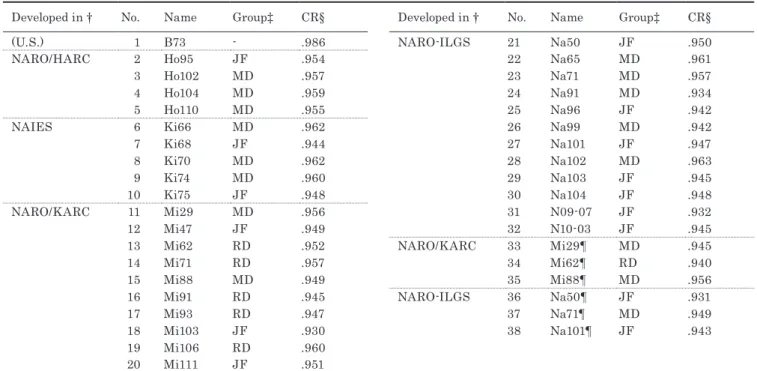
Shown in Table 1 are the 38 individuals from 32 inbred lines whose SNPs were explored in this study. All inbred lines but ‘B73’, a public line of U.S. widely regarded as the standard 17), have been developed in Japanese public sectors; i.e. National Agriculture and Food Research Organization (NARO) Hokkaido Agricultural Research Center (NARO/
HARC), Nagano Animal Industry Experiment Station (NAIES), NARO Kyushu Okinawa Agricultural Research Center (NARO/KARC) or NARO Institute of Livestock and Grassland Science (NARO-ILGS).
Their seeds were provided from the stocks in NARO- ILGS for breeding experiments. The 31 lines can be classified into three groups in terms of their genetic background (they are hereafter called genetic groups);
dent mainly derived from U.S. corn-belt dent (MD, 12 lines), semi-dent mainly developed from hybrids for summer seeding (RD, 5 lines) and flint mainly derived from Japanese landraces (JF, 14 lines). The numbers from 33 to 38 in Table 1 are the second individuals of the six inbred lines, ‘Mi29’, ‘Mi88’ and ‘Na71’ in MD,
‘Mi62’ in RD and ‘Na50’ and ‘Na101’ in JF, to examine the extent of intra-inbred-line polymorphisms. Their seeds are provided from the same seed lots of the first individuals.
DNA preparation
A part of a fresh leaf (about 1g) of each individual (seedling) growing in a greenhouse of NARO-ILGS was cut by scissors, frozen with liquid nitrogen, and milled with ‘Multi-beads shocker®’, manufactured by Yasui Kikai Corporation (Osaka, Japan), for 6 times (each time consists of an operation for 5 seconds at 1000 rpm) in the frozen condition. After 300 μl of ‘PrepMan® Ultra Reagent’, manufactured by Life Technologies Corporation (Carlsbad, CA, U.S.), was added to the milled leaf, the mixture was moved to a 1.5-mL Eppendorf® tube, and the tube was kept in boiling water for 10 minutes.
After the stock was cooled down to room temperature, it was processed with protease (incubated in 37 degree centigrade for 60 minutes), and then the DNA was
purified with the procedures consisting of extraction with Tris-buffered 50% phenol, 48% chloroform, 2%
isoamyl alcohol solution (in the second time and afterward, it was substituted with chloroform), ethanol precipitation, and dissolution in TE buffer (10 mM Tris-Cl, pH 7.5 and 1 mM EDTA). The procedures repeated for up to four times until each DNA solution exceeded 1.75 in the ratio of absorbance at 260 to 280 nm. After the purification, the density of DNA was adjusted to 50 ng μl-1 with the TE buffer.
SNP analysis
T he SN P a na lysis was made w ith the combination of products manufactured by Illumina Inc. (San Diego, CA, U.S.), ‘MaizeSNP50 BeadChip’
and an analyzing system including the software
‘GenomeStudio’, which genotypes up to 56110 SNP loci of maize over its whole genome at once. The datasheet and the manifest file (including the list of the SNP loci) of the BeadChip are in the website of Illumina, http://res.illumina.com/documents/
products/datasheets/datasheet_maize_snp50.pdf and http://supportres.illumina.com/documents/
downloads/productfiles/maizesnp50/maizesnp50_
a.csv, respectively (both sites were cited on January 24th, 2014). Although ‘GenomeStudio’ allows operators to adjust the setting for judging genotypes on each SNP locus manually, the authors fully followed the automatic judgment made by the software in this study.
Dendrogram drawing
A dendrogram was drawn based on the results to investigate in whether they would accord with the past similar studies and/or our breeding records, i.e. to evaluate their reliability, because the authors thought that it was necessary to verify them prior to the discussion on the primary purpose of this study, the SNPs obtained with the products. The methods adopted for the drawing were mostly equivalent to Enoki et al. 8) where the genetic similarity (GS) of maize inbred lines developed in Japanese public sectors had been investigated with simple sequence repeat (SSR) markers; i.e. adopted here were the unweighted pair group method with arithmetic mean
(UPGMA) and the computation presented by Dice 5) and Nei et al. 15). On the other hand, the following two slight modifications were made in this study; (1) that genetic distance (GD) was adopted instead of GS, both of which can be converted to each other with the equation that GD=1-GS, and (2) that a combination of a heterozygous genotype “AB” with homozygous
“AA” or “BB” was counted as 0.5, which had not been considered in the past study with SSR markers.
Highly distinguishable SNP loci within a genetic group
SNP loci were examined on the ability to distinguish inbred lines within a genetic group i.e.
on the potential usefulness in GwS. Let us assume here that N inbred lines (N≥2), all of which belong to a genetic group G, were genotyped, and that numbers of inbred lines genotyped as “AA” and “BB” are a and b (0<(a+b)≤N ), respectively, in an SNP locus L. In this case, D is calculated from the following equation
where is the number of all possible pairs made in G. If D>0.45, L is judged as a ‘highly distinguishable locus’ in G. The threshold 0.45 has been set based on that D exceeds it if N is between 5 (in RD) and 14 (in JF), if all inbred lines are successfully genotyped as “AA” or “BB”, and if the ratio of a to b is between 1:2 and 2:1. In other words, D is lower than the threshold and then the SNP locus is not judged highly distinguishable if genotyping has been failed in one (in RD) or two (in MD and JF) inbred line(s) of the relevant group, or if the genotypes are extremely one- sided to “AA” or “BB”.
Intra-inbred-line polymorphic loci
I n e x a m i n i n g t h e i n t r a - i n b r e d - l i n e polymorphisms, an SN P locus was regarded polymorphic in the relevant inbred line if at least one of the two individuals had been genotyped heterozygous or if they had been genotyped differently (i.e. combinations of “AA” and “BB”). Combinations of homozygous and unidentified genotypes were not regarded polymorphic.
A fter identification of intra-inbred-line CN2
CN2
D G(L, ) = ... (1) ab
polymorphic loci, their ratio was computed in each genome region. A genome region was defined to consist of 500 (a somewhat different number in the end of each chromosome) ‘polymorphic and reliable loci’ that, according to the SNP list in the website of Illumina, could be regarded consecutive on a single chromosome. See Results and Discussion for the detailed definition of ‘polymorphic and reliable loci’.
Results and Discussion
The SNP information was thought reliable
Two indices are often used to evaluate the results of SNP genotyping with the products of Illumina; one is ‘Call Rate’, the ratio of SNP loci successfully genotyped for each sample, and the other is ‘GenTrain Score’ to evaluate the confidence of the genotyping for one SNP on all samples 2,4). The Call Rates exceeded 0.9 in all samples (Table 1),
from which it was concluded that no materials need to be excluded, considering that many studies in the past have abandoned samples only if they are below 0.9 10,18).
GenTrain Scores of the 5 6110 SN P loci ranged in this study from zero to 0.9 93. The scores of 12231 loci were below 0.7, which authors screened out, considering that studies in the past including Han et al. 9) and Namjou et al. 14) on human (Homo sapiens L.) as well as Pasam et al. 16) on barley (Hordeum vulgare L.) adopt this value as the threshold. In addition, another 4561 loci were excluded because the software judged that more than 10% of the materials successfully genotyped on the loci were heterozygous (such high frequency of heterozygosity was thought unrealistic because all of the materials were inbred lines and because almost all of their neighboring loci seemed fixed), or because no polymorphisms could be detected among the 32 inbred
Developed in † No. Name Group‡ CR§ Developed in † No. Name Group‡ CR§
(U.S.) 11 B73 - .986 NARO-ILGS 21 Na50 JF .950
NARO/HARC 12 Ho95 JF .954 22 Na65 MD .961
13 Ho102 MD .957 23 Na71 MD .957
14 Ho104 MD .959 24 Na91 MD .934
15 Ho110 MD .955 25 Na96 JF .942
NAIES 16 Ki66 MD .962 26 Na99 MD .942
17 Ki68 JF .944 27 Na101 JF .947
18 Ki70 MD .962 28 Na102 MD .963
19 Ki74 MD .960 29 Na103 JF .945
10 Ki75 JF .948 30 Na104 JF .948
NARO/KARC 11 Mi29 MD .956 31 N09-07 JF .932
12 Mi47 JF .949 32 N10-03 JF .945
13 Mi62 RD .952 NARO/KARC 33 Mi29¶ MD .945
14 Mi71 RD .957 34 Mi62¶ RD .940
15 Mi88 MD .949 35 Mi88¶ MD .956
16 Mi91 RD .945 NARO-ILGS 36 Na50¶ JF .931
17 Mi93 RD .947 37 Na71¶ MD .949
18 Mi103 JF .930 38 Na101¶ JF .943
19 Mi106 RD .960
20 Mi111 JF .951
† NARO/HARC, NAIES, NARO/KARC and NARO-ILGS are the abbreviations of NARO Hokkaido Agricultural Research Center, Nagano Animal Industry Experiment Station, NARO Kyushu Okinawa Agricultural Research Center and NARO Institute of Livestock and Grassland Science, respectively.
‡ JF, MD and RD indicate flint mainly derived from Japanese landraces, dent mainly derived from U.S. corn-belt dent, and semi-dent mainly derived from hybrids for summer seeding, respectively.
§ Means ‘Call Rate’, the ratio of SNP loci successfully genotyped for each sample.
¶ The second individuals for examining intra-inbred-line polymorphisms.
Table 1. The parental inbred lines whose single nucleotide polymorphisms (SNPs) were examined in this study and their ‘Call Rate’
lines. Therefore further analyses were made with the remaining 39318 loci that were judged polymorphic and reliable. On the SNP list of Illumina are the chromosomes of 35508 loci out of the 39318, and the coordinates of 35424 loci out of the 35508. Based on these 35424 loci will be discussed the intra-inbred- line polymorphisms in each genome region (Table 2).
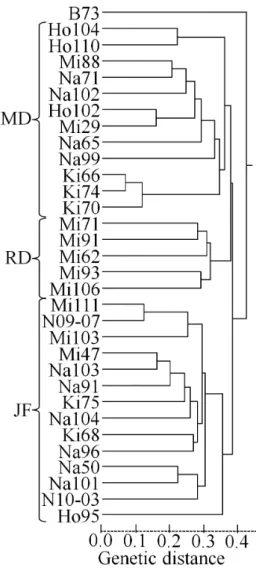
The dendrogram based on the polymorphisms observed in the 39318 SNP loci (Fig. 1) mostly accords with the breeding records and/or the past studies, including that the genetic distances among the three genetic groups, MD, RD and JF, are roughly equivalent 13), that ‘Ho102’ has been developed from a crossing including ‘Mi29’, and that ‘N09-07’ and
‘Mi111’ have been developed from the same random- mating population. Therefore the authors concluded that the results were reliable on the whole (though it seems to have some errors), and that they would help the maize breeders in Japanese public sectors promote molecular breeding in the future.
The only discrepancy between the results in this study and those in the past is that the American public line ‘B73’ is very distantly located from MD group, to which it was assumed to belong. This seems to reflect the policy of the manufacturer in designing the BeadChip; the datasheet in the website of Illumina mentions that it has approximately 4000 SNPs that will less perform in other samples than in
Table 2. The SNP loci adopted for the analyses in this study
Description Numbers
Total† (a) 56110
GenTrain Score‡ < 0.7 (b) 12231
GenTrain Score‡ ≥ 0.7 but frequency of heterozygosity§ > 0.1 (c) 457 GenTrain Score‡ ≥ 0.7 but no polymorphisms found among all inbred lines (d) 4104 SNP loci with which further analyses were made in this study (e)=(a)-(b)-(c)-(d) 39318 SNP loci in (e) whose chromosomes are identified on the SNP list of Illumina (f) 35508 SNP loci in (f) whose coordinates are identified on the SNP list of Illumina 35424
† Total SNPs that can be detected with a product of Illumina, ‘MaizeSNP50 BeadChip’.
‡ See the text for its definitions.
§ See the text for the detailed reason why these SNP loci were excluded.
Fig. 1. The dendrogram of the 32 inbred lines drawn based on the genetic distance (GD) having been calculated from the single nucleotide polymorphisms (SNPs) detected in this study
this inbred line regarded as the most standard and having been used as the materials of various genetic analyses in the past 3,7). In this study, the number of SNP loci unique to ‘B73’ was 481, three and 12 times as large as the second largest ‘Ho95’ (158) and the average of another 31 materials (39.4), respectively.
Sufficient SNPs over the whole genome
As mentioned above, the previous simulation study by the authors 20) has shown that an important key to the success of GwS is to arrange molecular markers at intervals of 20 cM or shorter. Considering the whole genome size is about 1800 cM 1), it means that more than 90 molecular markers should be arranged over the genome. Therefore the primary purpose of this study was to discover many “highly distinguishable SNP loci” i.e. SNPs which can efficiently distinguish inbred lines within a genetic group. It has been found that the numbers of such SNP loci are 7787 (in JF) or more, and that those per cM are 1.94 or more (Table 3. The information on the length of each chromosome in cM is based on the web page http://www.maizegdb.org/cgi-bin/
displaycompletemaprecord.cgi?id=1203637, to which the previous simulation study by the authors has also referred). The authors have concluded from these results that sufficient SNP markers can be arranged over the whole genome for Japanese public sectors to conduct GwS.
The datasheet in the website of Illumina suggests that little attention has been paid to Japanese germplasms in choosing the 56110 SNP loci. But the products provided in this study not only more than 39000 polymorphic loci in total but also more than 7700 highly distinguishable loci within the genetic group mainly originated from Japanese landraces. These results suggest that the products have the potential to bring sufficient information on the polymorphisms within another genetic group of maize to which molecular approaches have never been made.
Many and/or large unfixed genome regions in some inbred lines
The averaged heterozygosity rates of the six inbred lines whose intra-inbred-line polymorphisms were examined in this study ranged from 0.05 (Na71) to 2.76% (Mi62) (Table 4), which seem similar to those of ‘B73’ and ‘Mo17’ (another standard inbred line in U.S.) indicated on the datasheet in the website of Illumina, 0.32 and 2.50%, respectively.
The ratio of polymorphic loci between two individuals belonging to the same inbred line ranged from 0.09 (Na71) to 4.28% (Mi62) (Table 4).
The more important for the authors interested in introducing GwS is that the polymorphic loci seem to concentrate in some genome regions (Fig. 2). Inbred lines have been developed in Japanese public sectors
Chromosome number (top) and length (bottom, in cM) ‡
1 2 3 4 5 6 7 8 9 10
Total†
286 183 211 189 173 145 158 160 164 136
MD§ Numbers¶ 1584 494 1324 1137 1478 881 1023 1281 780 804 11804
Numbers¶ per cM 5.54 2.70 6.27 6.02 8.54 6.08 6.47 8.01 4.76 5.91
RD§ Numbers¶ 1227 449 1143 1177 1168 901 707 962 515 795 9859
Numbers¶ per cM 4.29 2.45 5.42 6.23 6.75 6.21 4.47 6.01 3.14 5.85
JF§ Numbers¶ 1080 355 1187 1081 693 557 459 654 542 452 7787
Numbers¶ per cM 3.78 1.94 5.63 5.72 4.01 3.84 2.91 4.09 3.30 3.32
† The numbers of total SNP loci do not accord with those summed up on all 10 chromosomes because the carrying chromosomes have not been identified in some SNP loci.
‡ The length of each chromosome in cM has been quoted from the website http://www.maizegdb.org/cgi-bin/displaycompletemaprecord.
cgi?id=1203637
§ JF, MD and RD indicate flint mainly derived from Japanese landraces, dent mainly derived from U.S. corn-belt dent, and semi-dent mainly derived from hybrids for summer seeding, respectively.
¶ Numbers of ‘highly distinguishable SNP loci’. See the text for their definition.
Table 3. Numbers of ‘highly distinguishable SNP loci’ within each genetic group and those per cM in each chromosome
through repeated selfing for five or six times19,21). The results shown in this study suggest that some genome regions have remained unfixed during the procedures of repeated selfing. Some inbred lines have been found to have large and/or many unfixed genome regions, suggesting the necessity to revise the assumption having been made in the previous simulation study by the authors 20) that the intra- inbred-line polymorphisms can be negligible. In addition, the supposition of unfixed genome regions in inbred lines will make the choice of molecular markers for GwS more complicated. In the case mentioned in Introduction where the training population has been developed from a three-way cross (D1×D2)×FT, heterozygous loci on FT must be avoided to distinguish genotypes of individuals in the training
population accurately, i.e. careful consideration will be required in choosing marker loci in the genome regions that have remained unfixed in FT. On the other hand, such unfixed genome regions may raise the efficiency of yield improvement. Again in the case mentioned in Introduction, let us assume a genome region where the inbred lines D1 and D2 have been unfixed and fixed, respectively. As shown in Fig. 3, two and one candidate genome regions from D1 and D2, respectively, i.e. three candidates in total, can accurately be distinguished by two marker loci in a haplotype. It means that breeders can select the best candidate from the three, which may be better than the selection from two in the case both D1 and D2 have been fixed.
Name (genetic group) † Heterozygosity
rate‡ Ratio of ‘intra-inbred-line polymorphic loci§’
Mi29(MD) .0007 .0011
Mi62(RD) .0276 .0428
Mi88(MD) .0093 .0191
Na50(JF) .0016 .0020
Na71(MD) .0005 .0009
Na101(JF) .0154 .0172
† JF, MD and RD indicate flint mainly derived from Japanese landraces, dent mainly derived from U.S. corn-belt dent, and semi-dent mainly derived from hybrids for summer seeding, respectively.
‡ The ratio of heterozygous loci to the ‘polymorphic and reliable loci (see the text for their definition)’ successfully genotyped in the relevant individual.
Shown is the average of two individuals each.
§ See the text for their definition.
Table 4. Heterozygosity rate and ratio of intra-inbred-line polymorphic loci of the six inbred lines
Fig. 2. The ratio of intra-inbred-line polymorphic loci in each genome region (see the text for the definitions) of the six inbred lines
References
1) Bernardo, R. and Yu, J. (2007). Prospects for genomewide selection for quantitative traits in maize, Crop Sci., 47, 1082-1090.
2) Butler, H. and Ragoussis, J. (2008). BeadArray- based genotyping, In Genomics Protocols (Ed.
Starkey, M. and Elaswarapu, R.), 53-74, Humana Press, New York
3) Cañas, R.A., Amiour, N., Quilleré, I. and Hirel, B. (2010). An integrated statistical analysis of the genetic variability of nitrogen metabolism in the ear of three maize inbred lines (Zea mays L.), J.
Exp. Bot., 62, 2309-2318.
4) Deulvot, C., Charrel, H., Marty, A., Jacquin, F., Donnadieu, C., Lejeune-Hénaut, I., Burstin, J.
and Aubert, G. (2010). Highly-multiplexed SNP genotyping for genetic mapping and germplasm
diversity studies in pea, BMC Genomics, 11, 468.
5) Dice, L.R. (1945). Measures of the amount of ecologic association between species, Ecology, 26, 297-302.
6) Eathington, S.R., Crosbiea, T.M., Edwardsb, M.D., Reiterc, R.S. and Bull, J.K. (20 07).
Molecular markers in a commercial breeding program, Crop Sci., 47 (Supplement 3), S154-S163.
7) Eichten, S.R., Foerster, J.M., de Leon, N., Kai, Y., Yeh, C.T., Liu, S., Jeddeloh, J.A., Schnable, P.S., Kaeppler, S.M. and Springer N.M. (2011). B73- Mo17 near-isogenic lines demonstrate dispersed structural variation in maize, Plant Physiol., 156, 1679-1690.
8) Enoki, H., Sato, H., and Koinuma, K. (2002). SSR analysis of genetic diversity among maize inbred lines adapted to cold regions of Japan, Theor.
Appl. Genet., 104, 1270-1277.
Fig. 3. A typical model to genotype individuals of a training population developed from a three-way cross (D1×D2) × FT in a certain genome region where D1 and D2 have been unfixed and fixed, respectively
9) Han, S., K im-Howard, X., Deshmukh, H., Kamatani, Y., Viswanathan, P., Guthridge, J.M., Thomas, K., Kaufman, K.M., Ojwang, J., Rojas- Villarraga, A., Baca, V., Orozco, L., Rhodes, B., Choi, C.B., Gregersen, P.K., Merrill, J.T., James, J.A., Gaffney, P.M., Moser, K.L., Jacob, C.O., Kimberly, R.P., Harley, J.B., Bae, S.C., Anaya, J.M., Alarcón-Riquelme, M.E., Matsuda, K., Vyse, T.J. and Nath, S.K. (2009). Evaluation of imputation-based association in and around the integrin-α-M (ITGAM) gene and replication of robust association between a non-synonymous functional variant within ITGAM and systemic lupus erythematosus (SLE), Hum. Mol. Genet., 18, 1171-1180.
10) Harlizius, B., Lopes, M.S., Duijvesteijn, N., van de Goor, L.H.P., van Haeringen, W.A., Panneman, H., Guimarães, S.E.F., Merks, J.W.M. and Knol, E.F. (2011). A single nucleotide polymorphism set for paternal identification to reduce the costs of trait recording in commercial pig breeding, J.
Anim. Sci., 89, 1661-1668.
11) MAFF (2011). Fiscal Year 2010 Annual Report on Food, Agriculture and Rural Areas in Japan -Summary, 1-5 6, Ministry of Agriculture, Forestry and Fisheries of Japan
12) Meuwissen, T.H.E., Hayes, B.J. and Goddard, M.E. (2001). Prediction of total genetic value using genome-wide dense marker maps, Genetics, 157, 1819-1829.
13) Muraki, M., Enoki, H., Cai, H.W., Yuyama, N.
and Komatsu, T. (2010). Classification of maize (Zea mays L.) parental lines for the Japanese warm regions by profiling, Grassl. Sci., 56(b), 91 (in Japanese).
14) Namjou, B., Sestak, A.L., Armstrong, D.L., Zidovetzki, R., Kelly, J.A., Jacob, N., Ciobanu, V., Kaufman, K.M., Ojwang, J.O., Ziegler, J., Quismorio, F. Jr., Reiff, A., Myones, B.L., Guthridge, J.M., Nath, S.K., Bruner, G.R., Mehrian-Shai, R., Silverman, E., Klein-Gitelman, M., McCurdy, D., Wagner-Weiner, L., Nocton, J.J., Putterman, C., Bae, S.C., Kim, Y.J., Petri, M., Reveille, J.D., Vyse, T.J., Gilkeson, G.S., Kamen, D.L., Alarcón-Riquelme, M.E., Gaffney, P.M.,
Moser, K.L., Merrill, J.T., Scofield, R.H., James, J.A., Langefeld, C.D., Harley, J.B. and Jacob, C.O.
(2009). High-density genotyping of STAT4 reveals multiple haplotypic associations with systemic lupus erythematosus in different racial groups, Arthritis and Rheum., 60(4), 1085-1095.
15) Nei, M. and Li, W.H. (1979). Mathematical model for studying genetic variation in terms of restriction endonucleases, Proc. Natl. Acad. Sci.
USA, 76, 5269-5273.
16) Pasam, R.K., Sharma, R., Malosetti, M., van Eeuwijk, M.F.A., Haseneyer, G., Kilian, B. and Graner, A. (2012). Genome-wide association studies for agronomical traits in a world-wide spring barley collection, BMC Plant Biol., 12, 16.
17) Ramakrishna, W., Embertona, J., Ogdena, M., SanMiguelb, P. and Bennetzen, J.L. (2002).
Structural analysis of the maize Rp1 complex revea ls numerous sit es a nd u nex pe ct ed mechanisms of local rearrangement, Plant Cell, 14, 3213-3223.
18) Satake, W., Nakabayashi, Y., Mizuta, I., Hirota, Y., Ito, C., Kubo, M., Kawaguchi, T., Tsunoda, T., Watanabe, M., Takeda, A., Tomiyama, H., Nakashima, K., Hasegawa, K., Obata, F., Yoshikawa, T., Kawakami, H., Sakoda, S., Yamamoto, M., Hattori, N., Murata, M., Nakamura, Y. and Toda, T. (2009). Genome-wide association study identifies common variants at four loci as genetic risk factors for Parkinson’s disease, Nature Genet., 41, 1303-1307.
19) Sendo, S. (1998). Corn, In Plant Breeding in Hokkaido (Ed. Sanbuichi, T.), 219-244, Hokkaido Kyodo Kumiai Tsushin-sha, Sapporo, Japan (in Japanese)
20) Tamaki, H., Sato, H., K ikawada, T. and Mitsuhashi, S. (2012). Preliminary study on
‘genomewide selection’ for maize (Zea mays L.) breeding in Japanese public sectors: Estimated selection response in the first selfing cycle of single-cross progeny, Grassl. Sci., 58, 20-27.
21) Tozawa, H. (2005). Corn - History, Culture, Feature, Cultivation, Processing and Utilization, Nosan Gyoson Bunka Kyokai, Tokyo, Japan (in Japanese)
22) Tuberosa, R. and Salvi, S. (2008). QTL for agronomic traits in maize production, In Handbook of Maize: Its Biology (Ed. Bennetzen, J.
and Hake, S.), 501-541, Springer, New York.
23) Yan, J., Yang, X., Shah, T., Sánchez-Villeda, H., Li, J., Warburton, M., Zhou, Y., Crouch, J.H. and Xu, Y. (2010). High-throughput SNP genotyping with the GoldenGate assay in maize, Mol. Breed.,
25, 445-451.
24) Yu, J. and Buckler, E . S. (2 0 0 6). Genetic association mapping and genome organization of maize, Curr. Opin. in Biotech., 17, 155-160.
25) Yu, J, Holland, J.B., McMullen, M.D. and Buckler, E.S. (2008). Genetic design and statistical power of nested association mapping in maize, Genetics, 178, 539-551.
摘 要
一塩基多型(SNP)の検知に要する費用が近年大きく減少したことにより,飼料用トウモロコシ(Zea mays L.)
の育種を担当する日本の公的機関もゲノムワイドセレクション(GwS)の様な分子育種技術の導入が可能になりつ つある。前報で著者らはコンピューター ・ シミュレーションを用い,分子マーカーをゲノム全体に渡って 20 センチ モルガン(cM)以下の間隔で配置できれば,トウモロコシの収量性の改良を加速させる上でGwSが有効であるこ とを示した。本研究の目的は,将来におけるGwSの実施を視野に,日本の公的機関で育成されたトウモロコシ自殖 親系統群内におけるSNPの発見であった。この目的を達するため,32 自殖親系統(うち 31 が日本の公的育種機関 の育成)38 個体について,最大 56110SNP遺伝子座のジェノタイピングを試みたところ,以下の結果を得た。(1)
将来のGwS実施に充分な数のSNPが発見された。(2)得られた結果を基に描かれた系統樹が過去の育種記録や既 往の知見とほぼ一致した。(3)その一方,2 個体をジェノタイピングした 6 自殖親系統の一部において多数または広 大な未固定ゲノム領域が発見された。以上のことから,本研究により得られた結果は高い信頼性を有する一方,「自 殖親系統内の多型は無視できるほど小さい」とした前報のシミュレーションにおける前提条件は,実際のGwSにお いては見直す必要性があると考えられた。
キーワード:ゲノムワイドセレクション,トウモロコシ育種,分子マーカー,一塩基多型 玉置宏之・松本敏美1・三ツ橋昇平・奥村直彦2・黄川田智洋a・佐藤尚
農研機構畜産草地研究所 飼料作物研究領域,那須塩原市,329-2793
1 農業生物資源研究所,つくば市,305-8602
2 農林水産先端技術研究所,つくば市,305-0854
日本の公的機関におけるトウモロコシ(Zea mays L.)育種のためのゲノム ワイドセレクションに関する研究:親自殖系統群内に見られた一塩基多型
a 現 農研機構北海道農業研究センター
緒 言
シバ(Zoysia japonica Steud.)は我が国を含む東ア ジアを原産地とし,古くから放牧地の飼料資源として低 投入持続型畜産に利用されている。芝草としても重要な 地位を占めており,実用栽培の統計はないが平成 23 年 花木等生産状況調査によると,シバ・コウシュンシバ
(Z. matrella (L.) Merr.)・コウライシバ(Z. tenuifolia Willd.)を合わせた日本芝は,種苗生産だけで作付面積 4884 ha,年間出荷数量 3832 ha,年間出荷額 55 億円に 達している13)。産地の名称や茎葉の大きさによって区 別される在来系統7)も流通しているが,今後は特性が 一定かつ明確な種苗法に基づく登録品種が主体になる と考えられる。シバ属として品種登録されているのは 2013 年 8 月現在で 30 品種あり12),芝草分野では耐踏圧 性,病害抵抗性,虫害抵抗性,葉色の濃さ,低草高に伴
う刈芝発生量の少なさ,冬季の緑度維持能などが求めら れている。農林水産省品種登録ホームページ12)で公開 されている品種登録/出願公表データによると,現在の 登録品種には生態型の特性を活かした栄養系選抜や生態 型の交雑後代からの選抜によって育成されたものが多い が,今後,芝草用品種育成を加速するためには遺伝子組 換え技術の利用も期待される。
シバにおける遺伝子組換えでは,均一な遺伝子型をも つ再分化個体の養成が困難であることが制約となってい た。すなわち,シバは他殖性で母材となる植物のヘテロ 接合性が高いことから,それらに由来する個々の種子は 異なる遺伝子型をもつと考えられるため,緑化向けの市 販種子において遺伝的に均一な種子は入手不可能であ る。自殖を繰り返して純系(ホモ接合型)種子を得よう としても自殖によるホモ化の過程で自殖劣性が生じる可 能性が大きく,純系品種が存在しないため遺伝的に均一
要 約
遺伝的に不均一な市販シバ(Zoysia japonica Steud.)種子約 1 万粒から組織培養適性に優れた系統を選抜し,栄 養繁殖性品種「シバ中間母本農 1 号」として 2009 年に品種登録(第 18204 号)した。本品種には直立茎の生長点か ら誘導したカルスの再分化能が高い特長があるため,種子由来カルスと異なって遺伝的背景が明瞭かつ均一なカルス および再分化植物体が得られ,再現性の高い遺伝子組換え実験が可能である。モデル実験では再分化植物における β-glucronidase遺伝子の形質転換がPCRによって,発現が染色によってそれぞれ確認された。形態的特性では葉長・
葉幅・出穂茎の太さ・小穂数は大であるが,匍匐茎の密度・長さは小であり,生育特性では初期生育・春の草勢・秋 の草勢・さび病抵抗性に劣るため,牧草・芝草としての実用栽培には適しない。2008 年に登録された特許第 4228044 号「シバ属植物の再分化植物体及び形質転換植物体」による手法と本品種を組み合わせることにより,シバの遺伝子 組換え研究が進むことが期待される。また,さび病罹病性の特徴を活かし,接種源やさび病罹病性の基準品種として の利用も期待される。
キーワード:シバ,再分化能,遺伝子組換え,さび病
小林真*・蝦名真澄*・高溝正・霍田真一a
農研機構畜産草地研究所 飼料作物研究領域,那須塩原市,329-2793
2013 年 9 月 25 日受付 , 2013 年 11 月 18 日受理
*共同第 1 著者
a 現 国際農林水産業研究センター
「シバ中間母本農 1 号」の育成
なF1種子を得ることもできない。既知の培養系ではシ バ種子からカルス誘導・再分化する方法を採っている
が2,16,17),これらの方法では上述の理由で遺伝的背景が
不明なカルス・再分化個体しか得られないので,遺伝子 組換え体作出に適用したとしても再現性の高い実験系構 築は期待できない。一方,シバは匍匐茎によって容易に 栄養繁殖が可能なので,多数の生長点を切り出して組織 培養に供することで遺伝的に均一なカルス・再分化個体 が得られ,再現性の高い遺伝子組換え実験系を構築でき ると考えられる。しかし,これまで生長点由来カルスの 再分化を示した報告はない。
著者らはシバの生長点からカルスを誘導し植物体にま で再分化させる培養系およびアグロバクテリウム法に よって形質転換14)を行った後に植物体を再分化させる 方法を発明し,2002 年に特許出願を行い,2008 年に特 許第 4228044 号として登録された9)。この過程で選抜・
育成した再分化能の高いシバ系統を 2007 年に種苗法に 基づく品種登録に出願し,2009 年に「シバ中間母本農 1 号」として登録(第 18204 号)された。「シバ中間母本 農 1 号」はシバ属の組換え体作出において基盤的育種材 料として有用であり,本品種の匍匐茎から採取できる生 長点を外植体として再現性の高いカルス誘導・遺伝子組 換え・再分化が可能である。本報告では,「シバ中間母 本農 1 号」の育成の経過,再分化に関する成績,本品種 を用いた遺伝子組換え実験結果および形態的特性・生育 特性について報告する。
材料および方法
1. 再分化系統の選抜と再分化能の評価
2000 年に雪印種苗(株)販売のシバ市販種子(品種 不確定の「普通種」)約 1 万粒を用いて再分化能の選抜 を行った。培地組成はAsano et al.3)に準じて下記のよ うに定めた。供試種子を定法(70% エタノール 1 分,
1.0% 次亜塩素酸ナトリウム溶液 1 分浸透後,滅菌水で 3 回すすぐ)により滅菌後,ガンボルグビタミンを添 加したMurashige & Skoog (以下,MS)基本培地に 2,4-dichlorophenoxyacetic acid(以下,2,4-D)を 2 mg/l,
6-Benzylaminopurine (以下,6-BAP)を 0.5 mg/l,α- ケトグルタル酸を 100 mg/l,リボフラビンを 1 mg/l,
ゲルライトを 2.5 g/l加えた培地上で培養した。種子を 置床後,30 日間,25℃・暗条件下で培養し,カルス誘 導を行った。優良な生育を示したカルスは,カルス誘導 培地と同じ組成でホルモンフリーの再分化培地に置床 し,28 日間,25℃,24 時間の明条件下で培養して,数
多くのシュートを形成することから再分化能が高いと認 められるカルスを選抜した。そのカルスから再分化した シュート 1 本に由来する個体「EM2」をポット栽培に 移し,栄養繁殖で維持した。品種登録出願に当たり,こ の個体「EM2」の栄養系を「シバ中間母本農 1 号」と 付名した。
生長点を外植体とするカルスの再分化能を確かめるた め,「シバ中間母本農 1 号」および「朝駆」(品種登録第 10487 号,育成:農研機構畜産草地研究所)8)を供試して,
3 ~ 4 葉期の直立茎を 70% エタノールで 2 分間浸透滅 菌を行い,滅菌水で 3 回すすぎ,クリーンベンチ内で実 体顕微鏡による観察を行いながら生長点を切り出した。
上記と同じ培養条件で生長点からカルスを誘導し,カル ス誘導率とそのカルスからの再分化率を求めた。直径 1 cm以上のカルスについてはシュート数も求めた。
「シバ中間母本農 1 号」の再分化能が安定した特性で あることを確認するため,生長点由来カルスから再分化 した個体を用いて,さらに生長点からカルス誘導・再分 化する処理を 2 サイクル繰り返した。
遺伝子組換えのモデル実験として,アグロバクテリウ ム法によるβ-glucronidase(以下,GUS)遺伝子の形質 転換を行った。「シバ中間母本農 1 号」の茎頂組織の生 長点を外植体としてカルス誘導培地に置床し,25℃・暗 条件で培養してカルスを誘導した。1 ヶ月後に誘導され たカルスを分割し,さらにカルス誘導培地で 1 ヶ月毎に 3 回以上継代培養した。遺伝子導入を可視化して確認す ることができる 35S-Intron-GUS遺伝子(pIG121 Hm)
を導入したアグロバクテリウムLBA4404 株6)(名古屋 大学から分譲)のコロニーを液体AB培地4)に植菌し,
3 日間・28℃で振盪培養した。この懸濁液 20 mlに直径 5 mm程度に分割したカルスを浸漬し,25℃・暗条件で 緩やかに振盪した。5 日後,懸濁液からカルスを取り出 して,アセトシリンゴン 50 mg/lを含む前述のカルス 誘導培地に移し,25℃・暗条件に 7 日間静置し共存培 養した。カルベニシリン 250 mg/lおよびセフォタキシ ム 200 mg/lを加えた滅菌水でカルスをすすいで付着し ているアグロバクテリウムを除菌した後,ハイグロマイ シン 50 mg/l・カルベニシリン 500 mg/l・セフォタキシ ム 100 mg/lをMS基本培地に加えたカルス誘導培地に 置床し,25℃・暗条件で約 3 ヶ月静置培養した。褐変せ ずに生き残ったカルスを,ハイグロマイシン 50 mg/l・ カルベニシリン 500 mg/l・セフォタキシム 100 mg/lを MS基本培地に加えた再分化培地(選抜培地)に置床し,
25℃・暗条件で約 1 ヶ月間静置培養した。さらに生き残っ たカルスを新しい選抜培地に置床し,25℃・34.2 µmol/
m2/s・16 時間日長条件で約 2 ヶ月培養し,再分化した 植物体を鉢上げした。
再分化個体におけるGUS遺伝子の導入はPCRによ り,発現は組織化学的染色法により確認した。PCRは 100 µg/µlのCTAB法10)により抽出したゲノムDNA 溶液 0.5 µl,10 ×Ex Buffer 2.0 µl,dNTP(各 2.5 mM)
1.8 µl,5 U/µlの耐熱性DNAポリメラーゼ(TaKaRa Ex Taq, タカラバイオ株式会社,大津市)0.1 µl,10 pmol/µlのプライマー各 0.5 µl,滅菌蒸留水 14.6 µlの合 計 20.0 µlの反応液で行い,PCR反応の条件は,95℃で 10 分間,続いて 94℃で 30 秒間,55℃で 1 分間,72℃
で 90 秒間それぞれ保持するサイクルを 30 回,最後に 72℃で 10 分間保持とした。PCRでは葉身 0.1 gから ゲノムDNAを抽出し,35Sプロモーター遺伝子の内 部 配 列 5’-ATCTCCACTGACGTAAGGGATGAC-3’ お よびGUS遺伝子の内部配列 5’-CCCGGCTTTCTTGT AACGCGCT-3’ のプライマーを用いて 453 bpのPCR 増幅バンドにより導入遺伝子の有無を確認した。PCR 増幅バンドの確認は,反応液 10 µlをTAE (Tris-base 40 mM, Acetic acid 20 mM, EDTA-2Na 1 mM) バ ッ ファーを加えた 1% のアガロースゲルにて 100 V・30 分 の電気泳動で行い,増幅バンドの染色はエチジウムブロ マイドで行った。組織化学的染色法では葉身をGUS染 色15)した後,70%エタノールに 3 時間浸漬して葉緑素 を脱色し,染色の有無を観察した。
2. 形態的特性・生育特性の評価
品種登録の審査基準となっている「昭和 57 年度種苗 特性分類調査報告書」11)に基づき,畜産草地研究所試 験圃場(栃木県那須塩原市,北緯 36 度 55 分・東経 139 度 55 分,標高 313 m)で特性評価を行った。同報告書 で定める標準品種は「Emerald」・「Meyer」のみであるが,
両品種とも 1950 年代に米国農務省によって育成された 匍匐茎の伸長性や葉長・葉幅が小さい品種であり1),国 内流通品種との比較対象として十分ではないため,生育 旺盛な国内育成品種を対照品種として加えた。対照品種 には 1995 年以降育成された品種から,緑度維持能の高 い「みやこ」(品種登録第 4300 号,育成:(株)ジェイツー),
匍匐茎の伸長性に最も優れる「朝駆」8),芝密度と匍匐 茎の伸長性に優れる「朝萌」8)(品種登録第 11724 号,
育成:農研機構畜産草地研究所),草高が低く葉色が濃 い「つくばグリーン」(育成:茨城県)を選んだ。
各品種とも,匍匐茎を採取して 7.5 cm径ポリポット
(個体植区)および 5 cm角のピートモス製ポット(密 植区)で育苗し,2003 年 7 月 7 日に個体植え・密植そ
れぞれ 3 反復で定植した。施肥はN:P2O5:K2O各 15 g/m2を年 3 回(4 月下旬・梅雨明け後・9 月上旬),5 g/m2ずつ分施した。形態的特性・生育特性の評価は,
2003 年から 2006 年にかけて「昭和 57 年度種苗特性分 類調査報告書」11)に基づいて行った。
データの有意差検定は,統計処理ソフトウェア「JMP 7」(SAS Institute Japan株式会社,東京)を用いて行っ た。
結 果
1. 再分化系統の選抜と再分化能の評価
再分化系統の選抜において供試した市販種子約 1 万粒 のうち,カルス誘導培地上で特に優良な生育を示したの は 4 粒由来のカルスのみであり,このうち,再分化培地 上で優れた再分化能を示したのは 1 粒由来のカルスのみ であった。このカルスから再生した 1 本のシュートに由 来する植物体を「シバ中間母本農 1 号」として栄養系で 維持し,以後の試験に使用した。
生長点由来カルスは,「シバ中間母本農 1 号」が誘導 率および再分化率ともに 100%,長径 1 cm以上のカル ス当たりの平均シュート数 9.4 であったのに対し,「朝駆」
はカルス誘導率は 70%であったが,再分化培地上では カルスが褐変・枯死して全く再分化しなかった(図 1,
表 1)。
再分化個体の生長点からのカルス誘導・再分化を 2 サ イクル繰り返した結果,「シバ中間母本農 1 号」のカル ス誘導率および再分化能は維持され,安定した特性であ ることを確認した。
「シバ中間母本農 1 号」の生長点から誘導したカルス を用いてGUS遺伝子をアグロバクテリウム法で形質転 換し,得られた再分化植物体は 13 個体であった。これ らの 13 個体すべてにおいて,PCRの結果ではゲノム DNAにGUS遺伝子が存在していることを示す 453 bp のバンドが認められ(図 2)9),さらに GUS 染色によっ て明らかな発色を示した(図 3)。これらの結果は,本 品種のゲノムにGUS遺伝子が導入され,発現したこと を示している。
2. 形態的特性・生育特性の評価
特性評価の結果,「シバ中間母本農 1 号」と標準品種
「Emerald」・「Meyer」および対照品種「みやこ」・「朝駆」・
「朝萌」・「つくばグリーン」の特性評価値との間には有 意差が認められた。以下の記述において単位を付さない 数値は,9 段階評価値の 3 反復平均値を示す。
1)形態的特性等
草型(極直立:1 ~極匍匐:9)は 5.8 で標準品種・対 照品種との間に有意差がなかった。匍匐茎の密度(極 疎:1 ~ 極 密:9) は 2.4 で「Emerald」・「 朝 駆 」・「 朝 萌」より疎であり,「Meyer」・「みやこ」・「つくばグリー ン」並みであった。匍匐茎の長さは定植 3 ヶ月後は 14.0 cm,同 11 ヶ月後は 18.3 cmで「みやこ」・「朝駆」・「朝 萌」・「つくばグリーン」より短く「Emerald」・「Meyer」 並みであった。匍匐茎の太さは 2.26 mmで「Emerald」・
「Meyer」・「みやこ」・「朝萌」・「つくばグリーン」より 太く「朝駆」より細かった。葉長は 4.97 cm,葉幅は 5.12 mmで「Emerald」・「Meyer」・「みやこ」・「つくばグリーン」
より大で,「朝駆」・「朝萌」並みであった。葉色(極淡:
1 ~極濃:9)は 4.3 で「Meyer」・「朝駆」・「つくばグリー ン」より淡く,「Emerald」・「みやこ」・「朝萌」並みであっ た(表 2)。
出穂茎の太さは 1.33 mmで「Meyer」・「みやこ」・「朝駆」
より太く「朝萌」並み,出穂茎の長さは 15.2 cm,穂長 は 46.8 mmで「Meyer」より長く「みやこ」・「朝駆」・「朝 萌」並みであった。穂色(極淡:1 ~極濃:9)は 7.0 で
「Meyer」・「みやこ」・「朝駆」・「朝萌」より濃く,小穂 長は 3.75 mmで「みやこ」・「朝萌」より長く「Meyer」・
「朝駆」並み,小穂幅は 1.41 mmで「Meyer」・「みやこ」・
「朝駆」・「朝萌」より広く,小穂数(1 穂当たりの計数 値)は 49.5 で「Meyer」・「みやこ」・「朝駆」より多く「朝 萌」並みであった(表 3)。出穂始め(極早:1 ~極晩:
9)は 7 で有意差検定はできなかったが遅めであり,出 穂は春のみであった。穂数は 1484.5 本 /m2で「Meyer」 より少なく「朝萌」並み,自然受粉による稔実率は 1.2%
で「Meyer」・「朝駆」・「朝萌」より低かった(表 4)。
2)生育特性
定植後の初期生育(極不良:1 ~極良:9)は 3.1 で
「みやこ」・「朝駆」・「朝萌」より不良で「Emerald」・
「Meyer」・「つくばグリーン」並み,2004 年春の草勢(極 不良:1 ~極良:9)は 2.0 で「Emerald」・「Meyer」・「み やこ」・「朝駆」・「朝萌」より不良で「つくばグリーン」
並み,2004 年秋の草勢(極不良:1 ~極良:9)は 3.0 で「みやこ」・「朝駆」・「朝萌」・「つくばグリーン」より 不良で「Emerald」・「Meyer」並み,再生の良否(極不 良:1 ~極良:9)は 5.3 で「みやこ」・「朝駆」より良で シバ中間母本農 1 号 朝駆
カルス誘導率 100% (100) 70% (30)
再分化率 100% (100) 0% (30)
シュート数 平均 9.4 0
最大値 22 0
最小値 4 0
注:カルス誘導率は生長点からの誘導率で示した。( )内の数字は置床数を示す。
再分化率は再分化培地に置床したすべてのカルスについて,シュート数は長 径 1cm以上のカルスについて計測した。
表1. カルス誘導培地における誘導率および再分化培地における再分化能 図1. 生長点から誘導したカルスの再分化培地上での再分化(左:シバ中間
母本農1号)と褐変(右:朝駆)
「Emerald」・「Meyer」・「つくばグリーン」並みであった。
緑化の早晩(3 月 31 日を 0 とした日数)は 2005 年は 22.0 で「Emerald」・「Meyer」・「朝駆」より早く「みやこ」・
「朝萌」・「つくばグリーン」並みであったが,2006 年は
25.0 で「Emerald」・「つくばグリーン」より早く「朝萌」
より遅く「Meyer」・「朝駆」並みであった(表 5)。
紅葉の早晩(10 月 31 日を 0 とした日数)は 16.7 で供 試品種・系統の中で最も早かった。越冬の良否(極不良:
品種 草型 匍匐茎の密度 匍匐茎の長さ
(cm) 匍匐茎の太さ
(mm) 葉長
(cm) 葉幅
(mm) 葉色 極直立:1 ~
極匍匐:9 極疎:1 ~
極密:9 定植 3ヶ月後 定植11ヶ月後 極淡:1 ~
極濃:9 シバ中間母本農 1 号 5.8 ab 2.4 c 14.0 d 18.3 c 2.26 b 4.97 ab 5.12 a 4.3 de
Emerald 7.0 a 5.2 ab 33.5 bcd 39.1 bc 1.14 e 2.07 d 1.69 d 5.2 cd
Meyer 4.3 b 3.0 bc 24.0 cd 36.5 bc 1.65 d 2.20 d 3.13 c 6.4 b
みやこ 6.5 a 4.7 abc 50.0 b 55.4 b 1.89 cd 3.65 c 4.25 b 3.9 e
朝駆 6.4 a 4.7 ab 122.6 a 141.9 a 2.69 a 5.61 a 5.53 a 6.1 bc
朝萌 6.0 ab 5.4 a 115.6 a 118.8 a 1.83 cd 4.29 bc 4.78 ab 4.4 de
つくばグリーン 6.5 a 4.0 abc 43.9 bc 55.8 b 1.94 c 1.83 d 4.06 b 7.6 a 注:Tukeyの多重比較の結果,異なる文字間には 5%水準で有意差が認められる。
表2. 「シバ中間母本農1号」および標準・対照品種の形態的特性(栄養体)
図2. PCRによるGUS遺伝子導入の確認
M:分子量マーカー(λ-EcoT14I),P:バイナリーベクターpIG121 HmのPCR産物,C:非形質転換「シバ中間母本農1号」
のPCR産物,1~13:「シバ中間母本農1号」由来形質転換体(全13個体)のPCR産物
図3. 葉身の組織化学的染色によるGUS遺伝子発現の確認
左:GUS遺伝子が発現している「シバ中間母本農1号」カルス由来の再分化個体,右:非形質転換「シバ中間母本農1号」
1 ~極良:9)は 4.0 で有意差は検出できなかった。越夏 の良否(極不良:1 ~極良:9)は 5.3 で最も不良であった。
さび病(Puccinia zoysiae Dietel)抵抗性(審査基準に おける表記はシバさび病抵抗性,極弱:1 ~極強:9)は 4.3
で最も弱,斑葉葉巻病抵抗性(極弱:1 ~極強:9)は 9.0 と罹病が認められず,「Meyer」より強く「Emerald」・「み やこ」・「朝駆」・「朝萌」・「つくばグリーン」並みであっ た(表 6)。
品種 初期生育 2004 年春の草勢 2004 年秋の草勢 再生の良否 緑化の早晩
(2005 年) 緑化の早晩
(2006 年)
極不良:1 ~
極良:9 極不良:1 ~
極良:9 極不良:1 ~
極良:9 極不良:1 ~
極良:9 3 月 31 日を 0 と
した日数 3 月 31 日を 0 と した日数 シバ中間母本農 1 号 3.1 b 2.0 c 3.0 b 5.3 ab 22.0 a 25.0 cd
Emerald 4.3 b 3.7 b 3.7 b 5.5 ab 16.0 c 37.0 a
Meyer 4.3 b 3.7 b 3.3 b 5.2 ab 18.3 bc 23.0 de
みやこ 6.2 a 6.0 a 5.7 a 3.0 c 20.0 ab - -
朝駆 6.5 a 7.3 a 5.7 a 3.3 c 18.7 bc 27.0 c
朝萌 6.8 a 7.3 a 7.0 a 4.2 bc 20.0 ab 20.0 e
つくばグリーン 3.6 b 3.0 bc 5.7 a 6.3 a 21.0 ab 31.0 b 注:Tukeyの多重比較の結果,異なる文字間には 5%水準で有意差が認められる。
表5. 「シバ中間母本農1号」および標準・対照品種の生育特性(その1)
品種 出穂茎の太さ
(mm) 出穂茎の長さ
(cm) 穂長
(mm) 穂色 小穂長
(mm) 小穂幅
(mm) 小穂数 極淡:1 ~
極濃:9 小穂 / 穂
シバ中間母本農 1 号 1.33 a 15.2 a 46.8 a 7.0 a 3.75 ab 1.41 a 49.5 a
Emerald - - - -
Meyer 0.73 c 7.8 b 25.8 b 2.6 c 3.37 bc 0.93 c 31.5 c
みやこ 0.73 c 15.4 a 43.7 a 4.4 b 3.08 c 0.90 c 39.5 b
朝駆 1.03 b 13.0 a 43.3 a 4.4 b 4.20 a 1.18 b 34.5 bc
朝萌 1.10 ab 12.2 a 47.6 a 4.8 b 3.06 c 1.15 b 50.7 a
つくばグリーン - - - -
注 1:Tukeyの多重比較の結果,異なる文字間には 5%水準で有意差が認められる。
注 2:「Emerald」,「つくばグリーン」は試験期間中出穂しなかった。
表3. 「シバ中間母本農1号」および標準・対照品種の形態的特性(穂・種子,その1)
品種 出穂始め 春秋の出穂の有無 穂数 稔実率(自然受粉)
極早:1 ~
極晩:9 1:不出穂,2:春のみ,
3:秋のみ,4:春も秋も 本 /m2 (%)
シバ中間母本農 1 号 7 - 2 - 1484.5 b 1.2 d
Emerald - - 1 - - - - -
Meyer 5 - 2 - 2714.2 a 76.4 a
みやこ 7 - 4 - - - - -
朝駆 6 - 2 - - - 25.2 c
朝萌 6 - 2 - 635.1 b 49.1 b
つくばグリーン - - 1 - - - - -
注 1:Tukeyの多重比較の結果,異なる文字間には 5%水準で有意差が認められる。出穂始めには反復間差がないため,
春秋の出穂の有無は質的形質であって不連続値のため検定できなかった。
注 2:「Emerald」,「つくばグリーン」は試験期間中出穂しなかった。
注 3:稔実率は試験圃場において放任受粉状態で結実した種子数を小花数で除して求めた。
表4. 「シバ中間母本農1号」および標準・対照品種の形態的特性(穂・種子,その2)