Societal Changes and Establishment of Local
Comprehensive Care System in Japan -- Reform
of the long-term care insurance program and
future of elderly welfare service
journal or
publication title
Journal of social policy and social work
volume
15
page range
5-24
year
2011-03
Societal Changes and Establishment of Local Comprehensive
Care System in Japan - Reform of the long-term care
insurance program and future of elderly welfare service
Hirokazu MURAKAWA
Miyuki MURATA
Introduction
As ageing population has been progressing on the global scale, situations surrounding ageing society are posing the most serious problem in the social life in Japan as well as in foreign nations. With the society getting matured and ageing population further progressing, how should elderly people spend their longer life in their old age? In addition, various problems are piling up, such as increased nuclear families in Japan’s depopulating society, solitude of elderly people, and an increase in frail elderly people and those requiring health,medical and social care services.
In the development process of elderly welfare services in Japan, charity services by voluntary gentlemen as well as elderly support services as a poor-relief program used to play central roles in the past. Since lawmakers passed Act on Social Welfare Service for Elderly in 1963, institutional care services provided by social welfare corporations have been playing certain roles until recently. Through submitting Golden Plan and enacting Long-term Care Insurance Act, more emphasis is placed on the quality of life (QOL) and self-reliance support for elderly people. In this context, at-home care services and other services that would meet such needs are becoming necessary.
In the contemporary trend of social security structural reforms, including pension system and medical care programs, the government started the Long-term care insurance program in 2000. It is necessary to provide care services in line with user needs, improve service quality, and set up user-friendly, small-size and multi-functional core facilities. As elderly people are estimated to occupy approximately 35% of Japan’s total population in 2030s, social welfare corporations, social welfare councils, elderly people’s volunteer activities, non-profit organizations, such as local NPOs, cooperative movement grups, and agricultural cooperatives, as well as business sector for elderly, are becoming more important. It is the time to strongly push ahead with developing various services and social resources in local communities.
Chapter I. Trend surrounding aged society with declining birthrate
1-1. Shift from ageing society to aged society with declining birthrate
The term “Ageing society” has appeared on the scene for years, but it is the United Nations’ report that points out the situations of ageing society for the first time. Ageing society means people aged 65 or over occupy 7% or more of the total population in a nation. As Japan shifted to ageing society in 1970 and sees further population aging thereafter, the nation falls under the situation called “Aged society” and suffers common social problems with western advanced industrial countries. In addition, with birthrate dropping for recent years, the social situation/term, “Ageing society with declining birthrate”, has been taking root in Japan.
1-2. Population trend and ageing population in the world
The overall world population stands at 6,414.75 million as of 2005 and is estimated to increase to 9,091.29 million in 2050. People aged 65 or over as a percentage to the total population have been increasing from 5.2% in 1950 to 7.3% in 2005. In addition, the percentage is estimated to further rise to 16.2% in 2050. Ageing population will progress rapidly in a half century ahead. Except for a large portion of Africa, global-scale ageing population and maturation of the human society will be progressing throughout the 21st century.
As shown in Table 1, elderly people register 20.1% of the total population in Japan, 19.7% in Italy, 17.2% in Sweden, 18.8% in Germany, and 12.3% in the United States as of 2005. Japan hits the world’s highest figure of elderly people as a percentage to the total population.
Ageing population in Japan is characterized by its unprecedentedly high speed in the world. Elderly population has increased from 7% to 14% of the total population only for 24 years. Ageing population in Japan has been progressing at a much quicker pace than that in France (115 years) or Sweden (85 years). The percentage of elderly citizens straightly indicates significant and abrupt changes for the society, people, families, and local communities in Japan.
Table 1. International comparison of ageing population rate (People aged 65 or over as a percentage to the overall population)
Nation Percentage of people aged 65 or over Future estimate 2050
Japan 2005 20.1% 39.6%
The United States 2005 12.3% 20.6%
The United Kingdom 2005 16.1% 23.2%
Germany 2005 18.8% 28.4%
France 2005 16.3% 27.1%
Sweden 2005 17.2% 24.7%
Italy 2005 19.7% 35.5%
(Source) Japan Center of Longevity Society, “Handbook of Elderly Care 2007,” p.3; the author has partially amended the data.
1-3. Population trend and ageing population in Japan
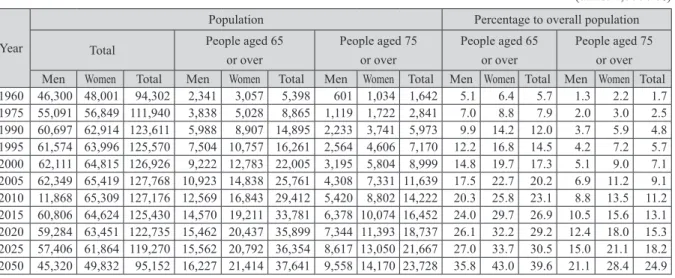
As of October 2007, the total population in Japan stands at 127.77 million, remaining almost flat at the preceding year’s level. Population aged 65 or over stands at 27.46 million (11.70 million men and 15.76 million women), occupying 21.5% of the overall population (i.e., ageing rate).
Among elderly citizens, population of early-stage elderly people (aged 65-74) is 14.76 million, while that of late-stage elderly people (aged 75 or over) stands at 12.70 million, exceeding 10 million.
In Japan, elderly citizens only occupied less than 5% of the nation’s overall population in 1950, but they grew further than 7% in 1970 (so-called “ageing society”) and exceeded 14% in 1994, leading to rapid progress in aged society. Population of elderly people will reach its peak at 38.63 million in 2042 and take downturn thereafter.
Japan’s overall population started a downward trend in 2005, but ageing rate will keep rising, increasing to 25.2% in 2013 and 40.5% in 2055 when one person out of 2.5 Japanese citizens will be older than 65.
Table 2. Trend of elderly population (1960 to 2050) (units: 1,000 / %)
Year
Population Percentage to overall population Total People aged 65
or over People aged 75 or over People aged 65 or over People aged 75 or over Men Women Total Men Women Total Men Women Total Men Women Total Men Women Total 1960 46,300 48,001 94,302 2,341 3,057 5,398 601 1,034 1,642 5.1 6.4 5.7 1.3 2.2 1.7 1975 55,091 56,849 111,940 3,838 5,028 8,865 1,119 1,722 2,841 7.0 8.8 7.9 2.0 3.0 2.5 1990 60,697 62,914 123,611 5,988 8,907 14,895 2,233 3,741 5,973 9.9 14.2 12.0 3.7 5.9 4.8 1995 61,574 63,996 125,570 7,504 10,757 16,261 2,564 4,606 7,170 12.2 16.8 14.5 4.2 7.2 5.7 2000 62,111 64,815 126,926 9,222 12,783 22,005 3,195 5,804 8,999 14.8 19.7 17.3 5.1 9.0 7.1 2005 62,349 65,419 127,768 10,923 14,838 25,761 4,308 7,331 11,639 17.5 22.7 20.2 6.9 11.2 9.1 2010 11,868 65,309 127,176 12,569 16,843 29,412 5,420 8,802 14,222 20.3 25.8 23.1 8.8 13.5 11.2 2015 60,806 64,624 125,430 14,570 19,211 33,781 6,378 10,074 16,452 24.0 29.7 26.9 10.5 15.6 13.1 2020 59,284 63,451 122,735 15,462 20,437 35,899 7,344 11,393 18,737 26.1 32.2 29.2 12.4 18.0 15.3 2025 57,406 61,864 119,270 15,562 20,792 36,354 8,617 13,050 21,667 27.0 33.7 30.5 15.0 21.1 18.2 2050 45,320 49,832 95,152 16,227 21,414 37,641 9,558 14,170 23,728 35.8 43.0 39.6 21.1 28.4 24.9 (Data) Statistics Bureau, Ministry of Internal Affairs and Communications, “Population Census” and “Population Estimates”;
and National Institute of Population and Social Security Research, “Population Projections for Japan” (Estimated as of December 2007, medium estimate)
Out of elderly population, population of early-stage elderly citizens will gradually decrease after hitting a peak in 2016, but late-stage elderly people aged 75 or over are estimated to keep increasing and will exceed early-stage elderly citizens in 2017, inevitably sending up the number of elderly citizens requiring care services because they suffer dementia or become bedridden.
On the other hand, birthrate has been taking a downward trend, resulting in lower fertility. In contrast to increased elderly population, child population (aged 0-14) will account for a lower percentage. This will push down Japan’s overall population in the long run, bringing down labor force population, leading to a decrease in taxpayer population and social insurance policyholders, which will surely pose significant impacts on Japan’s socioeconomic structure as well as on the nation’s social programs, such as pension, medical care, welfare, and care programs.
1-4. Aged society with declining birthrate, and its factors
(1) Mortality rate and longer average life expectancy
Japan’s mortality rate (the number of deaths per 1,000 citizens) decreased by half for approximately 15 years from 14.6 in 1947 because mortality rate of babies, toddlers, and young people dropped sharply due to improved living standards, better dietary life and nutrition, and progress of medical technologies. Since then, the mortality rate kept a gradual downward trend, hitting the record low of 6.0 in 1979. It takes a slight upward trend for recent years, standing at 8.6% in 2006 (1,106,000 deaths). However, since stronger health awareness among Japanese citizens as well as remarkable development of medical technologies has resulted in lower mortality rate for patients with cerebrovascular diseases and longer life for patients of other diseases, the mortality rate for middle-aged or older citizens has been improving.
In particular, mortality rate for elderly people aged 65 or over has been consistently taking a downward trend since the end of WWII, falling from 71.5 in 1950 to 47.4% in 1980, and 33.8% in 2006. As for a gender gap of mortality rate among elderly persons, mortality rate for women significantly falls short of that for men in any age bracket.
As mortality rate gets lower, average life expectancy for Japanese people has been sharply rising from 50.06 years for men and 53.96 years for women in 1947 to 79.00 years for men and 85.81 years for women in 2006. Japan is the nation with the greatest longevity.
As average life expectancy at the age of 65 has been also getting longer from 10.16 years for men and 12.22 years for women in 1947 to 18.45 years for men and 23.44 years for women in 2006, both men and women are spending longer senior life. In the future, average life expectancy will keep getting longer to 83.67 years for men and 90.34 years for women in 2055 (according to the December 2006 medium estimates of National Institute of Population and Social Security Research, “Population Projections for Japan”).
(2) Progress of lower birthrate
persons) is 8.4.
In addition, total fertility rate (i.e., the sum of age-specific birthrate of women aged 15 to 49, which represents the number of children that would be born to a woman over her lifetime if she were to experience the age-specific fertility rate for her age) sharply fell down since the first baby boom. The rate stood at 2.22 in 1956 and kept the necessary level to maintain population (2.05 to 2.10) for a while. However, it fell to 1.91 in 1975, falling below 2.00, and decreased to 1.46 in 1993, dipping from 1.5. Total fertility rate kept falling thereafter. As of 2006, total fertility rate stands at 1.32, rising 0.06 point from the 2005 level.
Figure 1. Annual trend of live births and total fertility rate
(Source) Japan Center of Longevity Society, “Handbook of Elderly Care 2007,” p.5, 2007
A drop of live births and birthrate in this way is attributable to multiple factors. As Japan has a relatively small number of babies born outside of marriage, direct factors would include a rise in first-marriage age (tendency to marry later) and an increase in people going unmarried (an increase in people staying single).
A percentage of unmarried persons started to particularly rise for men aged 25-39 and women in their 20s around 1975. The rate of remaining single for life has been taking an upward trend both for men and women, standing at 15.96% for men and 7.25% for women in 2005, rising stronger for men than women. First-marriage age is also rising both for men and women.
Average number of children born to a married woman takes a slight downward trend. However, married women in younger generation tend to give birth to fewer children than those in other generations. In addition to tendency to marry later and an increase in people staying single, if married couples give birth to a decreased number of children, fertility rate will further drop, according to some analysts.
education background and self-reliance attitude, a rise in women’s labor-force participation ratio, poor child-care services for babies and toddlers, difficult balance between child-rearing and working, husband’s poor participation in child-rearing, and a change in social awareness of marriage and child-rearing.
1-5. Ageing population in each region
(1) Population trend since the 1970s: Overpopulation and underpopulation
Ageing population in Japan significantly varies region by region. Significant regional gap is attributable to a labor force shift from rural areas to urban areas in the high-growth era from the 1960s to the 1970s. Since industrial structural change has sent out younger labor force to urban area and has brought about concentration of younger generations from rural areas to urban areas, underpopulation and ageing population in rural communities or local small cities have progressed, posing serious social problems. Urban areas have also suffered from environmental deterioration or housing problems due to overpopulation. In this sense, overpopulation and underpopulation have brought about overwhelmingly serious problems.
(2) Ageing population in local areas
Ageing population significantly varies among local areas. Ageing population has been particularly progressing in Tohoku, Shikoku, and Kyushu areas, while that in Tokyo metropolitan area and Kinki area is progressing at a slightly slower pace, but is estimated to gradually take a quicker pace in the future.
In addition, elderly citizens occupy a majority of the overall residents in some municipalities, while ageing population is expected to progress rapidly in some prefectures in Tokyo metropolitan area, such as Tokyo, Chiba, Saitama, and Kanagawa Prefectures in the 2020s and the 2030s. In this context, it is important to take countermeasures on ageing population from the viewpoints of decentralization and local social welfare services.
Chapter II. Living conditions of elderly citizens in Japan
2-1. Households with elderly people
As of 2006, 18.29 million households have at least one elderly person, occupying 38.5% of the overall households (47.53 million households).
Figure 2. Trend of households with elderly person aged 65 or over
(Source) Japan Center of Longevity Society, “Handbook of Elderly Care 2007,” p.10, 2007
As for the future trend of elderly households in Japan, the total number of households with household head aged 65 or over (hereinafter, such households are referred as “elderly households”) is estimated to increase approximately 1.4 times from 13.55 million in 2005 to 19.03 million in 2030. On the other hand, the number of ordinary households will increase from 49.06 million in 2005 to 50.60 million in 2015. As a result, elderly households as a percentage to the total number of ordinary households will increase from 27.6% in 2005 to 39.0% in 2030 (“ordinary households” means a group of persons under the common residence and livelihood or a single person that has his/her own household).
2-2. Economic life for elderly people
(1) Income
Annual income of elderly households (average income as of 2005) stands at \3.019 million, slightly exceeding a half of the average income of all households (\5.638 million). However, as elderly households usually have fewer household members, income per household member is \1.89 million, suggesting almost no gap with ordinary household’s average income per household member (\2.059 million) (See Table 4).
Table 4. Income of elderly households
Category
Average income Income per household
Income per household member (average number of household members)
Elderly households
Gross income: \3.019 million Labor income: \545,000 (18.0%) Public pension: \2.119 million (70.2%) Property income: \157,000 (5.2%) Social welfare benefits other than pension: \25,000 (0.8%) Money sent or other income: \172,000 (5.7%)
\1.89 million (1.60 persons)
All households Gross income: \5.638 million
(Source) Cabinet Office, “Annual Report on the Aging Society 2008,” Saeki Printing, p.26, 2008
According to Cabinet Office’s first survey report that focuses on elderly men and women’s economic anxiety and their self help in their daily life (survey respondents: age 55 to 74), approximately a half of elderly women make annual revenues less than \1.8 million. A little bit more than 20% of them spend their life with the annual revenues less than \1.2 million. As for elderly male single persons, 10% of unmarried male elderly persons make annual revenues of less than \600,000.
As for distribution of annual income of elderly households, the income bracket of \1 million or more but less than \2 million controls the largest percentage of 27.1%, followed by that of \2 million or more but less than \3 million (18.5%), \3 million or more but less than \4 million (16.9%), and less than \1 million (15.7%), and the median value stands at \2.4 million (See Figure 3). Elderly persons aged 65 or over occupy 39.8% of the overall recipients of livelihood protection subsidy. Out of this, single-person households controls 28.5%, and in particular, female single-person households account for 16.8%.
(2) Consumption
Figure 3. Distribution of annual income of elderly households
(Data) Ministry of Health, Labour and Welfare, “Comprehensive Survey of Living Conditions of the People on Health and Welfare” (2006) (Annual income in the said survey)
(Note) Elderly household means a household consisting of senior citizen(s) aged 65 or over or a household comprising senior citizen(s) aged 65 or over and unmarried person(s) younger than 18 years old.
(3) Savings
Savings on hand for Japanese citizens tend to increase as they get older. According to “Annual Report on the Aging Society 2008,” elderly households have \24.29 million savings on hand on average as of 2006, 1.4 times of the average of all households. Almost 20% of elderly households have savings on hand more than \40 million.
As for whether or not they think they have enough savings for their old age, 27.9% of elderly respondents think they “have sufficient savings” (i.e., the sum of respondents answering they “have enough savings” and “have minimum savings at least”). Respondents choosing the answer option they have “insufficient savings” (i.e., the sum of respondents answering they “have a little bit insufficient savings” and “have quite insufficient savings”) occupy 64.7% of the overall respondents, rising 7.6% from 57.1% in the preceding survey.
(4) Housing
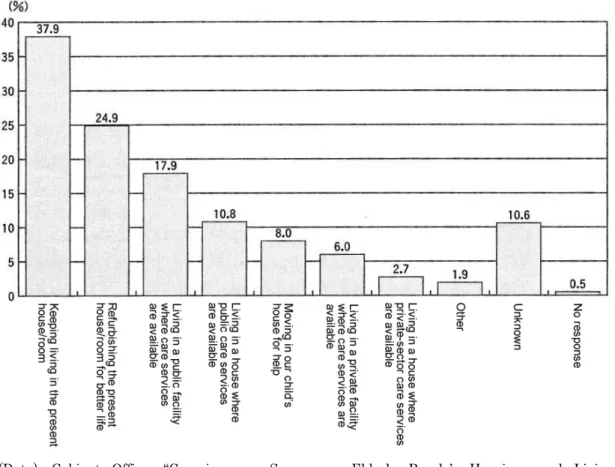
In terms of housings for elderly people aged 65 or over, almost 60% (59.0%) of senior citizens live in the same residence for 31 years or longer (some of them are living in the same house since they were born). On the other hand, 6.5% of senior people live in the same house for “5 years or shorter,” suggesting a downward trend of senior citizens living in the same house for a long time of 20 years or longer.
Figure 4. Residence patterns that elderly people are wishing when they get run-down (multiple answers allowed)
(Data) Cabinet Office, “Consciousness Survey on Elderly People’s Housings and Living Environment” (2006)
(Note) This survey covers male and female respondents aged 60 or over all over Japan.
(5) Increased nuclear families and lifestyle changes
Social structural changes after WWII have significantly altered local communities and family life. Traditionally, large families consisting of three or four generations were widely observable both in urban and rural areas. However, as nuclear families have been getting increased until recent years, the percentage of elderly citizens living with their children takes a downward trend. In fact, 79% of elderly people lived with their children in 1963 when lawmakers passed Act on Social Welfare Service for Elderly, but the percentage fell to 47.1% in 2002 and sharply dropped to 43.9% in 2006.
In addition, the percentage of husband-wife-only elderly households and elderly single-person households stands at 52.2% as of 2006, occupying more than a half of elderly persons. In particular, Japan is characterized by an increase in elderly persons living alone. According to the estimate of National Institute of Population and Social Security Research, Ministry of Health, Labour and Welfare, single-person households with household head aged 65 or over will sharply increase to 6.354 million households in 2020.
people now have a variety of self-fulfillment opportunities due to changes of the times, they enjoy increased opportunities to actively work on what they long wish to do. On the other hand, weaker mental/ physical conditions due to ageing as well as problems requiring care services would prevent them from achieving their life images that they have envisioned.
If they face weaker mental/physical conditions or problems requiring care services, they will feel a lot of anxieties, such as what they should do, or how they should use or take procedures for, necessary services or programs. These mental anxieties and cost burden associated with hospital visit, hospital stay or other issues for continuing their life should not be underestimated.
Table 5 shows what elderly citizens are worrying in their daily life. Approximately 68% of elderly people feel “very insecure” or “a little insecure,” suggesting an example of their anxieties about care service problems.
Table 5. Expected care service providers if elderly citizens require care services Japan The United
States South Korea Germany Sweden
1. Spouse or partner 46.7 36.1 40.7 41.5 44.9
2. Son (including adopted son) 8.1 6.8 29.4 8.6 3.6
3. Daughter (including adopted daughter) 9.8 22.2 7.0 20.7 9.2
4. Spouse or partner of son or daughter 8.7 2.7 13.5 2.1 0.7
5. Other family members or relatives 1.3 6.0 0.5 5.0 2.2
6. Friends/acquaintances 0.3 2.9 0.1 3.6 2.3
7. Nonprofessional service providers, such as
volunteers 0.7 0.1 0.6 1.0 0.8
8. Professional service providers, such as care
attendants 10.4 13.8 0.5 8.3 28.6
9. Others 1.1 1.4 0.3 1.8 0.6
10. No care providers available 1.4 2.1 3.7 1.4 0.6
11. Unknown 11.2 5.2 3.8 4.7 5.8
(Data) Director General for Comprehensive Planning Coordination, Cabinet Office, “International Comparison Survey on Elderly Citizens’ Life and Awareness (FY2000)”
(Source) Japan Center of Longevity Society, “Handbook of Elderly Care 2007,” p.27, 2007
Chapter III
3-1. Historically Systematic deployment of elderly care services: Since Long-Term Care Insurance Act became effective
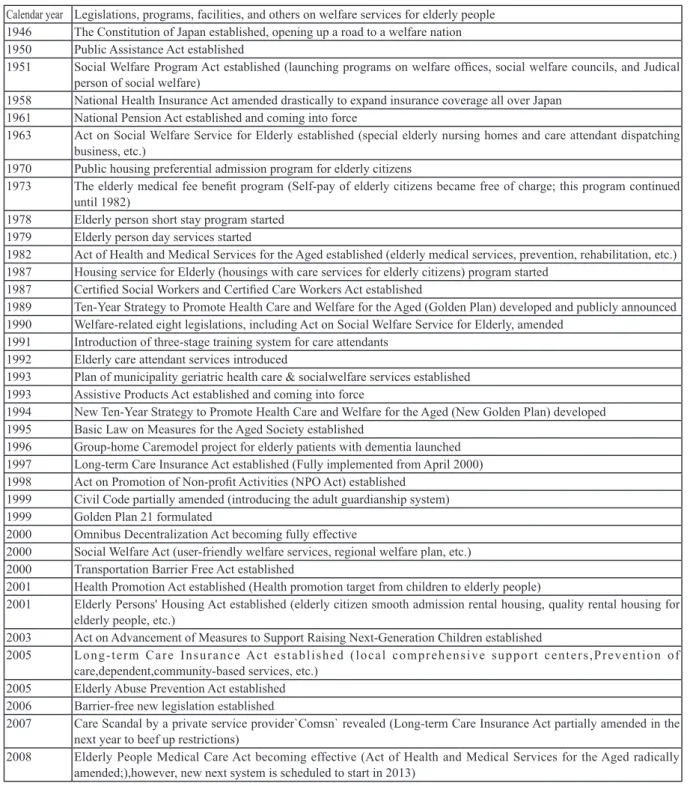
Table 6 describes Japan’s social policies and welfare programs for elderly citizens since the end of WWII. After efforts through Golden Plan and New Golden Plan, lawmakers passed Long-Term Care Insurance Act in the Diet in December 1997, which became fully effective in April 2000. To take specific countermeasures on elderly care for the 21st century, the government aims at “socialization of care services” by setting up comprehensive care services/programs, such as at-home care services, facility-based services, and care support services (care management), while local governments are working on providing better environment for care services based on their long-term care insurance project plans and health/welfare plans for elderly residents (for more information, see section 4 of this chapter and Chapter V). In line with launch of the long-term care insurance program, Gold Plan 21 has started, putting emphasis on countermeasures on dementia.
In June 2005, about five years later than launch of the long-term care insurance program in FY2000, lawmakers amended Long-term Care Insurance Act in the Diet. This amendment to Long-term Care Insurance Act is intended at sustainable and stable program operations mainly through (1) shifting to a prevention-based system (such as expanding care preventive services and amending how to certify long-term care needs), (2) clearly stating dignity of elderly citizens in Article 1 of the said legislation, (3) improving policy actions on elderly patients with dementia, (4) setting comprehensive community services, (5) reviewing facility-based benefit programs (introducing food/housing-cost-related user charges and supplemental benefits), and (6) improving service quality (launching a new program to disclose care service information). This amendment became fully effective in FY2006. In addition, it is decided that municipalities will set up local comprehensive support centers that provide comprehensive counseling services for local elderly residents, to prevent abuses on elderly persons and provide care preventive services.
NPOs, which are incorporated in accordance with Act on Promotion of Specified Non-profit Activities, are working on welfare activities for elderly citizens, such as group homes for elderly patients with dementia. As lawmakers have passed Social Welfare Act in the Diet, social welfare corporations are also working on addressing complaints and improving service quality, aiming to provide more user-friendly services.
In addition, as Elderly Persons' Housing Act and barrier-free new legislation are put in place to provide appropriate environment for elderly citizens’ smoother daily life, efforts are made for solving residence/ housing problems of elderly people and improving their living environment.
future.
As mentioned above, in line with the preparation/implementation process of the long-term care insurance program, Omnibus Decentralization Act became fully effective to push ahead with municipality mergers. At the same time, the government introduced the adult guardianship program by amending Civil Code. In this context, as more than 60 years have passed since the end of WWII, Japan’s society inevitably needs structural reforms. It is also necessary to specifically and effectively solve problems, such as an increase in jobless people and low-income workers, and economic negative impacts on elderly pension recipients under global-scale economic fluctuations since 2008.
Table 6. Chronology on welfare programs for elderly citizens in the modern era
Calendar year Legislations, programs, facilities, and others on welfare services for elderly people 1946 The Constitution of Japan established, opening up a road to a welfare nation 1950 Public Assistance Act established
1951 Social Welfare Program Act established (launching programs on welfare offices, social welfare councils, and Judical person of social welfare)
1958 National Health Insurance Act amended drastically to expand insurance coverage all over Japan 1961 National Pension Act established and coming into force
1963 Act on Social Welfare Service for Elderly established (special elderly nursing homes and care attendant dispatching business, etc.)
1970 Public housing preferential admission program for elderly citizens
1973 The elderly medical fee benefit program (Self-pay of elderly citizens became free of charge; this program continued until 1982)
1978 Elderly person short stay program started 1979 Elderly person day services started
1982 Act of Health and Medical Services for the Aged established (elderly medical services, prevention, rehabilitation, etc.) 1987 Housing service for Elderly (housings with care services for elderly citizens) program started
1987 Certified Social Workers and Certified Care Workers Act established
1989 Ten-Year Strategy to Promote Health Care and Welfare for the Aged (Golden Plan) developed and publicly announced 1990 Welfare-related eight legislations, including Act on Social Welfare Service for Elderly, amended
1991 Introduction of three-stage training system for care attendants 1992 Elderly care attendant services introduced
1993 Plan of municipality geriatric health care & socialwelfare services established 1993 Assistive Products Act established and coming into force
1994 New Ten-Year Strategy to Promote Health Care and Welfare for the Aged (New Golden Plan) developed 1995 Basic Law on Measures for the Aged Society established
1996 Group-home Caremodel project for elderly patients with dementia launched 1997 Long-term Care Insurance Act established (Fully implemented from April 2000) 1998 Act on Promotion of Non-profit Activities (NPO Act) established
1999 Civil Code partially amended (introducing the adult guardianship system) 1999 Golden Plan 21 formulated
2000 Omnibus Decentralization Act becoming fully effective
2000 Social Welfare Act (user-friendly welfare services, regional welfare plan, etc.) 2000 Transportation Barrier Free Act established
2001 Health Promotion Act established (Health promotion target from children to elderly people)
2001 Elderly Persons' Housing Act established (elderly citizen smooth admission rental housing, quality rental housing for elderly people, etc.)
2003 Act on Advancement of Measures to Support Raising Next-Generation Children established
2005 Long-term Care Insurance Act established (local comprehensive support centers,Prevention of care,dependent,community-based services, etc.)
2005 Elderly Abuse Prevention Act established 2006 Barrier-free new legislation established
2007 Care Scandal by a private service provider`Comsn` revealed (Long-term Care Insurance Act partially amended in the next year to beef up restrictions)
3-2. Reorganization of elderly care services, and new approaches
(1) Problems surrounding the long-term care insurance program
As demand-supply relation in care services is gradually getting matured after the long-term care insurance program was put in place, a variety of problems are emerging on a local basis. Here are the main points of these problems.
First, while various care services are supplied, the at-home care service sector is seeing a wide variety of new market entrants. In this context, users are facing difficulty of service choice, wondering which service providers they should select. This is a unique problem mainly to metropolitan areas, that is, users are actually spending way too much time and cost before finding out a satisfactory service provider. In addition, in response to heinous service providers, including the COMSN (its scandal revealed in 2007), the government has decided to beef up applicable restrictions by partially amending Long-term Care Insurance Act.
Second, as mentioned in the preceding section (at-home care, facility-based care, etc.), analysts are raising questions on care services from qualitative perspectives. As an approach to secure care service quality, service providers will need to disclose information, while policymakers should actively push ahead with service evaluation in objective and specific manners.
Third, users are facing urgent needs, such as their long waiting time before admission to care facilities. They are also making requests or complaints about facility-based service menu and facility operations. In the meantime, facility operation problems are getting improved through efforts on small-size life units (unit care). However, as problems, such as accommodation cost burdens and non-insurance cost burdens, are emerging, policymakers need to take fine-tuned countermeasures for low-income persons.
If the viewpoint of residence care is incorporated, policymakers should reexamine the residence (admission to residence or facility) facility-based service structure by making clear roles of care houses or deploying elderly housing-related policy actions.
On the other hand, cost burden for using facilities should be disclosed in an easily understandable manner to users. In relation with reforms on elderly medical care programs, it is a high time to reset facility usage fees with focus on the ability-to-pay principle.
To solve these problems, policymakers should reorganize care insurance and elderly welfare systems in a sustainable program. In addition, it is also necessary to systematically train human resources, mainly certified care workers that play central roles in providing services and to systematically push ahead with stress management for care workers.
(2) Reorganization of elderly care, and new approaches
In relation with reviewing the long-term care insurance program, some policymakers are considering identifying new care services and launching a new insurance benefit program by partially reorganizing the traditional care benefit and preventive benefit programs.
care services.
In parallel with this, local rehabilitation services should be also enhanced. Specifically speaking, appropriate services for the acute, recovery, and maintenance stages should be made available in a mutually related manner in a local community. It is necessary to specifically designate local rehabilitation center easily accessible to elderly citizens. One idea would be to enhance capabilities of care-related comprehensive facilities and local core hospitals in a way that they will play specific roles as local rehabilitation center.
The third approach is to push ahead with local comprehensive care services. The concept of local comprehensive care services has been traditionally put in place with focus on local medical services. From the viewpoints of enhancing collaboration between health medical treatment and social welfare, it is necessary to set up new model of local care services, including stabilization and development of local comprehensive support centers.
Analysts recently pay increased attentions to developing and diffusing small-scale multifunctional care services. Paying due attentions to local characteristics, group homes, elderly housings, and so-called elderly day care centers/salons should be put in place in an interrelated manner. In any event, policymakers should inevitably streamline construction cost, but it is necessary to work on improving quality of life for users (or residents) in terms of program operations, rather than simply providing “cheep welfare” services.
(3) Problems of long-term care insurance and elderly health welfare programs
As a lot of new problems are emerging in relation with elderly local residents, policymakers should launch elderly welfare programs from new perspectives, rather than simply reexamining the long-term care insurance program.
First, it is necessary to make use of adult guardianship program that supports daily life of elderly dementia patients and improve/enhance local welfare human rights protection projects. In this relation, in line with the purposes of Elderly Abuse Prevention Act of October 2005, policymakers should make efforts to respect dignity and human rights of elderly citizens.
Second, there are problems surrounding reorganization of facility-based care services. As long-term-care and medical facilities will be abolished in the near future, how facilities in local communities will be reorganized? In relation with elderly citizens waiting for their admission to special elderly nursing homes, what should facility-based care services be in the future? In addition, what are appropriate elderly housings adjunct to facility-based care services and their supplementary services (day services, salons, etc.)? There are a lot of problems that should be solved.
Third, since illegal business practices on housing refurbishing services or financial instruments, as well as so-called bank transfer scams, have been spread out nationwide, a lot of elderly citizens are suffering from fraud damages. It is absolutely necessary to drastically enhance consumer counseling services and beef up collaboration among organizations relating such as health and welfare services.
service human resources in the medium- and long-run.
Among a variety of problematic situations, citizen’s participation (in stand-watching, supports, mutual-help, and local network) is desired at the municipality level, while municipalities should also make community-building efforts with participation of elderly citizens.
Chapter IV. Toward setting up local comprehensive care system
4-1. Common aspects and diversity of elderly people's needs
More than 10 years have passed since the long-term care insurance program became effective to address care service needs of elderly people. It is necessary to set up a new framework toward the 2020-30s when ageing population will reach its peak, in particular, toward the year 2025 in which baby boomers will all become late-stage elderly citizens. In relation with medium-term reforms on the long-term care insurance program, the study group on “local comprehensive care” has been examining and suggesting possible solutions for two years of FY2008-09. [note 1]
Analysts has traditionally discussed the concept of local comprehensive care to come up with details for network of related organizations and possible collaboration among professional staff, while making clear the necessity of cooperation among health, medical care, and welfare sectors in systematically deploying local medical services.
The recommendations in March 2010 and related materials call for 1) expanding sustainable care services and setting up appropriate framework, 2) beefing up collaboration between the care service sector and the medical sector, 3) expanding elderly housings, 4) systematically pushing ahead with dementia-related care, 5) paying attentions to elderly citizen’s isolated deaths in local communities, 6) taking policy actions with due considerations to low-income people, and 7) securing care service human resources and setting up their career progression system.
4-2. Common aspects and diversity of elderly people’s needs
As of September 2010, Japan has approximately 29.44 million elderly people aged 65 or over, and ageing rate stands at 23.1% (as announced by Ministry of Internal Affairs and Communications). In the near future, elderly population will exceed 30 million, and ageing rate will also rise further than 25% (a quarter of the overall population). In addition, 4.88 million people certified as requiring care services/ supports all over Japan. The nation has 826,000 persons staying in long-term care insurance-related facilities, 2.924 million at-home service users, and 250,000 local-based service users (Ministry of Health, Labour and Welfare, “Report on Long-term Care Insurance Program, preliminary report in May 2010”).
lot of elderly persons older than 100 years old were identified as missing all over Japan this summer, municipalities and case workers faced pressing works to address this problem.
By the way, under the recent “deflation and economic crisis,” the pension/benefit level for elderly citizens is an urgent problem. From income security perspectives, it is necessary to provide job opportunities for elderly persons and sustain/stabilize the pension programs. In addition, for elderly citizens suffering from various diseases, it is also urgently necessary to revitalize local medical services and to shift to and establish an alternative program to replace the late-stage elderly medical program.
Looking in this way, almost 30 million elderly people in Japan have diversified needs for their daily life and care services. In addition, it is necessary to find out a new direction to solve problems suffered by elderly persons and provide comprehensive supports (including their consumption life-related problems). 4-3. Principles and basic direction of local comprehensive care services
“Local comprehensive care” is a keyword when establishing new elderly policy actions, such as reforms of the current Long-term Care Insurance Act and related programs. The following three points may be pointed out as the principles of local comprehensive care.
(1) Continuing to live a life in a local community and residence that elderly citizens are accustomed to (i.e., comprehensive life supports are important);
(2) Making selection by the elderly person on his/her own (elderly person’s needs should be respected); and
(3) Making use of and maintain elderly people’s abilities, are important.
As for how to provide services, priority should be placed on at-home services (including local-based services). It is necessary to improving daily living conditions for elderly citizens and providing better housing for them (barrier-free is absolutely necessary both for rental house and their own house), while facility-based services should play complementary services for elderly citizens that suffer difficulties of spending their life at home.
In the 21st century trend of decentralization reform, policymakers should put more emphasis on roles of local governments, mainly municipalities that are closer to local residents. They should also make clear elderly health welfare and care service program plans that incorporate appropriate framework for comprehensive life supports and various services from the medium- and long-term perspectives, with focus on care services, preventive and medical services.
4-4. Desirable services: Elements of local comprehensive care
As for desirable services in the local comprehensive care system, because of an increase in physically weak late-stage elderly citizens and home-care dementia patients as well as increased patients with cancer or other “terminal” conditions, it is important to collaborate between care service and medical sectors (in particular, fundamentally setting up a team care program consisting of at-home care services including local home-visit care, and home-visit nursing-care), and collaborate between the care/welfare side and attending doctors/medical institutions.
Specifically speaking, it is necessary to work on the tasks inside/outside the long-term care program and expand various care services as shown below.
(1) Tasks for drastically expanding at-home services
i) Establishing care management approaches to support local comprehensive care (such as setting up comprehensive and coherent assessment planning approaches) [Note 2]
ii) Enhancing 24-hour short-time routine-run services (mainly, at-home care and home visit nursing-care)
iii) Pushing ahead with home visit nursing-care and rehabilitation services
iv) Pushing ahead with at-home medical services (Japanese-type GP = Outlook for comprehensive clinician system, creation of at-home terminal care teams, etc.)
v) Expanding local support projects (providing comprehensive life supports, such as expansion of catering and other meal services)
vi) Reexamining care prevention projects (developing/diffusing multilayered preventive programs that incorporate health promotion and lifestyle-related diseases prevention as the primary service, coupled with disease prevention, secondary and tertiary prevention services)
(2) Putting more emphasis on elderly housings (adding public housings, UR housings, and elderly-exclusive-use rental housings, as well as smoother moving-in)
(3) Improving/reorganizing long-term care insurance facility categories (improving special elderly nursing homes, reorganizing care/medical treatment-type medical facilities, etc.)
(4) Systematically pushing ahead with dementia care (including establishment of local stand-watching network)
(5) Drastically enhancing capabilities/framework of local comprehensive support centers
(6) Making clear importance and services of family member supports (respite support, counseling service, etc.)
In relation with care human resources, the following tasks and countermeasures are necessary. (7) Fostering/securing care workers, mainly certified careworkers
(8) Improving employment management and organization management practices by the employer (9) Providing better working conditions for care workers (health management and welfare programs
for care workers)
4-5. Agenda for the future
Under the recent “gap society” phenomenon and “deflation and economic crises,” it is important to expand policy actions in line with elderly people’s lifestyles.
(1) It is absolutely necessary to take policy actions with due considerations to low-income people (overcoming difficulties of joining unit care facilities, group homes, etc.)
In addition, in terms of isolated death of elderly persons in local community as well as missing elderly citizens older than 100 years old, the following efforts should be made.
(2) It is necessary to solve specific problems in daily life by better addressing basic matters of elderly people-related policy actions. As specified in “Act on Social Welfare Service for Elderly,” it is needed to grasp the overall picture of elderly local residents and provide substantive counseling/ support services, mainly by municipalities.
The author attaches importance to daily life of citizens in Japan, including elderly people, and puts emphasis on the following actions in order to set up sustainable care program for elderly people. (3) Policymakers should start to reexamine possible financial resources and financial resource
breakdown (Because insurance premium from the fifth period after 2012 will rise to \5,000 on national average, it might be important to “mitigate” insurance premium hike by increasing the public expenditures).
(4) Reexamination of insurance premium and user charges is necessary. (It might be an idea to shift to the ability-to-pay principle by introducing cost burden categories in line with income levels, for example)
(5) Examining appropriate cost-sharing between the central and local governments (providing adjustment subsidies in an appropriate manner, trend and result of “lump-sum subsidies” accompanied with the decentralization reform)
Conclusion
Policymakers are expected to seek for new approaches, including possible approaches stated above. At the same time, analysts pay increased attentions to what policymakers would do when preparing FY2011 budget, amending Long-term Care Insurance Act and the Fifth-period plan from FY2012 onward. To conclude this paper, the author would like to add some comments on urgent matters.
(1) As a possible policy approach in line with the characteristics of ageing society with lower birthrate in Japan, policy actions on next-generation fosterage supports to mitigate lower birthrate will ultimately pose direct positive impacts on elderly support policy programs (because it will secure future generations that will support pension and other programs). To put it briefly, policymakers should prepare FY2011 budget to keep the “Child Allowance” program and increase the amount of Child Allowance.
the local comprehensive care system, and secure special elderly nursing homes and other long-term care insurance-related facilities as well as elderly housings with alternative capabilities in Tokyo, Kanagawa, Chiba, and Saitama Prefectures. [Note 3]
(3) As care services and life support services are characterized by “services by person, for person,” mobilizing the human resources available as much as possible is absolutely necessary. By continuing policy actions that will overcome low-wage for care workers and radically improve their working conditions, policymakers should push ahead with necessary and sufficient conditions to attract younger workers to the care service sector and thereby keep the care service sector more sustainable.
Lawmakers passed “Care Work Force Securing Act” unanimously, including ruling and opposing parties, in the Diet in May 2008, but Japanese citizens earnestly desire solving problems for improving citizen’s life through political leadership, rather than chaotic “distorted” Diet as envisioned by mass media.
Breaking News and Thanks
We Have had the Great earthquake in Eastern Japan on March 11, 2011 ! We must support Victims, especially the Elderly Children and Disable persons. In near future Japan administration & the Diet shall enact the new legislation on the relief programs for victims by the earthquake.
We are thankful to the Volunteers devoted and to the each country with the international Solidarity.
[Note 1] Local Comprehensive Care Study Group, “Report of Local Comprehensive Care Study Group,” March 2010 (The secretariat: Mitsubishi UFJ Research & Consulting)
Hirokazu Murakawa “Local Comprehensive Care” in ‘Elderly Health Welfare Handbook,’ Dai-ichi Hoki, October 2010
Hirokazu Murakawa, et. al. (ed), “Study on Long-term Care Insurance,” Dai-ichi Hoki, 2009
[Note 2] “Developing Japanese-style CPAT (tentative title),” Kosei Kagaku Kenkyuusha, 2010 (to be published shortly) CPAT: Care Planning Assessment Tool
This is the outcome of Japan-Australia joint research project and is developed as a compact, visual common tool intended for professional care workers, medical staff, health workers, and welfare staff.