Study on Stereo specific HPLC using Self-assembled Polymer as organic phase
Dissertation Submitted to the Graduate School of Science and
Technology of Kumamoto University for the Degree ofDoctor of Philosophy
Mahnaz Derakhshan
September, 2007
Department of Materials and Life Sciences
Graduate School of Science and Technology
Kumamoto University
Dedication
To my Husband Dr. Hamid Reza Ansarian
for his guidance, support, love and enthusiasm. Without these things this could not have been possible
To my newborn angel NOOR
for her profusion of blessings to our life
To my Parents
who, as always, have supported me throughout all that I have done.
To my Sisters
for their unconditional love
To my in-laws for their relentless supports
ACKNOWLEDGEMENTS
I would like to express my gratitude and appreciation to Professor Dr.
Hirotaka Ihara for his continuous guidance and support throughout the course of this research.
I want to thanks Dr. Makoto Takafuji, associate professors of Department of Material and Life Science for his scientific directions.
I am indebted to Dr. Hamid R. Ansarian for his prayers and support which have also added a great deal to my ability to prepare this thesis.
An honors thesis is never simply the work of one person. Rather, it is the result of the combined efforts of many people, supporting the author. It is because of this fact that the author of this thesis would like to thank the following people:
Dr. A. Shundo for his excellent comments.
Ms. A. Hashimoto for her thoughtful and responsible manner.
Ms. Y. Kira for her helps.
Contents:
Chapter 1- Introduction
1.1. Theory of Reversed-Phase Liquid Chromatography 1 1.2. Chemical and thermal stability of staionary phase for RPLC 4
1.3. Retention Models in RPLC 7
1.4. Development of HPLC stationary phases 10
1.5. HPLC stationary phases from highly-ordered structures 12
Chapter 2- Engineering of the novel stationary phase
2.1. Introduction 23
2.2. Process design 23
2.3. Molecular design 24
2.4. Materials and Experiments 28
2.4.1. Materials 28
2.4.2 Synthesizing process 29
2.4.3. Characterization process 33
2.4.4. Telomerization and Stabilization on silica surface 33
2.5. Summary 34
Chapter 3- Synthesis and characterization of L-glutamide-derived lipid, a highly-ordered stationary phase
3.1. Materials 36
3.1.1. Samples and Reagents 37
3.2. Preparation of L-glutamide-derived lipid 37
3.2.1. Tail Part Synthesis 37
3.2.1.1. N-benzyloxycarbonyl-L-glutamic acid (L-Glu Z) 37
3.2.1.2. N1 ,N5-didocecyl-N2-benzyloxycarbony1-L-glutamide
(2Ci2L-gln-Z) 39
3.2.1.3. Nl,N5-didocecyl-L-glutamide (2Ci2L-Glu) 40 3.2.1.4. N-benzyloxycarbonyl-B-Alanin (6-Ala-Z) 41
3.2.1.5. N',N5-didodecyl-N2-[3-(N-benzyloxycarbonyl)amino]propionyl
-L-glutamide (2Ci2-L-Glu-|3-Ala-Z) 43
3.2.1.6.2cl2-L-Glu-|3-Ala 44
3.2.2. Head and neck part synthesis 46
3.2.2.1. Ethyl 4-(4- formylphenoxy) butanoate 46 3.2.2.2. 4-[4(2 nitro-l-ethenyl)phenoxy] butyric acid, ethyl ester 46 3.2.2.3. 4-[4(2 nitro-1 -ethenyl)phenoxy] butyric acid 48
3.2.3. Bonding neck to the tail part 49
3.3. polymerization and grafting on silica particles 51 3.4. Characterization of L-glutamide-derived lipid and Sil-pLGN 52
3.4.1 Differential Scanning Calorimetry (DSC) 52
3.4.2 Transmission Electron Microscopy (TEM) 52
3.4.3 NMR spectroscopy 52
3.4.3.1. Suspension-state ]H-NMR 53
3.4.3.2. Solid-state 13C-CP/MAS NMR 54
3.4.4 Chromatography 55
3.4.4.1. Chromatographic parameters for assessment of
column performances 56
3.5. Summary 58
Chapter 4- Characterization of the Stationary Phase
4.1. Double alkyl lipophilic L-glutamide derivative (LGN) 71
4.1.1. general characterization 71
4.1.1.1. Sol -Gel Transition 71
4.1.1.2. Differential Scanning Calorimetry Methodology 72 4.1.1.3. UV-VIS spectroscopy for determining the aggregates type 72 4.1.1.4. SEM and TEM for determining the aggregates shape and size 77 4.1.2. Driving forces of molecular aggregation (NMR observation) 78 4.1.3. The role of p-nitrostyrene head part in the self-assembly 79
4.1.3.1. Introduction 79
4.1.3.2. Material and Method 81
4.1.3.3. Results 82
4.1.3.4. Conclusion 86
4.2. Characterization by variant temperature 1H-NMR 88 4.3. Stationary phases from highly-ordered L-glutamide derived lipid 90
4.4. Surface coverage and alkyl chain densities 91
4.5. Comparative Suspension-state JH NMR measurements of the
stationary phases 92
4.5.1. Suspension-state !H-NMR 93
4.5.2. Referencing with Solution-state 1H-NMR 94
4.6. Evaluation of mobility of the grafted organic phase 94 4.6.1. Determination of Liquid Phase Percentage (LPP) 98
4.7. Summary 101
Chapter 5- Molecular Recognition with pLGN
5.1. HPLC system 103
5.2. Determination of retention mode of the new stationary phases 103 5.2.1. Retention behaviors of PAHs and alkylbenzenes on Sil-PLGN 103 5.2.2. Retention behaviors of geometrical isomers on Sil-pLGN 107 5.2.3. Recognition of Sil-PLGN towards molecular planarity 109 5.2.4. Retention behaviors of four-membered ring molecules on Sil-PLGN
(Molecular Slenderness/Linearity) 110
5.2.5 Shape parameter (L/B ) and retention behaviors of PAHs on Sil-PLGN 111
Chapter 6- Application
6.1. Double alkyl liphophilic L-glutamide derivative (LGN) 118
6.1.1. pharmacology and medicine 118
6.2. Stationary phases from highly-ordered L-glutamide derived lipid 120
6.2.1. Enhanced selectivity for chiral 120
6.2.2. enhanced selectivity for diastromers 121
6.2.2.1. Comparison of diastereomer separation ability between
Sil-pLGN and ODS 124
6.2.2.2. Conclusion 124
6.3. Summary 125
Abstract
Introduction.
Inspired by biological world, scientists are devising new strategies to design and fabricate organic functional materials using non-covalent intermolecular forces. Interactions such as hydrogen bonding or ji-jt stacking cause the self-assembly of complex supramolecular architecture, which allows the synthesis of materials with nanoscale morphologies. Among these structures are nanofibrilar assemblies, which possess chiral centers in their structures one of the most significant but poorly investigated applications of these chiral superstructures can be providing chiral surfaces for highly selective separation. For this purpose it is logical to manipulate molecular structure to optimize their ability of forming chiral structures.
Experimental
As an arguable strategy we designed a molecule, LGN, comprising not only a glutamate derived lipid supposed to form ordered structure at the first step but also an additional polymerizable part (a beta nitrostyrene derived head group) to stabilize it in the next step.
|3-nitrostyrene was selected not only for its tendency to be polymerized by direct UV radiation in low temperature that is essential for saving the ordered structure but also for probing it's polymerization after self-assembly.
Synthesis of LGN was done via three main steps. The double chain alkylated L-glutamide, tail part, was synthesized according to our procedure previously described. The head part is synthesized through a 3-step procedure, 4-hydroxybenzaldehyde with ethyl 4- bromobutyrate pass through a keton formation reaction and then through a condensation with nitromethane under ammonium acetate the nitrostyrene part of molecule formed. The
resultant ethyl ester was hydrolyzed in acidic situation to yield the head part. LGN was prepared through bonding the head and the tail parts. Each step of synthesis was reconfirmed by elemental analysis, FT-IR and NMR spectroscopy. To introduce telomerized LGN on silica surface, the mixture of LGN, agent S710, and AIBN in a molar ratio of 10,2,2 respectively was exposed to UV irradiation (315-400 nm) until full telomerization of lipid (confirmed by NMR spectroscopy).
The resultant telomere (pLGN) was coupled to Silica surface. Silica particles (YMC 120- S5) were mixed with pLGN in a weight production of 3 to 10 and stirred at reflux temperature in chloroform for 18 hours, then toluene was added and stirring was continued in toluene for 6 days. The product was gathered after filtration and frequently washed with hot chloroform and hot methanol. After 24 hours vacuum drying, the amount of carbon and hydrogen was determined to be 18.6 and 3.1% based on elemental analysis. The process was repeated with different wt proportion of silica and pLGN and in mass production (3-4 g) in which both the concentration of gel during polymer formation and the concentration of pLGN during coupling was much higher than the first experiment. In that experiment the obtained carbon percentage was equal to 7.3 and with a step up process it increased to 8.3%.
The low carbon percentage can be attributed to the theory that in high concentration condition the telomers cannot penetrate to silica pores; also big telomeres (secondary to high concentration during telomerization) cannot penetrate the silica easily.
To evaluate the column, its LPP (Liquid Phase Percentage) were measured which was equal to 29.1, 34.5, 35.5 in 1 °C, 20 °C, and 50°C respectively. Trivial change in LPP with temperature indicates presence of stable aggregates. Also a probability for a change in behavior of column around 1°C in HPLC can be inferred.
Results and discussion:
The retention mode as well as the extent of hydrophobic interaction between the elutes and the packing materials was determined by retention studies of alkylbenzenes as elutes. The
relationship between log k and log P on Sil-pLGN and ODS plot shows a similar slope to that in ODS and thus the mechanism of hydrophobicity is involved in separation behaviour of Sil-pLGN. It can be due to the two acyl chain as the tail part of molecule. Also higher retention factor for PAHs than for alkylbenzenes in Sil-pLGN indicates that it provides specific interaction sites (such as je-jc interaction sites) for PAHs. Examining the elutes with different planarity shows higher selectivity of Sil-pLGN than ODS.
In examining the molecules with different length there is only a trivial difference between the selectivity of Sil-pLGN and ODS for 4-rings polycyclic aromatic hydrocarbons.
However for the serie of "Benzene, Naphthalene, Anthracene, Naphthacene and Penthacene a big difference can be seen between the selectivity of two stationary phase for Naphtacene. (17.86 in Sil-pLGN, 2.22 in ODS). This finding proposes the role of other mechanism rather than shape or length selectivity for Sil-pLGN. Also Sil-pLGN showed a good ability in separation of chiral and diastromers The use of Sil-pLGN enables us to separate the 2-(2,3-anthracenedicarboximide) cyclohexane-derived. It shows selectivity for separation of hexahelicene and (lS,2S)-diaminocyclohexane.
Chapter 1
Introduction
1.1. Theory ofReversed-Phase Liquid Chromatography
Reversed-phase liquid chromatography is the most widely used analytical technique for the separation of complex mixtures. The separation is achieved by analytes having different interactions with the stationary phase. However, the complete mechanism is still subject to debate.
In reversed-phase liquid chromatography, solutes are separated using their hydrophobicity. A more hydrophobic solute will be retained on the column longer than a less hydrophobic one. Also, polar solutes will interact with the silica surface to cause peak tailing.
The mobile phase is one of the two components involved in the separation process.
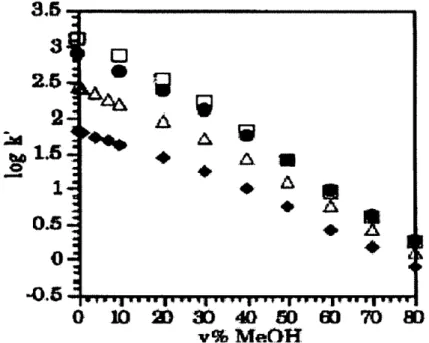
Water is generally one of the components of a binary mixture in RPLC. Water is considered to be the weak component of the mobile phase and does not interact with the hydrophobic stationary phase chains. The most popular organic modifiers used in RPLC are methanol and acetonitrile. [1] The organic modifier is the strong solvent in the mobile phase. All of the following studies use methanol as the organic modifier. The higher the concentration of organic modifier, the less retention an analyte will have. Hsieh and Dorsey demonstrated numerous examples of the effect of methanol composition (Hsieh, 1993). The column had a bonding density of 3.41 mol/m2. Figure 1.1. shows =
napthalene, = ethylbenzene, p = toluene, and J = benzene as the solutes used in this study. As the mobile phase increases in strength (more organic modifier), the solute is
swept off the column faster, so capacity factor decreases.
A
1
a 10 m 30 40 so eo to m
v%
Figure 1.1. Effect of methanol composition vs. Capacity factor.
The capacity factor, k1, is defined as the retention of a solute, tr, minus the dead time, to, divided by the dead time: —t\\
lo)\
I h !
The dead time is the time it takes for an unretained solute like thiourea, uracil, or D20 to pass through the system. One downfall of increasing k' is that the higher the k', the longer the chromatographic run, which may not be beneficial due to time or money constraints.
The stationary phase is the other component in the separation process. The adsorbent is the support for a derivatizing agent to be bonded to the surface. The
adsorbent must be rigid and impermeable to the analytes to be studied, so only the surface may interact with the analyte.
An equilibrium is established between the mobile and stationary phases in the system. The most important characteristics for good chromatographic performance of an adsorbent are particle size, particle porosity, and surface area.
Particles can either be spherical or nonspherical. Spherical particles are reported by their diameter, while nonspherical particles are reported by the diameter of an equivalent sphere. The particle size should be between 3-10 m with a very small distribution. It is impossible to have, for example, particles that are only 5 m, so the smaller the range the better. Preferably, for 5 m particles, the range will be 4 - 6 m with a Gaussian shape distribution. With a smaller particle size distribution, the packing of a column will be greatly enhanced.
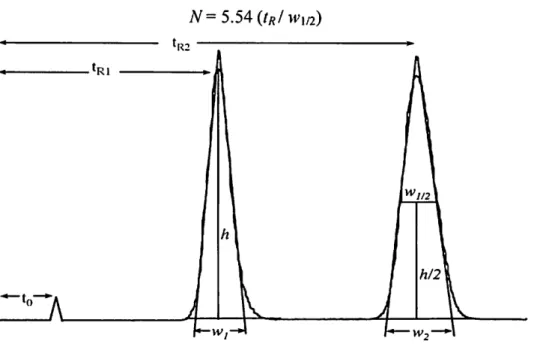
The number of theoretical plates a column has is described as the efficiency of the column. The number of theoretical plates is calculated by the Foley-Dorsey equation (Foley, 1983):
41.7
N = 1.25 + B/A
In this equation, tr is the retention time of a solute, Wo.i is the peak width at 10%
peak height, and B/A is the peak asymmetry measure at 10% peak height. The B/A must always be > 1. The height equivalent to a theoretical plate is simply the length of the
Chromatographic retention is a process of transfer of solutes from mobile phase into or onto stationary phase. This process involves partitioning, adsorption or both. Solutes are approximately embedded within the stationary phase in the partition process. On the other hand, solutes are in surface contact with the stationary phase which are not fully embedded in the adsorption process. Solutes are, however, initially surrounded by the mobile phase molecules in both instances. After exchange of transfer, they are fully or partially surrounded by the neighboring molecules of stationary phase.
Retention prediction and selectivity optimization are very important in RPLC [2].
However, retention in RPLC is a very complicated process [3-7] and depends on many physical and chemical properties of the system such as temperature [8-10], solute molecular properties [11], stationary phase characteristics [12], and mobile phase composition [11, 13, 14].
Many early studies of RPLC suggested that the mobile phase plays the dominant role in establishing retention and selectivity [15-19]: However, more recent studies have recognized the active role of the stationary phase [20-22]. Some studies indicate that the net interaction (the sum of disfavorable cavity formation and attractive intermolecular forces) in the stationary phase outweighs the net interaction in the mobile phase [23,24].
1.2. Chemical and thermal stability ofstaionaty phasefor RPLC
Until now and for good reasons, silica-based RP columns are and will be used to solve many separation problems. The great variety in selectivity of the available silica- based RP columns, their high efficiency and reproducibility are yet unsurpassed.
Furthermore, for many separation problems in practice, specific silica RP phases offer
sufficient chemical and also thermal stability over a wide range of experimental
conditions.
In principle, the chemical and thermal stability of RP columns can be enhanced
by:
1. The improvement and development of substrates and bonding chemistry.
2. The adjustment and optimization of the mobile phase composition and other experimental conditions.
Silica is the most popular substrate to manufacture RP stationary phases. Silica has a high mechanical strength that enables its use under the high-pressure conditions encountered in HPLC. Furthermore, this substrate does not swell or shrink when exposed to organic solvents. Finally, its production and bonding chemistry is well understood and can be performed in many different morphologies and also is very reproducible [1], [25- 32]. For these reasons, silica seems the perfect starting material for the manufacturing of (bonded) phases for HPLC. During the last decades, many workers have suggested several different approaches for the synthesis of silica-based RP stationary phases and also to improve their chemical and thermal stability. Polymer-coated [33, 42], horizontally polymerized [43, 44], bidentate [45, 46], hybrid organic-inorganic [47] and also polar embedded [48] stationary phases are typical examples in the research for new generations of RP phases of improved selectivity and chemical and thermal stability.
However, depending on the physico-chemical properties of the stationary phase,
the eluent composition and other experimental parameters silica and silica-based RP stationary phases are vulnerable to deterioration effects. This in turn may result in early column failure. Deterioration of chemically modified silica-based RP phases can be
distinguished in two major different processes. Silica already dissolves slightly in the pH range 2-7. The saturation concentration is about 100 ppm, which value is somewhat dependent on the pH [49]. Above approximately pH 7, however, silica dissolution is
substantially accelerated. This in turn causes the impairment of the silica backbone of an RP stationary phase. This process generally results in reduced plate numbers and finally in column clogging [50]. At acidic pH values of the eluent, another process is mainly responsible for the deterioration of RPLC stationary phases. The organic ligands of most of the presently manufactured RP phases are covalently bonded to the silica surface by mono- or polyfunctional Si-O-Si siloxane bond(s) [1], [25], [30], [51, 52]. Kirkland et al.
provided evidence that in acidic eluents hydrolysis of the covalently bonded Si-O-Si organic ligands is the main responsible mechanism of stationary phase degradation [50].
During the last 10-15 years, a number of reports with focus on the chemical stability of conventional as well as new types of silica-based RP phases have appeared.
The conclusions of these studies, however, are not always in agreement with each other.
Partly, this can be ascribed to the different conditions like, for example, the nature of the organic modifier, the actual eluent pH and the temperature, under which several groups investigated their RP phases under study. In addition, a major difference between these investigations is also related to how RP columns were subjected to aggressive alkaline or acidic eluents. Generally, workers investigate the chemical stability of RP phases by putting them into contact with aggressive eluents. During that process changes in chromatographic parameters like, for example, plate number, retention factor, and peak asymmetry of specific test components are monitored [48,50]. In addition to that in some studies on purging columns under alkaline eluent conditions, the amount of SiO2 in a
column effluent was continuously measured. In these studies, columns were purged with freshly prepared eluents, and were not recycled [46, 50]. The SiO2 amount in the column effluents could simply be determined by a silica molybdate complex colorimetric method.
The amount of silica in the eluent was then taken as a measure of column deterioration [50].
At present, in high-performance liquid chromatography (HPLC) for the majority of analyses, reversed-phase liquid chromatography (RPLC) is the separation mode of choice. Faster method development procedures using aggressive eluents under elevated temperature conditions, the need for improved selectivities, efficiencies and resolution, the reduction of solvent consumption and also the decrease of analysis times require reversed-phase (RP) columns of high chemical and thermal stability. Until now, the majority of columns for RPLC separations are manufactured from silica substrates. Silica has many favorable properties making this material nearly ideal as a support for RP columns. However, its solubility, that increases considerably in eluents of pH about 7y is*
a drawback preventing its widespread use over the entire pH range. In addition, for the same reasons, many efforts have also been made to synthesize polymer and also polymer- coated phases. These latter phases show a high degree of chemical and thermal stability compared to silica counterparts.
1.3. Retention Models in RPLC
One of the first attempts to model retention in reversed phase chromatography was by Horvath and Melander [53] who interpreted the solvophobic theory of Sinano lu [54-57]. This model described the retention process by a compilation of energy changes.
It stated that retention was controlled by a solute's hydrophobic volume (the size of the cavity in the mobile phase needed to surround the molecule), the volume of the mobile and stationary phases, the dielectric constant and surface tension of the mobile phase, and the differences in partial electrostatic charges. The combination of these parameters yielded a model that argued the retention process was largely controlled by the energy liberated from the re-ordering of solvent molecules after the expulsion of the non-polar solute. However, this theory neglects any influence of the stationary phase to retention, such as chain length or surface density of the bonded phase. This model has rarely been used as a fitting function for chromatographic retention vs. mobile phase composition for the determination of log k'w, but it is important to mention since there have been many
retention models based on this work.
To explain the solvophobic effect in liquid-chromatography (LC), Horvath et al.
and co-workers concluded that the magnitude of solute retention is determined by the energy balance of solute-stationary, eluent-stationary and solute-eluent interactions [53].
They, however, pointed out eluent-stationary and solute-eluent interactions as the dominating factors, and solvation of solutes solely accounts for the relative retention.
They also characterized the solvophobic strength by four properties. Among those the surface tension of eluents plays the principal role in the reversed-phase chromatography.
Carr et al. described the solvophobic driving force in terms of free energy of transfer based on alkylbenzenes as test solutes [58]. They concluded in contrast to the conventional solvophobic models of RPLC that the net free energy of interaction of methylene group with the stationary phase, i.e., in the non-polar media, is larger than the net free energy of interaction of methylene group with the mobile phase. The free energy
of transfer of a methylene group from methanol-water mobile phase to bulk hexadecane is sufficiently similar to that for transfer to the bonded phase. The grafted chains, however, do not have all the possible conformations due to the boundary condition
imposed by the interface and lateral interactions among neighboring chains [58-61].
These constraints cause the grafted chains to be more ordered than the bulk liquid phase.
For surface densities at which the neighboring interactions become important, Dorsey and Dill described a "disorder gradient", wherein the chain segments nearest to the surface are the most highly ordered (i.e., aligned normal to the surface), with rapidly increasing disorder towards the chain ends [59]. The ordering of chain increases with increasing surface density. Bilayer membranes with similar interfacial constraints widely showed these kinds of equilibrium gradients [62]. Motional gradients have also been observed in RPLC [63-65].
From the experiment of Sentell and Dorsey, it has been confirmed that the variation in the surface density of the grafted chains causes a change in retention from a minimum to a maximum value [66]. These results, however, conflict the predictions of solvophobic theory. According to this theory, retention of solutes should not depend upon the nature of stationary phases. A second conclusion drawn from the data of Sentell and Dorsey is that partitioning, rather than adsorption, is the dominating mechanism for retention.
The hydrophobic solubility does not account for the enhanced shape selectivity with decreasing temperature for polycyclic aromatic hydrocarbons (PAHs) on ODS columns [67, 68]. The non-linearity in Van't Hoff plots is postulated due to the change in retention interactions with temperature [68-71]. With decreasing temperature, the
mobility of the bonded chain decreases, and the molecules are elongated, rigid and have fewer bends and kinks conformations [71]. The access of solute and solvent molecules is restricted as the mobility of the chains decreases. A polarity gradient exists between the
chains. Solute molecules intercalate themselves between chains in the region where they find the most favorable interactions [72, 73]. Schunk and Bruke concluded that low polarity and non-polar solutes whose interactions are primarily through Van der Waals and dipole-induced dipole forces are on average retained in the central region of the stationary phase where a minimum polarity exists and the most favorable non-polar solvation interactions occur [74].
1.4. Development ofHPLC stationary phases
The evolution of liquid chromatography as a modern analytical technique is due in part to advances made in column technology. Chemical modification of silica packing materials remains a popular approach for achieving novel solute selectivity in high performance liquid chromatography (HPLC) [75-79]. Most progress in reversed phase high-performance liquid chromatographic (RP-HPLC) separation has been achieved due to the introduction of numerous silica-based stationary phase materials. Chemical modification of silica packing materials remains a popular approach to achieve novel solute selectivity in high-performance liquid chromatography. The creation of new stationary phases has always been one of the primary lines of research in chromatographic science, in particular in HPLC. Nevertheless, as the result of years of development, only a limited number of stationary phases remained on the market.
Reversed phase high performance liquid chromatography is a powerful analytical
technique for the separation of complex mixture. It is widely applied in chemical research for the separation and isolation of chemical compounds because of its good separation power and wide applicability [80-82]. In spite of these extensive applications in various scientific fields, such as agricultural, pharmaceutical, and medical sciences, as well as fundamental studies in separation science, the separation mechanism operative in the chromatographic process has still not been unequivocally established. This is because there are very many parameters controlling molecular recognition in the chromatographic process. Most LC applications in reversed-phase (RP) conditions have been carried out with octadecylsilica phases (ODSs), the selectivity and the ordering differences between polymeric and monomeric ODS phases have already been reported [83-86]. However, a systematic theory describing the molecular interaction between solutes and bonded phase ligands has not been firmly established because of difficulties encountered in the surface characterization of these ODS stationary phases. In the past 15 years, however, various newly synthesized bonded phases have been introduced as stationary-phases, thanks to > • recent developments in synthetic and bonding chemistries [87-90]. Because these new stationary phases could be synthesized according to the design of the bonded phase ligands, the systematic characterization of stationary phases has become increasingly important for the development of more powerful stationary phases with desirable separation performance for particular applications. However, there is still no universal stationary phase material suited to the specific properties of all possible solutes.
Alkylamide phases show interesting chromatographic properties [91-93] which are ascribed to the participation in the separation process of different interaction sites, e.g.
residual, unreacted silanols and unreacted amine groups as well as hydrophobic chains
with amide groups. In addition, the affinity of these phases to solute molecules differs significantly from that observed for conventional alkyl phases. These advantages have special importance under hydro-organic conditions in binary or ternary mobile phases.
Therefore, intermolecular interactions determining elution of solutes of different character on alkylamide phases are interesting from both practical and theoretical points of view.
1.5. HPLC stationary phasesfrom highly-ordered structures
In biological membranes, lipid bilayers play key roles in the selective permeation and transition of substrates and molecules. These functions of biological membranes would be powerful tools for analytical chemistry and separation engineering because the membranes are based on highly oriented structures. Continuing the effort of new stationary phase development by our group we have reported about dioctadecyl L- glutamide derived lipid membrane analogue grafted silica-for RP-HPLC stationary phase-.
Self-assembled systems such as lipid membrane aggregates can provide a highly-ordered microenvironment leading to unique host-guest chemistry exceeding the functions of the original lipid. Earlier we have reported about the use of polyoctadecylacrylate-grafted silica (Sil-ODAn); (as shown in Figure 1.2.) a lipid membrane analogue as stationary phase for RP-HPLC [94-96]. Sil-ODAn showed unique separation behaviors with ordered-to-disordered phase transitions of long alkyl chains (as shown in Figure 1. 2.).
Hf CH- CH2-VS(CH2)3Si -O
Sil-ODAn
Figure 1.2. Polyoctadecylacrylate (ODAn) grafted silica: lipid membrane analogue
In particular, extremely high selectivity towards polycyclic aromatic hydrocarbons (PAHs) was observed in the ordered (crystalline) state [97-100] and the combination of chromophoric diasteriomeric reagents yielded better selectivity for enantiomers than
conventional ODS phases [89-91]. In general, better separation of PAH isomers can usually be achieved with stationary phases prepared by polymeric surface modification chemistries (compared with monomeric surface modification) [101]. A number of synthetic polymers, such as poly (styrene) [102], poly(acrylonitrile) [103], poly(methylacrylate) [104], poly(vinylpyridine) [105], and poly (L-alanine) [106], were used to develop the polymer silica hybrid materials as stationary phase of HPLC. We have reported that, self-assembling systems, such as lipid aggregates, can provide a highly-ordered microenvironment leading to host-guest chemistry exceeding the functions of the original lipids. Particularly, we have had a great interest in lipophilic L- glutamide derivatives as gel-forming materials in the past decade [107-109]. The L- glutamide moiety as a chiral source, double long-chain alkyl groups as lipophilic parts, and a head group as a functional part can characterize these compounds. The unique
properties are emphasized by the facts that the gel formation is observed at a low concentration and this is brought through the network formation with microfibrous aggregates based on highly-oriented structure in organic media such as benzene, toluene,
ethanol, cyclohexane. In most of these cases, the gelator forms nanofibrous aggregates based on highly-ordered structures with inter-molecular interactions such as hydrogen bonding, van der Waals forces and jt-n interactions. These fibrous aggregates form a three-dimensional network by entwining with themselves and gelation is brought by encapsulation of solvent molecules into the network. Formation of organic gels can be visually observed and micro fibrous aggregates can be detected by using transmission electron microscopies (TEM). Earlier we have reported about polyoctadecylacrylate grafted silica (Sil-ODAn) as stationary phase for RP-HPLC. Our detailed investigation about the retention of PAHs on Sil-ODAn phases showed that the aligned carbonyl groups are effective for the recognition of molecular length and planarity through multiple jt-ji interactions [110-112]. Other Lipid membrane" analogues (e.g., double- alkylated L-glutamide-derived stationary phases) attached to the silica surface have been found with extremely enhanced molecular shape selectivity compared with the common reverse phases that can be explained by a carbonyl k (present in lipid-grafted stationary phases)-
benzene n (present in guest PAHs) interaction mechanism. These interactions are shown to be more effective for ordered carbonyl groups and solid states and can form supramolecular assemblies with specific properties based on their highly ordered structures in aqueous and organic media [113].
References:
[I] U.D. Neue, HPLC Columns: Theory, Technology and Practice, Wiley-VCH, New York (1997) ISBN 0-471-19037-3.
[2] L.R. Snyder, JJ. Kirkland, J.L. Glajch, Practical HPLC Method Development, Wiley, New York, 1997.
[3] Cs. Horvath, W. Melander, I. Molnar, J. Chromatagr., 125 (1976) 129.
[4] Cs. Horvath, W. Melander, J. Chromatagr., 15 (1997) 393.
[5] W. Melander, Cs. Horvath, in: Cs. Horvath (Ed.), High Performance Liquid Chromatography - Advances and Perspectives, Vol. 2, Academic Press, New York, 1980, 201.
[6] P. W. Carr, J. Li, A.J. Dallas, D.I. Eikens, L.C. Tan, J. Chromatogr. A, 724 (1996) 1.
[7] P.W. Carr, L.C. Tan, J.H. Park, J. Chromatogr. A, 724 (1996) 1.
[8] P.W. Carr, R.M. Doherty, M.J. Kamlet, R.W. Taft, W. Melander, C. Horvath, Anal Chem., 58(1986)2674.
[9] J.W. Li, P.W. Carr, Anal. Chem., 69 (1997) 2202.
[10] D. Bolliet, C.F. Poole, Analyst, 123 (1998) 295.
[II] M.H. Abraham, M. Roses, J. Phys. Org. Chem., 7 (1994) 672.
[12] L.C. Tan, P.W. Carr, M.H. Abraham, J. Chromatogr. A, 752 (1996) 1.
[13] K. Valko, L.R. Snyder, J.L. Glajch, J. Chromatogr., 656 (1993) 501.
[14] L.C. Tan, P.W. Carr, J. Chromatogr. A, 799 (1998) 1.
[15] D.C. Locke, J. Chrom. Sci., 12 (1974) 433.
[16] Cs. Horvath, W. Melander and I. Molnar, J. Chromatogr, 125 (1976) 129.
[17] B.L. Karger, J.R. Grant, A. Hartkopf and P.H. Weiner, J. Chromatogr., 128 (1976)
65.
[18] W.J. Cheong and RW. Carr, J. Chromatogr, 499 (1990) 373.
[19] A. Alvarez-Zepeda, B.N. Barman and D.E. Martire, Anal. Chem., 64 (1992) 1978.
[20] D.E. Martire and R.E. Boehm, J. Phys. Chem., 87 (1983) 1045.
[21] K.A. Dill, J.Phys. Chem., 91 (1987) 1980.
[22] M.R. Bohmer, L.K. Koopal and R. Tijssen, J. Phys. Chem., 95 (1991) 6285.
[23] P.W. Carr, J. Li, AJ. Dallas, D.I. Eikens and L.C. Tan, J. Chromatogr. A, 656 (1993)113.
[24] L.C. Tan and P.W. Carr, J. Chromatogr, (1996).
[25] H.A. Claessens, TrAQ 20 (2001) (10), p. 563.
[26] M. Keleand G. Guiochon,/. Chromatogr A; 830 (1999), p.<41.
[27] M. Kele and G. Guiochon, J. Chromatogr. A, 855 (1999), p. 423.
[28] M. Kele and G. Guiochon, /. Chromatogr. A, 830 (1999), p. 55.
[29] M. Kele and G. Guiochon, J. Chromatogr. A, 869 (2000), p. 181.
[30] In: K.K. Unger, Editors, Packings and Stationary Phases in Chromatographic Techniques, Marcel Dekker, New York (1990).
[31] J. Nawrocki, C. Dunlap, A. McCormick and P.W. Carr, J. Chromatogr. A, 1028 (2004), p. 1.
[32] J. Nawrocki, C. Dunlap, J. Li, J. Zhao, C.V. McNeff, A. McCormick and P.W. Carr, J. Chromatogr A, 1028 (2004), p. 31.
[33] M. Petro and D. Berek, Chromatographia, 37 (1993), p. 549.
[34] H. Figge, A. Deege, J. Kohler and G. Schomburg, J. Chromatogr., 351 (1986), p.
393.
[35] E. Tonhi, K.E. Collins and C.H. Collins, J. Chromatogr. A, 948 (2002), p. 109.
[36] C.B.G. Bottoli, Z.F. Chaudhry, D.A. Fonseca, K.E. Collins and C.H. Collins, J.
Chromatogr. A, 948 (2002), p. 121.
[37] L.F. Costa Melo, C.H. Collins, K.E. Collins and I.C. Sales Fontes Jardim, J.
Chromatogr. A, 869 (2000), p. 129.
[38] R. Barbosa Silva, K.E. Collins and C.H. Collins, J. Chromatogr. A, 869 (2000), p.
137.
[39] V. Bien-Vogelsang, A. Deege, H. Figge, J. Kohler and G. Schomburg, Chromatographia, 19(1984), p. 170.
[40] K.E. Collins, C.B.G. Bottoli, C.R.M. Vigna, S. Bachmann, K. Albert and C.H.
Collins, J. Chromatogr. A, 1029 (2004), p. 43.
[41] D.A. Fonseca, H.R. Gutierrez, K.E. Collins and C.H. Collins, J. Chromatogr. A, 1030 (2004), p. 149.
[42] G. Schomburg, A. Deege, V. Bien-Vogelsang and J. Kohler, J. Chromatogr., 287 (1983), p. 27.
[43] MJ. Wirth and H.O. Fatunmbi, Anal. Chem., 64 (1992), p. 2783.
[44] MJ. Wirth and H.O. Fatunmbi, Anal Chem., 65 (1993), p. 822.
[45] JJ. Kirkland, J.L. Glajch and R.D. Farlee, Anal Chem., 61 (1989), p. 2.
[46] JJ. Kirkland, J.B. Adams, M.A. van Straten and H.A. Claessens, Anal. Chem., 70 (1998), p. 4344.
[47] K.D. Wyndham, J.E. OAfGara, T.H. Walter, K.H. Glose, N.L. Lawrence, B.A.
Alden, G.S. Izzo, C.J. Hudalla and RC. Iraneta, Anal. Chem., 75 (2003), p. 6781.
[48] J. Layne, J. Chromatogr. A, 957 (2002), p. 149.
[49] K.K. Unger, J.N. Kinkel, B. Anspach and H. Giesche, J. Chromatogr., 296 (1984), p.
3.
[50] JJ. Kirkland, M.A. van Straten and H.A. Claessens, J. Chromatogr. A, 691 (1995), p.
3.
[51] E. Katz, R. Eksteen, P. Schoenmakers, N. Miller (Eds.), Handbook ofHPLC, Marcel Dekker, New York, 1998. ISBN 0-8247-9444-3.
[52] U.D. Neue In: R.A. Meyers, Editors, Encyclopedia ofAnalytical Chemistry, Wiley (2000), p. 11450.
[53] C. Horvath, W. Melander, I. Molnar, J. Chromatogr. 125 (1976) 129.
[54] O. Sinanoglu, Theor. Chim. Acta 33 (1974) 279.
[55] T. Halicioglu, O. Sinanoglu, Ann. N.Y. Acad.- Sci. 158 (1969) 308:- [56] O. Sinanoglu, Advan. Chem. Phys. 12 (1967) 283.
[57] O. Sinanoglu, S. Abdulner, Fed. Proc. 24 (1965) 12.
[58] P.W Carr, J. Li, AJ. Dallas, D.I. Eikens and L.C. Tan, J. Chromatogr., 656 (1993) 113
[59] J.G. Dorsey and K.A. Dill, Chem. Rev., 89 (1989) 331.
[60] C. Horvath, W. Melander and I. Molnar, J. Chromatogr., 125 (1976) 129.
[61] K.A. Dill, J. Naghizadeh and J.A. Marqusee, Annu. Rev. Phys. Chem., 39 (1988) 425.
[62] J.Q. Seelig, Rev. Biophys., 10 (1977) 353.
[63] R.K. Gilpin and M.E. Gangoda, J. Chromatogr., 21 (1983) 352.
[64] D.W. Sindorf and G.E. Maciel, J. Am. Chem. Soc, 105 (1983) 1948.
[65] R.K. Gilpin, J. Chromatogr. Set, 22 (1984) 371.
[66] K.B. Sentell and J.G. Dorsey, Anal. Chem., 61 (1989) 930.
[67] L.C. Sander and S.A. Wise, LCGC, 8 (1990) 378.
[68] K.B. Sentell and A.N. Henderson, Anal. Chim. Ada., 246 (1991) 139.
[69] D. Morel, K. Tabar, J, Serpinet, P. Claudy and J.M. LeToffe, J. Chromatogr., 395(1987)73.
[70] L.A. Cole and J.G. Dorsey, Anal. Chem., 64 (1992) 1317.
[71] L.C. Sander, J.B. Callis and L.R. Field, Anal Chem., 55 (1983) 1068.
[72] A. Tchapla, H. Colin and G. Guiochon, Anal. Chem., 5 (1984) 621.
[73] G.E. Berebdsen and L. de Galan, J. Chromatogr., 190 (1989) 930.
[74] T.C. Schunk and M.F. Burke, J. Chromatogr., 656 (1993) 289.
[75] H. Ihara, M. Takafuji, T. Sakurai, Encyclopedia of Nanoscience and Nanotechnology, American Science Publishers, USA, 9 (2004) 473-495.
[76] K. Jinno, T. Nagoshi, N. Tanaka, M. Okamoto, J. C. Fetzer, W. R. Biggs, J.
Chromatogr. 392 (1987) 75.
[77] K. Jinno, K.Yamamoto, T. Ueda, H. Nagashima, K. Itoh, K. J. Chromatogr. 594 (1992) 105.
[78] Y. Saito, K. Jinno, J. J. Pesek, Chromatographia 38 (1994) 295.
[79] J. J. Kirkland, J. L. Glajch, R. D. Farlee, Anal. Chem.6\ (1989) 2.
[80] J. G. Dorsey, W.T Cooper, B.A. Siles, J.P. Foley, H.G. Barth, Anal. Chem., 70 (1998) 591.
[81] W. R. LaCourse, Anal Chem., 72 (2000) 37.
[82] W. R. LaCourse^na/. Chem., 74 (2002) 2813-2832.
[83] L. C Sander, S.A. Wise, Anal. Chem., 56 (1984) 504-510.
[84] L. C. Sander, S.A. Wise, J. Chromatogt:, 316 (1984) 163-181.
[85] K. Jinno, T. Nagoshi, N. Tanaka, M. Okamoto, J.C. Fetzer, W.R. Biggs, J.
Chromatogr., 392 (1987) 75-82.
[86] K. Jinno, S. Shimura, N. Tanaka, K. Kimata, J.C. Fetzer, W.R. Biggs, Chromatographia, 27 (1989) 285-291.
[87] J. J. Kirkland, J.C. Glajch, R.D. Farlee, Anal Chem., 61 (1989) 2-11.
[88] C. Welch, W.H. Pirkle, J. Chromatogr., 609 (1993) 89-101.
[89] N. Tanaka, K. Kimata, K. Hosoya, Development of a High-capacity Stationary Phase Containing Heavy Heteroatoms for the Separation of Fullerenes, in K. Jinno, Ed., Separation of Fullerenes by Liquid Chromatography, RSC Chromatography Monographs, The Royal Society of Chemistry, Cambridge, UK, 1999, pp. 107-128.
[90] R. Jinno, Ed., Chromatographic Separations Based on Molecular Recognition, Wiley-VCH, New York, USA, 1996.
[91] B. Buszewski, R. M. Gandzala-Kopciuch, M. Markuszewski, R. Kaliszan, Anal Chem. 69 (1997) 3277-3284.
[92] B. Buszewski, J. Schmind, K. Albert, E. Bayer, J. Chromatogr. 552 (1991) 415.
[93] B. Buszewaski, R. K. Gilpin, M. Jaroniec,^ Chromatogr.A, 673 (1994) 11.
[94] C. Hirayama, H. Ihara, T. Mukai, Macromolecules, 25 (1992) 6375.
[95] H. Ihara, H. Tanaka, S. Nagaoka, S. Sasaki, C. Hirayama, J. Liq. Chromatogr. 19 (1996)2967.
[96] H. Ihara, T. Sagawa, Y. Goto, S. Nagaoka, Polymer, 40 (1999) 2555.
[97] H. Ihara, T. Nakanishi, T. Sagawa, C. Hirayama, T. Sakurai, T. Kinoshita, Y. Tsujita, Chem.Lett. 1998,963.
[98] H. Ihara, W. Dong, T. Mimaki, M. Nishihara, T. Sakurai, M. Takafuji, S. Nagaoka, J.
Liq. Chromatogr. 26 (2003) 2473.
[99] H. Ihara, M. Takafuji, T. Sakurai, Encyclopedia ofNano Science and Technology, 9 (2004) 473.
[100] H. Ihara, Y. Goto, T. Sakurai, M. Takafuji, T. Sagawa, S. Nagaoka, Chem. Lett.
2001, 1252.
[101] Y. Goto, K. Nakashima, M. Mitsubishi, M. Takafuji, S. Sasaki, H. Ihara Chwmatographia, 56 (2002) 19.
[102] H. Ihara, N. Nakamura, S. Nagaoka and C. Hirayama, Anal. Set, 1995, 11, 739.
[103] H. Ihara, S. Okazaki, K. Ohmori, S. Uemura, C. Hirayama and S. Nagaoka, Anal.
Sci., 1998, 14,349.
[104] H. Ihara, H. Tanaka, M. Shibata, S. Sasaki and C. Hirayama, Chem: Lett.; 1997, 113.
[105] H. Ihara, W. Dong, T. Mimaki, M. Nishihara, T. Sakurai, M. Takafuji and S.
Nagaoka, J. Liq. Chromatogr., 26 (2003) 2473.
[106] H. Ihara, T. Nakanishi, T. Sagawa, C. Hirayama, T. Sakurai, T. Kinoshita and Y.
Tsujita, Chem. Lett., 1998, 963.
[107] H. Ihara, H. Hachisako, C. Hirayama, K. Yamada, Chem. Commun., 1992 1244.
[108] H. Ihara, M. Yoshitake, M. Takafuji, T. Yamada, T. Sagawa,C. Hirayama, Liq.
Cryst., 26(1999)1021.
[109] H. Ihara, T. Sakurai, T. Yamada, T. Hashimoto, M. Takafuji, T. Sagawa, H.
Hachisako, Langmuir, 18 (2002) 7120.
[110] H. Ihara, T. Sagawa, Y. Goto, S. Nagaoka, Polymer, 40 (1999) 2555.
[Ill] H. Ihara, Y. Goto, T. Sakurai, M Takafuji, T. Sagawa and S. Nagaoka, Chem. Lett.,
2001, 1252.
[112] A. J. F. Griffith, J. H. Miller, D. T. Suzuki, An Introduction to Genetic Analysis.
New York, W. H. Freeman & Co. 1996.
[113] M. M. Rahman, M. Takafuji, H. R. Ansarian, and H. Ihara, Anal. Chem., Vol.77, 2005,6671.
Chapter 2
Engineering of the novel stationary phase
2.1. Introduction
Lipid base membranes have attracted considerable attention due to their potential application. We have reported that, self-assembling systems, such as lipid aggregates, can provide a highly-ordered microenvironment leading to host-guest chemistry exceeding the functions of the original lipids. Particularly, we have had a great interest in lipophilic L-glutamide derivatives as gel-forming materials in the past decade. [1-3] As an interesting class of organogelators, alkylated-glutamic acid derived connected to especial head group have provided a new approach to design and engineering of new organogelators through head selection. [4-6] different kind of polymerizable head groups are known. Also the importance of spacer length is of no doubt.
Besides the organogelator structure, the process of its synthesis, polymerisation and immobilization is of noticeable importance. In this chapter off-line molecular and process design is described.
2.2. Process design
There are known biomembrane-like ordered super-structures [7] for lipophilic molecules which can be seen in different phases [8,9]. The vision of this thesis work is to make a novel usage of this highly ordered aggregate through telomerization and stabilization onto silica surface using an anchor.
The main designed process for this mater is composed of three steps, "make aggregation", "telomerization" and "immobilization on silica surfaces". Although performing all of these three step is byond this thesis work, because of the importance of this off-line process design and the relationship of all parts of process , they are described wholly.
In a simple description through these process an organogellator is dissolved in proper organic solvents to make an organogel. The resultant superstructure undergo
telomerization to be more stable. With special technique selected anchors take part in this telomerization process and become packed between molecules in superstructure.
Each step of this process has its noticeable pitfalls . The organogelator should be special molecule that not only has gelation ability but also can be polymerised on ordered orientation. Its property is described in next seccion , molecular design.
About telomerization of the resultant superstructure we desire that telomerization don't break the network of superstructure. However its reported that process like polymerisation and telomerization change the properties of ordered structures. So selecting a proper polymerizable group is noticeable. Also polymerizable group can be incorporated into network-forming lipophils any where along the lipid head or tail and the properties of these two kind polymerised molecules are different. In other words selecting a proper polymerisation group and proper design for its position in a molecule is quite important. Also the polmerization process should be monitored. If there is a special polymerizable group with known UV absorption, monitoring the polymerisation process with UV-VIS spectroscopy will be convenient. During the polymerisation process using an anchor which can incorporate into molecular superstructures the site for immobilization on silica surface will be prepared. Selecting this anchor will be based on the properties of the resultant organogel. And immobilization on silica surface is the last step in which our laboratory has perfect experiences. Direct immobilization of lipid onto silica gel was reported by pidgeon and venkataram. This was obtained by amidation of aminated silica gel with a dimyristoyl phosphatydilcholine derivative containing a terminal carboxylic group. Such chemically bonded lipids are stble but it may be impossible to reproduce molecular orientation and lateral diffusion of lipid on carrier particles. A new method which is developed by Ihara et al. Is using 3-mercaptopropyltrimethoxy silane (MPS) or any other special trimethoxysilane-containing molecules [10]. These mean that telomerization of themixture of the lipophilic molecule with an anchor, with reactive terminal group, assure easy immobilization on silica surface. As mentioned former selecting a proper anchor should be based on the properties of the synthesized lipophil and the organogel made by it.
2.3. Molecular design
As described former the proper molecule for this work should have a head and a tail which are connected to each other by a spacer.
peptide -based derivatives not only have amide bonds that work as a strong driving force for molecular aggregation but also have a plural number of hydrogen bonds moieties.
In our previous works it is showed that double chain alkylated L-glutamic acid which possess three amide bonds around the L-glutamic moiety, works as a good organogelator. TEM and SEM observation of that lipophil showed a three dimentional networkwith fibrillar aggregates in organogel and xerogel with a minimum diametr of about 20 nra [11]. Its shown that if two of the three amide bonds are replaced by the ester bonds , no gelation is observed even when their concentration is 10 times higher than the former. MOPAC calculation indicated that the three amide bonds around the L-glutamic acid moiety provided a proper conformation for intermolecular interaction.
[11,12]
Typical examples of organogelators derived from L-glutamide acid has been reported [10, 12, 13, 14, 15, 16, 17, 18].
3. *■**
Figure 2.1. The chemical structures of L-glutamic acid derived lipids [12].
As it is shown in their structures these organogelators are composed of L-glutamide moiety as a chiral source , double long-chain alkyl groups as lipophilic parts and a
head group (X) as functional group.
Three dimentional structure of polymers make them difficult to accommodae in two-dimentional membrane like structures. This inherent organization problem was alleviated by the inclusion of flexible spacer groups to decouple the motion of the lipid alkyl chains from the motion of the polymer chain. The spacer concept has been used successfully in the synthesis of liquid crystalline polymers [19]. The incorporation of spacer groups into the side chain of the poly (lipid) made it possible to form well-ordered stable structures.
p-alanin drived spacer were chosen whilst we were aware of significance of spacer length.
Polymerizable groups have been incorporated into superstructure-forming molecules by chemical synesis. The polymerizable moiety can be positioned anywhere along the lipid tails or linked (covalently or electrostatically) to the head group. Polymerisation of lipid tails usually leads to abolition of the bilayer Tm, whereas polymerisation in the head group does not. Covalent linkage of the lipid tails inhibit the formation of the gauche rotamers.
.A
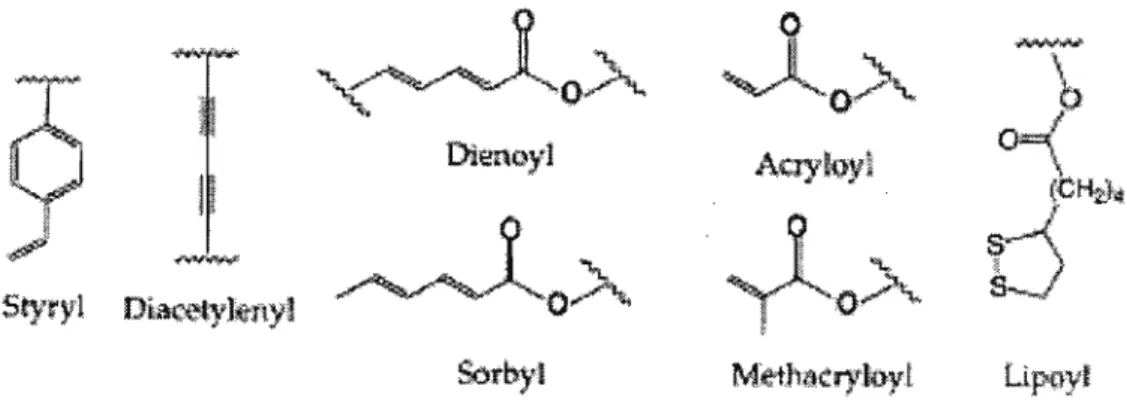
Figure 2.2. Examples of polymerizable groups which have been incorporated into polymerizable superstructure-forming molecules
A variety of polymerizable groups has been successfully employed including styryl, diacethylenyl, dienoyl, sorbyl, methacryloyl, acryolyl, and lipoyl. All but thediacetyl group, can be polymerised in the more fluid liquid-crystalin phase. Many studies showed that photo polymerisation is especially effective for diacetylenyl, styryl, dienoyl, and sorbyl containing molecules, whereas thermally sensitive adical initiators
are frequently used for the styryl, dienoyl, sorbyl, acryloyl, and methacryloyl compounds. Redox inititor may also be employed for these monomers [20].
A study using glutamate - based amphiphils emphasized the effect of molecular packing on the polymerisation. When the head group contained phenyl group they observed The most efficient packing and polymerisation [21].
In a study of using styryl group as a polymerizable group in anphiphils the auther demonstrated that the polymerised aggregates exhibit enhanced colloidal stability.
[22,23] A comperehensive study of the photopolymerization of superstructure composed of the styryl monomers showed that the polymerisation process was faster in the organized media than when the monomers were in isotropic solution.
[24]
Moreover the rate of photopolymerization was independent of the vesicle concentration thereby conclusively demonestrating that the polymer chain growth was limited to individual vesicle., styryl lipid monomer can be polymerised with a photoini tiator with exposure to uv light.
Also styryl group can be used as a perfect probe for monitoring the ptelomerization process. In studies on b-nitrostyene, disappearance of the absorption in UV-VIS spectroscopy with polymerisation was found. [25] In other word The benzene unit is a versatile spectroscopic probe for assessing the bilayer organization [26].
O
0 —(CH2)3 — CNH —(CH2 )2—CNH — CH — CNH— (CH2 )U— CH3
II H |
O O CH2
CH2— CNH (CH2 Vh CH3
Head group
Amide bondings
0
II
Double chain aikylated L-glutamide moiety
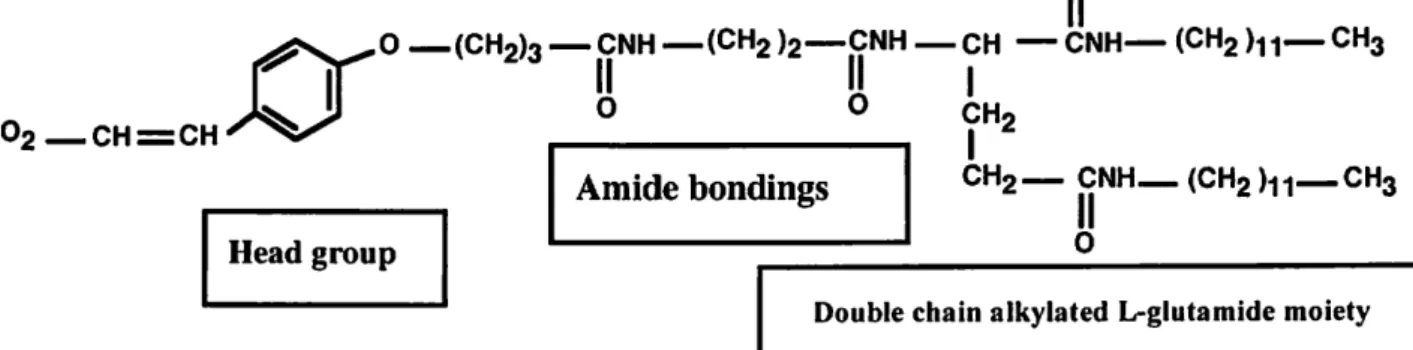
Figure 2.3. Designed organogelator with special moieties
Briefly the lipophil molecule is designed based on following facts:
In head group
1. Phenyl group: reassures stable and efficient packing even after polymerization 2. Nitrostyrene moiety shows high yield of polymerization via UV irradiation in
ordered structures
3. The polymerizable group can be polymerized below Tc [27]
4. Polymerization process in aggregates is faster than monomers in isotropic solution [28]
5. Polymer chain growth is limited to individual superstructures [29]
6. The benzene ring is a versatile spectroscopic probe for assessing the superstructure organization. [30]
In tail part
1. Double chain alkylated L-glutamide moiety is a key unit to create highly-oriented nanofibrillar aggregates [11, 12, 31 ]
2. Amide bondings are in Favorable position for intermolecular interactions which promote the formation of highly-oriented structures [131
2.4. Materials and Experiments 2.4.1. Materials
Based on designed pathway the chemicals can be cathegorized under titels commertially available and comertially not-avaiable machemicals.
the main material which are commercially available for this work are:
L-glutamic acid, z-chloride, dodecylamine, palladium carbon, beta-alanin, ethyl-4-bromobutyrate, 4-hydroxybenzaldehyde, nitromethane. They purchased from Sigma-Alderich, Nakalai Tesque and Wako.
The material which are not commercially available and should be synthesized are N-benzyloxycarbonyl-L-glutamic acid (L-GluZ),
Nl,N5-didocecyl-N2-benzyloxycarbonyl -L-glutamide (2Ci2L-gln-Z),
Nl,N5-didocecyl-L-glutamide (2Ci2L-Glu), N-benzyloxycarbonyl-fi-Alanin (B-Ala-Z),
N1,N5-didocecyl-N2-[3-(N-benzyloxycarbonyl)amino]propionyl-L-glutamide
(2Ci2-L-Glu- P-Ala-Z),
N1,N5-didocecyl-N2-(3-amino)propionyl-L-glutamide (2Ci2-L-Glu-P-Ala),
Ethyl 4-(4- formylphenoxy) butanoate,
4-[4(2 nitro-l-ethenyl)phenoxy] butyric acid, ethyl ester, 4-[4(2 nitro-l-ethenyl)phenoxy] butyric acid.
The first 6 process are known synthesis pathway in our laboratory. Many reports are published for their synthesis [12], but the last 3 one are quit new material which their
synthesis process is described under next item.
2.4.2 synthesizing process
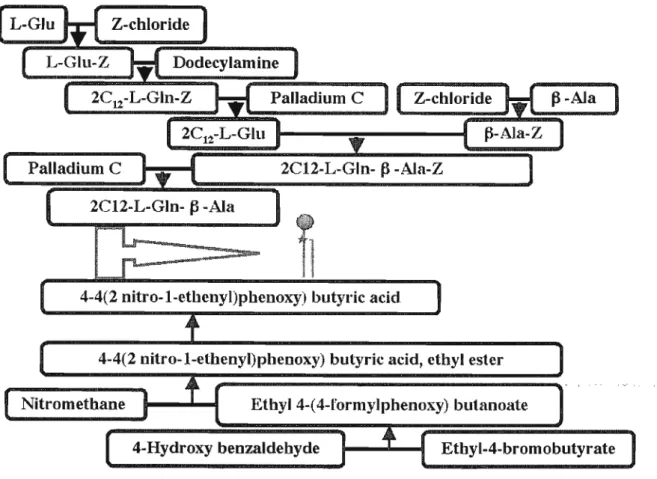
The synthesis process is composed of synthesis the head part (connected to spacer), synthesis the tail part, and connection this two part. (Figure 2.4)
L-Glu Z-chloride
L-GLu-Z Dodecylamine
2C12-L-Gln-Z Palladium C Z-chloride p-AJa
2CI2-L-Glu Palladium C
P-Ala-Z
2C12-L-Gln-^-Ala-Z 2C12-L-Gln-P-Ala
4-4(2 nitro-l-ethenyl)phenoxy) butyric acid
4-4(2 nitro-l-ethenyl)pheDOxy) butyric acid, ethyl ester
Nitro methane Ethyl 4-(4-rormylphenoxy) butanoale
4-Hydroxy benzaldehyde Ethyl-4-bromobutyrate
Figure 2.4. Designed synthesis pathway for organogelator
The tail part is derived from L-glutamic acid, which has 3 site for substitution. Our desired functional group in first step are the two carbonyl groups for connecting to alkyl chains. To prevent side reactions the nucleopilic amino group of glutamic acid must be protected to make it non nucleophilic.the amino group is converted to an amide by treatment with an appropriate acylating agent. Acylation of the aminogroup is often done to protect it from unwanted nucleophilic reactions. A wide variety of acid chlorides and acid anhydride are used for acylation of the amino group.
Benzyl chloroformate acylate the ami no group to give a benzyl-oxycarbonyl derivative useful in peptide synthesis. The amino group of the N-benzyloxy carbonyl derivatives is protected as the amide half of a carbamate ester (a urethane) which is more easily hydrolysed than most amides. In addition the ester half of this urethane is a benzyl ester that can undergo hydrolysis.
After bonding the alkyl chains via amide bonds the N-terminus of the molecule should be de-protected. The N terminal amide bond must be cleaved without breaking any of the peptide bonds in the product. Fortunately the benzyloxy carbonyl group is partly an amide and partly a benzyl ester and catalytic hydrogenolysis of the N-benzyloxycarbonyl amino acid gives an unstable carbamic acid that quickly decarboxylate to give the deprotected N-terminus.hydrogenolysis of the benzyl ester.
o o o o
\\ II II II
R1—C—OH + C2H5O—p — C = N ► R1—C—C=N + C2H5O—p—OH
OC2H5 OC2H5
O O
II N
R2 NH2 + R1—C—C=N R2 NH C—R1+ H —C=N
H| C=N"
C2H5 N C2H5 + H—C = N * C2H5 N C2H5
C2H5 Figure 2.5. Mechanism of reaction DEPC and triethylamine
takes place under mild condition that do not cleae the other amide bonds. This mild cleavage is the reasn for use of benzyloxy carbonyl group to protect the N terminus.
De-protection is performed through hydrogenation.
For bonding the alkyl chains and also any other bonding in which amide bond will be formed, Diethyl cyanophosphonate (DEPC ) and triethylamine is used. The use of these chemicals is Based on this theory that if a substrate is prone to substitution we can minimize the amount of substitution by using a bulky base the bulky base has large
alkyl group that hinder its approach to attack a carbon atom (substitution), yet it can easily abstract a proton from the substrate (elimination). Mechanisem of their reaction is shown in figure 2.5.
For synthesis the head part, in first step the hydroxy 4-bromobutyrate and 4-hydroxybenzaldehide under a Williamson ether synthesis reaction form Ethyl 4-(4- formylphenoxy) butanoate
In Williamson Ether Synthesis alkoxides are prepared by reaction of alcohols with bases. Then reaction of alkoxides with primary alkyl halides happen. In fact this reaction is a SN2 substitution reaction with oxygen serving as nucleophile.
R_OH + Na ► R—O" + H2
R.,__O' R2—X *► R-i— O — R2 + X
Figure. 2.6 Williamson Ether Synthesis mechanism
the used alkyl halide is primary so the backside attack is not sterically hindered.
The next step is changing Ethyl 4-(4- formylphenoxy) butanoate, as an benzaldehyde to nitrostyrene. The most versatile synthesis of nitroalkanes involves the henry condensation reaction of carbony moiety with nitroalkane to give beta-nitro alcoho;
which undergoes dehydration affording conjugated nitroalkene. This condensation reaction is usually accomplished under midly basic condition. In the report of Gairaud and Lappin in 1952 a more general procedure for condensation of nitroalkanes with benzaldehyde was introduced. They showed that alcoholic potassium hydroxide condensation has generally poor results with most substituted benzaldehyde in the reaction with nitromethane. Condensation with methanolic methylamine is more successful but it can give good yields only if the resulting beta-nitrostyrene is high-melying and sufficiently insoluble in the reaction medium to precipitate almost as fast as it is formed.
It can be inferred from the Gairaud and Lappin's report that the most satisfactory procedure is the use of ammonium acetate in glacial acetic acid.
,H
Also in order to obtain the maximum yield of nitrostyrene yet avoid the formation of the polymer it was necessary to run a series of
experiments with a given aldehyde-nitroalkane combination to find the optimum time.
The next step is hydrolysis the resultant ester to have carboxyl group for the last amide-bon forming reaction. Esters can be hydrolyzed into their constituent carboxylic acid and alcohol parts under either acidic or basic conditions. The reagents for this hydrolysis can be aqueous acid (e.g. H2SO4) / heat,
or aqueous NaOH / heat (known as
"saponification").Both are based on the formation of a CH3 | OCH3
tetrahedral intermediate which then dissociates, and in both cases it is the C-O bond between the acyl group and the oxygen that is cleaved. The beta-nitrostyrenes undergo rapid cleavage in alkaline aqueous solution.
The cleavage reaction involves rate-deermining nucleophilic attack by hydroxide ion at the alpha position of the styrene, leading to an intermediate that rapidly split into a benzaldehyde and the anion of the nitromethane. So in this step ester hydrolysis under basic condition is not suitable. In fact the acid catalysed mechanism is the reverse of the Fischer esterification. It can be categorized to 6 step. Step 1 is an acid/base reaction. Since there is a weak nucleophile and a poor electrophile its needed to activate the ester. Protonation of the ester carbonyl makes it more electrophilic. In step 2 The water O functions as the nucleophile attacking the electrophilic C in the C=O, with the electrons moving towards the oxonium ion, creating the tetrahedral intermediate.
H3O
Figure 2.7. mechanism of ester hydrolysis (acidic condition)
:QH \
:OHH
H6-CH3
Step 3 is another acid/base reaction. Deprotonation the oxygen that came from the water molecule happens. Step 4 is also An acid/base reaction. Need to make the -OCH3 leave, but need to convert it into a good leaving group first by protonation. In step 5 the electrons of an adjacent oxygen is used to help "push out" the leaving group, a neutral methanol molecule. And in last step Deprotonation of the oxonium ion reveals the carbonyl in the carboxylic acid product and regenerates the acid catalyst [32] (Figure 2.7)
After acidic condition ester hydrolysis, the last designed process of synthesis should be performed. The last step is also an amide-bond forming reaction which can be done with the use of DEPC and triethylamine as it is described former.
Obviously all steps specially the head synthesis steps should followed up by different techniques like HPLC, NMR and UV-VIS spectroscopy to find the end point of each reaction.
2.4.3. characterization process
characterization of the molecule will be done in 2 category, characterization the synthesised molecule and characterization the organogels
in characterization the molecule melting poin , mobility of different part of the molecule, and spectroscopic data should be mentioned. About the organogel properties like sol-gel transition behaviour, shape, type and size of organogel network, and aggregation behaviour should be studied.
2.4.4. Telomerization and. stabilization on silica surface
The resultant material should telomerized in ordered state and using grafting agent stabilized on silica surface. The chemical structure of agent 710 which will be used for this step is shown in figure 2.8.
OCH3 CH2 = C — C—O— (CH2)3— Si — OCH3
CH3 OCH3
Figure 2.8. grafting agent to silica :agent 710
2.5. Summary
The double chain alkylated L-glutamide, tail part, is synthesized according to our procedure previously described. The head part is synthesized through a 3-step procedure, 4-hydroxybenzaIdehyde with ethyl 4-bromobutyrate pass through a keton formation reaction and then through a condensation with nitromethane under ammonium acetate the nitrostyrene part of molecule form. The ethyl ester is hydrolyzed in acidic situation. Lipophil molecule is prepared through bonding the head and the tail parts. Each step of synthesis should be reconfirmed by elemental analysis, FT-IR and NMR spectroscopy.
References
[I] H. Ihara, T. Nakanishi, T. Sagawa, C. Hirayama, T. Sakurai, T. Kinoshita, Y.
Tsujita, Chem. Lett. 1998, 963.
[2] H. Ihara, W. Dong, T. Mimaki, M. Nishihara, T. Sakurai, M. Takafuji, S. Nagaoka, J. Liq. Chromatogr. 26 (2003) 2473.
[3] H. Ihara, M. Takafuji, T. Sakurai, Encyclopedia ofNano Science and Technology, 9 (2004) 473.
[4] H. Ihara, M. Yoshitake, M. Takafuji, T. Yamada, T. Sagawa, C. Hirayama, H.
Hachisako, Liquid Crystals 1999, 26, 1021-1027.
[5] H. Ihara, T. Sakurai, T. Yamada, T. Hashimoto, M. Takafuji, T. Sagawa, H.
Hachisako, Langmuir 2002, 18, 7120-7123.
[6] Hirotaka Ihara, Makoto Takafuji, Toshihiko Sakurai, Masahiro Katsumoto, Noriko Ushijima, Tomohiro Shirosaki, Hiroshi Hachisako, Organic & Biomolecular Chemistry (J. Chem. Soc, Perkin Trans. I & II) 2003, 1, 3004-3006.
[7] M Takafuji, H. Ihara, C. Hirayama, H. Hachisako, K. Yamada. Liquid Crystals
1995,2(18), 97-99.
[8] Anja Mueller, David F. O Brien, Chem. Rev. 2002, 102, 727-757.
[9] J. Materials Chemistry 2001,11(12), 3018.
[10] H. Ihara, H. Tanaka, S. Nagaoka, K. Sakaki, C. Hirayama, Journal of Liquid Chromatography 1996, 19(17&18), 2967-2984.
[II] H. Ihara, M. Yoshitake, M. Takafuji, T. Yamada, T. Sagawa, C. Hirayama, H.
Hachisako, Liquid Crystals 1999, 26, 1021-1027.
[12] H. Ihara, T. Sakurai, T. Yamada, T. Hashimoto, M. Takafuji, T. Sagawa, H.
Hachisako, Langmuir 2002, 18, 7120-7123.
[13] Hirotaka Ihara, Makoto Takafuji, Toshihiko Sakurai, Masahiro Katsumoto, Noriko Ushijima, Tomohiro Shirosaki, Hiroshi Hachisako, Organic & Biomolecular Chemistry (J. Chem. Soc, Perkin Trans. I & II) 2003, 1, 3004-3006.
[14] M. Takafuji, H. Ihara, C. Hirayama, H. Hachisako, K. Yamada. Liquid Crystals 1995, 2(18), 97-99.
[15] Anja Mueller, David F. O Brien, Chem. Rev. 2002, 102,121-151.
[16] J. Materials Chemistry 2001,11(12), 3018.
[17] H. Ihara, H. Hachisako, C. Hirayama, K. Yamada, Journal of the Chemical Society, Chemical Communications 1992, 9(17), 1244-1245.
[18] H. Ihara, K. Shudo, H. Hachisako, K. Yamada, C. Hirayama, Liquid Crystals 1996, 6(20), 807-809.
[19] H. Ringsdorf, B. Schlarb venzmer, J. Angew. Chem, Int Ed. 1988, 27, 113-158.
[20] Anja Mueller, David F. O Brien, Chem. Rev. 2002, 102, 727-757.
[21] S. Kato, T. Kunitake, Polym. J. 1991, 23, 135-146.
[22] P. Tundo, D. J. Kippenberger, P. L. Klahn, N. E. Prieto, T. C. Jao, J. H. Fendler, J.
Am. Chem. Soc. 1982, 104, 456-461.
[23] D. Kippenberger, K. Rosenquist, L. Odberg, P. Tundo, J. H. Fendler, J. Am.
Chem. Soc. 1983, 105, 1129-1135.
[24] W. Reed, L. Guterman, P. Tundo, J. H. Fendler, J. Am. Chem. Soc. 1984, 106, 1897-1907.
[25] B. J. Ravoo, W. D. Weringa, J. F. B. Nengberts, langmuir 1996, 12, 5773-5780.
[26] Macromolecules 1989, 22(9), 3544-50.
[27] Anja Mueller, David F. O Brien, Chem. Rev. 2002, 102, 727-757.
[28] H. Ihara, H. Tanaka, S. Nagaoka, K. Sakaki, C. Hirayama, Journal of Liquid Chromatography 1996, 19(17& 18), 2967-2984.
[29] H. Ihara, H. Hachisako, C. Hirayama, K. Yamada, Journal of the Chemical Society, Chemical Communications 1992, 9(17), 1244-1245.
[30] H. Ihara, K. Shudo, H. Hachisako, K. Yamada, C. Hirayama, Liquid Crystals 1996, 6(20), 807-809.
[31] T Kimura, S Shinkai, Chem. lett. 1998,1035.
[32] On-Line Learning Center for Organic Chemistry (Francis A. Carey)

![Figure 2.1. The chemical structures of L-glutamic acid derived lipids [12].](https://thumb-ap.123doks.com/thumbv2/123deta/5726386.2025416/36.856.151.701.561.986/figure-chemical-structures-l-glutamic-acid-derived-lipids.webp)
![Table 3.7 Comparative results of elemental analysis of 4-[4(2 nitro-l-ethenyl)phenoxy] butyric acid, ethyl ester](https://thumb-ap.123doks.com/thumbv2/123deta/5726386.2025416/58.858.200.634.572.721/table-comparative-results-elemental-analysis-ethenyl-phenoxy-butyric.webp)