Survival of Japanese Patients With Idiopathic/Heritable Pulmonary Arterial Hypertension
Aiko Ogawa, MD, PhD
a,*, Toru Satoh, MD, PhD
b, Yuichi Tamura, MD, PhD
c, Keiichi Fukuda, MD, PhD
c, and Hiromi Matsubara, MD, PhD
aIdiopathic/heritable pulmonary arterial hypertension has a poor prognosis despite the available therapeutic options. Survival of Japanese patients with this disease entity has not been reported in the multicenter setting. A retrospective study of 141 patients with idio- pathic/heritable pulmonary arterial hypertension treated at 3 pulmonary hypertension centers in Japan from 1992 to 2012 investigated survival and determinants of survival.
Mean survival time from treatment initiation was 14.7–0.8 years (95% confidence interval, 13.1 to 16.3 years) and the 1-, 3-, 5-, and 10-year survival rates were 97.9%, 92.1%, 85.8%, and 69.5%, respectively. Patients showed significant improvement in exercise capacity and hemodynamics after treatment. Patients with 6-minute walk distance>372 m, mean pul- monary arterial pressure£46 mm Hg, and cardiac index>2.5 L/min/m2at follow-up had a significantly better prognosis. Most patients (99.2%) were receiving pulmonary hypertension-targeted drugs at follow-up. Use of endothelin receptor antagonists and intravenous epoprostenol were related to survival in the univariate analysis. Among the patients who were on intravenous epoprostenol therapy, those with endothelin receptor antagonists had a significantly better prognosis, whereas patients on warfarin had a significantly worse prognosis. In conclusion, survival of Japanese patients with idiopathic/heritable pulmonary arterial hypertension in this study was good, showing improvement in hemodynamic parameters supported by pulmonary hypertension-targeted drugs. Ó2017 Elsevier Inc. All rights reserved. (Am J Cardiol 2017;-:-e-)
Pulmonary arterial hypertension (PAH) is a progressive disease with increased pulmonary vascular resistance (PVR) and pulmonary arterial pressure. The median survival of patients with idiopathic PAH was 2.8 years before PAH- targeted drugs became available.1 Despite the progression in therapeutic options over the last 2 decades, overall survival continues to be unsatisfactory.2e5 We previously conducted a retrospective study at a single center in Japan and reported improved survival of Japanese patients with idiopathic/heritable pulmonary arterial hyper- tension (I/HPAH),6 whereby patients showed a significant improvement in hemodynamic parameters after treatment.
To elucidate the survival of Japanese patients with I/HPAH on a larger scale, we conducted the first multicenter study on survival of Japanese patients with I/HPAH treated at 3 referral centers. This study also aimed to identify determinant factors for the survival of Japanese patients with I/HPAH, including hemodynamic changes and treatment
regimen, and to confirm the improvement of hemodynamic parameters after treatment.
Methods
We conducted a retrospective chart review of patients with I/HPAH. Patients were treated at 3 pulmonary hy- pertension centers in Japan (National Hospital Organiza- tion Okayama Medical Center, Kyorin University Hospital, and Keio University Hospital) between November 1992 and August 2012. Diagnosis was performed using a stan- dard approach for the diagnosis of PAH including physical examination and right heart catheterization.7,8 The study protocol was approved by the institutional review board of each hospital. The follow-up period for analyses of sur- vival data ended in December 2014. Patients who under- went lung transplantation were censored at the time of operation.
World Health Organization (WHO) functional class, 6-minute walk distance (6MWD), plasma levels of brain natriuretic peptide (BNP), heart rate (HR), oxygen saturation (SpO2), and hemodynamic parameters (mean pulmonary arterial pressure [mPAP], cardiac index [CI], mixed venous oxygen saturation [SvO2], and PVR) were evaluated at baseline. Follow-up data were collected when patients achieved the best values for mPAP with preserved CI. Data regarding the treatment received by patients at follow-up were also collected.
Results are expressed as the meanstandard deviation or median (minimumemaximum value), unless otherwise specified. The chi-square test was used to assess the
aDepartment of Clinical Science, National Hospital Organization Okayama Medical Center, Okayama, Japan; bDivision of Cardiology, Department of Medicine, Kyorin University Hospital, Tokyo, Japan; and
cDepartment of Cardiology, Keio University School of Medicine, Tokyo, Japan. Manuscript received October 11, 2016; revised manuscript received and accepted January 18, 2017.
Funding source: none.
See page 5 for disclosure information.
*Corresponding author: Tel:þ81-86-294-9911; fax:þ81-86-294-9255.
E-mail address:[email protected](A. Ogawa).
0002-9149/17/$ - see front matterÓ2017 Elsevier Inc. All rights reserved. www.ajconline.org
http://dx.doi.org/10.1016/j.amjcard.2017.01.015
significance of differences between categorical variables.
Continuous variables at baseline and follow-up were compared using U tests.
Survival analyses were conducted using the Kaplan- Meier method. Survival time is expressed as mean stan- dard error (95% confidence interval). Differences between survival curves were assessed using the log-rank test. A Cox proportional hazards model was used to determine the var- iables associated with increased mortality. Multivariate stepwise models were applied to candidate explanatory variables that remained significant (p <0.1) in univariate analyses. The hazard ratio and 95% confidence interval were defined. Receiver operating characteristic curves were con- structed to determine an optimal cutoff value for 6MWD, mPAP, CI, and HR. All analyses were undertaken with SAS Release 9.4 (SAS Institute, Cary, NC) and IBM SPSS 20 (IBM, Armonk, NY). Statistical significance was defined as p <0.05.
Results
We conducted a retrospective chart review of 141 consecutive patients with I/HPAH. Patients’characteristics are listed in Table 1. Patients were predominantly women and in their 30s at diagnosis. At baseline, 86.5% of patients were in WHO functional class III or IV. Hemodynamic parameters were severely impaired, with mPAP >60 mm Hg and PVR>1,500 dyn,s/cm5.
Data of 130 patients who underwent follow-up right heart catheterization were collected. At follow-up, WHO func- tional class, 6MWD, and BNP were significantly improved.
HR was unchanged. SpO2 and hemodynamic parameters (mPAP, CI, SvO2, and PVR) were significantly improved over those at baseline (p<0.001).
During the study period, 40 patients died and 7 under- went lung transplantation. Thirty-one patients (22.0%) died from right heart failure, 1 from alveolar hemorrhage, 1 from sudden death, 1 from acute renal failure, and 2 from adverse effects of drugs. In 4 patients, causes of death were unrelated to PAH (malignant lymphoma, esophageal
carcinoma, gastrointestinal bleeding, and a traffic accident). The mortality rate related to PAH was 25.5%
(Figure 1). Mean survival time from treatment initiation was 14.7 0.8 years (95% confidence interval, 13.1 to
Table 1
Clinical characteristics of patients
Variable Baseline (n¼141) Follow-up (n¼130) PValue
Male 37 (26.2%)
Age at diagnosis (years) 33.314.4
Heritable pulmonary arterial hypertension 12 (8.5%)
Time between baseline and follow-up, (years) median (minemax) 3.3 (0.2e14.4)
WHO functional class (I/II/III/IV), n 1/18/91/31 10/83/34/3 <.001
6-minute walk distance (meters) 267.1154.4 407.9106.6 <.001
Brain natriuretic peptide (pg/mL) 326.2348.1 74.1172.2 <.001
Heart rate (bpm) 78.915.7 79.015.6 .385
Oxygen saturation (%) 95.24.2 96.13.5 .037
Mean pulmonary artery pressure (mm Hg) 60.314.7 37.611.4 <.001
Cardiac index (L/min/m2) 2.10.9 3.21.1 <.001
Mixed venous oxygen saturation (%) 63.29.9 74.07.0 <.001
Pulmonary vascular resistance (dyn,s/cm5) 1522.7799.5 591.6426.3 <.001
Values are expressed as mean SD unless otherwise specified. Follow-up data were evaluated in patients who underwent follow-up right heart catheterization.
Figure 1. Overall survival. Survival representing mortality with disease-related death. Mean survival time from treatment initiation was 14.70.8 years (95%
confidence interval, 13.1 to 16.3 years), with 1-, 3-, 5-, and 10-year survival rates of 97.9%, 92.1%, 85.8%, and 69.5%, respectively.
Table 2
Cox proportional hazards analysis
Variable Hazard
Ratio
95% Confidence Interval
PValue
Baseline
Heat rate (bpm) 1.036 1.007e1.065 .014
At follow-up 6-minute walk
distance (meters)
0.994 0.988e0.9997 .040
Heart rate (bpm) 1.081 1.018e1.149 .012
Mean pulmonary artery pressure (mm Hg)
1.058 1.003e1.117 .038
Cardiac index (L/min/m2) 0.102 0.028e0.382 <.001 p Values for each analysis are shown. Since cardiac index (CI) is related to mixed venous oxygen saturation and pulmonary vascular resistance, CI was chosen as a representative variable in multivariate analysis.
16.3 years), with 1-, 2-, 3-, 5-, and 10-year survival rates of 97.9%, 94.3%, 92.1%, 85.8%, and 69.5%, respectively.
The Cox proportional hazards model was used to estimate the risk factors for disease-related death based on the baseline data of patients. Age at diagnosis, male gender, HPAH, WHO functional classes III or IV, mPAP, CI, and PVR were not significant in univariate analysis, although 6MWD, BNP, HR, SpO2, and SvO2were significant. In multivariate anal- ysis, HR was significantly related to survival (Table 2). With regard to follow-up data, WHO functional classes III or IV, 6MWD, BNP, HR, SpO2, mPAP, CI, SvO2, and PVR were significant in the univariate analysis. In multivariate analysis, 6MWD, HR, mPAP, and CI at follow-up were determinants of survival (Table 2).
Based on the area under the curve calculated from the receiver operating characteristic curves, cutoff values were calculated: baseline HR (area under the curve, 0.694; cutoff value, 85 beats/min), 6MWD at follow-up (0.849; 372 m), HR at follow-up (0.664; 77 beats/min), mPAP at follow-up (0.782;
46 mm Hg), and CI at follow-up (0.882; 2.5 L/min/m2).
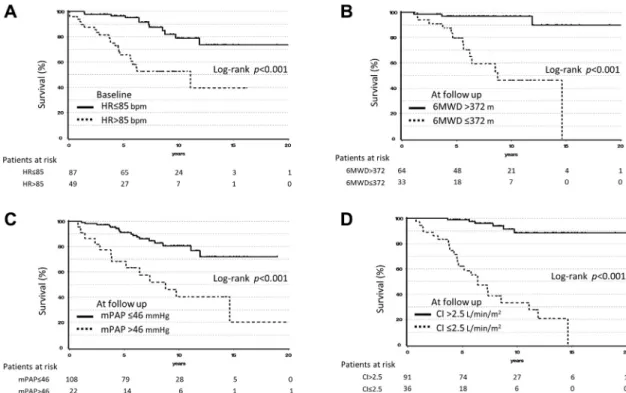
A baseline HR>85 beats/min showed a significantly worse prognosis (p<0.001), although the cutoff value for HR at follow-up did not stratify survival. Patients with 6MWD
>372 m, mPAP 46 mm Hg, and CI >2.5 L/min/m2 at follow-up had a significantly better prognosis (p <0.001) (Figure 2).
The treatment regimen was evaluated in patients who underwent follow-up catheterization (Table 3). Less than 40% of patients were administered warfarin. Most patients were receiving PAH-targeted drugs: prostacyclin analogs, endothelin receptor antagonists (ERAs), and phosphodies- terase type 5 (PDE5) inhibitors. Intravenous prostacyclin was highly prescribed. All patients received epoprostenol except for 1 patient who received treprostinil. The maximum dose of epoprostenol was 70.6 39.5 ng/kg/min. Approximately 80% of patients were treated with combination therapy.
The Cox proportional hazards model was used to esti- mate the risk factors for disease-related death with regard to treatment at follow-up. Oral prostacyclin analog, PDE5 in- hibitors, and warfarin did not show significance in univari- ate analysis (p ¼ 0.168, 0.257, and 0.156, respectively).
ERA and intravenous epoprostenol were important for sur- vival in the univariate analysis (p ¼ 0.027 and 0.046,
Figure 2. Survival rate of patients stratified by parameters at baseline(A)and follow-up(B to D).(A)Survival rate of patients with heart rate85 beats/min at baseline was significantly better than that of patients with HR>85 beats/min (p<0.001).(B)Survival rate of patients with 6MWD>372 m at follow-up was significantly better than that of patients with 6MWD372 m (p<0.001).(C)Survival rate of patients with mPAP46 mm Hg at follow-up was significantly better than that of patients with mPAP>46 mm Hg (p<0.001).(D)Survival rate of patients with cardiac index (CI)>2.5 L/min/m2 at follow-up was significantly better than that of patients with CI2.5 L/min/m2(p<0.001).
Table 3
Treatment at follow-up (n¼130)
Variable n (%)
Warfarin 49 (37.7%)
Pulmonary arterial hypertension targeted therapy 129 (99.2%)
Oral prostacyclin analog 20 (15.4%)
Intravenous prostacyclin 102 (78.5%)
Endothelin receptor antagonist 83 (63.8%)
Phosphodiesterase type 5 inhibitor 89 (68.5%)
Combination therapy 103 (79.2%)
Double therapy 41 (31.5%)
Triple therapy 62 (47.7%)
respectively). However, no drug showed significant benefit to survival in the multivariate analysis. In the Kaplan-Meier analysis, patients administered ERA showed significantly better survival (log-rank test, p ¼ 0.015) (Figure 3) with significant improvement of hemodynamics at follow-up (Supplementary Table 1), although patients administered ERA did not show any difference in the baseline data except for HR. Patients who did not need epoprostenol had a better prognosis (log-rank test, p ¼ 0.026) (Figure 3). Among patients who were administered intravenous epoprostenol therapy, those taking ERA had a significantly better prog- nosis (log-rank test, p ¼0.012) (Figure 3); although there was no difference in the baseline data, they showed signif- icant improvement of hemodynamics at follow-up (Supplementary Table 2). Among patients on epoprostenol therapy, patients given warfarin had a significantly worse prognosis (log-rank test, p ¼0.017) (Figure 3). There was no difference in the baseline data except for lower SpO2, but
patients not given warfarin showed significant improvement of hemodynamics at follow-up (Supplementary Table 3).
Furthermore, patients given intravenous prostacyclin were divided into 4 groups: with or without ERA and with or without warfarin (Figure 3). There was a significant differ- ence in survival (log-rank test with a Tukey adjustment, p¼0.014), and a significant difference was found between ERA-only and warfarin-only groups (p ¼ 0.007). Male prevalence and SpO2were significantly different parameters among these 4 groups at baseline, whereas mPAP, CI, and PVR were significantly different at follow-up (Supplementary Tables 4and 5).
Discussion
This is thefirst multicenter report on survival of Japanese patients with I/HPAH treated at 3 referral centers. The re- sults confirmed our previous report on the high survival rate
Figure 3. Kaplan-Meier estimates stratified according to treatment at follow-up.(A)Survival rate of patients with ERA was significantly better than that of patients without ERA (p¼0.015).(B)Survival rate of patients with intravenous (IV) prostacyclin (PGI2) was significantly worse than that of patients without IV PGI2 (p¼0.026).(C)Survival rate of patients with ERA was significantly better than that of patients without ERA among patients who were on IV PGI2 therapy (p¼0.012).(D)Survival rate of patients with warfarin (WF) was significantly worse than that of patients without warfarin among patients who were on IV PGI2 therapy (p¼0.017).(E)Survival rates of patients with and without ERA and with or without warfarin were compared among patients who were on IV PGI2 therapy. Survival rate of patients with warfarin was significantly worse than that of patients with ERA (p¼0.014).
of Japanese patients with I/HPAH and significant improvement in hemodynamic parameters after treatment.6 In patients receiving epoprostenol therapy, concomitant use of ERA was beneficial and warfarin was related to worse survival.
Survival of patients with PAH improved after progress in the use of PAH-targeted drugs, although the results continued to be unsatisfactory.2e5 Numerous parameters have been reported to be improved by targeted therapies, including WHO functional class, 6MWD, and BNP. It is essential to understand which parameters need to be improved, and to what extent, in achieving better survival.
Among the baseline characteristics, HR is the only prognostic factor in the present study. However, HR did not change after treatment and the importance of HR in patients with I/HPAH may be limited, although HR is a known prognostic factor in left-sided cardiac failure.9 The improvement in other parameters after treatment is more significant in our patients in comparison with those enrolled in previous studies, although the baseline parameters were comparable with those reported previously.2e5,10,11Patients with 6MWD>372 m, mPAP46 mm Hg, and CI>2.5 L/
min/m2 at follow-up had a significantly better survival.
Improvement in the 6MWD, which has long been consid- ered the end point in most clinical trials, has been shown not to be related to long-term survival.12CI was also reported to be a prognostic factor in thefirst report on survival.1Mean PAP was found to be significant in stratifying patients’ survival in our previous single-center report.6 In line with the previous results, thefinding that mPAP can be lowered by treatment and is a determinant factor was confirmed by the present study. mPAP improvement may deserve to be recognized as a determinant factor of prognosis, as already is the case for chronic thromboembolic pulmonary hypertension.13,14
The significant improvement in pulmonary hemody- namics might be attributed to the high prescription rate and combination therapy including epoprostenol treatment.
Epoprostenol is known to be the most potent drug among all the PAH-targeted drugs, reducing mPAP by approximately 8 mm Hg after 1 year of treatment with 21 ng/kg/min monotherapy.15 We have reported that a rapid uptitration regimen of epoprostenol soon after the initiation of treat- ment was associated with a continuous decrease in mPAP and better survival compared with the slow uptitration regimen.16,17 Combination therapy has been shown to be beneficial in PAH.18e20 In the present study, epoprostenol and combination therapy were chosen for 80% of patients and a reduction in mPAP of 37.6% was achieved. This result is consistent with our previous report of a 44% reduction in mPAP in 75% of patients given epoprostenol treatment6and 32.5% reduction in mPAP by upfront combination ther- apy.18 This treatment regimen is enabled by the Japanese national health care system, which subsidizes medical care for patients with rare and intractable diseases.
Our results showed that patients who were given ERA showed better survival compared with those not given ERA.
Because patients who require epoprostenol are the most severe cases, they showed worse survival than those who did not need it. However, in patients who needed epopros- tenol treatment, concomitant use of ERA led to significantly
better survival, which was indicated by the BREATHE-2 study, a placebo-controlled combination study of epopros- tenol and bosentan that showed a trend toward hemody- namic and clinical improvement.21 We did not observe a favorable effect on survival when using a PDE5 inhibitor as an add-on therapy to epoprostenol treatment, although the PACES trial demonstrated pulmonary hemodynamic improvement by adding sildenafil to epoprostenol therapy.22 Many patients included in our study were already diagnosed and treated before PDE5 inhibitors were approved in Japan.
Patients able to survive until the approval of PDE5 in- hibitors may not have further appreciated its benefit.
The use of anticoagulation is controversial in patients with I/HPAH.23e25 In the present study, patients given warfarin showed a tendency toward worse survival compared with those not given warfarin (data not shown, p ¼ 0.06). Furthermore, among patients who underwent epoprostenol therapy, concomitant use of warfarin was associated with a poor prognosis, despite similar baseline parameters. The exact reason cannot be determined from this study because we did not specifically collect the data regarding warfarin-related adverse events, such as bleeding.
We previously reported an increased risk of pulmonary alveolar hemorrhage with>28 ng/kg/min of epoprostenol.26 Patients in the present study were on high-dose epoprostenol therapy, which can reduce platelet coagulation activity and ultimately may result in adverse effects. The use of anti- coagulation in patients with I/HPAH should be considered with caution, especially with epoprostenol therapy.
Another reason for the improvement in survival may be due to racial/ethnic factors. Reports from China and Korea showed higher survival rates than in Western countries.10,11 It is possible that a difference in genetic background be- tween Asians and Caucasians leads to a different response to treatment. Furthermore, the mean age at diagnosis of pa- tients reported from China, Korea, and in the present study is in the 30s. This also differs from recent reports from Western countries, which consist of patients in their 50s at the time of diagnosis, although the age at diagnosis of pa- tients in the first registry was in the 30s.1 Differences in ethnicity in patients with I/HPAH and the patient profile of Asian populations therefore need to be evaluated in a larger cohort.
There are several limitations to this study. The fact that this is a retrospective study with a small number of patients precludes control of the baseline characteristics and may thus lead to biased results. Furthermore, the study comprised patients who were diagnosed from 1992 to 2012, whereas the first PAH-targeted drug became available in 1999 in Japan. The possibility of selection bias and survivor bias could not be avoided. Prospective studies to ascertain the results presented herein are warranted.
Disclosures
Dr. Ogawa has received lecture fees from Actelion Pharmaceuticals Japan Ltd. (Tokyo, Japan), GlaxoSmithK- line KK (Tokyo, Japan), Nippon Shinyaku Co., Ltd. (Kyoto, Japan), and Pfizer Japan Inc. (Tokyo, Japan) and a research grant from GlaxoSmithKline KK. Dr. Satoh has received a research grant from Actelion Pharmaceuticals Japan Ltd.
Dr. Tamura has received lecture fees from Actelion Phar- maceuticals Japan Ltd., Bayer Yakuhin Ltd. (Osaka, Japan), Nippon Shinyaku Co., Ltd., and Pfizer Japan Inc. and research grants from Actelion Pharmaceuticals Japan Ltd.
and Nippon Shinyaku Co., Ltd. Dr Fukuda has no conflict of interest directly relevant to the content of this article.
Dr. Matsubara has received lecture fees from Actelion Pharmaceuticals Japan Ltd., AOP Orphan Pharmaceuticals AG (Vienna, Austria), Bayer Yakuhin Ltd., GlaxoSmithK- line KK, Nippon Shinyaku Co., Ltd., and Pfizer Japan Inc.
Supplementary Data
Supplementary data related with this article can be found, in the online version, at http://dx.doi.org/10.1016/j.amjcard.
2017.01.015.
1. D’Alonzo GE, Barst RJ, Ayres SM, Bergofsky EH, Brundage BH, Detre KM, Fishman AP, Goldring RM, Groves BM, Kernis JT, Levy PS, Pietra GG, Reid LM, Reeves JT, Rich S, Vreim CE, Williams GW, Wu M. Survival in patients with primary pulmonary hypertension. Results from a national prospective registry.Ann Intern Med1991;115:343e349.
2. Humbert M, Sitbon O, Chaouat A, Bertocchi M, Habib G, Gressin V, Yaici A, Weitzenblum E, Cordier JF, Chabot F, Dromer C, Pison C, Reynaud-Gaubert M, Haloun A, Laurent M, Hachulla E, Cottin V, Degano B, Jais X, Montani D, Souza R, Simonneau G. Survival in patients with idiopathic, familial, and anorexigen-associated pulmonary arterial hypertension in the modern management era. Circulation 2010;122:156e163.
3. Thenappan T, Shah SJ, Rich S, Tian L, Archer SL, Gomberg-Maitland M.
Survival in pulmonary arterial hypertension: a reappraisal of the NIH risk stratification equation.Eur Respir J2010;35:1079e1087.
4. Benza RL, Miller DP, Barst RJ, Badesch DB, Frost AE, McGoon MD.
An evaluation of long-term survival from time of diagnosis in pul- monary arterial hypertension from the REVEAL Registry. Chest 2012;142:448e456.
5. Lee WT, Ling Y, Sheares KK, Pepke-Zaba J, Peacock AJ, Johnson MK. Predicting survival in pulmonary arterial hypertension in the UK.Eur Respir J2012;40:604e611.
6. Ogawa A, Ejiri K, Matsubara H. Long-term patient survival with idiopathic/heritable pulmonary arterial hypertension treated at a single center in Japan.Life Sci2014;118:414e419.
7. Galie N, Hoeper MM, Humbert M, Torbicki A, Vachiery JL, Barbera JA, Beghetti M, Corris P, Gaine S, Gibbs JS, Gomez- Sanchez MA, Jondeau G, Klepetko W, Opitz C, Peacock A, Rubin L, Zellweger M, Simonneau G. Guidelines for the diagnosis and treatment of pulmonary hypertension.Eur Respir J2009;34:1219e1263.
8. Hoeper MM, Bogaard HJ, Condliffe R, Frantz R, Khanna D, Kurzyna M, Langleben D, Manes A, Satoh T, Torres F, Wilkins MR, Badesch DB. Definitions and diagnosis of pulmonary hypertension.
J Am Coll Cardiol2013;62:D42eD50.
9. Fox K, Ford I, Steg PG, Tendera M, Robertson M, Ferrari R;
BEAUTIFUL Investigators. Heart rate as a prognostic risk factor in patients with coronary artery disease and left-ventricular systolic dysfunction (BEAUTIFUL): a subgroup analysis of a randomised controlled trial.Lancet2008;372:817e821.
10. Zhang R, Dai LZ, Xie WP, Yu ZX, Wu BX, Pan L, Yuan P, Jiang X, He J, Humbert M, Jing ZC. Survival of Chinese patients with pulmonary arterial hypertension in the modern treatment era.Chest2011;140:301e309.
11. Kang BJ, Lee SD, Oh YM, Lee JS. Improved survival of Korean pa- tients with idiopathic pulmonary arterial hypertension after the intro- duction of targeted therapies.Heart Lung2014;43:561e568.
12. Savarese G, Paolillo S, Costanzo P, D’Amore C, Cecere M, Losco T, Musella F, Gargiulo P, Marciano C, Perrone-Filardi P. Do changes of 6-minute walk distance predict clinical events in patients with pul- monary arterial hypertension? A meta-analysis of 22 randomized trials.
J Am Coll Cardiol2012;60:1192e1201.
13. Riedel M, Stanek V, Widimsky J, Prerovsky I. Long-term follow-up of patients with pulmonary thromboembolism. Late prognosis and evo- lution of hemodynamic and respiratory data.Chest1982;81:151e158.
14. Lewczuk J, Piszko P, Jagas J, Porada A, Wojciak S, Sobkowicz B, Wrabec K. Prognostic factors in medically treated patients with chronic pulmonary embolism.Chest2001;119:818e823.
15. Sitbon O, Humbert M, Nunes H, Parent F, Garcia G, Herve P, Rainisio M, Simonneau G. Long-term intravenous epoprostenol infu- sion in primary pulmonary hypertension: prognostic factors and sur- vival.J Am Coll Cardiol2002;40:780e788.
16. Tokunaga N, Ogawa A, Ito H, Matsubara H. Rapid and high-dose titration of epoprostenol improves pulmonary hemodynamics and clinical outcomes in patients with idiopathic and heritable pulmonary arterial hypertension.J Cardiol2016;68:542e547.
17. Kimura M, Tamura Y, Takei M, Yamamoto T, Ono T, Kuwana M, Fukuda K, Satoh T. Rapid initiation of intravenous epoprostenol infusion is the favored option in patients with advanced pulmonary arterial hypertension.PLoS One2015;10:e0121894.
18. Sitbon O, Jais X, Savale L, Cottin V, Bergot E, Macari EA, Bouvaist H, Dauphin C, Picard F, Bulifon S, Montani D, Humbert M, Simonneau G. Upfront triple combination therapy in pulmonary arterial hypertension: a pilot study.Eur Respir J2014;43:1691e1697.
19. Sitbon O, Sattler C, Bertoletti L, Savale L, Cottin V, Jais X, De Groote P, Chaouat A, Chabannes C, Bergot E, Bouvaist H, Dauphin C, Bourdin A, Bauer F, Montani D, Humbert M, Simonneau G. Initial dual oral combination therapy in pulmonary arterial hypertension.Eur Respir J2016;47:1727e1736.
20. Bergot E, Sitbon O, Cottin V, Prevot G, Canuet M, Bourdin A, de Groote P, Rottat L, Gressin V, Jais X, Humbert M, Simonneau G. Current epoprostenol use in patients with severe idiopathic, heritable or anorexigen-associated pulmonary arterial hypertension: data from the French pulmonary hyper- tension registry.Int J Cardiol2014;172:561e567.
21. Humbert M, Barst RJ, Robbins IM, Channick RN, Galie N, Boonstra A, Rubin LJ, Horn EM, Manes A, Simonneau G. Combi- nation of bosentan with epoprostenol in pulmonary arterial hyperten- sion: BREATHE-2.Eur Respir J2004;24:353e359.
22. Simonneau G, Rubin LJ, Galie N, Barst RJ, Fleming TR, Frost AE, Engel PJ, Kramer MR, Burgess G, Collings L, Cossons N, Sitbon O, Badesch DB, Group PS. Addition of sildenafil to long-term intravenous epoprostenol therapy in patients with pulmonary arterial hypertension:
a randomized trial.Ann Intern Med2008;149:521e530.
23. Fuster V, Steele PM, Edwards WD, Gersh BJ, McGoon MD, Frye RL.
Primary pulmonary hypertension: natural history and the importance of thrombosis.Circulation1984;70:580e587.
24. Olsson KM, Delcroix M, Ghofrani HA, Tiede H, Huscher D, Speich R, Grunig E, Staehler G, Rosenkranz S, Halank M, Held M, Lange TJ, Behr J, Klose H, Claussen M, Ewert R, Opitz CF, Vizza CD, Scelsi L, Vonk-Noordegraaf A, Kaemmerer H, Gibbs JS, Coghlan G, Pepke- Zaba J, Schulz U, Gorenflo M, Pittrow D, Hoeper MM. Anti- coagulation and survival in pulmonary arterial hypertension: results from the Comparative, Prospective Registry of Newly Initiated Ther- apies for Pulmonary Hypertension (COMPERA). Circulation 2014;129:57e65.
25. Preston IR, Roberts KE, Miller DP, Sen GP, Selej M, Benton WW, Hill NS, Farber HW. Effect of warfarin treatment on survival of pa- tients with pulmonary arterial hypertension (PAH) in the registry to evaluate Early and long-term PAH disease management (REVEAL).
Circulation2015;132:2403e2411.
26. Ogawa A, Matsubara H, Fujio H, Miyaji K, Nakamura K, Morita H, Saito H, Kusano KF, Emori T, Date H, Ohe T. Risk of alveolar hemor- rhage in patients with primary pulmonary hypertensioneanticoagulation and epoprostenol therapy.Circ J2005;69:216e220.