ISSN 1344-8803, CSSE-7 January 31, 2000
Generalized State-Dependent Scaling for Local Optimality, Global Inverse Optimality,
and Global Robust Stability
12Hiroshi Ito y3
y
Department of Control Engineering and Science, Kyushu Institute of Technology 680-4 Kawazu, Iizuka, Fukuoka 820-8502, Japan
Phone: (+81)948-29-7717, Fax: (+81)948-29-7709 E-mail: [email protected]
Abstract: This paper provides a solution to an inverse optimal robust control problem for uncertain nonlinear systems. A new version of robust backstepping is proposed in which inverse optimality is achieved through the selection of generalized state-dependent scaling factors. Like other robust backstepping methods, this design is always successful for uncertain nonlinear systems in strict-feedback form. The class of cost functionals allowed in the inverse optimal design is such that the uncertainty structure and desired level of global robustness can be prescribed a priori. Furthermore, the inverse optimal control law can always be designed such that its linearization is identical to a linear optimal control law for the linearized system with respect to a prescribed quadratic cost functional.
Key Words: Inverse optimal control, Robust backstepping, Global robust stability, State- dependent scaling, Robust control Lyapunov function
1
Technical Report in Computer Science and Systems Engineering, Log Number CSSE-7, ISSN 1344-8803. c
2000 Kyushu Institute of Technology
2
The rst version of the paper was completed by November 1, 1998 during a six months visit to Dept. of Electrical and Computer Engineering, Northwestern University, 2145 Sheridan Road, Evanston, IL 60208-3118, USA. This version was completed on March 4, 1999.
3
Author for correspondence
1 Introduction
Backstepping methods for the design of robustly stabilizing controllers for uncertain nonlinear sys- tems have been evolving over the past several years. Early results in [1, 2, 3] extended the break- through [4] in nonlinear adaptive control to a class of strict-feedback systems with nonlinear time- varying uncertainties[5]. More recently, these designs have been rened in the context of an inverse optimal robust control problem in which the resulting controller is optimal with respect to some cost functional belonging to a specied class [6, 7, 8, 9]. A primary benet of achieving inverse optimality is that, for an appropriately chosen class of cost functionals, it can guarantee additional robustness with respect to certain types of input uncertainties not taken explicitly into account in the robust controller design [10, 7]. The inverse optimal design represents an attractive alternative to the gen- erally infeasible approach of directly computing an optimal controller with respect to a pre-specied cost functional by solving a Hamilton-Jacobi-Bellman (HJB) or Hamilton-Jacobi-Isaacs (HJI) partial dierential equation.
A drawback of these inverse optimal backstepping designs is that they do not necessarily provide the same local performance achieved by linear controllers constructed for the linearized system using modern robust control methods such as
H1. Ideally one would attempt to design the nonlinear controller not only to achieve global robustness but also to recover the local linear performance. One such design was presented in [8]; here the controllers guarantee local
L2-disturbance attenuation of level
as well as global inverse optimality and input-to-state stability (ISS). The local property is achieved by forcing the inverse optimal cost functional to agree locally with a pre-specied
H1-type cost for the linearized system. However, the parameter
is not given a global interpretation in [8];
the global robustness property is simply stated as input-to-state stability with no reference to
.
In this paper we consider a global robust stabilization problem in which the parameter
plays
both a local and global role in describing the allowable \size" of the structured uncertainty. In this
context global input-to-state stability becomes just a special case of global robustness with respect to
a particular class of structured uncertainty. We rst generalize the class of cost functionals employed
in [8] in the denition of inverse optimality to reect this new global role of the parameter
. We
then show that for uncertain nonlinear systems in strict feedback form, we can always achieve such
extended inverse optimality through the use of generalized state-dependent (SD) scaling. This notion
of generalized SD scaling is an extension of the SD scaling developed for robust nonlinear control in
[11, 12, 13, 14]. The control system obtained through our generalized SD scaling design is guaranteed
to have a global robustness property with respect to structured uncertainty with size described by
the parameter
. Furthermore, the inverse optimal control law can always be designed such that its
linearization is identical to a linear optimal control law for the linearized system with respect to a
prescribed cost functional (again parameterized by
). By incorporating the parameter
into our
denition of global robust stability, we achieve a seamless integration of the three desired properties of
our nonlinear design: local optimality, global inverse optimality, and global robust stability. Finally, it
is worth noting that the generalized SD scaling approach to inverse optimal backstepping is a natural
extension of the idea of scaling designs popular in linear robust control theory.
2 Motivation and problem statement
We consider a nonlinear plant with control input
uand disturbance
wof the form _
x
=
f(
x) +
f1(
x)
w+
f2(
x)
u(1) where
f,
f1and
f2are suciently smooth vector elds on
Rn with
f(0) = 0,
f1(0) = 0 and
f2(0) = 0.
An optimal control problem for (1) is described by a cost functional
J
opt = min u max w
Z 10
L
(
x;w;u)
dt(2)
where
Lis a smooth function satisfying
L(0
;0
;0) = 0. The Hamilton-Jacobi(HJ) equation for this optimal control problem is written somewhat informally as
min u max w
hL(
x;w;u) + _
V(
x;w;u)
i= 0
; V(0) = 0 (3) with a smooth positive semi-denite function
V(
x). For an appropriate choice of
L(
x;w;u), the solution
Vwill lead to a control law
u(
x) which provides optimality, stability, and robustness with respect to the disturbance
w.
The disturbance
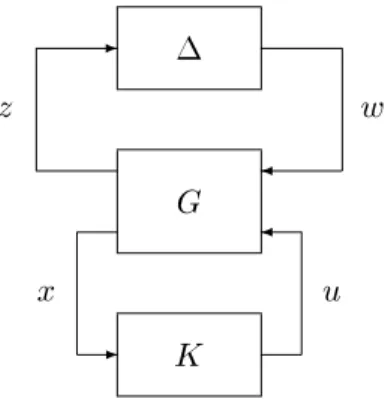
win (1) usually represents uncertainty arising from various locations in the control system. To specify the location and structure of the uncertainty, the robust control paradigm depicted Fig.1 is popular. The system is an uncertainty and
Kis a state-feedback controller. The system
Gnot only describes a nominal plant, but also includes information about how the uncertainty aects the nominal plant such as geometrical locations and types of nonlinearities where uncertain parameters are present. This uncertainty structure is described by the input map in
Gat
wand the output map in
Gat
z. The principal problem of robust control for the uncertain system is to construct a controller
K
achieving global robust stability:
Global robust stability
If the closed-loop system is globally stable in the presence of every belonging to a given family of admissible uncertainties, the system is said to be globally robustly stable.
The structure of the uncertainty denes the set of disturbances
win (1), (2) and (3). It is well known that such a robust control design usually comes at the price of solving a Hamilton-Jacobi partial dierential equation (3) with an appropriate function
L. Such a task is generally not feasible.
This infeasibility of solving HJ equations motivated the development of the inverse optimality direction in robust nonlinear control [6]. Roughly speaking, an inverse optimal design is an optimal design in which the choice for the function
Lis left open:
Global inverse optimality
If there exist a function
Lsuch that (3) has a positive denite and radially unbounded solution
V
(
x) on
Rn , then the control
uachieving minimum of (3) is said to be globally inverse optimal.
Inverse optimality exploits the fact that an HJ equation with a xed function
Lis only a sucient
condition for achieving robustness. The inverse optimal design seeks a particular solution to an
appropriate class of HJ equations which lead to desired robustness of a system by using
Las a
design parameter. It is important to remember that the inverse approach enables us to design robust
controllers without solving HJ equations directly, provided the function
Lis chosen from an appropriate
class.
According to Lyapunov's rst method, we can achieve stability robustness in Fig.1 at least locally by using a linearized description of the system. Fortunately, an HJ equation for a linearized system reduces to an algebraic Riccati equation which can be solved easily and eciently. The optimal controller directly guarantees the stability robustness in Fig.1 for linear
Gand families of including memoryless and dynamic, structured and unstructured uncertainties. Thus, for achieving robustness at least locally, the following property is desirable:
Local optimality
Suppose that a function
Lis given a priori so that it describes desired stability robustness. If the linearization of a control law
uat
x= 0 is an optimal control associated a value function which solves the linear version of (3) (i.e., Riccati equation), the control law
uis said to be locally optimal.
However, a controller that performs well on a linearized model may drastically reduce the stability region of the actual nonlinear system. Local optimality by itself is not sucient for inherently nonlinear systems.
If maximization with respect to
wis dropped in the global inverse optimal design, then global optimality does not necessarily imply global robust stability. For example, consider the following choice for
Lwhich is a natural generalization of LQ optimal control:
L
=
q(
x) +
r(
x)
u2; q(
x)
0
; q(0) = 0
; r(
x)
>0
8x2Rn (4) with optimality described by
J
opt = min u
Z 10
L
(
x;w;u)
dtsubject to
w0 (5)
instead of (2). A global inverse optimal controller with respect to (5) may exhibit robustness properties in the sense of stability margins [10], but it generally only guarantees stability robustness with respect to certain types of input uncertainties. In fact, in general the optimal controller does not achieve robustness for the disturbance
was specied in Fig.1. In contrast, for the same function
Lin (4), global optimality in terms of (2) implies robust stability of the system in Fig.1 because
Jopt
< 1implies
x(
t)
!0 as
t ! 1. It is known that robust stabilizability of the system with the family of memoryless uncertainties is equivalent to the existence of a robust control Lyapunov function (rclf). In fact, it has been shown in [6] that every rclf solves an HJ equation associated with the cost functional (2) and the inverse optimal control law is given in terms of the rclf. The inverse optimal control in [6] thus takes robust stability into account. However, the relationship between the global optimality achieved and robust stabilization of the linearized system is not clear. Indeed, in general, the globally inverse optimal control law is not locally optimal.
Another candidate for the function
Lin (2) for inverse optimal control is as follows:
L
=
q(
x) +
r(
x)
u2;2w2; q(
x)
0
; q(0) = 0
; r(
x)
>0
8x2Rn (6)
Because this
Lis a natural generalization of linear
H1optimal control, it has been shown in [8] that
the associated globally inverse optimal controllers can be locally
H1optimal for a class of nonlinear
systems. However, because of the negative term in
L, global inverse optimality does not necessarily
assure global robust stability in the presence of the disturbance
w. In [7], a terminal penalty is
introduced which excludes this possibility of destabilizing inverse optimal controllers:
J
opt = min u max w
(
T lim
!1"
E
(
x(
T)) +
ZT
0
q
(
x) +
r2(
x)
u2;r1(
x)
w2dt# )
(7)
q
(
x)
0
; q(0) = 0
; r1(
x)
0
; r2(
x)
>0
; 8x2Rn
Here,
Eis a positive denite radially unbounded function. It was proved in [7] that for a class of input-to-output stabilizable systems, input-to-output stability can be achieved in the presence of input unmodeled uncertainty. However, this type of global stability is guaranteed for a certain class of unstructured input uncertainties which in general does not conform to the location/structure specied in Fig.1. Furthermore, the inverse optimal control in [7] is not guaranteed to be locally optimal.
The purpose of this paper is to develop a backstepping procedure which meets all the three objec- tives simultaneously: global inverse optimality, local optimality, and global robust stability. For this purpose, an appropriate choice of
Lwill given by generalized state-dependent scaling.
3 Denitions
Consider the uncertain nonlinear system described by
: _
x=
A(
x)
x+
B(
x)
w+
G(
x)
u :(8) where dimensions of signals are
x(
t)
2Rn ,
u(
t)
2R1,
w(
t)
2Rp . Functions
A(
x),
B(
x) and
G(
x) are assumed to be suciently smooth. We make the following structural assumptions on these matrices.
First, we assume that
A,
Band
Gcan be written in the form
A
(
x)=
2
6
6
6
6
6
6
6
4 a
11
(
x)
a12(
x) 0
0
a
21
... ... (
x)
a22... ... (
x)
a23... ... ... ... ... (
x) 0 ... 0 0
a
n
;1;
1(
x)
an
;1;
2(
x)
an
;1;n (
x)
a
n
1(
x)
an
2(
x)
ann (
x)
3
7
7
7
7
7
7
7
5
(9)
B
(
x)=
2
6
6
4 B
11
(
x) 0
0
B
21
... (
x)
B22... ... 0 (
x) ... ...
B
n
1(
x)
Bn
2(
x)
Bnn (
x)
3
7
7
5
;G
(
x)=
2
6
6
4
0... 0
a
n;n
+1(
x)
3
7
7
5
:
(10)
Each scalar-valued function
aij is required to satisfy
a
ij (
x) =
aij (
x1;x2;;xi )
;1
in;1
ji+ 1 (11)
a
i;i
+1(
x1;x2;;xi )
6= 0
;1
in(12) for all
x 2Rn . The dimension for the matrix
B(
x) is
Bij (
x)
2R1p
iand
p=
Pni
=1pi ,
pi
0. Its dependence on
xis
B
ij (
x) =
Bij (
x1;x2;;xi )
;1
in;1
ji:(13)
Denition 1 Given a positive semi-denite, radially unbounded, C
1function
V(
x) and a positive scalar-valued function
r(
x), the control law
u
(
x) =
;1
2
r;1(
LG
V) T (14)
is globally inverse optimal with disturbance level
when
(i) The equilibrium
x= 0 of is globally asymptotically stabilized by (14) when
w0.
(ii) There exist a scalar-valued function
q(
x) and a
Rp
p -valued function (
x) such that
L
Ax
V+ 1 4
2LB
V;1(
LB
V) T
;1
4
LG
Vr;1(
LG
V) T +
q= 0 (15)
q
(
x)
0
; r(
x)
>0
;(
x) = T (
x)
>0
; 8x2Rn
:The control law (14) with a solution to (15) minimizes the worst-case value of the cost functional
J
(
u;w) =
Z 10 h
q
(
x) +
r(
x)
u2;2wT (
x)
widt(16) subject to the disturbance
wover all stabilizing control laws, i.e., min u max w
2L2J(
u;w) is achieved.
The function
V(
x) is the optimal value function[15, 16]. The disturbance penalty in the cost functional (16) was refereed to as state-dependent weighting in [7]. It has been proved that if (8) is input-to- state stabilizable, then the inverse optimal problem is solvable with respect to (16)[7]. Note that the function
V(
x) satisfying the Hamilton-Jacobi-Isaacs(HJI) equation (15) is positive denite if
q(
x)
0 implies
x0. In the cost functional (16), since can absorb
, the roll of
is not clear in Denition 1. The meaning of
in connection with robustness will be discussed in Section 7. When
p= 0, the inverse optimal control dened in Denition 1 reduces to the inverse optimality without disturbance [6, 10].
We now consider Jacobian linearization of as follows:
_
x
=
Al
x+
Bl
wl +
Gl
ul (17)
A
l =
@f@x
x
=0=
A(0)
; Bl =
B(0)
; Gl =
G(0)
:(18) We assume that
Ql =
QTl
>0,
rl
>0 and l = Tl
>0. Then, since (
Al
;Gl ) is controllable by our assumptions on
A(
x) and
G(
x), there exists a positive number
such that
A
Tl
Pl +
Pl
Al +
Pl
1
2
B
l
;1BTl
;Gl
r;1l
GTl
Pl +
Ql =0 (19) has a unique solution
Pl =
PTl
>0 for
>and the control law
u
l =
;rl
;1GTl
Pl
x(20)
stabilizes the linear system (17). The control law (20) with the solution
Pl
>0 to the Riccati equation (19) achieves min u
lmax w
l2L2Jl (
ul
;wl ) for the cost functional
J
l (
ul
;wl ) =
Z 10 h
x
T
Ql
x+
rl
u2l
;2wTl l
wl
i
dt
(21)
over all stabilizing control laws
ul . Here,
Vl (
x) =
xT
Pl
xis the optimal value function.
Denition 2 Suppose that
Ql =
QTl
>0,
rl
>0 and l = Tl
>0 are given and
is chosen as
>
. The control law (14) is said to be locally optimal and globally inverse optimal with disturbance level
if
(i) the control (14) is globally inverse optimal with disturbance level
.
(ii) the Jacobian linearized control law
u
=
;1
2
r;1(0)
GT (0)
@2V@x 2
x
=0x
(22)
stabilizes the linear system (17) and achieves min u max w
2L2Jl (
u;w).
(iii)
q(
x)
0,
r(
x)
>0 and (
x) = T (
x)
>0 satisfy 2
Ql =
@2q(
x)
@x 2
x
=0; r
l =
r(0)
;l = (0) (23)
If (
x) is restricted to an identity matrix for all
x 2 Rn , the above denition reduces to the local optimality and global inverse optimality dened in [8].
Without loss of generality, l = (0) is assumed to be a diagonal matrix throughout this paper.
In fact, we can always replace any l
>0 with an identity matrix as follows. Decompose l into l =
WT
Wwith a lower triangular matrix
Wby using the Cholesky factorization. By dening
w
l =
Wwl , the
wl -term in (21) becomes
2wTl l
wl =
2wTl
wl . Since
Wis lower triangular,
B(
x)
W;1is again in the block lower triangular form of (10). Consider the inverse optimal problem of
J
(
u;w) =
Z 10 h
q
(
x) +
r(
x)
u2;2wT (
x)
widt(24) for the system in which
B(
x)
wof is replaced with
B(
x)
W;1w. This problem is the same as the inverse optimal dened with (16) for the original system with respect to (
x) =
WT (
x)
W, while in the optimal control with respect to (24), we have (0) =
W;T (0)
W;1=
Ip as desired.
4 Global inverse optimality via generalized SD scaling
We now consider the following weighting functions for the cost
Jin (16):
q
(
x) =
xT
CT (
x)(
x)
C(
x)
x+
xT
Q(
x)
x(25)
r
(
x) =
U (
x)
;(
x) = T (
x) (26) (
x)
>0
; Q(
x)=
QT (
x)
>0
;U (
x)
>0
;(
x)
>0
; 8x2Rn
The matrix
C(
x)
2Rq
n is a prescribed function and it is assumed to have the form
C
(
x)=
2
6
6
4 C
11
(
x) 0
0
C
21
... (
x)
C22... ... 0 (
x) ... ...
C
n
1(
x)
Cn
2(
x)
Cnn (
x)
3
7
7
5
;
C
ij (
x)=
Cij (
x1;x2; ;xi )
1
in;1
ji(27)
for suciently smooth functions
Cij (
x)
2 Rq
i1,
qi
0 and
q=
Pni
=1qi . The matrices (
x) and (
x) are parameters to be used for achieving the inverse optimality of Denition 1. The matrices are assumed to consist of scalar-valued functions
i (
x) and
i (
x),
i= 1
;2
;:::;nwith
(
x)=block-diag[
1(
x)
Iq
1;2(
x)
Iq
n;;n (
x)
Iq
n] (28)
(
x)=block-diag[
1(
x)
Ip
1;2(
x)
Iq
n;;n (
x)
Ip
n]
:(29)
Here,
Iq
idenotes a
qi
qi identity matrix. Each
i or
i is a function of
xof the form
i (
x)=
i (
x1;x2; ;xi )
;i (
x)=
i (
x1;x2; ;xi )
;1
inThe scalar-valued function
U is also a parameter to be chosen in the inverse optimal design and its dependence on
xis
U (
x) =
U (
x1;x2;;xn )
:We assume that
i (
x)
>0
;i (
x)
>0
; 8i;U (
x)
>0
; 8x2Rn
:Substituting the above parameters into (16), the cost function
J(
u;w) becomes
J
(
u;w) =
Z 10 h
z
T (
x)
z+
xT
Q(
x)
x;2wT (
x)
widt(30) with an augmented system
a :
x_ =
A(
x)
x+
B(
x)
w+
G(
x)
uz
=
C(
x)
x+
Hu ;(31)
where
C
(
x)=
2
6
6
6
6
6
4 C
11
(
x) 0
0
C
21
... (
x)
C22... ... 0 (
x) ... ...
C
n
1(
x)
Cn
2(
x)
Cnn (
x)
0 0 0 0
3
7
7
7
7
7
5
; H
=
2
6
6
6
6
6
4
0 0 0 ...
1
3
7
7
7
7
7
5
(32)
(
x) = block-diag[(
x)
;U (
x)]
:(33)
The cost functional (30) can be rewritten as
J
(
u;w) =
Z 10
"
n
X
i
=1(
i (
x)
zTi
zi
;2i (
x)
wTi
wi ) +
xT
Q(
x)
x+
U (
x)
u2#
dt
(34)
where
wand
zare partitioned as
w
=[
wT
1; ;wTn ] T
; wi
2Rp
i; z=[
z1T
; ;zTn
;u] T
; zi
2Rq
i :When we choose
i =
i for
i= 1
;2
;:::;nin (34), the parameter
i (
x) becomes the state-dependent(SD) scaling [12]. Therefore, in this paper, we call ((
x)
;(
x)) the generalized state-dependent scaling for inverse optimal control.
Let
x[k
]denote the states
x1through
xk .
x
[
k
]=
x1 x2 xk
T
We consider a dieomorphism
=
S(
x)
xbetween
x2Rn and
2Rn . Let
S;1(
x) denote the inverse map of the dieomorphism and choose
S
;1
(
x) =
2
6
6
6
6
6
6
6
4
1 0 0 0
0
s
1
(
x) 1 0 0
0
d
21 s
2
(
x) 1 0 ... 0
d
31 d
32 s
3
(
x) 1 ... 0 ... ... ... ... ... ...
d
n
;1;
1 dn
;1;n
;2 sn
;1(
x) 1
3
7
7
7
7
7
7
7
5
;
(35)
where the smooth scalar functions
s1(
x1)
;s2(
x[2])
;,
sn
;1(
x[n
;1]) are to be determined in a recursive manner from
s1through
sn
;1. Each function
si depends only on the state components
x1through
xi . The other scalar constants
dij , 2
in;1, 1
j i;1, are any real numbers. Then,
S(
x) is
S
(
x) =
2
6
6
6
6
6
6
4
1 0 0
0
4
1
1 0
0
4
2 4
2
1 ... ...
... ... ... ... 0
4
n
;1 4n
;11
3
7
7
7
7
7
7
5
where
4j denotes any function depending only on
s1through
sj . This dieomorphism
S(
x) is the same as the one in [6] and [14] if we take
dij = 0. The time-derivative of
is
_
=
@S@x
1 x;
@S
@x
2 x;;
@S
@x
n
x
_
x
+
S(
x)_
x=
T(
x)_
x:(36) with a smooth function
T(
x):
T
(
x) =
2
6
6
6
6
6
6
4
1 0 0
0
?
1
;
11 0
0
?
2
;
2 ?2;
21 ... ...
... ... ... ... 0
?
n
;1;n
;1 ?n
;1;n
;11
3
7
7
7
7
7
7
5 :
The entries
?i;j depend only on the states
x1through
xi and the functions
s1through
sj and their partial derivatives. We now consider a state-feedback law
u
(
x) =
sn (
x[n
])
n (37) where
sn is another smooth function yet to be determined. Then, the closed-loop system consisting of (31) and the state-feedback law becomes
cl :
(
_ =
TA^
S^ +
Bwz
= ^
CS^ (38)
^
S
:=
0
S;10
sn
; A
^ := [
A G]
; C^ := [
C H]
:Theorem 1 Suppose that
P= diag[
P1;P2;;Pn ] is a constant diagonal matrix and
M
(
x):=
2
6
4
^
S
T
A^ T
TT
P+
PTA^
S^
;1PTB S^ T
C^ T
;1
B
T
TT
P ;0
^
CS^ 0
;3
7
5
<
0 (39)
P >
0 (40)
are satised for all
x2 Rn , Then, the nonlinear system is globally asymptotically stabilized by the state-feedback law
u=
sn
n and
J
(
u;w;T) =
ZT
0 h
z
T (
x)
z+
xT
Q(
x)
x;2wT (
x)
widtV