Toru Umeda
An Analysis of the Altruistic Behavior in the Market:
Why Does It Help Generate Inefficiency?
Foreword
Cr it ics of mai n st rea m econom ics have characterized economism as a prevalent ideology (Polanyi 1977 ; Ulrich 2008 ; Des Gapser 2004 ; Umeda 2016 a; Umeda 2016 b). The key components of economism include a faith of economists in an autonomous economic system, the assumption of a utility maximizing selfi sh actor model, and a closed market concept clearly demarcated from the non- market (Umeda 2016 b). Of those, the selfish human actor model, so-called homo economicus ( HE ) , enshrined in the base of mainstream economists ʼ theory, is the biggest source of concern as it has helped produce among citizens a recognition that economic actors ought to selfishly behave (Aldred 2009 ).
1I have argued for the need to overcome economism (Umeda 2016 b). Once freed from yoke of economism, citizens would be able to have unconventional, uninhibited views and approaches to socioeconomic realities. Scholars would be able to explain with ease consumers ʼ irrational choices or actions characterized by behavioral economists as ʻ anomalous behaviors ʼ or ʻ anomalies ʼ (Thaler 1991 ) in the market. Replacing the conventional HE model with the homo socio-economicus ( HSE ) model is part of my proposal as a step forward to overcome economism and fi nd ways to explain such anomalies in a diff erent way behavioral economists do.
The HSE model can by definition behave both selfishly and altruistically. The altruistic or other- regarding behavior of the HSE model may generate economic inefficiency as a result of such actions
taken out of concern for others ʼ or social interests
2. I will argue in this paper that altruistic behaviors of consumers cannot be explained without any reference to such inefficient and (economically) irrational choices by economic actors in the market since altruistic, non-selfish, other-regarding behaviors of economic actors, as a matter of logic, ought to generate a fraction of ineffi ciency, loss or waste in the course of such an action taken.
I will fi rst outline how the distance grew between economics and ethics in order to ascertain the role that the HE model has played in the growth. Next, I will examine the range of behavioral patterns that the HSE model can take, referring to the relationship between the HE model and the concept of economic rationality. This is followed by an analysis on how behavioral patterns of HSE can help generate ineffi ciency, loss or waste, with examples showcased of what I regard as ethical, or altruistic, behaviors of economic actors in the market.
Distance between Economics and Ethics At around what time did the distance start to grow between economics and ethics? The first ramification could be pinned down on what I call ʻ self-interest pursuit formula, ʼ the origin of which we can trace back to Adam Smith ʻ s Wealth of Nations of 1776 (Umeda 2016 a). With hindsight, the formula, discrediting the value of pursuing social causes by commercial participants, set the direction in which modern economics has subsequently developed.
The next ramification is so-called ʻ Marginal Revolution ʼ (MR)
3. MR led economists to challenge
1“
Assuming people are selfish becomes a self-fulfilling prophecy, with the result that altruism, trust and cooperation are all undermined. And the assumption of selfishness can even act to exercise, or indirectly justify, immoral behavior.
“(p.
12). The
“Homo economicus doctrine actively recommends selfi shness.
”2
With the term
ʻineffi ciency
ʼI intend to not only convey the standard meaning of the word---not being effi cient. I also intend to use the word to imply
something uneconomical, waste, loss, or additional burden or cost incurred, trying to cover all the deviations from the concept of
ʻrationality
ʼas an ideal
or standard which mainstream economists espouse.
the legitimacy of the Labour Value Theory (LVT), long taken for granted since Adam Smith or before, and it instead prompted economists to accept the Theory of Marginal Utility (TMU). According to TMU, the value of a thing varies depending on the differing level of the utility a person gains through obtaining or consuming it, the logic of which could translate into the value of a thing being a matter of personal valuation.
The application of the theory in a commercial context is found to be the varying price of an item depending on how much a consumer is willing to pay for it on one side of a market, and/or on how much a retailer is willing to sell (or a producer is willing to produce) an item on the other side. The demand curve representing the marginal relationship of the price of an item to aggregated consumers ʼ willingness to pay for it, while the supply curve represents the relationship in which the price of an item varies as the willingness to provide it of aggregated suppliers (retailers or producers) increase or decrease, which modern economists tend to explain with the concept of marginal cost.
Pre-revolutionary so-called ʻ classical economists ʼ , having noticed a dynamic movement existing between demand and supply force in a market, failed to make a theoretical formulation. The concept of marginality enabled economists to make the breakthrough, and they came to be known as ʻ neoclassical (school of) economists ʼ . A conviction shared by the school of economists that market dynamism ought to drive the price of a good to equilibrium led to the primacy of ʻ exchange value ʼ over the concept of ʻ use value ʼ , subsequently crowding out of economists ʼ vocabulary the term ʻ use value ʼ .
4The discovery of the concept of scarcity is another landmark in the history of the discipline development. It led to the solution of the Diamond- Water Paradox which had puzzled classical economists (Smith 1776 ). Classical economists failed to theoretically explain that the scarcity of diamond is
the determinant of its higher value in exchange than water. ʻ Scarcity ʼ came to stand as a crucial concept for the price-determining role of the market which became the primary concern of the economist in the following generations.
A characteristic of the economic theory of neoclassical economists is that a hypothetical human actor model designed to pursue its own interest or maximize its utility is enshrined in its basis. This selfi sh actor model is no more than homo economicus ( HE ). The incorporation of the HE model in their theory meant that economists chose to focus on the only motivation (pursuit of self-interest) from among plural goal (or multi-motivational) patterns of human behaviors. An attention to this single motivation enabled economists to foresee human economic behavior (Marshall 1920 : I.ii. 7 ; Stout 2008 : 160 ), and the focus on the foreseeability of human economic behaviors contributed to characterizing economics as a positive science. Positivism in economics self- defined economics as something akin to natural science, which helped it exclude ethical or moral elements (Rothschild 1993 : 16 )
5. This process meanwhile meant that the economic system was separated from other systems such as political and social dimensions.
The assumption that the agent in the HE model pursues only self-interest meant that the actor does not have to take into consideration others ʼ interests or community ʼ s interests. The existence of others for a person, or of one ʼ s having relationships with others, necessarily concerns morality or ethics. As the HE model manifests itself as isolated from other persons or a community it lives in, and committed to pursuing self-interest or maximizing utility on the base of cost- benefit calculation, the agent is dispossessed of the ability to make an ethical judgment other than pursuing its own interest or utility: it is separated from a moral value system. As seen above, considering that the HE model produced the thrust of economics toward a positive science, the adoption of
3
Zouboulakis (
2014) wrote: "The separation of economic from other social considerations was the result of the redefi nition of the fi eld of economic analysis by the marginalists at the end of nineteenth century." (p.
121).
4
Menger (
1871) used both concepts of
ʻuse value
ʼand
ʻexchange value
ʼ, while Marshal (
1920) exclusively used
ʻexchange value
ʼin the sense of general purchasing power. Most economic textbooks these days no more deal with the word
ʻuse value
ʼ, indicating that it is not given a proper place in the textbook of economics.
5
Rothschild (
1993) notes:
“The scientifi cation of economics . . . has led to a separation of economics from its ethical roots. The
ʻmainstream economics
ʼof
the
20th century fully accepts this separation.
”(p.
16). Hodgson (
2011) writes:
“Economics has mistakenly tried to fashion itself as an exact science akin
to physics.
”(p.
4).
the model in neoclassical economics undoubtedly contributed to its crowding out moral and ethical elements from the construction of its related theories (Hodgson 2013 : 4 - 5 )
Thus, the HE model has played an important role in widening the distance between economics and ethics
6.
The Relationship between ʜoⅿo Econoⅿicus and Economic Rationality
The word ʻ economic ʼ involves an attitude attaching importance to efficiency. The HE model was enshrined at the base of economic theory as an agent who rationally pursues economic efficiency.
The rational choice by an HE forms the base of market effi ciency.
7The problem concerns whether economic actors in markets always retain homo economicus -like nature.
This author ʼ s answer to this question is ʻ No ʼ . Real human beings in society do not always pursue economic rationality or effi ciency. While real human beings undoubtedly have an aspect of the HE model, it must also be recognized that they do often behave unlike the HE model. Much behavioral economics research demonstrates that people do make irrational choices (White & Staveren 2010 : 3 ).
8The irrational behaviors that HSE takes include actions or behaviors that does not seek (and produce) economic rationality or effi ciency. A demarcating line between the ʻ pursuit ʼ and the ʻ non-pursuit ʼ of economic rationality can be drawn in theory, but two concepts do not represent a dichotomy. Though the ʻ non-pursuit ʼ of economic rationality can be distinguished from ʻ pursuit ʼ of economic rationality, the content range which the latter covers can be
greatly diverse because of the combinations of the motivations and/or goals with the resulting behavioral patterns and effects which the actor is designed to take (Brennan 2009 : xiii). Thus, the ʻ non-pursuit ʼ of economic rationality inevitably involves complexity, which unsurprisingly in turn impeded a theorization or systematization of this aspect of human behavior in the economic discipline.
Mainstream economists have succeeded, though, in establishing economic theory as an entity which they believe akin to natural science, by only focusing on the ʻ pursuit ʼ aspect while entirely dismissing the cumbersome ʻ non-pursuit ʼ aspect concerning economic rationality. The complexity impeding theorization, however, should not be a reason for the disregard or exclusion of the ʻ non-pursuit ʼ aspect concerning economic rationality. A well-designed economic agent model which can satisfy the need of incorporating this ʻ non-pursuit ʼ of economic rationality into theory is needed. This is a reason a new but diff erent economic agent model called homo socio-economicus ( HSE ) has to be introduced in the place of the conventional HE model (O ʼ Boyle 1994 ; O ʼ Boyle 2011 ).
9HSE can behave diff erently from HE in so far as it is given diff erent characteristics other than HE . HSE is defined, unlike HE , as an agent having various purposes or goals, with these goals not necessarily tied to economic effi ciency. It can take actions that do not meet economic effi ciency. That means that it can take economically inefficient action including incurring losses, producing waste, or sacrificing energy or profit. This does not mean, however, that HSE does never pursue efficiency/rationality at any time. HSE does pursue economic efficiency/
rationality, and more importantly, it can be regarded a
6
Regarding this separation, Robbins (
1948) notes more than
80years ago (
1st ed.):
“Unfortunately it does not seem logically possible to associate the two studies in any form but mere juxtaposition. Economics deals with ascertainable facts; ethics with valuations and obligations. The two fi elds of enquiry are not on the same plane of discourse. Between the generalisations of positive and normative studies there is a logical gulf fi xed which no ingenuity can disguise and no juxtaposition. In space or time bridge over (p.
148). Schabas (
2005) depicts this separation process as
ʻdenatularization
ʼof the economic order.
7
Pareto Optimality is among the concepts which mainstream economists espoused. Pareto Optimality situations requires as prerequisites that there is no externalities in the market and that each economic actor must take maximizing utility behavior in the market. Mainstream economists ought to recognize that irrational behaviors of economic actors jeopardize Pareto Optimality. Irrational actions produce market ineffi ciency, see Buchanan (
1985), pp.
19-
31, and Leibenstein (
1987) points that irrational behavior trigger ineffi ciency in organizations.
8“
A large literature from behavioral economics and psychology
finds that people often make inconsistent choices, fail to learn from experience, exhibit reluctance to trade, base their own satisfaction on how their situation compares with the satisfaction of others and depart from the standard model of the rational economic agent in other ways.
“Kahneman and Kruger (
2006), p.
3.
9
The words
ʻhomo socio-economicusʼwas borrowed from O
ʼBoyle (
1994); O
ʼBoyle (
2011). Several alternatives to the homo economicus model have been
proposed to date by scholars. They include
ʻhomo reciprocans
ʼby Bowels and Gintis (
1998),
ʻethical man
ʼby Casson (
1990), and more recently
ʻHuman
ʼagainst
ʻecon
ʼby Thaler (
2015).
rational agent when it tries to work for realization of a social cause, an aspect to which mainstream economists have remained blind. That a person takes an action for a social cause means nothing but that he or she is taking an action or making a choice for a certain goal or goals; to this extent the person is (goal-)rationally behaving.
The pursuit of economic rationality in this context is synonymous with the pursuit of self- interest or utility maximization (Sen 1987 : 12 ). It is so especially in the languages used by mainstream economists whose fundamental conceptions of the economy and the economic agent are derived from those of neoclassical economists. The terms economic rationality and the terms ʻ economic efficiency ʼ are interchangeable. In short, self-interested behaviors in economic agents are related to economic rationality and economic efficiency, and as a result of these actions economic rationality and economic effi ciency ought to be generated. Mainstream economic theories are based on these interchangeable conceptions.
This logic can apply to the HSE model. HSE can pursue economic rationality/efficiency, but at other times it does not pursue it as a result of which irrationality, inefficiency and/or waste would be generated by such actions or choices. This is because HSE is designed as behaving in both ways, rationally or irrationally. Risking the fallacy of simplifi cation, the author summarizes the analysis above by sketching a rough contrast as follows: given a wide range of behavioral patterns attributable to HSE , ʻhomo economicus -like ʼ behaviors involves economic rationalit y and eff iciency, while ʻnon-homo economicus -like ʼ behaviors, which accords to the non- pursuit of economic rationality (of an agent) outlined above, involves economic irrationality (in the sense of the under-maximization of actor ʼ s utility) or ineffi ciency.
10What is the motivation of an HSE when it takes an irrational action or choice? What are supposed to be the causes? The causes of producing ineffi ciency can be various and tend to be diffuse. Such causes may include illiteracy or under-literacy of economic knowledge, or inattentiveness of an agent. From the viewpoint of this author, who propounds the need to
overcome economism as an alarm to prevalent egoism
— a cause of which he thinks is economism — it is relevant to select, from a vast pool in which causal relationships between irrational behaviors or choices and their results, those kinds of non-economic reasoning such as a consideration to other ʼ s interest or to community ʼ s interest, or a contribution to a social cause.
The part concerning the ʻ non-pursuit ʼ of economic rationality, as noted above, involves a wide range of behavioral patterns and motivational combinations and the resulting complexities. For the sake of convenience, in the rest of this paper, the author deliberately limits the scope of examination, focusing the choices that HSE deliberately and consciously makes, not the choices of rationality or inefficiency that are made unconsciously. This limitation of the scope will hopefully contribute to clarifi cation of that the HSE do not behave rationally in any way, rather takes choices that may be against economic rationality in order to attain its own goals.
Along with this, inefficiency which is produced because of inattention or the illiteracy of economic knowledge is not within the scope of this paper.
3. Behavioral Patterns of ʜoⅿo Socio︲
econoⅿicus
Based on the analysis above, the author will then demonstrate typical behaviors of the HSE model, utilizing a simulational exercise with a more specifi c context, invoking explanations of the indifference curve which contemporary economic textbooks never fail to touch upon.
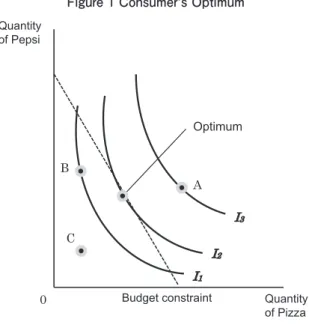
Mankiw ʼ s Principles of Microeconomics is one of the most popular economic textbooks in Japan. “ An indifferent curve shows the various bundles of consumption that make the consumer equally happy ” (Mankiw 2010 : 42 ). As Mankiw takes the example of the combination of Pepsi and pizza, the author will follow suit. Any point or all points on the same indiff erent curve indicate that the consumer is equally satisfi ed with the combination of Pepsi and pizza. See the Figure titled The Consumer ʼ s Optimum.
1110
I will use the italicized word of word
ʻirrational or
ʻirrationality
ʼin order to emphasize that it means
ʻunder-satisfaction or under under-maximization of utility,
ʼthat it does not mean
ʻpurposeless.
ʼ11
The fi gure was taken from Mankiw
2010only with Point C extrapolated by this author.
A
Quantityof Pepsi
Optimum B
I
3C I
2I
1Quantity of Pizza Budget constraint
0
Figure 1 Consumerʼs Optimum
Three indifference curves were drawn for a single consumer. A higher indiff erence curve shows the level of satisfaction of the consumer is higher than the others. Then, the textbook asks the following question: Which combination of Pepsi and pizza within the limited budget of the consumer represents the most rational choice? Given a certain budget, the budget constraint line can be drawn as in Figure 1 . Standard economics ʼ answer to the question is to choose the Optimum point where the indifferent curve I
2is tangent to the budget line. We are talking about the combination of Pepsi and pizza. The combination of these items at this Optimum point, which represents the highest satisfaction within the most efficient use of budget money, is most rational and most effi cient. An explanation attached to Figure 1 is as follows:
The consumer chooses the points on his budget constraint that lies on the highest indifference curve. At this point, . . . the highest indiff erence curve the consumer can reach is I
2. The consumer prefers point A, which lies on indiff erence curve I
3, but the consumer cannot aff ord this bundle of pizza and Pepsi. By contrast, point B is affordable, but because it lies on a lower indiff erence curve, the consumer does not prefer it. (Mankiw 2012 : 441 )
As for the choice of point B, the note above explaining that ʻ the consumer does not prefer it ʼ means that the choice is one that a consumer will not make if he or she is rational enough. The choice at point B represents an irrational selection because the choice of combination of the items does not satisfy the consumer (not maximize his or her utility) while it represents an ineffi cient choice in the sense that the consumer does not make an efficient use of the budget. It shows a double meaning of irrational choice.
Let me explain the same thing using the two agent models, the HE and the HSE models. An HE is the human actor model on which mainstream economic theor ies have adopted as a basic assumption, assuming it to refl ect rational behavior.
In this specifi c case shown in Figure 1 , any HE ought to choose the Optimum point without failure. On the contrary, an HSE is able to choose the Optimum point while it is still able to make choices other than the Optimum point. The range of choice for any HSE is in theory unlimited so that it can choose any point in the zone lower than the indiff erent curve I
1in Figure 1 .
However, the author will limit the range of choice for a consumer for the sake of simplifi cation. Let us assume that a consumer chooses point C. As point C represents a combination of less Pepsi and less pizza, the choice of point C would not satisfy the consumer.
The indiff erent curve I
1represents the combination of Pepsi and pizza that satisfi es his stomach. Though it is not clear if point C is on an indiff erent curve or not, it is inferable that point C represents a lower level of satisfaction of the consumer, the point being located below any of the current indiff erent curves shown in the fi gure. A hypothetical HE would not choose point C as it represents an irrational , in the sense that it does not maximize its utility, choice. The choice of this point is also irrational for a hypothetical HSE . Any HE would not intentionally choose the point. On the contrary, an HSE might intentionally and/or consciously make this choice.
1212
This point may be an interesting topic of
ʻfreedom from economic rationality
ʼto discuss. It leads to the argument that human beings have a right to
choose not to pursue economic rationality or effi ciency. Saeki (
2012)
ʼs following remarks shares the concern:
“Something
“irrational”or
“wasteful
”needs to be allowed to an extent in our life.
”The implication of these arguments include that the scope of choice by consumers is far wider than
economists have suggested.
4. Why does the ʜSE make an irrationaˡ choice?
Why does HSE make the choice of point C? An exploration for the reasons is not something mainstream economists are likely to tackle. For mainstream economics adopting the HE model as a basic assumption, the mission is to indicate that the choices of point B and point C are both irrational . Once indicated, the mission is thought to be completed, with no further exploration required.
However, since we have introduced the HSE model, we must be interested in the reasons of irrational choices made by HSE . With the conditions given, including purchasing item like Pepsi and pizza, in Figure 1 , a lack of information on consumer ʼ s motivation would limit the scope of plausible answers. An answer of reasoning may be something like ʻ out of consideration of his own health ʼ , which reminds me of the Japanese conventional axiom Hara-hachi-bun’me (whose literal meaning is that 80 percent gastric fullness is desirable). A plausible reason of that choice by the consumer may be ʻ out of concern for his health. ʼ Despite being a goal-rational choice, this choice should be regarded as irrational in the sense that it does not maximize its utility.
Furthermore, the choice shows that it inwardly diverts from the budget constraint line, which means that there some budget left unused, pointing to inefficiency. If we use standard terms which mainstream economists prefer to use, the point shows non-Pareto Optimal choice, leaving room for improvement.
The core information Figure 1 intends to convey to the reader is the relationship between given two commodities, Pepsi and pizza, on one hand, and the consumer, on the other; it does not contain any information on the socio-economic conditions in which the consumer is situated, such as from whom he is going to buy those items. This situational design is the source of producing HE . The isolation of HE
from its social background structure is the necessary condition of the model
13. This understanding helps us transfer with ease the HE model to the HSE model;
we can only extrapolate some additional information on environmental conditions around the model into the conditions given in Figure 1 .
Then what kinds of socio-political conditions need to be added? A minimum requirement of information necessary to be added may be the existence of a person which is ideally diff erent from a seller of Pepsi and/or pizza. Let us assume that another person is hypothetically put in the Figure 1 condition with the consumer, Pepsi and pizza given as they are. In which situation does this consumer, who is supposed to be you, make a choice which does not maximize your satisfaction in this case? We shall start with this question.
Suppose a hypothetically-added person in front of you is hungry and thirsty, while you are not either hungry or thirsty. If you offer, out of sympathy toward this miserable person before you, to share with him some portion of Pepsi and pizza which you have just bought, keeping yourself under-satisfied, your choice of off er or give-help decision then might be judged as irrational in the strict sense that your full satisfaction had to be sacrificed by your charitable behavior.
A plausible objection expected to be raised to this simulation is that such a situation is far from reality
14. Yes, it is a hypothetical case, most simplifi ed for the sake of promoting understanding by the reader. Even with given Pepsi and pizza, several stories of hypothesis could be made up, and if freed from the given commodities, far more manifold, close-to reality stories could be provided to explain the case of an under-satisfied, altruistic in a sense, consumer we have seen above. In a nutshell, there are virtually unlimited sets of combination of the agent other than the consumer and/or socio-economical environments centering the consumer appearing in Figure 1 . Thus, the ʻ far-from-reality ʼ objection above
13
The
HEmodel is assumed in the background of both the demand curve and the supply curve. It stands an isolated model divorced from other socioeconomic situations. Tominaga (
1997) called it a
ʻmonadic model
ʼ, referring to the constructions in which the model is placed, saying:
“The consumer looks as if it singularly faces an item (good). In reality, a bilateral transaction between the seller and the buyer is characterized as
ʻdyadic model
ʼ(p.
38).
14
Another objection that may be raised is the argument that since the purchaser is satisfi ed with the purchase of those items, meaning that his utility is
satisfi ed, his giving some portion of pizza and beverage to another person should be regarded as a purely social behavior, not an economic one. The
identifi cation of the purchase, prior to digestion of pizza and beverage, with the satisfaction of his utility, as economists often do, is misleading because
the timing of real satisfaction comes at his eating and drinking those items, not at his purchasing the items.
certainly fi nds ungrounded.
Amartya Sen called a choice which does not lead to maximizing one ʼ s utility ʻ counter-preferential choice ʼ (Sen 1977 : 33 ). The question we raised to be asked is: Why do people make a ʻ counter-preferential choice? We had been looking for other-regarding reasoning rather than self-regarding reasoning, which is relatively with ease to conceive, a sample of which is that the consumer does so ʻ out of concern for his health ʼ . We came to understand that the answer to the question is theoretically reachable, and we gained one at last by extrapolating socioeconomic conditions into an isolated HE condition. With application of this to a more realistic context, we have reached with confi dence an answer that reasoning such as ʻ for the sake of others ʼ or ʻ for the sake of society ʼ could be relevant motivations, even if partly, causing a consumer to make a counter-preferential choice.
Let me put the issues in order. ʻ For the sake of others ʼ or ʻ for the sake of society ʼ reasoning is not applicable to HE as it is isolated from socioeconomic conditioned it would be in
15. A real human being can, at least sometimes, if not often, give up part or whole of his interest or benefit, which would otherwise accrue to him (or would be maximized) as a result of his behaving for the sake of others or for the sake of a community it belong to or acts in. This sacrifi ce can be regarded as an irrational choice meaning that it does not help maximize its own interest, thus economically ineffi cient as well.
HE does (can) not make this choice, while HSE may make this choice. The diff erence is evident: the former is an economic agent isolated from any social environments except an object or more appearing before him for assessment, while the latter, designed to work in a real socioeconomic situation, is an agent close to a real human being; the former too simplifi ed an agent modeled after a human being, while the latter takes more manifold behavioral patterns.
5. Altruistic behaviors in the market
The HSE model needs to be conceived as part of real socioeconomic situations in which it is assumed to behave, and into these situations ethical and/or moral principles, rules and concepts are incorporated.
Then, how are ethical and/or moral elements related to irrational (meaning economically ineffi cient) choice or action of HSE ?
Commitment, as Sen wrote, involves counter- preferential choice (Sen 1977 : 93 ). It “ involves choosing an action that yields a lower expected welfare than an alternative available action. ” Sen recognized that it is in the public good area in which the question of commitment is most important, while he wrote in “ the private choice of many consumer goods, the scope for the exercise of commitment is may indeed be limited ” (Sen 1977 : 95 ). In fact, the cases he referred to in the book are “ such exotic acts as the boycotting of South African avocados or the eschewing of Spanish holidays. ” No doubt that the public goods area is the one where commitment needs to be exercised, what this author interested in is the possibility that economic agent in a market exercises commitment. In my observations, to be shown below, choices which can be regarded as kind of commitment have been exercised even in a market context. Such reasons as ʻ for the sake of somebody ʼ or ʻ for the benefi t of society ʼ can be inferred from those cases signifying the exercise of commitment.
Let me take up an example of irrational or self- sacrificing purchases. In the aftermath of the earthquakes of April 2016 hitting the Kyushu Region of southern Japan, mass media reported that a number of citizens went to what Japanese people call an antenna shop, a shop selling local specialties. People reportedly stood in a long queue before the opening of the shop located in central Tokyo to purchase products made in Kumamoto, the most affl icted area of the quake. Some of the shoppers might have come to purchase goods they like, but others might have bought things not in need, but goods related to
15
Any altruistic elements can be drawn from HE. Altruistic economics propounded by Becker (
1976); Becker (
1981) deals with a diff erent model from HE.
An actor gaining utility from taking altruistic behavior for another person is far from the archetype of HE as taking an altruistic action indicates non-
homo economicus nature. Mainstream economists tend to think that economics can defend altruistic action by using self-interest maximization theory
like one coming out of Becker
ʼs ingenuity. Altruistic economics helped strengthen links between economics and the self-interest pursuit assumption. It
is ironical enough that altruistic economics further helped solidify the selfi sh behavior ground. The point often overlooked is that effi ciency is sacrifi ced
in return for such altruistic behaviors. A predominant focus placed on utility maximization might have helped prevent the effi ciency lost concern from
emerging in sight as a problem.
Kumamoto out of consideration that they would like to support producers in Kyushu or contribute to the region ʼ s economy by their purchasing Kumamoto products. Purchases driven from such motivations would violate the assumption of the HE model which by defi nition ought to behave to maximize his utility.
A choice of a shopper not maximizing its own utility or even sacrifi cing its own utility can be regarded as an exercise of commitment ʼ . If a person purchased things he did not need, one can argue that the purpose of the purchase was to support the people or the economy of the affl icted region and can be regarded as a typical case of commitment.
16A purchase for the sake of someone could be denominated ʻ compassionate consumption ʼ— or ʻ ethically driven purchase ʼ may be a more neutral expression. Economics assume that an agent consumes something for his or her own sake so that consumption for someone else violates the economic logic, thus being not a rational consumption. In practice, however, compassionate consumption practices have become a fact. A campaign called ʻ One for One campaign ʼ that the US brand TOMS started ten years ago may be a typical example for a promotion of such consumption
17. When a consumer purchases a TOMS brand item — shoes, eyewear, coffee etc. — the company TOMS donates the same unit of it to those who need it in a developing country.
This campaign is no less than the company ʼ s CSR activity as the donor is TOMs itself, not consumers.
If a consumer purchases a TOMS good knowing that his or her purchase would contribute to the poor in a developing country, it is no longer a consumption to exclusively satisfy his or her utility. In order to sustain this business model TOMS might put higher prices on goods of its brand than otherwise. It means it virtually gives up setting a normal price, while consumers choosing TOMS brand goods intentionally choose higher priced goods. This business model
could not be sustained without such commitment by both side of the transaction.
Another pattern of compassionate consumption can be seen in a practice called suspended coffee, which reportedly has originated a century ago in Naples in Italy (Asahi Shinbun 2014 , 2016 ). A customer in a coffee shop adopting the suspended coffee system pays two cups of coffee and consume only one cup, withholding the amount for the other cup of coffee for someone having no money for coff ee. Paying double for just one cup of coff ee to be consumed is not an economically rational choice.
Should the (economic) irrationality of this choice be denied, any consumption of consumers would be regarded as rational, which is tautological.
18Let us look at the issue from a different perspective. The choice of the Optimum point may be producing economical rationality. A standard assumption is that each agent makes such a rational choice, and that the aggregation of each rational choice or the accumulative result of such choices is also positively approvable. A conviction that rational pursuit of one ʼ s own interest would promote the well- being of the whole society or serve to public interest accords to what Adam Smith ʻ s the ʻ invisible hand ʼ metaphor seems to suggest.
The conviction has been unscrupulously inherited and remains dominant to this day. Should the process generate any negative effect, it would successfully be pushed out of the economic system as ʻ externalities ʼ : some separate measures to address such externalities are incorporated into the theories of economic systems which mainstream economists advocate. So much so that a sophisticated system has been established to date, economists have not had to be bothered by questions on the ethical/moral relevancy of the aggregated or accumulated results of rational pursuit of each economic agent.
Meanwhile, critics have long been pointing that
16
Röpke (
1963)
ʼs following observations are not far from the point. There are businesses which embrace more or less an element of self-sacrifi ce (and, therefore, uncompensated
“giving
”) and of genuine service. The medical profession is one example. The, too, we expect of the scholar and of artist that they put devotion to their vacations before mere gain, and that I practicing their profession they be not motivated by the principles of the delicatessen- owner. . . . Expressions such as
“trade
”or
“business,
”applied to the professions of medicine or law, are felt to be out of place and demeaning.
”(p.
22).
17
https://www.toms.com/beyond-one-for-one
18
Economists may defend by the help of so-called
ʻwarm-glow
ʼtheory arguing that a consumer paying double for a cup of coff ee out of concern for
someone in need fi ts perfectly economically rationality because the payer gains another kind of utility (satisfaction or psychological elevation gained
through an altruistic action). The
ʻwarm-glow
ʼtheory assumes an actor maximizes his utility in return for taking an altruistic action to others. This
reasoning, as argued earlier, does not fi t HE explanations as the
ʻwarm-glow
ʼtheory assumes a diff erent actor model than HE. Paying double contradicts
economic rationality meaning thrifty. It should not be overlooked that the
ʻwarm-glow
ʼtheory paradoxically explains there are some altruistic persons in
real society.
the accumulative growth of each economic agent ʼ s maximization of satisfaction would threat to generate social negatives, such as jeopardizing the health of the natural environment. A ʻ Tragedy of the Commons ʼ alarm made by Garrett Hardin (Hardin 1968 ) is a typical example and a ʻ Limits to Growth ʼ alarm issued by the Club of Rome in the early 1970 s is another. Both represent calls for ethical/moral reassessments on what have been established as standard practices. In recent developments, the government ʼ s initiative to consider a need to legally regulate so-called high frequency trading (HFT) which would jeopardize the stability of the fi nancial market has relevancy in this topic.
The problem raised above can be summarized in the following. If it would be clear that the accumulative result of economically rational choices made by each agent would generate negative fallouts, economic agents, as ethical agents, would wisely be advised to reconsider the legitimacy of their economic standard behaviors, only to make choices adhering to lower levels of satisfaction (under- satisfaction). This process is the exercise of ʻ virtue of prudence, ʼ which Adam Smith mentioned in his Theory of Moral Sentiments (Smith 1790 ) and Sen ( 1986 ) appreciated in his works. It also relates to what Ostrom ( 1990 ) argued for
19. If this logic of thinking be approved, the choice is economically irrational one as it does not maximize the utility of the HE - conditioned chooser
20. Note that the choice was certainly rational as far as it was made aiming to support or realize certain the social cause which is reducing negative effect of his or her economic actions on the society.
Hav i ng showca sed exa mples i nvolv i ng commitment exercised in market contexts, this author makes two additional comments. First, the pattern of
commitment behavior can vary. To have an overall view of the issue and to make further analysis, an attempt to categorize a wide variety of commitment patterns is expected to be addressed in the future.
Second, we should recognize the fact that such a variety of commitment behaviors have already taken place in society. Put aside the question of whether these behaviors can be regarded as altruistic, they undoubtedly involve ethical or moral elements in one sense or another. This indicates that the traditional ʻ self-interest maximization ʼ theory has to work too hard to relevantly and convincingly explain the quality of commitment-related actions taken in a market context.
Concluding Remarks
One of the main characteristics of the HE model lies in its isolation from all social background conditions except the limited amount of information such as presence of an object or two for it to mull over and/or information on the price(s), or the amount of resources available. The model is designed as an agent aiming to maximize its own interest, itself freed from any social constraint including ethical or moral concerns; the only constraint, if any, is budget constraint or the limited amount of resources given.
This isolation not only underlies the economic agent;
it may also involve the separation of the economic system from other socio-political and ethical systems.
The HSE model, designed to overcome the fl aws mentioned above, posits an agent who can behave in given socio-political conditions, which inherently includes ethical and/or moral elements including social institutions
21. The introduction of the HSE model ushers in ethical/moral elements into the circumstances in which it acts; thus it, as an agent
19
Ostrom (
1990) demonstrated that several parties sharing a commons able to manage the commons through their voluntary provisions of resources without any help of public power. This implies the possibility that actor
ʼs voluntary action for public interest may help resolve economic externalities.
20
Suppose a case in which an economic actor decides to decrease his use of resources considering that accumulative eff ects of choices, even if rational, by each actor would lead to enhanced risk of the depletion of the natural resources. This decision seems rational at fi rst glance, but it involves the loss of effi ciency taking place in the side of this actor since he has to sacrifi ce (or give up) some of its utility he would otherwise get. This case indicates how pro-social concern works in practice with a fraction of loss inevitably accruing. This explains why an
ʻinternalization of externalities
ʼprocedure, which we borrow from mainstream economists
ʼvocabulary, would be required. Parties concerned, on trying to solve a social issue by sharing the cost, would emerge as
homo socio-economicus, not
homo economicus. The point of my emphasis is that the internalization of externalities is a result of an externalization process. If there were no externalities, there would be no need for the internalization of them.
21