The Legal status of genetic resource in Vietnam from the perspective of legitimacy
Kobayashi Kunihiko1
1 Research Institute for Humanity and Nature, [email protected]
Abstract
Law is a legitimizing authority. Legitimacy is “the acceptance and justification of shared rule by a community” (Bernstein 2005). In liberal democratic systems, governments are typically legitimized through electoral processes, and their decisions are given weight by legislation (Boedeltje and Cornips 2004). In fact, as G. Sakamoto et al. (2016) pointed out, legitimacy depends on acceptance by the community or people, and the results of the acceptance, such as law. Legitimacy is one of the components for effective governance in sustainable development (Michael Lockwood 2010), because the cases that have a lack of legitimacy will result in conflict between the local community and the rights owner or a local authority.
Given this context, this paper focuses on an aspect of law, with a particular focus on genetic resources in Vietnam. Genetic resource was stipulated in international conventions, such as the Convention on Biological Diversity(CBD). In particular, CBD recognizes the sovereign rights of states over their natural resources, and their authority to control access to genetic resources. Being under the jurisdiction of the national governments, it is therefore subject to national legislation. However, CBD does not refer to the legal status of the genetic resource because that is dependent on the national legislation. Previous studies, such as Elisa Morgera(2013),Rosendal, G. Kristin(2016)have focused on the national ABS system but have not focused on legal status.
This paper, therefore, aims to fill the gap and focus on the expanded legal nature of genetic resources in Vietnam.
Survey results have shown that by reviewing relevant law documents on genetic resources in Vietnam, such as the Civil Code (2015 revised), Biodiversity Law (2008), and the Seed Ordinance (2004), genetic resource was clearly established as a people- owned property, as stipulated in the Biodiversity Law. People-owned property implies management by the State belonging to the entire people with the representation and centralized management of the State, as provided Civil Code. However, Seed Ordinance stipulated that “plant genetic resources are national property which is managed by State”, but at the adoption of Biodiversity Law, Ordinance wasn’t in force. This Ordinance was made by the National Assembly Standing Committee, and will be submitted to the Diet only after it is enforced for a certain period of time and deliberated on to determine whether it should be legalized or not. The Law on Promulgation of legislative documents provide the general legal framework of Vietnam and in accordance with its law, Law is a superior norm comparing with Ordinance.
It may not be appropriate to compare the different legal nature of a Law and an Ordinance, however, this shift from being a national property to a people-owned property, is an immensely important aspect from the perspective of legitimacy. This is particularly true for the users of genetic resources, such as breeding companies, universities and farmers. The reason to occur such a shift will be surveyed as future challenge.
Keywords: Genetic Resource, Legitimacy, Vietnam, Biodiversity Law, legal status
1. Introduction
Law is a legitimizing authority. Legitimacy is “the acceptance and justification of shared rule by a community” (cited in Bernstein 2005). In liberal democratic systems, governments are typically legitimized through electoral processes, and their decisions are given weight by legislation (Boedeltje and Cornips 2004). In fact, as G. Sakamoto et al. (2016) pointed out, legitimacy depends on acceptance by the community or people, and the results of the acceptance, such as law. Legitimacy is one of the components for effective governance in sustainable development (Lockwood 2010), because the cases that have a lack of legitimacy will result in conflict between the local community and the rights owner or a local authority.
On the other hand, genetic resources were stipulated in international conventions, such as the Convention on Biological
Diversity(CBD), its Nagoya Protocol on Access and Benefit Sharing (ABS)
1, International Treaty on Plant Genetic
Resources for Food and Agriculture and WHO Pandemic Influenza Preparedness (PIP) Framework regarding the access,
utilization and benefit-sharing. In particular, CBD recognizes the sovereign rights of states over their natural resources, and
their authority to control access to genetic resources. Being under the jurisdiction of the national governments, it is therefore
subject to national legislation
2. However, CBD does not refer to the legal status (such as utilization and transfer to others) of
genetic resources because this is dependent on national legislation. Previous studies, such as Elisa Morgera(2013)and
Rosendal, G. Kristin(2016)have discussed national ABS systems but have not focused on legal status. On the other hand, Imaizumi(2010), for example, is trying to clarify how seeds are handled from international institutions related to plant genetic resources such as Convention on the Protection of New Varieties of Plants 1991 (herein after “UPOV 1991 Convention”), Convention on Biological Diversity and International Treaty on Plant Genetic Resource for Food and Agriculture (ITPGR) and practical approaches in Europe. In addition, Nemoto et al. (2008) is trying to clarify how seed transactions are done in Germany, Netherlands and Asia, using sociological methods. In each of the preceding studies discussed above, although discussion on plant genetic resources is made from different viewpoints, the terms "seed" and "plant genetic resource" are used without distinction. When genetic functions are used as value objects, it will be treated as genetic resource, but if it is not, such as agricultural product and food, that will be treated as biological resource (Isozaki 2015)
3.
Given this context, this paper focuses on an aspect of law, with a particular attention to genetic resources in Vietnam.
Vietnam is chosen as a case study because it is a socialist country but has characteristics such as a member of UPOV 1991 Convention.
2. Methods
In this study, I will examine according to the following procedure.
(A) Clarify the Vietnamese legal system and legal framework on plant genetic resources
(B) Clarify the legal status of plant genetic resources from the relevant law such as Civil law, biodiversity law, seed ordinance and intellectual property law.
(C) Consider the legal status of plant genetic resource from the view of legitimacy and conclude the tentative results.
The following database and methods to identify the “relevant laws and regulations” were utilized;
1. Literatures
2. ECOLEX ( https://www.ecolex.org/ ) is an information service on environmental law, operated jointly by FAO, IUCN and UNEP.
3. Interviews to JICA experts and staff of relevant Ministry in Vietnam such as Ministry of Agriculture and Rural Development and Ministry of Natural Resources and Environment (from the dates of August 29
thto September 6
th, 2017) 3. Legal framework on plant genetic resources in Vietnam
3-1.Overview of Vietnam
Vietnam is regarded as a socialist country, but in 1986 adopted the Doi Moi policy which is based on the introduction of a market economy system and an opening to the world at the 6th Communist Party Congress. Since then, Vietnam is working to strengthen structural reforms and international competitiveness, for example, by signing Trans-Pacific Partnership (TPP:
Trans-Pacific Strategic Economic Partnership Agreement) and ratification of UPOV Convention and the WTO Agreement.
The current situation of the ratification of the international convention related to plant genetic resources are shown in Table 1. One of the major industries in Vietnam is the agriculture, forestry and fisheries industry, especially coffee is the second largest production in the world (JETRO, 2011).
Table 1.Current situation of the ratification of international convention relevant to plant genetic resources as of 12th of March, 2018
The name of Convention The date of Ratification
Convention on Biological Diversity 14th of February, 1995
International Treaty on Plant Genetic Resources for Food and Agriculture Non (Not Ratify) International Union for the Protection of New Varieties of Plants 24th of November, 2006 WTO Agreement on Trade-Related Aspects of Intellectual Property Rights 11th of January, 2007
3-2.The legal system of Vietnam
Vietnam legal system was enacted in 1997 by the "Law on Promulgation of legislative documents”. After the enactment in 1997, the law was revised three times: 2002, 2008 and 2015 (Endo, 2007), and in its amendments, the content related to the legal system has also seen some changes
4.
The law is enacted within the scope of the Constitution by the National Assembly. The Ordinance as a lower level of the law is enacted by the Standing Committee established in the National Assembly. Matters specified by the Ordinance are not necessarily clearly defined, but they are enacted on matters authorized by the National Assembly, submitted to the Diet after being enforced for a certain period, deliberated and decided whether or not to legalize. (Revised in 2015, this has been changed to not give the enactment right by the National Assembly Standing Committee). Regarding the Ordinance, Kawazu (2003) pointed out that "It is meaningful as supplementing the part that can’t be dealt with in the Diet in the cases that needs to be established due to urgency and to have the same effect as the law. Because the Diet held only twice a year and the enacted number is limited." The overview of the Vietnamese legal system is showed in Fig 1.
3-3.Legal framework on plant genetic resources in Vietnam
The plant genetic resources were stipulated in biodiversity law and seed ordinance that dealt with the acquisition and transfer of plant genetic resource mainly. In addition to perspective of the intellectual property right, intellectual property law has also been enacted on the aspects of use of plant genetic resources. Others laws would also cover plant genetic resources such as Natural Resources Act (1999), Conservation Law (2005 revision), and forest protection law (2004 revision) (Pham Thi Sen et al, 2010 ).
4. Results and Discussion on legislation concerning plant genetic resource and its relationship
In this section, I expound on how the plant genetic resource is regarded as legal status from the Constitution and Civil Code.
The general principles regarding property rights and biodiversity law, seed ordinance and intellectual property law are defined in relation to genetic resources.
4-1.Constitution / Civil Code
General principles, rights and obligations relating to property rights are stipulated in the Constitution and the Civil Code.
Article 53 of the Vietnam Constitution’"The land, water resources, mineral resources, resources in the sea and airspace, other natural resources and property invested and managed by the State are public properties, coming under ownership of the entire people represented and uniformly managed by the State" so that the State manages the natural resource as a common property uniformly without giving the property rights to individuals. It is similarly prescribed in Article 197 of the Civil Code, but individuals and corporations can use and develop property rights in line with purpose based on the management by the State (Article 203).
4-2.Biodiversity law and its decree on the management of access to genetic resources and the sharing of benefits arising from their utilization
Biodiversity law was enacted in 2008 and after the adoption, the decree on the management of access to genetic resources and the sharing of benefits arising from their utilization (hereinafter, ABS Decree) was enacted in 2017 and it has been operational.
Biodiversity law is not limited to the provision of acquisition of genetic resources. The law has a wide range of content related to biodiversity conservation, such as the planning of protected areas to clarify the rights and obligations of organizations, households and individuals for the biodiversity conservation and sustainable development.
Constitution
Codes and Laws of the National Assembly
Ordinances of Standing Committee of the National Assembly
Decrees of the Government
Upper
lower Fig 1 Vietnamese legal system
Genetic resources, are defined under the title of "conservation and sustainable development of genetic resources (Chapter 5)”.
Article 55 stipulates "the State uniformly manages all genetic resources in the Vietnamese territory" so that the management authority of the genetic resources is in the State. In the law, genetic resources were defined as “all species and genetic specimens in nature, conservation areas, biodiversity conservation facilities and scientific research and technological development institutions and in nature”. Upon this provision the State assigns organizations and individuals to manage genetic resources.
Article 56 stipulated the rights and obligations of the appointed individuals or organizations; Article 57-59 defines procedures relating to the acquisition of genetic resources, including contract and application contents; and Article 60 stipulates the rights and obligations of individuals or organizations that acquired genetic resources. Rights (a and b) and obligations (c-e) given to appointed individuals and organizations are as follows:
a) To investigate and collect genetic resources assigned to them for management;
b) To exchange, transfer and supply genetic resources assigned to them for management to other organizations or individuals in accordance with law;
c) To notify competent state management agencies of the exchange, transfer or supply of genetic resources to other organizations or individuals for purposes of research and development and production of commercial products;
d) To enter into contracts on access to genetic resources and benefit sharing with organizations or individuals that are granted licenses for access to genetic resources under Article 59 of this Law;
e) To control the investigation and collection of genetic resources by organizations and individuals that are granted licenses for access to genetic resources;
In this manner, the appointed individuals are obliged to investigate, collect and provide genetic resources. When acquiring genetic resources from individuals who have administrative authority, they are entitled to conduct investigation activities, collect, export, use of genetic resources, and comply with contracts, submit reports, and share the benefits from its use (Article 60). The transfer of genetic resource to a third party is prescribed in Article 14 of the ABS decree and can be done if the requirements are satisfied. Furthermore, in the acquisition of intellectual property rights, it is required to identify the source or origin of genetic resources.
4-3.Seed ordinance
Seed ordinance was enacted by the National Assembly of the Standing Committee on March 24, 2004. Seed ordinance stipulated the research, selection, evaluation, testing, protection on new plant varieties and the quality management of the seed.
In this ordinance, plant genetic resources is defined as follows: " whole plant or any part of plant which has genetic information to be able to breed or used in breeding new plant variety" in Article 2. The provisions on the management and preservation of plant genetic resources are set in Articles 10 to 13 of Chapter 2.
In Article 10, “Plant genetic resources are national property which is managed by the State” so that, if there is a new exploitation and a request for use, a person needs to require the permission from the Ministry of Agriculture and Rural Development, Ministry of Fishery. Further, while in the case of exchanging a rare plant genetic resource, it should be within the purpose of research, selection, breeding, production and trading of new plant varieties. For the exchange of international rare plant genetic resources it is stipulated to acquire the approval of Minister of Ministry of Agriculture and Rural Development, Ministry of Fishery.
4-4.Intellectual property law
The Intellectual Property Act was enacted in 2005, revised in 2010, and currently in operation. Newly developed varieties by breeding can be protected and acquired exclusive rights (breeder’s right) in accordance with this law. The law has set the 2 types of the rights. One is the right to give to those who developed new varieties. The other is the right given to the person possessing the plant variety protection certificate through the procedure as defined in the law. The right to give to the person who developed the new varieties is defined as "the right of the organization or individual to the new varieties of plants created or discovered and developed by the organization or individual and falling under the ownership of the organization or individual" in the Article 4. In addition, the right of a person having a plant variety protection certificate relates to production, sales offer, import and export as prescribed in the UPOV Convention. It is possible to obtain the right that satisfies the condition (Article 158) judged to be a new breed, by a predetermined examination procedure (Article 164). Penalties are imposed as infringement of rights if the above acts are done without obtaining permission from a person having a protection certificate.
However, acts such as private use for non-commercial purposes, scientific research purposes and to create other plant varieties are not regarded as exception for breeder's rights in the Article 190.
5. Discussion and Conclusions on the legal status on plant genetic resources in Vietnam and further issues from the “legitimacy”
In Vietnam, the plant genetic resources are regarded as state-owned property in the Seed Ordinance, enacted by the Standing Committee of the National Assembly in 2004, but in the Biodiversity Act, enacted by the National Assembly in 2008, the genetic resources are managed by the State belong to the entire people with the representation and centralized management of the State. On the legal system of Vietnam, since the law established by the National Assembly takes precedence over Ordinance established by the Standing Committee of the National Assembly, the Biodiversity Act has been in operation since 2008.
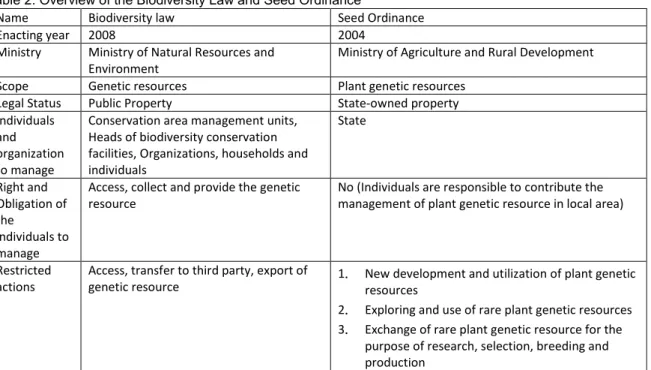
Therefore, although plant genetic resources were regarded as state-owned property, it was clear that it can be positioned as public property by the enactment of the Biodiversity Act. However, different contents of genetic resources and plant genetic resources were restricted in each law and ordinance (see Table 2).
Biodiversity Act obliged the individuals and organizations to access, collect and provide the genetic resources.
Table 2. Overview of the Biodiversity Law and Seed Ordinance