Introduction
A high percentage of hepatocellular carcinoma
(HCC)patients exhibit viral hepatitis and liver cir- rhosis; an average of approximately 20% of pa- tients experience recurrent HCC lesions every year after treatment.1) 4) However, no drugs signifi- cantly inhibiting the recurrence are yet available.
In 1998 Lever et al. reported that longterm ad- ministration of ACE inhibitors resulted in a de-
crease in the mortality of cancer.5) In 2001, Yoshiji et al. examined the effects of ACE inhibi- tors on the growth of mouse liver cancer, thus re- porting that perindopril significantly inhibited the growth of liver cancer, probably though its neovas- cularization inhibiting effect6)7) in comparison to the control. It is possible that ACE inhibitors ex- ert a neovascularization inhibiting effect on can- cers with a strong tumor vessel proliferation such as liver cancer. To examine the effect of ACE in- hibitors on the recurrence of HCC, we retrospec-
Follow up Study on Recurrence of Hepatocellular Carcinoma in Patients Administrated ACE Inhibitor
Kaoru IWATA, Tetsuro SOHDA, Akira ANAN, Makoto IRIE, Yasuaki TAKEYAMA, Satoshi SHAKADO
and Shotaro SAKISAKA
Department of Gastroenterology and Medicine, Faculty of Medicine, Fukuoka University, Fukuoka, Japan
Abstract:Background/Aims:Hepatocelluar carcinoma(HCC)has a higher rate of recurrence after treatment because of its multiple central growth and intrahepatic metastasis in compari- son to other cancers. Recent studies have shown angiotensin converting enzyme(ACE)inhibi- tors to reduce the mortality rate of cancer through its inhibitory effect on neovascu- larization. We therefore examined effects of ACE inhibitors on the growth of HCC which ac- companies profound neovascularization. The inhibition of the growth of cancer by ACE inhibi- tors is said to induce neovascularization. ACE inhibitors are therefore expected to be effective for the treatment of HCC with many newly formed blood vessels. Method:Of the 318 patients who were diagnosed with HCC and received medical treatment initially, 32 patients with a tumor diameter of less than 5 cm and hepatic reserve capacity classified as A or B according to the Child s classification, who take only one kind of antihypertensive agent because of hypertension developing complication, were selected as the subjects. Ten of those patients were taking ACE inhibitors while and 22 patients were taking calcium antagonists. Results:Concerning the clini- cal features, significant differences were found in the diastolic pressure but not in the number of tumors and tumor diameter between the two groups. The 3year recurrence rate was 67.5% in the ACE inhibitor group and 62.6% in the calcium antagonist group(p=0.851). Conclusion:
According to the retrospective investigation, no significant difference in the 3year recurrence rate was found between the group of ACE inhibitor and calcium antagonist.
Key words:Angiotensin converting enzyme(ACE)inhibitor, Hepatocelluar carcinoma
(HCC), Calcium antagonist, Recurrent rate of HCC
Correspondence to:Kaoru IWATA, M.D., Ph.D.
Department of Gastroenterology and Medicine, Faculty of Medicine, Fukuoka University, 7 45 1 Nanakuma, Jonanku, Fukuoka City, 8140180, Japan
Tel:(81)92 801 1011(ext 3355) Fax:(81)92 874 2663 E mail:iwata k@fukuoka u.ac.jp
tively investigated recurrence after treatment of HCC in patients who had taken a antihypertensive agent over a long period of time for the treatment of hypertension accompanying HCC.
Subjects and Methods
1. Patients
Of the 318 patients who were diagnosed to have HCC and received initial treatment(percutaneous ethanol injection therapy, hepatic artery emboliza- tion therapy and combined use of both therapies ) at Fukuoka University Hospital during a 5year period, 234 patients had a HCC a tumor diameter of less than 5 cm, a hepatic reserve capacity classi- fied as A or B according to the Child’ classification and a clinical effectiveness rated as either a com- plete response(CR)or good partial response
(PR). The diagnosis of HCC was made based on abdominal ultrasonography(US), computed tomo- graphy(CT)imaging, and/or hepatic arterial an- giography, tumor target biopsy. Of them, 32 patients who had been complicated by hyertension and had taken only one kind of antihypertensive agent regularly(mean age 67.6±7.0 years, range 53 80)were thus selected as the subjects. Hyperten-
sion was defined as either a systolic pressure con- sistently at 140 mmHg or higher or a diastolic pres- sure consistently at 90 mmHg or higher. They included 24 males and 8 females. Of the 32 pa- tients, ten patients of them were taking ACE in- hibitor and 22 patients were taking calcium antagonist. The ACE inhibitors administered to
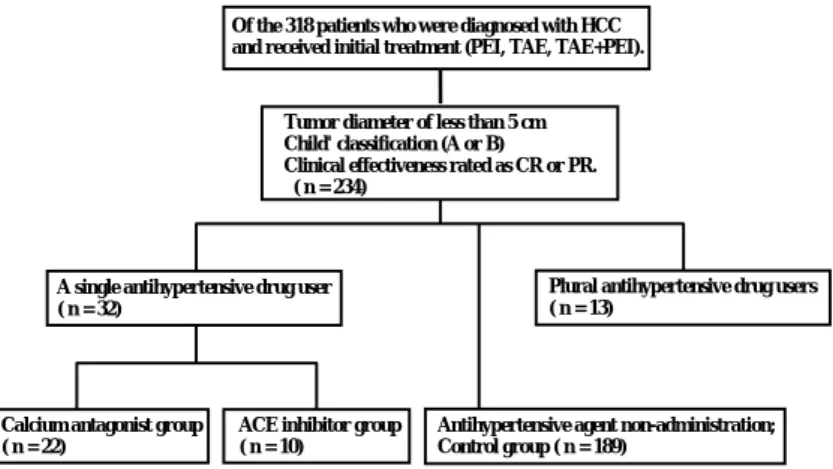
ten cases of the ACE inhibitor group were enala- pril for five cases, imidapril for three cases and te- mocapril for two cases. Both antihypertensive agents were continuously administrated through- out the follow up period. They were divided into the ACE inhibitor group and calcium antagonist group for study of the recurrence rate. Of the re- maining 202 patients, 189 patients excepting 13 pa- tients taking antihypertensive agents other than ACE inhibitors or calcium antagonists or more than two antihypertensive agents were designated as the antihypertensive agent nonadministration group, and the cumulative recurrence rate of these 189 patients was used as the drug non administra- tion control(Figure 1).
2. Follow up of the patients
After the complete initial treatment for HCC, the patients were followed up at the outpatient department. When a new lesion of HCC found by abdominal US or CT during a regular observation, it was defined as recurrence.
3. Statistical analysis
The data are presented as the means±standard deviation. The significance of differences among different groups was determined by Student’s t test. Recurrent curves were constructed accord- ing to the Kaplan Meier method and were com- pared using the log rank test.
Of the 318 patients who were diagnosed with HCC and received initial treatment (PEI, TAE, TAE+PEI).
Tumor diameter of less than 5 cm Child' classification (A or B) Clinical effectiveness rated as CR or PR.
( n = 234)
Plural antihypertensive drug users ( n = 13)
A single antihypertensive drug user ( n = 32)
Calcium antagonist group ( n = 22)
ACE inhibitor group ( n = 10)
Antihypertensive agent non-administration;
Control group ( n = 189)
Figure 1. Study flow chart. PEI:percutaneous ethanol injection therapy, TAE:hepatic artery embolization therapy, CR:
complete response, PR partial response.
Results
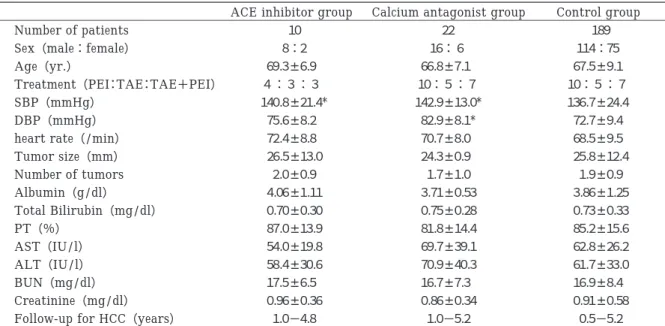
Table 1 shows the clinical features. No signifi- cant difference was found in the tumor diameter and number of tumors. Nor was there any signifi- cant difference in the liver reserve capacity includ- ing alubumin, PT, and total bilirubin. No signi- ficant difference in the blood pressure was found between the two groups during the administration of antihypertensive drugs. The systolic blood pressure was significantly higher in the two groups in comparison to the control.
The recurrence rate was 50% , number of days of recurrence 590 in the ACE inhibitor group and
50% , 713 in the calcium antagonist group, but sta- tistically no significant difference was found. The comparison between each with the control did not show any significant difference in comparison to the rate of recurrence(Figure 2).
Complications other than hypertension in the pa- tients taking depressors included diabetes in nine cases, chronic renal failure in three cases, long standing cerebral infarction in two cases and long standing cerebral hemorrhage in one case. No se- rious events due to these diseases were found dur- ing the follow up period. Three patients died during the follow up. No patient died due to the side effects of the medicine. As for their cause of death, hepatic failure death(decompensation liver
Table 1. Clinical characteristics of two groups.
Control group Calcium antagonist group
ACE inhibitor group
189 22
10 Number of patients
114:75 16:6
8:2 Sex(male:female)
67.5±9.1 66.8±7.1 *
69.3±6.9 * Age(yr.)
10:5:7 10:5:7
4:3:3 Treatment(PEI:TAE:TAE+PEI)
136.7±24.4 142.9±13.0*
140.8±21.4*
SBP(mmHg)
72.7±9.4 82.9±8.1*
75.6±8.2 * DBP(mmHg)
68.5±9.5 70.7±8.0 *
72.4±8.8 * heart rate(/min)
25.8±12.4 24.3±0.9 *
26.5±13.0* Tumor size(mm)
1.9±0.9 1.7±1.0 *
2.0±0.9 * Number of tumors
3.86±1.25 3.71±0.53*
4.06±1.11* Albumin(g/dl)
0.73±0.33 0.75±0.28*
0.70±0.30* Total Bilirubin(mg/dl)
85.2±15.6 81.8±14.4*
87.0±13.9* PT(%)
62.8±26.2 69.7±39.1*
54.0±19.8* AST(IU/l)
61.7±33.0 70.9±40.3*
58.4±30.6* ALT(IU/l)
16.9±8.4 16.7±7.3 *
17.5±6.5 * BUN(mg/dl)
0.91±0.58 0.86±0.34*
0.96±0.36* Creatinine(mg/dl)
0.5−5.2 1.0−5.2 *
1.0−4.8 * Follow-up for HCC(years)
ACE:angiotensin converting enzyme;PEI:percutaneous ethanol injection therapy;TAE:hepatic artery emboli- zation therapy;SBP:systolic blood pressure;DBP:diastolic blood pressure;PT:prothrombin time;ICG R15%:
indocyanine green clearance teat;AST:asparate aminotransferase;ALT:alanine aminotransferase;BUN:blood urea nitrogen;NS:not significant. *P<0.05 vs Control group
Figure 2. The significant difference was not recognized among three groups.
cirrhosis)was the cause in two cases and tumor death(HCC)was the cause in one case.
Discussion
HCC has a high rate of recurrence two years af- ter treatment in from 4080% of all cases in com- parison to other cancers because of its multi central growth and intrahepatic metastasis. How- ever, no drugs significantly inhibiting recurrence are yet available.
The longterm administration of ACE inhibitors has been reported to lead to a decrease in the mor- tality rate of cancer.5)
Yoshiji et al. examined effects of ACE inhibi- tors on the growth of HCC transplanted to nude mouse, and they concluded that perindopril among the ACE inhibitors significantly inhibited the growth of liver cancer in comparison to the control.6)7) Furthermore, angiotensin Ⅱ accelerated the expression of VEGF mRNA and angiotensin Ⅱ had a neovascularization promoting effect.8)9)In addition, neovascularization in diabetic retinopa- thy has also been reported to be inhibited by the ad- ministration of ACE inhibitors.10)11)Presumably, the production of angiotensin Ⅱ is inhibited by the administration of ACE inhibitors and, as a result, the neovascularization of tumors is hindered and the growth of tumors is suppressed.
Our research did not demonstrate any signifi- cant difference in the recurrence rate of HCC pa- tients in the ACE inhibitor group, calcium antagonist group, and control group. The results of our recurrence rate of HCC were the same as the recurrence rate of HCC of other reports.1)4) The following may be mentioned as a possible reason why no significant difference in the recurrence of cancer was found between the ACE inhibitor group, calcium antagonist group and non antihy- pertensive agent administration group in the pre- sent study.
Yoshiji et al. suggested that the influence of the ACE inhibitor on angiogenesis occurs in a com- pound specific manner.5) VEGF is now widely known to be one of the most potent angiogenic fac- tors, and as a survival factor of tumor. VEGF and its receptor interaction is believed to play a ma- jor role in angiogenesis in human tumors. VEGF
is regulated by several factors, including AT
Ⅱ. The ACE inhibitor perindopril has been shown to significantly inhibit tumor growth and angio- genesis along with suppression of the VEGF level. An other possible cause, perindopril which was described in Yoshiji's report, was not investi- gated in our research. In addition, there is a diffe- rence in the quantity of the ACE inhibitor between animal experiments and the clinical dose.
The chymase system is a system by which the production of angiotensin Ⅱ does not depend on an angiotensinconverting enzyme.12)14)
An angiotensin Ⅱ receptor antagonist was devel- oped which does not contribute to the chymase system.15)16)
Based on the above findings, a prospective inves- tigation using these angiotensin Ⅱ receptor an- tagonists is thus considered to be required.
References
1)Teratani T, Yoshida H, Shiina S, Obi S, Sato S, Tate- ishi R, Mine N, Kondo Y, Kawabe T, Omata M. Radiofrequency ablation for hepatocellular car- cinoma in socalled highrisk locations. Hepatology 43:1101 1108, 2006.
2)Ikeda K, Arase Y, Kobayashi M, Saitoh S, Someya T, Hosaka T, Suzuki Y, Suzuki F, Tsubota A, Akuta N, Kumada H. Significance of multicentric cancer re- currence after potentially curative ablation of hepato- cellular carcinoma:a longterm cohort study of 892 patients with viral cirrhosis. J Gastroenterol 38:
865 876, 2003.
3)Tsukuma H, Hiyama T, Tanaka S, Nakao M, Yabuuchi T, Kitamura T, Nakanishi K, Fujimoto I, Inoue A, Yamazaki H, et al. Risk factors for hepato- callular carcinoma among patients with chronic liver disease. N Engl J Med 328:1797 1801, 1993.
4)Kumada T, Nakano S, Takeda I, Sugiyama K, Osada T, Kiriyama S, Sone Y, Toyoda H, Shimada S, Taka- hashi M, et al. Patterns of recurrence after initial treatment in patients with small hepatocellular carcinoma. Hepatology 25:87 92, 1997.
5)Lever AF, Hole DJ, Gillis CR, McCallum IR, McInnes GT, MacKinnon PL, Meredith PA, Murray LS, Reid JL, Robertson JW. Do inhibitors of angiotensin 1 converting enzyme protect against risk of cancer ? Lancet 352:179 184, 1998.
6)Yoshiji H, Kuriyama S, Kawata M, Yoshii J, Ike- naka Y, Noguchi R, Nakatani T, Tsujinoue H, Fukui H. The angiotensin I converting enzyme inhibitor perindopril suppresses tumor growth and angiogene-
sis:possible role of the vascular endothelial growth factor. Clin Cancer Res. 7:1073 1078, 2001.
7)Yoshiji H, Kuriyama S, Fukui H. Angiotensin I converting enzyme inhibitors may be an alternative antiangiogenic strategy in the treatment of liver fi- brosis and hepatocellular carcinoma. Possible role of vascular endothelial growth factor. Tumour Biol. 23:348 356, 2002.
8)Ichiki T. Role of renin angiotensin system in angio- genesis:it is still elusive. Arterioscler Thromb Vas Biol. 24:622 624, 2004.
9)Otani A, Takagi H, Oh H, Suzuma K, Matsumura M, Ikeda E, Honda Y. Angiotensin Ⅱ Stimulated Vas- cular Endothelial Growth Factor Expression in Bo- vine Retinal Pericytes. Investigative Ophthalmo- logy and Visual Science. 41:1192 1199, 2000.
10)Wilkinson Berka JL. Diabetes and retinal vascular disorders:role of the renin angiotensin system.
Expert Rev Mol Med. 6:1 18, 2004.
11)Skopinski P, Sommer E, Borowska A, Hevelke A, Ro- gala E, SkopinskaRozewska E. Angiotensincon- verting enzyme activity and angiomodulatory effects
of sera in patients with diabetic retinopathy. Int J Clin Pharmacol Res. 21:73 78, 2001.
12)Arakawa K, Urata H. Hypothesis regarding the pa- thophysiological role of alternative pathways of angi- otensin formation in atherosclerosis. Hyper- tension 36:638 641, 2000.
13)Urata H, Strobel F, Ganten D. Widespread tissue distribution of human chymase. J Hypertens Suppl.
12:17 22, 1994.
14)Urata H, Ganten D. Cardiac angiotensin Ⅱ forma- tion:the angiotensinI converting enzyme and hu- man chymase. Eur Heart J. 14:177 182, 1993.
15)Benndorf R, Boger RH, Ergun S, Steenpass A, Wie- land T. Angiotensin Ⅱ type 2 receptor inhibits vas- cular endothelial growth factorinduced migration and in vitro tube formation of human endothelial cells. Circ Res. 93:438 447, 2003.
16)Wilkinson Berka JL. Diabetes and retinal vascular disorders:role of the renin angiotensin system. Ex- pert Rev Mol Med. 6:1 18, 2004.
(Received on July 4, 2008, Accepted on September 5, 2008)