Acta Med. Nagasaki 46 : 49-53
Effects of Pulmonary Rehabilitation for Patients with Chronic Pulmonary Diseases with Different Types of Ventilatory Defects: Relationships between Pulmonary Function Parameters and Exercise Torelance
Hidefumi ISHIKAWA 1), Kazunori OISHI 1), Hideaki SENJYU 2), Masashi YAMAMOTO 3)
1) Department of Internal Medicine, Institute of Tropical Medicine, Nagasaki University 2) Department of Physical Therapy, The School of Allied Medical Science, Nagasaki University 3) Department of Medicine, Tagami Hospital
This prospective cohort study was conducted to determine which pulmonary function parameters are useful in the pre- diction of exercise torelance and exercise-induced hypoxemia (EIH) among patients with chronic pulmonary diseases with different types of ventilatory defects. Fifty one patients with chronic pulmonary diseases who underwent comprehensive pulmonary rehabilitation for periods of 4 to 8 weeks, and who were classified as to different types of ventilatory de- fects; obstructive, restrictive and mixed type based on their pulmonary functions. All patients were measured for pulmo- nary function parameters, 6-minute walking distance (6MD) and the activity of daily living (ADL) before and after pulmo- nary rehabilitation. After pulmonary rehabilitation, the pa- tients demonstrated a significant (p<0.001) increase in 6 MD and ADL scores for all types of ventilatory defects. In the relationship between 6 MD and pulmonary function pa- rameters, the forced expiratory volume in 1 sec. (FEV1.0) was significantly correlated with 6 MD for all types of ventilatory defect. Vital capacity (VC) and maximal volun- tary ventilation (MVV) correlated with 6MD in the obstruc- tive and the mixed ventilatory defects, and PaO2 correlated with 6 MD relative to mixed ventilatory defects. In the rela- tionship between EIH and pulmonary function parameters, VC significantly correlated with EIH relative to restrictive ventilatory defects. FEV1.0 and MVV correlated with EIH relative to obstructive ventilatory defects. Our present data suggest that specific pulmonary function parameters which can be correlated with 6 MD and EIH for different types of ventilatory defects, may be useful in terms of devising pul-
monary rehabilitation protocols for these patients.
ACTA MEDICA NAGASAKIENSIA 46 : 49-53, 2001
Address Correspondence: Hidefumi Ishikawa, M.D.
Department of Internal Medicine, Institute of Tropical Medicine, Nagasaki University, 1-12-4 Sakamoto, Nagasaki 852-8523, Japan
TEL: +81-95-849-7842 FAX: +81-95-849-7843
Key Words: pulmonary rehabilitation; pulmonary function pa
rameters; 6-minute walking distance; exercise-
induced hypoxemia; chronic pulmonary disease;
activity of daily living
Abbreviations: 6MD=6-minute walking distance; EIH=exercise -induced hypoxemia; ADL=activity of daily
living; FEV,.o=forced expiratory volume in 1
sec.; FVC=forced vital capacity; VC=vital ca
pacity; MVV=maximal voluntary ventilation;
TB seq=sequela of pulmonary tuberculosis;
SpO2=arterial oxygen saturation by pulse
oximetry; PI max=maximal inspiratory pres sure; VO2max=maximal oxygen uptake
Introduction
Two common types of chronic pulmonary diseases, such as chronic obstructive pulmonary disease (COPD ) and restrictive lung diseases, are known". The restric- tive lung diseases involve pulmonary fibrosis, pleural diseases including sequela of pulmonary tuberculosis
(TB seq), and skeletal abnormalities'. With an in- creased number of elderly in the general population, the importance of pulmonary rehabilitation for chronic pulmonary diseases has been highlighted. However, the effectiveness of pulmonary rehabilitation for patients with chronic pulmonary diseases other than COPD has received less attention'-". No studies have been con- ducted relative to evaluating the effects of pulmonary rehabilitation for chronic pulmonary diseases which are associated with different types of ventilatory de- fects, although Foster, et al.') recently reported that pulmonary rehabilitation is beneficial for patients with severe chronic pulmonary diseases other than COPD, as well as for patients with COPD.
Pineda, et al.') demonstrated that maximum oxygen consumption was correlated with FEV,.o and MVV in
patients with COPD. Furthermore, several studies° 1~
have previously reported that the evaluation of pulmo- nary function parameters is helpful in predicting which patients are likely to develop increasing hypoxemia dur- ing exercise in cases of COPD. However, little is known about the relationship between pulmonary function pa- rameters and exercise tolerance or exercise-induced hypoxemia (EIH) among patients with chronic pulmo- nary disease who have different types of ventilatory defects. Such information may provide us with a bet- ter way to predict exercise capacity of these patients, and may be helpful in prescribing exercise training.
In order to determine the effects of pulmonary reha- bilitation for patients with chronic pulmonary disease with different types of ventilatory defects, we evalu- ated the pulmonary function parameters, 6-minute walk- ing distance (6MD) and activity of daily living (ADL ) before and after pulmonary rehabilitation among these patients in this study. We also analyzed the relation- ships between pulmonary function parameters and 6 MD or EIH in order to determine which pulmonary function parameters are useful in predicting the exer- cise torelance and EIH of patients with a specific type of ventilatory defect.
Patients and Methods
Subjects
Fifty-one patients (33 male and 18 female; ranging in age from 32 to 84 year-old; mean age ± SD: 68 ± 12 year- old) with chronic pulmonary diseases were prospectively evaluated at Tagami Hospital, Nagasaki city, between 1991 and 1996. They were clinically stable during the period of study. Patients were admitted and then sub- jected to the comprehensive pulmonary rehabilitation
including disease evaluation, educational programs as well as programming of exercise for a period of 4 to 8 weeks. The severity of breathlessness among these pa- tients according to the definitions of Fletcher, et al. 121 were 10 in grade II, 24 in grade III, 12 in grade IV and 5 in grade V, respectively. Diagnostic groups included pul-
monary emphysema (n=8), TB seq (n=16), pulmonary emphysema with TB seq (n=19 ), chronic bronchitis (n=2), bronchiectasis (n=1), radiation pneumonitis (n=1), status post lung resection (n=1), TB seq with pulmonary fibrosis (n=1), pneumoconiosis (n=1), and pneumoconiosis with TB seq and lung resection (n=1). Eleven patients received supplementary oxy- gen during exercise because of chronic respiratory fail- ure.
Programming of pulmonary rehabilitation
The rehabilitation program consists of multiple compo- nents',',"); (1) an education program, (2) physical ther- apy including bronchial drainage, pursed-lip breathing, diaphragmatic breathing and relaxation techniques, (3) exercise conditioning regimens involving the stationary bicycle riding, floor walking, step walking, muscle train- ing of the extremities "and ventilatory muscle trainin g,als). Pulmonary function tests and 6 MD were exam- ined, and the severity of breathlessness and ADL were assessed before and after pulmonary rehabilitation. ADL was assessed based on three parameters (velocity of motions, shortness of breath and oxygen demands) in daily activity with various grades of exertions includ- ing eating, defecation, face washing and brushing the teeth, bathing, dressing, walking in the room, walking in the ward, walking in the hospital, walking up the stairs, and shopping. Arterial oxygen saturation by pulse oximetry (SP02) was monitored for each patient during the 6 MD test.
Patients were classified into three groups; the ob- structive type (n=15), the restrictive type (n =11)
and the mixed type (n=22; obstructive and restric- tive) of ventilatory defect. The obstructive and the re- strictive type of ventilatory defect was defined when the the FEV,.o /FVC % was less than 70% and when the percentage of predicted VC was less than 80%, re- spectively. The mixed type of ventilatory defect was defined by a combination of FEV,.o /FVC % being less
than 70% and the %VC being less than 80%.
Statistical analysis
Changes in pulmonary function parameters, the 6 MD and ADL score in patients with a specific type of ventilatory defect before and after pulmonary rehabilita- tion were compared by using Student's paired t tests.
The data are presented as the mean ± SD. Pearson's correlation coefficients were used to determine the re- lationships between pulmonary functions and 6 MD or EIH (the levels fall in SpO2 in absolute values with 6 MD exercise) before pulmonary rehabilitation of differ-
ent types of ventilatory defects. Significance was ac- cepted if p<0.05.
Results
Regarding the effects of pulmonary functions, 6 MD and the ADL score before and after pulmonary reha- bilitation were compared to patients with chronic pul-
monary diseases with different types of ventilatory
Table 1. Comparison of pulmonary functions, 6 MD and ADL score among patients with chronic pulmonary diseases in different types of ventilatory defects before and after pul- monary rehabilitation.*
Restrictive Obstructive Mixed
n=15 n=11 n=22
Before 1.32 ± 0.46 2.70 ±0.57 1.66 ±0.49
V C (L) After 1.61±0.50 2.59 ± 0.54 1.90 ± 0.62
p p < 0.05 NS p<0.005
Before 1.03±0.39 1.32±0.58 0.79±0.41 FEVI.o(L) After 1.14±0.39 1.30±0.57 0.83±0.42
p NS NS NS
Before 35.0±12.4 49.5±26.6 25.6±11.1 MW(I1min) After 41.6±15.2 52.1±27.2 25.8±12.1
p p < 0.001 NS NS
Before 73.5±14.9 73.5 ± 7.2 66.5±12.2 Pa02 (mmHg) After 76.8 ±14.3 75.4± 8.8 69.0 ±11.1
p NS NS NS
Before 44.7±8.9 42.8±4.1 47.9±8.6 PaC02(mmHg) After 45.0±7.2 41.4±4.6 47.4±7.0
p NS NS NS
Before 34.9±25.0 45.6±23.5 31.5±15.6
PI max
(cmH2O) After 46.7±29.5 57.5±31.8 46.7±23.8
p p<0.05 NS p<0.01
Before 275.6 ± 86.5 376.2± 99.5 268.1±94.2
6 MD (m) After 347.8±86.3 427.7±91.4 313.7±78.3 p p<0.001 p<0.001 p < 0.001
Before 72.0±19.4 81.2± 8.1 59.0 ±21.4 ADL score After 84.5±12.1 90.8±6.3 69.6±19.9 p p<0.001 p<0.001 p < 0.001
*Data represent the means ± SD
, NS = not significant.
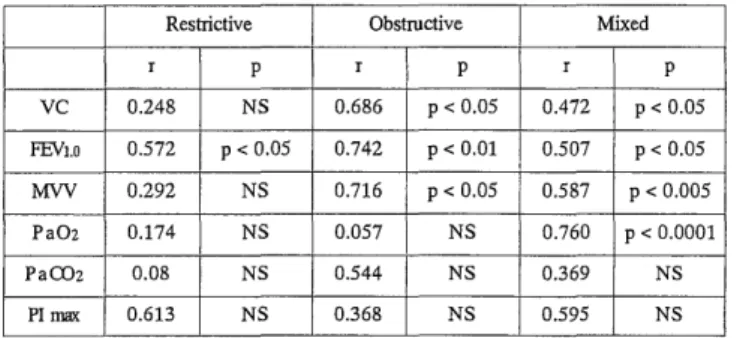
Table 2. Correlation between 6 MD and pulmonary functions among patients with chronic pulmonary diseases in different types of ventilatory defects before pulmonary rehabilitation.*
Restrictive Obstructive Mixed
r p r p r p
VC 0.248 NS 0.686 p < 0.05 0.472 p < 0.05
FEVI.o 0.572 p < 0.05 0.742 p < 0.01 0.507 p < 0.05
MW 0.292 NS 0.716 p < 0.05 0.587 p < 0.005
PaO2 0.174 NS 0.057 NS 0.760 p < 0.0001
Pa002 0.08 NS 0.544 NS 0.369 NS
PI max 0.613 NS 0.368 NS 0.595 NS
*r = coefficients of correlation; NS = not significant .
defects (Table 1). No differences in the values of FE V,.o, Pa02 or PaCO2 were found before and after pulmo- nary rehabilitation. Significant increases in the values for VC and PI max, however, were observed in the
restrictive (p<0.05 in VC and PI max) and in the mixed (p<0.005 in VC and p<0.01 in PI max) in ventilatory defects, but not in subjects with obstructive ventilatory defects. We also found a significant im- provement in MVV only in the case of subjects with restrictive ventilatory defects (p<0.001). On the other hand, a significant improvement for the 6 MD and the
ADL score was observed for all types of ventilatory defects (p<0.001). We next evaluated the relationship between 6 MD and pulmonary function parameters, for different types of ventilatory defects before pulmonary rehabilitation (Table 2). The FEV,.o value was signifi- cantly correlated with 6 MD in all types of ventilatory defects (p<0.05 in the restrictive type, p<0.01 in the obstructive type, p<0.05 in the mixed type). The clinical significance of FEV,.o as an exercise endurance index can, therefore, be confirmed',"-"'. We also found a sig- nificant correlation between 6 MD and VC or MVV in the obstructive and the mixed ventilatory defects
(p<0.05; vs VC for both types and MVV in the obstruc- tive type, p< 0.005; vs MVV in the mixed type). It is noteworthy that the PaO2 value at rest was highly corre- lated with 6 MD only in the case of mixed ventilatory defects (p< 0.0001) (Fig. 1).
The benefit of oxygen supplementation during exer- cise in patients with EIH has been reported"-22. The rela- tionships between EIH (the fall in the percent SpO2) and pulmonary function parameters and arterial blood gases was investigated for the different types of vetilatory defects before pulmonary rehabilitation (Table 3). We
also found significant correlations between EIH and VC in the case of restrictive ventilatory defects (p<0.05), and between EIH and FEV,.o or MVV in the case of ob- structive ventilatory defects (p<0.05). No significant
correlation between EIH and arterial blood gas ten- sions at rest was observed for any types of ventilatory defects.
Table 3. Correlation between exercise induced hypoxemia (the level fall in Sp02 in absolute valuse with 6 MD exer- cise) and pulmonary functions among patients with chronic pulmonary diseases in different types of ventilatory defects before pulmonary rehabilitation.*
Restrictive Obstructive I Mixed
r p r p r p
vc 0.765 p < 0.05 0.649 NS 0.413 NS
FEVi.o 0.575 NS 0.847 p < 0.05 0.535 NS
MW 0.415 NS 0.882 p < 0.05 0.463 NS
Pa 02 0.207 NS 0.443 NS 0.393 NS
Pa C02 0.040 NS 0.756 NS 0.190 NS
Plmax 0.523 NS 0.588 NS 0.511 NS
* r = coefficients of correlation; NS = not significant .
Fig. 1. Correlation between 6 MD and Pa02 levels at rest among patients with chronic pulmonary diseases with mixed ventilatory defects.
Discussion
Ambulation distance, as determined by 6 MD, is a sim- ple exercise test that has been used in a number of previous studies as measure of exercise capacity, and has been shown to correlate with maximum oxygen up- take (V02max) in patients with COPD23,24) . The perform- ance of this test depends on several factors, including endurance, respiratory function, cardiovascular fitness, neuromuscular function, motivation, encouragement, and practice18'23,25) In this study, we demonstrated a sig- nificant improvement in 6 MD and ADL as a result of pulmonary rehabilitation among patients with chronic pulmonary diseases with any type of ventilatory defect.
Pulmonary rehabilitation improved VC and MVV to some extent, but the improvement in VC and MVV did not correlate with 6 MD (data not shown). Previous studies26-29) have reported that pulmonary rehabilita- tion results in significant improvement in physiologic exercise tolerance in contrast to those of pulmonary function for patients with COPD. In addition, Casaburi, et a129) have described that patients with COPD are able to achieve a physiologic training effect, as mani- fested by a reduction in blood lactates and ventilation at given level of exercise. These findings are consis- tent with the improvement in 6 MD and ADL of pa- tients with chronic pulmonary diseases in this study.
We next examined the relationship between pulmonary function parameters and an initial 6 MD for patients with chronic pulmonary disease with different types of ventilatory defects (Table 2). The FEV,.o value corre- lated significantly with 6 MD for patients with each type of ventilatory defect. A highly significant correla- tion was found especially in patients with the obstruc- tive type of ventilatory defect. Several investigators
have previously reported a relationship between exer- cise tolerance and pulmonary function parameters""-").
Jones et al.") reported correlations between the maximal work load and FEV,.o, VC, airway resistance and DLco in patients with chronic airway obstruction. ZuWallack et al.") similarly reported that the initial 12 MD corre- lated with FVC, FEV,.o, peak V02 and peak PaO2 in pa- tients with chronic pulmonary diseases. Furthermore, FEV,.o, VC and MVV values were significantly corre-
lated with 6MD both in patients with the obstructive type and the mixed type of ventilatory defect in this study. This fact suggests that a limitation on ventilation is closely associated with exercise endurance in these patients. More interestingly, the levels of PaO2 corre- lated with 6 MD for patients with chronic pulmonary diseases in the mixed type of ventilatory defect, al- though the specific reason for this remains unresolved.
These data suggest that it may be possible to predict exercise tolerance in each patient with a certain type of ventilatory defect by examining pulmonary func- tion tests and arterial blood gas prior to the start of pulmonary rehabilitation.
Breathing of supplemental oxygen improves exercise performance in patients with severe COPD2o-221. An indi- cation of the need for 02 supplementation during exercise should be based on finding relative to exercise tests rather than on resting hypoxemia alone'). Patients with a resting arterial oxygen tension of less than 55 mmHg as well as patients with arterial desaturation during ex- ercise are recommended to receive oxygen therapy"'.
Recent studies",") have shown that some indexes which are helpful in determining which patients include desaturated during exercise. Owens, et al.") have reported two indexes of diffusing capacity and FEV,.o are predic- tive of desaturation in patients with COPD. However, no reports have been conducted on the relationship be- tween EIH and pulmonary function parameters for cases of chronic pulmonary diseases with different types of ventilatory defects. In this study, we found significant correlations between EIH and VC in the restrictive type, and EIH and FEV,.o or MVV in the obstructive type of ventilatory defect, respectively (Table 3). These pulmo- nary function parameters, which correlate with EIH are important as limiting factors in patients with chronic pulmonary disease who have restrictive and obstruc- tive types of ventilatory defects, while many parame- ters did not correlate with EIH, in terms of the mixed type of ventilatory defect. This may be explained by circulatory insufficiency through pulmonary arterial vasoconstriction, since a low arterial blood oxygen pres- sure was found in these cases (PaO2 s 60 mmHg in 7 cases and PaO2 s 70 mmHg in 14 out of 22 cases)11,121.
Therefore, each pulmonary function parameter which
correlates with EIH in different types of ventilatory defects is also valuable for predicting arterial oxygen desaturation during exercise for patients with chronic pulmonary diseases.
In summary, a comprehensive pulmonary rehabilita- tion is clearly effective in patients with chronic pulmo- nary diseases which have any type of ventilatory defect.
We also found certain specific pulmonary function pa- rameters which were correlated with exercise torelance or EIH for patients with chronic pulmonary diseases with different types of ventilatory defect. These obser- vations support the conclusion that the evaluation of pulmonary function parameters may lead to a predic- tion of exercise torelance and EIH in patients with chronic pulmonary diseases with different types of ventilatory defect. We wish to emphasize that the ini- tial assessment of pulmonary function parameters is essential for patients who receive pulmonary rehabili- tation. Further studies will be required for the develop- ment of individual plans for pulmonary rehabilitation.
Acknowledgments
I am grateful to Dr. T. Nagatake (Department of Internal Medicine, Institute of Tropical Medicine, Nagasaki Univeristy) for his support and encourage- ment throughout this study.
References
1) Fishman AP. Approach to the patient with respiratory symptoms.
In Fishman AP, Elias JA, Fishman JA, Grippi MA, Kaiser LA,
Senior RM (eds). Fishman's Pulmonary Disease and Disorders.
New York, McGraw-Hill, vol 1 ; 361-393, 1998
2) American Thoracic Society.; Standards for the diagnosis and care of patients with chronic obstructive pulmonary disease (COPD)
and asthma. Am Rev Respir Dis 136: 225-244, 1987
3) Petty TL. Pulmonary rehabilitation in perspective:historical roots, present status, and future projections. Thorax 48: 855-862, 1993 4) Fishman AP. Pulmonary rehabilitation research. Am J Respir Crit
Care Med 149: 825-833, 1994
5) Couser JI Jr, Guthmann R, Hamadeh MA, Kane CS. Pulmonary re- habilitation improves exercise capacity in older elderly patients
with COPD. Chest 107: 730-734, 1995
6) Fedro GSS. Pulmonary rehabilitation for the patient with severe chronic obstructive pulmonary disease. Am J Med Sci 318: 99-102,
1999
7) Foster S, Thomas HM. Pulmonary rehabilitation in lung disease other than chronic obstructive pulmonary disease. Am Rev Respir
Dis 141: 601-604, 1990
8) Pineda H, Haas F, Axen K, et al. Accuracy of pulmonary function tests in predicting exercise tolerance in chronic obstructive pulmo-
nary disease. Chest 86: 564-567, 1984
9) Minh V, Lee HM, Dolan GF, et al. Hypoxemia during exercise in patients with chronic obstructive pulmonary disease. Am Rev
Respir Dis 120: 787-794, 1979
10) Lebecque P, Lapierre J-G, Lamarre A, et al. Diffusion capacity and oxygen desaturation effects on exercise in patients with cystic
fibrosis. Chest 91: 693-697, 1987
11) Owens GR, Rogers RM, Pennock BE, et al. The diffusing capacity as a predictor of arterial oxygen desaturation during exercise in
patients with chronic obstructive pulmonary disease. N Engl J Med 310: 1218-1221, 1984
12) Fletcher CM, Elmes PC, Fairbairn AS, et al. The significance of res- piratory symptoms and the diagnosis of chronic bronchitis in a
working population. Brit Med J 29: 257-266, 1959
13) American Thoracic Society. Pulmonary Rehabilitation. Am Rev Respir Dis 124: 663-666, 1981
14) Martinez FJ, Vogel PD, Dupont DN, et al. Supported arm exercise vs unsupported arm exercise in the rehabilitation of patients with
severe chronic airflow obstruction. Chest 103: 1397-1402, 1993 15) Larson JL, Kim MJ, Sharp JT, et al. Inspiratory muscle training
with a pressure threshold breathing device in patients with
chronic obstructive pulmonary disease. Am Rev Respir Dis 138:
689-696, 1988
16) Harver A, Mahler DA, Daubenspeck JA. Targeted inspiratory mus- cle training improves respiratory muscle function and reduces
dyspnea in patients with chronic obstructive pulmonary disease.
Ann Intern Med 111: 117-124, 1989
17) Jones NL, Jones G, Edwards RHT. Exercise tolerance in chronic airway obstruction. Am Rev Respir Dis 103: 477-491, 1971 18) Zuwallack RL, Patel K, Reardon JZ, et al. Predictors of improve-
ment in the 12-minute walking distance following a six-week out-
patient pulmonary rehabilitation program. Chest 99: 805-808, 1991 19) Niederman MS, Clemente PH, Fein AM, et al. Benefits of a multidisciplinary pulmonary rehabilitation program. Improvement
are independent of lung function. Chest 99: 798-804, 1991 20) Woodcock AA, Gross ER, Geddes DM. Oxygen relieves breathless-
ness in Pink puffers. Lancet 1: 907-909, 1981
21) Bye PTP, Esau SA, Levy RD, et al. Ventilatory muscle function during exercise in air and oxygen in patient with chronic air-flow
limitation. Am Rev Respir Dis 132: 236-240, 1985
22) Payen JF, Wuyam B, Levy P, et al. Muscular metabolism during oxygen supplementation in patients with chronic hypoxemia. Am
Rev Respir Dis 147: 592-598, 1993
23) Mcgavin CR, Gupta SP, Mchardy GJR. Twelve-minute walking test for assessing disability in chronic bronchitis. Brit Med J 1: 822-823,
1976
24) Butland RJA, Pang J, Gross ER, et al. Tow-, six-, and 12-minutes walking tests in respiratory disease. Brit Med J 284: 1607-1608, 1982 25) Guyatt GH, Pugsley SO, Sullivan MJ, Thompson PJ, et al. Effect
of encouragement on walking test performance. Thorax 39: 818-22,
1984
26) Casaburi R, Wasserman K. Exercise training in pulmonary rehabili- tation. N Engl J Med 314: 1509-1511, 1986
27) Mall RW, Medeiros M. Objective evaluation of results of a pulmo- nary rehabilitation program in a community hospital. Chest 94:
1156-1160, 1988
28) Casaburi R, Wasserman K, Patessio A, et al. A new perspective in pulmonary rehabilitation: anaerobic threshold as a discriminant in
training. Eur Respir J 2, Suppl.7: 618s-623s, 1989
29) Casaburi R, Patessio A, Ioli F, et al. Reductions in exercise lactic acidosis and ventilation as a result of exercise training in patients
with obstructive lung disease. Am Rev Respir Dis 143: 9-18, 1991 30) Beers MF. Oxygen therapy and pulmonary oxygen toxicity. In Fishman AP, Elias JA, Fishman JA, Grippi MA, Kaiser LA, Senior
RM (eds): Fishman's Pulmonary Disease and Disorders. New York,
McGraw-Hill, vol 2; 2627-2642, 1998
31) Voelkel NF. Mechanisms of hypoxic pulmonary vasoconstriction.
Am Rev Respir Dis 133: 1186-1195, 1986
32) Jensen KS, Micco AJ, Czartolomna J, et al. Rapid onset of hypoxic vasoconstriction in isolated lungs. J Appl Physiol 72: 2018-2023,
1992