Introduction
Management of acute cholecystitis has been particularly controversial; for example, whether urgent cholecystectomy or elective cholecystectomy after subsiding of inflammation should be chosen has been unclear
1, 2. In 2005, "Practice Guidelines for Acute Cholecystitis and Acute Cholangitis"
(in Japanese) and, in 2007, "Tokyo Guidelines for the Man- agement of Acute Cholangitis and Cholecystitis"
3were is- sued on the basis of evidence. According to these guide- lines, early cholecystectomy within 96 hours of the onset of acute cholecystitis, especially by a laparoscopic approach
(LC), is recommended in the acute phase unless the pa- tient's general condition does not allow a surgery to be per- formed.
In many institutes in Japan, including ours, "Practice Guidelines for Acute Cholecystitis and Acute Cholangitis (Guidelines)" has been referred to for the management of acute cholecystitis
4, 5. We reviewed the data of the patients with acute cholecystitis in whom cholecystectomy was per- formed in the past 7 years and evaluated the feasibility and problems of management of acute cholecystitis.
Acta Med. Nagasaki56: 69−72
Address correspondence:Kosho Yamanouchi, Department of Surgery, Nagasaki University Graduate School of Biomedical Sciences, 1-7-1 Sakamoto, Nagasaki, 852-8501, Japan.
Phone:+81-957-63-1145; Fax:+81-957-63-4864, E-mail:[email protected]
Received June 24, 2011; Accepted August 18, 2011
MS#AMN 07089
Feasibility and problem in managements of the patients with acute cholecystitis: A historical study at a single province institute.
Kosho Y
AMANOUCHI, Takashi A
ZUMA, Ken T
ANIGUCHI, Yusuke I
NOUE, Keisuke H
ANDA, and Shigetoshi M
ATSUODepartment of Surgery, Nagasaki Prefecture Shimabara Hospital, 7895 Shimokawajiri-machi, Shimabara, Nagasaki 855-0861, Japan
Objectives: "Practice Guidelines for Acute Cholecystitis and Acute Cholangitis (in Japanese)," issued in 2005 in Japan, rec- ommends early cholecystectomy in patients with acute cholecystitis. We evaluated the feasibility and problems in manage- ment of this condition.
Method: We analyzed the clinical and laboratory data of 120 consecutive patients in whom cholecystectomy was performed for treatment of acute cholecystitis between April 2003 and March 2010 in our hospital.
Results: After the Guidelines were issued, the rate of urgent operations increased (from 2.4% to 35.4%; p < 0.001) and the length of preoperative hospital stay decreased (form 12.5 days to 7.6 days; p < 0.05). Urgent operation, however, was chosen in only 35.4% of the patients even after the Guidelines were issued, mainly because of the shortage of surgeons and anesthe- siologists. In these patients with moderate to severe acute cholecystitis, percutaneous cholecystostomy (PC) was performed without severe complications, followed by cholecystectomy.
Conclusion: Urgent operation for acute cholecystitis has the advantages of earlier alleviation of symptoms and shorter hos- pital stays than PC followed by surgery or elective operation. PC followed by surgery may be a suboptimal option for patients with moderate to severe acute cholecystitis who might be able to tolerate an urgent operation, given that appropriate human resources are not available.
ACTA MEDICA NAGASAKIENSIA 56: 69−72, 2011
Keywords: acute cholecystitis; cholecystectomy; drainag
Kosho Yamanouchi et al.: Management of acute cholecystitis
Materials and Methods
We reviewed the clinical and laboratory data of 120 consecutive patients with acute cholecystitis, but without choledocholithiasis, in whom cholecystectomy was per- formed between April 2003 and March 2010 at our hospi- tal. To compare clinical factors depending on the types of management, we divided the patients into 3 groups accord- ing to processes carried out until surgery: (1) Urgent group included patients who underwent an operation within 96 hours of the onset of acute cholecystitis; (2) Drainage group included patients in whom percutaneous cholecystostomy (PC) was performed before the operation; and (3) Elective group included patients in whom an operation was per- formed after inflammation had subsided with conservative treatment. We compared clinical factors among the 3 groups and estimated the validity and problems of our strategy of treatment of the patients with acute cholecystitis. In addi- tion, since the Japanese Guidelines were published in 2005, we compared the patients in a chronological manner; that is, until (Early) and after (Late) March 2006.
The diagnosis and the severity of acute cholecystitis were determined according to the Guidelines.
The data are presented as the mean±standard deviation.
The Student's t-test was used for comparisons of continu- ous variables between two groups. The one-way ANOVA was used for continuous variables among three groups, and, if a p-value was <0.05, Tukey-Kramer test was applied for multiple comparison. The chi-square ( 2) test was used for categorical variables. A p-value of <0.05 was considered statistically significant. Statistical analysis was performed with StatMate III for Macintosh (ATMS Co., Ltd, Tokyo, Japan).
Results
Comparison of Clinical Factors Depending on Management
No operative deaths occurred during the study period.
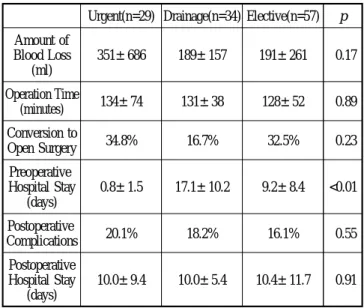
Further, PC was performed in all patients without major complications. The backgrounds of the patients in each group are shown in Table 1. The degree of inflammation indicated by the white blood cell (WBC) counts and the proportion of severe cases were higher in the Urgent and Drainage groups than in the Elective group. Table 2 shows the perioperative clinical factors of the patients in each group.
While the preoperative hospital stay was significantly shorter for the patients in the Urgent group than for those in the
other 2 groups, the other factors, including the amount of blood loss, operation time, rate of conversion to open cholecystectomy (OC) from LC, rate of postoperative com- plications including bile leakage, intraabdominal abscess, pancreatitis, skin burn, Steven-Johnson syndrome, urinary infection, brain infarction and respiratory failure, and post- operative hospital stay, were not different among the 3 groups.
Chronological Changes in the Management of Acute Cholecystitis
We compared the clinical factors of patients who under- went operations until (Early period) and after (Late period) March 2006. The rate of urgent operations was higher in the Late period than in the Early period (35.4% and 2.4%, respectively; p < 0.001; Figure 1). The preoperative hospi- tal stay was shorter in the Late period than in the Early pe- riod (Table 3). After March 2006, LC has been attempted more frequently and the rate of conversion to OC from LC has decreased. The amount of blood loss, operation time,
70Table 1.Backgrounds of patients in each group.
Urgent(n=29) Drainage(n=34) Elective(n=57) p Age (years) 67.0±14.7 71.7±11.0 65.1±14.5 0.09
Sex (male) 48.3% 50.0% 54.4% 0.89
WBC 14,020±4,891 16,196±4,916 10,877±4,247 <0.01 CRP 10.9±11.5 23.0±11.7 9.5±8.3 <0.01 Severe Cases 48.3% 47.1% 22.8% <0.05 Abbreviations: WBC, white blood cell; CRP, C-reactive protein.
Table 2.Comparison of patients in each group.
Urgent(n=29) Drainage(n=34) Elective(n=57) p Amount of
Blood Loss (ml)
351±686 189±157 191±261 0.17
Operation Time
(minutes) 134±74 131±38 128±52 0.89
Conversion to
Open Surgery 34.8% 16.7% 32.5% 0.23
Preoperative Hospital Stay
(days)
0.8±1.5 17.1±10.2 9.2±8.4 <0.01
Postoperative
Complications 20.1% 18.2% 16.1% 0.55
Postoperative Hospital Stay
(days)
10.0±9.4 10.0±5.4 10.4±11.7 0.91
Kosho Yamanouchi et al.: Management of acute cholecystitis
postoperative complications, and postoperative hospital stays were similar between the 2 groups.
Discussion
An examination of patients with acute cholecystitis showed that in patients with a higher degree of inflammation, almost equal of patients with more severe cases, urgent operation or PC was seemingly performed more frequently. Preoperative hospital stays were significantly shorter in the Urgent group than in both the Drainage and Elective groups, without an in- crease in morbidity, indicating that early operation for acute cholecystitis has the advantage of earlier alleviation of symp- toms.
In Japan, changes in the management of acute cholecystitis
were reported after the Guidelines were issued in 2005; the proportion of patients who underwent early operations in- creased
4, 5. We have tried to carry out early operation within 96 hours of the onset of acute cholecystitis since the Guideline issued, and in our study, a similar pattern was observed, and a shorter preoperative hospital stay was obvious in the Late period. Moreover, in the Late period, LC was chosen more frequently and the rate of conversion to OC was lower than that in the Early period. The reasons for these observations should partly be that LC has become a com- mon procedure and the techniques of LC have improved.
The Guidelines recommended PC for patients with jaundice and poor general conditions. PC was performed without major complications and can be taken into account for pa- tients with poor medical condition even though anticoagu- lant or antiplatelet agents are administered. The effective- ness of PC was reported as a bridge procedure before cholecystectomy in the case of critically ill patients with acute cholecystitis
6, 7. In our study, we evaluated only the cases wherein operations were performed, and did not evaluate the cases of patients who had not undergone surgery after PC. Recurrence of acute cholecystitis was occurred in ap- proximately 30% of patients with cholecystolithiasis after removal of the drainage tube without cholecystectomy
8, 9. At our institution, we usually recommend that patients with PC undergo cholecystectomy after improvement of inflammation.
Yamashita et al. reported that only 57.3% of patients with acute cholecystitis underwent urgent operations after the Guidelines were issued, based on the circumstances of each institute, such as human resources and availability of oper- ating rooms.
4Likewise, early operation could not be per- formed even in the Late period, mainly because of the shortage of human resources, i.e., our institute has 5 sur- geons, including 2 residents, and one anesthesiologist, and about 600 surgical operations must be performed annually.
In conclusion, although early operation after the onset of acute cholecystitis has the advantage in terms of short hos- pital stays and prompt alleviation of symptoms, PC fol- lowed by cholecystectomy can be a reasonable suboptimal option for moderate to severe acute cholecystitis, for even patients who are able to tolerate operations, depending on the circumstance of each institute.
References
1. Järvinen HJ, Hastbacka J. Early cholecystectomy for acute cholecystitis:
a prospective randomized study.Ann Surg191:501-505, 1980 2. Norrby S, Herlin P, Holmin T, Sjödahl R, Tagesson C. Early or de
layed cholecystectomy in acute cholecystitis? A clinical trial.Br J Surg 71
Figure 1.A comparison of the strategy for treatment of patients with acute cholecystitis between the Early and Late periods.
Table 3.Comparison of patients in each group.
Early period (n=41)
Late period
(n=79) p
Preoperative Hospital
Stay (days) 12.5±9.6 7.6±9.6 <0.05
LC 48.8% 77.2% <0.01
Conversion to OC
form LC 65.0% 18.0% <0.001
Amount of Blood
Loss (ml) 292±268 197±454 0.22
Operation Time
(minutes) 136±51 128±58 0.46
Postoperative
Complications 15.0% 18.2% 0.63
Postoperative
Hospital Stay (days) 10.8±9.2 9.9±9.9 0.63 Abbreviations: LC, laparoscopic cholecystectomy; OC, open cholecystectomy.
Kosho Yamanouchi et al.: Management of acute cholecystitis 70:163-165, 1983
3. Hirota M, Takada T, Kawarada Y, et al. Diagnostic criteria and severity assessment of acute cholecystitis: Tokyo Guidelines.J Hepatobiliary Pancreat Surg14:78-82, 2007
4. Yamashita Y, Yamauchi Y, Noritomi T. Have the Guideline played a role in the standardization of treatment for acute cholecystitis? (in Japanese with English abstract).Nihon Hukubu Kyukyu Igakkaizasshi (Japanese Society for Abdominal Emergency Medicine) 28:445-449, 2008
5. Matsuda S, Naito N, Sugimura Y, et al. The introduction of laparoscopic cholecystectomy for acute cholecystitis (in Japanese with English ab- stract). Nihon Hukubu Kyukyu Igakkaizasshi (Japanese Society for Abdominal Emergency Medicine) 29:471-476, 2009
6. Spira RM, Nissan A, Zamir O, Cohen T, Fields SI, Freund HR.
Percutaneous transhepatic cholecystostomy and delayed laparoscopic cholecystectomy in critically ill patients with acute calculus cholecystitis.
Am J Surg183:62-66, 2002
7. Winbladh A, Gullstrand P, Svanvik J, Sandström P. Systematic review of cholecystostomy as a treatment option in acute cholecystitis.HPB (Oxford) 11:183-193, 2009
8. Sugiyama M, Tokuhara M, Atomi Y. Is percutaneous cholecystostomy the optimal treatment for acute cholecystitis in the very elderly?World J Surg22:459-463, 1998
9. Van Steenbergen W, Ponette E, Marchal G, et al. Percutaneous transhepatic cholecystostomy for acute complicated cholecystitis in elderly patients.Am J Gastroenterol85:1363-1369, 1990
72