ORIGINAL ARTICLE
CERVICAL CANCER SCREENING BEHAVIOR AND FACTORS ASSOCIATED WITH SCREENING BEHAVIOR
Izumi Matsuo
1),Yoshiko Nishizawa
2),Kenshi Matsuo
3),and Akifumi Kagiya
4)Abstract Objective: This study is aimed at examining Japanese women’s screening behavior with a focus on differences in screening behavior between age groups and on factors associated with the behavior. Method: The survey period was from August 2010 to January 2012. An anonymous questionnaire form was distributed to Woman 20 years or older who participated in cervical cancer screening at medical institutions or examination centers in Aomori Prefecture, Japan and consented to participate in this survey. The survey was designed to investigate respondents’ background, screening behavior, and perceived health status. Results: Of 1,287 women who provided consent, data from 1,207 respondents who answered all the survey items were included in analysis (response rate:
93.4%). Their age ranged from 20 to 76 (mean: 37.2) years. Of these women, 75% regularly received screening provided by public health services. Demographically, the proportion of women who underwent regular screening was significantly higher in employed workers ( p < 0.05). The proportion of women who underwent regular screening increased with age. The percentage of women who were participating in cervical cancer screening for the first time was significantly higher in those in their 20s than that in the other age groups ( p < 0.05). Respondents strongly felt that they were healthy and had a high internal health locus of control. Respondents’ age, background, and previous screening experience were associated with their current screening behavior. Discussion: The findings indicate that motivational and other assistance individualized to people’s background and age may be effective in motivating women with no previous screening experience to participate in screening and others to continue screening.
Hirosaki Med.J. 64:103―118,2014 Key words: Cervical cancer screening; screening behavior; perceived health status;
Health Locus of Control (HLC); screening program.
原 著
子宮頸がん検診における受診行動の実態と影響要因
松 尾 泉
1)西 沢 義 子
2)松 尾 健 志
3)鍵 谷 昭 文
4)抄録 目的:受診行動の実態や年代による特徴,および受診行動に影響を与える要因を明らかにする.方法:2010年 8
月~2012年 1 月に青森県内の医療機関・健診センターで子宮頸がん検診を受診した20歳以上の女性で同意の得られた 対象者に無記名式調査用紙を配布し,対象者の背景・受診実態・健康感を調査した.結果:回収した1,287名のうち,す べての項目に回答した1207名(有効回答率93.4%)を分析した.年齢は20~76(平均37.2),75%が検診制度を利用し定期的 に受診していた.定期受診者の背景は,就業者が有意に多かった(p <0.05).年齢が高くなるほど定期受診者の割合が多 かった.20代は初回受診者が有意に多かった(p <0.05).対象者の主観的健康感および内的健康統制感は高かった.受診 行動には年代や背景これまでの受診経験が影響していた.考察:受診者の背景や年代に応じた支援は,初回受診を促し 継続的受診を可能にすると推察された.
弘前医学 64:103―118,2014 キーワード:子宮頸がん検診;受診行動;主観的健康感;主観的健康統制感;検診制度.
1)
Faculty of Nursing, Hirosaki Gakuin University
2)
Deprtment of Health Promotion, Hirosaki University Graduate School of Health Scienses
3)
Medical Corporation Yuaikai Hirosaki Ladies Clinic
4)
Tsugru Seihokugo Region Union Seihoku Central Hospital
Correspondence: I. Matsuo
Received for publication, October 3, 2012 Accepted for publication, December 18, 2012
1)
弘前学院大学 看護学部看護学科
2)
弘前大学大学院保健学研究科 健康支援科学領域健
康増進科学分野
3)
医療法人ゆうあい会 弘前レディスクリニック
4)
つがる西北五広域連合 西北中央病院
別刷請求先:松尾 泉
平成24年10月 3 日受付
平成24年12月18日受理
I. Introduction
Cervical cancer often affects and kills women who are planning to have or raising a child and is regarded as a “mother killer.” The cause of cervical cancer is persistent infection with high-risk human papilloma virus (HPV) in the cervical epithelial cells. Cervical intraepithelial neoplasia (CIN) develops into cervical cancer after more than 10 years.
1,2)The estimated global prevalence of cervical cancer is 12.4 persons per 100,000 population. Approximately 800,000 women develop or die from the disease annually. The prevalence of cervical cancer in Japan is 14.1 persons, which is higher than that in the United States (7.8), Britain (9.3), and the global average.
3,4)The prevalence of the disease in Japan has increased from 0.2 to 1.2 persons in women in their early 20s and from 2.0 to 6.3 persons in women in their late 20s since the 1980s. Cervical cancer is the most common form of cancer in women in their 20s. While mortality due to cervical cancer has not increased in recent years, the proportion of young women who die from the disease is increasing. Women in their 30s and 40s now account for 40% of deaths due to cervical cancer.
5)Cervical cancer may be prevented by early detection of CIN through cytological screening and HPV DNA testing.
6-8)Some European and Asian countries have introduced population-based screening schemes designed to motivate screening and raise the screening rates, and they have successfully decreased the prevalence of cervical cancer.
9)The most effective approach for prevention of cervical cancer is uterine cancer screening. In Japan, common uterine cancer screening involves an interview, internal examination, and cytological screening. The associations between the rate of screening with this type of program and mortality have been demonstrated.
10, 11)In Japan, the main cause of death is cancer. A number of
anticancer programs have been developed and implemented since the 1960s. Current programs are based on the Basic Plan to Promote Cancer Control Programs (Article 9-1 of Cancer Control Act). Population-based screening (at municipalities) implemented for different types of cancer including cervical, lung, stomach, and breast cancers is part of the programs.
12)The target screening rate at municipalities is 50%, which is considered the lowest required for screening to reduce mortality. The mean screening rate across Japan is only 23.8%, the lowest among OECD countries and extremely low compared to the rate in Britain (79%), the Netherlands (70%), and South Korea (65%).
13)When analyzed by age group, the screening rate across Japan among women in their early 20s is a mere 5.6%, which is approximately one- sixth of the screening rate among women in their late 40s and early 50s (32%). According to the Comprehensive Survey of Living Conditions 2010, the reason why adult women do not undergo screening is “No time” in 22.9% of the entire age group and in 25.8% of women in their 20s, and the proportion was higher in women in their 20s. Women who answered “I do not know the presence of screening” accounted for 4.5%
of the entire age group and 13.0% of women in their 20s; those who answered “Worried about fees” accounted for 19.6% of the entire age group and 29.1% of women in their 20s; and those who answered “I feel no need because I am confident of my health” accounted for 9.4%
of the entire age group and 15.1% of women in their 20s. Based on the results, it is assumed that women in their 20s were confident about their health and did not understand the purpose of cancer screening and that people should spend time and money on screening for their health.
In Europe and North America, education
programs aimed at preventing cervical cancer
are established and provided to young women at
schools and workplaces. These programs raise women’s knowledge of the disease and high- risk HPV and help them learn about disease prevention and available screening. The number of women who undergo HPV DNA testing and HPV vaccination are also high in those countries.
However, these factors that motivate women to participate in cervical cancer screening are lacking in Japan. Therefore, developing effective programs to raise the cervical cancer screening rate among women in their 20s and 30s at high risk is a major health challenge in Japan.
8, 10, 14)In addition, cervical cancer screening in such countries with a high screening rate is available in medical institutions that women usually visit and is conducted by nurses and midwives as well as physicians.
7, 15)Since 2007, the Ministry of Health, Labour and Welfare (MHLW) in Japan has made efforts to improve the primary care programs for promoting healthcare to reassure people throughout their lifetime. MHLW also recommends that people should have a local primary care physician. However, the role of primary care physicians is not completely understood and many outpatients present to large-scale hospitals. Furthermore, the shortage and uneven distribution of obstetricians and gynecologists have become a problem. In these situations, designing an assistance mechanism to motivate cervical cancer screening is necessary.
This is because, in comparison to general healthcare-seeking behavior that is usually triggered by occurrence of symptoms, cancer screening is aimed at people who have no symptoms.
Hence, individual background and perceived health status influence screening behavior.1
16,17)
Among the measures of subjective health, perceived health status (subjective definition of health or self-assessed health status) is one of the most important concepts in recent years and is reportedly associated with objective health and healthcare seeking behavior. Health
Locus of Control (HLC), one of the scales designed to measure perceived health status and developed in the United States in the 1960s, has been used for predicting health behavior and assessing the effectiveness of guidance.
18-20)HLC evaluates whether an individual has an internal or external health locus of control.
21)In Japan, cervical cancer screening was made available to all women in their 20s only a few years ago. Because of this, most research in this field is focused on studying screening rates and the validity of screening techniques.
In comparison, few studies have investigated participants’ perceived health or screening behavior. Factors associated with screening behavior have not been identified.
The present survey was conducted to investigate cervical cancer screening behavior, differences in the behavior among age groups, and factors associated with their behavior in women who underwent cervical cancer screening in the Tsugaru Region of Aomori Prefecture, Japan.
II. Method
1. Subjects
1) The outline of the survey region
The survey region was Hirosaki-shi, Aomori Prefecture. Its population is approximately 180 thousand, and it is the third most populated city in Aomori Prefecture. In the city, there are four universities and several institutions of higher education. There are large and small medical institutions, including highly functional hospitals such as a university hospital and a national hospital, and the per-capita number of medical institutions is the highest in Aomori Prefecture.
According to the survey in fiscal 2006,
employment rates in the working-age population
were 66.6% in total, 74.6% in men, and 59.4% in
women. The rate in women is increasing ever
year. The marriage rate in people in their 20s
is low, and the birth rate in women aged 20 to 24 years is the lowest in Aomori Prefecture.
The young population rate of Hirosaki-shi was 10% (8.6% in Aomori Prefecture and 7.2%
nationwide) and the total fertility rate was 1.19
(1.34 in Aomori Prefecture and 1.31 nationwide), according to the Health Statistics of Aomori Prefecture in fiscal 2008.
Health promotion measures for women in Hirosaki-shi are designed not only as health measures based on the Health Promotion Act but also as part of the municipal programs for the development of the next generation based on the national measures against the declining birth rate and for the development of children and youth. Since 2010, longitudinal work has been conducted with the cooperation system of the divisions for health promotion, children support, and health and physical education, the education institute, and other related units.
2) Summary of cervical cancer screening in Hirosaki-shi
The most common cause of death in Hirosaki-shi was cancer (31.6%), followed by heart disease (15.0%) and cerebrovascular disorder (11.2%), according to the Health Statistics of Aomori Prefecture in fiscal 2010.
As cancer measures based on the Health Promotion Act, screenings for cancers in the stomach, lung, large intestine, prostate, and breast are conducted. Cervical cancer screening is conducted under the name of “uterine cancer screening.”
Cervical cancer screening includes medical interview, visual inspection, cervical cytology, and internal examination. Colposcopic examination is also performed as necessary.
In cervical cytology, samples are collected by scraping the whole areas of the cervix and vaginal surface, and after rapid fixation, they are microscopically examined with Papanicolaou staining. The examinees are informed of the diagnosis approximately 2 weeks after
screening.
Screening is conducted at approximately 10 designated hospitals and clinics in Hirosaki- shi, including the city medical association examination centers. The qualifying age is ≥20 years, and there is no upper limit. Women aged
≥40 years can undergo screening also at local meeting places (circuit screening with a bus).
The expense for screening is subsidized when a woman’s age is an even number, and the actual expense is 700 yen for general women (350 yen for national health insurance subscribers and 630 yen for the members of National Health Insurance Association).
The health examination center (the Health Promotion Division) of Hirosaki-shi sends cancer screening notifications by mail to eligible women, and the information on screening is found in bulletins, the Health Calendar, and homepage of the city.
In fiscal 2009, 6,842 of 47,939 eligible women
(4,267 at designated medical institutions and 2,575 with circuit screening) underwent cervical cancer screening, and the screening rate was 14.9% (18.8% nationwide and 26.5% in Aomori Prefecture). Among them, the number of women with a finding that required further testing, such as precancerous lesions and suspected cancer, based on the screening result
(class III and above) was 99 (1.4%). In Aomori Prefecture, including the survey region, the number of women who require further testing is increasing, and they receive explanation on the importance of close examination and are encouraged to visit medical institutions.
22, 23)Employees and their dependent family
members can undergo screening paid by
their employers. Similar to population-based
screening, they can undergo screening at the
examination centers and designated medical
institutions. Voluntary screening is conducted at
the examination centers and medical institutions,
and women can concurrently receive cervical
HPV DNA testing and screening for cancer of the uterine body and ovary. In addition, women can undergo screening when they visit a medical institution for treatment or prenatal checkup. Those who undergo voluntary screening pay the full expenses, starting from approximately 2,500 yen.
3) Target of the survey
The subjects were women 20 years or older living in Hirosaki-shi or regions around Hirosaki- shi who underwent cervical cancer screening
(voluntary or population-based) at medical institutions or examination centers in Hirosaki- shi.
2. Survey method
A total of 1,449 women were invited to the survey in person and in writing. The anonymous questionnaire form was distributed to 1,287 women (88.8%) who consented to the survey.
Participants filled out the questionnaire, sealed the form in an envelope, and dropped it at a designated place. Researchers later collected the forms.
3. Survey items
The questionnaire form was distributed to each consented woman and was collected later.
1) Subject background
Data regarding the following was collected:
age; family structure (marital status, have/do not have children, live alone or with family); and employment status (full-time employed, part- time employed, full-time homemaker, student, or unemployed).
2) Screening behavior
The following information was collected:
1. Screening they were participating in:
a) screening designated by employers, b)
screening for residents of which Hirosaki-shi notified them, c) voluntary screening whose expense was out-of-pocket, and d) screening with treatment or prenatal checkup.
2. Previous screening experience: regular, irregular, or no previous experience
3. Institutions where they were receiving screening: medical institutions or examination centers
4. Time from the decision to undergo screening to the date of the screening: a) immediately, b)
within 1 week, c) within 1 month, d) within 3 months, e) longer than 3 months.
5. Any screening (other than cervical cancer screening) received in the past year and the type(s) of the screening
6. What motivated screening: a) because I have received screening before, b) free ticket to screening, c) recommendation by a healthcare professional, d) recommendation by family or a friend, e) because I am concerned about cancer, and f) because I obtained information on cancer.
3) Attitude towards screening
Data regarding the following were obtained.
1. Reasons for avoiding screening: a) have no family doctor, b) too much of a bother, c) do not know how to undergo screening, d) no time, e) afraid of finding abnormality, f) worried about fees, g) forget undergoing screening after receiving the notice, h) screening is unnecessary when there are no symptoms, and i) other reasons.
2. Barriers to screening: a) because doctors are often men, b) screening facilities are far away from my home or workplace/school, c) do not want to be asked about my sexual activities during screening, d) internal examination is embarrassing, e) anxious about screening procedures, f) cervical cancer screening is much different from other types of examinations, g)
worried about a long waiting time, h) screening is not conducted in later hours or on Saturdays or Sundays, and i) other reasons.
3. A preferred screening procedure or setting:
a) routine checkup at my workplace (by
health insurance) or school, b) voluntary
checkup at my own expense (at a clinic or in
complete medical checkup), c) population-based
general checkup by Hirosaki-shi, d) cancer
screening by Hirosaki-shi, e) screening during a gynecological visit for pregnancy or treatment, f) health checkup necessary for taking a job or examination.
4) Perceived health
Participants in the survey were asked to rate their perceived health status on a 4-point scale from “Very healthy” to “Unhealthy.”
To measure their health locus of control, the Japanese version of the Health Locus of Control (JHLC) was used. JHLC was developed by Horike et al., who integrated Japanese views of health and cultural attributes into HLC.
24)Adding 1 dimension to MHLC, JHLC consists of 5 subscales: a subscale measuring the internal locus of control (IHLC) and 4 subscales measuring the external loci of control [Professional (PrHLC), Family (FHLC), Chance
(CHLC), and Supernatural (SHLC)]. The stable 5-factor structure and Cronbach’s alpha coefficients for the subscales IHLC, PrHLC, FHLC, CHLC, and SHLC (0.82, 0.68, 0.87, 0.77, and 0.86, respectively) have demonstrated the reliability of JHLC.
25)Subjects chose 1 answer ranging from “Yes” to “No” for each of 5 questions (each assigned a score of 1–6) in each subscale. The highest score is 30 in each subscale.
4. Survey period
From August 2010 through January 2012.
5. Analysis
Summary statistics were calculated from collected answers. With respect to the subject background, screening behavior, and perceived health status, χ
2test and residual analysis were used to compare differences between the variables across age groups. An adjusted standardized residual of 2 or higher was defined as “significantly more frequent” and that of -2 or lower as “significantly lower in frequency.” One- way analysis of variance was performed using the mean subscale scores of the JHLC. Multiple comparison test (Tukey’s HSD) was performed
on the items with a significant difference. The reliability of the items was evaluated before analysis. Cronbach’s alpha coefficients for the subscales IHLC, PrHLC, FHLC, CHLC, and SHLC were 0.82, 0.74, 0.86, 0.79, and 0.83, respectively. Multivariate analysis was also performed to investigate factors associated with screening behavior. A logistic regression analysis was performed using respondents’
previous screening experience as the dependent variable and background and outcome of screening behavior as independent variables.
Subsequently, Pearson’s correlation coefficient was calculated to investigate the relationships between the internal locus of control and each identified factor. Statistical calculations were performed using IBM SPSS Statistic 20.0. The significance level in each test was p < 0.05.
6. Ethical considerations
This survey was conducted after obtaining approval from the Ethics Committee of Hirosaki University Graduate School of Medicine. The consent for participation was obtained from the representatives of the participating medical institutions and examination centers after explanation about the survey had been given in person or in writing. Thorough information about the survey was also given to prospective participants in writing or in person before consent was obtained.
III. Results
1. Subject background
Of collected data from 1,287 respondents, data from 1,207 respondents who answered all the survey items were included in analysis
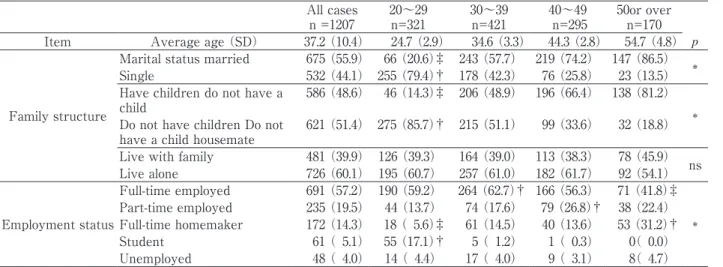
(response rate: 93.4%). The subject background information is shown in Table 1. The age of respondents ranged from 20 to 76 (mean: 37.2)
years. Approximately half the respondents
were married or had a child(ren), but the
percentages were significantly lower in women
in their 20s (p < 0.05). Approximately three- fourths had a full-time or part-time job, and approximately 14% were full-time homemakers.
The proportion of students was significantly higher in women in their 20s (p < 0.05).
2. Screening behavior
The respondents’ screening behavior is
shown in Table 2. Approximately 70% of respondents underwent population-based screening at workplaces or provided by municipalities. Others participated in voluntary screening or received screening in association with therapy or medical examination that they were undergoing. Over 80% of respondents
Table 1 The subject background information
All cases
n =1207 20~29
n=321 30~39
n=421 40~49
n=295 50or over n=170 Item Average age (SD) 37.2 (10.4) 24.7 (2.9) 34.6 (3.3) 44.3 (2.8) 54.7 (4.8) p
Family structure
Marital status married 675 (55.9) 66 (20.6)‡ 243 (57.7) 219 (74.2) 147 (86.5)
*Single 532 (44.1) 255 (79.4)† 178 (42.3) 76 (25.8) 23 (13.5)
Have children do not have a
child 586 (48.6) 46 (14.3)‡ 206 (48.9) 196 (66.4) 138 (81.2)
Do not have children Do not
*have a child housemate 621 (51.4) 275 (85.7)† 215 (51.1) 99 (33.6) 32 (18.8)
Live with family 481 (39.9) 126 (39.3) 164 (39.0) 113 (38.3) 78 (45.9) ns Live alone 726 (60.1) 195 (60.7) 257 (61.0) 182 (61.7) 92 (54.1)
Employment status
Full-time employed 691 (57.2) 190 (59.2) 264 (62.7)† 166 (56.3) 71 (41.8)‡
*
Part-time employed 235 (19.5) 44 (13.7) 74 (17.6) 79 (26.8)† 38 (22.4)
Full-time homemaker 172 (14.3) 18 ( 5.6)‡ 61 (14.5) 40 (13.6) 53 (31.2)†
Student 61 ( 5.1) 55 (17.1)† 5 ( 1.2) 1 ( 0.3) 0( 0.0)
Unemployed 48 ( 4.0) 14 ( 4.4) 17 ( 4.0) 9 ( 3.1) 8( 4.7)
Mean±SD or n(%).
The comparison according to the generation: χ
2test
*: p <0.05.
Adjusted standardization residual error †: Significantly thing with much frequency ‡: Significantly thing with a little frequency.
Table 2 The respondents’ screening behavior
Item All cases
n =1207 20~29
n=321 30~39
n=421 40~49
n=295 50 or over
n=170 p
Participating
Workplace 420 (34.8) 88 (27.4)‡ 137 (32.5) 121 (41.5) 74 (43.5)
Provided by municipalities 413 (34.2) 123 (38.3) 178 (42.3) 71 (24.1) 41 (24.1) * Voluntary 245 (20.3) 53 (16.5) 71 (16.9) 74 (25.1) 47 (27.6)
Association with therapy 129 (10.7) 57 (17.8) 5 ( 8.3) 29 ( 9.8) 8 ( 4.7)
Previous experience Regular 856 (70.9) 142 (44.2) 307 (72.9) 245 (83.1) 162 (95.3)
Irregular 133 (11.0) 31 ( 9.7) 65 (15.4)† 31 (10.5) 6 ( 3.5) * Previos experience 218 (18.1) 148 (46.1)† 49 (11.6) 19 ( 6.4) 2 ( 1.2)
Institution Examination center 685 (56.8) 139 (43.3) 269 (63.9) 172 (58.3) 105 (61.8)
Medical institutions 522 (43.2) 182 (56.7)† 152 (36.1) 123 (41.7) 65 (38.2) * Time from the
decision to undergo screening to the date of the screening
Immediately 261 (21.6) 89 (27.7)† 86 (20.4) 53 (18.0) 33 (19.4)
* A week 91 ( 7.5) 34 (10.6)† 30 ( 7.1) 19 ( 6.4) 8 ( 4.7)
A month 338 (28.0) 85 (26.5) 120 (28.5) 75 (25.4) 58 (34.1)
Three months 195 (16.2) 47 (14.6) 64 (15.2) 59 (20.0)† 25 (14.7)
Longer than three months 322 (26.7) 66 (20.6)‡ 121 (28.7) 89 (30.2) 46 (27.1)
Any screening Prior experience 745 (61.6) 174 (54.2) 257 (61.0) 191 (64.7) 123 (72.3)
No prior experience 462 (38.3) 147 (45.8)† 164 (39.0) 104 (35.3) 47 (27.6)‡ * n(%).
The comparison according to the generation: χ
2test *: p<0.05.
Adjusted standardization residual error †: Significantly thing with much frequency ‡:Significantly thing with a little
frequency.
had previous experience in cervical cancer screening. The proportion of women undergoing regular screening increased with age. Over 70%
of women answered that they had been thinking about undergoing the screening for more than a month. When analyzed by age, women in their 20s showed a statistically signifi cant diff erence in the following items in comparison to other age groups (p < 0.05): proportion with no prior
screening, proportion with screening at medical institutions, proportion of those who answered they received the screening “Immediately” after deciding to undergo a screening, and proportion of those with no prior experience in screening other than for cervical cancer. The proportion of women in their 30s who underwent screening irregularly was significantly higher than those in other age groups (p < 0.05).
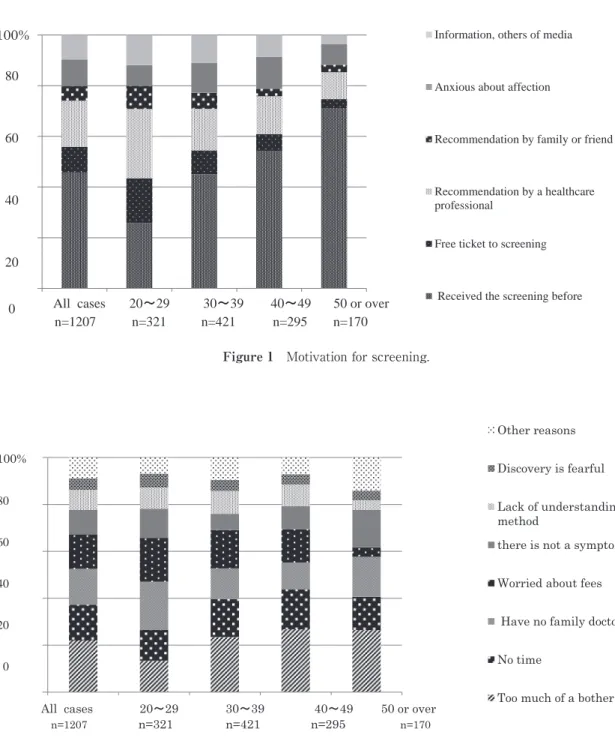
Figure 1 Motivation for screening.
0%
20%
40%
60%
80%
100%
all 20s n=321 30s n=421 40s n=295 50s ~ n=170 80
60
40
20
0 All cases 20~29 30~39 40~49 50 or over n=1207 n=321 n=421 n=295 n=170
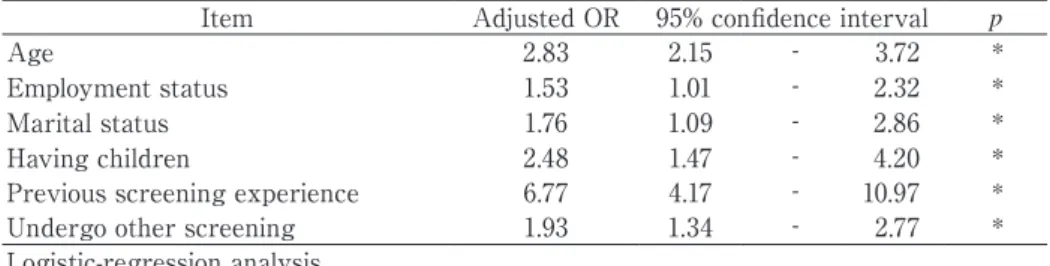
Figure 2 Reasons for avoiding screening.
0%
20%
40%
60%
80%
100%
全体 20代 30代 40代 50代以上