1. Introduction
In the modern world, English is regarded as lingua franca in intercultural communication. If this is the case, should we follow the English conversation style in order to avoid misunderstandings in intercultural communication?
The purpose of the present study is two fold: (1) to demonstrate that Japanese and Korean languages have their own conversation styles, i.e. Japanese is a listener- responsible language while Korean is a speaker-responsible one by criticizing Hinds’ claim that they can both be categorized as listener-responsible languages compared to English, and (2) to show that the ways of speaking in Japanese and Korean can be influenced by English acquisition or daily use of English.
2. Literature review
2.1. Language typology on Japanese and Korean From the point of view of language typology, Japanese and Korean are regarded as very similar languages. Both languages belong to the group of agglutinative languages, are categorized as SOV-languages, and the subject and object in a sentence in both languages are not obligatory.
Furthermore, the two languages have their own honorific systems no matter how they are different in relative or absolute use. In this way, Japanese and Korean are similar with respect to grammatical structure and honorific behavior (Ozaki, 2008).
In addition, according to Hinds’ typology of languages on discourse level, Japanese and Korean are both considered as listener-responsible, whereas English is classifi ed as speaker-responsible (Hinds, 1987). However, in conversation, Yoon (2009) demonstrated that Korean should be classified as a speaker-responsible language based on her contrastive analysis of daily conversations between married couples in Japanese and Korean, where address terms and fillers are used as contextualization
cues (Gumperz, 1982) to convey a speaker's intention to the interlocutor metacommunicatively. It was pointed out that Korean couples use address terms and fillers as contextualization cues more frequently and more variously than Japanese couples, especially in apologies.
2.2. Speaker-responsibility and listener-responsibility for understanding utterances
There are many contrastive studies on discourse between Japanese and Korean, but little attention has been given to the responsibility for understanding utterances.
Based on his analysis of an English essay and several English translations from Japanese, Chinese, Thai and Korean, Hinds (1990) pointed out that both Japanese and Korean could be categorized as listener-responsible because of several common features in Japanese and Korean writings. For example, in the analyzed essays the Japanese and Korean authors mentioned their purposes in the last sentence (delayed introduction of purpose; Hinds, 1990:
98) and therefore it is diffi cult for English-speaking readers to understand it. However, his claim on discourse level was restricted because his analysis was based only on writings.
Discourse consists of two levels: text and conversation. His analysis was based on the level of text and it is not clear whether it is valid on the conversational level.
With respect to the responsibility for understanding utterances in conversations in Japanese and Korean, Yoon (2009) analyzed samples of real conversations which were collected from Japanese married couples and Korean married couples. It was found that Korean married couples not only give more information, but also utter more directly than Japanese married couples to convey their intention to the listener in conversations. However, it is necessary to examine the results in conversations outside married couples.
Yim (2003) compared Japanese and Korean with respect to the responsibility of the listener for understanding utterances. According to Yim (2003), Japanese listeners are better at interpreting the intentions of the speakers than
English as Cultural Resource:
Infl uence on Ways of Speaking in Japanese and Korean
Sumi YOON Graduate School Human and Socio-Environmental Studies, second year Doctoral Student
Korean listeners.
2.3. Apology in Japanese and Korean languages Several contrastive studies have been made on apology behavior between Japanese and Korean (Hong,2006;
Kim,1996; Ogoe,1993). Most of the previous studies have focused on variations of apology and politeness in apologies rather than the responsibility for understanding an utterance.
3. Research questions
The present study attempts to answer the following research questions. First, what differences are there in the ways of making apologies in Japanese and Korean? Second, can the acquisition of English or daily use of English infl uence the ways that Japanese and Korean people speak their native languages?
4. Method
4.1. Participants
Four groups of participants were involved in this study:
Japanese and Korean university students in their countries, and Japanese and Korean university students in the United States of America. Specifically, 101 Japanese and 71 Korean university students who live in the capital spheres of Tokyo and Seoul, respectively, 34 Japanese and 58 Korean university students who were studying at universities which are located in Washington D.C. and Boston, Massachusetts in the United States of America at the time that this research was conducted. Table 1 shows the information on the number, age (average), and length of stay in the USA of each participant. The following abbreviations are used in the present study.
JU: Japanese university students KU: Korean university students
JIU: Japanese international university students who live in the United States of America
KIU: Korean international university students who live in the United States of America
U
M: Male F: Female
4.2. Method
A DCT (Discourse Complete Test) was completed by Japanese and Korean university students and Japanese and Korean international students to compare differences with respect to speaker responsibility in apologies.
4.3. Analysis of Data
It is not adequate to calculate words or sentences to compare information in utterances between Japanese and Korean, because there is not one-to-one correspondence of linguistic items between both languages. Therefore, the data obtained from the informants was analyzed quantitatively by using semantic formulas with respect to information in utterances in corresponding situations between Japanese and Korean speakers. The analysis of semantic formulas can clarify not only the amount of information in the utterances but also construction patterns of the utterances in apologies by Japanese and Korean speakers.
All the results in the present study are expressed in percentages because the number of informants is different in each group. A two-way ANOVA was used to compare the impact of a Japanese and Korean speaker’s residence and the daily use of English on the amount of information in utterances in their native languages. Also, SPSS was conducted to find out differences in the total amount of information in utterances, because ANOVA can not be used for values over 100. In addition to the statistical analysis, a qualitative analysis was conducted with respect to construction patterns within the contents of apologies.
Table 1 Participant Information
5. Results
The results of the DCT of apology are as follows.
Explanation of the scene: You and your close friend have decided to go to the movies. However, you arrived at the entrance of the theater about 20 minutes late.
Table 2 presents the semantic formulas used with respect to the amount of information in utterances in an apology.
Based on Tao (2007), these semantic formulas were
made after considering the purpose of the present study.
The participants were asked to apologize for being late to an appointment with their close friend. Therefore, the utterances for apology consisted of the semantic formulas and they were used to convey the speaker’s emotion.
5.1. Total number of all utterances
Table 3 shows percentages of utterances spoken by JU, KU, JIU, and KIU in the scene. As described above, the total amount of utterances was expressed based on the semantic formulas. The number of KU’s utterances (290.1%) is the highest and the number of JU’s utterances (213.9%) is the lowest in the scene. SPSS was used in order to examine whether the total amount of utterances is significantly different between JU and KU. The SPSS revealed that the total amount of KU’s utterances is signifi cantly higher than JU’s (χ = 9.4, p = 0.002). In other words, KU uttered significantly more semantic formulas than JU to convey their emotion to the interlocutor.
The amount of JIU’s utterances (258.9%) is higher than KIU’s (236.8%). However, there was no significant difference between the two groups.
5.2. Total number of utterances per semantic formula An ANOVA was conducted in order to examine if each group’s total amount of utterances varied depending on Table 2 Semantic Formula and the Examples
Table 3 Utterances Spoken by JU, KU, JIU and KIU (in percentage)
the acquisition of English or the daily use of English in the USA.
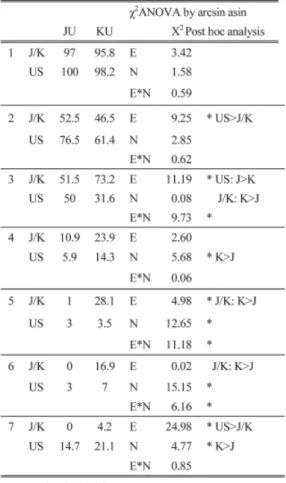
J/K: living in Japan or Korea US: living in the United States
E: Whether infl uenced by English or not N: Nationality
Table 4 shows average of total utterances per semantic formula in an apology. As shown in Table 4, there is no significant difference with respect to semantic formula 1 (apology) depending on the daily use of English in the United States. However the amount of utterances with respect to semantic formula 2 (fact) is signifi cantly different depending on the daily use of English in the U.S. The groups of JIU and KIU who were living in the United States uttered signifi cantly more semantic formulas of fact. As for semantic formula 3 (reason), the ANOVA revealed that the amount of utterances is signifi cantly infl uenced by the daily use of English in the United States. Between the two groups that stayed in their own countries, the amount of utterances
of KU is significantly higher than JU’s. In contrast to the two groups that studying in the US, the amount of utterances of JIU is signifi cantly higher than KIU’s.
There is a significant difference depending on the speaker’s native language in the amount of utterances with respect to semantic formula 4 (adverb modifying the apology expression). Korean people infl uenced by the daily use of English used significantly more adverbs. As for semantic formula 5 (filler used to convey speaker’s emotion), there are significant differences depending on both the speaker’s native language and staying in the US or their own countries. Korean speakers uttered fillers significantly more than Japanese, and with respect to the two groups of Koreans staying in their own country or the United States, the amount of the utterances of KU is significantly higher than KIU’s in terms of fillers used to convey speaker’s emotions.
In regards to semantic formula 6 (address term), it was revealed that Korean speakers uttered address terms signifi cantly more than Japanese. And as for the semantic formula 7 (others) , JIU and KIU tended to utter without using semantic formulas significantly more than JU and KU. It was also found that the amount of utterances by Korean speakers is significantly higher than that by Japanese speakers.
Finally, there are statistically signifi cant differences with respect to the three semantic formulas (3: reason, 5: fi ller, and 6: address term) of the amount of utterances depending on whether English is used daily or not. The results of these three semantic formulas were analyzed by using the MCT (Multiple Comparison Test). The results show that JIU uttered signifi cantly more with respect to semantic formula 3 (reason) in comparison with JU. In the case of semantic formulas 5 (fi ller) and 6 (address term), a comparison of the amount of uttered semantic formulas shows that KU used signifi cantly more semantic formulas than JU. Refer to the Appendix for a list of fi gures related to the results above.
6. Discussion
6.1. Korean as a speaker-responsible language and Japanese as a listener-responsible language
Except the basic three semantic formulas (apology, Table 4 Average of Total Utterances per Semantic Formula (in
percentage)
fact, and reason) which don’t differ significantly between Japanese and Korean for apology, it was revealed that Korean people uttered significantly more than Japanese people with respect to all the other semantic formulas (adverb, filler, address term, and others). In other words, Korean people use adverbs, fi llers, address terms, and other semantic formulas actively to convey how they feel in apologies.
The results of this study confirmed Yoon (2008) which pointed out that Korean people use address terms as contextualization cues more frequently in conversations compared with Japanese people.
6.2. Japanese and Korean infl uenced by the daily use of English
The results of this study showed that the daily use of English strongly influences both Japanese and Korean in relation with the semantic formulas of fact in apologies.
The fact that a person was late to an appointment is already recognized by both the listener and the speaker in the scene.
Nevertheless, the Japanese and Korean speakers who live in the US uttered the fact. For example, instead of just saying “I am sorry.” Japanese and Korean speakers staying in the US tend to say “I am sorry I am late”. They did not try to leave it to the listener to understand it from the situation.
The daily use of English also influenced the amount of utterances by JIU and KIU with respect to the semantic formula others. Most of the utterances including others offer compensation. For example, “Let me buy popcorn because I made you wait for a long time.”
As for the semantic formula reason, there was not a significant difference in the amount of utterances of JU and JIU. Kondo & Taniguchi (2007) compared the apology strategies between Japanese and American speakers.
According to them, if someone gave a reason for their apology, Japanese listeners take the reason as a “defense”, while American people regard it as a “polite explanation”
in apologies. With respect to giving reasons in apologies in Japanese, it is still not clear whether it can be infl uenced by the daily use of English.
However, compared with KU, KIU uttered fewer semantic formulas of reason and the amount of their utterances was the lowest, while the amount of utterances of KU was the highest among the four groups. It is assumed
that the one of reasons for this is the difference with respect to the experience of military service in Korea between male participants of KU and KIU. In Korea, it is every male’s duty to enter military service. KU consisted of male participants who did not need go into military service and have not experienced military service yet.
7. Conclusions and Implications
As described in the current study, Korean people produce many more utterances and convey more information per utterance in apologies. Also ways of speaking in Japanese and Korean can be infl uenced by the acquisition of English or the daily use of English in the United States of America with respect to some semantic formulas in utterances.
These results confirm that Korean people tend to convey their intentions more clearly and more directly to the interlocutor than Japanese people in corresponding situations, and therefore it can be said that Korean should be classified as a speaker-responsible language for understanding an utterance in a conversation. They help clarify the possible misunderstandings between Japanese and Korean speakers, owing to the different responsibility for understanding in a conversation. Furthermore, the results suggest that communication styles in American English could be regarded as a cultural resource in the modern world of globalization. It should be discussed whether such possible roles of English as a cultural resource are desirable or not.
* The current study was supported by the Field Manager Training Program of Culture-Resource Study from Kanazawa University.
Appendix
Figure 1 Use of Apology
Figure 2 Use of Fact
Figure 3 Use of Reason
Figure 4 Use of Adverb
Figure 5 Use of Filler
Figure 6 Use of Address term
Figure 7 Use of Etc.
References
Gumperz, John J. (1982). Discourse Strategies.Cambridge: Cambridge University Press.
Hinds, John. (1987). Reader Versus Writing Responsibility: A New Typology. In U. Connor & R. B. Kaplan (Ed.), Writing Across Language: Analysis of L2 Text (pp. 141-152). MA: Addison - Wesley.
Hinds, John. (1990). Inductive, Deductive, Quasi – inductive:
Expository Writing in Japanese, Korean, Chinese, And Thai.
In U. Connor and A. M. Johns (Ed), Coherence in Writing:
Research and Pedagogical Perspectives Alexandria (pp. 89 – 109), VA: Teachers of English to speakers of Other Languages Inc.
Kondo, Fumiko & Taniguchi, Hiromi. (2007). A comparative Study of Percetions of Apology Strategies between Japanese and Americans. Gendai Syakaigaku [Modern Sociology], 9, (pp. 131- 154).
Ozaki, Yoshimitsu. (2008). Taijinkoodooo no nikkan kenkyuu:
Gengo Koodoo no kite ni are mono [A Contrastive Study of Communication Behavior in Japanese and Korean: Underling Structures of Linguistic Behavior]. Tokyo: Hituzi Syobo.
Yim, Youngchul. (2003). Nihonjintono Komyuniken [ Communication with Japanese people]. Sahoieonhag. (pp. 239-251).
Yoon, Sumi. (2008). Comparison between Korean and Japanese address terms as a contextualization husband – wife’s dialogue.
Inquires into Korean Linguistics III. (pp. 377-387).
Yoon, Sumi. (2009). A contrastive Study of Metacommunicative Functon of Address terms between Husband and Wife in Korean and Japan. Current Issues in Unity and Diversity of Languages:
Collection of the Papers Selected from the International Congress of Linguists (CIL), 18, (pp. 3819-3831).