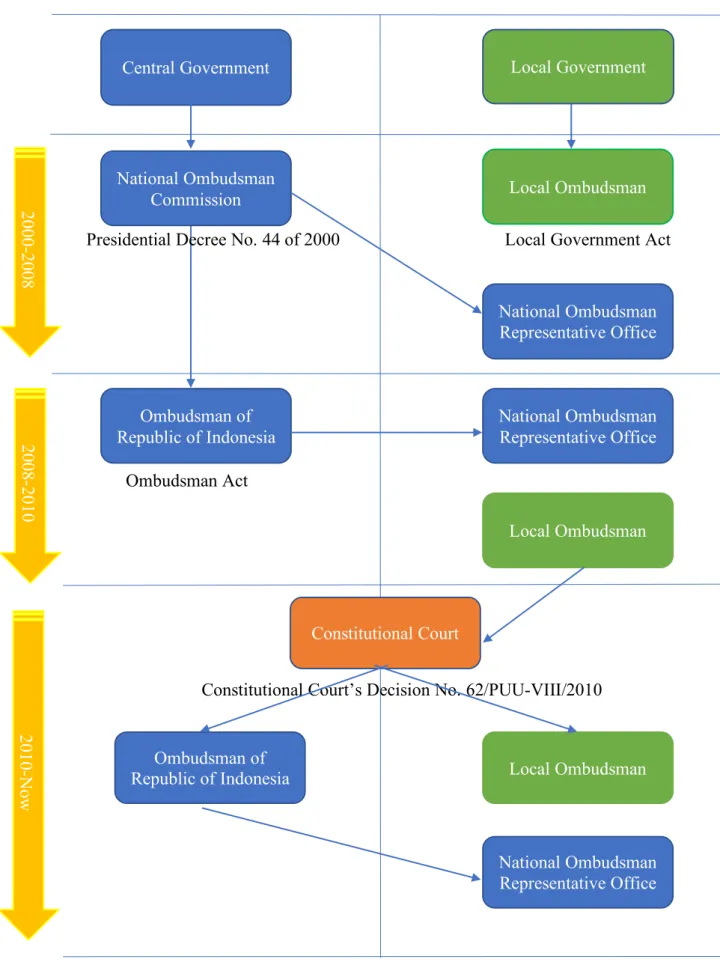
THE OMBUDSMAN SYSTEM FOR MALADMINISTRATION SETTLEMENT IN INDONESIA
著者 アグス トゥリオノ
著者別表示 Agus Triono journal or
publication title
博士論文本文Full 学位授与番号 13301甲第4919号
学位名 博士(法学)
学位授与年月日 2019‑03‑22
URL http://hdl.handle.net/2297/00054818
Doctoral Degree Thesis
THE OMBUDSMAN SYSTEM FOR MALADMINISTRATION SETTLEMENT IN INDONESIA
Division of Human and Socio-Environmental Studies Graduate School of Human and Socio-Environmental Studies
Kanazawa University
Student ID 1521082014
Name Agus Triono
Primary Supervisor Prof. Higashikawa Koji
ABSTRACT
Maladministration is a big problem for bureaucratic reform in Indonesia. This problem has been increasing along with the implementation of local autonomy in which local governments can do most of the government's affairs to provide public services by their initiatives. In addition, the discretionary power of government officials contributed to the many cases of maladministration in the regions.
Ombudsman system comes as an alternative dispute resolution to overcome this maladministration. This thesis examines how the Ombudsman can settle the problem of maladministration and achieve good governance.
Through the statute and case approach, I will analyze the process of establishing and transforming the Ombudsman system in Indonesia and clarify the overlapping issue between the Administrative Court and the Ombudsman system. In addition, I will describe how the Ombudsman system works and identify the benefits and challenges of the Ombudsman system in terms of advancing the public services of local government.
The study reveals that the Ombudsman system in Indonesia experienced a transformation of the status from the commission to the state institution. Although this process has strengthened the position and the oversight function of the Ombudsman, it is still necessary to improve its position by way of providing for the Ombudsman system in the text of the constitution. In overseeing government action, the Administrative Court and the Ombudsman system have similarities and differences. Both Administrative Court and Ombudsman system aim to resolve the problems of maladministration and provide access to justice. The differences between the Administrative Court and Ombudsman system lie in 1) the authority;
2) the way to resolve the case; 3) the legal effect of the dispute resolution process;
and 4) the implementation of the examination result. To enhance the quality of public services of local government, the Indonesian Ombudsman has benefits and challenges. The benefits of Indonesian Ombudsman include buttressed status of Ombudsman system in Indonesia legal system, the establishment of the National Ombudsman's representative offices in the regions, the improvement of the National Ombudsman's authority, and the support from other statutes. The challenges of Indonesian Ombudsman include lack of human resources, poor law enforcement, low government awareness to carry out Ombudsman order, discretionary power that makes the government more powerful, and overlapping the function and jurisdiction of the National Ombudsman and the local Ombudsman in the region.
Keywords: Ombudsman System, Maladministration, Local Autonomy
1 3
1 3 1
1
1 1
3 2
1 1
1
CONTENTS
ABSTRACT ... i
CONTENT ... iii
Chapter I: INTRODUCTION ... 1
1.1. Background ... 1
1.2. Outline of the Thesis ... 9
1.3. Research Method ... 10
Chapter II: OMBUDSMAN ... 12
2.1. Definition of Ombudsman ... 12
2.2. The Movement of Ombudsman System ... 15
2.3. Ombudsman’s Role in the Settlement of Maladministration ... 20
2.4. Ombudsman and Administrative Justice ... 22
2.5. Development of Ombudsman System in Some Countries ... 23
2.5.1. Ombudsman System in Scandinavian Countries ... 23
2.5.2. Ombudsman System in Australia ... 26
2.5.3. Ombudsman System in Netherlands ... 27
2.5.4. Ombudsman System in Japan ... 28
2.6. Summary ... 30
Chapter III: OMBUDSMAN SYSTEM IN INDONESIA ... 32
3.1. Establishment of Ombudsman System in Democratizing Indonesia ... 32
3.2. The Transformation of Ombudsman System in Indonesia ... 35
3.2.1. In the period 2000-2008 ... 39
3.2.2. In the period 2008-2010 ... 40
3.2.3. In the period 2010-Now ... 42
3.3. Characteristic of Indonesian Ombudsman System ... 43
3.4. Indonesia’s National and Local Ombudsman in the Era of Local Autonomy ... 46
3.4.1. The Distribution of Government Affairs ... 46
3.4.2. Decentralization and the Jurisdiction of National and Local Ombudsman ... 51
3.4.3. Ideal Position of the National and Local Ombudsman ... 54
3.5. Summary ... 58
Chapter IV: A COMPARISON OF ADMINISTRATIVE COURT AND OMBUDSMAN SYSTEM IN OVERSEEING GOVERNMENT ACTION ... 60
4.1. The Authority of Administrative Court and Ombudsman System ... 62
4.1.1. The authority of Administrative Court ... 62
4.1.2. The Authority of Ombudsman ... 64
4.2. The Procedure in Handling the Cases ... 65
4.2.1. The Procedure in the Administrative Court System ... 65
4.2.2. The Procedure in the Ombudsman System ... 68
4.3. The Legal Effect of the Dispute Resolution Process ... 75
4.3.1. The Legal Effect of the Administrative Court Process ... 75
4.3.2. The Legal Effect of the Ombudsman Process ... 77
4.4. Implementation of the Examination Results ... 78
4.4.1. Implementation of the Administrative Court Examination Results ... 78
4.4.2. Implementation of the Ombudsman Examination Results ... 79
4.5. Advantages of Ombudsman System Compared to Administrative Court . 81 4.5.1. Accessibility and Free of Charge ... 81
4.5.2. Flexibility ... 82
4.5.3. Activity of the Ombudsman ... 83
4.6. Summary ... 84
Chapter V: IMPLEMENTATION OF THE OMBUDSMAN SYSTEM IN INDONESIAN MALADMINISTRATION SETTLEMENT ... 86
5.1. Ombudsman System: A Legal Protection for the Citizen’s Rights ... 86
5.2. The Role of Indonesian Ombudsman’s Role in the Settlement of Maladministration ... 88
5.2.1. E-KTP Case ... 93
5.2.2. BPJS Kesehatan Case ... 95
5.2.3. Case Analysis ... 97
5.3. The Urgency of Systemic Review in the Settlement of Maladministration ... 100
5.4. Summary ... 104
Chapter VI: BENEFITS AND CHALLENGES OF INDONESIAN OMBUDSMAN IN ADVANCING PUBLIC SERVICES OF LOCAL GOVERNMENT ... 105
6.1. The Benefits of Ombudsman System ... 107
6.1.1. Strengthening of Ombudsman System in Indonesia Legal System ... 107
6.1.2. The establishment of National Ombudsman Representative Offices in the Regions ... 110
6.1.3. The Improvement of National Ombudsman’s Authority ... 111
6.1.4. Support from Other Statutes ... 113
6.2. The Challenges of Ombudsman System ... 117
6.2.1. Human Resources ... 117
6.2.2. Law Enforcement ... 120
6.2.3. People’s Complaint vs Government’s Counter-claim ... 123
6.2.4. Discretionary Power of Government Agency ... 124
6.2.5. Arising of Local Ombudsman by Local Government’s Initiative 129 6.3. Summary ... 130
Chapter VII: CONCLUSION ... 132
Bibliography
Chapter I INTRODUCTION
1.1. Background
The government of Indonesia had a lot of problems, one of which is a problem of corruption. The government did a major bureaucratic reform in 1998, but the problem still remains, and actually has been increasing along with the implementation of local autonomy in which local governments can do most of the national government's affairs to provide public services by their initiatives. Many government officials including the police, prosecutors, legislators, and members of the judiciary were found to be corrupt, colluding with nefarious parties, and practicing nepotism. Despite reforms and leadership changes, corruption has not been entirely resolved. In the International Corruption Index 2016,
1the Transparency International noted that Indonesia had ranked 90
thout of 176 countries in the world. Regionally in Southeast Asia, Indonesia performed worse than Malaysia and Brunei. Malaysia was ranked 55th and Brunei was ranked 41st.
The fact that Indonesia was outranked by two notoriously corrupt countries shows that there is still a seriously high level of public corruption.
1 Transparency International, International Corruption Index 2016, Published on January 25, 2017
While corruption leads to financial loss for a country as well as the reputation for violating social and economic rights, it is not the main subject of this study because the corruption itself is just the impact of the poor system of the government. Many factors contribute to corruption, such as political interests, economic needs, social environment, or weakness of law enforcement. However, corruption is primarily caused by maladministration or bureau-pathology in the government system. The concept of maladministration is explained by Gerald Caiden, a leading expert in public policy; in his article, he said:
Maladministration and bureau-pathology, in turn, open the door to corruption.
Where rewards are tempting and chances of being caught are slim, ambition and greed overcome moral scruples. As corruption becomes a tolerated and accepted way of life, it erodes culture, laws, and systems, which remain as a shell, covering up illicit transactions and the persistence of maladministration and bureau- pathology.
2The reform in 1998 mandated change based on the democratic governance and the rule of law in the government system. This reform aimed to make the government embrace the idea of the rule of law and to foster the idea that quality public service is the citizens’ right, as mentioned in Article 34 (3) of the Constitution of 1945. This provision explains that the state is responsible for providing the public with adequate services and facilities.
3Therefore, denial of delivering public service to the people is unconstitutional.
2 Gerald E. Caiden, “What Really is Public Maladministration?” Public Administration Review 51:6, 1991, p. 486–493, Caiden, G. and Caiden, N., “Administrative Corruption” Public Administration Review 37:3, 1977, p. 300–309, Klitgaard, R., Addressing Corruption Together Organization for Economic Cooperation and Development, Paris, 2014, see Gerald E. Caiden, Maladministration Revisited, op. cit., p. 4
3 Article 34 (3) of the Indonesian Constitution states that the state has to provide a sufficient medical and public service facilities.
During the 1998 reform, the Indonesian government introduced the idea of freedom of the press, released political prisoners, granted licenses for new political parties and trade unions, and limited the presidential term to two periods, that is 10 years, as well as decentralized the power to the local governments. The implementation of a local autonomy system was a significant policy adopted by the government after the 1998 reform. The government enacted Act No. 22 of 1999 on the Local Government.
4One of the main purposes of this Act was to improve the quality of public service. To realize this purpose, the Act provided the local governments with broad authority to deliver public services to its citizens. Through the process of decentralization, most government affairs were transferred to the local governments.
Then, by this authority, the local governments were able to optimally serve the people in their respective regions in accordance with their needs.
5However, it has been difficult for local governments to establish good public systems in their regions as they lack experience in providing public services for the people. As a result, many of the local governments failed to properly provide public services for their citizens.
Along with lack of experience, such failure to provide public services can be attributed to the maladministration or bureau-pathology in the region.
6Gerald E.
Caiden states that:
4 Local autonomy was imposed in Indonesia through Act No. 22 of 1999 on the Local Government. Furthermore, this Act has been changed in several times, the last time by Act No.
9 of 2015 on the Second Amendment of the Local Government Act.
5 Local government, according to the Local Government Act, is granted almost all authority related to public administration except for five areas which are the authority of the central government, namely the field of foreign policy, defense, judiciary, fiscal and monetary, and religion.
6 Bureau-pathology is a term used in the study of public administration, and it means various diseases that infect on the bureaucratic body and cause malfunction in the bureaucratic system, see Agus Dwiyanto, Mengembalikan Kepercayaan Publik Melalui Reformasi Birokrasi (Restoring public trust through bureaucratic reform), PT Gramedia Pustaka Utama, Jakarta, 2011, p. 59.
Maladministration is a dysfunctional systemic performance that can be corrected.
Bureau-pathology refers to all the maladies that afflict complex organizations through imperfect operations. Corruption is the deliberate and knowing obstruction of performance that rewards its participants while leaving its victims aggrieved and inadequately compensated.
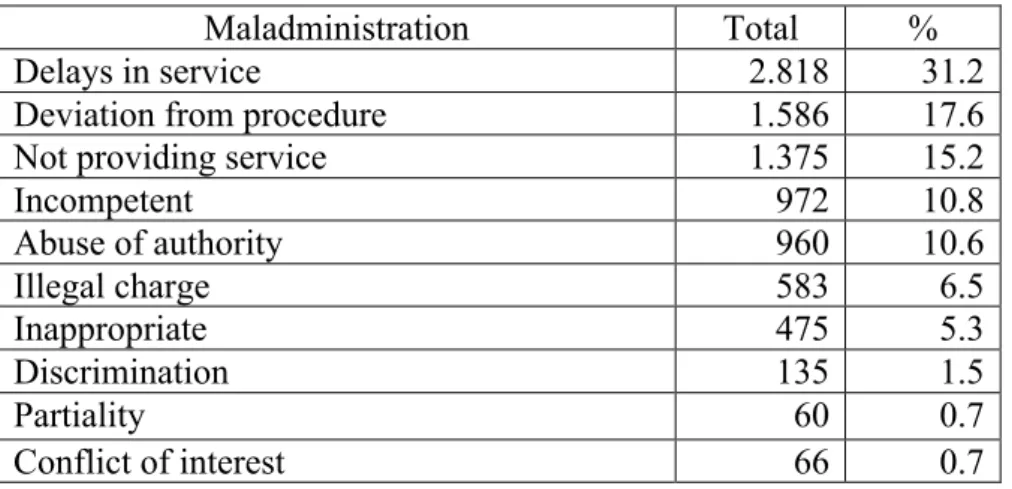
7In general, maladministration is defined as a behavior or act against the law and ethics in the process of delivering public services. These behaviors or acts include protraction of business, abuses of authority, failure of providing services, deviation from formal proceedings, demands for money, discrimination, taking sides, and conflicts of interest.
8Phillipus M. Hadjon dan Tatiek Sri Djatmiati stated that these acts of corruption occur specifically in the context of state financial losses caused by maladministration in the use of authority. Also, the abuse of power is an example of maladministration. This abuse of power often happens in the public service delivery.
9Distributing power to the local autonomous systems aimed to improve the quality of public service. Yet, granting power to local governments contributed to abuse of power on the local level. In his adage, Lord Acton (1834–1902) said, “power tends to corrupt, and absolute power corrupts absolutely.”
10Maladministration is an entry point to corruption and a severe challenge to the bureaucratic reform of Indonesia.
Presently, the Government of Indonesia is focusing on the development of a public
7 Gerald E. Caiden, Maladministration Revisited, draft article at the 75th Annual Conference of the American Society of Public Administration, Seattle, Washington, on 18 March, 2016, completed during August 2016, p. 3
8 Hendra Nurtjahjo, et al., Memahami Maladministrasi (Understanding Maladministration), Ombudsman of Republic of Indonesia, 2013, p. 4, Budhi Masthuri, Mengenal Ombudsman Indonesia (Understanding Indonesian Ombudsman), Pradnya Paramitha, Jakarta, 2005, p. 43
9 Philipus M. Hadjon dan Tatiek Sri Djatmiati, Hukum Administrasi dan Tindak Pidana Korupsi (Administrative Law and Corruption), Gadjah Mada University Press, 2011, p. 6
10 Bowman, J. & West, J. J, Lord Acton and Employment Doctrines: Absolute Power and the Spread of At-Will Employment, Journal of Business Ethics, Springer 2007, 74:119–130, DOI 10.1007/s10551-006-9224-0, accessed on December 10, 2017
welfare system. However, simultaneously, the government should overcome the problem of maladministration in the process of bureaucratic reform.
The Indonesian government has an internal oversight system to deal with the maladministration. But because this system has not been effective, it has not gained public trust. Poor bureaucracy and a lack of a supervisory system consequently led to maladministration and even corruption. It has been difficult for the government to prevent maladministration because the government is not only one actor of the problem. Sometimes, ordinary citizens are also beneficiary from the maladministration. For instance, administrative process take longer time and is even burdensome to people. And some cunning government officials take some money from the people to make the process short and easy. The involvement of all parties in the problem of maladministration has hampered the process of bureaucratic reform in Indonesia.
In addition, giving the local systems more autonomy has had a significant impact on the change of government paradigm. Today, the local governments are more powerful. They have discretionary power in the specific areas of their business, which means that every government official can decide or act by its own initiative.
With this discretionary power, they could abuse their power by making impartial decisions.
The fact that various cases of maladministration and even corruption happened in
the regions is indicative of local governments abusing their power. In fact, the local
governments often rank first among the various state institutions in many cases of
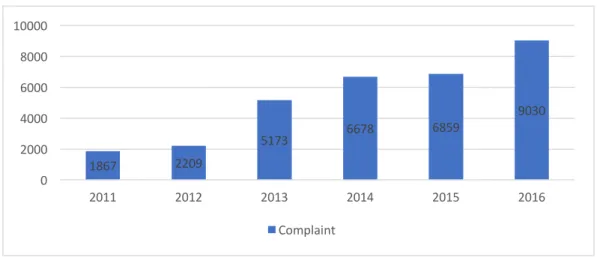
maladministration reported by the public of Indonesia. In 2014, the number of
incoming complaints of maladministration was 6,678, and 43.7% of the charges were complaints against local governments. In 2015, out of a total of 6,859 complaints, 41.59% or 2,853 were charges filed to local governments, and in 2016 there were 9,030 complaints, and 40% or 3,612 complaints were addressed to local governments.
11The fact that much maladministration occurred in the local regions indicates weakness in implementing the governmental reforms of granting more local autonomy and its supervisory system. The system of local autonomy has not been improving the quality of public service as expected. And the supervisory systems run by the government and non-government organizations have not been working well, either. This is due to the fact that the supervisory system run by the local government agency has no independence from the local government. Besides, the non-government organizations have no influence on the local government.
To realize the bureaucratic reform, the Government of Indonesia issued Act No. 28 of 1999 on the State Administrators Clean and Free of Corruption, Collusion, and Nepotism,
12which provides that the state administrators should uphold the general principles of state administration. The general principles are legal certainty, orderly state governance, public interest, disclosure, proportionality, professionalism, and accountability. In addition, this Act contains provisions dealing with legal enforcement against corruption, collusion, and nepotism by state administrators.
Moreover, Act No. 28 of 1999 gives the public the right to participate in the process of state administration. To realize a state administration that is free from corruption,
11 See the Annual Report of Ombudsman of Republic of Indonesia in 2014–2016.
12 Available at https://issuu.com/ethics360/docs/indonesia_-_law_28_of_1999_on_state, accessed on October 10, 2017
collusion, and nepotism, the Government of Indonesia empowered the people to conduct a social control. The Act also provided the establishment of an Inspection Commission
13that is authorized to calculate a public official’s assets before, during, and after their service, and to request information from former public officials, family, colleagues, as well as from the businesspeople with whom the official worked.
The effort of the Indonesian government, after the 1998 reform, to change the bureaucratic system was not only done by issuing regulations but also by developing new law enforcement commissions; they are the Inspection Commission, Public Information Commission, Judicial Commission, and other commissions in every state institution. However, these commissions have not been able to change the environment because of a lack of transparency and accountability.
They do not publicize any reports or information, and so, the public is unaware about how the commissions function. Besides, these commissions are not focusing on the maladministration as the main subject of bureaucratic reform. They just focus on their respective agency and only care about how to help their members do the right things and keep them on the right track. The people are so difficult to access the information of the problem they face. As such, the government needs to introduce a system dedicated to focusing on the issue of maladministration, reminding the government of the rule of law and providing the legal protection for the people.
13 See Article 10 of Act No. 28 of 1999 on the State Administrators Clean and Free of Corruption, Collusion, and Nepotism
Introduction of the Ombudsman system in 2000 showed the desire of the Government of Indonesia to reform the bureaucracy and to realize good governance. The Ombudsman exists to ensure that the delivery of public services is free from maladministration. As granting autonomous power to the regions has caused many cases of maladministration, this oversight system was expected to ensure that there is no abuse of power on the regional level.
The idea of Ombudsman in the Indonesian legal system aims to oversee government action and to protect the rights of the people. Similar to the Ombudsman system in many countries, the Indonesian Ombudsman fosters good governance by reminding the government of the idea of the rule of law and thereby protecting the rights of the people. However, many people doubted the effectiveness of the Ombudsman system in Indonesia. In the era of local autonomy, implementing an Ombudsman system would be difficult due to the heterogeneity of the regions. The problem is how to fit the Ombudsman system for all regions that have different characters.
In terms of overseeing government action, the Ombudsman system is quite similar
to the Administrative Court. This court is the special court that has the function to
resolve maladministration cases. The people can file a lawsuit when they are not
satisfied with a decision of the government. The settlement of the cases by the
Administrative Court is legally binding, but it is time-consuming and expensive to
reach the conclusion. As such, the people of Indonesia need another way to resolve
their problems.
Moreover, as most of the government affairs have been transferred to the local governments, the Ombudsman of Indonesia is expected to oversee Local Government Action and prevent maladministration. In addition, the Ombudsman of Indonesia is similar to a magistrate of influence that its legal product is just morally binding.
14So the effectiveness of the Ombudsman system is a problem when confronting the local government.
1.2. Outline of the Thesis
As an effort to realize bureaucratic reform, this study aims to analyze the transformation process of the Ombudsman system in Indonesia. Furthermore, I will clarify the problem of overlapping functions of the Ombudsman system and the Administrative Court. Also, I will describe the implementation of the Ombudsman system in the settlement of maladministration issues and identify the benefits and challenges of the Ombudsman system in advancing the quality of public services provided by the local governments. Promoting good governance in the autonomous era is essential. To achieve these goals, the study will answer the following questions:
1. How did the transformation process of the Ombudsman system in Indonesia unfold?
2. What are the differences between the Administrative Court and Ombudsman system in supervising government action?
14 Teten Masduki, Ombudsman Daerah Dan Pemberdayaannya (Local Ombudsman and Its Empowerment), presented in the Seminar on the establishment of local Ombudsman in Yogyakarta, PUSHAM UII with Partnership for Governance Reform in Indonesia, Yogyakarta, October 23, 2003, available at http://pusham.uii.ac.id/upl/article/id_Teten%20Masduki.pdf, last visited on December 5, 2017
3. How effective is the implementation of the Ombudsman system in the settlement of maladministration?
4. What are the benefits and challenges of the Ombudsman system in advancing quality of public services from the local government?
This thesis is divided into seven chapters. Chapter One introduces the background of the research and explains the pertinence of this research. Chapter Two explains the basic notion of the Ombudsman system in general. In Chapter Three, I present the process of transforming the idea of the Ombudsman system in the Indonesian legal system. Chapter Four discusses the comparison between the Administrative Court and Ombudsman system in supervising government action. In Chapter Five, I present the implementation of the Ombudsman system in the settlement of maladministration. In Chapter Six, I discuss the benefits and challenges of the Ombudsman system in improving the quality of public services provided by the local government, and Chapter Seven provides the conclusion of this study and ideas for future research.
1.3. Research Methods
This research is a “normative legal research,” namely research based on the study of positive law and all the rules of law that are conceptualized as rules or norms that become the guidelines of human behavior. Normative legal research is used to explore the law, the principle of law, and the legal doctrines involved in resolving current issues.
15To analyze the questions this thesis poses, I use a statute and case
15 Peter Mahmud Marzuki, Penelitian Hukum (The Legal Research), Kencana Prenada Media Group, Jakarta, 2010, p. 35
approach. The study utilizes secondary data as a primary source supported by
primary data. The primary data of this research is obtained by reviewing legal
resources and literature, some documents related to the Ombudsman, and online
research. Then, the data are analyzed qualitatively to describe the content of the
research and to provide a conclusion.
Chapter II OMBUDSMAN
2.1. Definition of Ombudsman
The word “Ombudsman” comes from the ancient Swedish language “umbuðsmann”
meaning “representation.”
16In the Columbia Encyclopedia,
17Ombudsman is defined as a government agency serving as an intermediary between citizens and the government bureaucracy. The term “Ombudsman” implies an autonomous authority delegated to receive, examine, and address a complaint about injustice in the administration. The Ombudsman is typically independent, unprejudiced, and available. An Ombudsman works on behalf of the public and usually has the authority to perform investigations on its own initiative.
18Initially, this institution is independent of the executive power and the members of the Ombudsman are selected by the legislature, to whom they provide their reports.
19In addition to the governmental level, the position of “Ombudsman” can be found in companies, universities, and mass media associations. The word Ombudsman can be interpreted as a representative, an agent, a delegate, a lawyer, a guardian, or
16 Carolyn Stieber, 57 Varieties: Has the Ombudsman Concept Become Diluted? Negotiation Journal (2000) 16: 49. https://doi.org/10.1023/A:1007546404573 accessed on December 23, 2017
17 The Columbia Encyclopedia, Sixth Edition, Columbia University Press, 2001.
18 Mariteuw Chimère Diaw, Ombudsmen, People’s Defenders and Mediators: Independence and administrative justice in state transformation, p. 2, available at https://www.odi.org/sites/odi.org.uk/files/odi-assets/publications-opinion-files/4478.pdf, accessed on January 3, 2018
19 Bengt Wieslander, The Parliamentary Ombudsman in Sweden, The Bank of Sweden Tercentenary Foundation, 1994, see P. Ikiforos Diamandouros, The Ombudsman Institution and the Quality of
Democracy, European Ombudsman, available at
https://www.circap.org/uploads/1/8/1/6/18163511/diamanduros.pdf, accessed on December 2, 2017
any other person who is authorized by others to act on their behalf and to give reviews of their business.
It is well-settled that the term “Ombudsman” could be found in Sweden (1809) from the term “JustitieOmbudsman” or Ombudsman for Justice. However, the systems by which people could control the government have existed for millennia.
20In the Ombudsman in New Zealand, Bryan Gilling stated that during the Roman Empire era, there was a “Tribunal Plebes” institution whose task was almost the same as the Ombudsman—protecting the rights of the weak from the abuse of power by the nobles.
21In 221 BC, a model of control, such as the Ombudsman, was also widely seen during the Chinese empire. During the Tsin Dynasty, the Emperor established a supervisory body called Control Yuan or Consorate in charge of oversight of imperial officials and this institution received complaints about the actions of arbitrary government officials.
22Dean M. Gottehrer, the former president of the United States Ombudsman Association, discovered that in Islamic rule, the Ombudsman is basically rooted in the principles of justice that are part of the oversight mechanism in Islamic state administration. During the reign of Caliph Umar bin Khattab (633–644 BC), he positioned himself as a Muhtasib (the person receiving the complaint) and then
20 Mariteuw Chimère Diaw, Ombudsmen, People’s Defenders and Mediators: Independence and administrative justice in state transformation, op. cit.
21 Bryan Gilling, The Ombudsman in New Zealand, Dunmore Press, Wellington, 1998, in Budhi Masthuri, Mengenal Ombudsman Indonesia (Understanding Indonesian Ombudsman), Pradnya Paramita, Jakarta, 2005, p. 2
22 Budhi Masthuri, ibid.
formed Qadi al Quadat (Chief Justice), with a specific mandate to protect the public from abuses of power by the government.
23Such a supervisory concept was then passed on and is still used in the Islamic state system of Turkey.
24The Chief Justice has important roles to oversee government affairs and to ensure the enforcement of Islamic law. In this system, the Chief Justice has the power to oversee maladministration by the Sultan.
25This idea then inspired the Swedish king, Charles XII (1697–1718), who was displaced in Turkey for several years after being defeated in the Battle of Poltava by Russia in 1709. Due to the fact that there was no king for a long time in Sweden, the administration deteriorated. In 1713, the King appointed representatives to monitor the Swedish administrative institutions and the judiciary, and they officially formed Justitiekanslern (Chancellor of Justice) in 1719.
In 1809, the Swedish government introduced the provisions of this oversight system in its Constitution and established justitieOmbudsman.
26The parliament appointed the members of the justitieOmbudsman. The authorities in this institution oversaw public administration and the judiciary, and prosecuted officers who failed to fulfill their official duties.
27Sweden currently uses the 1974 Constitution and has four
23 Budhi Masthuri, ibid.
24 This Chief Justice had a similar function to the current Ombudsman. The idea for the position of Chancellor of Justice may have come from the Turkish office of Qodi al Quadat (Chief Justice), in Linda C Reif, The Ombudsman, Good Governance and the International Human Rights System, Koninklijke Brill NV, Leiden, The Netherlands, 2004, p. 5, see B. Wieslander, The Parliamentary Ombudsman in Sweden, Bank of Sweden Tercentenary Foundation, 1994, p. 13, W. Gellhorn, The Swedish JustitieOmbudsman, 75 Yale Law J., 1965, p. 1
25 The Sultan is a name for a king or Muslim leader, who has a full sovereign territory called the Sultanate.
26 Linda C. Reif, supra note 9
27 Budhi Masthuri, loc. cit, p. 3–5, Linda C. Reif, ibid, p. 6, Mariteuw Chimère Diaw, Ombudsmen, People’s Defenders and Mediators: Independence and administrative justice in state transformation, available at https://www.odi.org/sites/odi.org.uk/files/odi-assets/publications-opinion- files/4478.pdf, accessed on January 3, 2018, p. 2
parliamentary Ombudsmen.
28The Parliamentary Ombudsman of Sweden has the mandate to supervise the rule of law in the public administration and the judiciary.
Besides, it is empowered to ensure that there is no violation of the fundamental rights and freedoms of citizens.
2.2. The Movement of Ombudsman System All Over the World
As the first institution established in the form of modern law in the early 19th century, the Swedish Ombudsman model has transformed to various types of public oversight and corporate accountability, and has contributed to the globalization of the idea of good governance.
29Other Scandinavian countries adopted the Swedish Ombudsman model (Finland in 1919 and Denmark in 1955), but the idea was not accepted by other countries until the 1960s. The growing awareness within governments on the ability of the central and local governments to handle the complaints contributed to the spread of the Ombudsman system worldwide.
30The primary worldwide surge happened during the mid-1960s, and it raised various reactions in many countries.
31In the United States, the idea of Ombudsman contradicts the integrity of the Western constitutional system that still uses the concept of separation of powers. In the United States, the introduction is considered to be an unspectacular and relatively small government reform to improve the well- established and efficient system. In France, the general opinion is that the Ombudsman system has no place in a state that possesses the best method of
28 The number of Ombudsmen increased during the twentieth century, Linda C. Reif, The Ombudsman, Good Governance and the International Human Rights System, Koninklijke Brill NV, Leiden, The Netherlands, 2004, p. 6
29 Mariteuw Chimère Diaw, Ombudsmen, People’s Defenders and Mediators, op. cit., p. 2
30 Ibid., p. 21
31 Ibid., p. 2
jurisdictional control over the administration. Canada, on the other hand, was more welcoming the idea of Ombudsman.
32In Great Britain, another form of Ombudsman was discovered in 1967 called the Commissioner of Parliament for Administration. In Bangladesh, it took 25 years of debates between the first passage into law of the institution and its establishment in 2002.
33The thought had reverberation in this decade when bureaucracy became further impenetrable, and the people grew more concerned. Ombudsmen assisted in achieving fairness because they acted as independent operators with unfettered access to records and personnel, who could conduct careful investigations impartially, and had the prestige of the office.
34Mary Seneviratne explained that the popularity of the Ombudsman system was influenced by three things; the expansion of state activities during and after World War II (1939–1945), awareness of the importance of protecting human rights, and the increasing level of public education and participation.
35These social conditions were combined with the activities of International Commission of Jurists and the United Nations that favored the interest in Ombudsmen.
36The problem of bureaucracy and abuse of
32 Acceptance of the idea of Ombudsman in Canada is a response to the complexity of governance in a modern welfare state. In addition, this parallel development was also influenced by the Ombudsman's office throughout the British Commonwealth, and several American states. See Ian Darling, (PDF) The Role of Ombudsman in Canada & the USA. Available at:
https://www.researchgate.net/publication/260318633_The_Role_of_Ombudsman_in_Canada_the_
USA [accessed Sep 25 2018], accessed in July 2017
33 Mariteuw Chimère Diaw, op.cit, p.2
34 Carolyn Stieber, 57 Varieties: Has the Ombudsman Concept Become Diluted? Negotiation Journal, op.cit., accessed in December 2017
35 Mary Seneviratne, Ombudsmen: Public Services and Administrative Justice, Butterworths, 2002, p. 10
36 D. Rowat, The Ombudsman Plan, University Press of America, 1985, p. 131, see Mary Seneviratne, ibid. p. 10
discretionary power led to a need for more protection.
37Even within the government, some government officials were concerned about maladministration.
The spread of the Ombudsman system subsequently increased after the 1960s, when many countries, especially European countries, established Ombudsman institutions. Such countries include New Zealand (1962), England (1967), provinces in Canada (1977), Portugal (1975), Austria (1977), Tanzania (1968), Israel (1971), Puerto Rico (1977), Australia (1977 at the federal level, 1972–1979 at the state level), Spain (1981), and the Netherlands (1981).
38During the 1990s, Ombudsmen proliferated in many countries. Linda C. Reif mentioned several factors that contributed to this development, such as the wave of democratization that took place in the 1990’s and the increased interest of the international community in the Ombudsman system. Notably, development agencies such as the United Nations Development Program (UNDP), USAID, The Asia Foundation, World Bank, IMF, and donor countries were willing to support good governance and human rights institutions.
39In 1998, more than 100 countries around the world had established some form of an Ombudsman institution. In some countries, the Ombudsman existed at the regional, provincial, state, or district level (district/municipality) level. Some other countries such as Australia, Argentina, Mexico, and Spain have Ombudsman institutions at national as well as regional and sub-national levels, while other countries such as Canada, India, and Italy only have Ombudsman institutions at sub-national. Public sector Ombudsman institutions are
37 Ibid., p. 11
38 See Bryan Gilling, The Ombudsman in New Zealand, Dunmore Press, Wellington, 1998, see also Mariteuw Chimère Diaw, Ombudsmen, People’s Defenders and Mediators, op. cit., p. 2
39 Linda C. Reif, The Ombudsman, Good Governance and the International Human Rights System, Koninklijke Brill NV, Leiden, The Netherlands, 2004, p. 215
widely found in European countries, North America, Latin America, the Caribbean, Africa, Australia, the Pacific, and Asia.
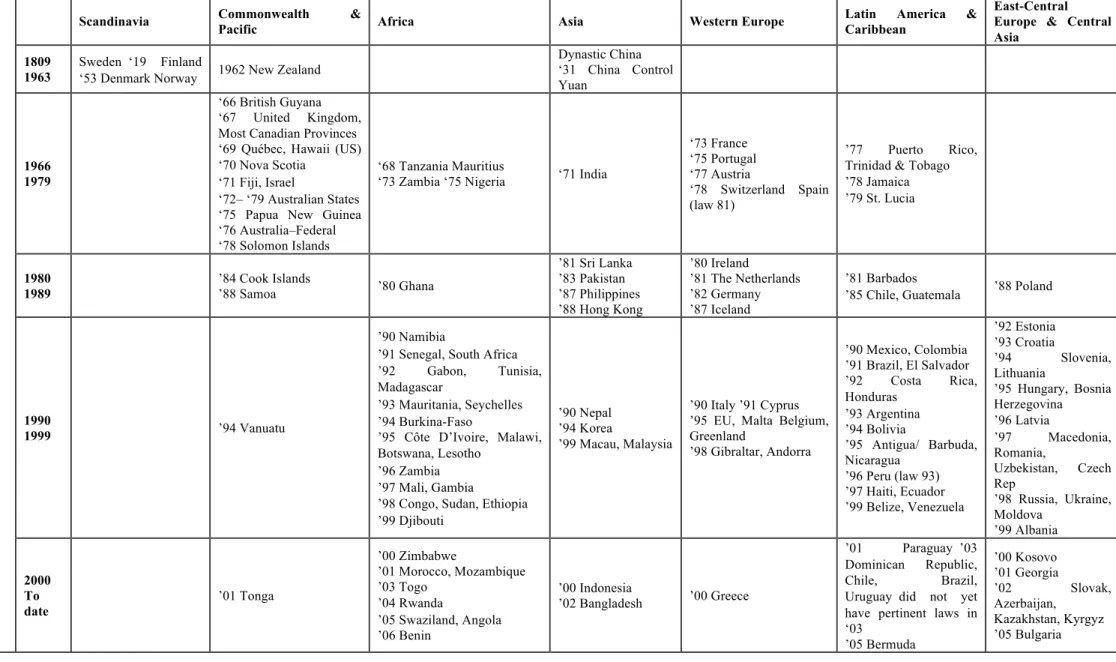
40Further details regarding the spread of the Ombudsman system can be seen in the table 1.
Although the spread of the idea of the Ombudsman was slow to begin with, the Ombudsman oversight system continues to grow. Currently, some 50 countries even have listed the Ombudsman system in their Constitution, such as Denmark, Finland, Philippines, Thailand, South Africa, Argentina, and Mexico. The spread of the Ombudsman institution has spread to such diverse nations due by its flexible nature, which makes it versatile to various social, constitutional, cultural, judicial, and political conditions. Flexibility infers decent variety among Ombudsmen, even inside the European Association.
4140 Ibid.
41 P. Nikiforos Diamandouros, The Ombudsman Institution and the Quality of Democracy, European Ombudsman, available at https://www.circap.org/uploads/1/8/1/6/18163511/diamanduros.pdf, accessed on December 2, 2017
Table 1: The Movement of the Ombudsman System Over the World.
42Scandinavia Commonwealth &
Pacific Africa Asia Western Europe Latin America &
Caribbean
East-Central Europe & Central Asia
1809
1963 Sweden ‘19 Finland
‘53 Denmark Norway 1962 New Zealand
Dynastic China
‘31 China Control Yuan
1966 1979
‘66 British Guyana
‘67 United Kingdom, Most Canadian Provinces
‘69 Québec, Hawaii (US)
‘70 Nova Scotia
‘71 Fiji, Israel
‘72– ‘79 Australian States
‘75 Papua New Guinea
‘76 Australia–Federal
‘78 Solomon Islands
‘68 Tanzania Mauritius
‘73 Zambia ‘75 Nigeria ‘71 India
‘73 France
‘75 Portugal
‘77 Austria
‘78 Switzerland Spain (law 81)
’77 Puerto Rico, Trinidad & Tobago
’78 Jamaica
’79 St. Lucia
1980 1989
’84 Cook Islands
’88 Samoa ’80 Ghana
’81 Sri Lanka
’83 Pakistan
’87 Philippines
’88 Hong Kong
’80 Ireland
’81 The Netherlands
’82 Germany
’87 Iceland
’81 Barbados
’85 Chile, Guatemala ’88 Poland
1990
1999 ’94 Vanuatu
’90 Namibia
’91 Senegal, South Africa
’92 Gabon, Tunisia, Madagascar
’93 Mauritania, Seychelles
’94 Burkina-Faso
’95 Côte D’Ivoire, Malawi, Botswana, Lesotho
’96 Zambia
’97 Mali, Gambia
’98 Congo, Sudan, Ethiopia
’99 Djibouti
’90 Nepal
’94 Korea
’99 Macau, Malaysia
’90 Italy ’91 Cyprus
’95 EU, Malta Belgium, Greenland
’98 Gibraltar, Andorra
’90 Mexico, Colombia
’91 Brazil, El Salvador
’92 Costa Rica, Honduras
’93 Argentina
’94 Bolivia
’95 Antigua/ Barbuda, Nicaragua
’96 Peru (law 93)
’97 Haiti, Ecuador
’99 Belize, Venezuela
’92 Estonia
’93 Croatia
’94 Slovenia, Lithuania
’95 Hungary, Bosnia Herzegovina
’96 Latvia
’97 Macedonia, Romania,
Uzbekistan, Czech Rep
’98 Russia, Ukraine, Moldova
’99 Albania
2000 To
date ’01 Tonga
’00 Zimbabwe
’01 Morocco, Mozambique
’03 Togo
’04 Rwanda
’05 Swaziland, Angola
’06 Benin
’00 Indonesia
’02 Bangladesh ’00 Greece
’01 Paraguay ’03 Dominican Republic, Chile, Brazil, Uruguay did not yet have pertinent laws in
‘03
’05 Bermuda
’00 Kosovo
’01 Georgia
’02 Slovak,
Azerbaijan, Kazakhstan, Kyrgyz
’05 Bulgaria
2.3. Ombudsman’s Role in the Settlement of Maladministration
Supervision of public services is an important part of the effort to attain good, clean, and efficient governance as well as to prevent the abuse of authority. Good governance is the goal of Ombudsmen in every country. Hence, the principle of good governance could be a measurement of the Ombudsmen work to supervise government actions. Good governance will be fully realized if the government has the political will and follows the rule of law along with the general principles of good governance. Besides, internal and external oversight is necessary to remind the government of the rule of law and to ensure the protection of the rights of the people. The presence of oversight bodies such as Ombudsmen can be an alternative dispute resolution.
As a system of external oversight, the Ombudsman has played an important role in the transformation of democratic government in recent decades. From a slow start, it has spread across continents and in many countries, albeit with varying levels of political commitment and success.
43The Ombudsman is very closely related to public complaints against an action or the decision of administrative officials considered to harm the community. The role of the Ombudsman is to protect the public against maladministration that includes rights violations, abuse of authority, errors, omissions, and unfair decisions to improve the quality of public administration. Also, the Ombudsman makes governmental actions more opened and more accountable to community members.
43 Mariteuw Chimère Diaw, ibid.
The Ombudsman reviews and examines not only individual cases but also systemic problems in administrative activities, public policy, and law.
44The fundamental role of this review is that the Ombudsman, who is independent of both the executive and the judiciary, supervises the activities of administrative bodies, with a focus on maladministration.
45The Ombudsman bridges the gap between the public and the government in term of maladministration. Moreover, the core function of the Ombudsman is to handle complaints against public authorities.
46The process of adapting the Ombudsman idea and its role has been different in each country. Not all the states that adopted an Ombudsman system fully embraced every facet of the role. In New Zealand, the Ombudsman can report on any decision, recommendation, act or omission that is allegedly contrary to law. In Denmark, the Ombudsman can criticize mistakes and irrational decisions. In Norway, the Ombudsman can oversee injustice and discretionary decisions that are absurd.
47The different role restrictions of the Ombudsman was influenced by the differences of each country in understanding what administrative matters were. Some took the initiative to give the Ombudsman a broad role. The concept of maladministration
44 Linda C. Reif, The International Ombudsman Yearbook Volume 1, 1997, Kluwer Law International, 1998, p. 5, 7–9; Marten Oosting, 'The Ombudsman: A Profession' in International Ombudsman Institute; Anita Stuhmcke, 'Ombudsman and Integrity Review' in Linda Pearson, Carol Harlow and Michael Taggart, Administrative Law in a Changing State; Essays in Honour of Mark Aronson, Hart Publishing, 2008, p. 349
45 Marten Oosting, 'Protecting the Integrity and Independence of the Ombudsman Institution: The Global Perspective' in Linda C. Reif (ed), The International Ombudsman Yearbook Volume 5, 2001 (Kluwer Law International, 2002), p. 13, 16–17.
46 Note that Ombudsmen do not make legally binding decisions, relying instead on moral authority, see P. Nikiforos Diamandouros, The Ombudsman Institution and The Quality of Democracy,
European Ombudsman, ibid., available at
https://www.circap.org/uploads/1/8/1/6/18163511/diamanduros.pdf, accessed on December 2, 2017
47 Ibid.
was allowed to be quite flexible and comprehensive enough, and its meaning was felt to be well understood.
482.4. Ombudsman and Administrative Justice
Ombudsman is now recognized as an alternative way to resolve disputes and provides a different way to protect and preserve some general value along with general norms protected by other state institutions such as, the courts, tribunals, or other judicial bodies. Justice becomes a keyword in the struggle of Ombudsmen around the world in carrying out its functions. Justice is essentially treating someone or another person by the rights and its obligations. Everyone should be treated equally without distinguishing tribe, degree, race, wealth, education, or religion.
In the context of the rule of law, the state must ensure justice for the people by making impartial policies and providing the necessary facilities. Besides, if there is injustice in the public service delivery or maladministration, the state must provide a dispute resolution mechanism for its citizens to seek justice. It is the reason why we need the tool for checking the use of power and realizing administrative justice.
Mary Seneviratne stated that administrative justice is not only concerned with providing remedies for citizen’s grievances. It is also involved with improving administrative practice and realizing better services.
49Administrative justice can be achieved when the state administration is good, clean, and transparent while the
48 Administrative Justice: Some Necessary Reforms (1988) Clarendon Press p. 138 in Mary Seneviratne, ibid. p. 46
49 Mary Seneviratne, Ombudsman; Public Services and Administrative Justice, ibid. p. 72
state administration provides alternative ways to resolve the problems of administration.
Everyone has the right to remedy where injustice happens. To deal with injustice occurring at the administrative level, the courts provide a judicial review for the people whose rights are violated. But it would spend much of energy to resolve maladministration. Previously, the problems of delivering administrative justice by the courts have been addressed. The court has not been handling these kinds of disputes very well.
50Like the court, the tribunal also has the same problem in handling the case. They have the problem on their effectiveness and independence of checking administrative decision-making.
51In fact, resolving disputes by the tribunals is not quick, formal, or technical, either. They have various steps on handling cases and have to deal with complex areas of law and factual situations.
52For some countries, they could achieve administrative justice without Ombudsmen, but an Ombudsman is a good option for countries that have been struggling with the problem.
2.5. Development of Ombudsman System in Some Countries
2.5.1. Ombudsman system in Scandinavian Countries
In Sweden, Riksdag (Parliament) appoints one or more members of the Parliamentary Ombudsman who shall oversee the implementation of laws and other
50 See C. Harlow and R. Rawlings, Law and Administration, Butterworths, p. 574 in Mary Seneviratne, ibid. p. 72
51 H. Genn, Tribunal Review of Administrative Decision-Making, p. 284 in Mary Seneviratne, ibid.
p. 73
52 Ibid.
regulations in public activities. It has the right to access information from the courts, administrative authorities and local government officials. It can also ask for help from a public prosecutor in carrying out its duties.
53The Swedish Ombudsman jurisdiction covers judicial bodies, government bodies at central and local level, and public officials or individuals who carry out the function of government. However, this institution has no authority to oversee the actions of the Riksdag, the cabinet ministers, the Chancellor of Justice or members of national or municipal councils.
54In 1919, Finland also developed an Ombudsman system after independence from Sweden. The members of Finnish Ombudsman are appointed by Parliament for 4 years. They must have extensive knowledge in the field of law. The task of the Ombudsman is to supervise courts, government and civil servants to remind themselves of the idea of the rule of law. In carrying out such supervision, the Ombudsman must also pay attention to human rights.
55Article 110 of the Finnish constitution authorizes the Ombudsman to prosecute judges who violate the law.
56More than that, the Ombudsman can send a report on the President’s act of treason or commit a crime against humanity to the Parliament. Based on the report from the Ombudsman, the Parliament can impeach the President.
5753 The Swedish Ombudsman is stipulated in the Constitution of 1908, the Instrument of Government of 1974, the Riksdag (Parliament) Act of 1990, and Act of Instruction to the Parliamentary Ombudsman of 1986. See Swedish Instrument of Government, available at http://www.wipo.int/edocs/lexdocs/laws/en/se/se122en.pdf, accessed on October 20, 2018
54 Swedish Institute, Swedish Ombudsman, 2000, p. 1 in
55 Article 109 of the Constitution of Finland, available at https://publicofficialsfinancialdisclosure.worldbank.org/sites/fdl/files/assets/law-library-
files/Finland_Constitution_2000_en.pdf, accessed on October 21, 2018
56 Article 109 of the Constitution of Finland
57 Article 113 of the Constitution of Finland
Denmark introduced the Ombudsman institution by amending the Constitution in 1953 and enacting the Ombudsman Act in 1954.
58The Danish Constitution stipulates that Folketing (Parliament) should choose one or two Ombudsmen to oversee the government.
59Unlike the Ombudsman in Finland and Sweden, the Danish Ombudsman is not authorized to prosecute and does not have the power to oversee the court. The Danish Ombudsman system was later adopted by most Ombudsmen in the world.
Norway also amended its Constitution in 1962 and issued the Ombudsman Act like Denmark did. The Norwegian Constitution mandates the Parliament to appoint an Ombudsman who oversees the administration of the government and to ensure that there is no injustice against a citizen.
60To maintain its independence, the Ombudsman may not concurrently become a member of Parliament. The Norwegian Ombudsman has added to the list of countries in Scandinavia that developed the Ombudsman system which is further known as the Classical Ombudsman. In general, it can be said that the characteristic of the Classical Ombudsman is the Ombudsman System formed by Parliament and responsible to Parliament but independent and free from the influence of any party.
58 Royal Danish Ministry of Foreign Affairs and the Danish Parliamentary Commissioner (Ombudsman), The Danish Ombudsman (T.t), p 3.
59 Article 55 of Danish Constitution, available at
https://www.constituteproject.org/constitution/Denmark_1953.pdf?lang=en, accessed on October 21, 2018
60 See Article 75 of Norway Constitution, available at
https://www.constituteproject.org/constitution/Norway_2014.pdf, accessed on October 21, 2018
2.5.2. Ombudsman System in Australia
Australia established the Ombudsman system in 1973. The core business of Ombudsman in Australia is investigation and inquiries.
61The Australian Ombudsman is independent and can carry out investigations upon every part of the government business. This institution can help the parties to resolve disputes between individuals and government institutions or private bodies.
62Like many Ombudsman services and other dispute resolution in other countries, Australian government Ombudsman service is free of charge and a means of resolving disputes outside the court system.
63Different from the court, the Australian Ombudsman can resolve cases quickly and send the information they got directly to Parliament.
The Jurisdiction of the Ombudsman covers all Australian government bodies.
Australia has an Ombudsman assigned to each state and also to the Commonwealth of Australia. The Commonwealth Ombudsman in Australia was established in 1977.
64The Commonwealth Ombudsman has a big power to investigate complaints over the administrative actions and decisions of Australian Government agencies.
65The Ombudsman can investigate complaints from the people who have been treated unfairly or unreasonably by an Australian Government department or agency. In addition, the Ombudsman may investigate
61 See https://en.wikipedia.org/wiki/Ombudsmen_in_Australia, accessed on October 21, 2018
62 Ibid.
63 Ibid.
64 See http://www.ombudsman.gov.au/about/other-resources/40th-anniversary-conference, last visited on October 21, 2018
65 See https://www.australia.gov.au/directories/australia/Ombudsman, accessed on November 2, 2018
private sector organization, including Australia Post, Centrelink, Child Support and the Department of Immigration and Border Protection.
662.5.3. Ombudsman System in Netherlands
Netherlands was one of the countries that had ruled Indonesia, and recognized Indonesian sovereignty on August 17, 1945. Netherlands was also one of the countries in Europe that amended its Constitution to insert provisions regarding the Ombudsman after this institution had long been established.
67Article 78a of the Dutch Constitution stipulates that the members of the National Ombudsman shall be elected by the Lower House of the State’s General.
68The Netherlands National Ombudsman Act states that the term of their service is for 6 years.
69The National Ombudsman of Netherlands is independent from the government and impartial. It is supported by about 170 employees.
70They are professionals who are highly skilled in their fields, and their uniqueness is that 72 percent of all employees are women, while 28 percent are men.
7166 Ibid.
67 In Netherlands, the National Ombudsman is supported by a special National Ombudsman Act (Wet Nationale ombudsman), the Dutch General Administrative Law Act (Algemene wet bestuursrecht) and is guaranteed by the Dutch Constitution (Chapter 4, Article 78a).
68 See Article 78a of the Dutch Constitution, available at https://www.government.nl/documents/regulations/2012/10/18/the-constitution-of-the-kingdom- of-the-netherlands-2008, last visited on November 15, 2018
69 Section 2 (3) of The Netherlands National Ombudsman Act, available at
http://hrlibrary.umn.edu/research/Netherlands/National%20Ombudsman%20Act%201981.pdf, accessed on October 4, 2018
70 https://www.nationaleombudsman.nl/vraag-en-antwoord/who-is-the-national-ombudsman-of- the-netherlands, last visited on November 20, 2018
71 Muhammad Firhansyah, Berkaca dari Ombudsman Belanda (Reflection on the Ombudsman of Netherlands), see http://ombudsman.go.id/artikel/r/artikel--berkaca-dari-ombudsman-belanda, accessed on October 20, 2018
The National Ombudsman of Netherlands aims to provide an opportunity for citizens to complain about the services provided by the government and to advise public administrators on how they improve their business.
72The authorities of the National Ombudsman are quite extensive including handling complaints, conducting independent investigations, mediating disputes, making recommendations, publishing reports, informing policy makers, holding discussions with various parties, reaching out to the people and giving public training and coordinating with the press.
73With these authorities, the National Ombudsman of Netherlands can conduct many systemic reviews that are very beneficial for the citizens.
2.5.4. Ombudsman System in Japan
Japan has no National Ombudsman system like most other countries in the world have. However, there are regional or municipal Ombudsmen in many prefectures and local government bodies. They are regulated by the local government regulation. The function of these regional Ombudsmen is to receive a public complaint and resolve the dispute.
74Besides the national government or parliament, control of government actions by a group of people such as “Citizen Ombudsman”
has been very active in Japan. This Citizen Ombudsman group began its activities in 1985. The main motive of these groups was to uncover government activities that
72 See the Netherlands National Ombudsman Act and the Constitution of the Kingdom of the Netherlands, available at https://www.government.nl/documents/regulations/2012/10/18/the- constitution-of-the-kingdom-of-the-netherlands-2008, last visited on November 15, 2018
73 See the Netherlands National Ombudsman Act of 1981
74 JAPAN Public Administration Country Profile Division for Public Administration Development Management (DPADM) Department of Economic and Social Affairs (DESA) United Nations, January 2006, p. 10
spent the budget. These citizen groups do not have a direct relationship with public institutions or legal institutions in appropriately. They consist of various community and voluntary groups.
75To date, the Japanese government has not intended to develop an Ombudsman system even though the proposal has been made for decades. They employ their own system and believe the system as a fairly adequate system.
76Administrative Evaluation Bureau (AEB) of the Ministry of Home Affairs and Communication (MIC) reviews the activities of the Japanese central government as an independent organ of the government.
77Although this system is a part of the government, AEB technically plays its role like the Ombudsman system in most other countries. It could be said that AEB is the Ombudsman system in Japanese version. The AEB conducts administrative counseling, administrative inspection, and policy evaluation. Like Ombudsman system does, the AEB receives the complaints from the public regarding government actions. It provides administrative counselors to conduct mediation between complainants and the administrative authorities in charge.
78It also conducts nation-wide surveys of policies and administrative procedures of the government. Moreover, the AEB oversees policy evaluation tasks of all the ministries and its implementation.
7975 Ibid.
76 See http://www.soumu.go.jp/english/aeb/index.html, last visited on July 3, 2018, see also Watarai Osamu, Deputy Director-General of the Administrative Evaluation Bureau Ministry of Internal Affairs and Communications, Japan, The Challenges Japanese Ombudsman Has Faced After the Great East Japan Earthquake, Presentation for the 10th World Conference of the International Ombudsman Institute November 15, 2012
77 http://www.soumu.go.jp/english/aeb/index.html, last visited on July 3, 2018
78 At present, there are around 5,000 administrative counselors and they do consultation. Most of them are retired public servants. This unique system started in 1961 when many people helped to make it happen.
79 Ibid.
The AEB is the member of the International Ombudsman Institute and the Asian Ombudsman Association. Administrative counselor networks of the AEB are recognized as a unique system among the International Ombudsman Community.
The reason for its uniqueness is that the administrative counselors are private sector members to work on a voluntary basis. They are appointed by the Minister of MIC and receive complaints from the public. Because of this uniqueness, some Ombudsmen from other countries came to Japan to study this system.
802.6. Summary
The word “Ombudsman” was first used in Sweden to name an institution that served to oversee the abuse of power. Nevertheless, this kind of supervisory model has been encountered in the past with different names. In the Roman Empire, there was an institution of tribunal plebes that had the same task as the Ombudsman. In the time of the Chinese empire (221 BC), the Tsin Dynasty established a supervisory body called “Control Yuan.” Control Yuan is still used as the name for the Ombudsman in Taiwan. Even long before that, this concept of supervision has been practiced in the Islamic state system since the Caliph Umar bin Khattab (634–644 BC).
Due to its flexibility, the Ombudsman’s oversight model is well received worldwide with the support of development agencies and donor states concerned with the pursuit of good governance. The popularity of Ombudsmen is increasingly in line
80 Ibid.