and Its Reduction in Semiconductor Lasers
著者 サザド ムハンマド サマウン イムラン
著者別表示 Sazzad Muhammad Samaun Imran journal or
publication title
博士論文本文Full 学位授与番号 13301甲第3951号
学位名 博士(学術)
学位授与年月日 2013‑09‑26
URL http://hdl.handle.net/2297/39361
Numerical Analysis of Optical Feedback Noise and Its Reduction in Semiconductor Lasers
Sazzad Muhammad Samaun Imran July 2013
Doctoral Dissertation
Numerical Analysis of Optical Feedback Noise and Its Reduction in Semiconductor Lasers
Graduate School of
Natural Science & Technology Kanazawa University
Major Subject: Division of Electrical Engineering and Computer Science Course: Electronic Science
School Registration No.: 1023112108
Name: Sazzad Muhammad Samaun Imran Chief Advisor: Professor Minoru Yamada
Semiconductor lasers play a central role in the growing world of optoelectronic technologies. A measure of the importance of this emerging optoelectronic technology is provided by the optical disc players, laser printers and the optical fiber communication system. But semiconductor lasers tend to be suffered by the optical feedback (OFB) noise caused by reflection of the output light at surface of the optical disc or the optical fiber. Hence, it is required to reveal the lower noise for the higher performance. This dissertation shows numerical simulations on the phenomena of the OFB noise, its suppression by the superposition of high frequency (HF) current and the condition at which the HF current is unable to suppress the noise.
We present an improved theoretical model to analyze dynamics and operation of semiconductor lasers under optical feedback. The model is based on a set of multimode rate equations in which the self and mutual gain saturation effects among lasing modes, re-injection of delayed feedback light reflected at surface of connecting optical device and Langevin noise sources for the intensity, phase and carrier fluctuations are taken into account. The proposed model is applied to 850nm GaAs lasers operating under optical feedback. Temporal variations of photon numbers, optical phases and electron density are traced by numerical calculation, and frequency spectra of intensity noise are determined by help of the fast Fourier transformation. Characteristics of the OFB noise are expressed in terms of the relative intensity noise (RIN).
The intensity noise of the semiconductor lasers consists of the quantum noise and the optical feedback noise. The quantum noise is generated by intrinsic property of the quantum mechanical fluctuation of the laser and very difficult to control in principle. On the other hand, numerical simulations based on our theoretical model confirmed that the OFB noise is classified into two types based on profiles of the frequency spectrum, where one is the low frequency type and another is the flat type.
The low frequency type noise must be caused by the mode competition among the lasing modes in the solitary laser, and the flat type noise by the phase distortion between the internal reflected light and the external feedbacked light.
The output noise level of the laser is increased by 20dB or more as a result of the optical feedback and this excess noise degrades performance of the system. Superposition of high frequency current is used in this dissertation as a technique to suppress the OFB noise. The OFB noise is well suppressed by suitable selections of frequency and amplitude of the superposed current. The HF current modulates both electron number and photon number which works to change the operating state of the lasers from bi-stable to monostable, and stop mode hopping resulting in suppression of the OFB noise.
OFB. In that case, modulations of the electron number and the photon number are suppressed by the phase locking effect with undesirable phase relation and thus, the noise suppression effect does not work under this condition.
Generating mechanism of the optical feedback noise and its suppression by the superposition of high frequency current are explained in this dissertation with approximated but analytical equations. Excellent correspondence between previously obtained experimental data and simulation is also demonstrated.
All praises are for the One above all of us, the omnipresent God, for giving me the strength and courage and all the opportunities to finish my PhD successfully.
This dissertation would not have been possible without the guidance and the help of several individuals who in one way or another contributed and extended their valuable assistance in the preparation and completion of this study.
First and foremost, I would like to express the deepest appreciation to my chief advisor Professor Minoru Yamada for the continuous support of my PhD study and research, for his patience, motivation, enthusiasm and immense knowledge in semiconductor lasers, quantum physics, semiconductor optical amplifiers and many others. His guidance helped me in all the time of research and writing of this dissertation and other sub-theses. I could not have imagined having a better advisor and mentor for my PhD study.
Besides my chief advisor, I would like to thank Associate Professor Yuji Kuwamura for enlightening me some important parts of my research and the rest of my dissertation committee for their encouragement, insightful comments and wise questions.
I thank my fellow labmates in Optical Communication Lab, Kanazawa University for their useful discussion and helps, and for all the fun we have had in the last three years. I am also grateful to all my friends in Kanzawa or elsewhere in the world for their moral support and valuable advice without which it would be difficult for me to successfully finish my PhD study.
I also wish to thank all the support staffs of Kanazawa University for their sympathetic help in secretarial works during my staying in Japan.
I owe my loving thanks and sincere gratitude to all my family members and relatives, especially to my parents for supporting me throughout my life and the hardships they go through due to my research abroad.
I gratefully remember the administrative and moral support from my colleagues, students and staffs at the University of Dhaka, my parent organization in Bangladesh.
Lastly, the financial support of the Japanese Government through MEXT Scholarship is gratefully acknowledged.
The following papers are already published in journals and serve as the basis for this PhD dissertation.
[1] S.M.S. Imran, M. Yamada and Y. Kuwamura, “Theoretical analysis of the optical feedback noise based on multimode model of semiconductor lasers”, IEEE J. Quantum Electron., vol. 48, issue 4, pp. 521-527, April 2012.
[2] S.M.S. Imran and M. Yamada, “Numerical analysis of suppression effects on optical feedback noise by superposition of high frequency current in semiconductor lasers”, IEEE J. Quantum Electron., vol. 49, no. 2, pp. 196-204, February 2013.
Author of this dissertation has attended in the following international conferences and symposiums, and presented and shared there some research findings related to this PhD study.
[1] S.M.S. Imran, M. Yamada and Y. Kuwamura, “A theoretical analysis of the optical feedback noise based on multimode model of semiconductor lasers”, PIERS Abstracts, Progress In Electromagnetics Research Symposium, pp. 604- 605, 19-23 August 2012, Moscow, Russia.
[2] S.M.S. Imran and M. Yamada, “Numerical analysis of the noise reduction effect by superposition of high frequency current in semiconductor lasers”, CLEO-PR &
OECC/PS 2013, 30 June – 4 July, 2013, Kyoto International Conference Center, Kyoto, Japan. (Accepted)
Author has also presented the research data in the following domestic/
local conferences and symposiums.
[1] S.M.S. Imran, M. Yamada and Y. Kuwamura, “Theoretical analysis of the optical feedback noise based on multimode model of semiconductor lasers”, Extended Abstract, The 34th International Symposium on Optical Communications, pp. 87, 21-23 August 2011, Kanazawa, Japan.
[2] S.M.S. Imran, M. Yamada and Y. Kuwamura, “An analysis of the optical feedback noise based on multimode model of semiconductor lasers”, Speech 16p- F3-9, DVD 05-019, pp. 53, 59th Spring Meeting (annual conference/meeting of JSAP), 15-18 March 2012, Waseda University, Tokyo, Japan.
[3] S.M.S. Imran and M. Yamada, “Analysis of the optical feedback noise in semiconductor lasers under superposition of high frequency current”, Extended Abstracts, The 35th International Symposium on Optical Communications 2012, pp. 36, 06-08 August 2012, Fujiyoshida, Japan.
[4] S.M.S. Imran and M. Yamada, “Numerical analysis of suppression effects on optical feedback noise by superposition of high frequency current in semiconductor lasers”, Speech 29p-B4-14, DVD 05-030, pp. 51, 60th Spring Meeting (annual conference/meeting of JSAP), 27-30 March 2013, Kanagawa Institute of Technology, Tokyo, Japan.
[5] S.M.S. Imran and M. Yamada, “An analysis of noise reduction effect by superposition of high frequency current in semiconductor lasers”, IEICE Technical Report, LQE2013-1 (2013-5), vol. 113, no. 49, pp. 1-6, 17 May 2013, Kanazawa University, Ishikawa, Japan.
(1) Fig. 2-1. Schematic structure of a semiconductor injection laser 11 (2) Fig. 2-2. Refractive index variation, optical field and potential barriers
confinement, and energy band diagram of a DH laser 12 (3) Fig. 2-3. Circulation of optical wave in semiconductor laser active region 13 (4) Fig. 2-4. Semiconductor laser with external reflector while connecting with
other optical device 15
(5) Fig. 3-1. Operation of a semiconductor laser under optical feedback 36 (6) Fig. 4-1. The simulated characteristics of quantum noise with normalized
current. The quantum noise reveals a peak value at the threshold current and
reduces with increasing of the current 46
(7) Fig. 4-2. The simulated spectra of RIN profiles for different OFB strengths.
The OFB noise is classified into the low frequency type and the flat type
based on noise frequency profile 46
(8) Fig. 4-3. Experimentally observed frequency spectra of the noise cited from
Ref. [21] 47
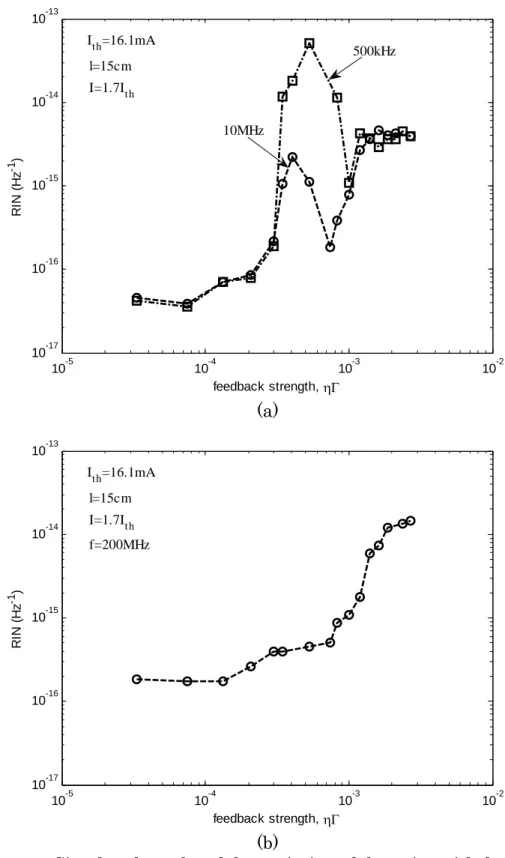
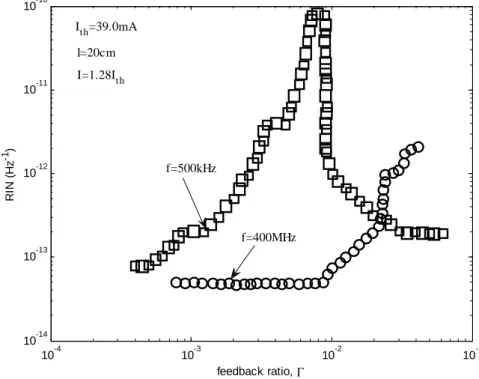
(9) Fig. 4-4. Simulated results of the variation of the noise with feedback strength. (a) Low frequency type, (b) Flat type. The low frequency type noise reveals the maximum peak with certain feedback ratio 48 (10) Fig. 4-5. Experimentally observed variation of the noise with the feedback
ratio cited from Ref. [21] 49
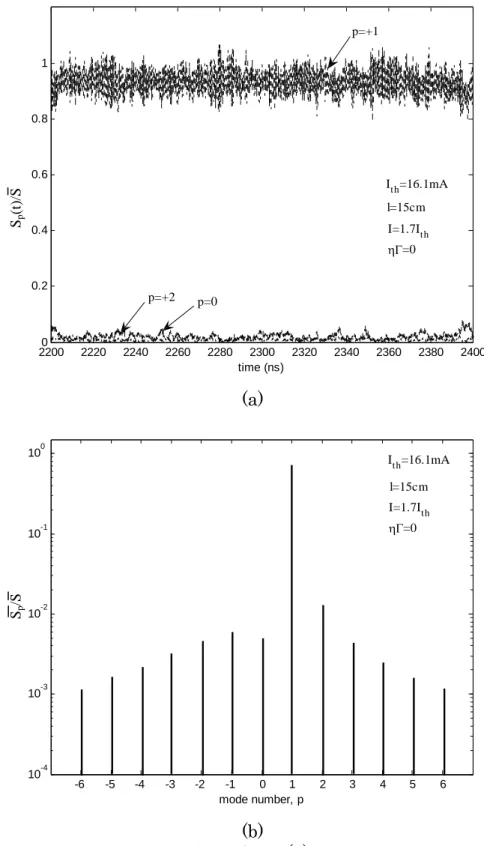
(11) Fig. 4-6. Modal behavior without OFB. (a) Temporal variation of lasing modes. (b) Time-averaged modal spectrum. Stable single mode operation is
achieved with low noise 50
(12) Fig. 4-7. Modal behavior when the RIN becomes the highest with form of the low frequency type noise by the OFB. (a) Temporal variation of lasing modes. (b) Time-averaged modal spectrum. The lasing modes show unstable
mode hopping between p=+1 and +2 51
(13) Fig. 4-8. Modal behavior with rather high OFB ratio. (a) Temporal variation of lasing modes. (b) Time-averaged modal spectrum. The operation changes to a stable multimode operation with reduction of the low frequency type noise, while the flat type noise increases with increase of the external
optical feedback ratio 52
(14) Fig. 4-9. Dynamic chart indicating mode competition phenomena between two lasing modes. When the OFB level increases the operating point jumps
from P to Q or from Q to P 54
(15) Fig. 4-10. The simulated spectra of RIN profiles of the OFB noise and suppressed noise by superposition of HF current 55 (16) Fig. 4-11. Dependency of suppressed noise level with the modulation
depth of HF current. HF modulation of more than 30% is required to suppress the OFB noise in this numerical example. Frequency of modulation chosen is
500MHz 55
(18) Fig. 4-13. Temporal variations of the gain Gp and the contribution of the OFB Cp with whichthe OFB noise is well suppressed. Variations of Gpand Cp
are not synchronized 57
(19) Fig. 4-14. Temporal variations of electron number and total photon number corresponding to Fig. 4-13. Variations of the electron number and the photon number are large enough and are in the same phase 58 (20) Fig. 4-15. Change to monostable state by inclusion of HF components in
the lasing operation. The operating point M indicates a stable multimode
operation of modes p and q 58
(21) Fig. 4-16. Calculated data showing dependence of the RIN on modulation frequency of the superposed HF current. The feedback distance is l=12cm
which corresponds to fex=1.25GHz 59
(22) Fig. 4-17. Experimental data showing dependence of the RIN on modulation frequency of the superposed HF current [26]. The feedback distance is l=21.4cm which corresponds to fex=700MHz 60 (23) Fig. 4-18. Temporal variations of the gain Gp and the contribution of the
OFB Cp for the case of 5fM=3fex with which the OFB noise is increased with the mode hopping remained. Variations of Gp and Cp are are synchronized with fM and have almost 1800phase difference 61 (24) Fig. 4-19. Temporal variations of electron number and total photon
number for the case of 5fM=3fex. Variation of the electron number and that of the photon number have 900 phase difference. Amplitudes of the variations
are small 61
(25) Fig. 4-20. (a) Temporal variations of all lasing modes in the case when the noise raises up with the condition 5fM=3fex. (b) Longitudinal mode spectrum corresponding to condition unable to reduce noise. The lasing modes show unstable mode hopping between p=+2 and p=+1 62
Abstract i
Acknowledgement iii
List of Related Publications iv
List of Figures v
Chapter I: Introduction
(1) Literature Review 1
(2) Significance of This Study 8
(3) Dissertation Outline 9
Chapter II: Overview of Semiconductor Lasers
(1) Fundamentals of Semiconductor Lasers 11
(a) Device Structure 11
(b) Injection Mechanism 12
(c) Laser Oscillation 13
(d) Lasing Modes 14
(2) Noise in Semiconductor Lasers 14
(a) Quantum Noise 15
(b) Optical Feedback Noise 15
(3) Noise Reduction in Semiconductor Lasers 16
(a) Optical Isolator 16
(b) Electric Negative Feedback 17 (c) Usage of Self-Pulsation Laser 17 (d) Superposition of High Frequency Current 17 (e) Electric Positive and Negative Feedback 18 Chapter III: Theoretical Model of Analysis
(1) Manner of Analysis 19
(2) Gain Coefficient 19
(3) Rate Equation for Electron Density 24 (4) Rate Equation for Photon Number 28
(5) Introducing Nonlinear Gain 29
(6) Introduction of the Noise Sources 33 (7) Introducing Optical Feedback Effect 36
(a) Constructing Langevin Noise Sources 41 (b) Calculating Relative Intensity Noise 43 (2) Procedure of Numerical Calculation 44
(3) Analysis of OFB Noise 45
(a) Noise Properties 45
(b) Generation of OFB Noise 49
(c) Generating Mechanism of OFB Noise 53 (4) Effect of Superposition of HF Current 54
(a) Reduction of OFB Noise 54
(b) Mechanism of Noise Reduction 57
(c) Condition Unable to Suppress Noise 59
Chapter V: Conclusion 65
References 67
Appendices
(A) Threshold Gain Level 71
(B) First & Second Order Density Matrix Elements 75 (C) Dynamic Equation for Carrier Numbers 78 (D) Varying Electron Density & Field Spatial Distribution 80
Chapter I: Introduction
Semiconductor laser was first invented in 1962 by Robert N. Hall [1]. Since then this is being used as principle device in all optical disc players, laser printers and most optical fiber communication systems. It is well known that optical feedback creates excess noise in semiconductor lasers. A variety of dynamical behaviors can be observed in semiconductor lasers with optical feedback and they have been investigated by many researchers for last three decades. In this context, this chapter reviews some major research articles on optical feedback noise in semiconductor lasers to briefly describe the progresses in this field. After that the significance of this PhD study is explained in succession with the previous research activities. Finally, outline of this dissertation is described.
1. Literature Review
M. Yamada and Y. Suematsu in their paper [2] discuss theoretically the condition for single longitudinal mode operation (SMO) of index guided semiconductor injection laser and a comparison with the experiment is done. Effects of the impurity concentration and the intraband relaxation, the spontaneous emission and the thermal resistance on longitudinal mode behavior are discussed. The conditions summarized for the SMO for GaAs lasers are: the dimension of the index-guiding waveguide must be set to cut off the higher order transverse modes; the spontaneous emission factor must be suppressed by decreasing the energy confinement in the active region; and the thermal resistance should be reduced to increase the stability of SMO at a fixed mode.
R. Lang and K. Kobayashi examine the influences of the externally reflected light on the static and dynamic behaviors of semiconductor laser [3]. Experimental observations with a GaAs/AlGaAs single mode laser are also presented with analysis based on a compound cavity laser model. It is demonstrated that the external feedback can make the injection laser multistable and cause hysteresis phenomena. It is reported that the multistability can show up more easily in semiconductor laser than in other lasers because of the strong dependence of the refractive index of the laser active region on the carrier density. The dynamic properties of semiconductor lasers are found to be affected by the interference effects in the compound cavity.
M. Yamada and Y. Suematsu analyze the gain suppression in injection lasers by taking into account the phase-synchronization effect, the intraband relaxation process and spatial diffusion of carriers [4]. They find that the excess gain suppression and the hysteresis phenomena are observable in lasers which have an undoped active region and well- designed index guiding structures. But the excess gain suppression is scarcely observed in lasers which have a heavily doped active region.
Single longitudinal mode operation is not obtained in a strongly inhomogeneous laser in which the relaxation time is larger than 3x10-13
sec for strong nonuniformity across the spectral or energy distributions and the gain of some resonating modes is increased. When the relaxation time is smaller than 2x10-13 sec, the gain can be seen to be nearly homogeneous and the gain of nonoscillating modes is sufficiently suppressed because of the strong mode coupling effect. The authors also report from [5] that the gain of nonoscillating modes is suppressed more strongly than the oscillating mode in the lightly doped lasers.
Quantum noise in semiconductor lasers is one of the most important problems to be encountered in their applications. Y. Yamamoto in [6]
describes quantum noise properties for semiconductor lasers through the use of four different theoretical formulations: the van der Pol equation; the Fokker-Planck equation; the rate equation; and the photon density matrix master equation. Theoretical formulations for AM noise (or intensity fluctuation) spectrum, photon number probability density, FM noise spectrum, instantaneous frequency probability density and power spectrum, that represent quantum noise characteristics for lasers, are derived. Formulas for the AM and FM noise spectra presented in this paper enable calculation of the signal-to-noise ratio and carrier-to-noise ratio degradation due to quantum noise. The paper clarifies that spontaneous emission coupled to a lasing mode is a direct origin of quantum noise.
In 1983 K. Vahala and A. Yariv present a semiclassical analysis of semiconductor laser noise which includes the carrier density as a dynamical variable and the carrier density dependence of the refractive index [7]. The treatment considers the effect of relaxation resonance in the power fluctuations spectrum of semiconductor lasers on the frequency fluctuations spectrum and field spectrum. Fluctuations of the field and the carrier density are driven by normalized Langevin forces. The authors investigate that carrier number fluctuations in the field spectrum result from the interactions of the carriers in the active region with other systems of particles. However, this analysis does not predict field spectrum linewidth broadening due to carrier number fluctuation in the active region.
The understanding of optical mode behavior and control of the oscillating mode in semiconductor injection lasers is a complicated but important problem for practical application of these devices. M. Yamada in [8] analyzes the oscillating transverse modes and longitudinal modes behavior based on the semiclassical method in which optical field is presented by Maxwell’s equations and the lasing phenomenon is analyzed quantum mechanically using the density matrix formalism. This theoretical approach has been shown to provide excellent agreement for both small signal and saturated gain characteristics of these lasers for both lightly doped and p-type active regions without requiring the assumption of band tail states or violation of wavenumber conservation for optical transitions. The author also postulates the possibility of obtaining single longitudinal mode operation by utilization of the strong coupling effect when the transverse mode is well controlled by the laser stripe
structure. Some experimental results are also given in this paper to support his analyses.
K. Stubkjaer and M.B. Small experimentally investigate the feedback induced noise in index guided semiconductor lasers and report a reduction in feedback noise of 15-20 dB by direct modulation of the laser [9]. Excess noise is mainly caused by mode jumping which results from variations in the amplitude and phase of the reflected signal.
P. Spano et al. derive analytical expressions for the power spectral densities of intensity and frequency noise of single mode semiconductor laser in the presence of optical feedback [10]. They include gain and refractive index variation in the active layer due to any spontaneous emission process. They prove that the maximum attainable reduction of the low frequency part of the frequency noise spectrum, which is responsible for the linewidth, is independent from the linewidth enhancement factor. Furthermore, the use of a short external cavity causes a flattering of the frequency noise spectrum and a lowering of its amplitude as compared to that of the solitary laser.
K.E. Stubkjaer and M.B. Small in [11] present an experimental analysis of noise due to feedback into the semiconductor laser. The mechanism for noise reduction by current modulation is also demonstrated. The analysis includes the dependency of noise on output power level, proportion of the reflected light returned to the laser, external cavity length and modulation level. A noise reduction of as much as 20 dB is obtained by direct modulation of the laser in the frequency range of 50- 200 MHz. They show that this reduction is correlated with the frequency modulation of the light output.
D. Marcuse in his first paper of a series devoted to theoretical studies of photon fluctuation in the light output of semiconductor injection lasers introduces the noise driven rate equations for a single-cavity laser, explains the method used for their numerical solution and discusses some approximate analytical results [12]. He outlines the derivation of the rate equations based on the theory of Langevin laser equations and collects the background material required for performing a computer simulation of the properties multimode, single-cavity lasers.
In [13] A. Ohishi et al. present a method of noise reduction by high- frequency (HF) superposition in single mode lasers. By this method, lasers show stable noise characteristics against ambient temperature variation or OFB. They develop a small packaged HF current source and apply to optical disc systems to suppress the excess noise induced by optical feedback.
Semiconductor injection lasers typically show mode hopping noise which accompanies unstable hopping phenomena among the oscillating longitudinal modes. In [14] M. Yamada theoretically analyzes the characteristics of the mode competition noise with the help of a perturbation approach. The source of the noise is supposed to be
fluctuations of the number of photons and electrons on optical emission and is amplified by optical gain. The noise becomes strongest when the lasing mode jump to another mode and the noise of total output power reduces when the laser is in pure single-mode operation or in stable multimode operation.
In [15] N. Schunk and K. Petermann estimate the effect of external feedback on a single-mode semiconductor laser by a numerical solution of the nonlinear rate equations. They distinguish three feedback regimes: in a regime I with low feedback the linewidth is broadened or narrowed depending on the feedback phase; in regime II with increasing feedback the laser locks to the mode with the maximum linewidth reduction; and in regime III the linewidth is drastically broadened which is also denoted as the coherence-collapse regime.
Dynamic equations for the injected carrier density and optical field are derived by M. Yamada based on density matrix formalism taking into account the nonlinear optical phenomena in semiconductor lasers [16].
Two kinds of nonlinear phenomena mentioned are – the beating vibration on spectral distribution of the injected carriers whose frequency range is limited by the intraband relaxation time, and the beating vibration of the injected carrier density whose frequency range is limited by the electron lifetime for band to band transition. The effects of these two phenomena on the saturated gain profile under a single-mode oscillation are derived which reveals the existence of an asymmetric property of the gain suppression effect.
M. Yamada and T. Higashi theoretically analyze, with support of experimental measurement, the mechanism of noise reduction method by superposition of high frequency (HF) current on the injection current based on mode competition theory in semiconductor injection laser [17].
The authors believe that multimode operation is not an essential condition to be free from the mode hopping phenomena. The results obtained are – superposition of HF current works to weaken the mode competition effect, noise reduction is most effective with modulation frequency near the resonance frequency and the noise reduction is more effective in the device having a higher thermal resistance.
Although the technique of high frequency injection (HFI) is popularly used to suppress the feedback induced RIN enhancement, the proper modulation frequency and depth must be chosen empirically. G.R.
Gray et al. investigate this problem through computer simulations of the multimode stochastic rate equations [18]. They present a rate equation model that is capable of explaining why the RIN is increased and why this intensity noise can be avoided through high frequency injection. The authors conclude that the increase in RIN with OFB arises from deterministic chaos caused by the coupling of the laser to an external cavity and the effectiveness of the HFI technique to keep the RIN at low rests in its ability to suppress or delay the onset of the chaotic regions.
H. Kakiuchida and J. Ohtsubo explain the characteristics of the oscillation of a semiconductor laser in the presence of external optical feedback by the rate equations by considering multiple reflections of light in the external cavity [19]. They introduce the compound cavity model with the fact that the distance of the external reflector from the laser cavity is much smaller than the coherence length. The effects of the compound cavity result in an additional gain factor and a phase change in the rate equations. The oscillation characteristics are strongly dependent on the feedback intensity and the external cavity length. Despite the fact that the authors ignore mode competition in multimode oscillations, the theoretical results agree well with the experimental findings.
K. Petermann in [20] reviews mode-hopping phenomena, strong excess noise and chaotic behavior in the coherence collapse regime occurring in semiconductor lasers by considering short external resonators.
The author mainly concentrates on the behavior of lasers due to weak optical feedback. He also gives guidelines for designing semiconductor lasers with high endurance against external optical feedback.
M. Yamada et al. and K. Matsuoka et al. report experimental evidence of two different types of mode competition phenomena in semiconductor lasers through characteristics on the noise spectrum [21], [22]. One is with competition among the internal cavity modes and the other is with competition among the external cavity modes which are built by the optical feedback. They also experimentally notice two different types of optical feedback noise – one was the low frequency type noise and the other was the flat type noise. However, the paper does not explain details of the operating conditions generating these excess noises.
K.I. Kallimani and M.J. O’Mahony present a study of the noise characteristics of semiconductor lasers with optical feedback and short external cavity length [23]. They use a unified rate equation model that is applied successfully to all the feedback regimes though the paper concentrates mainly on the moderate and strong feedback regimes. The rate equations include noise fluctuations for intensity, phase and carrier density but are only applicable for single mode emission. They conclude that weak feedback does not affect the frequency of relaxation oscillations, but the strong feedback results in significant reduction of the relaxation oscillation frequency.
One of the unstable features of the laser output is that the power drops with the frequency within the range of several to several tens of MHz known as low frequency fluctuations (LFF). Y. Takiguchi et al.
experimentally investigate this LFF in semiconductor lasers with optical feedback for high frequency injection current modulation [24]. They observe synchronization of the modulation frequency at and very close to the external cavity mode. Low frequency fluctuation is not observed in this state. But the laser output power becomes unstable with an increase or decrease of the detuning from the external cavity mode frequency. LFF tends to be observed with a lower bias injection current.
M. Ahmed et al. report in [25] a self-contained numerical model to analyze the intensity and phase noise and broadening of the line shape in semiconductor lasers. A new systematic technique is devised to generate the correlated Langevin noise sources on the photon and carrier numbers as well as on the phase of the lasing field while keeping their auto- and cross-correlations satisfied. The authors examine the contributions of the carrier-number noise source to intensity and phase noise and found that the characteristics in the high-frequency regime are unaffected, while the RIN values are overestimated at low frequencies when the source is ignored.
In 2001 M. Yamada et al. report experimental characteristics of the optical feedback noise in semiconductor lasers under superposition of the high frequency (HF) current [26]. The feedback noise is mostly suppressed by superposition of high frequency current, but still remains when frequency of the HF current coincides with a rational number of the time period for the optical feedback. The authors qualitatively analyze such characteristic by the mode competition theory for the external cavity modes. They explain the noise reduction effect as shift of the operating point with the modulated components of the carrier density and photon numbers.
J.S. Lawrence and D.M. Kane reports a systematic experimental investigation into the nonlinear dynamic behavior of a directly modulated diode laser subject to strong external optical feedback as compared to the same laser subject to strong OFB which is phase modulated by an electro- optic modulator in the external cavity [27]. The output state for both types of modulation is dependent on the ratio of the modulation frequency to the external cavity resonant frequency and the modulation power. They observe eight distinct dynamic states, namely, conventional amplitude modulation; multimode – low-noise amplitude modulation; multimode – high-noise amplitude modulation; periodic limit-cycle operation; quasi- periodicity; chaos; low frequency fluctuations; and mode-locking. The modulation instability when induced by increased modulation at a frequency very close to the external cavity resonant frequency is shown to dynamically distinct for direct modulation.
In their paper [28] C. Serrat et al. analyze the dynamics and coherence properties of a multimode semiconductor laser with an external cavity of intermediate length by using numerical model of the temporal dynamics in semiconductor lasers. They qualitatively observe that the coherence time is degraded as the laser becomes more multimode. Their study is limited to a value of the injection current as twice the lasing threshold at a particular length of the external cavity.
S.G. Abdulrhmann et al. present an improved time-delay model to investigate the influence of strong OFB on the dynamics and operation of semiconductor lasers [29]. The single mode model is versatile and applicable under an arbitrary amount of OFB ranging from weak to very strong. The model considers multiple round trips of the lasing field in the
external cavity but does not consider the Langevin noise sources that induce spontaneous emission fluctuations in dynamics of the lasing modes.
They classify the laser operation over wide ranges of the OFB and injection current to continuous wave under very weak optical feedback, chaos under moderate optical feedback and pulsation in the strong regime of OFB.
M. Ahmed and M. Yamada in [30] characterize the spectral line shape and the spectra of the RIN and frequency noise in five distinct operating regions – continuous wave, weak OFB-induced pulsation, period-doubling route-to-chaos, chaos or coherence collapse and strong OFB-induced pulsation. They generalize the simulation model of S.G.
Abdulrhmann et al. in [29] which treats the optical feedback as a multiple round-trip time delay of the lasing field in the external cavity. However, their study is limited to single-mode model but is considering Langevin noise sources for photon number, phase and carrier density.
Reduction of intensity noise in semiconductor lasers is important subject to extend application range of the device. In 2006, M. Yamada et al.
experimentally propose a novel scheme to reduce the optical feedback noise and the quantum noise [31]. They reduce the noise of InGaN blue- violet laser under optical feedback by applying electric feedback with is positive type at a high frequency and negative type for lower frequency range. Later the group refers the technique as EPNF (electric positive and negative feedback) method and compares the reduction ability of this method with that of the superposition of high frequency current [32]. They report the superiority of the EPNF method for quantum noise reduction noise due to the electric negative feedback.
In [33] M.C. Soriano et al. present their study on the influence of low-frequency current noise on a single-mode semiconductor laser subject to external optical cavity based on Lang-Kobayashi rate equations. The authors experimentally show that extra current noise and delayed optical feedback can modify the dynamical properties of single-mode semiconductor lasers. The modification of the dynamical properties is a linear superposition of the individual effects of the two.
S.M.S. Imran et al. analyze dynamics and operation of semiconductor laser under optical feedback based on a set of multimode rate equations for semiconductor lasers that includes nonlinear gain, re- injection of delayed feedback light and Langevin noise sources for the intensity and phase fluctuations [34]. The authors simulate the features of two types of intensity noise – the low frequency type and the flat type.
They conclude that the low frequency type noise is caused by the mode hopping between bi-stable states and the flat type noise is caused by the phase distortion between the internal reflected light and the external feedbacked light.
Optical feedback causes chaotic dynamics associated with intermediate levels of OFB and greatly enhances the intensity noise. M.
Ahmed et al. investigate control of this chaotic dynamics using time-delay
rate equation model including sinusoidal current modulation [35]. They found five distinct chaotic dynamic types, namely, continuous periodic signal, continuous periodic signal with relaxation oscillations, periodic pulse, periodic pulse with relaxation oscillations and periodic pulse with periodic doubling.
In [36] S.M.S. Imran and M. Yamada analyze mechanisms of the generation of the optical feedback noise and its suppression by the superposition of high frequency current. They explain, with approximated but analytical equations, the condition to suppress the OFB noise and present quantitative assessment for conditions unable to suppress optical feedback noise by HF current superposition. Highest OFB induced noise is caused by the mode hopping between bi-stable states. Superposition of high frequency current modulates both electron number and photon number that works to stop mode hopping resulting in suppression of the OFB noise. When frequency of the superposed HF current coincides with a rational number of external feedback frequency the modulations are suppressed by the phase locking effect and noise suppression effect does not work.
2. Significance of This Study
Semiconductor lasers are known to be very sensitive to output light when reflects from an external reflector and couples with the original field in the laser cavity. The dynamic behaviors of semiconductor lasers with optical feedback and their related topics have been investigated for last three decades. The phenomena still contain much of fundamental physics and the study is still under way.
This PhD study consists of two main parts, first part is the analysis of the optical feedback (OFB) noise and second part is the reduction of OFB noise by superposition of high frequency (HF) current. An improved theoretical model has been formulated that can numerically simulate generation of the OFB noise and its suppression by the superposition of HF current. The model is based on a set of multimode rate equations that include nonlinear gain, Langevin noise sources for photon number, phase and carrier density, the OFB and the HF superposition.
Theoretical analyses of the optical feedback noise in semiconductor lasers are classified into three groups. First one is the small signal analysis representing dynamic behaviors on frequency domain where the Langevin noise sources are taken into account [37], [38]. Dynamic effects of semiconductor lasers based on differential analysis of the rate equations using the Langevin method to determine laser’s relative intensity noise (RIN) has been presented in [38]. The effects of optical feedback on the quantum mechanical amplitude noise properties of laser have also been described in [23] and [39]. However, effects of the OFB on the mode competition have been first analyzed in [14]. The second group is the single mode model, where time delay of the feedbacked light is taken into
account with or without introduction of the Langevin noise sources [10], [15], [30], [40]. Generation of chaotic phenomena by the OFB was well explained by this model. H. Haken has proposed some theoretical models for single mode lasers based on instability hierarchies of laser light, i.e., chaos and routes to chaos, using semiclassical approach [40]. This second model is effective to apply on the DFB (distributed feedback) laser or laser with DBR (distributed Bragg reflector) mirrors which are also called the dynamically single mode lasers used in the high capacity optical communication systems. The third group is the multimode model which counts the mode competition phenomena among the lasing modes in the solitary laser, but has not counted the Langevin noise sources yet [41].
Model used in this study is an extension of the third group. We start with a set of multimode rate equations for a solitary laser, where effects of the OFB are taken into account as delayed light. Additionally, the Langevin noise sources caused with photon generation are taken into account. Introduction of the noise sources is essential to show the noise characteristics.
Superposition of high-frequency (HF) current is the most popularly used method to suppress OFB noise. The OFB noise is well suppressed by suitable selections of frequency and amplitude of the superposed current.
However, M. Yamada et al. experimentally report that the OFB noise is not suppressed when frequency of the superposed current and round-trip frequency of the OFB are in relation of rational numbers [26]. They give a theoretical analysis on this problem based on mode competition phenomena among external cavity modes which are built in the space between laser front facet and the reflecting point of OFB. Since this analysis is based on small signal approximation, quantitative assessment for conditions unable to suppress OFB noise is difficult.
Our proposed model allows numerical simulations of the generation of OFB noise and its suppression by the superposition of HF current.
Hence, conditions unable to suppress the OFB noise are evidently shown and explained based on approximated but analytical equations. Some published experimental results are also presented and compared with simulation data to support the accuracy of the model.
3. Dissertation Outline
This PhD dissertation consists of five different chapters, namely, introduction, noise in semiconductor lasers, theoretical model of analysis, results and discussion, and conclusion.
Chapter I: Introduction starts with the brief description of some published research papers on noise analysis of semiconductor lasers with optical feedback, noise suppression by superposition of high frequency current and their related topics. Then the background of this PhD study or the significance has been presented in continuation with the previous investigations and reported results.
First part of Chapter II: Overview of Semiconductor Lasers briefly describes fundamental structure and operating mechanism of semiconductor lasers without introducing detail mathematics. Different types of noise in semiconductor lasers and their properties are explained in the second part. This chapter ends with brief description on some noise reduction methods.
Chapter III: Theoretical Model of Analysis deals with devising laser rate equations that are used for the modeling of semiconductor lasers with optical feedback noise and high frequency current modulation. We present detail steps to generate the rate equations for photon number, its phase and carrier numbers from the classical Maxwell’s equations and quantum mechanical dynamic equation of the density matrix.
We present some numerically calculated data in Chapter IV:
Simulation and Results Discussion based on our theoretical model devised in Chapter III. First part of this chapter focuses on analysis of the optical feedback noise in semiconductor lasers. Then the second part describes mechanisms of noise reduction by superposition of high frequency current injection. Some peculiar features of this technique with detail analyses are also presented in this chapter.
The dissertation ends with Chapter V: Conclusion that gives some concluding remarks on the noise analysis and simulation results of semiconductor lasers under optical feedback. This chapter also comments on OFB noise reduction by superposition of high frequency current injection.
Chapter II: Overview of Semiconductor Lasers
This chapter explains basic noise characteristics of semiconductor lasers which will lead to both qualitative and quantitative understanding of the dynamics of optical feedback noise. Then we briefly describe some noise, especially the optical feedback noise, reduction techniques. But, at first we overview the fundamental structure and operating mechanism of semiconductor lasers.
1. Fundamentals of Semiconductor Lasers 1-a. Device Structure
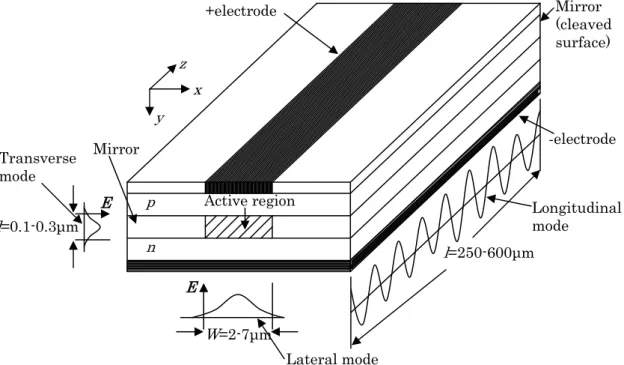
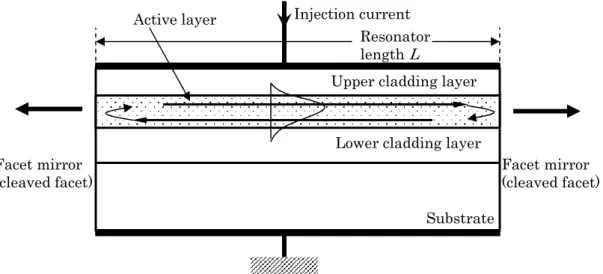
Fig. 2-1. Schematic structure of a semiconductor injection laser.
Semiconductor lasers are devices for oscillation or amplification of an optical wave based on stimulated emission of photons through optical transition of electrons in a semiconductor. It is composed of an active material which has optical gain and an optical resonator which feeds back lights by its reflectors. Fig. 2-1 shows a vastly simplified diagram of a semiconductor laser.
A semiconductor laser is usually fabricated with p-i-n semiconductor hetero junctions. Current, used to inject electrons and holes into the active region, is injected via two electrodes one of which is electrically connected to a heat sink. Lasing occurs in the active region between the electrodes. The optical wave propagates along the active region in the longitudinal z-direction. The optical resonator is formed by two parallel facets that are made by cleaving the substrate along crystal planes. Optical light is reflected back by these facet mirrors and forms a standing wave in the longitudinal direction. Typical sizes of the active
W=2-7μm d=0.1-0.3μm
l=250-600μm E
E p
n
Active region Mirror
Mirror (cleaved surface)
-electrode +electrode
Longitudinal mode
Transverse mode
Lateral mode x
z
y
region are 0.01-0.3μm thick by 2-10μm wide by 250-600μm long. Several refinements may be incorporated into the laser to attain low threshold, continuous wave (CW) operation, operation at high temperature, narrow linewidth spectra or high output power [42].
1-b. Injection Mechanism
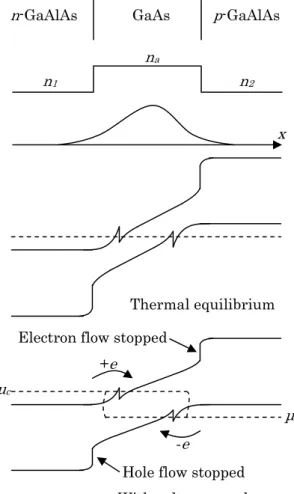
Fig. 2-2. Refractive index variation, optical field and potential barriers confinement, and energy band diagram of a DH laser.
Population inversion of a semiconductor laser is achieved with the structure of p-i-n junctions as illustrated in Fig. 2-2. The laser structure consists of an active layer of GaAs sandwiched between two cladding layers of AlxGa1-xAs with larger bandgap energy and has double heterojunctions (DH) [43]. The structure is fabricated by multilayer epitaxy on a GaAs substrate.
When voltage is applied from an external electric source, energy levels in the n-side are raised up and those in the p-side are brought down.
Then the electrons and holes are injected into the active region from the n- side and p-side, respectively. Since the bandgaps of the connecting regions are higher than that in the active region, the injected carriers are well confined within the active layer at high densities without diffusion from the junctions.
When the injection current is low, the laser shows small output due to spontaneous emission only. When the injection current crosses the
Thermal equilibrium Electron flow stopped
Hole flow stopped +e
-e μc
μv
With voltage supply
n-GaAlAs GaAs p-GaAlAs
n1 n2
na
x
threshold current level stimulated emission starts, spontaneous emission is amplified by the stimulated emission and optical output increases almost linearly with the injection current.
1-c. Laser Oscillation
Fig. 2-3. Circulation of optical wave in semiconductor laser active region.
To implement a laser oscillator that generates a coherent optical wave, it is required to provide optical amplification with optical feedback.
In semiconductor lasers, this is accomplished by cleaving the semiconductor crystal DH structure with the substrate to form a pair of facet mirrors perpendicular to the active layer. The optical wave undergoes amplification during circulation in the active region, as shown in Fig. 2-3.
Let R be the reflectivity of the facet mirrors, and L be the mirror separation; then the condition for the guided mode to recover its original intensity after a round trip is given by [43]
R2exp[2(Γg-k)L]=1 (2-1)
where g is the amplification gain factor under the assumption that the optical wave is completely confined and propagates in the active layer, Γ the coefficient of reduction due to the penetration of the guided mode into the cladding layers, and k the factor representing the optical losses due to absorption and scattering caused by imperfection of the structure.
The condition for the wave to be superimposed with the same phase after the round trip is given by [43]
2L=mλ (λ=2c/nrω) (2-2)
where λ is the optical wavelength, c the light velocity in vacuum, ω the optical angular frequency, nr the effective refractive index, and m an arbitrary integer. This is the condition for positive feedback.
An optical wave of wavelength satisfying Eq. (2-2) can resonate, since the wave is superimposed with the same phase after an arbitrary
Active layer Injection current Resonator length L
Upper cladding layer
Lower cladding layer
Substrate
Facet mirror (cleaved facet) Facet mirror
(cleaved facet)
number of round trips. When the injection current is increased and the effective gain for one of the resonant wavelengths reaches the value satisfying Eq. (2-1), optical power is accumulated and maintained in the resonator, and the power is emitted through the facet mirrors. This is the laser oscillation, i.e., lasing.
1-d. Lasing Modes
Properties of optical wave are characterized with the word mode.
The mode of the optical wave generated by a laser is generally classified by transverse modes and longitudinal modes. The transverse mode (lateral mode) is the intensity distribution in the cross section normal to the optical axis (width direction x and thickness direction y in Fig. 2-1), is defined by the waveguide structure.
The longitudinal mode (axial mode), on the other hand, is defined by the distribution, along the direction of propagation (the optical axis, propagation direction z in Fig. 2-1), of the standing wave in the resonator.
Each longitudinal mode corresponds to each integer m in Eq. (2-2) and constructs components with slightly different wavelengths.
The heterojunction of the active region is designed to achieve lower threshold current and suitable profile of the optical wave along thickness direction. The field distribution along the width direction is controlled with an artificially designed structure called the stripe structure. Hence, output optical wave spreads more widely along the thickness direction than the width direction. Also, direction of polarization is mostly characterized with the field distribution along the thickness direction.
Optical spectrum of output optical wave directly corresponds to the longitudinal mode. There are two cases of the spectrum – one is the single mode operation and another is the multimode operation.
Instability of the transverse mode gives rise to deterioration of the spatial coherence of the output wave and temporal coherence is degraded if several longitudinal modes oscillate simultaneously (multimode lasing) and/or there is fluctuation of modes.
In Fig. 2-1, optical field is confined in the active region and propagates along z-direction. The thickness of the active region is usually much smaller than the width w and is designed to obtain the lowest threshold current density [47], [48]. All higher order transverse modes along the y-direction are usually cut off with this optimum thickness.
2. Noise in Semiconductor Lasers
Noise problems in the semiconductor laser starts with the laser’s invention [45]. Classification of noise in semiconductor lasers is based on either application of laser light as carrier of information transmission or generating mechanism of physical disturbance. Therefore, Noises related to semiconductor lasers are as follows.
(A) Based on application of the optical wave
(i) IM noise: intensity noise or intensity modulation noise where intensity of the optical wave is used as signal and the noise is due to fluctuation in amplitude of light.
(ii) FM noise: frequency modulation noise where frequency of phase of the optical wave is used as the signal and is caused due to fluctuation in frequency of light.
(B) Based on generating mechanism of physical disturbance (a) Intrinsic noise, known as quantum noise or shot noise.
(b) External noise
(1) Optical feedback (OFB) noise
(i) Optical phase distortion: also known as coherent collapse or noise due to external mode competition.
(ii) Mode hopping noise: due to mode competition among internal lasing modes.
(2) Noise due to fluctuations in temperature, driving current and voltage. This type of noise is very low compared to the quantum noise and the optical feedback noise in semiconductor lasers.
2-a. Quantum Noise
As lasers are light emitting devices based on the optical transition of electrons, they inevitably involve a quantum noise problem [6], [43], [44].
Transition of one electron from conduction band to valence band induces one photon. This transition takes a finite time interval. Then both the photon number in the cavity and the electron density in the conduction band are not constant for time variation and must always have fluctuations. This type of intrinsic fluctuation is counted to be the quantum noise or the shot noise.
2-b. Optical Feedback Noise
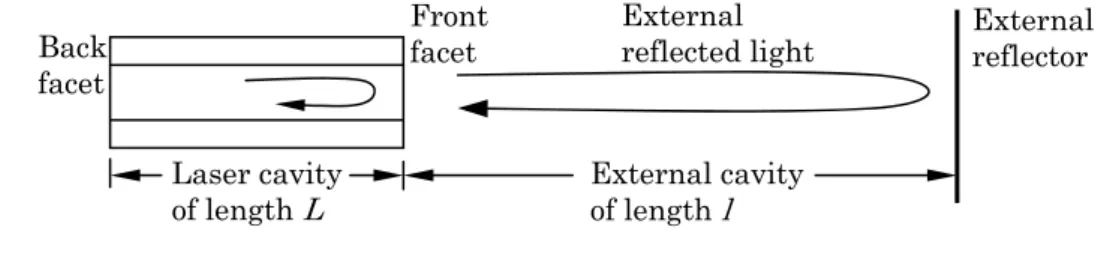
Fig. 2-4. Semiconductor laser with external reflector while connecting with other optical device.
When semiconductor laser is used as a light source connecting with other optical device, such as optical lens, optical fiber or optical detector, output light from the laser is reflected back from the optical device and re- injects into the laser. This optical feedback intricately changes light output characteristics of semiconductor laser according to the distance
Laser cavity
of length L External cavity of length l Front
facet Back
facet
External reflector External
reflected light


![Fig. 4-3. Experimentally observed frequency spectra of the noise cited from Ref. [21]](https://thumb-ap.123doks.com/thumbv2/123deta/5641540.2003464/58.892.226.714.319.704/fig-experimentally-observed-frequency-spectra-noise-cited-ref.webp)