• 検索結果がありません。

Numerical Analysis of Optical Feedback Noise and Its Reduction in Semiconductor Lasers

N/A
N/A
Protected

Academic year: 2021

シェア "Numerical Analysis of Optical Feedback Noise and Its Reduction in Semiconductor Lasers"

Copied!
6
0
0

読み込み中.... (全文を見る)

全文

(1)

Numerical Analysis of Optical Feedback Noise and Its Reduction in Semiconductor Lasers

著者 サザド ムハンマド サマウン イムラン

著者別表示 Sazzad Muhammad Samaun Imran journal or

publication title

博士論文要旨Abstract 学位授与番号 13301甲第3951号

学位名 博士(学術)

学位授与年月日 2013‑09‑26

URL http://hdl.handle.net/2297/37356

(2)

Dissertation Abstract

Numerical Analysis of Optical Feedback Noise and Its Reduction in Semiconductor Lasers

Graduate School of Natural Science & Technology Kanazawa University

Sazzad Muhammad Samaun Imran

July 2013

(3)

Abstract

This dissertation shows numerical simulations on the phenomena of the optical feedback (OFB) noise in semiconductor lasers, its suppression by the superposition of high frequency (HF) current and conditions at which the HF current is unable to suppress the noise. A set of multimode rate equations are formulated, in which the self and mutual gain saturation effects among lasing modes, re-injection of delayed feedback light reflected at surface of connecting optical device and Langevin noise sources for the intensity, phase and carrier number fluctuations are taken into account. Numerical simulations based on our theoretical model confirmed that the feedback noise is classified into two types based on profiles of the frequency spectrum, where one is the low frequency type and another is the flat type. Superposition of HF current is used as a technique to suppress the OFB noise. However, this is not effective when frequency of the HF current coincides with a rational number of the round trip time for the OFB.

Generating mechanism of the OFB noise and its suppression are explained with

approximated but analytical equations. The evidence of agreement between

experimental results and numerical simulations based on our model supports the

accuracy of the model.

(4)

Semiconductor lasers play a central role in the growing world of optoelectronic technologies. A measure of the importance of this emerging optoelectronic technology is provided by the optical disc players, laser printers and the optical fiber communication system. But semiconductor lasers tend to be suffered by the optical feedback (OFB) noise caused by reflection of the output light at surface of the optical disc or the optical fiber. Hence, it is required to reveal the lower noise for the higher performance. This dissertation shows numerical simulations on the phenomena of the OFB noise, its suppression by the superposition of high frequency (HF) current and the condition at which the HF current is unable to suppress the noise.

In this dissertation, we present an improved theoretical model to analyze dynamics and operation of semiconductor lasers under optical feedback. The model is based on a set of multimode rate equations in which the self and mutual gain saturation effects among lasing modes, re-injection of delayed feedback light reflected at surface of connecting optical device and Langevin noise sources for the intensity, phase and carrier fluctuations are taken into account. The proposed model is applied to 850nm GaAs lasers operating under optical feedback. Temporal variations of photon numbers, optical phases and electron density are traced by numerical calculation, and frequency spectra of intensity noise are determined by help of the fast Fourier transformation. Characteristics of the OFB noise are expressed in terms of the relative intensity noise (RIN).

10

6

10

7

10

8

10

9

10

10

10

-17

10

-16

10

-15

10

-14

10

-13

10

-12

10

-11

noise frequency (Hz)

RIN (Hz-1)

I

th

=16.1mA l=15cm I=1.7I

th

=0 (quantum noise)

=2.45x10

-3

(low frequency type noise)

=7.5x10

-3

(flat type noise) Without modulation

Fig. 1. Simulated spectra of RIN profiles for different OFB strengths. OFB noise is classified into low frequency type and flat type based on noise freq. profile.

The intensity noise of the semiconductor lasers consists of the quantum

noise and the optical feedback noise. The quantum noise is generated by intrinsic

property of the quantum mechanical fluctuation of the laser and very difficult to

control in principle. On the other hand, numerical simulations based on our

theoretical model confirmed that the OFB noise is classified into two types based

on profiles of the frequency spectrum, where one is the low frequency type and

another is the flat type. The low frequency type noise must be caused by the

(5)

mode competition among the lasing modes in the solitary laser, and the flat type noise by the phase distortion between the internal reflected light and the external feedbacked light [1].

The output noise level of the laser is increased by 20dB or more as a result of the optical feedback and this excess noise degrades performance of the system.

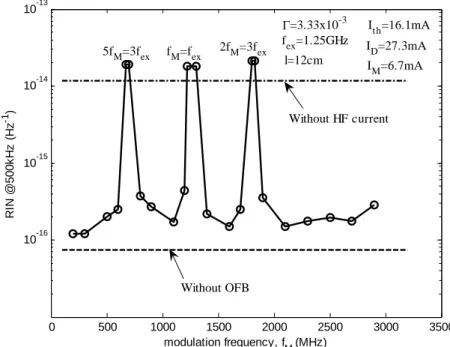
Superposition of high frequency current is used in this dissertation as a technique to suppress the OFB noise. The OFB noise is well suppressed by suitable selections of frequency and amplitude of the superposed current. The HF current modulates both electron number and photon number which works to change the operating state of the lasers from bi-stable to monostable, and stop mode hopping resulting in suppression of the OFB noise.

0 500 1000 1500 2000 2500 3000 3500

10

-16

10

-15

10

-14

10

-13

modulation frequency, f

M

(MHz)

RIN @500kHz (Hz-1)

I

th

=16.1mA

=3.33x10

-3

Without HF current

5f

M

=3f

ex

f

ex

=1.25GHz

Without OFB f

M

=f

ex

2f

M

=3f

ex

I

M

=6.7mA I

D

=27.3mA l=12cm

Fig. 2. Calculated data showing dependence of the RIN on modulation frequency of the superposed HF current.

However, this technique is not effective when frequency of the HF current coincides with a rational number of the round trip time for the OFB. In that case, modulations of the electron number and the photon number are suppressed by the phase locking effect with undesirable phase relation and thus, the noise suppression effect does not work under this condition [2].

Generating mechanism of the optical feedback noise and its suppression by the superposition of high frequency current are explained in this dissertation with approximated but analytical equations. Excellent correspondence between previously obtained experimental data and simulation is also demonstrated.

References:

[1] S.M.S. Imran, M. Yamada and Y. Kuwamura, “A theoretical analysis of the optical feedback noise based on multimode model of semiconductor lasers”, IEEE J. Quantum Electron., vol. 48, no. 4, pp. 521-527, 2012.

[2] S.M.S. Imran and M. Yamada, “Numerical analysis of suppression effects on optical

feedback noise by superposition of high frequency current in semiconductor lasers”,

IEEE J. Quantum Electronics, vol. 49, no. 2, pp. 196-204, 2013.

(6)

Fig. 1. Simulated spectra of RIN profiles for different OFB strengths. OFB noise  is classified into low frequency type and flat type based on noise freq
Fig. 2. Calculated data showing dependence of the RIN on modulation frequency  of the superposed HF current

参照

関連したドキュメント

Membrane DFB Lasers With Wire-Like Active Regions Since a typical semiconductor laser consists of multiple QWs (MQWs) acting as the active region sandwiched between wider

Standard domino tableaux have already been considered by many authors [33], [6], [34], [8], [1], but, to the best of our knowledge, the expression of the

mathematical modelling, viscous flow, Czochralski method, single crystal growth, weak solution, operator equation, existence theorem, weighted So- bolev spaces, Rothe method..

The edges terminating in a correspond to the generators, i.e., the south-west cor- ners of the respective Ferrers diagram, whereas the edges originating in a correspond to the

В данной работе приводится алгоритм решения обратной динамической задачи сейсмики в частотной области для горизонтально-слоистой среды

A wave bifurcation is a supercritical Hopf bifurcation from a stable steady constant solution to a stable periodic and nonconstant solution.. The bifurcating solution in the case

Sofonea, Variational and numerical analysis of a quasistatic viscoelastic problem with normal compliance, friction and damage,

Then it follows immediately from a suitable version of “Hensel’s Lemma” [cf., e.g., the argument of [4], Lemma 2.1] that S may be obtained, as the notation suggests, as the m A