Space by Space‑time Path:A Case Study of Taipei Xinyi District
著者 Shu‑Ying Tsai, Ting‑Yueh Chen, Chuan‑Jen Ning journal or
publication title
International Review for Spatial Planning and Sustainable Development
volume 4
number 3
page range 4‑13
year 2016‑07‑15
URL http://hdl.handle.net/2297/45835
doi: 10.14246/irspsd.4.3_4
4
International review for spatial planning and sustainable development, Vol.4 No.3 (2016), 4-13 ISSN: 2187-3666 (online)
DOI: http://dx.doi.org/10.14246/irspsd.4.3_4
Copyright@SPSD Press from 2010, SPSD Press, Kanazawa
Elderly People's Social Support and Walking Space by Space-time Path:
A Case Study of Taipei Xinyi District
Shu-Ying Tsai
1*, Ting-Yueh Chen
2,and Chuan-Jen Ning
31 Department of Architecture, National Taipei University of Technology.
* Corresponding Author, Email: [email protected] Received: 14 September, 2015; Accepted: 01 February, 2016
Key words: Elderly, Social Support, Walking Environment, Global Positioning System Abstract: Due to the trend of global aging, issues of the elderly should be paid attention
to. In January 2014, the elderly accounted for 11.57% of the population in Taiwan. By around 2017 Taiwan will become an Aged society. In order to provide seniors with a healthy and better life, the living environment and space arrangements will be important factors in the urban city. This study statistically assesses the walking space and the living path of elders by out-door activity type, walking range time and walking environment to understand the activity conditions and types of elders in Xin-Yu district, referencing the World Health Organisation’s recommendations on “Global Age-friendly Cities: Outdoor Spaces and Buildings”. This study investigates 22 seniors in the Xin-Yi district using the Global Positioning System, observations and deep interviews to explore the influencing factors, such as activity type, activity item, space equipment and walking environment of elders, to propose the requirements of walking spaces and suggestions for improvement in Xin-Yi district. The result found that the condition of elders’ activity and societal support demanded the utilisation of activity environments and walking spaces for social-type elders, including public social spaces, safe road crossings, bus stops and bus information support; for selection-type elders, demand was identified for communication chairs at shopping arcades and diverse sports facilities; and for essential-type elders, demands were on participatory open space and cooperative group facilities. Through the setting and improving of the urban resources above, social support for elders can be improved through the provision of friendly and healthy urban city activity spaces.
1. INTRODUCTION
As the world's population increases, problems related to the elderly are being increasingly noticed. According to the Directorate-General of Budget, Accounting and Statistics in Taiwan the population in Xin-Yi district is 228,125, of which 30,684 people are more than 65 years old and the proportion of the aged population is 13.45%, close to the United Nations standard of an aging society at 14%. The district of Xin-Yi is a very important part of Taipei.
There is much construction and its city planning is representative in Taiwan,
so it should examine the environmental lifestyle needs of the elderly. This
study discusses the elderly people's social support and walking space in Xin-
Yin district by the type of the outdoor activity, walking time and pedestrian
path environments, as well as other factors, to understand the activity condition of the elderly in Xin-Yin district, and to quantify the maximum number of the activity spaces within the walking space of a neighbourhood.
Through the establishment of these, social support improvements for the elderly can be identified, including more social support and activities.
2. CONTENT AND METHOD 2.1 Literature Review
2.1.1 Elderly pedestrian space
As people age, their physical capacity declines and the range of their activities becomes reduced, therefore, the design of pedestrian spaces becomes more important for seniors, also affecting their quality of life and environmental support. The design principles for elderly pedestrian spaces include: 1. Safety and accessibility, 2. Comfortable and workable space, 3.
Communication of information, and 4. Participation (Wang & Tong, 2009;
Xin, 2007). However, regular participation in physical activity can significantly improve an individual's physical, cognitive and emotional health at an older age (Mitra, Siva, & Kehler, 2015; Kerr, Rosenberg, & Frank, 2012). Borst et al. (2008) investigate 546 seniors in Portland, U.S.A, to discuss the pedestrian spaces that include seniors’ activity. The result shows the number of shops within a senior’s walking distance can affect the time that seniors spend walking.
Nowadays, the ecological theory of ageing emphasizes the importance of an interaction between a person and the environment for healthy ageing. Old age is identified as a critical stage in life when physical (i.e., the human built) environment can profoundly restrict an individual's health and wellbeing (in this context, active ageing including walking). The environmental support factors affecting seniors’ walking habits include: 1. Traffic conditions and street design, 2. Sidewalk quality, 3. Benches, trees and places to rest, 4.
Personal safety, and 5. Proximity to parks and natural landscapes (Mitra, Siva,
& Kehler, 2015).In addition, there is research using an “age-friendly city check list” to investigate 220 seniors in Taipei city, and the data shows most of the senior citizens often go to public facilities, including: 1. Parks (18.3%), 2. Markets (13%), 3. Community centres (10.2%), 4. Temples/churches (7.3%), and 5.Green land (6.6%). According to this finding, parks are the most important activity space for seniors (Tsai, 2014). The design principles of pedestrian walkways and the walking advantages for seniors, according to a literature review, are shown as below (Table 1).
Table 1. Design principles of pedestrian way and walking advantages for seniors Author/Year Design Principles of Pedestrian Way Senior Walking
Advantages Wang & Tong
2009
Safety and accessibility. 2. Comfortable and workability space. 3. Communicative. 4.
Participation.
Improve the life and environmental qualities.
Mitra , Siva, Kehler 2015
1. Traffic conditions and street design. 2.
Sidewalk quality. 3. Benches, trees and places to rest 4. Personal safety 5. Proximity to parks and natural landscape 6. Proximity to parks and natural landscape.
Cognitive and emotional
maintenance healthy, Improve the Body functions
6 IRSPSD International, Vol.4 No.3 (2016), 4-13
Corey 2008
Increase the number of shops the range of 400m, can increase walking distance with senior as well.
Improve the Body functions.
Tsai 2014
Senior often go to public facilities are 1.parks (18.3%). 2. Market (13%). 3. Community centre (10.2%). 4. Temples/ church. (7.3) 5.green land (6.6%)
Park is the most important activity space for seniors.
In the future, design principles supporting elderly pedestrians should reduce environmentally dangerous hazards and enhance safety for seniors.
Secondly, they should provide comfort facilities for seniors, such as benches, parks and recreational areas. Lastly, basic livelihood facilities, such as shops, community centres, etc. should be provided within the range of 400m. These design principles have the potential to improve bodily function and social support for seniors.
2.1.2 Time and space path
The ‘Lifestyle model’ means describing the physical environment using measures of personal activity, time and space to explain people's real life form (Tzeng & Wang, 2006). All of the space that people may be in direct contact with on a daily basis is referred to as the ‘activity space’. Space is an important manifestation of daily life, and daily activity spaces can be divided into three parts: 1. Moving from home to the surrounding area, 2. Round-trips between general activity locations, and 3. Moving around within activity spaces. Using these three activities as the basis, activity space can be conceptualized as a hierarchy of movement. The concept of space-time path expression is to express activity as behaviour in space and time; paths can be used to express a whole individual behaviour, including mobility paths, dwelling time and activities (Golledge & Stimson, 1997).
2.1.3 Elderly Social Support
Tsai (2015) and Godbey (1999) research the theory of aging and the relationship of social support with the elderly, and consider that with ageing social interaction will be reduced. However, participation in leisure activities can help to improve physiological function and slow down the aging process for seniors; through social support, the quality of life can be improved (Hirao et al., 2012). There are primarily five influential forms of social support for the health status of the elderly: instrumental support, emotional support, information support, interactive community support and close, family support.
Instrumental support directly affects the health of the elderly, increased social support and social networks can reduce the risk of depression, as well as raising quality of life, and enhance the independence of daily living.
(1) Emotional support: The expression of positivity and consideration.
(2) Information support: Messages of advice, guidance or evaluation support.
(3) Instrumental support: Providing material assistance or psychological support.
(4) Social support interaction: Familiar social integration in or around the home.
(5) Close support: The expression of love and affection.
Previous research has proved instrumental support and intimacy have a significant impact on other social support factors, including social support interactions, such as with mental and physical health, the physical environment, increased energy and increased social behaviour. Therefore, through modelling the daily activity paths, activities and behaviours of the elderly and their daily events can be observed.
2.2 Research Methods
This research uses the GPS location tracking function and in-depth in- person interviews to study 22 elderly people in Xinyi District, Taipei.
Following this, the GPS records are used to statistically assess the places, walking and activity behaviour of the elderly. Necessary social support for the elderly is thereafter identified based on their activity.
3. RESEARCH ANALYSIS
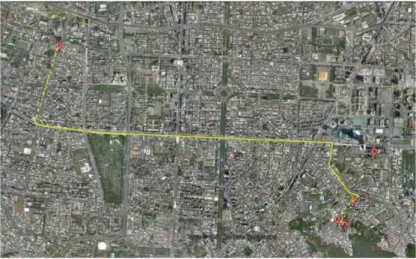
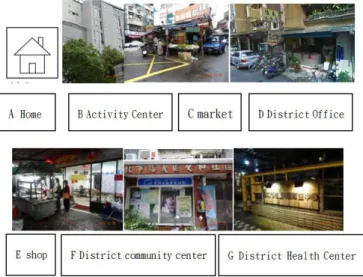
In this research, the activity paths of 22 elderly people are identified. The observations include: Daily life paths, walking time and distance, outings, etc., and the total distance and time, and from the research to the analysis, the relationships between length of the walking, activity type and workplace behaviour are identified. Then, possible ideas for improvement in the future are recommended.
3.1 Activity type for the elderly
There are three types of outdoor activities: social type, selection (or optional) type and necessary type (as Table 3.1).
Social type: Defined as the range of activities and activity participation being both within and outside Xinyi District.
Selection type: The range of activities is within Xinyi District, includes daytime activities of more than two types and does not require a long stay at the same location; activity paths are more varied.
Necessary type: These activities require staying for a long time at the same location, where the range of activities is within the nearby village, and activities must be necessary in the daily lives.
As in Table 1, much of the Elderly Activities are of the selection type and there are 11 people active within this type. Second is the social type, with seven people in this type, and last is the necessary type, with four people in this group. Walking time from most to least is: necessary type, social type then selection type. Walking distance from most to least is: social type, selection type then necessary type.
This research, using GPS records, found that the social type of the elderly
has the longest walking distance and will take transportation. The selection
type of the elderly spends the least time walking, and activities are more
changeable. The necessary type of the elderly has the shortest walking
distances, but they spend the most time on walking because their activities are
necessary to do in their daily lives, so the range is nearby their house, within
500m. Because the distance is short and their attitude is casual, they spend
more time walking than the others. The necessary type has the purpose of
casual walking for leisure, but those of the social and selection types have the
8 IRSPSD International, Vol.4 No.3 (2016), 4-13
purpose of walking for transportation. The research data of walking distance and time has been analysed as below (Table 2).
Table 2. Walking distance and time
Types People Xinyi District【walking time (minute)/distance (meter)】
Social 7 76/2960 meter
Selection 11 65 /2222 meter Necessary 4 86 /1274 meter Total 22 72 /2284 meter
Figure 1. Walking distance with different types of seniors
Figure 2. Walking time with different types of seniors
Figure 3. An example of an individual’s walking path for a day 0 500 1000 1500 2000 2500 3000 3500 social type
selection type nessary type
average
WALKING DISTANCE(METER)
0 20 40 60 80 100
social type selection type nessary type
average
WALKING TIME (MINUTES)
Figure 4. An example of an individual’s walking path for a day
3.2 Needs for walking and activity spaces for the elderly
The walking purpose for the elderly is divided into two, "transportation"
and "leisure". Those of the social type have the purpose of walking as a means of transportation. Those of the selection type have the purpose of walking as a means of both transportation and leisure, and those of the necessary type have the purpose of walking primarily for leisure. The conditions of walking spaces for the purpose of transportation are: street aesthetics, street connection, public facilities and property, livelihood facilities, and comfort of pedestrian space, and safety; The conditions of walking spaces for the purpose of leisure are: street aesthetics, livelihood facilities, comfort of pedestrian space, open space near nature, sports facilities for public, and social support facilities. Distance for the social type of elderly to walk to an activity space is within 12 minutes, or 675 meters, where most of the places constitute a part of the community centre, including mountain areas, sports centres, hospitals and clinics, public agencies, large exhibition games and so on. Demand exists for events and walking paths, including public facilities availability, sociability of open seating areas and the connecting of safe streets. Distance for the selection type of elderly to walk to an activity space is within 10 minutes, or 343 meters. Most of the places visited are squares, parks, shops, churches, mountains and other places, while demand for activities and walking paths includes demand for shop arcade seating areas and sports facilities.
Distance for the necessary type of elderly to walk to an activity space is within six minutes, or 145 meters. Most of the places visited are markets, parks, shops and community plazas, while demands for activities and walking paths include demand on activity communication and open space participation.
3.3 Social support for activities of the elderly
The effect of the elderly activity types depends not only on personal
factors, the types of activities, venue and facility factors, environmental
factors and community factors, but also on social support. Social support is
an important consideration for the elderly, during their activities seniors can
receive emotional support, information support, instrumental support, and
interactive social and intimate support. In addition, this research also
incorporated the religious activities of elders. This research therefore not only
10 IRSPSD International, Vol.4 No.3 (2016), 4-13
discusses the emotional support, information support, instrumental support, interactive support social and intimate support, but also religious support in the form of physiology, psychological perception, social contact, sensory experiences and others.
Social type: Most of the social type elders take the bus to participate in various volunteer services. Although the service types differ, the elderly experience social support during the volunteer activities, including forms of fitness and service. By serving people to promote their positive life in old age, and creating their own social groups, this type of elders can experience emotional support, instrumental support, messaging support and social support from the service. Elders involved in fitness are mostly alone during their activity, and therefore this type of elder does not get the same messaging support and social support from the service.
Selection type: Most of the selection type elders take the bus, motorcycle or bicycle to the activity places. Their activities are motivated by personal interest, which is divided into three categories: personal activities category, sports category and religious category, as described below.
Category of personal activities and sports: These activities come in many kinds, though the interaction between people is less and the time spent is short, these types of elders can get emotional support, instrumental support and information. The sport type of elders, are mostly alone during their activity and the range is short, therefore this type of elders can receive instrumental support only.
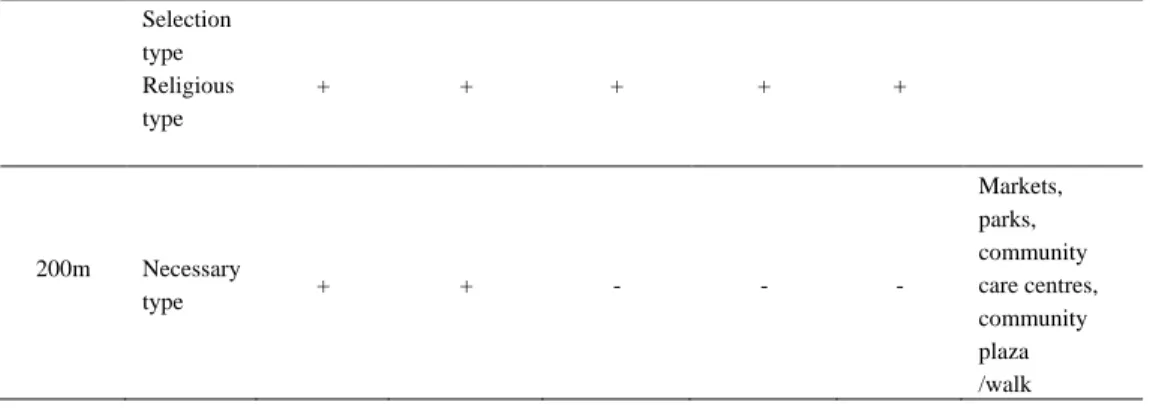
Religious type: For this type of elders the activities are related to religious activities and most of the activities are group activities. Therefore, the religious type of elder can receive social support and religious support, which includes emotional support, instrumental support and messaging support.
Necessary type: This type of elder walks to their activity space to meet their basic needs of daily life. Most the activity places are in the nearby community and include community care centres, markets, community squares, neighbourhood parks, and they can get emotional support, instrumental support and messaging support during the activities.
Table 3. Social support for the different types of elders
Range of Activities
Types of Activities
Emotional Support
Instrumental Support
Information Support
Interactive Community
Support
Religious Support
Activities place /Transportation
2050m
Social type Service type
+ + + + - Community
care centre, senior centre, park, sports centre /bus, walk Social
type Sport type
+ + - - -
700m
Selection type Personal activities
+ + + - -
Shops, cafes shops, activity centre, park, mountains, plaza, church, campus /bus, walk, bicycle Selection
type Sport type
- - + - -
Selection type Religious type
+ + + + +
200m Necessary
type + + - - -
Markets, parks, community care centres, community plaza /walk
As the Table 3 shows, each different types of senior can get different kind of support. Besides that, they also use different types of public facilities and have different ranges of the activities.
3.4 Pedestrian space, social support and Age-friendly City Checklist
This study combines the walking space facilities and the social support for the social type, selection type and necessary type of elders. Then through the elders’ outdoor activities, walking time-path and space facilities, suggests the needs of elders in their spatial environment. The different types of seniors use different spaces and can receive different types of social support from their activities, summarised as below in Table 4.
Following this, analysis of the social support from the elders’ outdoor activities is used to identify needs for pedestrian walkways and social support, which are checked against the Age-friendly City Checklist of the World Health Organisation (WHO). Combining the needs in these lists, this research could provide a valuable reference for urban planning in the future.
Table 4. Pedestrian space, social support and age-friendly city checklist
Type Pedestrian space Social support Aged-friendly City Checklist
Social type Service type
1. Safety of street at night
2. The availability of bus stops
3. To create more communicative spaces in the neighbourhood
1. Information support at bus stops 2. Provide more indoor activity spaces
1. Night lighting and sound tips on pedestrian walkways
2. Provide checklist of natural pedestrian walkways
3. Provide more indoor activity space in public spaces
Social type Sport type
1. Activity spaces connecting safe streets 2. Provide seating areas
1. Information support at seating areas
2. Provide more indoor activity spaces
1. Provide checklist of natural pedestrian walkways
2. Provide more indoor activity space in public spaces
Selection type Personal activities
1. Provide seating areas
2. Provides more activity facilities
Provides a gathering place for exchange within five minute walking range
1. Provide seating areas in arcades
2. Provide more shops near to activity spaces Selection
type Sport type
1. Provide seating areas
2. Provide more activity facilities
Provide a gathering place for exchange within five minute walking range
Provide seating areas
12 IRSPSD International, Vol.4 No.3 (2016), 4-13
Selection type Religious type
Religious space entrance useable by elders
Provide more communications areas near to religious buildings
Increase religious building entrance accessibility projects Necessary
type
Facilities are comfortable, with shelter.
Provide more activities in the neighbourhood parks and facilities
Provide more activity areas in the
neighbourhood
According to Table 4, the demands on the pedestrian walkways and social support are organized to form an Age-friendly City Checklist. This found that providing more activity spaces and rest areas could improve social support for elders. The social type of elder needs more indoor activity space and more communication space near pedestrian walkways. Selection type elders need shops, sport facilities and communication spaces. Necessary type elders need communication spaces in neighbourhood parks and plazas.
4. CONCLUSION
This research uses the Age-friendly Cities Index to analyse the walking paths and activity space of 22 elders, and to discuss their social support. The needs to be improved upon and fixed are identified, and a contribution to the planning of pedestrian spaces in Xinyi District is presented. The results are as follows:
There are three types of outdoor activities for the elders in Xinyi District.
From most to the least common is selection type, social type and necessary type elders. Social type elders have the longest walking distance and use public transportation. Therefore, to assist social type elders, the community could create more “nodes” such as bus stops or other transportation hubs and communication spaces on pedestrian walkways. Selection type elders spend the shortest time walking because they use other forms of transportation, such as bicycles, vehicles and public transportation well, so to provide more trees and shelter around pedestrian streets and bicycle paths, could enhance the health and safety of outdoor activities.
Necessary type elders have the shortest walking distance, but spend the most time walking. Their activities are limited by the accessibility of neighbourhood parks and markets. Therefore, planning social spaces could improve the social support for this type of elder.
The recommendations for social activity support for elders are as follows:
1) Planning to improve travel: Providing information support at the bus stop and public places for the elders, as well as providing communication spaces in the activity areas.
2) Integration and connection with pedestrian walkways: Recreation, rest and communication spaces and shops should be integrated. Also, small communication points around religious building should be provided.
3) To create more communication activity spaces: Create more communication activity spaces in the neighbourhoods and parks, and the community centre must have enough activities that support group work as well as other facilities that support the participation of elders.
REFERENCES
Borst, H. C., Miedema, H. M. E., de Vries, S. I., Graham, J. M. A., & van Dongen, J. E. F.
(2008). "Relationships between Street Characteristics and Perceived Attractiveness for
Walking Reported by Elderly People". Journal of Environmental Psychology, 28(4), 353- 361.
Godbey, G. (1999). Leisure in Your Life: An Exploration. State Collage, PA: Venture Publishing.
Golledge, R. G., & Stimson, R. J. (1997). Spatial Behavior: A Geographic Perspective. New York, NY: Guilford Press.
Hirao, K., Kobayashi, R., Okishima, K., & Tomokuni, Y. (2012). "Flow Experience and Health‐
Related Quality of Life in Community Dwelling Elderly Japanese". Nursing & health sciences, 14(1), 52-57.
Kerr, J., Rosenberg, D., & Frank, L. (2012). "The Role of the Built Environment in Healthy Aging Community Design, Physical Activity, and Health among Older Adults". Journal of Planning Literature, 27(1), 43-60.
Mitra, R., Siva, H., & Kehler, M. (2015). "Walk-Friendly Suburbs for Older Adults? Exploring the Enablers and Barriers to Walking in a Large Suburban Municipality in Canada". Journal of aging studies, 35, 10-19. doi: 10.1016/j.jaging.2015.07.002
Tsai, S.-Y. (2014). "Study of Taipei Public Spaces from Age-Friendly City Viewpoint: Taking Xinyi District and Wanhua District for Examples". Journal of Architecture, 90, 23-34.
Tsai, S.-Y. (2015). "The Relationships among Leisure Involvement, Social Support, Flow Experience and Life Quality in Older Adults". Journal of Sport and Recreation Management, 16(5), 83-86.
Tzeng, S. U., & Wang, L. F. (2006). "The Study on Daily Living Behavior Patterns and Activity Place Types for the Elderly in Institution, Part One: By Case of One Hospital-Based Nursing Home in Southern Taiwan". Journal of Design, 11(2), 115-137.
Wang, J., & Tong, Q. (2009). "Study on the Walking Space Design of the Aged People".
Huazhong Achitecture, 27(10), 49-50.
Xin, H.-y. (2007). "Creation of Outdoor Space for the Aged". Journal of Qingdao Technological University, 28(4), 57-61.