RESEARCH ARTICLE
Can Fasting Glucose Levels or Post-Breakfast Glucose Fluctuations Predict the Occurrence of Nocturnal Asymptomatic Hypoglycemia in Type 1 Diabetic Patients Receiving Basal-
Bolus Insulin Therapy with Long-Acting Insulin?
Sumie Mitsuishi1, Rimei Nishimura1,2*, Kiyotaka Ando1, Daisuke Tsujino1, Kazunori Utsunomiya1
1Division of Diabetes, Metabolism and Endocrinology, Department of Internal Medicine, Jikei University School of Medicine, Tokyo, Japan,2Graduate School of Public Health, University of Pittsburgh, Pittsburgh, Pennsylvania, United States of America
Abstract
Objective
To investigate whether the occurrence of nocturnal asymptomatic hypoglycemia may be predicted based on fasting glucose levels and post-breakfast glucose fluctuations.
Patients and Methods
The study subjects comprised type 1 diabetic patients who underwent CGM assessments and received basal-bolus insulin therapy with long-acting insulin. The subjects were evalu- ated for I) fasting glucose levels and II) the range of post-breakfast glucose elevation (from fasting glucose levels to postprandial 1- and 2-hour glucose levels). The patients were divided into those with asymptomatic hypoglycemia during nighttime and those without for comparison. Optimal cut-off values were also determined for relevant parameters that could predict nighttime hypoglycemia by using ROC analysis.
Results
64 patients (mean HbA1c 8.7 ± 1.8%) were available for analysis. Nocturnal asymptomatic hypoglycemia occurred in 23 patients (35.9%). Fasting glucose levels (I) were significantly lower in those with hypoglycemia than those without (118 ± 35 mg/dL vs. 179 ± 65 mg/dL;
P < 0.001). The range of post-breakfast glucose elevation (II) was significantly greater in those with hypoglycemia than in those without (postprandial 1-h, P = 0.003; postprandial 2- h, P = 0.005). The cut-off values determined for relevant factors were as follows: (I) fasting glucose level < 135 mg/dL (sensitivity 0.73/specificity 0.83/AUC 0.79, P < 0.001); and (II)
OPEN ACCESS
Citation:Mitsuishi S, Nishimura R, Ando K, Tsujino D, Utsunomiya K (2015) Can Fasting Glucose Levels or Post-Breakfast Glucose Fluctuations Predict the Occurrence of Nocturnal Asymptomatic
Hypoglycemia in Type 1 Diabetic Patients Receiving Basal-Bolus Insulin Therapy with Long-Acting Insulin? PLoS ONE 10(12): e0144041. doi:10.1371/
journal.pone.0144041
Editor:Stephen L Atkin, Weill Cornell Medical College Qatar, QATAR
Received:July 6, 2015 Accepted:November 12, 2015 Published:December 1, 2015
Copyright:© 2015 Mitsuishi et al. This is an open access article distributed under the terms of the Creative Commons Attribution License, which permits unrestricted use, distribution, and reproduction in any medium, provided the original author and source are credited.
Data Availability Statement:All relevant data are within the paper and its Supporting Information files.
Funding:The authors have no support or funding to report.
Competing Interests:The authors have read the journal's policy and the authors of this manuscript have the following competing interests: R.N. has received research support from Japan Diabetes Foundation, has participated in speaker's bureau/
1-h postprandial elevation > 54 mg/dL (0.65/0.61/0.71, P = 0.006), 2-h postprandial eleva- tion > 78 mg/dL (0.65/0.73/0.71, P = 0.005).
Conclusions
Nocturnal asymptomatic hypoglycemia was associated with increases in post-breakfast glucose levels in type 1 diabetes. Study findings also suggest that fasting glucose levels and the range of post-breakfast glucose elevation could help predict the occurrence of noc- turnal asymptomatic hypoglycemia.
Introduction
The goal of diabetes treatment is to prevent the onset of diabetic complications and to ensure quality of life (QOL) and longevity comparable to those in healthy individuals by controlling glucose and metabolism. HbA1c, a typical index for glucose control, reflects mean glucose lev- els that vary over the long term. However, large-scale clinical studies found that lowering HbA1c levels does not necessarily result in improved life prognosis [1–3].
Moreover, glucose control aimed at HbA1c reductions may be associated with increased risk of hypoglycemia [4]. A sub-analysis of the ADVANCE study reported that serious hypo- glycemia is a determinant of prognosis in cardiovascular and overall mortality [5]. Also, hypo- glycemia is reported to induce arrhythmia [6], especially in nocturnal hypoglycemia leading to increased sympathetic nerve activity, followed by over-compensatory vagal activity, thus caus- ing life-threatening brachycardia [7]. It is therefore suggested that nocturnal hypoglycemia may be associated with the so-called “ dead in bed ” syndrome or sudden death [8 – 11].
In fact, by using continuous glucose monitoring (CGM), several reports indicated that type 1 diabetic patients are frequently associated with nocturnal hypoglycemia [12 – 14].
Thus, it appears critically important to predict the occurrence of hypoglycemia and to improve HbA1c while avoiding hypoglycemia as much as possible. Given that hypoglycemia may remain asymptomatic, however, CGM may be required to detect the occurrence of noctur- nal hypoglycemia in all patients.
The Somogyi effect is used to describe how fasting glucose levels may become elevated by counter-regulatory hormones in response to nocturnal asymptomatic hypoglycemia [15]. The dawn phenomenon, defined as increased fasting glucose levels (resulting from an insufficiency of basal insulin and a surge of counter-regulatory hormones), is also used to account for ele- vated fasting glucose. It is difficult to determine without using CGM, however, whether fasting glucose levels become elevated through the Somogyi effect or the dawn phenomenon. Further- more, while nocturnal hypoglycemia has been reported to elevate post-breakfast glucose levels in patients treated with continuous subcutaneous insulin infusion (CSII) [16], to date, very few studies examined how nocturnal hypoglycemia may affect fasting and post-breakfast glucose levels in patients receiving basal-bolus insulin therapy.
In this study, therefore, type 1 diabetic patients receiving basal-bolus insulin therapy with long-acting insulin were assessed by CGM to examine whether the occurrence of nocturnal asymptomatic hypoglycemia may be predicted based on their fasting glucose levels and post- breakfast glucose fluctuations.
Patients and Methods
The study subjects comprised type 1 diabetic patients who were admitted to our hospital, assessed by CGM for their glucose profiles and received basal-bolus insulin therapy with
advisory panels for Astellas, Astra Zeneca, Boehringer Ingelheim, Daiichi-Sankyo, Eli Lilly, Johnson & Johnson, Kissei, Kowa, Medtronic, Novo Nordisk, Ono, Sanofi, Taishyo, Takeda and Tanabe- Mitsubishi, and served as a consultant for Abbott, Boehringer Ingelheim, Eli Lilly, and Taisho. K.U. has received research support from Kowa, Ono and Taishyo, and has participated in speaker's bureau/
advisory panels for Astellas, Astra Zeneca and Sanofi. All the other authors have no conflict of interest to declare. This does not alter the authors' adherence to PLOS ONE policies on sharing data and materials.
long-acting insulin (insulin glargine or insulin detemir). For analysis, CGM data were continu- ously recorded by using CGMS Gold from immediately after admission onwards for at least 24 hours. Then, patients were excluded from analysis if they had taken oral glucose upon becom- ing aware of nocturnal hypoglycemia and if they had taken oral α-glucosidase inhibitors, which are known to affect postprandial glucose levels.
Nocturnal asymptomatic hypoglycemia was defined as hypoglycemia (< 70 mg/dL) occur- ring between 12 pm and 6 am and the subjects were evaluated for 1) nocturnal glucose nadirs and 2) duration of nocturnal asymptomatic hypoglycemia. The subjects were also evaluated for I) fasting glucose levels; II) post-breakfast glucose levels (peak levels as well as postprandial 1- and 2-hour levels); III) the range of post-breakfast glucose elevation (from fasting glucose levels to peak, postprandial 1- and 2-hour glucose levels); and IV) the post-breakfast glucose concen- tration gradient (from fasting glucose levels to peak, postprandial 1- and 2-hour glucose levels).
The subjects were divided into hypoglycemic and non-hypoglycemic patients and compared for parameters I) through IV) by using t-test to examine whether the occurrence of nocturnal asymptomatic hypoglycemia may be predicted based on analysis of parameters I) through IV).
A receiver operating characteristic (ROC) analysis was also conducted to determine appropri- ate cut-off values for these parameters. Multivariate logistic regression was also conducted to identify predictors of nocturnal asymptomatic hypoglycemia.
As this retrospective study used anonymized patient data obtained in routine clinical set- tings, informed consent was not obtained from the patients. The study protocol was approved by the ethics committee of the Jikei University School of Medicine.
Results
Of all patients who underwent CGM assessments during hospitalization, 71 were type 1 dia- betic patients receiving basal-bolus insulin therapy. Of these, those who had taken oral glucose upon becoming aware of nocturnal hypoglycemia (n = 4) and those who had taken oral α-glu- cosidase inhibitors (n = 3) were excluded from analysis. As a result, 64 patients were available for analysis in this study (males/females, 20 [31.3%]/44 [68.8%]; mean age, 43.1 ± 14.4 years old; mean disease duration, 15.7 ± 11.6 years; HbA1c, 8.7 ± 1.8%; BMI, 22.2 ± 3.4 kg/m
2; and urinary C-peptide, 3.6 ± 6.0 μg/day) (Table 1, S1 File). Basal insulin was used once in 15 patients (23.4%) in the evening or before bedtime or twice in 49 patients (76.6%), i.e., once in the morning and once in the evening or before bedtime. Of the two basal insulin preparations used, insulin glargine was used in 35 patients (54.7%) and insulin detemir in 29 patients (45.3%).
The subjects (n = 64) were shown to have 1) a nocturnal glucose nadir of 98 ± 48 mg/dL, and 2) nocturnal asymptomatic hypoglycemia lasting 64 ± 107 minutes. The results for the parameters for post-breakfast glucose fluctuations were as follows: I) fasting glucose levels, 157 ± 63 mg/dL; II) post-breakfast peak, 1- and 2-hour glucose levels, 240 ± 58 mg/dL, 203 ± 58 mg/dL and 207 ± 60 mg/dL; III) range of post-breakfast peak, postprandial 1- and 2-hour glucose elevation, 84 ± 58, 46 ± 45 and 50 ± 74 mg/dL; and IV) post-breakfast peak, postprandial 1- and 2-hour glucose concentration gradient, 0.91 ± 0.83, 0.77 ± 0.75, 0.42 ± 0.62 mg/dl/min (Table 1).
Nocturnal asymptomatic hypoglycemia occurred in 23 patients (35.9%). Mean HbA1c did
not differ between those with hypoglycemia and those without (Table 1). No significant differ-
ence was observed between the 6 patients (40.0%) receiving once daily insulin (in the evening
or before bedtime) and the 17 patients (34.7%) receiving twice daily insulin (once in the morn-
ing and once in the evening or before bed) with regard to the frequency of nocturnal asymp-
tomatic hypoglycemia experienced due to the difference in the timing of basal insulin between
the two groups (P = 0.71; χ
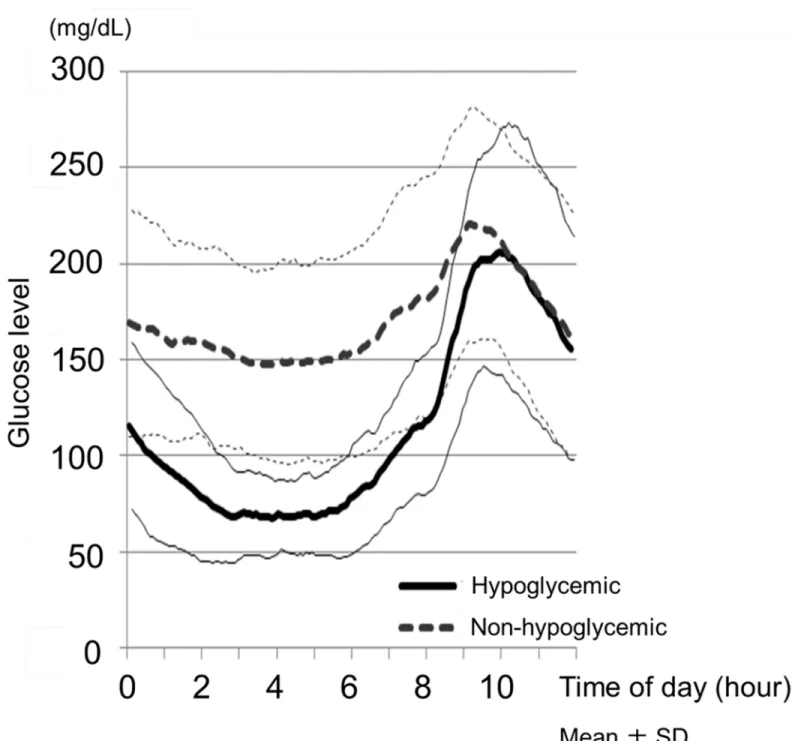
2test). Glucose profiles from nighttime to post-breakfast hours are shown for those with hypoglycemia and those without in Fig 1. Table 1 summarizes the results for the parameters examined for post-breakfast glucose variability in those with hypoglycemia versus those without. The fasting glucose levels were significantly lower among those with hyp- glycemia at 118 ± 35 mg/dL compared to 179 ± 65 mg/dL among those without (P < 0.001).
On the other hand, the post-breakfast peak, postprandial 1- and 2-hour levels were not signifi- cantly different between the two groups. However, the range of glucose elevation at postpran- dial 1 and 2 hours was significantly greater among those with hypoglycemia (postprandial 1-hour, 67 ± 33 vs. 34 ± 46 mg/dL, P = 0.003; postprandial 2-hour, 84 ± 54 vs. 31 ± 77 mg/dL, P = 0.005), as was the post-breakfast glucose concentration gradient (postprandial 1-hour, 1.13 ± 0.56 vs. 0.57 ± 0.77 mg/dL/min, P = 0.003; postprandial 2-hour, 0.70 ± 0.45 vs.
0.26 ± 0.64 mg/dL/min, P = 0.005).
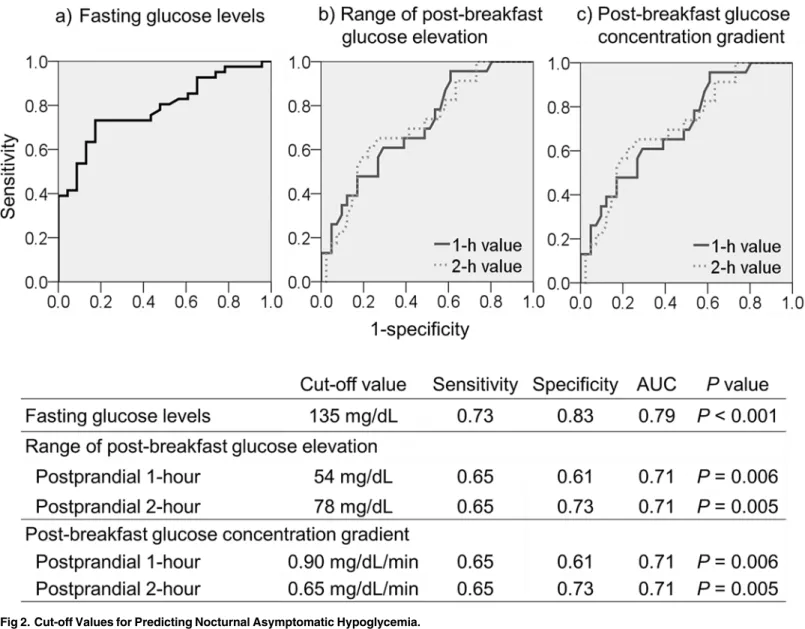
The ROC analysis-derived cut-off values for prediction of nocturnal asymptomatic hypogly- cemia were as follows: fasting glucose levels, < 135 mg/dL (sensitivity 0.73/specificity 0.83/
AUC 0.79, P < 0.001); range of post-breakfast glucose elevation, > 54 mg/dL at postprandial 1 hour (0.65/0.61/0.71, P = 0.006); > 78 mg/dL at postprandial 2 hours (0.65/0.73/0.71, P = 0.005); and post-breakfast glucose concentration gradient, > 0.90 mg/dL/min at postpran- dial 1 hour (0.65/0.61/0.71, P = 0.006), > 0.65 mg/dL/min at postprandial 2 hours (0.65/0.73/
0.71, P = 0.005) (Fig 2).
Table 1. Patient Profile and Parameters for Glycemic Variability Compared between Hypoglycemic and Non-hypoglycemic Patients.
Overall Hypoglycemic Non-hypoglycemic Pvalue*
Patients tested (n) 64 23 41
Age (years) 43.1±14.4 42.9±14.3 43.2±14.7 P= 0.937
HbA1c (%) 8.7±1.8 8.3±1.7 8.9±1.9 P= 0.251
Body Mass Index (kg/m2) 22.4±3.4 21.6±2.8 22.9±3.7 P= 0.147
Urinary C-peptide (μg/day) 3.6±6.0 4.5±7.7 3.0±4.8 P= 0.417
Duration of diabetes (years) 15.7±11.6 12.6±11.7 17.2±11.4 P= 0.141
Total daily insulin dose (TDD) (U/kg) 0.71±0.76 0.93±1.22 0.58±0.16 P= 0.184
Basal insulin ratio (%) 43.4±12.7 43.3±13.5 43.4±12.4 P= 0.977
Nighttime glucose nadir levels (mg/dL) 98±48 51±11 124±40 P<0.001
Nighttime duration of hypoglycemia (min) 64±107 177±110 0±0 P<0.001
Fasting glucose levels (mg/dL) 157±63 118±35 179±65 P<0.001
Post-breakfast glucose levels (mg/dL)
Peak 240±58 225±59 249±56 P= 0.116
Postprandial 1-h 203±58 186±53 213±59 P= 0.072
Postprandial 2-h 207±60 202±66 210±56 P= 0.634
Range of post-breakfast glucose elevation (mg/dL)
Peak 84±53 107±50 70±50 P= 0.006
Postprandial 1-h 46±45 67±33 34±46 P= 0.003
Postprandial 2-h 50±74 84±54 31±77 P= 0.005
Post-breakfast glucose concentration gradient (mg/dL/min)
Peak 0.91±0.83 1.05±0.35 0.83±1.00 P= 0.319
Postprandial 1-h 0.77±0.75 1.13±0.56 0.57±0.77 P= 0.003
Postprandial 2-h 0.42±0.62 0.70±0.45 0.26±0.64 P= 0.005
Data are shown as mean±SD
*t-test was employed for comparisons between the hypoglycemic and non-hypoglycemic patients.
doi:10.1371/journal.pone.0144041.t001
The logistic regression model identified the following factors as predictors of nocturnal asymptomatic hypoglycemia (each shown with its adjusted OR and 95% confidence interval):
HbA1c (per 1% increase in HbA1c), 0.46, 0.25 – 0.84; total daily dose of insulin (per 1 U/kg increase in total daily dose of insulin), 75.1, 1.65–3418; and insulin glargine (vs. insulin dete- mir), 6.93, 1.42 – 34.0. The logistic regression model suggested, however, that the following did not predict the occurrence of nocturnal asymptomatic hypoglycemia: female sex (2.35, 0.48–
10.6); BMI (per 1 kg/m2 increase in BMI) (1.00, 0.79 – 1.25); urinary C-peptide (per 1 μ g/day
Fig 1. Glucose Profiles Showing Nighttime to Post-Breakfast Glucose levels.Hypoglycemic patients (n = 23); Non-hypoglycemic patients (n = 41).
doi:10.1371/journal.pone.0144041.g001
increase in urinary C-peptide) (1.07, 0.92 – 1.22); duration of diabetes (pre 1 year increase in duration of diabetes) (0.97, 0.91–1.04); basal insulin ratio (per 1% increase in basal insulin ratio) (57.0, 0.06 – 51119); and once daily insulin in the evening or before bedtime (vs. twice daily insulin, once in the morning and once in the evening or before bedtime) (4.15, 0.54–
31.6).
Discussion
In this study, we examined 64 type 1 diabetic patients receiving basal-bolus insulin therapy (mean HbA1c, 8.7 ± 1.8%). Of these, nocturnal asymptomatic hypoglycemia ( < 70mg/dL) occurred in 23 patients (35.9%). The occurrence of nocturnal hypoglycemia in these patients was similar in frequency to that reported in other CGM-based studies, where it ranged from 29% to 36% [12–14]. In this regard, the DCCT study previously reported that severe hypogly- cemia occurred in 53% of the cases during nighttime [17 – 19], suggesting that nocturnal hypo- glycemia frequently occurs in type 1 diabetes.
Fig 2. Cut-off Values for Predicting Nocturnal Asymptomatic Hypoglycemia.
doi:10.1371/journal.pone.0144041.g002
Frequent nocturnal hypoglycemia may occur due to 1) the autonomic response to hypogly- cemia that becomes attenuated during sleep and 2) the decreased response of counter-regula- tory hormones to insulin during sleep [20 – 22]. Alternatively, it may occur due to the effect of basal insulin peaking during nighttime thus inducing nocturnal hypoglycemia. This study examined patients being treated with long-acting insulin preparations, which last longer than neutral protamine hagedron (NPH) insulin preparations and exert a consistent effect because of their stable absorption. It is suggested, however, that their effects may be less consistent and vary even within the same individuals [23]. The subjects may thus develop nocturnal hypogly- cemia, as the effect of insulin given in the evening or before bedtime peaks during nighttime.
In this study, fasting glucose levels were shown to be significantly lower among the hypogly- cemic patients (118 ± 35 mg/dL vs. 179 ± 65 mg/dL; P < 0.001), consistently with the results of earlier CGM-based studies in type 1 diabetic patients [13, 14, 24–26], which argue against the concept of the Somogyi effect [15]. On the other hand, the range of post-breakfast glucose ele- vation, as well as the post-breakfast glucose concentration gradient, was greater among the hypoglycemic patients both at postprandial 1 hour and 2 hours, with their post-breakfast glu- cose levels seen to surge acutely and rapidly in the presence of nocturnal asymptomatic hypoglycemia.
When the concept of the Somogyi effect was proposed in 1959 [15], NPH insulin was pri- marily used as basal insulin. Given that NPH insulin is unevenly absorbed subcutaneously and lasts shorter than long-acting insulin, counter-regulatory hormones may have increased soon after onset of nocturnal hypoglycemia with NPH insulin, which, coupled with its shorter dura- tion of action, may have led to rapid increases in glucose levels, thus elevating fasting glucose levels as a consequence. Conversely, the subjects in this study were treated with long-acting insulin preparations lasting longer than NPH insulin. Thus, it is plausible that the long-acting insulin may not have elevated fasting glucose levels, but have elevated glucose levels immedi- ately after breakfast in response to nocturnal asymptomatic hypoglycemia.
The ROC analysis-derived cut-off values for prediction of nocturnal asymptomatic hypogly- cemia were: fasting glucose levels, < 135 mg/dL; range of post-breakfast glucose elevation,
> 54 mg/dL at postprandial 1 hour; > 78 mg/dL at postprandial 2 hours; and post-breakfast glucose concentration gradient, > 0.90 mg/dL/min at postprandial 1 hour, and > 0.65 mg/dL/
min at postprandial 2 hours. The type 1 diabetic patients in this study had a mean HbA1c of 8.7 ± 1.8%, and their mean glucose level estimated as 203 mg/dL [27]. Thus, their actual fasting glucose level 135 mg/dL was shown to be lower than their HbA1c suggested, suggesting that nocturnal hypoglycemia may be suspected when actual fasting glucose levels are lower than those estimated by HbA1c. Study findings also suggest that three glucose measurements a day (before, and 1 hour and 2 hours after breakfast) to determine the range of post-breakfast glu- cose elevation, as well as post-breakfast glucose concentration gradient, may predict the occur- rence of nocturnal asymptomatic hypoglycemia with a close to 65% accuracy, even without having recourse to CGM.
The limitation of the study was that it included a relatively small sample size and that the CGM data obtained in an in-patient setting in the study may have yielded different results than those obtained in an outpatient setting.
Despite this limitation, however, our study results clearly showed the fasting plasma glucose
threshold for predicting nocturnal asymptomatic hypoglycemia and suggest that targeting this
cut-off value in glycemic control may raise the likelihood of avoiding nocturnal asymptomatic
hypoglycemia. Again, it is a key finding from this study that monitoring the range of post-
breakfast glucose increase may predict the occurrence of nocturnal asymptomatic hypoglyce-
mia. It is hoped that our data will serve as a reference that helps in formulating insulin therapy
which is less associated with hypoglycemia in type 1 diabetic patients.
Supporting Information S1 File.
(XLSX)
Acknowledgments
The authors would like to extend their heartfelt thanks to all patients for their participation in the study and to Ms. Kimie Shida for her help with the study data management.
Author Contributions
Conceived and designed the experiments: RN. Performed the experiments: SM RN KA DT KU. Analyzed the data: SM. Contributed reagents/materials/analysis tools: RN. Wrote the paper: SM RN KU.
References
1. Currie CJ, Peters JR, Tynan A, Evans M, Heine RJ, Bracco OL, et al. Survival as a function of HbA(1c) in people with type 2 diabetes: a retrospective cohort study. Lancet. 2010; 375:481–489. doi:10.1016/
S0140-6736(09)61969-3PMID:20110121
2. Action to Control Cardiovascular Risk in Diabetes Study Group, Gerstein HC, Miller ME, Byington RP, Goff DC Jr, Bigger JT, et al. Effects of intensive glucose lowering in type 2 diabetes. N Engl J Med.
2008 12; 358:2545–2559. doi:10.1056/NEJMoa0802743PMID:18539917
3. ADVANCE Collaborative Group, Patel A, MacMahon S, Chalmers J, Neal B, Billot L, et al. Intensive blood glucose control and vascular outcomes in patients with type 2 diabetes. N Engl J Med. 2008;
358:2560–2572. doi:10.1056/NEJMoa0802987PMID:18539916
4. Miller CD, Phillips LS, Ziemer DC, Gallina DL, Cook CB, El-Kebbi IM. Hypoglycemia in patients with type 2 diabetes mellitus. Arch Intern Med. 2001; 161:1653–1659. PMID:11434798
5. Zoungas S, Patel A, Chalmers J, de Galan BE, Li Q, Billot L, Woodward M, et al; ADVANCE Collabora- tive Group. Severe hypoglycemia and risks of vascular events and death. N Engl J Med. 2010;
363:1410–1418. doi:10.1056/NEJMoa1003795PMID:20925543
6. Tsujimoto T, Yamamoto-Honda R, Kajio H, Kishimoto M, Noto H, Hachiya R, et al. Vital signs, QT pro- longation, and newly diagnosed cardiovascular disease during severe hypoglycemia in type 1 and type 2 diabetic patients. Diabetes Care. 2014; 37:217–225. doi:10.2337/dc13-0701PMID:23939540 7. Chow E, Bernjak A, Williams S, Fawdry RA, Hibbert S, Freeman J,et al. Risk of cardiac arrhythmias dur-
ing hypoglycemia in patients with type 2 diabetes and cardiovascular risk. Diabetes. 2014; 63:1738– 1747. doi:10.2337/db13-0468PMID:24757202
8. Tattersall RB, Gill GV. Unexplained deaths of type 1 diabetic patients. Diabet Med. 1991; 8:49–58.
PMID:1826245
9. Weston PJ, Gill GV. Is undetected autonomic dysfunction responsible for sudden death in Type 1 dia- betes mellitus? The 'dead in bed' syndrome revisited. Diabet Med. 1999; 16:626–631. PMID:10477206 10. Robinson RT, Harris ND, Ireland RH, Macdonald IA, Heller SR. Changes in cardiac repolarization dur-
ing clinical episodes of nocturnal hypoglycaemia in adults with Type 1 diabetes. Diabetologia. 2004;
47:312–315. PMID:14712347
11. Suys B, Heuten S, De Wolf D, Verherstraeten M, de Beeck LO, Matthys D, et al. Glycemia and cor- rected QT interval prolongation in young type 1 diabetic patients: what is the relation? Diabetes Care.
2006; 29:427–429. PMID:16443902
12. Kaufman FR, Austin J, Neinstein A, Jeng L, Halvorson M, Devoe DJ, et al. Nocturnal hypoglycemia detected with the Continuous Glucose Monitoring System in pediatric patients with type 1 diabetes. J Pediatr. 2002; 141:625–630. PMID:12410189
13. Woodward A, Weston P, Casson IF, Gill GV. Nocturnal hypoglycaemia in type 1 diabetes—frequency and predictive factors. QJM. 2009; 102:603–607. doi:10.1093/qjmed/hcp082PMID:19574471 14. Choudhary P, Davies C, Emery CJ, Heller SR. Do high fasting glucose levels suggest nocturnal hypo-
glycaemia? The Somogyi effect-more fiction than fact? Diabet Med. 2013; 30:914–917. doi:10.1111/
dme.12175PMID:23672623
15. Somogyi M. Exacerbation of diabetes by excess insulin action. Am J Med. 1959; 26:169–191. PMID:
13617275
16. Perriello G, De Feo P, Torlone E, Calcinaro F, Ventura MM, Basta G, et al. The effect of asymptomatic nocturnal hypoglycemia on glycemic control in diabetes mellitus. N Engl J Med. 1988; 319:1233–1239.
PMID:3054544
17. The Diabetes Control and Complications Trial Research Group. The effect of intensive treatment of dia- betes on the development and progression of long-term complications in insulin-dependent diabetes mellitus. N Engl J Med. 1993:30; 329:977–986. PMID:8366922
18. The Diabetes Control and Complications Trial Research Group.Adverse events and their association with treatment regimens in the diabetes control and complications trial. Diabetes Care. 1995; 18:1415– 1427. PMID:8722064
19. The Diabetes Control and Complications Trial Research Group. Epidemiology of severe hypoglycemia in the diabetes control and complications trial. Am J Med. 1991; 90:450–459. PMID:2012085 20. Diabetes Research in Children Network (DirecNet) Study Group. Impaired overnight counterregulatory
hormone responses to spontaneous hypoglycemia in children with type 1 diabetes. Pediatr Diabetes.
2007; 8:199–205. PMID:17659061
21. Banarer S, Cryer PE. Sleep-related hypoglycemia-associated autonomic failure in type 1 diabetes:
reduced awakening from sleep during hypoglycemia. Diabetes. 2003; 52:1195–1203. PMID:12716752 22. Jones TW, Porter P, Sherwin RS, Davis EA, O'Leary P, Frazer F, et al. Decreased epinephrine
responses to hypoglycemia during sleep. N Engl J Med. 1998; 338:1657–1662. PMID:9614256 23. Heise T, Hermanski L, Nosek L, Feldman A, Rasmussen S, Haahr H. Insulin degludec: four times lower
pharmacodynamic variability than insulin glargine under steady-state conditions in type 1 diabetes. Dia- betes Obes Metab. 2012; 14:859–864. doi:10.1111/j.1463-1326.2012.01627.xPMID:22594461 24. Høi-Hansen T, Pedersen-Bjergaard U, Thorsteinsson B. The Somogyi phenomenon revisited using
continuous glucose monitoring in daily life. Diabetologia. 2005; 48:2437–2438. PMID:16240150 25. Wiltshire EJ, Newton K, McTavish L. Unrecognised hypoglycaemia in children and adolescents with
type 1 diabetes using the continuous glucose monitoring system: prevalence and contributors. J Pae- diatr Child Health. 2006; 42:758–763. PMID:17096709
26. Wentholt IM, Maran A, Masurel N, Heine RJ, Hoekstra JB, DeVries JH. Nocturnal hypoglycaemia in Type 1 diabetic patients, assessed with continuous glucose monitoring: frequency, duration and asso- ciations. Diabet Med. 2007; 24:527–532. PMID:17381503
27. Nathan DM, Kuenen J, Borg R, Zheng H, Schoenfeld D, Heine RJ; A1c-Derived Average Glucose Study Group. Translating the A1C assay into estimated average glucose values. Diabetes Care. 2008;
31:1473–1478. doi:10.2337/dc08-0545PMID:18540046