(資料)
Errors in English Composition
A description of the type of errors found in an English essay given to a 2
ndyear group of students studying at a Japanese nursing college
英語の作文の間違え
日本の看護大学二年生における英語作文の誤りの訂正と その説明
KEY WORDS: English, Error, Analysis
Huw Tyler *
The Japanese Red Cross Kyushu International College of Nursing
Purpose:
At the start of every school year, the British Council in Hong Kong had to check the level of over ten thousand students. They employed a team of testers solely for the selection process. In the late 1980s a language school in Tokyo had classes at 12 levels of English proficiency in which it could place its students. They ranged from Level 1, false beginner, to level 12 which was for students who were deemed capable of passing the Cambridge Proficiency Examination. The CPE is roughly equivalent
* Part-time Teacher, Faculty of Humanities, Fukuoka University
to a score of 900 on TOEIC. And for most specialist language schools and English language courses it is usual that prior to starting their programme, students will go through some form of level testing in order to place them in a class with students of similar ability. It also enables the institution to provide syllabi that will meet the linguistic needs of the students studying at a particular level. This is a very necessary process for a specialist language school or, intensive courses preparing participants for imminent overseas assignments, but at a Japanese university where the number of students majoring in English may be very small compared to the whole student population, it may seem to be a luxury rather than a necessity.
Nevertheless, the principal of making a syllabus which meets the needs of the students is valid for all subjects. In the absence of a system for assigning students to English classes according to their English proficiency level, the classroom instructor will need to make some critical decisions as to what linguistic areas to include and exclude in their syllabus. It was with the intention of gaining a more exact knowledge of the linguistic areas in the English language which cause problems for Japanese university students that I undertook an analysis of the errors students made in their end of term English essay.
Overview of students & course:
The target group comprised of 115 second year students at a 4-Year nursing university. The students were divided into two classes comprising of 56 and 59 students. After entering the college they had had 3 hours of compulsory English classes per week during their first year. A native English teacher (NET) taught one of the classes, and a Japanese English teacher (JET) taught the other class. The NET's class had featured speaking, listening, and reading skills but no substantial written work was required. In their second year the students continued with 3 hours of compulsory English classes with the same teachers. However, the focus for the NET's second year class was to develop their written English skills.
During the first semester students were expected to recognize punctuation and
particular written forms such as block capitals and initials. They were asked to do pictorial, word and phrase level activities including creating a poster. The first sentence level activities were to express like and dislike and to use adverbs and adverbial phrases of frequency. For example; I enjoy swimming. I swim twice a week. Subsequently, the students had to answer questions that elicited information about a friend's daily routine. They were then expected to use this information, making slight adjustments to incorporate the language they had been practising in the lesson, to write a paragraph about their friend. The process from information gathering to guided practice is illustrated below.
Information gathering: Note that the first sentence was given to the students. They had to insert the name of their friend and their friend's job.
Example: My friend, David Deckham, is a professional footballer.
1. Does he like his job?
Yes, he does.
2. How does he get to work?
By helicopter or bus.
3. What is one thing he does everyday?
Asks his wife what to wear.
4. What time does he arrive at work?
Before 9.00 a.m.
Guided writing practice: The students were then expected to adapt the answers using the sentence structure structures and vocabulary they had been practising in class. The result should have been similar to the example below.
My friend, David Deckham, is a professional footballer. He loves his job. He
sometimes goes to work by helicopter but usually he catches the bus. He always
asks his wife what clothes to wear and always arrives at work before 9.00 a.m.
Grammatical, notional and functional content required for the essay:
Subsequent lessons focused on writing physical descriptions of people, describing a person's personality, adjectives that describe emotions or, the agent which creates that emotion. For example; He was bored. - The show was boring. There was a lesson focusing on vocabulary describing human qualities. The students were also required to distinguish between the adjectival and noun word form. This was followed by an activity in which they had to fill out a form describing themselves and, a description of the kind of person they would like to meet. The 1st. semester's individual writing assignment was based on this activity as, done thoroughly, it could include all the language items previously described. The explanation of the assignment followed a lesson on non-defining relative clauses (NDRC). It was pointed out that NDRCs could also be used in the assignment.
Error analysis:
In 1988, Yoko Kiser did a study entitled "Common Mistakes in English-Language Journals." In her study she divided errors into five categories; structure (with particular reference to the use of the be-verb), pronouns, inappropriate use of vocabulary, other grammatical errors and new word formation. The final category was aimed at translators introducing words borrowed from other languages so it was not applicable to my students. The other categories were relevant although they needed to be defined more precisely. So for the purposes of this error analysis I divided errors into ten categories based on particular language items I had been teaching on the course, as well as problems of expression that habitually appear in both written and spoken work. The categories were as follows; subject - verb agreement, tense, word form, conjunctions, prepositions, pronouns, spelling, inappropriate vocabulary, expression, and omissions/additions. I classified single word interference as inappropriate vocabulary (In.V). For example;
I play a dance lesson three times a week.
If a whole sentence, clause or phrase was difficult to decipher, I termed it expression
(Ex).
For example;
I am a centre forward and a score is very glad that I put it.
I did not count mistakes or omissions of 'the' and 'a' as even advanced level students can have difficulty with articles. However, other omissions or additions were counted. For example;
My birthday is April 25th.and now 19 years old. (I am omitted before 19 years old.) I paint it about once a week. (Writing about her hobby painting, 'it' is not necessary.) Finally, in the break down of the five highest scoring essays, under the heading 'Grammatical, Notional & Functional Content' I included the linguistic points that had NOT been used in the essay. NDRC stands for non-defining relative clause. In the case of the five lowest scoring essays I entered the linguistic points, which had been included in the essay.
Results:
Table 1 shows that the greatest number of errors are related to inappropriate vocabulary, expression and omissions and additions. In these three areas, there is usually some interference from the students' first language. With the other criteria it is not so easy to determine the reason for the errors. Inadequate teaching, or, the students' inability to learn a rule could cause them. A superficial interpretation of the data would indicate spelling was a greater problem for students than using prepositions or conjunctions. However, if you consider that a spelling error could apply to every word that a student writes, whereas prepositions or conjunctions together total around 25% of the essay, then proportionally they represent a more frequent problem. Subject - verb agreement and using the correct tense are the stock of conventional grammar based syllabi so are these error levels high considering that the students only really needed to use the present tense for this assignment?
What the table does not show is a tendency towards a cluster of errors. I found that the same kind of error was repeated three times or more on nearly sixty occasions.
In some cases the same student had two sets of error clusters.
Table 1:
A quantitative analysis of the combined errors in the English essays of 115, 2nd.year nursing college students.
1. Error Type 2. Number of Errors 3. Number of Students
Inappropriate Vocabulary 123 79(68.7%)
Expression 118 66(57.4%)
Omissions/Additions 95 60(52.2%)
Word Form 85 55(47.8%)
Spelling 81 53(46%)
Subject - Verb Agreement 79 50(43.5%)
Pronouns 74 47(40.9%)
Tense 70 47(40.9%)
Conjunctions 41 29(25.2%)
Prepositions 35 27(23.5%)
TABLE 2 & 3: Type of Errors KEY
Conj. - conjunctions Ex. - expression
In.V. - inappropriate vocabu- lary
O/A - omissions/additions Prep. - prepositions Pro. - pronouns Sp. - spelling
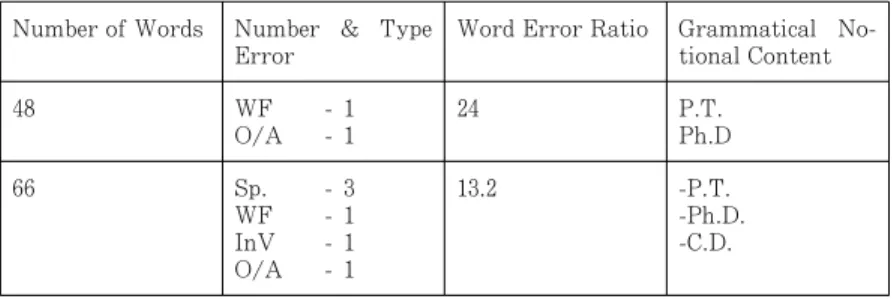
C.D. - character description Em.V. - emotion vocabulary F.Ad. - frequency adverbs L.D. - likes & dislike Ph.D. - physical description P.T. - present tense NDRC - non-defining relative
clause
Table 2: Five Highest Scoring Essays
Records the number, type and frequency of error, plus the linguistic criteria, which were NOT used in the highest scoring essays
Number of Words Number & Type of Error
Word Error Ratio Grammatical No- tional Functional Content
327 Sp. - 3
Pro - 2 In.V. - 1
54.5 All
208 Sp. - 2
Ten. - 1 In.V - 2
41.6 -Em.V
-NDRC
220 Sp. - 1
Ten. - 1 S-V - 1
WF - 1
Conj - 2 Pro - 1
31.4 -NDRC
177 Sp. - 1
S-V - 1
WF - 1
Conj - 1 In.V - 1
29.5 -Em.V
181 In.V - 1
O/A - 1
90.5 -NDRC
Table 3: Five Lowest Scoring Essays
Records the number, type and frequency of error, plus the grammatical and notional content, which were used in the essay.