CITATION
Alford, M.H., J.B. Mickett, S. Zhang, P. MacCready, Z. Zhao, and J. Newton. 2012. Internal waves on the Washington continental shelf. Oceanography 25(2):66–79, http://dx.doi.org/10.5670/
oceanog.2012.43.
DOI
http://dx.doi.org/10.5670/oceanog.2012.43 COPYRIGHT
This article has been published in Oceanography, Volume 25, Number 2, a quarterly journal of The Oceanography Society. Copyright 2012 by The Oceanography Society. All rights reserved.
USAGE
Permission is granted to copy this article for use in teaching and research. Republication, systematic reproduction, or collective redistribution of any portion of this article by photocopy machine, reposting, or other means is permitted only with the approval of The Oceanography Society. Send all correspondence to: [email protected] or The Oceanography Society, PO Box 1931, Rockville, MD 20849-1931, USA.
O ceanography THE OffICIAl MAGAZINE Of THE OCEANOGRAPHY SOCIETY
DOWNlOADED fROM HTTP://WWW.TOS.ORG/OCEANOGRAPHY
Internal Waves on the
Washington Continental Shelf
S p e C I a l I S S u e O N I N t e r N a l WaV e S
B y M at t h e W h . a l f O r d , J O h N B . M I C k e t t, S h u a N g Z h a N g , pa r k e r M a C C r e a d y, Z h O N g x I a N g Z h a O , a N d J a N N e W t O N
tOp | r/V Thomas G. Thompson crew and John Mickett of apl/uW preparing Cha Ba for deployment off
the Washington Coast. MIddle | field technician Zoë parsons (uW/apl) and r/V Thompson resident
Oceanography | June 2012 67
Internal Waves on the
Washington Continental Shelf
Oceanography | June 2012 67
mixing. As such, they are thought to be major players in mixing both the deep and shallow ocean. In coastal environ- ments, they have the potential to trans- port nutrients upward into the euphotic zone and transport heat, momentum, nutrients, pollutants, sediment, and even biota such as larvae. However, their slow propagation speed in shallow depths relative to strong low-frequency currents makes them even more variable and complex than in the deep ocean (e.g., see Nash et al., 2012, in this issue).
The Washington continental shelf (Figure 1), at the northern end of the California current system, is a highly bio- logically productive region that has been the topic of considerable attention of late,
owing to its sensitivity to harmful algal blooms (Horner et al., 1997), hypoxic and anoxic events (Whitney et al., 2008), and ocean acidification (Sabine et al., 2004).
A nitrate-limited system, the Washington shelf region appears to be several times more productive than the Oregon or California shelves. Yet, upwelling winds are weaker and more variable than they are further south (Hickey and Banas, 2003). The reasons for this discrepancy have been hypothesized to be related to the presence of the Juan de Fuca Strait, a massive estuary system linking Puget Sound and the Strait of Georgia, the Juan de Fuca eddy, and the Juan de Fuca submarine canyon (Figure 1; Foreman et al., 2008; MacFadyen and Hickey, 2010). In ways that are not yet fully understood, these three unique aspects of the Washington continental shelf may conspire to boost its productivity (Hickey and Banas, 2008).
Internal waves and mixing, are likely key players in these scenarios for Washington waters, though they have not been the subjects of detailed reports.
On the New England and Oregon conti- nental shelves, internal waves are respon- sible for a great deal of the observed mixing, with high-frequency nonlinear internal waves accounting for about half in each case (MacKinnon and Gregg, 2003a; J. Moum, Oregon State University, pers. comm., 2012). In the case of Oregon, turbulence has been observed to enhance the flux of nitrate to the eupho- tic zone (Avicola et al., 2007). Pineda (1999) demonstrated the potential for nonlinear internal tides to transport invertebrate larvae onto the Southern California continental shelf. Finally, Lucas et al. (2011) inferred lateral nitrate fluxes associated with the internal tide INtrOduCtION
Internal gravity waves, the undersea analogue to surface gravity waves, are ubiquitous in the world ocean. They cause density layers to move vertically as much as hundreds of meters, with horizontal currents up to a meter per second, in the most active regions such as the South China Sea (Alford et al., 2011). Thought to be primarily gener- ated by the wind blowing on the ocean’s surface (leading to “near-inertial waves”) and tidal currents flowing over seafloor bumps (leading to “internal tides”), they can give rise to strongly vertically sheared currents and even sweep denser water above lighter water. Both of these instabilities can lead to turbulence and
aBStr aCt. The low-frequency oceanography of the Washington continental
shelf has been studied in great detail over the last several decades owing in part
to its high productivity but relatively weak upwelling winds compared to other
systems. Interestingly, though many internal wave-resolving measurements have
been made, there have been no reports on the region’s internal wave climate and
the possible feedbacks between internal waves and lower-frequency processes. This
paper reports observations over two summers obtained from a new observing system
of two moorings and a glider on the Washington continental shelf, with a focus on
internal waves and their relationships to lower-frequency currents, stratification,
dissolved oxygen, and nutrient distributions. We observe a rich, variable internal
wave field that appears to be modulated in part by a coastal jet and its response to
the region’s frequent wind reversals. The internal wave spectral level at intermediate
frequencies is consistent with the model spectrum of Levine (2002) developed for
continental shelves. Superimposed on this continuum are (1) a strong but highly
temporally variable semidiurnal internal tide field and (2) an energetic field of high-
frequency nonlinear internal waves (NLIWs). Mean semidiurnal energy flux is about
80 W m
–1to the north-northeast. The onshore direction of the flux and its lack of a
strong spring/neap cycle suggest it is at least partly generated remotely. Nonlinear
wave amplitudes reach 38 m in 100 m of water, making them among the strongest
observed on continental shelves of similar depth. They often occur each 12.4 hours,
clearly linking them to the tide. Like the internal tide energy flux, the NLIWs are
also directed toward the north-northeast. However, their phasing is not constant
with respect to either the baroclinic or barotropic currents, and their amplitude
is uncorrelated with either internal-tide energy flux or barotropic tidal forcing,
suggesting substantial modulation by the low-frequency currents and stratification.
off California that matched expected nitrate drawdown rates estimated from observed biological production.
We recently designed and deployed a new three-component observing system consisting of two moorings and a glider line off the Washington coast. No turbu- lence measurements have yet been made.
However, the measurements are detailed enough to shed some light on the inter- nal wave field during two successive summers. We observe a rich, variable internal wave field that appears to feature some of the strongest nonlinear inter- nal waves yet reported on continental shelves, when viewed as a fraction of the water depth. This paper is just a first step in presenting these measurements. After first giving a brief primer on internal
waves, we report on the spectral level of the internal waves, the internal tide, and the nonlinear waves on the Washington continental slope. Ongoing work will examine these topics in significantly more detail.
Internal Waves
Anyone who has experimented with a tray of oil atop water has observed internal waves riding on the interface between the fluids. Because the density difference is much smaller than that between the oil and the air above it, the interfacial waves are larger and slower than the “surface” gravity waves above.
Moving into the real ocean, where the stratification does not all reside at one interface but is rather continuous, waves
may propagate vertically in addition to horizontally with frequencies up to the buoyancy frequency,
N
2–g ρ
∂ρ ∂z ,
where ρ is the density of seawater. Some interesting properties emerge from solv- ing the linear set of equations for these waves (Lighthill, 1978); for example, group propagation always occurs at right angles to phase propagation. Finally, introducing rotation, the Coriolis or inertial frequency f sets a lower bound on the wave frequency ω such that f < ω < N.
Internal-wave motion tends to be along “characteristic” slopes that are functions of the stratification and the wave frequency. However, the longest vertical scales feel both the sea surface and the seafloor, such that vertical
“modes” are appropriate descriptions of the motion. Because vertical displace- ment is zero at a flat bottom and very small at the surface (rigid lid approxima- tion), a discrete set of modes arises from these boundary conditions. For constant stratification, the modes are sines and cosines. For variable stratification, they must be computed numerically by solv- ing a Sturm-Liouville equation, with the greater stratification typically seen near the surface, leading to shorter vertical scales and greater velocities up shallow, with longer scales and greater vertical displacements down deep. The phase and group speeds can then be computed in straightforward fashion for each mode.
Internal tides
Energetic peaks in the spectrum of internal waves are typically observed at tidal frequencies. Gravitational forcing by the sun and moon drive large-scale
127°W 126°W 125°W 124°W
47°N 48°N
49°N
Velocity: 0.2 m/s
Observed flux: 50 W/m Model flux: 50 W/m
NDBC 46041
Tidal Conversion (W/m
2) Vancouver Island
Olympic Peninsula
Glider line
La Push
> 0.12 0.10
0.05
0.00
–0.05
–0.10
< –0.12 Juan de Fuca
Canyon
Multibeam bathymetry gaps
Strait o
f Juan de Fuca Juan de Fuca Eddy
2010
Curren t
2011figure 1. Map showing the location of the Northwest enhanced Moored Observatory (NeMO) moorings (open star) and glider line (black line), as well as the National data Buoy Center (NdBC) Cape elizabeth meteorological buoy 46021 (closed star). Observed barotropic tidal flow and time-mean vector of the current are shown with a dark gray ellipse and arrow, respectively, with scale as indicated. The red and blue arrows are the semidiurnal energy flux computed from observations and model, respectively. The colormap shows conversion of barotropic tidal energy to baroclinic tides (equation 1).
The black and yellow dashed line is the boundary of the Olympic Coast National Marine
Sanctuary. Contour levels are each 100 m until 500 m, then each 200 m thereafter.
Oceanography | June 2012 69
variations in sea level and predominantly depth-independent (“barotropic”) cur- rents. When the currents associated with this so-called “barotropic tide” flow over seafloor features such as undersea ridges, seamounts, and even the continental slope, baroclinic or “internal” tides (IT) are generated at the same frequency, with nonlinearity leading to higher harmon- ics or “overtides.” A variety of genera- tion mechanisms exists, depending on the slope of the seafloor relative to the characteristic slope and the lateral excur- sion of the barotropic tide relative to the scale of the topography (St. Laurent and Garrett, 2002). The energy con- verted from the barotropic tide to internal tides is
C –p
bottomu
BT•H, Δ (1)
where p
bottomis the baroclinic pressure at the seafloor, C –p
bottomu
BT•is the barotropic veloc- H, Δ ity, and H is the water depth (Kelly and Nash, 2010). C can be positive, indicat- ing energy input from the barotropic tide to the internal tide, or negative, indicat- ing the opposite, or barotropic tide gain- ing energy from the internal tide.
Once generated, waves are seen radiating away from the source along lines of characteristic slope, with the motions transitioning primarily to first and second vertical modes after about a mode-1 wavelength (≈ 150 km in the open ocean). These low-mode internal tides are now known to propagate far, carrying a large fraction (≈ 70–80%) of the converted energy thousands of kilometers from the generation regions (Zhao and Alford, 2009). This capac- ity is partly because their long vertical scales support only very weak shear, and because they interact only slowly with the rest of the internal waves—but also
because the phase speeds of these low modes in the deep ocean are ≈ 3 m s
–1, much greater than the low-frequency currents (≈ 0.2 m s
–1) that could refract and otherwise disrupt their propaga- tion (Rainville and Pinkel, 2006). This situation contrasts sharply with that on continental shelves, where wave speeds are much slower (≈ 0.4–0.5 m s
–1) and currents are much faster, so that the two are comparable, allowing much stron- ger refraction and Doppler shifting of the motions. Additionally, stratification tends to be much more variable near the coasts than in the open ocean, affecting both the generation and propagation of the waves on the shelf.
In addition to these factors affect- ing internal tides generated near coasts, long-distance-propagating internal tides generated far away can also complicate coastal records, where they appear as
“remote” waves that interfere with those generated locally. Complicated and time- variable interference patterns can result (Alford et al., 2006; Martini et al., 2011;
recent work of authors Zhao and Alford and colleagues). One useful tool for separating remote and local is by exam- ining the fortnightly spring/neap cycle.
Because barotropic forcing typically shows a spring/neap cycle, locally gener- ated baroclinic motions typically do also, with only a short phase lag, given the
proximity to the source. Because ocean signals have propagated far and arise from multiple sources, they tend to be more incoherent, with a less-pronounced spring/neap cycle than local signals.
On the other hand, in complex coastal regions such as the Washington conti- nental shelf, barotropic forcing itself can be variable enough to lack a spring/neap cycle, invalidating this approach.
Nonlinear Internal Waves on Continental Shelves
Nonlinear internal waves (NLIWs) are common features of the coastal ocean, often appearing as sharp depressions of the near-surface thermocline with opposing horizontal flow above and below (Apel et al., 1985; Farmer and Armi, 1999; Scotti and Pineda, 2004).
They can often be seen in space-borne synthetic aperture radar (SAR) images (Jackson et al., 2012, in this issue).
Ostrovsky and Stepanyants (1989) and Apel et al. (2006) give excellent reviews of the topic. NLIWs observed on con- tinental shelves tend to be 10–30 m in amplitude (Table 1), and directed onshore, implying generation at the shelf break. A variety of generation mechanisms are possible (Jackson et al., 2012, in this issue). The many mecha- nisms that involve tidal flows include lee waves that are formed during one
Matthew H. Alford ([email protected]) is Principal Oceanographer, Applied
Physics Laboratory, and Associate Professor, School of Oceanography, University of
Washington, Seattle, WA, USA. John B. Mickett is Senior Oceanographer, Applied Physics
Laboratory, University of Washington, Seattle, WA, USA. Shuang Zhang is Research
Assistant, Applied Physics Laboratory, School of Oceanography, University of Washington,
Seattle, WA, USA. Parker MacCready is Professor, University of Washington, Seattle, WA,
USA. Zhongxiang Zhao is Senior Oceanographer, Applied Physics Laboratory, University
of Washington, Seattle, WA, USA. Jan Newton is Principal Oceanographer, Applied Physics
Laboratory, School of Oceanography, University of Washington, Seattle, WA, USA.
table 1. Selected studies of nonlinear waves observed on continental shelves and their amplitudes in relation to water depth.
Location H (m) Max. Wave
Ampl. (m) Ratio Reference
New england Shelf 70 18 0.26 Mackinnon and gregg (2003a)
147 30 0.20 Colosi et al. (2001)
New Jersey Shelf 70 15 0.21 Shroyer et al. (2011)
Massachusetts Bay 80 30 0.35 Butman et al. (2006)
Oregon Shelf 80 < 20 < 0.25 J. Moum, OSu, pers. comm. (2012)
Scotia Shelf 80 25 0.31 Sandstrom and elliott (1984)
160 50 0.31 Sandstrom and Oakey (1995)
Okhotsk Sea 70 < 20 < 0.29 Nagovitsyn et al. (1991)
South China Sea 400 140 0.35 lien et al. (2012)
Washington Shelf 100 38 0.38 This study
phase of the barotropic tide over a bump and then released when the flow relaxes (Maxworthy, 1980; Farmer and Armi, 1999), interaction of internal tide beams with the surface (Pingree and New, 1989), and steepening of internal tides as they shoal (Colosi et al., 2001; Lien et al., 2005; Farmer et al., 2009; Alford et al., 2010). Others involve nontidal flows. One of the most dramatic exam- ples of this type of mechanism occurs when buoyant river plumes enter the much denser ocean interior. As the lat- eral density gradients evolve, the plumes radiate energetic trains of gravity waves, as observed at the Columbia River mouth, about 200 km to the south of our measurements (Nash and Moum, 2005).
Unlike linear internal waves, which transport momentum and heat but not mass, nonlinear waves have the poten- tial to trap parcels of water within them and carry them appreciable distances (Lamb, 2002; Lien et al., 2012). Because of this property, their potential for trans- porting nutrients and larvae in coastal
environments has long been appreciated (Sandstrom and Elliott, 1984; Pineda, 1999). They can also transport sedi- ment and pollutants Bogucki et al., 1997;
Klymak and Moum, 2003).
The rapid and strong vertical dis- placements and sheared horizontal flows of NLIWs make them efficient at mixing. Several studies (Sandstrom and Oakey, 1995; Carter and Gregg, 2002; MacKinnon and Gregg, 2003a;
St. Laurent et al., 2011; Martini et al., in press) have found substantially ele- vated turbulence associated with NLIWs, with the first study finding that half of the total turbulence observed over the New England shelf was due to NLIWs.
We have not yet measured turbulence on the Washington shelf, but because the waves observed have amplitudes as great as 38 m in 100 m of water—among the largest seen in similar depths—the distinct possibility exists that they could play an active role in the ecosystem’s supply and redistribution of nutrients, plankton, and fish larvae.
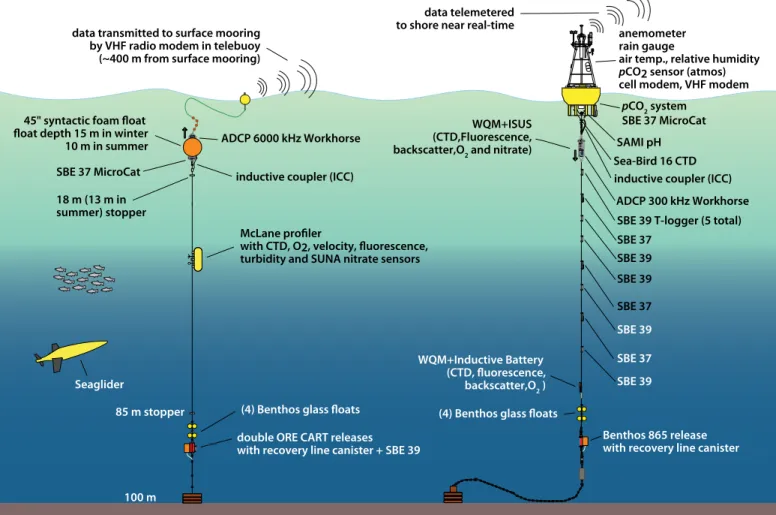
data aNd MethOdS The two moorings, one surface and one subsurface (Figure 1, star), and the glider line (Figure 1, black line), maintained by the University of Washington, are collectively referred to as the Northwest Enhanced Moored Observatory (NEMO); they are part of the Northwest Association of Networked Ocean Observing Systems (NANOOS).
The surface mooring, in 100 m of water
at 47°57'N, 124°58'W, consists of a
UNIX-based buoy controller in a 2 m
discus buoy (Figure 2, right), a suite of
meteorological sensors, a down-looking
300 kHz acoustic Doppler current
profiler (ADCP) to measure full-water-
column currents, and instrumentation
attached at discrete depths along the
main mooring cable to collect a variety of
physical, biological, and chemical mea-
surements. Most relevant to the current
work are the ADCPs, which sample every
five minutes, and Sea-Bird temperature
loggers and MicroCAT conductivity-
temperature-depth (CTD) sensors at 1,
Oceanography | June 2012 71
5, 10, 15, 20, 25, 40, 50, and 60 m depth, which sample every minute. Data are telemetered up the main mooring wire inductively, buffered, archived aboard the buoy controller, and sent back to shore in real time via a Freewave VHF modem.
The shoreside modem is mounted atop a communications tower at the US Coast Guard station 13 nautical miles to the east in La Push, WA, and data are transferred back to the University of Washington from there via Internet.
A McLane moored profiler (MP) on a subsurface mooring 500 m to the north of the surface mooring complements the discrete-depth data from the surface mooring, at the expense of time resolu- tion (Figure 2, left). The MP crawls up
and down the subsurface mooring wire at 25 cm s
–1between 18 and 92 m depth, completing a profile pair every two hours. Instrumentation includes a Sea-Bird MP52 CTD with a dissolved oxygen sensor, a Falmouth Scientific acoustic current meter, Seapoint fluorometer and turbidity sensors, and a Satlantic Submersible Ultraviolet Nitrate Analyzer (SUNA). The NANOOS MP is the first to carry a nitrate sensor. Data from the subsurface mooring are also telemetered back to shore in real time, via inductive modem to a controller on the subsurface float, to the surface moor- ing via a small “telebuoy” on an L-tether, and back to the Coast Guard station.
In order to provide spatial context
for the mooring observations, we use results from a realistic ocean circulation hindcast model of the region. The 2006 model simulation, described in detail in Sutherland et al. (2011), has been exten- sively validated against data on the shelf;
however, these comparisons mainly focused on subtidal currents and stratifi- cation. The model is forced with realistic wind stress, atmospheric heat flux, rivers, barotropic tides, and subtidal ocean con- ditions on the open boundaries. Notably, it lacks forcing from any open-ocean internal wave field, so the internal tide it develops is due solely to local baro- tropic tide interaction with topography.
The results of this study, given below, demonstrate that the model significantly
inductive coupler (ICC) inductive coupler (ICC)
anemometer rain gauge
air temp., relative humidity p CO2 sensor (atmos) cell modem, VHF modem
85 m stopper 18 m (13 m in
summer) stopper
(4) Benthos glass floats (4) Benthos glass floats
double ORE CART releases with recovery line canister + SBE 39 ADCP 6000 kHz Workhorse
SBE 37 MicroCat
100 m
data transmitted to surface mooring by VHF radio modem in telebuoy (~400 m from surface mooring)
ADCP 300 kHz Workhorse data telemetered
to shore near real-time
SBE 37 MicroCat SAMI pH
SBE 37
SBE 37 SBE 39
SBE 39 T-logger (5 total)
Benthos 865 release with recovery line canister
pCO
2system WQM+ISUS
(CTD,Fluorescence, backscatter,O
2and nitrate)
SBE 39
SBE 39
SBE 39 Seaglider
WQM+Inductive Battery (CTD, fluorescence, backscatter,O
2) McLane profiler
with CTD, O2, velocity, fluorescence, turbidity and SUNA nitrate sensors 45" syntactic foam float
float depth 15 m in winter 10 m in summer
SBE 37 Sea-Bird 16 CTD
figure 2. Schematic of the NeMO system showing the surface mooring (right), the subsurface profiling mooring (left), and the glider.
underestimates the observed energy flux of the internal tide at the mooring, sug- gesting that the neglected internal wave boundary forcing may be important.
The observational systems developed over the past few years will soon be deployed year-round and will be serviced twice yearly as part of the NANOOS pro- gram. This paper describes observations from the first two summertime deploy- ments of the system, in 2010 (surface mooring only) and 2011 (both systems), with a focus on the 2011 measure- ments. The glider data are only used here to provide full-depth stratification information for the flux energy calcula- tions, with the spatial transects deferred for another paper.
OBSerVatIONS
Oceanographic Context
The observed low-frequency currents and stratification are typical of the Washington continental shelf in sum- mer, as described in Hickey (1978) and Hickey and Banas (2003). Winds are predominantly from the northwest (Figure 3a, blue) with periodic south- erly winds typically associated with stormy weather (red periods). Currents (Figure 3b) are generally toward the southeast (135° true), as shown by the time-mean vector plotted in black in Figure 1. One to two days following each of the southerly wind events, currents slacken substantially and even reverse at some depths. The depth average cur- rent (Figure 3c, green) tends to zero during the most substantial of the wind reversals, but it never quite changes sign.
The speed of the low-frequency current varies from ≈ 0 to as great as 0.4 m s
–1, the same as the group speed of the fastest internal waves in this water depth and
stratification. It is therefore expected that wave propagation should be affected pro- foundly as changing currents advect and refract waves.
Figure 4 examines in more detail the 46-day period after August 8 when the subsurface mooring was profil- ing. Current reversals associated with changes in wind direction are again seen in the velocity plot (Figure 4b). However, at this magnification, the combined semidiurnal barotropic and baroclinic tides appear as regular vertical stria- tions during a 12.4-hour period. The baroclinic tide can be seen as depth- dependent fluctuations in these, and also in the contours of temperature, salinity, and the other scalar fields (Figure 4c–h).
Isopycnals (black) demonstrate the verti- cal motions of the internal tide, which are about 20 m peak-to-peak during the strongest periods.
Temperature, salinity, and stratifica- tion generally respond in the expected way to the low-frequency wind shifts, with the upwelling following each wind burst by one to two days, tending to elevate isopycnals and the other sca- lar fields (e.g., isopycnals rising from August 18–22, then dropping following the downwelling event). The rain gauge on the surface buoy detected 4 cm of rain (not shown) during the August 22 south wind event, which likely also affected shallow stratification.
The semidiurnal fluctuations in velocity and the vertical isopycnal dis- placement tend to weaken during the periods when the current has weakened (e.g., August 23 and September 19), suggesting a connection between the internal waves and the mesoscale flows that will be examined in more detail in later sections. A natural quantity to
examine is the stratification or buoyancy frequency, N, because it has a direct effect on the vertical scales as well as the generation and propagation speeds of the waves. N (Figure 4e) is clearly modulated at these timescales, though not always in a straightforward way. For example, N increases at the surface dur- ing the first two downwelling events, as might be expected, but decreases substantially at depth during the last event, which persists to the end of the record. The complexity is likely at least partly due to three-dimensional effects such as gradients in the along-current/
along-shelf direction.
Figure 4f–h presents dissolved oxy- gen, nitrate, and chlorophyll fields.
Because each quantity depends on bio- logical as well as physical processes, they are considerably more complex than the physical quantities. For example, the record begins with high nitrate and low oxygen in the mixed layer, and nearly no observable chlorophyll. A bloom appears on August 13, coincident with the onset of south winds and weakened current, resulting in high chlorophyll.
Reduced nitrate and increased oxygen
follow, consistent with phytoplankton
growth. The internal tide displace-
ments heave the chlorophyll, oxygen,
and nitrate fields up and down as the
bloom develops. As upwelling resumes,
isopycnals are brought upward, but
nitrate suddenly increases in the upper
30 m on August 22, implying a lateral
transport. Future work will examine the
relative roles of the low-frequency cur-
rents and the internal waves in modulat-
ing these fields.
Oceanography | June 2012 73
7HPSHUDWXUHR&
9HORFLW\PVï
ï
PVï
D:LQGVSHHG 6RXWKZLQGVGRZQZHOOLQJ 1RUWKZHVWZLQGVXSZHOOLQJ
'HSWKP
ï ï
PVï 6HPLGLXUQDO
N-Pï
G6HPLGLXUQDOHQHUJ\DQGIOX[ +.(
$3(
PHWHUV
H'RZQZDUGZDYHGLVSODFHPHQW
'DWH 6DPSOHSHULRG
6DPSOHSHULRG
6DPSOHSHULRG
6DPSOHSHULRG
7HPSHUDWXUH
$PSOLWXGHP
3URSDJDWLQJ7RZDUGRWUXH
9HORFLW\
7HPSHUDWXUH
$PSOLWXGHP
3URSDJDWLQJ7RZDUGRWUXH
9HORFLW\
7HPSHUDWXUH
$PSOLWXGHP
3URSDJDWLQJ7RZDUGRWUXH
9HORFLW\
7HPSHUDWXUH
$PSOLWXGHP
3URSDJDWLQJ7RZDUGRWUXH
9HORFLW\
GHSWKP
GHSWKP GHSWKP
GHSWKP
GHSWKP
GHSWKP
F'HSWKïDYHUDJHGFXUUHQW /RZïIUHTXHQF\
E1RUWKHDVWZDUGFXUUHQWDQGLVRWKHUPV
VSULQJWLGHV
figure 3. a 2011 time series from the surface mooring, with outer insets showing zoom-ins of 18-hour periods around the four times marked in (d) to demonstrate the variability in the internal tide. Inner insets are zoomed in further on the period indicated in each outer inset to illustrate the temperature (top) and baroclinic northward velocity (bottom) of the nonlinear internal waves. (a) Wind speed, colored by direction (south = red, northwest = blue).
(b) Velocity toward 315° true (northwest), with blue colors indicating flow to the southeast. The 8°, 9°, and 10°C isotherms are contoured in gray. (c) depth- averaged velocity towards 315° true (northwest) of the low-frequency flow (green) and the semidiurnal tidal band (blue). (d) Mode-1 semidiurnal tide:
horizontal kinetic energy (hke) and available potential energy (ape) are plotted as stacked histograms, with their sum indicating total energy. energy flux
magnitude in kW m
–1, which is always toward the north-northeast, is plotted in black. The times of the insets are indicated in red in (d,e). Black dashed lines
in (c–e) show full and new moons, which should correspond with spring tides or maximal semidiurnal tidal forcing. (e) amplitude of the nonlinear internal
waves computed by tracking the depth of the isotherm normally at 15 m depth.
Internal Waves Spectrum
A broad range of frequencies is obvi- ous in both Figures 3 and 4. To quantify the level of the fluctuations at each fre- quency and compare it to other envi- ronments, we compute the spectrum of rotary velocity (Mooers, 1970; Gonella,
1972) using the sine multitaper method of Riedel and Sidorenko (1995). To focus on baroclinic motions, baroclinic velocity u
bcis first computed by remov- ing the depth mean at each time. By computing the Fourier transform of the time series of u
bc+ iv
bc, a frequency spectrum is obtained wherein clockwise
and counterclockwise motions appear at negative and positive frequencies, respectively, which are plotted as blue and green in Figure 5 for 2010 (top) and 2011 (bottom). As expected for internal waves in the Northern Hemisphere, motions are strongly clockwise polar- ized at frequencies near f, becoming unpolarized by about 10 cycles per day.
No prominent near-inertial peak is seen at f, unlike the usual situation in the open ocean. This observation is not surprising given the generally light to moderate winds, because storms are the most efficient generators of near-inertial waves (D’Asaro, 1985). One would expect much stronger near-inertial signals in winter. Instead, semidiurnal and four- times-daily peaks are seen during these summertime records, which are the semidiurnal tide and its “overtide” or first harmonic.
The level of the “continuum” spec- trum between f and N gives the strength of the internal wave field, which is thought to be set by nonlinear inter- actions among the internal waves. In the open ocean, the “GM76” model (Garrett and Munk, 1975, as modified in Cairns and Williams, 1976) provides a framework for comparing continuum levels in different environments. GM76 is over-plotted in gray in Figure 5. For continental shelves, the L02 spectrum (red; Levine, 2002) is more appropri- ate, because it accounts for the effects of the upper and lower boundaries on the waves, but the two spectral forms are nearly identical for our location.
Above the tidal and twice-tidal peaks, the continuum level of the clockwise motions is very close to the L02 and the GM76 model spectra for both 2010 and 2011. At the highest frequencies,
−0.35 0.35
(c) Temperature 0
50 100
°C
7 11
(d) Salinity 0
50 100
psu
31 34
(e) Buoyancy Frequency
Depth (m)Depth (m)Depth (m)Depth (m)Depth (m)Depth (m)Depth (m)
0 50 100
0 12
(f) Dissolved Oxygen 0
50 100
mg l–1µg l–1
0 8
(g) Nitrate 0 50 100
µmol l–1
0 40
(h) Chlorophyll
08/14 08/21 08/28 09/04 09/11 09/18
0 50 100
0 300 (b) Velocity
0 50 100 0 5 10
m s–1 m s–1cph
(a) Wind Speed South Winds: Downwelling Northwest Winds: Upwelling