• 検索結果がありません。

Time Series Classification

N/A
N/A
Protected

Academic year: 2021

シェア "Time Series Classification"

Copied!
1
0
0

読み込み中.... (全文を見る)

全文

(1)

平成

30

年度電気関係学会四国支部連合大会 講演論文集 (2018 愛媛大学)

2018 SHIKOKU-SECTION JOINT CONVENTION RECORD OF THE INSTITUTES OF ELECTRICAL AND RELATED ENGINEERS (EHIME)

Time Series Classification

with 1D-Convolutional Neural Networks

Tomoya TAKATA Ken KAMIYOTSUMOTO Kazuki NAGAO Yoko UWATE Yoshifumi NISHIO

(Tokushima University)

1. Introduction

The research on Convolutional Neural Network (CNN) was established as an academic field in 1956. Since then, it has repeated the ice ages and booms many times and now reaches the present. Currently, CNN is diverse in medical field, car field, home electronics field and so on. The be- ginning of these booms is image recognition. Computers have already proven to be superior to ability of human im- age recognition. Images have a two-dimensional structure.

Recently, CNN is used not only for two-dimensional data but also one-dimensional data and three-dimensional data.

In this study, we investigate how to classify one- dimensional time series data with CNN.

2. Proposed method

We carry out time series classification of the surface shape of nine fabrics. We propose to transform time series data into frequency series data with Discrete Fourier Transform (DFT). DFT is often used for frequency analysis of dis- cretized digital signals such as signal processing.

{

X(ω) =

x(n)e

i2πknN

(1)

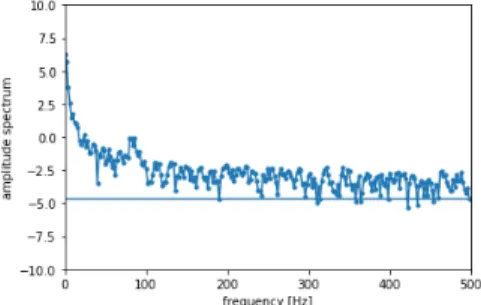
Equation (1) shows DFT. x(n) means time function. n means time. k means frequency. N(= 500) means the num- ber of the samples.

Figure 1: Amplitude spectrum.

In this study, we use amplitude spectrum. Figure 1 shows the spectrum. This spectrum is expressed as | X(ω) | .

We use digital filters. Then we try to increase classifica- tion accuracy. In this study, we use three types of digital filters. They are Low-pass filter, High-pass filter and Band- pass filter.

 

 

 

f

1

= 2 f

s

f

2

= 60 f

s

(2)

f

s

(= 1kHz) means sampling frequency.

3. Simulation result

Figure 2 shows the structure of CNN which we use in this study. It should be noted that the dimension of the input layer is one dimention.

The data which we use is time series data obtained by sensor with surface shape of fabric. The number of the training time series data is 720. The number of the test time series data is 360. So we carry out the 9-value classification with 1D-CNN. Table 1 shows the results of our research. We investigate the average of three times of accuracy. Time series data shows the highest train accuracy. Frequency data shows the highest test accuracy. Low-pass filter and High-pass filter show lower accuracy than the data does not pass through filter.

Figure 2: Structure of CNN.

Table 1: Train and test accuracy

train accuracy(%) test accuracy(%)

time series 99.0 45.8

frequency 96.7 50.3

Low-pass filter 81.0 40.3

High-pass filter 95.1 37.5

Band-pass filter 98.9 47.2

4. Conclusion

In this study, we carry out 9-value classification by using 1D-CNN. Then, we understand that it is more effective to classify frequency series data than time series data.

However, we cannot show the usefulness of the digital filter. In the future, we will choose optimal cutoff frequency with changing sampling frequency and raise accuracy.

21

1-21

Figure 2 shows the structure of CNN which we use in this study. It should be noted that the dimension of the input layer is one dimention.

参照

関連したドキュメント

Time series plots of the linear combinations of the cointegrating vector via the Johansen Method and RBC procedure respectively for the spot and forward data..

This paper aims to model integer valued time series with possible negative values and either positive or negative correlations by introducing the Poisson difference integer

This paper aims to model integer valued time series with possible negative values and either positive or negative correlations by introducing the Poisson difference integer valued

In this paper we study one dimensional backward stochastic differential equations (BSDEs) with random terminal time not necessarily bounded or finite when the generator F (t, Y, Z)

T. In this paper we consider one-dimensional two-phase Stefan problems for a class of parabolic equations with nonlinear heat source terms and with nonlinear flux conditions on the

Indeed, general infinite-dimensional R-matrices are given by integral operators, but their reduction to a finite-dimensional invariant subspace in one of the tensor product

Abstract: In this note we investigate the convexity of zero-balanced Gaussian hypergeo- metric functions and general power series with respect to Hölder means..

Section 4 will be devoted to approximation results which allow us to overcome the difficulties which arise on time derivatives while in Section 5, we look at, as an application of