DISCUSSION PAPER No.141
日本企業の海外展開と国内事業再編
Overseas Expansion and Domestic Business Restructuring in Japanese Firms
2017 年 3 月
文部科学省 科学技術・学術政策研究所 第1研究グループ
伊藤恵子 池内健太
本DISCUSSION PAPERは、所内での討論に用いるとともに、関係の方々からの御意見を頂く ことを目的に作成したものである。
また、本DISCUSSION PAPERの内容は、執筆者の見解に基づいてまとめられたものであり、
必ずしも機関の公式の見解を示すものではないことに留意されたい。
The DISCUSSION PAPER series is published for discussion within the National Institute of Science and Technology Policy (NISTEP) as well as receiving comments from the community.
It should be noticed that the opinions in this DISCUSSION PAPER are the sole responsibility of the author(s) and do not necessarily reflect the official views of NISTEP.
【執筆者】
伊藤恵子 専修大学経済学部 教授
文部科学省科学技術・学術政策研究所 客員研究官(2016年3月迄)
池内健太 独立行政法人経済産業研究所 研究員
文部科学省科学技術・学術政策研究所 客員研究官
【Authors】
Keiko Ito Professor, Graduate School of Economics, Senshu University Affiliated Fellow, National Institute of Science and Technology Policy (NISTEP), MEXT (until March 2016)
Kenta Ikeuchi Fellow, Research Institute of Economy, Trade and Industry
Affiliated Fellow, National Institute of Science and Technology Policy (NISTEP), MEXT
本報告書の引用を行う際には、以下を参考に出典を明記願います。
Please specify reference as the following example when citing this paper.
伊藤恵子・池内健太 (2017) 「日本企業の海外展開と国内事業再編」,NISTEP DISCUSSION PAPER,No.141,文部科学省科学技術・学術政策研究所.
DOI: http://doi.org/10.15108/dp141
Ito, Keiko, and Ikeuchi Kenta (2017) “Overseas Expansion and Domestic Business Restructuring in Japanese Firms,” NISTEP DISCUSSION PAPER, No.141, National Institute of Science and Technology Policy, Tokyo.
DOI: http://doi.org/10.15108/dp141
日本企業の海外展開と国内事業再編
文部科学省 科学技術・学術政策研究所 第1研究グループ 要旨
本稿は、2001年、2006年、2009年及び2012年の事業所レベルのパネルデータを用いて、日本 の多国籍企業による国内事業の再編成について分析する。本稿では事業所の「定型業務度
(routine-task intensity)」に注目し、企業が多国籍化すると日本国内では、(1)どのような事業所
を閉鎖あるいは新しく開設するようになるのか、(2)どのような事業所で雇用が増加あるいは減 少するようになるのか、について分析する。海外投資コストが低下した時、定型業務のような取 引可能性の高い業務を行う労働力に依存する事業活動はより海外に移転されやすいと考えられ る。本研究では、職種レベルの定型業務度と産業別の職種構成の情報を用いて各事業所の定型業 務度を推計し、企業の多国籍化と国内事業再編の関係について分析を行った。分析の結果、企業 が多国籍化すると、定型業務の多い事業所を閉鎖する可能性が高いことがわかった。また、閉鎖 されなかった存続事業所においても、定型業務が少ない事業所ほど、雇用の増加率が高いことも わかった。これらの結果は、企業の海外展開には、国内の事業再編を加速し、国内の事業活動を より定型業務の少ない活動へとシフトさせる効果を持つことを示している。
Overseas Expansion and Domestic Business Restructuring in Japanese Firms
First Theory-Oriented Research Group, National Institute of Science and Technology Policy (NISTEP), MEXT
ABSTRACT
In this paper, we examine domestic business restructuring by Japanese multinational enterprises (MNEs) by using establishment-level panel data constructed for the years 2001, 2006, 2009, and 2012. Focusing on the routine-task intensity of establishments, we examine (1) what type of establishments are closed or newly established and (2) what type of establishments increase or reduce their employment when a firm becomes multinational. When the cost of investment abroad decreases, firms are expected to relocate tradable-task (i.e., routine-task) labor-intensive activities abroad. We measure the skill level of each establishment using the occupation-level routine-task intensity and the occupation compositions for each industry. We find that more routine-task intensive establishments are more likely to exit when the firm becomes multinational. In the case of continuing establishments, we find that less routine-task intensive establishments tend to have a higher employment growth rate when a firm becomes multinational. Our results imply that overseas expansion accelerates domestic business restructuring within a MNE and shifts domestic activities toward less routine-task intensive ones.
概要
i
1.
はじめに
本研究では、日本企業の母集団情報を用いて、企業の海外展開(海外子会社の設立・取得)
が国内での事業再編(business restructuring)に与える影響について、業務の海外移転可能性 に注目して、分析を行う。具体的には、事業所の「定型業務度(RTI:Routine Task Intensity)」 を推計し、企業の海外進出にともなって、国内ではどのような事業所が閉鎖あるいは新設さ れ、どのような事業所で雇用が増加あるいは減少するのか、を明らかにする。
先行研究によれば、多国籍企業による海外生産の拡大は国内の経済活動に対して、様々 な影響をもたらしうる。これまでに多くの研究者によって、企業の海外展開が国内の雇用や 生産、輸出入、生産性などに与える影響など様々な角度から、事業所、企業、産業といった 多様なレベルのデータに基づいた分析がおこなわれてきた。これら多くの先行研究に一致 する傾向として、海外展開と国内の生産活動との間には強い負の関係は見られないことが わかっている。また、多国籍企業の国内での事業活動の生産性は比較的高い傾向にあり、海 外展開はその企業の生産性の向上をもたらすことが知られている。しかしながら、このよう な企業の多国籍化による生産性上昇のメカニズムはよくわかっていない。
そこで本研究では、海外展開にともなう国内事業再編や組織再編が多国籍企業の生産性 上昇の源泉になっている可能性について検証する。特に、多国籍企業における事業再編にと もなう労働者の業務の変化に注目する。英国のデータを用いた先行研究では、低所得国への 海外直接投資にともなって、英国企業は英国国内において熟練度の低い産業の事業所を閉 鎖する傾向があることが示されている(Simpson 2012)が、本研究の新規性は主に2つある。
1つ目は、業務の移転可能性の観点から、労働者の熟練度ではなく、事業所の「定型業務度」
の違いによって企業の海外進出の影響が異なる可能性を検証していることである。2つ目 は、先行研究で分析が行われている企業の海外展開が国内事業所の閉鎖に与える影響のみ ならず、企業の海外進出が存続事業所の雇用成長や新たな事業所の設立に与える影響につ いてもあわせて分析していることである。
2.
分析方法
本研究では、図 1の分析枠組みを用いて、以下の3点を統計的に検証する
(1)海外展開した企業では、その企業が所有する国内の事業所の中で相対的に定型業務の 多い事業所を閉鎖させる傾向が強まるかどうか、
(2)海外展開の前後で、その企業が所有する国内の事業所の中で相対的に定型業務の多い 事業所で雇用を減らし、定型業務が相対的に少ない事業所の雇用を増やすようになるかど うか、
(3)海外展開の前後で、企業が相対的に定型業務の多い事業所を国内に新たに設立する傾
ii 向があるかどうか。
図 1:本研究の分析枠組み
本研究で分析に用いる主なデータセットは 2001 年及び 2006 年の「事業所・企業統計調 査」(総務省)と2009年及び2012年の「経済センサス」(総務省)の事業所レベルのパネル データである。両調査はいずれも総務省の基幹統計調査であり、一部産業の個人事業所を除 く、日本全国のほぼ全ての事業所を対象としている。これらの調査では、各事業所が多国籍 企業(海外に子会社がある企業)に所属しているかどうかが調査されており、この情報を用 いて分析する。なお、パネルデータに含まれる事業所のうち、複数の事業所を所有する企業 でかつ、2001年から2006年、2006年から2009年、2009年から2012年のそれぞれの期間 において存続している企業の事業所に限定して分析を行った。分析対象の企業数及び事業
所数は、2001~2012年の4期間の合計でそれぞれ延べ約28万社及び延べ約230万事業所で
ある。これは日本の全体の事業所数の約4割を占める。
図 1 の分析枠組みにおける各事業所の定型業務度は、米国労働省(雇用訓練局)の
「Occupational Information Network (O*NET)」に基づいて推計する。O*NETには職種別に30 国内事業所の
閉鎖確率・雇用増加率 企業の海外展開の有無
経済センサス 事業所・企業統計調査
O*NET
(米国)
国内事業所の定型業務度
(推計値)
職種別の定型業務度
国勢調査
(日本)
産業分類別 の職種構成 国内事業所
の産業分類
産業分類別の定型業務度
(推計値)
事業所に産業分類に応じて、
産業別の定型業務度を対応付けることで 事業所別の定型業務度を推計
職種別の定型業務度と産業分類別の職種構成の情 報に基づいて、産業分類別の定型業務度を推計
企業の海外展開の有無、
国内事業所の定型業務度及び 閉鎖確率・雇用増加率の間の 相互関係を統計的に分析
iii
種類以上の詳細な業務(task)ごとにその業務の各職種における重要性が 0~100 点のスコ アで表されている。先行研究(Costinot et al. 2011)にしたがい、「意思決定及び問題解決」
業務に関する重要性のスコアにより、職種別の定型業務度を求めた。「事業所・企業統計調 査」及び「経済センサス」では事業所別の職種の構成は調査されていないため、職種別の定 型業務度を日本の「国勢調査」(総務省)の公表結果から得られる産業別の職種構成比の情 報を用いて、各産業の定型業務度を推計し、各事業所が所属する産業の定型業務度を事業所 別の定型業務度として分析に用いた。
なお、本来は海外進出先の違いを考慮して、分析を行うことが望ましいが、残念ながら、
「事業所・企業統計調査」及び「経済センサス」では海外子会社の立地(国・地域)につい ての情報は調査されていない。しかしながら、経済産業省の「企業活動基本調査」の結果に よれば、日本の多国籍企業の大部分はアジアの新興国に最初に海外進出し、その後他の国・
地域に拡張していくことがわかっている。そのため、本研究では、多国籍企業はアジアを中 心とする発展途上国に子会社を有する企業と仮定して分析結果を解釈することとした。
3.
分析結果
分析の結果、分析方法の冒頭で示した3点は全て概ね統計的に検証された。第1に、事業 所の閉鎖確率に関する分析結果は図 2 のとおりである。海外子会社の有無によらず、企業 内で相対的に定型業務度の高い事業所ほど閉鎖される確率が高いが、海外子会社を設立し て多国籍化した企業では、その傾向が強まることがわかる。すなわち、多国籍企業は国内の 事業所の中で相対的に定型業務の多い事業所を閉鎖する傾向が強い。
図 2:事業所の定型業務度がその事業所の閉鎖確率に与える効果の推定結果
第 2に、図 3は事業所の雇用成長率に関する分析結果を示しており、海外子会社を新た に設立または取得した企業では、相対的に定型業務度の高い(定型業務が多い)事業所で雇
-4%
-3%
-2%
-1%
0%
1%
2%
3%
4%
-0.100 -0.050 0.000 0.050 0.100
事業所の閉鎖確率への効果
事業所の相対的な定型業務度(企業内平均=0)
海外子会社あり 海外子会社なし
iv
用を減らし、定型業務度の低い(定型業務の少ない)事業所の雇用を増やす傾向が強まるこ とがわかる。
図 3:事業所の定型業務度が雇用の成長率に与える効果の推定結果
第3に、図 4は新設事業所のRTIに関する分析結果を示しており、海外子会社をもつ多 国籍企業が新設した事業所は海外子会社のない企業が新設した事業所に比べて相対的な定 型業務度が低いことがわかる。すなわち、この結果は、多国籍企業では既に所有している事 業所に比べて相対的に定型業務の少ない産業で新しく事業所を設立する傾向が強いことを 示している。
図 4:企業の海外子会社の有無が新設事業所の定型業務度に与える効果の推定結果 -5.0%
-4.0%
-3.0%
-2.0%
-1.0%
0.0%
1.0%
2.0%
3.0%
4.0%
5.0%
-0.100 -0.050 0.000 0.050 0.100
事業所の雇用成長率への効果
国内事業所の相対的な定型業務度(企業内平均=0)
海外子会社あり 海外子会社なし
-0.0040 -0.0035 -0.0030 -0.0025 -0.0020 -0.0015 -0.0010 -0.0005 0.0000
海外子会社なし 海外子会社あり 新設事業所の相対的な定型 業務度(企業内平均=0)
v
4.
結論と含意
本研究では、2001年から2012年までの事業所レベルのパネルデータを用いて、日本の多 国籍企業による国内事業再編について分析した。定型業務の多い事業所と定型業務の少な い事業所の違いに注目し、企業が海外子会社を持ち、多国籍化することが、日本国内で所有 する各事業所の閉鎖確率や雇用の成長率に与える影響と企業の多国籍化が国内に新設する 事業所の定型業務度に与える影響を分析した。主な分析結果は以下の3点である。
(1) 企業が海外展開すると、その企業が所有する国内事業所の中で相対的に定型業務の 多い事業所ほど閉鎖される傾向が強くなる。
(2) 企業が海外展開すると、その企業が所有する国内事業所の中で相対的に定型業務の 多い事業所で雇用が減少し、定型業務の少ない事業所では雇用が増加する傾向が強 まる。
(3) 企業が海外展開すると、その企業が所有する既存事業所に比べて定型業務の少ない 産業で新しく事業所を設立する傾向が強くなる。
これらの分析結果は、企業が海外展開すると、国内ではより定型業務の多い事業活動を縮 小し、定型業務の少ない事業活動を拡大する傾向があることを示している。すなわち今後、
企業の海外展開がさらに進んだ場合、定型業務の割合が高い産業や職種に関連した労働者 への影響が特に大きく、定型業務から非定型業務への労働者の移動を円滑にするための労 働者の再教育などの政策が重要となることが示唆される。これは、企業の海外展開にともな う国内事業再編といった経済のグローバル化の進展に適応するためには、労働政策や産業 政策、さらには教育政策等、多様な政策分野の相互補完性を高める必要があり、省庁横断的 な政策議論の重要性を意味している。
しかしながら、本研究にはいくつかの残された課題もある。最も重要な点は、利用可能な データの制約から、分析に用いた事業所の定型業務度は、米国のデータに基づく職種別の定 型業務度と産業別の職種構成の情報に基づく推計値に依存している点である。より精緻な 分析を行うためには、日本の職種別の定型業務度のデータを用いるとともに、産業別ではな く事業所別あるいは企業別の従業者の職種構成のデータを用いる必要がある。そのために は、日本においても本研究で注目した定型業務度のような職種別の業務特性に関する精緻 なデータベースを整備するとともに、労働統計と企業統計を事業所・企業単位で直接リンク して分析可能なデータベースの整備を進めていく必要がある。また、これらのデータベース を整備することは、本研究で注目した企業の国際化が雇用に与える影響のみならず、近年注 目が高まっている人工知能やロボット技術の影響といった、企業の競争環境や技術条件の 変化が雇用に与える影響についての包括的な調査研究を促進するためにも不可欠であると 考えられる。
vi
参考文献
Costinot, Arnaud, Lindsay Oldensky, and James Rauch (2011) “Adaptation and the Boundary of Multinational Firms,” Review of Economics and Statistics 93(1):
298−308.
Simpson, Helene (2012) “Investment Abroad and Labour Adjustment at Home: Evidence from UK Multinational Firms,” Canadian Journal of Economics 45(2): 698−731.
本文(英語)
1
1. Introduction
Expansion of overseas production by multinational enterprises (MNEs) is expected to have various impacts on their domestic activities. To date, a number of researchers have investigated the impacts of overseas expansion on domestic employment and production, exports and imports, productivity, and so on, using either firm- or plant-level data or industry-level data.
The majority of such studies have not found a strong negative relationship between overseas expansion and domestic activities such as employment and production within MNEs.1 Rather, many studies confirm that MNEs tend to be more productive and that overseas expansion by MNEs contributes to their productivity growth. Although the mechanism of MNEs’ productivity growth has not yet been understood sufficiently, restructuring or reshuffling their business activities within MNEs is likely to be a source of their productivity growth. On the one hand, the changes in skill compositions within a MNE can produce productivity growth, as confirmed by many papers such as Head and Ries (2002), Hijzen et al. (2005), and Becker et al. (2013), who identify a link between offshoring and labor demand shifts toward high-skilled workers. More recently, a growing number of papers focus on labor demand shifts away from manual low-wage task workers toward nonroutine high-wage task workers. For example, Oldensky (2012) shows that US MNEs are more likely to offshore more routine tasks, whereas less routine tasks are performed in their headquarters.
On the other hand, related to the skill composition changes, domestic activities are likely to be reshuffled within a MNE and some of the domestic establishments would be forced to change their line of business drastically if a MNE shifted a part of their domestic operation to a foreign country. Some of the establishments may even be shut down, while other domestic establishments may be able to improve their productivity either by expanding their operations or by shifting their activities to more technologically
1 Although the evidence overall is rather mixed, the more recent studies tend to show that overseas operations and home operations are complementary (e.g., Desai et al. 2009). Harrison and McMillan (2011) do not find a strong negative relationship between overseas activities and home employment, although the effect of overseas activities on employment at home differs depending on the tasks performed at home and abroad in the case of US-based multinationals. Similarly, for Japan, Yamashita and Fukao (2010), using a matched dataset of parent firms and their overseas affiliates, find no evidence that the expansion of overseas operations reduces the MNEs’ home employment.
2
advanced ones. Such restructuring within a MNE is likely to contribute to overall productivity improvement at the firm level.
In fact, several recent studies suggest that MNEs tend to be more active in resource reallocation across establishments within a firm. For example, Kneller et al.
(2012), using firm plant-linked data for Japanese manufacturing firms, find that plants belonging to multi-plant MNEs are the most likely to be shut, followed by multi-plant non-MNE firms and then single-plant MNEs. Kodama and Inui (2015) also find that multi-establishment MNEs show a high job-reallocation rate, i.e., the sum of the job creation rate and job destruction rate, suggesting that MNEs have greater flexibility in adjusting to changing market conditions. Furthermore, using British firm plant-linked data, Simpson (2012) finds that firms investing in low-wage economies tend to close down plants in low-skill industries at home.
The findings of these studies suggest that MNEs actively reallocate resources across establishments within the firm, while overall firm-level employment is not necessarily reduced in response to overseas expansion. Rather, they are more likely to improve overall productivity as a result of efficient resource reallocation within the firm.2
Numerous previous studies examine why MNEs relocate low-skill labor intensive processes to low-wage developing countries and they are expected to shift their activities at home toward less labor intensive and/or high-skill labor intensive processes. More recently, however, an increasing number of studies add another dimension to this issue:
tradability of tasks. Grossman and Rossi-Hansberg (2008) claim that offshoring is costly if the tasks required for processes at an offshore location are not easily moved offshore even though workers can be hired more cheaply abroad. The literature has shown that firms are more likely to offshore routine tasks and keep nonroutine tasks in their headquarters (Oldensky 2014). Routine tasks can be broken down into clear steps and procedures and communicated to someone located overseas. Nonroutine tasks, however, involve decision making and problem solving that often require face-to-face communication within a team, and they are more difficult to communicate to overseas affiliates. Taking the tradability of tasks into account, recent studies such as Ebenstein et
2 Giroud and Mueller (2015) also find that within-firm resource reallocation increases aggregate firm-wide productivity, although they do not focus on MNEs but rather on US plants that received a positive productivity shock such as the introduction of new airline routes.
3
al. (2014), Goos et al. (2014), and Keller and Utar (2016) argue that offshoring or import competition from low-wage countries leads to job polarization mainly by pushing workers from initially abundant mid-level routine jobs in manufacturing toward both high-wage nonroutine and low-wage manual jobs.3 Oldensky (2014), taking both comparative advantages and task tradability into account, also shows that offshoring by US firms has contributed to relative gains for the most high-skilled workers performing nonroutine tasks and relative losses for middle-skilled workers performing routine tasks.4
Moreover, as the servitization of manufacturing firms, i.e., the phenomenon where activities of manufacturing firms are shifted toward more nonmanufacturing services activities, has been observed often in developed countries, MNEs’ domestic activities may shift toward activities using nontradable service jobs intensively.
Therefore, the bottom line of these arguments is that globalization affects not only the relative demand for low-skill and high-skill workers within manufacturing activities, but also the relative demand for workers in tradable task sectors and in nontradable task sectors including both manufacturing and services activities.
Such changes in labor demand are expected to lead to within-firm reallocation of resources, i.e., domestic business restructuring by MNEs, and to industry composition changes within a firm depending on the skill type of each industry. Therefore, in this paper, we examine (1) what type of establishments are closed or newly established and (2) what type of establishments increase or reduce their employment, when an MNE expands its overseas operation. Although our paper is closely related to Simpson (2012), a novelty of our study is to investigate the impact of overseas business expansion on domestic business restructuring within the firm, taking task tradability (or task
“offshorability”) into account. We assume that routine tasks are more tradable (or offshorable) tasks in the sense that such tasks can be easily displaced by computers and relocated overseas. Therefore, when the cost of investment abroad decreases, firms are expected to relocate routine-task labor-intensive activities abroad and keep nonroutine-
3 Autor and Dorn (2013) find that rising employment and wages in service occupations account for a substantial share of aggregate polarization of the US employment and earnings distributions.
4 Keller and Yeaple (2013), focusing on the difficulty of communicating knowledge from one person to another, show that more knowledge intensive production processes are less likely to be moved to distant locations. Their finding also suggests that MNEs tend to keep their nonroutine task processes at home or in regions closer to their home country.
4
task labor-intensive activities within their home country, if the MNE’s home country has a comparative advantage in nonroutine occupations. Moreover, we examine not only establishment closures but also new establishment entries and employment growth in continuing establishments within a MNE, which is an aspect that most previous studies have ignored.
The remainder of this study is organized as follows. Section 2 describes the data and presents some descriptive statistics. Section 3 explains the empirical framework we use in the present study. Section 4 presents the empirical results. Finally, Section 5 concludes and presents future research questions.
2. Data and descriptive statistics 2.1 Firm establishment-matched data
The main dataset used in this study is an establishment-level panel dataset constructed from the Establishment and Enterprise Census (for years 2001 and 2006) and the Economic Census (for years 2009 and 2012) for Japan. The censuses are provided by the Ministry of Internal Affairs and Communications and cover all establishments in all industries (cover only incorporated establishments in the case of agriculture, forestry, and fishery industries) in Japan. Although the censuses, except for 2012, do not contain detailed firm-level financial information, other information for each establishment such as the number of workers, the business activities at the 3-digit JSIC (Japan Standard Industry Classification) industry level (approximately 480 industries), and location is available.5 Moreover, firm ID code is attached to each establishment and we can identify which establishment belongs to which firm. For each establishment, we can identify whether it is a single-establishment firm, a branch establishment of a firm, or a headquarter establishment of a firm. For each firm, information on whether it owns domestic or foreign subsidiaries is available. We mainly use this information to identify whether a firm is multinational.6 We should note that in the censuses, branch
5 For the 2012 Economic Census, more detailed information on business activities such as sales of goods produced and sales of supporting service activities at the establishment level is available.
6 The number of domestic or foreign subsidiaries for each firm is available only for the 2006 and 2009 censuses. Therefore, we do not use this information and mainly use a binary indicator as to
5
establishments and subsidiaries are clearly distinguished. Although a substantial number of firms own branch establishments in foreign countries, we define MNEs as firms with at least one foreign subsidiary. Therefore, firms with foreign branches but without foreign subsidiaries are defined as non-MNEs.
Unfortunately, information on the location (country or region) of foreign subsidiaries is not available in the censuses. Although many previous studies suggest that investment or offshoring to low-income countries has a different impact on domestic economies from that to high-income countries, we cannot examine potentially different effects by destination because of data constraints. However, in the case of Japanese MNEs, more than 80 percent of MNEs have subsidiaries in Asian countries, according to the Basic Survey of Japanese Business Structure and Activities conducted by the Ministry of Economy, Trade and Industry. Probably reflecting the geographical proximity to Asian low-wage countries relative to American or European countries, the majority of Japanese MNEs set up their subsidiaries in an Asian country first, and then expand to other regions. Therefore, it would be safe to assume that they are very likely to have a subsidiary in an Asian country.
We construct the establishment-level panel dataset for the years 2001, 2006, 2009, and 2012. Moreover, we link the firm-level information such as firm-level employment size, firm industry, and domestic or foreign subsidiaries with the establishment-level data.
For exits of establishments and/or firms, we identify them if an establishment or a firm existed in the census for a certain year but disappeared in the next census. For entry of establishments and/or firms, we identify them by using the information on the start-up year.
2.2 Data on skill-mix by industry
Using this dataset, we investigate how firms restructure their domestic business activities when they become multinational, whether such behavior of firms with overseas subsidiaries differs from that of firms without overseas subsidiaries, and whether firms with overseas subsidiaries are more likely to concentrate on higher-skill nonroutine
whether a firm owns at least one foreign subsidiary or not.
6
activities domestically. More specifically, we investigate what types of establishments with respect to skills are closed or newly established when multinational firms restructure their domestic activities.
In order to measure the skill level of each establishment, following previous studies such as Costinot et al. (2011) and Oldenski (2012), we utilize the Occupational Information Network (O*NET).7 We use the importance of “making decisions and solving problems” as our index of how routine a task is. Similar to Oldenski (2012), who argues for the existence of a strict connection between job autonomy and routine intensity, we consider a routine intensive task as a task with little autonomy for the individual at work. Following Costinot et al. (2011), we measure routineness at the 3-digit sector level, by combing task-level data for each occupation with sector-level data from the Japanese Population Census. Because detailed task-level data equivalent to the O*NET are not available for Japan, we use the task information for each US occupation and match the US occupations with the Japanese occupations.8 More specifically, we construct our
“routine” task intensity measure at the sector level in the following way.
First, we match the information on tasks for each US occupation included in the June 2007 version of O*NET9 with each Japanese occupation, using the concordance table between the 2010 US Standard Occupational Classification (SOC) codes and Japan’s 2005 occupation classification codes constructed by Tomiura et al. (2015).10 Then, we measure the routineness (t) of an occupation t as:
7 This is the US Department of Labor’s successor to the Dictionary of Occupational Titles (DOT) (US Department of Labor 1977), which is used to construct task measures from previous studies such as Autor and Dorn (2013). We use the information taken from the O*NET, not the DOT, because the job task information described in the DOT is that of year 1977. Taking into account the fact that tasks have changed substantially even within the same occupation in recent decades, we use newer job-task information taken from the O*NET.
8 Although the Japan Institute for Labour Policy and Training started a similar service to O*NET, called “Career Matrix (CMX),” in 2006, the CMX website was closed in 2011 and the data are no longer available because this service was abandoned as a result of the Japanese government’s budget screening process. If we can obtain the data underlying the CMX in the future, we would like to check the robustness of our results using the Japanese task-occupation matched data.
9 We use the 0−100 score that O*NET reports to measure the importance of each task in each occupation. These scores are constructed from surveys of individuals in those occupations and are normalized to a 0−100 scale by analysts at the Department of Labor. Lindsay Oldenski kindly provided us with the 0−100 scale index and we utilized her data.
10 Although the original task importance measures provided by Oldenski were available for over 500 US occupations, the occupation-level task importance measures are aggregated to the 172
7
μ(𝑡) = 1 − 𝑃(𝑡)/100,
where P(t) ∊ [0, 100] measures the importance of making decisions and solving problems of an occupation, t, according to O*NET but matched with the Japanese occupation classifications. We define a sector as a three-digit industry in the Japanese Standard Industry Classification (JSIC) revision 11. We use the share of workers in each occupation for each industry, which is calculated from the 2005 Population Census data, and construct the JSIC three-digit level routine-task measure:
𝜇𝑠 = ∑ 𝑏𝑠(𝑡)𝜇(𝑡)
𝑇
𝑡=1
,
where 𝜇𝑠 is our proxy for routineness at sector s, and 𝑏𝑠(𝑡) is the share of employment of each occupation, t, in sector s. Thus, we construct the 3-digit sector-level routine-task measure as a weighted average of occupation-level routine-task measures. Our measure is a sector-specific but time-invariant measure, assuming that the task contents do not change substantially within a sector during the period of our analysis, 2001−2012.
Although we may construct a time-variant task measure, we believe that the time-variant task measure is likely to be endogenous to establishment share changes across industries.
Therefore, we use the time-invariant task measure in our analysis.
Moreover, as mentioned above, we measure the routine-task measure for each establishment using the 3-digit industry-level information because of data constraints.
That is, we assume that the routine-task measure is the same for all the establishments belonging to the same 3-digit industry. Appendix Table 1 shows the list of the 50 industries with the highest routine-task measure and the 50 industries with the lowest routine-task measure. In addition, we should note that we use the task information for each US occupation, assuming that the task contents for each occupation are the same in the United States as in Japan. Looking at the routine-task index constructed from the OECD’s Programme for the International Assessment of Adult Competencies (PIAAC) database11, the correlation coefficient between the Japanese and US routine-task index by occupation is over 0.6 and the Spearman rank correlation between them is also over
Japanese occupations. When more than one US occupation matches with one Japanese occupation, we took an average value of the importance score for the US occupations.
11 See, for example, Marcolin et al. (2016).
8
0.6.12 Although the task contents for each occupation may not be exactly the same in the both countries, the correlation is high and we use the US task measure as a proxy for the Japanese task measure.
We also checked the correlation between our routine-task intensity measure and the share of unskilled workers based on the education attainment for workers in each industry. That is, we calculate the share of workers who graduated from junior college or had higher education for each industry, using the data taken from the 2000 Population Census for Japan. Then, we measure the share of unskilled workers in each industry as the residual from one: 1 − (share of workers who graduated from junior college or had higher education). The correlation coefficient for our routine-task measure and the unskilled worker share is 0.23 (statistically significant at the one percent level). The Spearman rank correlation is 0.21 and also statistically significant. The positive correlation between the two measures indicates that nonroutine-task intensity positively correlates with unskilled worker share in terms of education attainment. However, the magnitude of the correlation coefficient also indicates that these two measures are not very highly correlated and that they reflect somewhat different skill characteristics.
Although closer investigation of the differences across various skill intensity measures is required in our future research, we use the Costinot et al.-type routine-task intensity for this study.13
2.3 Descriptive statistics
Table 1 summarizes the number of establishments by firm ownership type and by firm- level industry. We focus on establishments belonging to private firms. More specifically, our dataset includes establishments for which the legal organization is 1) a joint-stock company, 2) a limited or unlimited partnership, 3) a limited liability company, or 4) a mutual insurance company. We exclude branch establishments whose headquarters are located in foreign countries, because firm-level information is not available in the
12 Luca Marcolin kindly provided us with the routine-task index at the 3-digit occupation level for Japan and the United States.
13 Simpson (2012) mainly uses the share of workers with qualifications (basically measured by education level). We could also have used the wage rank of occupation data compiled by Goos et al.
(2009) in order to construct a measure of skill intensity for each industry.
9
Japanese Census for these establishments. We also exclude establishments for which employment is zero or missing. As a result, in 2006, approximately 2.6 million privately owned establishments in Japan remained in our dataset. Furthermore, we exclude establishments of firms that disappeared in the next Census, i.e., the 2009 Economic Census. These firms are likely to have exited and were shut down sometime between 2006 and 2009. That is, we focus on establishments of firms that continued operating until the next census year, and we are left with approximately 1.9 million such privately owned establishments for 2006 as summarized in Table 1. As mentioned above, we define Japanese MNEs as firms that have at least one foreign subsidiary while we define foreign MNEs as firms with a parent company in a foreign country. As shown in Table 1, reflecting the fact that MNEs tend to be large firms, most of the establishments of Japanese MNEs are part of a firm with more than one establishment (multi-establishment firm). Although the number of establishments of Japanese MNEs is only four percent of the total number of establishments (= 78,896/(1,817,023 + 6,652)), the corresponding share becomes nearly 10 percent (= 78,896 * 0.978/(1,817,023 * 0.40 + 78,896 * 0.978 + 6,652 * 0.831)) when we focus on multi-establishment firms.
As shown in Table 1, nearly 98 percent of Japanese MNEs’ establishments are part of a multi-establishment firm. Given this fact and because we focus on within-firm business restructuring, we restrict our sample for the following analyses to the establishments belonging to multi-establishment firms.
INSERT Table 1
Table 2 shows the descriptive statistics for the establishments used in our analysis: establishments belonging to multi-establishment firms. The figures in the table, except the number of observations, are averaged over the years 2001, 2006, and 2009. In fact, the 2012 Census does not have information on whether a firm has at least one foreign affiliate, and we cannot identify multinationals as of 2012. Therefore, we show the average value of the statistics for the three years. To calculate exit and entry rates during
10
the period from 2009 to 2012, however, we also use the data taken from the 2012 Census, where we classified a firm’s multinational status using the data for year 2009.14
In Table 2, we show the statistics for the establishments belonging to manufacturing firms and for establishments belonging to nonmanufacturing firms, separately. Various characteristics are shown for establishments owned by three different types of firms: domestic only, Japanese-owned multinationals, and foreign-owned multinationals. First, the proportion of establishments that exit or enter in the period between two censuses is much higher for Japanese-MNE and foreign-MNE establishments than for establishments owned by domestic firms. We should note that we exclude single-establishment firms and focus on establishments belonging to multi- establishment firms that continued operating for the period between the two censuses.
Even focusing on multi-establishment firms, domestic firms show lower exit and/or entry rates than Japanese and foreign MNEs, implying that MNEs are more likely to be active in shutting down and/or opening establishments. In addition, establishments owned by domestic firms are on average much smaller in terms of employment size than those owned by multinationals.
We construct three indicators of multi-establishment firms: Multi_same 3-digit industry, Multi_manufacturing, and Multi_nonmanufacturing. Multi_same 3-digit industry is a dummy variable that equals one for establishments that are a part of a firm with other establishments (a multi-establishment firm) and for which the 3-digit industry is the same as the firm-level industry. Multi_manufacturing is a dummy variable that equals one for establishments that are part of a multi-establishment firm and for which the 3-digit industry is not the same as the firm-level industry but is a manufacturing industry. Multi_nonmanufacturing is a dummy variable that equals one for establishments that are part of a multi-establishment firm and for which the 3-digit industry is not the same as the firm-level industry but is a nonmanufacturing industry. In the case of manufacturing firms, the share of Multi_nonmanufacturing is much higher for Japanese and foreign MNEs than for domestic firms, suggesting that manufacturing
14 More specifically, to calculate the entry and exit rates, we count the number of exited establishments and new establishments for the three periods: 2001−2006, 2006−2009, and 2009−2012. A firm’s multinational status is identified using the information of the initial year of each period, 2001, 2006, and 2009.
11
MNEs have many nonmanufacturing establishments within the firm although their main business activity is manufacturing. The figures show that more than half (over 60 percent) of the establishments of manufacturing MNEs conduct nonmanufacturing business activities, which is consistent with the growing importance of the servitization of manufacturing firms in developed countries (e.g., Crozet and Milet 2014 and Bernard et al. 2016). On the other hand, in the case of nonmanufacturing firms, the majority of establishments within a firm belong to the same industry as the firm-level industry, suggesting that business activities are less diversified within a nonmanufacturing firm.
As for average task measures, establishments owned by MNEs tend to have a slightly higher routine-task index on average than those owned by domestic multi- establishment firms in the case of manufacturing firms. However, in the case of nonmanufacturing firms, establishments owned by Japanese MNEs tend to have a slightly lower routine-task index than those owned by domestic multi-establishment firms. By only looking at the average routine-task index, the differences in task intensities between domestic firms’ establishments and MNEs’ establishments are less clear. We will examine the relationship between routine-task intensity and establishments’
dynamics in more detail by estimating empirical models in the following sections.
INSERT Table 2
In Table 3, we examine the share of foreign-owned establishments by firm industry and its evolution over time. Columns (1)−(3) show the share of Japanese MNEs at the firm level: the number of Japanese multinational firms divided by the total number of firms, while columns (4)−(6) show the corresponding share at the establishment level:
the number of establishments owned by Japanese multinational firms divided by the total number of establishments. Looking at the firm-level shares, industries such as manufacturing, telecommunication, and finance and insurance tend to show a higher share of multinationals. Moreover, the shares tend to decrease from 2006 to 2009 while they tend to increase from 2001 to 2006 in many industries, which might reflect the trend in the growth of the world economy.
12
The establishment-level shares in columns (4)–(6) show a more or less similar trend, but the magnitude of the shares are much larger than the firm-level shares, reflecting the fact that multinationals tend to be larger and have more establishments within a firm than nonmultinational firms. Moreover, the establishment-level MNE shares did not decrease substantially from 2006 to 2009 in many industries, although the firm-level corresponding shares decreased in many industries during the period. This finding may imply that MNEs increased their presence in the overall Japanese economy in recent years not by extensive margin changes but by intensive margin changes. That is, although the number of new MNEs may be stagnant, existing MNEs may have increased the number of establishments within their firm. However, the decrease in the share of MNEs for the period 2006−2009 could be a short-run impact of the drastic economic downturn after the 2008 Lehman shock.
INSERT Table 3
3. Estimation approach 3.1 Baseline specifications
Following the research frameworks in Kneller et al. (2012) and Simpson (2012), the starting point of our empirical analysis is to examine the determinants of the exit of establishments, taking routine-task intensity of establishments into account. Then, we will also examine the routine-task intensity of the new establishments.
Simpson (2012) assumes that foreign countries are more abundant in low-skill labor with lower wages than the home country and that the wages of high-skill workers at home are no higher than the wages of high-skill workers in foreign countries. Then, she shows that a reduction in the fixed cost of investment in a relatively low-skill- abundant country results in the substitution of domestic for overseas production in low- skill-intensive but not in high-skill-intensive industries. Therefore, the likelihood of plant closure resulting from outward foreign direct investment (FDI) will decrease with the high-skill intensity of the industry. On the other hand, for firms that switch production overseas, expand output, and increase profits, their remaining activities at home will increase output and the likelihood of survival.
13
Although we follow the empirical model of Simpson (2012), our theoretical motivation follows Acemoglu and Autor (2010) and Oldensky (2014). In the model of Acemoglu and Autor (2010), workers are classified as low-, medium-, or high-skilled, and each skill level has a comparative advantage in the performance of a subset of production tasks. Tasks are indexed such that high-skilled workers have a comparative advantage in the higher numbered tasks. They assume that although workers of any skill level can perform any task, only one skill level in which workers have a comparative advantage will actually be used in the production of that task in equilibrium. If a set of tasks that had previously been performed by middle-skilled workers were offshored, the range of tasks performed by these workers would be reduced. However, the ranges of tasks performed by high-skilled workers (nonroutine tasks) and by low-skilled workers (manual tasks) are less likely to be affected.
Therefore, taking task “offshorability” into account, we expect that firms that expand overseas activities are more likely to shut down establishments in medium-skill- intensive industries than establishments in high-skill- or low-skill-intensive industries.
We use the routine-task intensity measure explained above to characterize both skill levels and task tradability for each industry. Following Simpson (2012), we estimate a linear probability model of establishment death:
𝐸𝑥𝑖𝑡𝑖𝑡 = 𝛼 + 𝑋𝑖𝑡𝛽 + 𝛾𝑀𝑁𝐸𝑓𝑡+ 𝛿𝑀𝑁𝐸𝑓𝑡∗ 𝑅𝑒𝑙𝑎𝑡𝑖𝑣𝑒 𝑅𝑇𝐼𝑖𝑡+ 𝜇𝑅𝑒𝑙𝑎𝑡𝑖𝑣𝑒 𝑅𝑇𝐼𝑖𝑡+ 𝜑𝑆𝐼𝑍𝐸𝑓𝑡 +𝐼𝑛𝑑𝑗+ 𝑇𝑡+ 𝑅𝑟+ 𝐹𝑓+ 𝜀𝑖𝑡, (1)
where i indicates establishment, f firm, j establishment’s industry, t year, and r establishment’s prefecture. Exitit is a dummy variable that equals one if establishment i exits during the period from t and t+s. s denotes the number of years until the next census.
Xit is a vector of establishment characteristics and includes age and establishment size (measured as log employment). We also include a dummy variable, Same 3-digit industry, that equals one for establishments for which the 3-digit industry is the same as the firm- level industry. MNEft is a firm-level variable that equals one if firm f, which owns establishment i, has one or more subsidiaries in foreign countries. Relative RTIi is the
14
routine-task index for establishment i relative to the average routine-task index for firm f. The routine-task index is defined at the 3-digit industry level as explained in the previous section, but we take the deviation from the simple average of the routine-task index for all the establishments belonging to a firm. As described above, the routine-task index is the same for all the establishments belonging to the same 3-digit industry and is not a time variant index. However, by taking the deviation from the firm-level average, our relative RTI measure becomes establishment-specific and time variant. The higher the relative RTI value is, the more routine-task intensive the establishment within the firm is. Assuming that routine tasks are relatively low or medium skill tasks and are more easily moved offshore than nonroutine tasks, we expect that MNEs are more likely to shut down establishments in more routine-task intensive industries at home when they expand overseas activities. Therefore, we expect a positive value for . SIZEft is the log of employment at the firm level, which is included to control for the firm size. Indj are establishment i’s industry dummies that control for industry-level offshoring or import competition and industry-specific technological changes, and so on. Tt, Rr, and Ff are year dummies, establishment i’s region (defined as one of the 47 prefectures in Japan) dummies, and firm f’s dummies, which control for year-, region-, and firm-specific shocks or characteristics, respectively. In the estimations, the standard errors are clustered at the firm level. As mentioned above, we restrict our sample to establishments of firms that continue operating until the next census year in order to avoid possible biases arising from firm exits. Moreover, we restrict our sample to establishments that are part of a multi-establishment firm, because the decision for firm exits and for closure of one of the establishments owned by a firm should be considered separately.
In addition to the exit analysis, we also examine whether new establishments of MNEs have different characteristics from those of domestic firms. More specifically, our main interest is whether MNEs are more likely to shift their business activities toward less routine-task intensive activities. In order to examine whether new establishments of MNEs are less routine-task intensive than those of other domestic firms, we estimate the following model:
𝑅𝑒𝑙𝑎𝑡𝑖𝑣𝑒 𝑅𝑇𝐼𝑖𝑡+𝑠 = 𝛼 + 𝑋𝑓𝑡𝛽 + 𝛾𝑀𝑁𝐸𝑓𝑡+ 𝐼𝑛𝑑𝑘+ 𝑇𝑡+ 𝑅𝑟+ 𝐹𝑓+ 𝜀𝑖𝑡, (2)
15
where Relative RTIit+s is the routine-task index for establishment i which was newly established between years t and t+s, and it is relative to the average routine-task index for firm f as of year t+s. Xft is a vector of firm characteristics and includes firm age, size (measured as log employment), and the number of domestic establishments firm f owns.
MNEft is a firm-level variable that equals one if firm f, which owns establishment i, has one or more subsidiaries in foreign countries. Indk are firm f’s industry dummies that control for firm industry-specific effects. Tt, Rr, and Ff are year, new establishment i’s region (prefecture), and firm dummies, respectively. We estimate equation (2) using OLS, clustering standard errors at the firm level. We restrict our sample to establishments of firms that continued operating during the period between two censuses in order to avoid possible biases arising from firm entries. We also restrict our sample to establishments that are part of a multi-establishment firm, because the decision for a new firm’s entry and for adding of new establishments by an incumbent firm should be considered separately.
Furthermore, we examine the determinants of employment growth for the continuing establishments. We estimate the following model and see whether the establishments of MNEs in routine-task intensive industries increase their employment more than establishments of other types.
∆𝑙𝑛𝐸𝑀𝑃𝑖𝑡+𝑠= 𝛼 + 𝑋𝑖𝑡𝛽 + 𝛾𝑀𝑁𝐸𝑓𝑡+ 𝛿𝑀𝑁𝐸𝑓𝑡∗ 𝑅𝑒𝑙𝑎𝑡𝑖𝑣𝑒 𝑅𝑇𝐼𝑖𝑡+ 𝜇𝑅𝑒𝑙𝑎𝑡𝑖𝑣𝑒 𝑅𝑇𝐼𝑖𝑡 +𝜑𝑆𝐼𝑍𝐸𝑓𝑡+ 𝐼𝑛𝑑𝑗+ 𝑇𝑡+ 𝑅𝑟+ 𝐹𝑓+ 𝜀𝑖𝑡, (3)
where lnEMPit+s is the growth rate of employment for establishment i from year t to t+s.
The other variables are defined in the same way as those in equation (1) above. However, in order to control for within-firm resource reallocation effects, we include a dummy variable that equals one if firm f, which owns the continuing establishment, shut down at least one other establishment i during the period from year t to t+s. We restrict our sample to establishments that continue operating during the period between the two censuses and to establishments that are part of a multi-establishment firm. We estimate equation (3) using OLS, clustering standard errors at the firm level.
16
3.2 Empirical issues
The decision to invest in a foreign country is potentially endogenous, because the decisions to invest abroad and to shut down establishments at home (or restructure domestic business activities) are possibly made simultaneously. Moreover, a firm may invest abroad in order to survive in the domestic market. Therefore, we control for the time-invariant firm-specific effects in the above specifications in order to take into account the possibility that unobserved firm-characteristics are related to both the decisions to invest abroad and restructure domestic activities.
In order to address the potential endogeneity issue more rigorously, however, we estimate the probability of a firm owning a subsidiary abroad as an instrument. This type of approach is used in Simpson (2012) and Bandick (2016), etc., and this approach generates estimates comparable to Heckman’s (1978) well-known endogeneity bias- corrected OLS estimator. In order to generate a firm’s predicted probability to invest abroad, we estimate the following model using the linear probability model approach:
Pr(𝑀𝑁𝐸𝑓𝑡= 1) = Φ(𝑋𝑓𝑡, 𝐼𝑛𝑑𝑗, 𝑇𝑡, 𝑅𝑟, 𝐹𝑓, 𝑈𝑆𝐷𝐼𝐴𝑗𝑡−2), (4)
where Xft is a vector of relevant firm-specific characteristics in year t, which may affect the firm’s probability to invest in foreign countries in year t. Indk, Tt, Rr, and Ff control for time-invariant fixed industry, year, prefecture, and firm effects, respectively. The estimation is conducted using the firm-level data, not the establishment-level data, and we control for firm-level industry fixed effects and prefecture fixed effects of the location of the headquarters of an establishment of a firm. Given firm-level data availability and assuming that a firm’s decision to invest abroad is influenced by the firm’s productivity and the degree of the firm’s exposure to foreign markets, we include the following firm- level variables in the vector Xft. We include log employment, number of domestic branch establishments owned by a firm and number of foreign branch establishments owned by a firm, which are proxies for firm size and productivity. The number of 3-digit industries that a firm is engaged in is also included as another proxy for the firm’s productivity, assuming that the more diversified firms should have higher productivity by exercising
17
economies of scope. As proxies for the degree of a firm’s exposure to foreign markets, we include ownership share of foreign shareholders and the ratio of employment at foreign branch establishments to total employment of the firm. We also control for firm age and the routine-task index for a firm.15
As for the exogenous explanatory variable included in the FDI decision equation, we include the two-year lagged ratio of workers employed by overseas affiliates of US MNEs to the total employment in the US at the industry level. The ratio is calculated using the number of employed workers taken from the US Current Employment Statistics compiled by Bureau of Labor Statistics and the number of employees at foreign affiliates of US Multinational firms taken from the US Direct Investment Abroad, Activities of US Multinational Enterprises (MNEs), compiled by the US Bureau of Economic Analysis.
Because it is not straightforward to find a strictly exogenous variable at the firm level, we use the industry-level foreign worker share for the US MNEs as an exogenous variable that explains Japanese firms’ propensity to become multinational.
We estimate equation (4) using the linear probability model and calculate the probability to invest abroad for each firm.16 Then, using the estimated probability as an instrument for the MNE dummy variable, we estimate IV regressions for equations (1), (2), and (3).
For further robustness checks, we split our sample into establishments owned by manufacturing firms and those owned by nonmanufacturing firms and conduct separate estimations, taking into account the possibility that the domestic business restructuring of manufacturing firms is different from that of nonmanufacturing firms because of the structural, technological, and demographic changes of developed economies. We define manufacturing firms as firms whose firm-level industry is classified as one of the manufacturing industries.
4. Estimation results
15 The routine task index for a firm is the routine task index for the firm’s headquarter industry.
16 The OLS estimation results for the determinants of investing abroad are shown in Appendix Table 2.
18
4.1 Exit of establishments
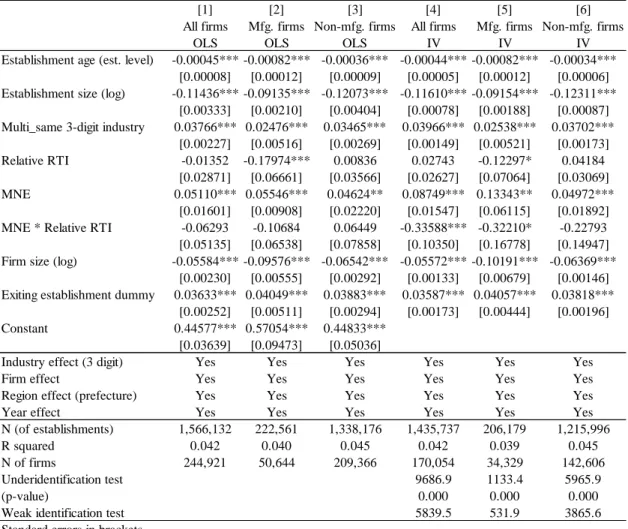
Table 4 shows the estimation results for equation (1). Larger establishments are less likely to exit, which is consistent with most previous studies on firm exits. Although older establishments are less likely to exit, they are more likely to exit in the case of establishments owned by manufacturing firms (columns 2 and 5). Establishments in the same industry as the firm’s industry are less likely to exit. The coefficient of the MNE variable is positive and significant in the case of the IV regressions (columns 4−6), suggesting that the probability of establishment exits increases when a firm becomes multinational. However, the coefficient of the MNE variable is not significant for the OLS regressions (columns 1−3). Relative RTI tends to have a positive coefficient and the estimated coefficient is statistically significant for all the cases except the cases of manufacturing firms (columns 2 and 5). As for the coefficient of the interaction term of MNE and relative RTI, it is positive and significant in the case of the IV regression for nonmanufacturing firms (column 6), while the OLS estimations show somewhat different results. According to these results, more routine-task intensive establishments are more likely to exit and the likelihood of exit is even higher when the firm becomes multinational. This is the case particularly for nonmanufacturing firms. This result is consistent with our prediction that routine-task intensive establishments are more likely to be shut down when a firm becomes multinational.
INSERT Table 4
4.2 Type of new establishments
Table 5 shows the estimation results for equation (2). The MNE variable tends to have a negative coefficient in all the cases, and the estimated coefficient is statistically significant in the case of the IV regression for nonmanufacturing firms (column 6). The negative coefficient suggests that newly added establishments tend to be less routine-task intensive compared with other establishments belonging to the same firm when a firm becomes multinational as expected. However, such results are not statistically significant in most cases.