Architectural Examples from the NW Pacific
Margin
著者
Itoh Yasuto, Takano Osamu, Takashima Reishi,
Nishi Hiroshi, Yoshida Takeyoshi
year
2017-05-31
その他のタイトル
島弧の移動と合体のダイナミクス : 北西太平洋縁
辺における構造論的事例
URL
http://hdl.handle.net/10466/14970
Intermittent Formation, Sedimentation and
Deformation History of Cenozoic Forearc Basins along
the Northwestern Pacific Margins as an Indicator of
Tectonic Scenarios
Osamu Takano
Additional information is available at the end of the chapter http://dx.doi.org/10.5772/intechopen.68290
Abstract
This chapter examines the basin‐filling stratigraphy and major unconformity events of the Cenozoic forearc basins in the NE Japan, SW Japan, Ryukyu and Izu‐Bonin forearc territories along the northwestern Pacific margins to obtain information on the back‐ ground tectonic scenarios along the plate subduction zones. The forearc basin type and tectonic history are characteristic for each forearc territory, reflecting the differences in plate tectonic processes. Several major unconformity events seem to be synchronous for a forearc territory or whole forearc territories around Japan, suggesting that these events originated from more or less wider scale plate tectonic events. In the NE Japan forearc territory, the Oligocene unconformity can be the largest events, which transformed the forearc basin styles from the trench slope break‐uplifted, fluvial system‐dominated type to the tensional, deeper marine sloped type. In the SW Japan and Ryukyu forearc ter‐ ritories, the latest Oligocene to Middle Miocene gap was the transformation phase from the Palaeogene Shimanto‐type forearc and accretionary complex, to the Neogene com‐ pressive, sloped to ridged forearc basins, developments of which have been interrupted by several unconformity events possibly related to changes in plate tectonic condition. These transformations of the forearc basin styles may reflect the changes in plate tectonic conditions in the northwestern Pacific region.
Keywords: forearc basin, unconformity event, basin‐filling stratigraphy, northwestern
Pacific margin, plate tectonics
© 2017 The Author(s). Licensee InTech. Distributed under the terms of the Creative Commons Attribution-NonCommercial 4.0 License (https://creativecommons.org/licenses/by-nc/4.0/), which permits use, distribution and reproduction for non-commercial purposes, provided the original is properly cited.
1. Introduction
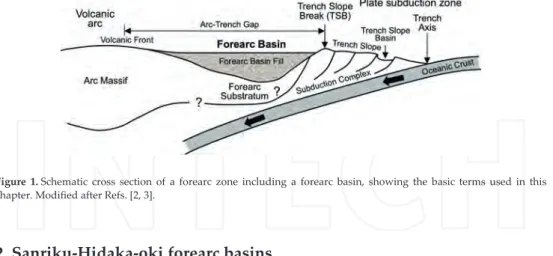
Forearc basin is a sedimentary basin developed between the volcanic arc and the plate sub‐ duction zone (Figure 1). Although the formation and subsidence mechanisms of forearc basins are still controversial [1, 2], the forearc basin behaviour including its formation, sedimentation, deformation and unconformable erosion may more or less reflect the plate subduction conditions along the plate convergent margins. In this scheme, it is supposed that the timing identification of such events provides important information on the plate tectonic history. Furthermore, the characterization of forearc basin‐filling sediments by rec‐ ognizing depositional‐system transition trends, such as upward‐shallowing and deepening successions associated with the balance between subsidence and sediment supply, may also provide crucial information on the basin setting parameters controlled by the plate tectonic conditions.
This chapter attempts to compile the timing of forearc basin formation, sedimentation and deformation along the northwestern Pacific margin, which has long been a plate convergent zone since the Mesozoic, to collect the information on the plate tectonic conditions during the Cenozoic. The examined forearc basin groups include the Sanriku‐Hidaka‐oki, Joban‐oki, Boso, Tokai‐oki‐Kumano‐nada, Shikoku‐Miyazaki‐oki, Ryukyu and Izu‐Bonin forearc basins (Figure 2). For each forearc basin group, the lithostratigraphic division with sedimentation age determination, major depositional systems and successive trends of basin‐filling sedi‐ ments and major unconformities are detected with discussion of tectonic implications.
2. Sanriku‐Hidaka‐oki forearc basins
2.1. Basin‐filling stratigraphy
The Cenozoic Sanriku‐Hidaka‐oki forearc basins (basin group) are located along the N‐S trending zone from the northeastern offshore of the Honshu Island to the south central part
Figure 1. Schematic cross section of a forearc zone including a forearc basin, showing the basic terms used in this chapter. Modified after Refs. [2, 3].
of Hokkaido (Figures 2 and 3). Basin‐filling sedimentation in this forearc basin group started from the latest Jurassic, and has continued until the present with several intermission events.
Figure 4 demonstrates the Cenozoic stratigraphic correlation chart of the Hidaka‐oki forearc
basin on the northern part and the Sanriku‐oki forearc basin on the southern part (Figure 3). In
Figure 4, the Sanriku‐oki forearc basin is further divided into the main part, which is mainly
in the offshore territory at present, and the western basin margin part, where the Cretaceous to Palaeogene stratigraphic studies are well documented (e.g., [4–9]), using outcrop sections along the present coastline.
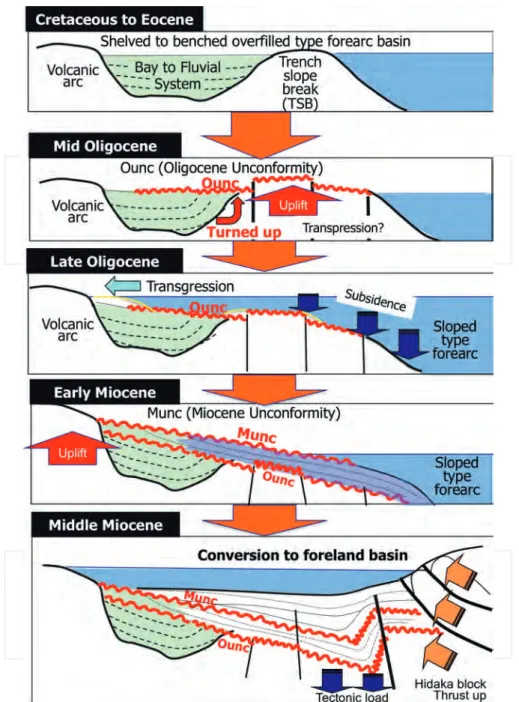
The Cenozoic sedimentation both in the Hidaka‐oki and Sanriku‐oki forearc basins began at around the Late Palaeocene time after the K/T gap unconformity (Tunc) event [10], and continued until the interruption by the large‐scale Oligocene unconformity (Ounc [11]) for‐ mation event (Figure 4). Overall depositional systems in this stratigraphic interval between ‘K‐T gap Tunc’ and ‘Ounc’ were coal‐bearing fluvial systems with cyclic intercalations of bay‐estuarine systems in response to relative sea‐level changes (Figure 4: [12]). The detailed sedimentological basin analysis revealed that the depositional settings must have been in a restricted environment sheltered from an open marine condition, as shown in Figure 5 [3, 13]. This forearc setting can be categorized as the shelved, benched type in the [2]’s forearc basin classification scheme, in which the trench slope break ridge is uplifted and the basin inside is overfilled with bay to fluvial sediments. Thus, the Cretaceous to Palaeogene forearc basins in
Figure 2. Map showing the distributions of forearc territories and groups in the western Pacific region. This study deals with four forearc territories: NE Japan, SW Japan, Ryukyu and Izu‐Bonin forearc territories; and these forearc territories include several forearc basin groups as indicated in this figure. Image from Google Earth.
the Sanriku‐Hidaka‐oki forearc basins are characterized as such trench‐slope‐break uplifted, overfilled configuration with aggradational coal‐bearing bay to fluvial sediments.
After the formation of ‘Ounc’, both the Hidaka‐oki and Sanriku‐oki forearc basins started drowning due to a wide‐scale, tectonic hinge‐type subsidence commencement (Figure 6), possibly related to the onset of tectonic erosion at the plate subduction zone along the NE Japan Arc. This event resulted in the transformation of the forearc basin type from the shelved, benched type to the sloped type of [2]’s scheme. The ‘Ounc’ unconformity surface was overlain by a transgressive succession, which was further followed by deeper marine muddy facies predominant over the Neogene and Quaternary successions in the Sanriku‐oki forearc basin, although short‐term episodes of unconformities (Munc: Miocene unconformity
Figure 3. Location maps of the Sanriku‐Hidaka‐oki forearc basins and the Joban‐oki forearc basins, showing the basin distributions and cross section locations. After [3, 11, 15]. Note that the basin distributions are different between the Cretaceous‐Palaeogene forearc and the Neogene‐Quaternary forearc, since the forearc basin type altered after the Oligocene unconformity (Ounc) event.
and Qunc: Quaternary unconformity) took place at around Early Miocene and the earliest Quaternary (Figure 4). On the contrary, the Hidaka‐oki basin experienced the conversion from a forearc to foreland basin after the ‘Munc’ formation due to the westward collision of the Hidaka block associated with the Kuril forearc sliver migration (Figure 6). The deeper
Figure 4. Cenozoic stratigraphic chart of the Sanriku‐Hidaka‐oki forearc basins, showing lithostratigraphy, major depositional systems, basin‐filling trends and unconformity events as indicators of background plate tectonic history. Compiled after Refs. [5–7, 11, 14].
part of the foreland basin was filled with submarine‐fan turbidites, which were derived from the uplifted Hidaka block (Figure 4). The basin‐filling succession as a whole demonstrates an aggradational to upward‐shallowing succession, resulting in the shelfal to shallow marine facies in the uppermost part (Figure 4).
Figure 5. Schematic and conceptual forearc setting model for the Sanriku‐Hidaka‐oki forearc basins [3]. This setting can be categorized as the shelved, benched type of [2]’s forearc basin classification.
Figure 6. Cartoons showing the basin evolution and transformation of the Sanriku‐Hidaka‐oki forearc basins. The ‘Ounc’ event caused the transformation of the basin type from a benched, overfilled fluvial‐dominated forearc to a sloped deeper marine forearc. The Hidaka‐oki basin experienced further conversion to a foreland basin due to the Hidaka block collision.
2.2. Major unconformities and tectonic implications
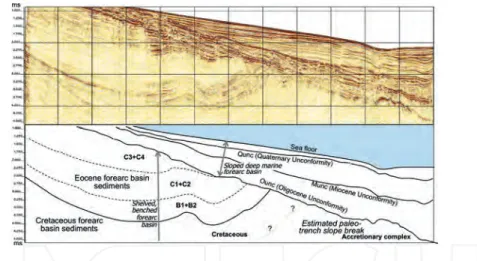
In the Sanriku–Hidaka‐oki forearc basins, four major unconformities: ‘Tunc’, ‘Ounc’, ‘Munc’ and ‘Qunc’ [11, 14] interrupt the Cenozoic basin‐filling succession (Figures 4 and 6). ‘Tunc (K‐T gap unconformity)’ occurs widely over the N‐S trending zone including the Sanriku–Hidaka‐oki forearc and Sorachi‐Yezo belt in central Hokkaido (Figure 3) [5, 10], but the background tecton‐ ics is still controversial [5]. The largest Cenozoic tectonic event in the Sanriku‐Hidaka‐oki forearc basins is regarded as the formation of ‘Ounc (Oligocene unconformity)’, which corresponds to the turning point from the trench slope break‐uplifted, shelved, benched, fluvial‐dominated type forearc to the sloped, deeper marine forearc (Figures 4 and 6). The seismic survey sec‐ tion demonstrates a characteristic turned‐up structure in the Cretaceous to Eocene forearc basin sediments due to intense arc‐ward suppression and uplift of the trench slope break at the time of ‘Ounc’ formation (Figures 6 and 7). Since in the northern extension of this forearc zone in central Hokkaido, which has been defined as the ‘Sorachi‐Yezo belt’, a strong dextral strike‐slip tecton‐ ics was dominant during mid‐Oligocene time [3, 13], it is considered that the ‘Ounc’ event more or less reflected the Oligocene dextral slip tectonics along the convergent zone.
3. Joban‐oki forearc basins
3.1. Basin‐filling stratigraphy
The Joban‐oki forearc basins (basin group) are located in the southern part of the forearc territory of the NE Japan arc (Figure 3). The outline of the basin‐filling stratigraphy for the
Figure 7. An E‐W long 2D seismic section transecting the Sanriku‐oki forearc basin, showing trench slope break uplift and Cretaceous to Eocene basin confinement (shelved, benched forearc) as modeled in Figure 5. After the formation of ‘Ounc (Oligocene unconformity)’, seaward dipping subsidence took place, and the forearc basin became a deep marine sloped type. The 2D seismic data were acquired in the MITI survey ‘Shimokita‐Kitakami’ [16]. The seismic survey line location is shown in Figure 3. Modified after Ref. [3].
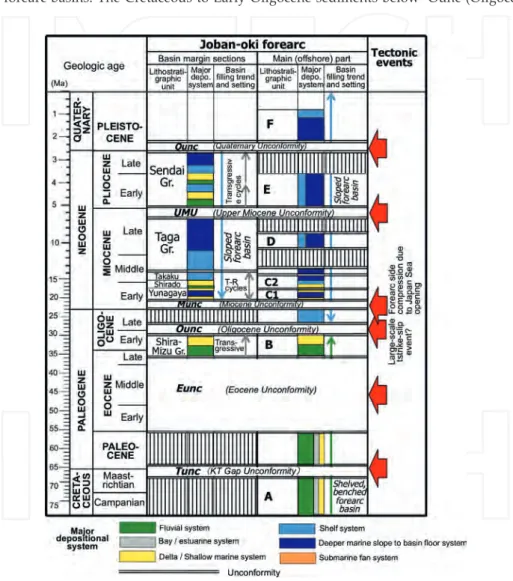
western onshore part has comprehensively been compiled by [17] with thorough consider‐ ation of the newest geologic age data set. The offshore stratigraphy has been reported by [15, 18, 19], using few well datasets including isotope and microfossil geologic age informa‐ tion. Figure 8 demonstrates the basin‐filling stratigraphy and major unconformity horizons both in the onshore and offshore parts of the Cenozoic Joban forearc basin. Although it seems that the Joban‐oki basin‐filling successions were interrupted more frequently by mul‐ tiple unconformities, the total basin‐filling pattern is similar to those of the Sanriku‐Hidaka‐ oki forearc basins. The Cretaceous to Early Oligocene sediments below ‘Ounc (Oligocene
Figure 8. Cenozoic stratigraphic chart of the Joban‐oki forearc basins, showing lithostratigraphy, major depositional systems, basin‐filling trends and unconformity events as indicators of background plate tectonic history. Compiled after Refs. [15, 17–19].
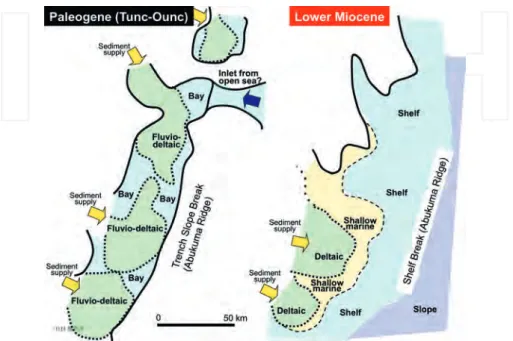
unconformity)’ are dominated by fluvial, delta and bay systems (Figures 8 and 9), and their distributions were limited to the arc‐side of the Abukuma Ridge (Figures 3, 9 and 10), sug‐ gesting that they were deposited in a restricted forearc basin inside the uplifted trench slope break. This situation is mostly the same as that of the Cretaceous to Eocene situation in the Sanriku–Hidaka‐oki forearc basins (Figure 5), which were categorized as the shelved, benched type of [2]’s forearc basin classification.
Figure 9. Schematic depositional models for the Paleogene and Lower Miocene in the Joban‐oki forearc basins. Note that the Paleogene basin was restricted by a trench slope break ridge, whereas the Early Miocene basin faced directly to an open marine condition as a sloped forearc.
Figure 10. Interpreted transverse (E‐W trending) seismic survey section in the northern part of the Joban‐oki forearc basins. The used seismic survey section: MITI seismic survey ‘Minami‐Sanriku‐Kashima‐oki’ M86‐6 section [20]. The section line location is shown in Figure 3.
Based on the Palaeogene and Lower Miocene depositional models (Figure 9) and an E‐W cross section of the Joban‐oki basins (Figure 10), it is inferred that ‘Ounc’ functioned as the transitional event from a shelved, benched forearc to sloped forearc, as seen in the Sanriku‐Hidaka‐oki forearc basins. On the contrary to the Cretaceous to Eocene succession below ‘Ounc’, the Neogene and Quaternary succession above ‘Ounc’ shows an open marine condition, consisting mainly of a deeper marine slope system at the transgression phases and fluvial, delta, shallow marine to shelf systems at the regression phases. Since these Neogene to Quaternary sediments were deposited over the Cretaceous to Eocene trench slope break without any confinement in sediment distributions as shown in Figures 9 and
10, the Neogene to Quaternary Joban‐oki forearc can be determined as the sloped type in
[2]’s classification.
3.2. Major unconformities and tectonic implications
As the Sanriku‐Hidaka‐oki forearc basins, ‘Tunc (K‐T gap unconformity)’, ‘Ounc (Oligocene unconformity)’, ‘Munc (Miocene unconformity)’ and ‘Qunc (Quaternary unconformity)’ can be recognized in the Joban‐oki forearc basins. Among these unconformities, it seems that ‘Ounc’ was the largest event in the Joban‐oki forearc history in terms of the transition from a trench slope break‐uplifted type to a sloped type.
The Joban‐oki forearc basins show additional unconformity events including the ‘Eunc (Eocene unconformity)’, ‘Middle Miocene unconformity (MMU)’ and ‘Upper Miocene unconformity (UMU)’ (Figure 8). Although the Eocene was one of the major depositional phases in the Sanriku‐Joban‐oki forearc basins, the Joban‐oki forearc basins lack the major part of the Eocene because of this unconformity event. ‘MMU’ and ‘UMU’ also are char‐ acteristic in the Joban‐oki forearc basins, which cannot be seen in the Sanriku‐Hidaka‐oki forearc basins.
4. Boso forearc basins
4.1. Basin‐filling stratigraphy
The Boso forearc basins (basin group) are developed in the east side of the collision zone between the Izu‐Bonin Arc and Honshu Arc (Figure 11). Since the major parts of the Boso forearc basins are exposed subaerially, many stratigraphic and sedimentologic outcrop stud‐ ies have been conducted. Based on these studies, the basin‐filling stratigraphy has compre‐ hensively been outlined by [21] with the newest geologic age data set. Figure 12 depicts the basin‐filling stratigraphy and major unconformity horizons of the Boso forearc basins. The Early Miocene and older sediments in the Boso forearc basins have been preserved as accre‐ tionary prism‐related sediments, which contain distorted, deformed blocks within muddy bedrocks. The Neogene forearc basins started at around the latest Early Miocene time, accord‐ ing to the newest geologic age data [21]. The Miura Group (or Awa Group) mainly consists of a transgressive succession at the base, and deeper marine slope to basin floor mudstones
and turbidite sandstones in the main part. Ref. [22] reported that the submarine‐fan turbidite sandstones of the middle to upper part of the Miura Group were deposited in a subduction zone‐parallel, trough‐like basin restricted by an uplifted trench slope break ridge, suggesting that at least Late Miocene trench slope break was uplifted and formed a ridged‐type forearc basin configuration. After the formation of the ‘Kurotaki unconformity’, the latest Pliocene to Quaternary Kazusa forearc basin was created and the thick upward‐shallowing succes‐ sion of the Kazusa Group was deposited in the basin. The Late Pleistocene Shimosa Group unconformably overlies the Kazusa Group and was deposited in shallow marine and bay environments.
4.2. Major unconformities and tectonic implications
In the Cenozoic Boso forearc basins successions, the ‘Early Miocene unconformity’ between the accretionary prism complexes and overlying Miura Group, and the Late Pliocene ‘Kurotaki unconformity’ between the Miura and Kazusa Groups are the major unconformi‐ ties in terms of plate tectonic history. The former ‘Early Miocene unconformity’ indicates the onset of the Neogene forearc basins with distinct formation of a trench slope break by thick piling of long‐standing accretionary prism stacking. The latter Late Pliocene ‘Kurotaki unconformity’ can be suggestive of changes in plate subduction conditions, such as subduc‐ tion direction change, which resulted in a large‐scale uplift and subsequent subsidence of the forearc area.
Figure 11. Location maps of the Boso, Tokai‐oki‐Kumano‐nada, Shikoku‐oki, Miyazaki‐oki and Izu‐Bonin forearc basins (forearc basin groups), showing the approximate basin distributions. After Refs. [23–25].
5. Tokai‐oki‐Kumano‐nada forearc basins
5.1. Basin‐filling stratigraphy
The Tokai‐oki‐Kumano‐nada forearc basins (basin group) are developed in the eastern half of the SW Japan forearc territory along the Nankai Trough subduction zone, which is adjacent
Figure 12. Cenozoic stratigraphic chart of the Boso, Tokai‐oki‐Kumano‐nada and Shikoku‐oki forearc basins, showing lithostratigraphy, major depositional systems, basin‐filling trends and unconformity events as indicators of background plate tectonic history. Compiled after Refs. [3, 21, 24].
to the Honshu Arc‐Izu‐Bonin Arc collision zone at the eastern end (Figure 11). The basin‐fill‐ ing stratigraphy of the northeastern margin of the basins has been investigated using onshore outcrop sections [21, 26, 27], whereas the major part of the basin, which is occupied by the offshore territory, has been investigated using seismic survey and few exploration well data‐ set (e.g., [3, 28–32]).
Figure 12 depicts the basin‐filling stratigraphy and major unconformity horizons of the
Tokai‐oki‐Kumano‐nada forearc basins. The Paleogene sediments, including the Oigawa, Setogawa and Mikura Groups, have been preserved as accretionary complex and related older forearc sediments, consisting mainly of submarine‐fan turbidites and mudstones. The Neogene forearc basin sedimentation started during Early Miocene time, and the transgres‐ sive to regressive Saigo and Kurami Groups were deposited, first. The Neogene forearc basin sedimentation seems to have been interrupted several times by unconformity events possibly related to uplifting of trench slope break. The Middle Miocene unconformity separates the Saigo/Kurami Groups and the overlying Sagara Group, the Pliocene unconformity separates the Sagara Group and the overlying Kakegawa Group, and the Pleistocene unconformity sep‐ arates the Kakegawa and the overlying Ogasa Group. Figure 13 depicts the cyclic uplifting of trench slope break associated with forearc compression during the Pliocene to Pleistocene, suggesting such tectonic fluctuation, possibly related to change in plate subduction condition, created unconformity events in the Tokai‐oki‐Kumano‐nada forearc basins.
5.2. Major unconformities and tectonic implications
As shown in Figure 12, it seems that the major unconformity events mostly match those in the Boso forearc basins, except the Middle Miocene unconformity, although unconformity timing shows a subtle difference.
Figure 13. Stratigraphic tectono‐sedimentary process chart of the Tokai‐oki‐Kumano‐nada forearc basins, showing cyclic compression‐relaxation fluctuation and associated basin deformation. Numbers in black arrows in the right column indicate deformation stages. Note that the climax phase of compression coincides in time with the unconformity horizon. Compiled and modified after Refs. [3, 31, 32].
6. Shikoku‐oki forearc basins
6.1. Basin‐filling stratigraphy
The Shikoku‐oki forearc basins (basin group) are developed to the south of Shikoku Island along the Nankai Trough subduction zone (Figure 11). Since there are no outcrop sections and exploration wells penetrated, there is no direct information on the lithology in the Shikoku‐ oki basin sediments. However, seismic survey sections and their correlations to the adjacent areas provide the stratigraphic outline of the Shikoku‐oki basin sediments. Ref. [24] described the outline of the basin‐filling stratigraphy and sediment distributions using offshore seismic survey data set. According to [24], the basin‐filling sediments can be divided into Unit M, T, K1, K2, K3 and P in a stratigraphic ascending order Figure 12. The acoustic basement corre‐ sponds to Palaeogene Unit M, and is considered to have been composed of accretionary com‐ plex. Miocene Unit T is widely distributed, and is considered to be equivalent to the Middle Miocene Tanabe, Saigo and Kurami Groups. Upper Miocene to Lower Pliocene Unit K1 over‐ lies depressions formed at the Middle Miocene unconformity event, and is considered to be equivalent to the Sagara Group. Pliocene‐Pleistocene Units K2 and K3 seem to be affected by compressive undulation events, and is considered to be equivalent to the Kakegawa Group. Pleistocene Unit P blankets the underlying sediments, and is considered to be equivalent to the Ogasa Group.
6.2. Major unconformities and tectonic implications
As shown in Figure 12, it seems that the major unconformity events mostly coincide in time with those in the Tokai‐oki‐Kumano‐nada forearc basins: Lower Miocene unconformity between the accretionary complex and Neogene forearc basin initiation sediments, Middle Miocene unconformity, Pliocene unconformity and Pleistocene unconformity. All these are regarded as common tectonic events along the Nankai Trough during the Neogene time.
7. Miyazaki‐oki forearc basins
7.1. Basin‐filling stratigraphy
The Miyazaki‐oki forearc basins (basin group) are located on the forearc side of the junction between the Honshu (SW Japan) Arc and Ryukyu Arc (Figure 11). The basin‐filling stratig‐ raphy of the northwestern margin of the basins has been investigated using onshore outcrop sections by many researchers (e.g., [21, 33‐35]) with detailed geologic age controls, whereas the major part of the basin, which is occupied by offshore territory, has been investigated using seismic survey and few exploration well data set [23].
Figure 14 depicts the basin‐filling stratigraphy and major unconformity horizons of the
Miyazaki‐oki forearc basins. The Cenozoic basin‐filling successions of the Miyazaki‐oki for‐ earc basins seem to be separated by the Early Miocene to early Late Miocene unconformity
or hiatus into the lower accretionary prism‐related older sediments and the upper Neogene forearc basin fill. The lower accretionary prism‐related sediments, including the Paleogene Nichinan, Hyuga, Gumage and Kitakawa Groups, are composed of contorted and blocked accretionary complexes and the adjacent forearc basin sediments consisting mainly of gravity flow deposits and deeper marine shales. The upper Neogene forearc basin fill includes the Upper Miocene to Pliocene Miyazaki Group and Pleistocene Hyuganada Group, and mainly consists of large‐scale transgressive‐regressive cycles of fluvial, delta, shallow marine, shelf, delta‐fed submarine‐fan and slope sediments.
7.2. Major unconformities and tectonic implications
As shown in Figure 14, the Early Miocene to early Late Miocene gap is the largest unconfor‐ mity or hiatus separating the Miyazaki‐oki forearc basin‐filling successions. Smaller uncon‐ formities can be observed within the Neogene forearc basin fill; those are, the base of the Miyazaki and Tsuma facies (latest Miocene) and the boundary between the Miyazaki and Hyuga‐nada Groups (earliest Pleistocene).
Figure 14. Cenozoic stratigraphic chart of the Miyazaki‐oki, Ryukyu, Izu‐Bonin forearc basins, showing lithostratigraphy, major depositional systems, basin‐filling trends and unconformity events as indicators of background plate tectonic history. Compiled after Refs. [21, 23, 25, 33–35].
8. Ryukyu forearc basins
8.1. Basin‐filling stratigraphy
The Ryukyu forearc basins (basin group) are located on the forearc side of the Ryukyu Arc (Figure 2). The basin‐filling stratigraphy has been investigated using partly exposed onshore outcrop sections in the archipelagos, offshore seismic survey results and several exploration well dataset (e.g. [23, 35]).
Figure 14 depicts the basin‐filling stratigraphy and major unconformity horizons of the
Ryukyu forearc basins. It seems that the Cenozoic Ryukyu forearc basin developments have been sporadic in time and space, being separated by several unconformities/hiatuses and forearc territory segments. The Palaeogene accretionary complex and associated forearc sedi‐ ments had been deposited until mid‐Oligocene time. After the no deposition period during the Late Oligocene to Early Miocene, sporadic sedimentation of the Yaeyama Group and its equivalent took place in the Early to Middle Miocene. Thick accumulation of the Shimajiri Group started at around mid‐Late Miocene, showing a transgression‐regression cycle with short hiatus periods in the middle. In association with the Okinawa Trough opening, which prevented siliciclastic input, the Upper Quaternary Ryukyu Group, mainly consisting of shal‐ low marine carbonate rocks, was deposited upon the early Quaternary unconformity.
8.2. Major unconformities and tectonic implications
As shown in Figure 14, the ‘Late Oligocene‐Early Miocene gap’ is the largest unconformity or hiatus separating between the underlying accretionary complex and the Neogene forearc basin fill. The Middle to Late Miocene unconformity separates the sporadic developments of the Middle Miocene Yaeyama Group and the overlying Upper Miocene to Pliocene Shimajiri Group. The Early Pleistocene unconformity between the Shimajiri and Ryukyu Groups is considered to be related to the Okinawa Trough opening.
9. Izu‐Bonin forearc basins
The Izu‐Bonin forearc basins (basin group) are located along the forearc side of the Izu‐Bonin Arc (Figures 2 and 11). Although the detailed basin‐filling stratigraphy has not been investi‐ gated, fine meshes of 2D seismic survey sections and some ODP drilling data have revealed the stratigraphic framework and major lithology information in the Izu‐Bonin forearc basins (e.g. [25, 36]).
Figure 14 depicts the outlined basin‐filling stratigraphy of the Izu‐Bonin forearc basins.
According to [25], the forearc basin fill can be divided into Units I–VI in a stratigraphic ascend‐ ing order. As the initiation of the forearc basins, Unit I was deposited at the bottom of the forearc basins as syn‐rift deposits during the Eocene time. Unit II, which was deposited dur‐ ing the Early to mid‐Oligocene, conformably overlies Unit I, and is considered as post‐rift deposits. Both Units I and II mainly consist of turbidite sandstones. Unit III is regarded as the coincident sediments with the Shikoku Basin opening event, and partly shows unconformable
relationship with the underlying Unit II. Although the depocenter shifts can be observed, there are no distinct event features in the succession of Units IV–VI, which are mainly composed of hemipelagic shales and volcaniclastics derived from the adjacent volcanic arc.
10. Synthesis: possible event phase tracing
As a result of compilation above, Figure 15 summarizes the unconformity events and basin types of the Sanriku‐Hidaka‐oki, Joban‐oki, Boso, Tokai‐oki‐Kumano‐nada, Shikoku‐oki, Miyazaki‐oki, Ryukyu and Izu‐Bonin forearc basins. Based on Figure 15, some characteristic features can be suggested as follows.
10.1. Difference between the NE Japan, SW Japan, Ryukyu and Izu‐Bonin forearc basins Figure 15 indicates that the forearc basin type and tectonic history are different between the
NE Japan, SW Japan‐Ryukyu and Izu‐Bonin forearc territories.
The Cretaceous to Palaeogene forearc basin types in the NE Japan forearc territory are char‐ acterized by the shelved, benched, fluvial‐dominated type, which was followed by the deeper marine sloped type after the ‘Ounc’ formation, except for the Hidaka‐oki basin, which was transferred to a foreland basin. This deeper marine sloped type forearc basin shows overall subsidence of the forearc regions, including the underlying benched‐type forearc basins, into
Figure 15. Summary chart of unconformity event phases and basin type transitions in the Sanriku‐Hidaka‐oki, Joban‐ oki, Boso, Tokai‐oki‐Kumano‐nada, Shikoku‐oki, Miyazaki‐oki, Ryukyu and Izu‐Bonin forearc basins. Gray territories show sedimentation gaps formed by unconformity or hiatus indicative of tectonic events.
a deeper marine condition, and can be classified as the tensional non‐accretion forearc type of [37]. On the contrary, the Neogene forearc basin types in the SW Japan‐Ryukyu and Izu‐ Bonin forearc territories are characterized mainly by the deeper marine sloped or ridged type, depending on the arc‐ward suppression of accretionary complex related to active accretion in the plate subduction zone. This type of forearc basins can be classified as the compressive accretion type of [37].
With regard to the tectonic history, Figure 15 suggests that the NE Japan, SW Japan‐Ryukyu and Izu‐Bonin forearc territories experienced different tectonic history. The largest tectonic event in the NE Japan forearc can be ‘Ounc (Oligocene unconformity)’, which caused the transformation of the basin types from the shelved, benched, fluvial‐dominated type to the deeper marine sloped type. On the contrary, in the SW Japan‐Ryukyu and Izu‐Bonin forearc territory, the Shimanto Belt‐related accretionary complex formation and related forearc basin sedimentation continued until the Late Oligocene to Early Miocene, and subsequently, the Neogene forearc basin sedimentation started at the Early, Middle or Late Miocene. The Izu‐ Bonin forearc basin started at the Eocene and has continued sedimentation until the present.
10.2. Unconformity synchronicity indicating plate tectonic events
Figure 15 also indicates that some unconformity events are synchronous for a forearc terri‐
tory or whole forearc territories around Japan, suggesting that these events originated from more or less wider‐scale plate tectonic events. ‘Ounc (Oligocene unconformity)’ can clearly be observed along the NE Japan forearc territory, and is considered to be caused by a large‐scale plate tectonic event as indicated by the erosional turned‐up structure and transformation of the forearc basin style. ‘Munc (Miocene unconformity)’ in the NE Japan forearc territory and the ‘Early Miocene unconformities’ developed in the SW Japan forearc territory can be involved within the opening event periods of the Shikoku Basin and the Sea of Japan, suggest‐ ing that these unconformities reflected the backarc opening tectonics. The ‘Middle Miocene unconformities (MMU)’ also demonstrate synchronous formation both in the NE Japan and SW Japan forearc territories. ‘Qunc (Quaternary unconformity)’ in the NE Japan forearc terri‐ tory possibly coincided in time with the Kurotaki unconformity event in the SW Japan forearc territory.
10.3. Unconformity event diachronicity
Although synchronicity of unconformity events can be suggested in a wider view, some unconformity events may indicate systematic diachronicity in a finer view.
’Early Miocene unconformities’ in the SW Japan forearc‐Ryukyu forearc territories show a time transgressive occurrence of each unconformity event from the west to the east, indicating the unconformity event took place slightly earlier in the west and later in the east. Since this ‘Early Miocene unconformity’ phases coincide in time with the Shikoku Basin opening, this diachronicity is possibly related to the Shikoku Basin opening event.
The late Pliocene unconformities also show a time transgressive pattern, indicating unconfor‐ mity occurred earlier in the west and later in the east.
11. Conclusions
This chapter attempted to compile the basin‐filling stratigraphy and major unconformity events of the Cenozoic forearc basins in the Sanriku‐Hidaka‐oki, Joban‐oki, Boso, Tokai‐oki‐ Kumano‐nada, Shikoku‐oki, Miyazaki‐oki, Ryukyu‐oki and Izu‐Bonin forearc territories. The results of the compilation provided the following new findings.
(1) The forearc basin type and tectonic history are characteristic of the NE Japan, SW Japan‐ Ryukyu and Izu‐Bonin forearc territories, respectively, reflecting the differences in plate tectonic processes.
(2) Several major unconformity events were synchronous for a forearc territory or whole forearc territories around Japan, suggesting that these events originated from more or less wider‐scale plate tectonic events.
(3) ‘Ounc (Oligocene unconformity)’ is considered as the largest plate tectonic event in the NE Japan forearc territory, which converted the forearc basin type from the benched flu‐ vial‐dominated type to the deeper marine sloped type.
(4) In the SW Japan and Ryukyu forearc territories, the latest Oligocene to Middle Miocene gap was the transformation phase from the Paleogene Shimanto‐type forearc and accre‐ tionary complex to the Neogene compressive, sloped to ridged forearc basins.
(5) ‘Munc (Miocene unconformity)’ in the NE Japan forearc territory and the ‘Early Miocene unconformities’ developed in the SW Japan forearc territory can be related to the opening event of the Shikoku Basin and the Sea of Japan.
(6) Some unconformity events may indicate systematic diachronicity in a finer view, possibly reflecting gradual shifts of a tectonic event.
Acknowledgments
The author is grateful for JAPEX, JOGMEC and METI, who gave data permission for publication.
Author details
Osamu Takano
Address all correspondence to: [email protected]
References
[1] Dickinson WR, Seely DR. Structure and stratigraphy of forearc regions. American Association of Petroleum Geologists Bulletin. 1979;63:2–31
[2] Dickinson WR. Forearc basins. In: Busby C, Ingersoll RV, editors. Tectonics of Sedi‐ mentary Basins. Oxford: Blackwell; 1995. pp. 221–261
[3] Takano O, Itoh Y, Kusumoto S. Variation in forearc basin configuration and basin‐filling depositional systems as a function of trench slope break development and strike‐slip movement: examples from the Cenozoic Ishikari‐Sanriku‐oki and Tokai‐oki‐Kumano‐ nada forearc basins, Japan. In: Itoh Y, editor. Mechanism of Sedimentary Basin Formation: Multidisciplinary Approach on Active Plate Margins. ISBN: 978‐953‐51‐1193‐1, InTech; Rijeka, Croatia. 2013. pp. 3–25. Available from: http://www.intechopen.com/books/ mechanism‐of‐sedimentary‐basin‐formation‐multidisciplinary‐approach‐on‐active‐ plate‐margins/variation‐in‐forearc‐basin‐configuration‐and‐basin‐filling‐depositional‐ systems‐as‐a‐function‐of‐
[4] Terui K, Nagahama H. Depositional facies and sequences of the Upper Cretaceous Kuji Group, Northeast Japan. Memoir of the Geological Society of Japan. 1995;45:238–249 (in Japanese with English abstract)
[5] Ando H. Stratigraphic correlation of Upper Cretaceous to Paleocene forearc basin sedi‐ ments in Northeast Japan: cyclic sedimentation and basin evolution. Journal of Asian Earth Sciences. 2003;21:919–933
[6] Ando H. Upper Cretaceous fore arc basin sequences in Northeast Japan: Large‐scale con‐ trolling factors as eustasy, volcanism and relative plate motion. Journal of the Geological Society of Thailand. 2004;1:35–44
[7] Ando H. Geologic setting and stratigraphic correlation of the Cretaceous to Paleocene Yezo forearc basin in Northeast Japan. Journal of Japanese Association for Petroleum Technology. 2005;70:24–36 (in Japanese with English abstract)
[8] Ando H. Apparent stacking patterns of depositional sequences in the Upper Cretaceous shallow marine to fluvial successions, Northeast Japan. Memoir of the Geological Society of Japan. 1997;48:43–59
[9] Umetsu K, Hirayama R, Sonoda T, Takashima R. Marine and nonmarine deposits of the Cretaceous Miyako and Kuji groups and Late Cretaceous terrestrial vertebrates in Iwate Prefecture, northeast Japan. Journal of the Geological Society of Japan. 2013;119(Supplement);82–95 (in Japanese with English abstract)
[10] Ando H, Tomosugi T. Unconformity between the Upper Maastrichtian and Upper Paleocene in the Hakobuchi Formation, north Hokkaido, Japan: A major time gap within the Yezo forearc basin sediments. Cretaceous Research. 2005;26:85–95
[11] Osawa M, Nakanishi S, Tanahashi M, Oda H. Structure, tectonic evolution and gas exploration potential of offshore Sanriku and Hidaka provinces, Pacific Ocean, off northern Honshu and Hokkaido, Japan. Journal of Japanese Association for Petroleum Technology. 2002;67:38–49 (in Japanese with English abstract)
[12] Takano O, Waseda A. Sequence stratigraphic architecture of a differentially subsid‐ ing bay to fluvial basin: The Eocene Ishikari Group in the Ishikari Coal Field, central Hokkaido, Japan. Sedimentary Geology. 2003;160(1–3):131–158
[13] Itoh Y, Takano O, Kusumoto S, Tamaki M. Mechanism of longstanding Cenozoic basin formation in central Hokkaido: An integrated basin study on an oblique convergent margin. Progress in Earth Planetary Sciences. 2014;1:6.
[14] Japan National Oil Corporation (JNOC). Report for the geological study of the MITI Sanriku‐oki well. Fiscal Year 1998. Tokyo: Japan National Oil Corporation; 2000. p. 48 [15] Iwata T, Hirai A, Inaba T, Hirano M. Petroleum system in the Offshore Joban Basin, north‐
east Japan. Journal of the Japanese Association for Petroleum Technology. 2002;67:62–71 (in Japanese with English abstract)
[16] Japan National Oil Corporation. Report on the geophysical survey ‘Shimokita‐Kitakami’. Fiscal Year 1973. Tokyo: Japan National Oil Corporation; 1974.
[17] Ando H, Yanagisawa Y, Komatsubara J. Cretaceous to Neogene strata in the Joban area and their sedimentation of the Joban forearc basin. Journal of Geological Society of Japan. 2011;117(Supplement):49–67
[18] Kato S, Akiba F, Moriya S. The Upper Cretaceous‐Cenozoic stratigraphy and geologic structure in the offshore Soma area, northeast Japan. Journal of the Geological Society of Japan. 1996;102:1039–1051
[19] Kato S, Tazawa K, Nakano T. Cenozoic strontium isotope stratigraphy in the MITI Soma‐oki well, northeastern Japan. Journal of the Geological Society of Japan. 1997;
103:1046–1052
[20] Japan National Oil Corporation. Report on the geophysical survey ‘Minami‐sanriku– Kashima‐oki’. Fiscal Year 1986. Tokyo: Japan National Oil Corporation; 1987
[21] Ito M, Kameo K, Satoguchi Y, Masuda F, Hiroki Y, Takano O, Nakajima T, Suzuki N. Neogene–Quaternary sedimentary successions. In: Moreno T, Wallis S, Kojima T, Gibbons W, editors. The Geology of Japan. London: Geological Society; Special Publication. 2016. pp. 313–341
[22] Tokuhashi S. Sedimentological study of the flysch type alteration of Hk horizon in the Kiyosumi Formation (Part 2). Depositional processes and circumstances of sandstone beds. Journal of the Geological Society of Japan. 1976;82:757–764
[23] Association of Natural Gas Mining and Association for offshore petroleum exploration, editor. Petroleum and Natural Gas Resources of Japan. Tokyo: Association of Natural Gas Mining and Association for offshore petroleum exploration; 1992. p. 520 (in Japanese)
[24] Sasaki K, Okuda Y, Kato S. Petroleum geology of the Pacific side of Southwest Japan. In: Association of Natural Gas Mining and Association for Offshore Petroleum Exploration, editor. Petroleum and Natural Gas Resources of Japan. Tokyo: Association of Natural Gas Mining and Association for Offshore Petroleum Exploration; 1992. pp. 225–246 [25] Hoshi K, Yanagimoto Y, Akiba F, Koda K. Architecture and tectonic evolution of sedi‐
mentary basins in the Izu‐Ogasawara Arc based on a seismic reflection survey inter‐ pretation. Journal of Geography (Chigaku Zasshi). 2015;124:847–876 (in Japanese with English abstract)
[26] Tsukawaki S. Depositional environments of the Sagara and Kakegawa Groups (Middle Miocene‐Early Pleistocene), and the evolution of the sedimentary basin, central Japan. Science Report of the Tohoku University, Sendai, Second Series (Geology). 1994;63:1–38 [27] Kameo K. Upper Neogene and Quaternary stratigraphy in the Kakegawa district based
on the calcareous nannofossil datum planes, with reference to the stratigraphic position of the Tamari Formation. Journal of the Geological Society of Japan. 1998;104:672–686 [28] Japan National Oil Corporation. Report for the MITI offshore geophysical survey Tokai‐
oki–Kumano‐nada. Fiscal Year 2001. Tokyo: Japan National Oil Corporation; 2003 [29] Japan National Oil Corporation. Report for the geological study of the MITI Tokai‐oki–
Kumano‐nada wells. Fiscal Year 2003. Tokyo: Japan National Oil Corporation; 2004 [30] Arai K, Okamura Y, Ikehara K, Ashi J, Soh W, Kinoshita M. Active faults and tectonics
on the upper forearc slope off Hamamatsu City, central Japan. Journal of the Geological Society of Japan. 2006:112;749–759 (in Japanese with English abstract)
[31] Takano O, Nishimura M, Fujii T, Saeki T. Sequence stratigraphic distribution analysis of methane‐hydrate‐bearing submarine‐fan turbidite sandstones in the Eastern Nankai Trough area: relationship between turbidite facies distributions and BSR occurrence. Journal of Geography. 2009;118:776–792 (in Japanese with English abstract)
[32] Takano O, Fujii T, Saeki T, Shimoda N, Noguchi S, Nishimura M, Takayama T, Tsuji T. Application of sedimentological methodology to the methane‐hydrate exploration proj‐ ect in the eastern Nankai Trough area. Journal of Japanese Association of Petroleum Technology. 2010;75:9–19 (in Japanese with English abstract)
[33] Nakamura Y, Ozawa T, Nobuhara T. Stratigraphy and molluscan fauna of the upper Miocene to lower Pliocene Miyazaki Group in the Aoshima area, Miyazaki Prefecture, southwest Japan. Journal of the Geological Society of Japan. 1999;105:45–60 (in Japanese with English abstract)
[34] Oda M, Chiyonobu S, et al. Integrated magnetostratigraphy of the Pliocene‐Pleistocene Miyazaki succession, southern Kyushu, southwest Japan: Implications for an early Pleistocene hiatus and defining the base of the Gelasian (P/P boundary section) in Japan. Journal of Asian Earth Sciences. 2001;40:84–97
[35] Miyazaki K, Ozaki M, Saito M, Toshimitsu S. The Kyushu‐Ryukyu Arc. In: Moreno T, Wallis S, Kojima T, Gibsons W, editors. The Geology of Japan. London: Geological Society; 2016. pp. 139–174
[36] Taylor B. Rifting and the volcanic‐tectonic evolution of the Izu‐Bonin‐Mariana Arc. Proceedings of ODP, Scientific Results. 1992;126:627–651
[37] Noda A. Forearc basins: Types, geometries, and relationships to subduction zone dynamics. Geological Society of America Bulletin. 2016;128:879–895


![Figure 5. Schematic and conceptual forearc setting model for the Sanriku‐Hidaka‐oki forearc basins [3]](https://thumb-ap.123doks.com/thumbv2/123deta/8516439.1805941/7.722.107.625.102.746/figure-schematic-conceptual-forearc-setting-sanriku-hidaka-forearc.webp)