The Japanese Psychonomic Society
NII-Electronic Library Service
The JapanesePsychonomic Society
ThelaPanesejburnalofPsychonomicScience
2003,VoL 22,No.1,43-44
Prizewinner's
Summary2-A-12
Individual
differences
of
spatial
span
and
view-dependence
in
three-dimensional
object
recognition
Takeo
KoNDou
andTamotsu
TosHiMA
Hiroshima
Uheiversity*
A largememory set size and a high similarity have been reported tocause view-dependence
in
3-D object recognitien
(NewelL
1998), Inthisstudy, we examined whether individualdifferences
in the capacity of spatial information processing(spatial
span) relateto
this
type ofview-dependence
or not.According
to
the
scoring of a spatial span task(Shah
& Miyake, 1996),tenparticipantswith a
high
spatial span score and tenparticipantswith a low spatial span score wereassigned tohigh and low spatial span groups,respectively,
The
results indicatedthatonly thelow
spatial span group showed a view-dependence
in
thchigh
cognitiveload
condition of the 3-D objcctdiscrimination
task. This suggested thatindividualdifferences
in
spatial span could beone of thefactors
which affect the view-dependence in3-D object recognition,Key words: view dependefice, canonical view, three-dimensional object recognition, working memory
Introduction
Working
mernory<WM)
isa limitedresourcc thatprocesses actively stored
information
to performgoal-orientedtasks,and thereare individualand
de-velepmental differences.Simultaneously
increasing
in
thenumber of target objects(memory
set size) and thesimilaritybetween
targetanddistracter
objects,makes therecognition of 3-D objects view-dependent
CNewelL
1998),
This
means that theincreased
load on processingand storing the 3-D objects produces a
view-dependent performance. Individual
differences
alsoeccur invisual-spatial WM, and a span testtoassess the capacity of an individuaVs WM has been
devel-oped
(Spatial
span task;Shah
&
Miyake,
1996).
The presentstudy examined whether the
perform-ance of
3-D
object recognition would change withindividual
differences
in
WM
capacity.
Method
Participants Thirty-two naive undergraduate
and graduate students were volunteered to partici-pate.*
Department
ofPsychology,
Hiroshima
sityKagamiyarna
1-1-1,
Higashi-Hiroshima
739-8524
Materials The stimuli were twenty objects
from
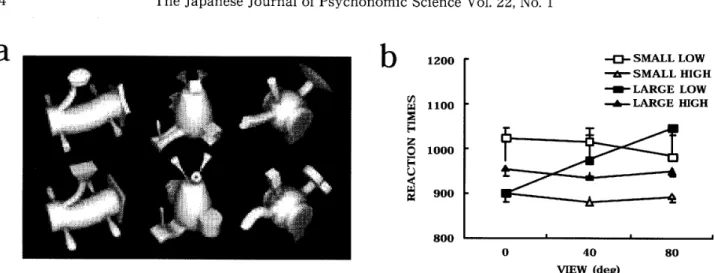
a set,some of which are shown inFigure 1(a),The
set of target
images
consisted of a canonical viewwhich was
decided
by
the participants and another two views which were incrernented from the canoni-cal viewby
40'
and80e
respectively, Thcdistracter
objects had a main
body
of the same shape as thetarget
objects, and had appendages at approximatelythe same locationand with the same
interrelation-ship,
The
set of distracterimages were made fromthe distracterobjects and
from
thcsame viewpointas the targetimage set.
ExperimentalDesign&Procedure
Thedesignof
the present study used
the
spatial span task(SST)
score group as a
between-participants
variable(HIGH,
LOW>, and the memory set size(LARGE,
SMALL)
and viewpoint(OO,
400,800)as the within-participantvariab]es,First,a
SST
was used toassess theability of theparticipant'sworking memory capacity to
simulta-neously process and store spatial infermation,
In the
following
delayecldiscrimination task,theparticipants were
initially
asked to rernember theshape of
targets
which were rotatedfive
timesonthe
display
of aCRT.
According tothememory set size condition, theparticipants were shown threeor onetargetobject.
The
participantsthen were shown allThe Japanese Psychonomic Society
NII-Electronic Library Service
The JapanesePsychonomic Society
44 The
Japanese
Journal
of Psychonomic Science VoL 22,No. 1a
Figure
1.
(a)
Examples
of the stimuli,(b)
Medstimulus object's viewpoint, with
SST
scoreLARGE>
as a parameter,b
I:9vN
IZOO 1100 1000 900 800ian reaction times as
(LOW,
HIGH)
groupthe
viewsfrom
thirty-six
viewpoints of the targetobject, and asked tochoose the best
(canonical
view:O")
frem
these views. After・that,
the participants were asked todiscriminate
the targetimages
fromthe distracter
images
by
pressing a computer mousebutton
(regardless
of the changes in viewpoint).Each trialwas composed of a fixationcross
for
500
ms,
then
adisplay
of a testimage
(the
target ordistracter),
The testimage disappeared when theparticipantresponded, and thenext tria]
(which
wasfollowed
by
blank
for
500
ms>then
started,
Results
Ten
participants with a highSST
score and ten with a lowSST
score were assigned totheHIGH andLOW
score groups, respectively. The remainder oftheparticipantswere excluded frornour analysis.
The median reaction
times
for
the correctre-sponses as a
function
of viewpoint, with the SSTscore group and memory set size as a parameter, are
shown
in
Figure 1(b}.A three-way ana]ysis of variance was calculated
with one
between-participants
factor
(SST
group;HIGH,
LOW)
and two within-participant factors(memory
set size: LARGE,SMALL:
viewpoint: OO,400,
80e}.
The
analysis revealed a significantinterac-tionof al]of the threefactors.Ina second analysis,
only
for
theLARGE memory set size condition, theLOW group'sreaction time
for
800
was significantlylonger
thanfor
O".
Further analysis revealed thattherewas not a significant effect of viewpoint for
the
O 40 80
VIEW
(degl
a
function
of the angles ofthe
and memory set $ize
{SMALL,
SMALL
memory set sizeand the HIGH group.
Discussion
The results revealed that only the LOW scere
group showed a view-dependence
in
the conditionwith a LARGE memory set size and close similarity
between
the objects, thatis,the condition of ahigh
load on theWM
The
view-dependence observed inthe current study was considered to be caused by this
increased
]oad on theWM. The performance ofthe participants thereiorechanged with their indi-vidual
differences
in
the capacity of theirWMindi-cated
by
theirSST
score. Itisinterestingto note that,aside frornthe factorsof an object's attribution,internal
factors
of an observer can cause theoccur-rence of view-dependent recognition, Individual
dif-ferences
in
WM could thereforebe important factorswhen examining 3-D recognition processes,
because
a participant'sperformance of recognizing the same
object might vary with theirindividualdifference
in
WM.
References
Newell,
F.
N.
1998Stimulus
context and viewpendence inobject recognition. Il2rception,27,
68.Shah,
P.
&
Miyake,
A.
1996
The
separability ofworking memory resources
for
spatial thinkingand