The Japanese Psychonomic Society
NII-Electronic Library Service
The JapanesePsychonomic Society
TheJltpanesefourna[ofPsychonomicScience
2013,VbL32,No.1,13].]32
Summary
of
Awarded
Presentation
Effects
of
spatial
factors
on
tactile
roughness
percep
A
study
based
on
signal
detection
theory
-tlon
Seiya
KAKIzAKI*,
YUika
SuzuKi,
and
Jiro
GyoBA
Ibhoku
U}iiversity
Our
previous
studiesdemenstrated
that
spatialfacters,
such asfinger
position
{hand
posture)
anddistance
from
the
stimulatedfinger
te
the
head
modulatetactile
roughnessperception.
Herein
weinvestigate
whether spatialfactors
influence
the
sensitivity
or responsebias
eftactile
reughnessdiscriminatien
using signaldetection
tech-niques,
Participants
were askedto
discriminate
the
roughness oftwo-sided
stimulibetween
twe
fingers
in
a varietyof
postures.
When
the
stimuli werepresented
closeto
the
head,
the
discrimination
sensitivityfor
the
finger
located
on
the
back
surface ofthe
stimuli waslower
than
that
for
the
finger
onthe
front
surface.Furthermore,
judgments
by
the
finger
onthe
back-side
werebiased
toward
the
samedirection
asthe
roughness efthe
front
surface regardlessef
the
distance
ofthe
hand
from
the
head.
These
resultsindicate
that
spatialfactors
differently
modulatethe
sensitivity andthe
responsebias
ofroughnessdiscrimination.
Key
words:touch,
roughnessdiscrimination,
peri-head
space, sensitivitF responsebias
Our
preyious
studyfound
that
whenparticipants
were askedto
discriminate
the
roughness ofone side of atwo-sided
abrasive
paper
pinched
withthe
thumb
andindex
finger,
the
discrimination
ability wasimpaired
especially whenthe
dis-tractor
wasthe
inside
relativeto
the
head
ratherthan
the
out-side ofthe
two
sides of stimuli(Kakizaki,
Suzuki,
&
Gyoba,
2011).
In
addition,this
effect was observed only whenthe
hand
waslocated
in
the
peri-head
space,Herein
we aimto
clarify whether spatial
factors
modulatethe
sensitivity or re-sponsebias
oftactile
roughnessdiscrimination
using
signaldetection
analysis.We
conductedtwo
experimentsin
whichthe
stimulus signal was rougher or smootherthan
the
noise signaLMethods
Participants
IXvelvegraduateandundergraduatestudents
participated
both
in
Experiment
1
andExperiment
2,
Stimuli
Each
stimulus was athick
paper
(3X9
cm) withabrasive
paper
(3
×6
cm) attachedto
both
sides,The
grit
val-ues ofthe
abrasivepapers
were#4000
(average
particle
size of3
gm:
smoother stimulus) and#1200
(12
"m:
rougherstimu-lus).
The
smeother(rougher)
stimulus was regarded asthe
signal
(noise)
in
Experiment
1
and vice versain
Experiment
2.
*
Corresponding
author.Department
of
Psychology,
Graduate
School
ofArts
andLetters,
Tbhoku
Universitp
27-1
Kawauchi,
Aoba-ku,
Sendai
980-8576,
Iapan
E-mail:thedevilishlefty@yahoo,co.jp
The
distractor
stimulus wasthe
same(noise)
throughout
the
experiment,
The
target
stimulus was eitherthe
signalin
the
SN
condition orthe
noisein
the
NN
condition(Fig.
IA).
Procedure
Participants
sat on a chair andplaced
their
chins on
the
chin-rest,They
wereblindfolded
by
eye-masksand wore
headphones
through
which white noise(5S
dB)
wasdelivered
during
the
experiment.They
pinched
atwo-sided
stimulus with
their
right thumb and opposingindex
finger.
Their
fingertips
pointed
toward
the
left.
The
stimuli were moved6
cmtoward
their
fingertips
by
an experimenter at a speed ofapproximately4
cmls.Stirnuli
werepresented
near orfar
from
the
head
(12
cm or'
50
cmin
front
ofthe
base
ofthe
participant
snese,Fig.
IB).
The
participants
were randomlydivided
into
two
groups
with respectto
the
side
of
the
target
stimulus
that
was assignedto
the
index
finger
orthumb.
AccerdinglM
the
participants
in
one
A
SNcondition
si;x・・as,ggeei.,asma
Tar etslde/ Distractersidesfieswel,cepy
ag'ng'$leeesX$iewname
B
t-me・ttt/
NN
conditianFigure
1.
Configuration
oftactile stimuli(A)
andtion
ofstimuluspresentation
(B).
right
2013.
TheIapanese
Psychonomic
Society
All
rights reserved.The Japanese Psychonomic Society
NII-Electronic Library Service
TheJapanesePsychonomic Society
132
The
Japanese
Journal
ofPsychonomlcScience
Vbl.
32,
No.
1
group
wereasked
to
judge
the
roughness of stimulipresented
tothe thumb
{thumb
group),
whilethe
othergreup
respondedto
the
stimuluspresented
to
the
index
finger
(index
finger
group).
The
participants
werethen
instructed
to
verballyjudge
whetherthe
roughness ofthe
stimulus onthe
target
sidewas
`smoeth'
or
'rough'.
The
judgrnent
ofeachtrial
was scoredas either a
hit
or rnissin
the
SN
condition and correctrejec-tions
orfhlse
alarmsin
the
NN
condition.Forty
trials
wereconducted
for
each ofthe
eight conditions, which consisted ofstimulus
position
(nearlfar
from
the
head)
×type
of stimuli(SNINN)
× sideof
target
stimuli(inside/outside
relativelyto
the
head).
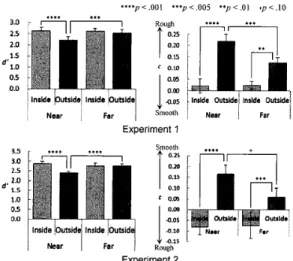
Results
For
eachparticipant,
the
d'
(discrimination
sensitivity)
andc
(response
bias)
in
each condition were calculated andana-lyzed
usingtwo-way
repeatedANOXCAs
withdistance
(nearl
far)
×target
side(insideloutside)
asfactors
(Fig.
2).
Regardless
of
the
condition,the
thumb
andindex
finger
groups
did
notdiffersignificantly
The
d's
had
significant main effectsfor
the
target
side
CExp.
1:
F(1,
11)==42.85,
p<.OOI;
Exp.
2:
F(1,
11)=6.65,
p<.05)
and significant
distanceXtarget
sideinteractions
(Exp,
1:
F(1.
11)=17,90,
p<.O05;
Exp.
2:
F(1,
11)=13,27,
p<.O05).
Post
hoc
comparisons revearedthat
the
sensitivity scoresin
the
near cenditionwere
higher
in
the
inside
conditionthan
that
in
the
outside
condition(Exp.
1:
ps<,e05;
Exp.
2:
Ps<,OOI),
The
cshad
main effectsfor
the
target
side
(Exp.
1:
F(1,
11)=33.67,
p<.OOI;
Exp.
2:
F(1,
11)=31.61,p<.OOI)
and significant
distance
Xtarget
sideinteractions
(Exp.
1:
F(1,
11)=5.79,
p<.05;
Exp
2:
F(1,
11)=5.46,
p<.05).
Post
hoc
comparisons revealedthat
the
judgments
in
the
outside cendition werebiased
towardthe
rougher(Exp.
1:
ps<.el)
and srnoother(Exp.
2:
ps<.e05)
sidesthan
those
in
inside
condition, suggestingthat
the
biases
in
the
outside conditionswere
in
the
samedirection
asthe
distractors'
roughness.Furthermore,
onlyin
the
eutside condition wasthe
bias
in
the
near condition strongerthan
that
in
the
far
condition(Exp.
1:ps<.O05;
Exp,
2:ps<,10).
3e
.:f'
',・ll::1:
l
s.s ],o 1.5 1.0a' L5 1.0 D.5 DO '-'p<afrth
1:nside
Miaj'
insitie o-tstael/ 1 N{tr / Ftr i
t----i-l
.OOL
+"p<.OOS Rougn --"T
OIS-OIO
-ots
,
t o.w 1 ,l./e;,i'll/ag,side.,,/ "p
.t
.Ol
ti)(.104--Expeliment1
1ottwdFnrrl' Smooth1
oli omo o,ts,:NIO
l
om "os oco O,ISRotigh
[
Mi-Jfi]
oeNdtlasnte--l-.
imulFerI
Experiment2Figure
2.
Mean
d'
(left)
andc(right)
in
Experiment
1
(above)
andExperiment
2
(below).
Errer
bars
indicate
the
standard errors ofthe means,
Discussion
We
investigated
the
effectsof
spatial
factors
on roughnessdiscrimination
tasks
whenparticipants
grasped
double-sided
abra$ivepaper
between
their
thumb
andindex
finger,
When
the
participants
discriminated
the
stimuliin
their
peri-head
space,
the
discrimination
sensitivities onthe
outsidefinger
werelower
than
those
onthe
inside
finger.
In
addition,the
analyses