1
ボリビア・チャカルタヤ山宇宙線観測所における
高エネルギーγ線・宇宙線のための
空気シャワー実験
東京大学宇宙線研究所
大 西 宗 博
平成29年度 東京大学宇宙線研究所 共同利用研究成果発表会 (東京大学柏キャンパス) 2017年12月9日 11:00-11:102
研究課題:
「ボリビア・チャカルタヤ山宇宙線観測所における
高エネルギーγ線・宇宙線観測のための空気シャワー
実験」
(
代表: 常定芳基)
採択額: 150万円
・国内打ち合わせ旅費
・ボリビアへの旅費
・チャカルタヤ観測所運営分担金
・ALPAQUITA準備
3
活動状況
★
ボリビア渡航: 1回
・6/2 - 6/11 瀧田、田島
(
理研)
実験サイト インフラ整備等打ち合わせ
★
国際会議等
・ICRC 2017 (7/12 - 7/20, 山, 韓国) 2講演
・TeVPA 2017 (8/7 - 8/11, Ohio, USA) 1講演
・The VII School on Cosmic Rays and Astrophysics
(8/21 - 9/1, Quito, Equador) 1講演
★
国内学会
・2017春 日本物理学会 (大阪大学) 2講演
・2017秋 日本物理学会 (宇都宮大学) 1講演
・2017秋 日本天文学会 (北海道大学) 1講演
経緯
• ボリビア・チャカルタヤ山宇宙線観測所(東大宇宙線研共同利用研究拠点)における空気シャ
ワー実験:BASJE - 5200m
• 2015年9月 終了
• 2015年度共同利用成果発表会において垣本史雄(東工大/当時)が最終報告
• 2015年6月 チベットおよびボリビアグループ有志による話し合い
• 南天で観測する意義の再確認
• チャカルタヤ山観測所のインフラ、サンアンドレス大学とのパイプという資産
• さらにインド GRAPES グループとも連携 ̶> 海外3実験の「合流」
• ターゲット: Sub-PeV ガンマ線・宇宙線の広視野連続観測
• チャカルタヤ山中腹、4740m (依然として世界最高高度)
• 空気シャワーアレイ 86,000m
2、検出器400台
• 地下ミューオン検出器 5,400m
2• モードエネルギー:5TeV
• 角度分解能:0.2 、エネルギー分解能 30% (100TeV)
• 視野:2 sr
• プロジェクト名:ALPACAに決定。 (ボリビアグループも含めて投票)
昨年度までの
83,000
: 20 - 25% (100 TeV gamma)
4東京大学宇宙線研究所将来計画検討委員会
最終報告書
(2017年10月26日)
ALPACA実験計画
委員会の評価
「南天には、銀河中心、Fermi bubble をはじめ、超新星残骸、
パルサー星雲など多数の興味深い天体が存在することから、銀河
系内 PeVatron の発見が期待され、100TeV領域でのガンマ線サー
ベイ観測を目指す
本計画の科学的位置付けは非常に高い
。技術的
予算的にも実現可能性が高く、
是非とも推進すべき研究であると
評価
する。 」
5The ALPACA Collaboration
IIF, UMSA, Bolivia
Martin SUBIETA, Rolando TICONA, Hugo RIVERA, Mirko RALJEVICH, Pedro MIRANDA
Faculty of Education, Utsunomiya Univ., Japan
Naoki HOTTA
Japan Atomic Energy Agency, Japan
Harufumi TSUCHIYA
Dept. of Physics, Shinshu Univ., Japan
Kazuoki MUNAKATA, Chihiro KATO, Yoshiaki NAKAMURA
ICRR, Univ. of Tokyo, Japan
Masato TAKITA, Takashi SAKO, Munehiro OHNISHI, Kazumasa KAWATA
College of Industrial Technology, Nihon Univ., Japan
Atsushi SHIOMI
Tokyo Metropolitan College of Industrial Tech., Japan
Toshiharu SAITO
National Inst. of Informatics, Japan
Masaki NISHIZAWA
RIKEN, Japan
Norio TAJIMA
Faculty of Engineering, Kanagawa Univ., Japan
Kinya HIBINO, Shigeharu UDO
Faculty of Engineering, Yokohama National Univ., Japan
Yusaku KATAYOSE, Takanori ASABA, Mikihiro KATAOKA, Takuro SASAKI, Masaru SUZUKI, Miho WAKAMATSU
College of Engineering, Chubu Univ., Japan
Akitoshi OSHIMA, Shoichi SHIBATA
Faculty of Engineering, Aichi Inst. of Tech., Japan
Hiroshi KOJIMA
Graduate School of Science, Osaka City Univ., Japan
Shoichi OGIO, Yoshiki TSUNESADA, Rosa MAYTA
Faculty of Engineering, Osaka Electro-Communication Univ., Japan
Yuichiro TAMEDA
Graduate School of Information Sciences, Hiroshima City Univ., Japan
Koichi TANAKA
Escuela de Ciencias Físicas y Nanotechnología, Yachay Tech, Ecuador
Takashi K. SAKO
7
ALPACA Site
Mt. Chacaltaya, Bolivia
8 4200m 4000m 4400m 4600m 4800m
UMSA CR Observatory
5200 m a.s.l.
ALPACA site
4740 m a.s.l.
La Paz
8Experimental Cite:
Cerro Estuqueria
500 m × 500 m flat within ± 1°
4,740 m above sea level (16°23’S, 68°08’W)
10
Schematic view of ALPACA
Image of 1 m
2plastic
scintillation detector
Image of unit (56 m
2)
underground
water
Cherenkov muon
detector
AS
MD
11 *Based on MC simulation
for the Tibet AS+MD
Sensitivity to the Point Source
CTA Review by Kubo (JPS 2015)
M. Daniel, Proc. of 28th Texas Sympo. (2015)
14
10
010
−110
110
10
210
310
CTA
EGRET 16 8 9 1510
10
FERMI10
Tibet AS Milagro − 2 −2 − 1Energy (eV)
10
1310
1210
1110
1010
5 sigma or 10 events Past CASA−MIA Present Future[GeV] [TeV] [PeV]
HAWC
VERITAS
Crab flux
50 hours or 1 year (Wide FoV instrument)
H.E.S.S.
ALPACA
MAGIC
12
ALPAQUITA Array in the ALPACA Project
-
Cosmic Ray Experiment in the Southern Sky -We are now proposing a new project which consists of a large air shower array (83,000 m2) and
a muon detector array (5,400 m2) located at the altitude of 4,740 m near La Paz in Bolivia to
observe 100 TeV gamma rays in the southern sky. The ALPAQUITA array is a prototype air shower array which will be constructed at the ALPACA site. This array consists of 45 scintillation counters of 1 m2 in area each, and its effective area is approximately 8,000 m2
(1/10 of ALPACA air shower array). In the present paper, we report on the current status and the performance of the ALPAQUITA array.
Abstract
ALPACA Project
ALPAQUITA Array in the ALPACA Project
T. Asaba,a K. Hibino,b N. Hotta,c M. Kataoka,a Y. Katayose,a C. Kato,d K. Kawata∗,e
H. Kojima,f g R. Mayta,h P. Miranda,i K. Munakata,d Y. Nakamura,d M. Nishizawa,j
S. Ogio,h M. Ohnishi,e A. Oshima,k M. Raljevich,i H. Rivera,i T. Saito,l T. K. Sako,me T. Sasaki,a S. Shibata,k A. Shiomi,n M. Subieta,i M. Suzuki,a N. Tajima,o M. Takita,e
Y. Tameda,p K. Tanaka,q R. Ticona,i H. Tsuchiya,r Y. Tsunesada,h S. Udob and M. Wakamatsua (The ALPACA Collaboration)
aFaculty of Engineering, Yokohama National University, Japan bFaculty of Engineering, Kanagawa University, Japan
cFaculty of Education, Utsunomiya University, Japan dDepartment of Physics, Shinshu University, Japan
eInstitute for Cosmic Ray Research, The University of Tokyo, Japan fFaculty of Engineering, Aichi Institute of Technology, Japan
gChubu Innovative Astronomical Observatory, Japan
hGraduate School of Science, Osaka City University, Japan
iInstituto de Investigaciones Físicas, Universidad Mayor de San Andrés, Bolivia jNational Institute of Informatics, Japan
kCollege of Engineering, Chubu University, Japan
lTokyo Metropolitan College of Industrial Technology, Japan
mEscuela de Ciencias Físicas y Nanotechnología, Yachay Tech, Ecuador nCollege of Industrial Technology, Nihon University, Japan
oRIKEN, Japan
pFaculty of Engineering, Osaka Electro-Communication University, Japan qGraduate School of Information Sciences, Hiroshima City University, Japan rJapan Atomic Energy Agency, Japan
E-mail: [email protected]
We are now proposing a new project which consists of a large air shower array (83,000 m2) and a muon detector array (5,400 m2) located at the altitude of 4,740 m near La Paz in Bolivia to observe 100 TeV gamma rays in the southern sky. The ALPAQUITA array is a prototype air shower array which will be constructed at the ALPACA site. This array consists of 45 scintillation counters of 1 m2 in area each, and its effective area is approximately 8,000 m2 (1/10 of ALPACA air shower array). In the present paper, we report on the current status and the performance of the ALPAQUITA array.
35th International Cosmic Ray Conference — ICRC2017 10–20 July, 2017
Bexco, Busan, Korea
∗Speaker.
c
⃝ Copyright owned by the author(s) under the terms of the Creative Commons
Attribution-NonCommercial-NoDerivatives 4.0 International License (CC BY-NC-ND 4.0). http://pos.sissa.it/
ALPACA Collaboration
300m Underground PoolALPACA Experiment
101. Air Shower Array ~83,000m2
= 401 x 1m2 scintillation detectors
2. Water Cherenkov Type
muon detector ~5400m2
underground 2.5m (~19X0) = 56m2 with 20”φ PMT x 96 cells
" Gamma-ray air shower has much less muons.
Background cosmic rays can be rejected by >99.9% @100TeV. " Wide FoV (~2sr) observation regardless day/night and weather
7500
8
Site Survey
Cosmic Ray Laboratory at 5200m a.s.l. Site at 4740m a.s.l Airport La Paz
A Prototype AS Array :
ALPAQUITA
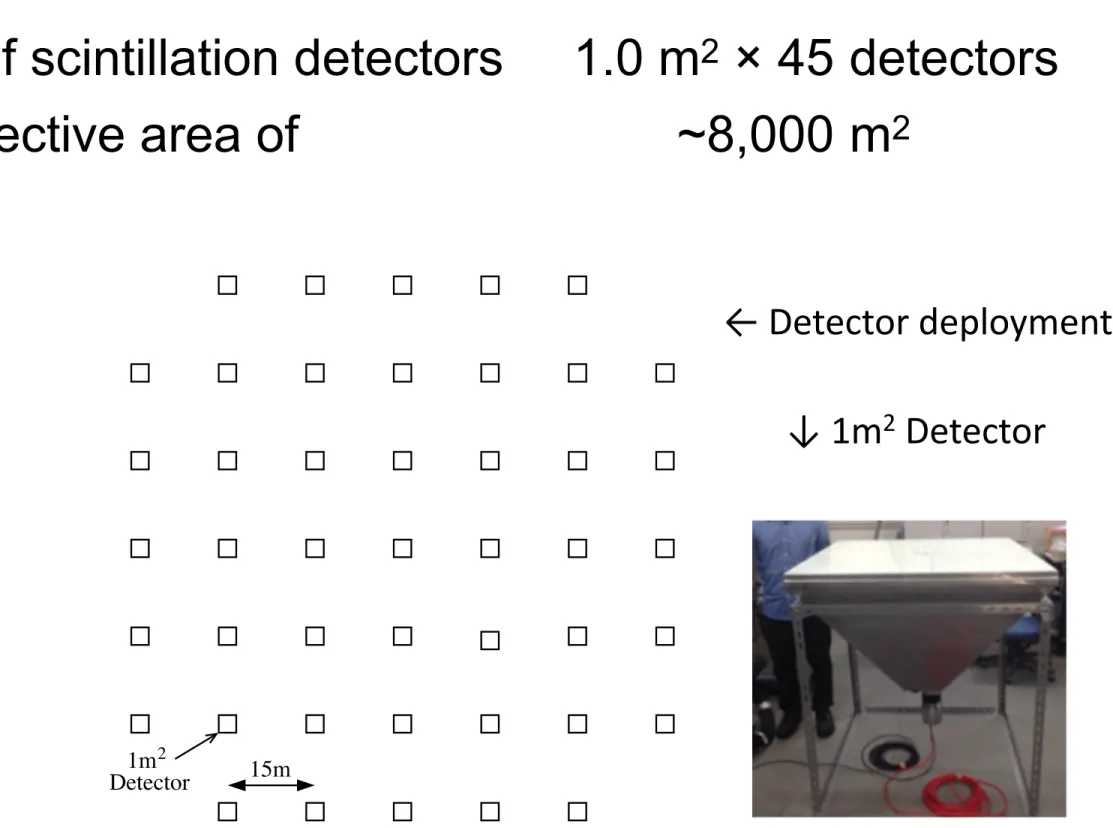
ALPAQUITA K. Kawata 2 15m Detector1mFigure 1: (Left) detector deployment of the ALPAQUITA array. Open squares show 45 scintillation detec-tors of 1 m2. (Right) picture of a prototype 1 m2 detector.
electron-positron pairs in the shower. The inside of all scintillator boxes is painted by white color (NIPPON PAINT ACALUX) to increase the effective photocoverage of each detector.
We have measured characteristics of a prototype detector, such as the detector gain, transit time spread, and their position dependences in the laboratory utilizing cosmic muons. The observed 1 MIP peak of the detector is clearly above dark noise, and the luminosity decreases by ∼10% at 50 cm from the center. The transit time spread of the detector is measured to be ∼0.7 ns (∼1.1 ns) at the center of detector (at 50 cm from the center). Based on these detector characteristics, we are now developing the detailed MC simulation.
The electronics hut will be constructed around center of the array. The whole detector is covered with a white sheet to reduce the temperature variation. All the signal cables of detectors have the same length of 100 m and use low-loss and high-frequency coaxial cable (FUJIKURA 2.5D-HQ.SUPER).
3. Performances and Sciences
The primary purpose of the ALPACA experiment is the gamma-ray astronomy at the energy range between 10 TeV and 1000 TeV in the southern sky. In addition, we will also observe the charged cosmic rays with a threshold of a few TeV. The ALPAQUITA array will be operated as an engineering air shower array without the muon detectors. Using this array, we will evaluate the performance, and develop the MC simulation, and expect some traditional cosmic-ray studies.
Recently, the IceCube and IceTop experiments located at the South Pole measured the detailed cosmic-ray anisotropy at the energies 20-2000 TeV in the southern sky [4, 5]. They found changes of anisotropy features depending on the energy. Currently, there is no anisotropy measurement at
3
↓ 1m
2Detector
The ALPAQUITA array will be constructed at an altitude of 4,740 m, near La Paz in Bolivia, which is the same as the ALPACA site. This array consists of 45 scintillation detectors of 1 m2,
and the detectors are placed on a lattice with 15 m spacing, covering 8,000 m2 (Left).
Each counter has a plastic scintillator of 1 m2 (0.25 m2 × 4) in area and 5 cm in thickness
(made by CI Kogyo) and is equipped with a high-gain 2-inch PMT (HAMAMATSU H7195) (Right). The scintillator box is set-up in an upside-down pyramidal style, and the height of box is set to 0.7 m to optimize the balance between the timing accuracy and the number of observed photoelectrons. The box can be installed a low-gain PMT next to the high-gain PMT to increase dynamic range of the number of detected particles for the future plan. A 0.5 cm-thick lead plate is put on the top of each counter to increase the array sensitivity by converting γ-rays into electron-positron pairs in the shower. The inside of all scintillator boxes is painted by white color (NIPPON PAINT ACALUX) to increase the effective photocoverage.
We have measured characteristics of a prototype detector, such as the detector gain, transit time spread, and their position dependences in the laboratory utilizing cosmic muons. The observed 1 MIP peak of the detector is clearly above dark noise, and the luminosity decreases by 10% at 50 cm from the center. The transit time spread of the detector is measured to be 0.7 ns ( 1.1 ns) at the center of detector (at 50 cm from the center). Based on these detector characteristics, we are now developing the detailed MC simulation.
The electronics hut will be constructed around center of the array. The whole detector is covered with a white sheet to reduce the temperature variation. All the signal cables of detectors have the same length of 100 m and use low-loss and high-frequency coaxial cable (FUJIKURA 2.5D-HQ.SUPER).
← Detector deployment
Recently, the IceCube and IceTop experiments located at the South Pole measured the detailed cosmic-ray anisotropy at the energies 20-2000 TeV in the southern sky. They found changes of anisotropy features depending on the energy. Currently, there is no anisotropy measurement at he TeV region in the southern hemisphere. The ALPAQUITA array can first measure the
cosmic-ray anisotropy above a few TeV in the southern sky. The trigger rate of cosmic ray is estimated
to be roughly 150 Hz. We expect to detect the large-scale sidereal anisotropy with an amplitude 0.1% at the significance 10σ/year.
The Tibet air shower experiment have continuously observed the Sun’s shadow since 1990 in the northern hemisphere. They found a clear solar-cycle variation of the Sun’s shadow is seen in the 10 TeV during a full solar cycle from 1996 to 2009. Since the site of the ALPAQUITA is located near the equator, the culmination altitude of the Sun is relatively high. Therefore, the
Sun’s shadow observation is possible through 1 year in our FoV with the zenith angle less than
50 . Thus, the exposure of the ALPAQUITA along the Sun’s orbit will be twice larger than that of the identical array placed in Tibet.
Performance & Science
PoS(ICRC2017)437
Presenter : K. Kawata (ICRR, The Univ. of Tokyo) Email : [email protected]
ALPAQUITA: prototype AS array
# of scintillation detectors 1.0 m
2
× 45 detectors
13
ALPAQUITA:
現状
インフラ
(
道路、土地、フェンス、建物、避雷針、電気、インターネット)
ー 現在ボリビア側が準備中
検出器架台
ー ボリビアにて試作品完成
その他の物品
ー
来週ボリビアへ向けて
輸送業者に引き渡し
※
日本からボリビアまで 海上+トラック で約4ヶ月
14