Panel Data Research Center at Keio University
DISCUSSION PAPER SERIES
DP2017-006 December, 2017
Impact of a Wife's Employment on her Husband's Retirement Decision: Evidence from Japanese Longitudinal Data
Tadashi Sakai* Akihito Toda** Atsuhiro Yamada*** 【Abstract】
Based on a large longitudinal data set on Japanese middle-aged and older individuals, this study investigates whether women’s labor force participation affects their husbands’ retirement decisions. Employing a simple fixed-effects model, we found a significant positive effect of wives’ labor force participation on husbands’ retirement decisions, which seems to imply that a husband’s leisure is complementary to that of his wife. However, when employing the instrumental variable fixed-effects model, which assumes joint decision-making by the husband and wife, we found no significant effect of the wife’s employment on her husband’s retirement decision, regardless of employment type.
* Faculty of Economics, Hosei University ** Recruit Works Institute
*** Faculty of Economics, Keio University
Panel Data Research Center at Keio University
Keio University
Impact of a Wife’s Employment on her Husband's Retirement Decision:
Evidence from Japanese Longitudinal Data
Tadashi Sakai
+, Akihito Toda
++, and Atsuhiro Yamada
+++December, 2017
Abstract
Based on a large longitudinal data set on Japanese middle-aged and older individuals, this study investigates whether women’s labor force participation affects their husbands’ retirement decisions. Employing a simple fixed-effects model, we found a significant positive effect of wives’ labor force participation on husbands’ retirement decisions, which seems to imply that a husband’s leisure is complementary to that of his wife. However, when employing the instrumental variable fixed-effects model, which assumes joint decision-making by the husband and wife, we found no significant effect of the wife’s employment on her husband’s retirement decision, regardless of employment type. Keywords: Retirement; Middle-aged person; Interdependence
JEL Classification Numbers: J14; J22; J26
I. Introduction
The Japanese government is facing a steady decline in the labor force associated with an aging population, and is consequently tasked with the urgent need to raise the labor force participation rate of older individuals. What has come to be known is the fact that in many industrialized countries, labor force participation of older women has driven, not curbed, their husbands’ labor force participation,
+ Hosei University, Machida-shi, Tokyo, Japan. ++ Recruit Works Institute, Chuo-ku, Tokyo, Japan. +++ Keio University, Minato-ku, Tokyo, Japan.
2
which implies that a husband’s leisure is complementary to his wife’s. According to Schirle (2008), husbands’ responses to increases in their wives’ labor force participation can account for one-fourth, one-half, and one-third of the increase in the recent labor force participation of older men in the United States, Canada, and the United Kingdom, respectively. In contrast to those countries, the extent to which the wife’s labor force participation determines her husband’s retirement is not yet known for Japan. Figure 1, which corresponds to Figure 1 of Schirle (2008), shows a gradual rise in the labor force participation rate of Japanese women aged between 55 and 64 years, and a high, stable participation rate of Japanese men in the same age range. Almost the same patterns are found for men and women between the ages of 60 and 64 years. If complementarity of leisure between a husband and wife plays a key role in the retirement decision, the upward trend of Japanese women’s labor participation will lead to higher participation by the older men. In contrast, if the income effect is important, the rise in the Japanese women’s labor participation rate will serve as a disincentive for older men to work. The goal of this study is to determine the effect that is dominant in the husband’s retirement decision, using the largest longitudinal dataset on Japanese middle-aged and older individuals.
Interdependencies between husband and wife have long been considered a central issue in the study of labor supply. Theoretically, as remarked above, it is ambiguous whether the spouse’s employment would encourage or discourage the other spouse’s employment. An impediment to a precise estimate of the impact is that the husband and wife may jointly make decisions about working, possibly causing a bias in the result of estimation by reduced form equation in which the spouse’s labor supply is treated exogenously. To avoid the bias, several studies exploit exogenous variations in the spouse’s labor supply, which are generated by legal changes such as regulations on the workweek and tax reform (Goux et al., 2014; Gelber, 2014). In our analysis, we use health status, the existence of care need in the household, and pensionable ages as the instrumental variables (IVs) for the spouse’s
3 labor force participation1.
At retirement age, individuals may be more responsive to their spouse’s work-or-leisure choice. Several studies found a positive correlation between the husband and wife’s retirement decision (Blau, 1998; Gustman and Steinmeir, 2000). Further evidence implicates asymmetric complementarities of leisure, that is, men are very responsive to their wives’ employment, while women are not as responsive to their husbands’ employment (Coile, 2004). Our study contributes to the understanding of the interdependencies between Japanese middle-aged and elderly married couples’ work decisions. To the best of our knowledge, ours is the only study to xplore such interdependencies by using large longitudinal dataset on Japanese middle-aged and older individuals, and the IV technique.
We found significant positive effects of the wife’s labor force participation on her husband’s participation when employing the simple fixed-effects model, which seems to imply that the husband’s leisure is complementary to his wife’s. When the IV fixed-effects model is employed, however, the effect of the wife’s employment on the husband’s employment is not significant regardless of employment type and firm size.
The remainder of this paper is organized in the following manner. Section II presents the methodology used to examine the impact of the wife’s employment on her husband’s retirement decision. Section III describes the dataset used in the analysis. Section IV provides the results of estimation. Section V concludes.
II. Empirical Model
To examine the interdependencies in spousal labor supply, we estimate the following IV fixed-effects model:
1 Yamada and Sakai (2016), whose study is based on the same dataset as the present analysis, find
only women are less likely to have a job when they have a frail parent. Fukahori et al. (2015) also find that the incidence of a frail individual in the household has a larger impact on women’s employment than on men’s employment.
4
H t i it W it H itL
X
v
u
L
where, by H itL
and W itL
, we denote the employment status for year t for ith husband and ith wife , respectively, and whereL
it
1
indicates that the individual is employed. Wit
L
is an endogenous variable for which we exploit wife’s health condition, the existence of care need in the household, and the pensionable ages as IVs. The health status of the wife consists of three dummy variables that indicate health status is “very good,” “good,” and “fair,” respectively. The existence of care need in the household is a dummy variable that equals one if the respondent is living with a family member who needs care. Two pensionable ages are used as IVs: pensionable age for basic pension and pensionable age for second-tier pension, both of which have been raised since 2000s according to the schedule. The variable Hit
X
includes variables regarding age, health condition, homeownership, the amount of deposits and housing loan of the husband.We conduct the IV fixed-effects model at the expense of abandoning nonlinear specification to deal with unobserved heterogeneity2. We compare the result of the IV fixed-effects model with the
result of the simple fixed-effects model so as to distinguish the role of IVs. Standard errors are clustered by individual, as including fixed effects is not enough for controlling for all the within-cluster correlation of the error (Cameron and Miller, 2015).
III. Data
The data used to estimate the model described in Section II come from the Longitudinal Survey of Middle-aged and Elderly Persons (LSMEP), a nationally representative sample of middle-aged and elderly individuals who were aged between 55 and 59 years at the end of October of 2005. LSMEP is
2 Following Schirle (2008), we also estimated the recursive bivariate probit model for a nonlinear
specification to confirm the robustness of our results, and found almost the same result as that of the IV fixed-effects model, though these are not shown in this paper.
5
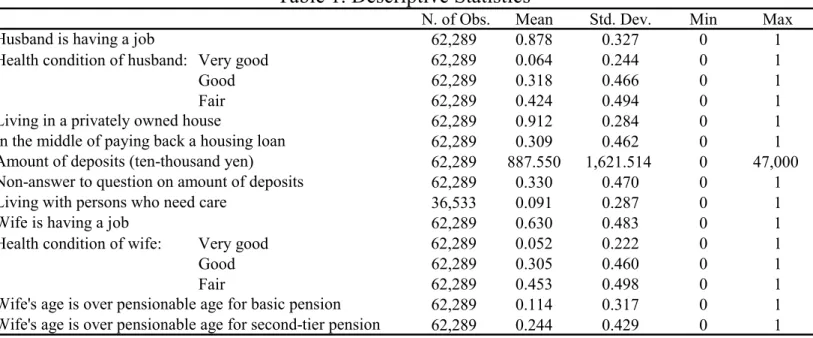
the largest longitudinal survey of middle-aged and elderly individuals in Japan, and has been conducted annually by the Japanese Ministry of Labour, Health and Welfare since 2005. This survey included 34,240 respondents in the initial year, and approximately 70% of those respondents remained in the survey as of 2012. The survey provides a rich set of information about the respondents’ family background, health status, employment status, and financial situations. Since our main interest is a spouse’s employment status, we picked up households with both husband and wife as respondents and matched their information to create sub-samples of couples. This matched sub-sample is approximately 40% of the whole sample. Although our base estimation relies on the first eight waves, the IV estimates are based only on the fourth through the eighth waves as the question on whether there is a fragile individual in the household starts with the fourth wave. The descriptive statistics of the dataset for our estimation are shown in Table 1.
IV. Results
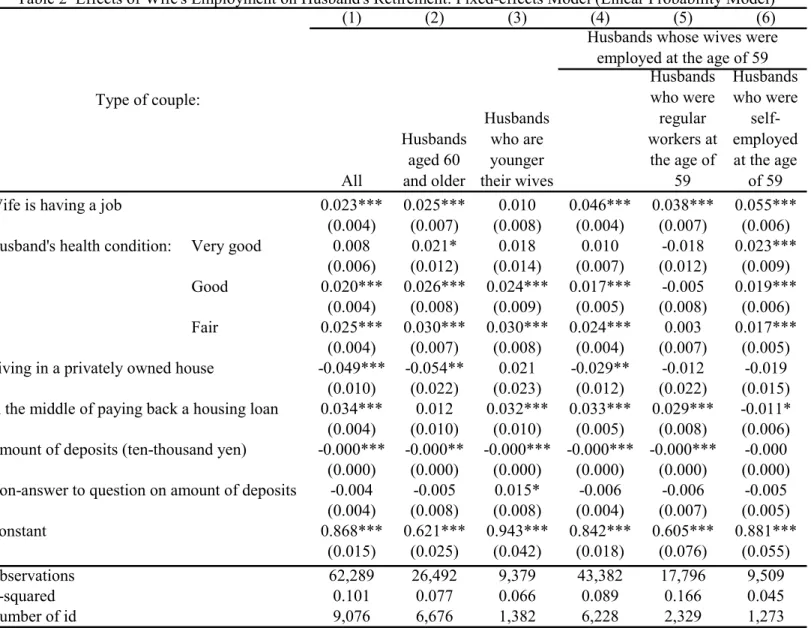
The estimation results of the fixed-effects model are presented in Table 2. In column (1), which shows the result of the estimation based on all couples, we find that the coefficient of the wife’s employment is positive and statistically significant. This result seems to imply that a husband’s and wife’s leisure are complementary to each other. It is also found that middle-aged and elderly men are more prone to work if they are healthier, if they do not own houses, and if they are in the middle of paying back their housing loans.
We also estimated the models on the basis of the sample respondents whose age is over 60 years (column (2) in Table 2), since a focus of the present study is to investigate whether elderly men remain in the labor market beyond the mandatory retirement age3. In this case, too, positive and statistically
significant coefficient of the wife’s employment was observed.
6
The result of the estimation based on couples where the wife is older than the husband is presented in Column (3) of Table 2. Among those couples where the wife enters the retirement process ahead of the husband, the wife’s employment status is considered to be more exogenous for the husband’s retirement decision. We found that the coefficient of the wife’s employment is positive, but insignificant in this case.
Japanese wives often quit their jobs upon marriage and continue to be housewives in the years that follow. In such cases, the husband may not consider his wife’s employment status in making his retirement decision. Hence, we re-estimate the same model limiting the sample to those husbands whose wives are employed at the age of 59, so as to capture the decision-making of those who may change the timing of their retirement depending on their wives’ employment. The results are presented in column (4) of Table 2, where it is observed that the coefficient of the wife’s employment is significantly positive, and much larger than the case of all couples.
To capture the fact that there is a substantial difference in the retirement process between employees and self-employed workers, we divide the sample by the husband’s employment type at age of 59 (columns (5) and (6) in Table 2)4. Column (5) shows the result of estimation conducted on
a sub-sample that consists of husbands who were regular workers at the age of 59 and whose wife had a job at the age of 59, whereas the result of estimation based on the sub-sample of those husbands who were self-employed at the age of 59 is shown in column (6). In both columns, we found a significant positive effect from the wife’s employment.
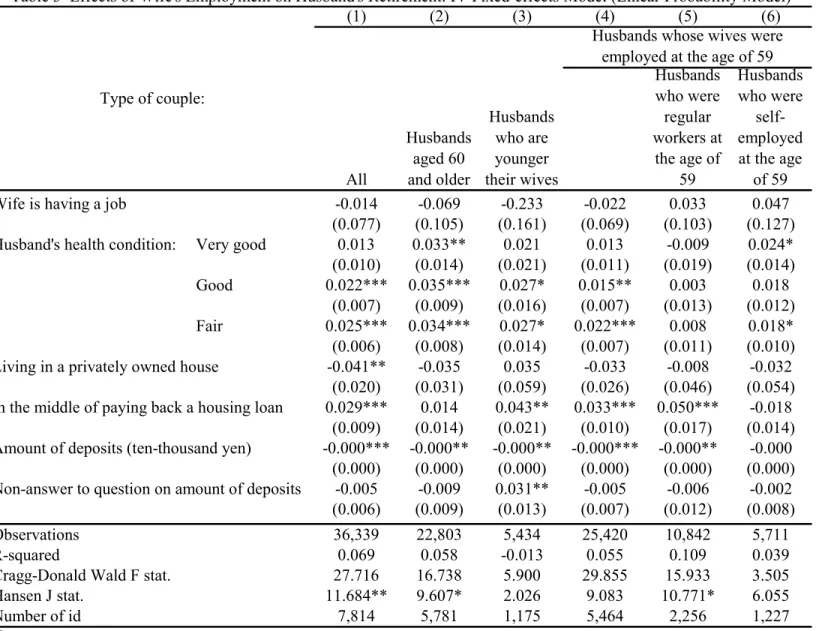
The estimation results of the IV fixed-effects model are presented in Table 3, in which each column corresponds to each specification of Table 2. We find that the IVs are not weak in most of the specifications. However, the results mark a sharp contrast with the results shown in Table 2 as we find
4 Usui et al. (2015) found that Japanese workers in salaried jobs gradually move to part-time work
or retire after beginning to receive pension benefits, while self-employed workers neither retire nor reduce their working hours after beginning to receive pension benefits.
7
that all the estimated coefficients on the wife’s employment from the IV fixed-effects model are insignificant5.
Although not shown in Table 3, we also estimated the IV fixed-effects model on two additional sub-samples: the first, where husbands were non-regular workers at the age of 59, and the second, where husbands were employed as non-regular workers in a company with less than 300 workers. Those who consist of the above sub-samples are considered to have the relative freedom of choosing the timing of retirement. Even among them, however, we found no significant coefficient on wife’s employment6.
V. Conclusion
From the results of the IV estimations, we found that a Japanese worker’s retirement decision is independent of the spouse’s employment. This result was in contrast with the results from the estimations that treat the spouse’s employment as exogenous. The finding based on the IV model is robust regardless of employment type and firm size, and reveals that husband and wife indeed make decisions about retirement jointly. Although the findings are inconsistent with similar existing studies in Europe and the United States, in which complementarity of leisure between a husband and wife has been found, our findings may imply that, in Japan, factors such as mandatory retirement age, post retirement employment, and health may be more important conditions that affect retirement timing.
5 Assuming that husbands who were self-employed at the age of 59 rarely receive benefit of
second-tier pension, the pensionable age for second-second-tier pension as an IV is excluded from the first-stage equation for the estimation of column (6) in Table 3.
6 We also found that even in the sample where husbands work in firms that do not have a mandatory
8 Acknowledgement
This work was supported by Health Labour Sciences Research Grant(厚生労働科学研究費補助金
(政策科学総合研究事業(政策科学推進研究事業))「就業状態の変化と積極的労働市場政策に関
する研究」(H26-政策-一般-003,研究代表:慶應義塾大学・山本勲). We are permitted to use the Longitudinal Survey of Middle-aged and Elderly Persons by Ministry of Health, Labour and Welfare under Article 33 of the Statistics Act. We would like to thank Yoshio Higuchi and Isamu Yamamoto for their helpful comments. We take full responsibility for any remaining errors.
9 References
Blau, D., (1998) “Labor Force Dynamics of Older Married Couples,” Journal of Labor Economics 16(3): 595-629.
Cameron, C., and D. MIller (2015) “A Practitioner's Guide to Cluster-Robust Inference,” Journal of
Human Resources 50(2): 317-372.
Coile, C., (2004) “Retirement incentives and couples’ retirement decisions,” B.E. Journal of Economic Analysis & Policy 4(1): 1–30.
Fukahori, R., Sakai, T., and K. Sato (2015) “The Effects of Incidence of Care Needs in Households on Employment, Subjective Health, and Life Satisfaction among Middle-aged Family Members,”
Scottish Journal of Political Economy, 62(5):518-545.
Gelber, A., (2014) “Taxation and the Earnings of Husbands and Wives: Evidence from Sweden,”
Review of Economics and Statistics 96(2): 287-305.
Goux, D., Maurin, E., and B. Petrongolo (2014) “Worktime Regulations and Spousal Labor Supply,”
American Economic Review 104(1): 252-76.
Gustman, A., and T. Steinmeier (2000) “Retirement in Dual-Career Families: A Structural Model,”
Journal of Labor Economics 18(3): 503-545.
Schirle, T., (2008) “Why Have the Labor Force Participation Rates of Older Men Increased since the Mid-1990s?” Journal of Labor Economics Vol. 26, No. 4, pp. 549-594.
Yamada, A., and T. Sakai (2016) “Labor Supply and Income Reduction of Middle- and Old-Aged People in Japan with a Parent in Need of Long-Term Care” Economic Analysis 191: 183-212 (in
Japanese).
Usui, E., Shimizutani, S., and T. Oshio (2016) “Are Japanese Men of Pensionable Age Underemployed or Overemployed?” Japanese Economic Review 67(2): 150–168.
0.30
0.40
0.50
0.60
0.70
0.80
0.90
1973
1977
1981
1985
1989
1993
1997
2001
2005
2009
2013
Figure 1. Participation rates of individuals aged 55–64, by sex
Men(55-64)
Women(55-64)
Men(60-64)
Women(60-64)
11
N. of Obs. Mean Std. Dev. Min Max
62,289 0.878 0.327 0 1
Health condition of husband: Very good 62,289 0.064 0.244 0 1
Good 62,289 0.318 0.466 0 1 Fair 62,289 0.424 0.494 0 1 62,289 0.912 0.284 0 1 62,289 0.309 0.462 0 1 62,289 887.550 1,621.514 0 47,000 62,289 0.330 0.470 0 1 36,533 0.091 0.287 0 1 62,289 0.630 0.483 0 1
Health condition of wife: Very good 62,289 0.052 0.222 0 1
Good 62,289 0.305 0.460 0 1
Fair 62,289 0.453 0.498 0 1
62,289 0.114 0.317 0 1
62,289 0.244 0.429 0 1
Wife is having a job
Wife's age is over pensionable age for basic pension Wife's age is over pensionable age for second-tier pension
Table 1. Descriptive Statistics
Amount of deposits (ten-thousand yen)
Non-answer to question on amount of deposits Living with persons who need care
Husband is having a job
Living in a privately owned house
12 (1) (2) (3) (4) (5) (6) All Husbands aged 60 and older Husbands who are younger their wives Husbands who were regular workers at the age of 59 Husbands who were self-employed at the age of 59
Wife is having a job 0.023*** 0.025*** 0.010 0.046*** 0.038*** 0.055***
(0.004) (0.007) (0.008) (0.004) (0.007) (0.006)
Husband's health condition: Very good 0.008 0.021* 0.018 0.010 -0.018 0.023***
(0.006) (0.012) (0.014) (0.007) (0.012) (0.009)
Good 0.020*** 0.026*** 0.024*** 0.017*** -0.005 0.019***
(0.004) (0.008) (0.009) (0.005) (0.008) (0.006)
Fair 0.025*** 0.030*** 0.030*** 0.024*** 0.003 0.017***
(0.004) (0.007) (0.008) (0.004) (0.007) (0.005)
Living in a privately owned house -0.049*** -0.054** 0.021 -0.029** -0.012 -0.019
(0.010) (0.022) (0.023) (0.012) (0.022) (0.015)
In the middle of paying back a housing loan 0.034*** 0.012 0.032*** 0.033*** 0.029*** -0.011*
(0.004) (0.010) (0.010) (0.005) (0.008) (0.006)
Amount of deposits (ten-thousand yen) -0.000*** -0.000** -0.000*** -0.000*** -0.000*** -0.000
(0.000) (0.000) (0.000) (0.000) (0.000) (0.000)
Non-answer to question on amount of deposits -0.004 -0.005 0.015* -0.006 -0.006 -0.005
(0.004) (0.008) (0.008) (0.004) (0.007) (0.005) Constant 0.868*** 0.621*** 0.943*** 0.842*** 0.605*** 0.881*** (0.015) (0.025) (0.042) (0.018) (0.076) (0.055) Observations 62,289 26,492 9,379 43,382 17,796 9,509 R-squared 0.101 0.077 0.066 0.089 0.166 0.045 Number of id 9,076 6,676 1,382 6,228 2,329 1,273 Note:
The dependent variable is a dichotomous variable which indicates one if a husband is having a job. All models include dummy variables for husband's age and survey year as independent variables. Cluster-robust standard errors are in parentheses. *** p<0.01, ** p<0.05, * p<0.1.
Table 2 Effects of Wife's Employment on Husband's Retirement: Fixed-effects Model (Linear Probability Model) Husbands whose wives were
employed at the age of 59 Type of couple:
13 (1) (2) (3) (4) (5) (6) All Husbands aged 60 and older Husbands who are younger their wives Husbands who were regular workers at the age of 59 Husbands who were self-employed at the age of 59
Wife is having a job -0.014 -0.069 -0.233 -0.022 0.033 0.047
(0.077) (0.105) (0.161) (0.069) (0.103) (0.127)
Husband's health condition: Very good 0.013 0.033** 0.021 0.013 -0.009 0.024*
(0.010) (0.014) (0.021) (0.011) (0.019) (0.014)
Good 0.022*** 0.035*** 0.027* 0.015** 0.003 0.018
(0.007) (0.009) (0.016) (0.007) (0.013) (0.012)
Fair 0.025*** 0.034*** 0.027* 0.022*** 0.008 0.018*
(0.006) (0.008) (0.014) (0.007) (0.011) (0.010)
Living in a privately owned house -0.041** -0.035 0.035 -0.033 -0.008 -0.032
(0.020) (0.031) (0.059) (0.026) (0.046) (0.054)
In the middle of paying back a housing loan 0.029*** 0.014 0.043** 0.033*** 0.050*** -0.018
(0.009) (0.014) (0.021) (0.010) (0.017) (0.014)
Amount of deposits (ten-thousand yen) -0.000*** -0.000** -0.000** -0.000*** -0.000** -0.000
(0.000) (0.000) (0.000) (0.000) (0.000) (0.000)
Non-answer to question on amount of deposits -0.005 -0.009 0.031** -0.005 -0.006 -0.002
(0.006) (0.009) (0.013) (0.007) (0.012) (0.008)
Observations 36,339 22,803 5,434 25,420 10,842 5,711
R-squared 0.069 0.058 -0.013 0.055 0.109 0.039
Cragg-Donald Wald F stat. 27.716 16.738 5.900 29.855 15.933 3.505
Hansen J stat. 11.684** 9.607* 2.026 9.083 10.771* 6.055
Number of id 7,814 5,781 1,175 5,464 2,256 1,227
Cluster-robust standard errors are in parentheses. *** p<0.01, ** p<0.05, * p<0.1.
Husbands whose wives were employed at the age of 59 Type of couple:
Table 3 Effects of Wife's Employment on Husband's Retirement: IV Fixed-effects Model (Linear Probability Model)
Note:
The dependent variable is a dichotomous variable which indicates one if a husband is having a job.
All models include dummy variables for husband's age and survey year as independent variables. Columns (2)-(6) are the results of estimations which rely on 4th-8th waves.