An Attempt at Cross-Cultural Exchange
Activity: Collaborative Field Study with
International Students
著者
Yumie MURATA
著者別名
村田 由美恵
雑誌名
東洋大学人間科学総合研究所紀要
号
15
ページ
135-145
発行年
2013-03
URL
http://id.nii.ac.jp/1060/00004216/
Creative Commons : 表示 - 非営利 - 改変禁止
http://creativecommons.org/licenses/by-nc-nd/3.0/deed.ja
An Attempt at Cross-Cultural Exchange Activity :
Collaborative Field Study with International Students
Yumie MURATA
*
1 。Introduction
The faculty of Regional Development Studies has the largest number of international students among all
the faculties at Toyo University. The faculty offers various cross-cultural e χchange activities every year. For in-stance, the International Student Symposium and field studies are offered, which are attended by foreign visi-tors, and Japanese speech contests and e
χcursions are held for international students of the faculty. It is a mean-ingful e χperience for both international students and Japanese students to e χchange opinions based on their per-spectives h
・om their various cultural backgrounds 。
In general, it is eχpected that cross-cultural contact with people of a host country will foster the visitor'sadaptation to that country. This idea is called
“contact hypothesis," and Tanaka (2000)explained that it can beapplied to various aspects of adaptation. such as avoiding potential health problems and developing intercul-turality.
International students especially prefer to have contact with their hosts for academic help (Bochner,McLeod, and Lin, 1977
; Furnham and Alibhai, 1985). To encourage international students to have more contactwith Japanese students, the faculty's Japanese language teachers have tried to offer opportunities for interna-tional students to meet with Japanese students. For instance. the
teachers invited Japanese students to Japanese
language classes attended by international students for discussions or cultural presentations. However, thoseevents tend to result in only temporary contacts. Therefore, the teachers decided to launch a new program to
im-prove this situation.
2. Background of Planning a New Program
The teachers sought to discover why previous cross-cultural activities did not help to sustain students' long-term intercultural contacts. Common cultural e χchange activities offered in the past include :
* A lecturer in the Faculty of Regional Development Studies, and a member of the Institute of Human Sciences at Toyo University
136 東 洋 大 学 人 間科 学 総 合研 究 所 紀 要 第15 号(2013 )
(1 )Presentations
Introducing the lifestyle and customs of their home countries Introducing tourist spots in participants' hometowns
Inviting Japanese students to Japanese speech contests in which international students compete (2 )Discussion meetings
Discussions about various themes such as campus life and hobbies
Although these activities were interesting, they did not help students to sustain contact with those of the
host country. For example, in activity (1), students on both sides tend to be passive while listening to presenta-tions.
Though there is time for discussion or comments. the students' remarks do not go beyond the superficial.As for Japanese speech contests, it is rare to have a Japanese audience. and there is no time for Japanese studentsto
offer comments. In activity (2), the students do enjoy the sessions. but they do not continue to meet with eachother after the activities are over. This may be because they do not remember the names of the participants, orbecause they do not have a good
reason to begin conversing with each other outside the classroom 。 Other than the past examples noted above, teachers could plan other activities such as
(3)Cultural experiences
Making Chinese dumplings together(taught by Chinese students)
This would be fun for all participants, but it might not encourage the students to talk very much. Partici-pants would follow the instructions given by the volunteer instructors. but there would not be enough time for
them to enhance their e χchange of opinions with more than superficial comments. Also, again, students may notfind a good reason to talk outside the classroom 。
Given these circumstances , two Japanese language teachers planned a new approach to encouraging cul-tural exchange and long-term connections between the Japanese and international students. The teachers set up aprogram intended especially for first-year students to participate in a cultural exchange.
The author, who is one of those Japanese language teachers. determined that the students needed to have some exercises in which they could practice friendly communication and then continue a conversation with
someone whom they met for the first time. International students in Japan are experiencing life in a different cul-ture. All of them have stayed in Japan for more than two years and experienced Japanese language schools or
common high schools. However, international students from Japanese language schools have not had Japaneseclassmates before they entered the university. Moreover,
most Japanese students have not had the experience ofstudying with international classmates in their earlier years of school. The author decided to devise a plan thatincluded activities such
as breaking the ice, pair-work conversations, and tips for continuing friendly conversa-tions outside the classroom after this activity ・
The teachers also decided to have a main activity that took place after those communication activities. To avoid allowing some students to remain passive. a collaborative learning activity seemed to be desirable for those first-year students who are motivated to start a new life on campus. Since the faculty is characterized by active learning through field studies. the teachers tried to come up with a learning plan based on a short field study. a small survey, and presentations.
3. Contents of the Program
The teachers chose the theme “Chinese Cuisine in Japan : Its Uniqueness." Chinese food is quite commonin Japan, and there are many “traditional" Chinese restaurants. However, most of these restaurants are local, andthey serve
foods considerably different from those in China. For e χample. everyone would agree that Ramen isoriginally a Chinese noodle, but highly arranged by Japanese people. Another good e χample is dumplings.Dumplings are usually served boiled in China, but in
Japan boiled dumplings are rare : they are usually pan
fried. The flavoring of foods is also different between China and Japan. Chinese students often point out thatChinese food served in Japan tastes sweet.
These cultural features are obvious for Chinese students. but most Japanese students would be unaware of
these aspects of Chinese food because traditional Chinese restaurants are too familiar to them. Furthermore, fewJapanese students
have the chance to compare authentic Chinese restaurants with the local traditional Chineserestaurants in Japan. 0n the other hand, although Chinese students think there is a big difference between
Chi-nese food in China and Japan, they usually do not have the opportunity to tell this to anyone. Since they are
try-ing hard to get accustomed t0 livtry-ing in Japan, they soon forget their initial impressions and become unaware ofthem.
The opportunity offered by the teachers for them to tell about the uniqueness of Chinese food in Japanwould be a good chance for them to e χpress the cultural differences between China and Japan 。
Though our faculty has international students from other countries. the teachers conceived that this theme would also be valuable to those students from other countries. Chinese food is common all over the world. The students could compare Chinese restaurants in their countries with those in Japan 。
Beside food, there are other unique features of Chinese restaurants in Japan. The teachers e χpected the stu-dents to collaborate and identify the various unique features.
3-1. Objectives
The objectives of the program are as follows :
(1)To motivate the first-year students to pursue a new academic challenge
(2 )To encourage a cultural eχchange between Japanese and international students through building communi-cation skills and collaborative learning
fac-138 東 洋 大 学 人 間 科 学総 合研 究 所 紀 要 第15 号 (2013)
ulty ’s motto, “Think Globally, Act Locally"
㈲ To try to take another look at familiar things through the experience of a simple field study of Chinese res-taurants
3-2. Participants
The total number of students was 28 : (1) 17 Japanese students from the Department of Tourism,
Introduc-tory Zemi (Seminar), (2)1 1 international students from a Japanese language class (a compulsory subject)for thefirst-year
students. All the international students were from China, eχcept for one student who was from thePhilippines.
Two Japanese language teachers ran the program and gave the instructions. One of the teachers wasalso in charge of the Introductory Zemi.
3-3. Schedule of Program
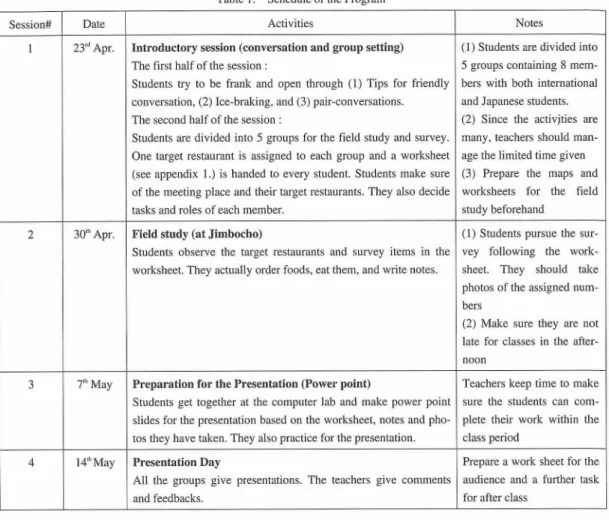
The program took four periods. The teachers outlined the schedule as below (every Monday, y period) On day 2, students might use their lunchtime as well. A rough schedule is shown below in Table 1.
3-4. Budget and E χpense
The budget for every student is 800 yen excluding tax. The total expense is supposed to be 25,200 yen for 28 students and 2 teachers. The university can partially cover the expense.
4. Details of each Session
Details of aims and outcomes of each session of the program are as follows.
4-1. Session l (1 )Aims
Session l is for communication activities. The students need to break the ice and receive tips for friendly communication. To make their collaborative survey successful. they should become close to each other in thissession.
Since the activity takes place in April, the beginning of the new academic year, even Japanese studentsare anxious to make new friends. The students are e χpected to make friends, including with the international stu-dents.
In general, international students are more e χperienced at engaging in conversations with people they firstmeet than Japanese students, because by coming to Japan, they have e
χperienced living in another country. Theteachers arranged as many communication pairs as possible consisting of Japanese students and internationalstudents.
Of course. there are a greater number of Japanese students, and therefore some pairs consist of onlyJapanese students. However,
Table 1. Schedule of the Program
Session# Date Activities Notes
1 23" Apr. Introductory session (conversation and group setting)The first half of the session :Students try to be frank and open through (1)Tips for friendlyconversation,
(2)Ice-braking, and (3)pair-conversations.The second half of the session :Students are divided into 5 groups for
the field study and survey・One
target restaurant is assigned to each group and a worksheet
(see appendiχ 1.) is handed to every student. Students make sureof the meeting place and their target restaurants. They also decidetasks and roles
of each member. (1)Students are divided into5 groups containing 8 mem-bers with both internationaland
Japanese students.(2)Since the acdvjties aremany. teachers should man-age the limited
time given
(3) Prepare the maps andworksheets for the fieldstudy beforehand
2 30* Apr, Field study (at Jimbocho)Students observe the target restaurants and survey items in theworksheet.
They actually order foods. eat them, and write notes. (1)Students pursue the sur-vey following the work-sheet. They should takephotos of the assigned num-bers(2)Make sure they
are not late for classes in the
after-noon
3 7" May Preparation for the Presentation (Power point)Students get together at the computer lab and make power pointslides for the presentation based on the worksheet, notes and pho-tos they
have taken. They also practice for the presentation.Teachers keep time to makesure the students can com-plete their work within the
class period
4 14*May Presentation DayAll the groups give presentations. The teachers give commentsand feedbacks.Prepare a work sheet for theaudience and a further taskfor after class
(2)Effects
The results showed that students enjoyed the communication activities and became close enough to pursue
their collaborative survey in the ne χt session. After listening to the explanation of the survey worksheet (see Ap-pendix 1), they discussed the survey in their groups.
4-2. Session 2 (1 )Aims
Session 2 is for the collaborative survey. The pairs of participants are divided into 5 groups, and each group visits an assigned restaurant. Following the guidelines on the worksheet handed out in the previous session, they order foods, take notes, and photographs. The international students are expected to give their opinions about the differences between Chinese food in their countries and in Japan. For Japanese students. it is a good chance to listen to “live" opinions : they can actually eat the foods. In other typical shai'ed cross-cultural activities. foods
140 東 洋 大 学 人 間 科 学 総 合 研 究 所 紀 要 第15 号 (2013 )
are sometimes offered, but participants have to try hard to find mutual conversation topics. However, since thestudents have a shared
mission this time, they can talk to each other enthusiastically. (2)Effects
The result was that the students discussed enough during lunchtime and completed their survey.
4-3. Session 3 (1)Aims
Session 3 is for the planning the presentation. First, based on the data they collected, the students decidewhat to talk about, which photos to show, and
so on. Second, they cooperate to make slides for presentation inthe computer lab. Because the students are freshmen. the teachers need to suggest some tips for how to manageeffective
discussions and engage in brainstorming ・
The teachers did not assign this planning as homework because most of the international students do not
have time to get together again due to their part-time jobs. Therefore, eveiything should be done in one period(90 minutes).
(2)Effects
One of the teachers acted as a timekeeper to manage the limited time. Students discussed well and most of the groups completed their planning in time. The groups that could not complete it managed to divide their work among the members without having additional meetings.
4-4. Session 4 (1 )Aims
In 90 minutes, each of the 5 groups gives a presentation for 15 minutes. Students are e χpected to take notesso that they can ask questions. They need to vote for the best presentation as well.
As an established rule. all the members should be given a chance to talk in public, i.e., it is not acceptablefor a student to choose a representative to give the presentation. This is a good opportunity for the international
students to give presentations in front of native Japanese speakers. For the Japanese students, it is stimulating tosee good presentations in Japanese by the international students.
(2 )Effects
All of the students were given a chance to make a presentation in public. The good presenters became mod-els for the other students. Some international students gave good presentations in Japanese, and they astonished
the Japanese students.
Students' findings included many different points of view. Examples of what they pointed out are as fol-lows :
-Difference in what the restaurants served (e.g・, Ebichi 凪chili-peppered prawn, is not originally fromChina)
-Difference in tastes (e・g・, Sichuan cuisine such as Ma po tofu and tantan men is much hotter in China)
-Difference in the interior design of the restaurants (e.g., Japanese style or a luxury western style in Japan)-Difference in customs (e ・g・, the Chinese do not eat noodles with rice)
-Difference in the service (e ・g., Oshibori is not common in China ; waiters in black suits are rare in China ;hall staff are very kind in Japan , and so on)
5. Results
Both the Japanese and the international students viewed the program favorably. Most of them commented that they would like to have another opportunity to participate in similar events. The students' comments ai'e ba-sically positive.
The Japanese students commented that it was almost their first experience of meeting international
stu-dents ,especially Chinese stustu-dents. and they confessed that they had changed their image of Chinese people :they became more interested in China. Two stustu-dents commented that they usually get information about Chinathrough TV or the Internet, and this program presented them a good opportunity to actually listen to Chinesestustu-dents.
Some students commented that they discovered different points of view about culture through conver-sations with the international students. A student pointed out that having lunch at a Chinese restaurant with theinternational students had not only led them to e
χpand their comments beyond “delicious" or so on, but also thatthis program made her 100k at Chinese cuisine from other points of view 。
The international students commented that this activity was very good for a cultural exchange with Japa-nese students. Some students suggested that talking about ChiJapa-nese food based on actually eating them was a
genuinely good e χperience. This activity taught the Japanese students about foods in China, which made themmore confident. A student from the Philippines also enjoyed the activity, and she discovered cultural differencesamong the Philippines, China,
and Japan. The international students talked about their countries to the Japanesestudents,
but they also found new points of view through the conversations with the Japanese students. It wasalso an opportunity for them to look at their own countries and at Japan from different perspectives 。
Both the Japanese and international students shared one mission while pursuing this field study, which was
to make their communication meaningful. According to a research study by Tsuboi (1991), the major reasonswhy Japanese students did not have friends who were international students and why international students did
not have Japanese friends were (l)they did not have opportunities to get to know each other and (2)they couldnot find mutual interests to talk about. He compared the lifestyle and interests of both Japanese and international
students and found that there was a big gap between them. However, because this program offered the studentsan opportunity not only to meet each other but also to collaborate on a field study, they were able to identify
142
mutual interests.
東 洋 大学 人 間 科 学 総 合 研 究 所 紀 要 第15 号 (2013 )
6. Conclusion
Overall the program could be regarded as successful. In session 1, the students learned communication
skills, as the teachers had e χpected. This session built a good foundation for all the students to collaborate witheach other in the succeeding sessions. In session 2, the students enjoyed conversations and pursued their surveyas had been planned. They discovered many cultural differences. according to the worksheet. Their commonmission helped
them make their communication meaningful. In session 3, they could complete their task within the time allotted, although for some of them, making presentation slides on a computer was a new experience. Students also learned that they could go beyond their cultural differences to collaborate with each other. In
ses-sion 4, they learned how to give an effective presentation through an actual opportunity to make a presentationand listen to the other presentations. In all the sesses-sions. the students' remarks were completely autonomous andmuch more than superficial. The discusses-sions
were real and meaningful. It is possible to conclude that this pro-gram genuinely improved the previous situation described 。
Because the students who participated in this program are still freshmen. many things looked new to them.
The program motivated them for their new campus life. But it might have been different if they had been upper-classmen. The author would like to emphasize that this program helped the students learn how to be open to new
relationships. It helped them not only to communicate on friendly terms with people from different countries butalso to make new friends from their own countries. Before they entered the university. most of them had limitedrelationships in their small communities. The Japanese students were confined within their own high schools,and most of the international students
were attending language schools. The author is convinced that this pro-gram offered an opportunity for them to learn communication skills that will be useful for them to make new re-lationships and to challenge new things 。
After two months had passed. the author asked the international students whether they still maintained con-tact with those Japanese students. Some students answered that they sometimes talked with those Japanese friends on campus, but that they did not go beyond that. The author hopes that all the students who took part in this program will take full advantage of this experience to enhance their cross-cultural understanding ・
Acknowledgement : l wish to e χpress my gratitude to Professor Setsuko Kakimoto, the other teacher involved inthis program.
Reference
Bochner, S., McLeod, B., and Lin, A. 1977. Friendship patterns of overseas students : a functional model. International Jour-nal of Psychology, 12,277-294.
Furnham, A. and AlibhaLN, 1985. The friendship networks of foreign students : a replication and extension of the functionalmodel. International Journal of Psychology, 20, 709-722
田 中 共 子(2000 )『留 学 生 の ソ ー シ ャ ル ・ ネ ッ ト ワ ー ク と ソ ー シ ャ ル ・ ス キ ル 』 ナ カ ニ シ ヤ 出 版
坪 井 健(1991 )r ア ジ ア の 学 生 ・ 日 本 の 学 生 一 留 学 生 調 査 と 日 本 ・ 台 湾 ・ 韓 国 の 比 較 調 査 を 通 し て ー 』 駒 渾 社 会 学= 研 究, 23, 115-144
東 洋 大 学 人 間 科 学 総 合 研 究 所 紀 要 第15 号 (2013 ) 144
Appendix 1. The Worksheet
j ? g 回 g ど タ タ タ タ -( 呂 ●四11m
1
で
|
{J
- N -寸−
ル
゜
¬
−
』
1
−
∃
・Q
∽
|
|Ea3
{∽ | ≪ ∽1 コJj』
← 八 m 々 に 口 3 1 U E U S ] U G . i n R l S 3 > T [ s i u a p n i s │ u i i O T ] i ; u J 3 i u i P U F a s a u G d u r i j i o q l u o j j ) s j u a u i L U c u ⋮ t ' S p ' I S ■ ( S U 1 3 1 1 f u c i i i 3 J 0 L U ) s o u i d d i i i u j a m J O c u t u t u i o j i a o u a j a j j T Q ■ ■ c 3 p [ [ S ■ s a j n p i d p u i ; ' a o u d ' ( s ' i u d i t ( 7 -x i ; [ a j ] p o j D p j o n o o -T ■ 。 。 z = > v \ \ % ■ ^ j n i -i i d J 0 I J 3 1 X 3 ' j u t J j n i J i s s j l o s u i r z . : 一 3 P ! I S ■ : s i u a i u o n s a p i i s 寸 ■ a n o . i r i J 3 u s a i n u i m n ︻ : 3 1 U I I l u o i i n m o s a i j ︼ OlLliqiJOS ︶XXXXXXXX-XXX : '" ≫ \ ailfloui SJaiiacaj.ojin 3JBW-liin!S 7 ﹄3ipi!Dl U1IA \ lUlOd oUll3:>W ︼ ■ j 3 L │ i ( ) i p n a l u o j j l J i i d n p p m ; u o i i n i u a s a j d j n o ^ ﹄ o j m n p i i S n o i i a s a k u n O i ( a j i i s 5 -A V . y ^ 。 ■ { s j o i u o i s n o p u t ! │ i ≪ i s l u n j n n j s o j 3 i D q . r ヨ s i p i o i i o p ) s i i i n j n i ? ) S 3 J o u i o n i s i n o s u o i u i d o j n o X o S u c i p x g . S U I I U 3 J 3 1 1 V ■ ] i ^ ^ 3 . ^ x ^ 1 0 1 1 o n " ( x n i S u i p n i n x o ) i i o s u o d j ? d U D 。 C n O S s i p S p n o ■ ( s o s i i o d x o t i A \ o j n o X j o a o s o i o a i u │ n o X ' 1 0 1 1 │ i ) i d i o o o j o i n O N u i o i o -i n s o ^ j i i v ^ ■ 1 1 0 1 1 W O P O U I 1 1 1 S 3 1 0 1 1 O N t ! l . ■ ( s j o u i o i s n a p i r n i i i i i s i i i m コ i n s 3 J 3 1 1 1 j o i ^ s 3 i J i i O 3 p u n u o i i i u B p i s u o o A \ o [ ( s ) S I U 3 1 1 1 0 . T ^ O A J O s i i i o L i i T p i i o i i ; 3 1 1 1 > │ m i p i o A V ■ ■ { o r q m i s s p s i p a A J S s s j n s i K a i i i s l i i u 3 L ( m ) s a j i i p i d a N U ] o i u o i s y i i u j D d n s w ■ ■ s j 3 u i o i s n : > J 3 1 1 1 0 j o s a j n p i d S u q u i p i o 。 \ v ■ ■ J 0 U 3 1 X 3 _ s u i m m ; i s 3 J 3 1 1 こ o K O J n p i d s J i n i n o ^ i i a i r M s i i i n J l 0 1 i n t c u n a a q . S S J I l l O i d S N B t I I O j ^ U S I I M 一 s u o i i s s o o n s l ■ 3 u l l i ; i [ 3 p i m l d t 3 3 3 J 3 L │ 1 u [ p u i i i i 0 1 S J 3 L 1 . 1 1 1 3 J a m u i e m l u i o d S u i i a a i u a u ] o i a M m i u s s a j c i a i l u s p m s r p u a s " / C a A J i i s s m S i i n a i d L u o o J c u j v ■ ■ s ] │ ! Q 3 1 1 1 3 D l 3 S n o ^ ≫ 3 q A \ X j i s j a A t u f ] o X o j _ o i p s s s a j p p G l d i a o a j i : S A i a M y . ’ l o o u s v j o M O L i i 0 1 3 u i p J O 3 3 B X o A j n s H j a n p i i o r ) . ■ ( a a u d p L i c s u i e u ) i i ! 3 n o / i j r u a v j o s a j o u 3 > ( e r . ■ U O O S D U G . p o o l ' 3 : i i i i u i ! ? d d i ! i i ! u j o i x o s l u c j n m s o j o i n ( o s c u n i o i d o n i j j 。 . ■ S J 3 L p i ! 3 i 3 4 1 l u o j i / ^ a u o L U a q i S A i a o a j p u i ; n ^ ' ^ [ │ O J i ; 3 > n ; j . . u o u u i c o u n o q i u i f J O ] i X 9 / _ v 3 4 1 U ' J ^ m ^ S o i i s o . [ . . -i s n u i n o i ] s e s s j s A O D U E e u u Q m i M u o s u e d u i o n : s s d u s n b i u n s ) i p i ︼ a ︻ l E d G f H I s u i s i n D a s a u i i n【Abstract
】
異文化交流の試み一留 学生との協働フ ィールド スタディ ー−
村 田 由 美 恵 *
異 文化 交 流 の た め の ア ク テ ィビ テ ィ は、 学 生 の異 文 化 理 解 を 促 進 す る ため 、 また 留 学 生 の 適 応 を 促 す ため に 有 効 であ る と 考 え ら れ る。 し かし 、 こ れ まで 学 内 で 催 し て き た異 文 化 交 流 行 事 は、 交 流 が 一 過 性 で 長 続 きし ない 、 発 言 が 表面 的 に 終 わ る な ど の難 点 が あ っ た。 本 稿 は、 こ の 状 況 を 改 善 す る た め に企 画 さ れ た 新 し い 試 み につ い て 報 告 す る も の であ る。 す な わ ち、 日木 人 学生 と留 学 生 か 、 と も に 日 本 の 中 華 料 理店 で 実 際 に 試 食 し 、 日 本 にお け る 中 華 料 理 の 独 自 性 や 、 本 場中 国 を含 む他 の国 の 中華 料 理 と の 相 違 を調 査 す る とい う フ ィ ー ルド ス タ デ ィ ー を核 に、 コ ミ ュ ニ ケ ー シ ョ ン ス キ ルの 向 上 や 異 文 化 理 解 を 促 進 する プ ロ グ ラ ム を 企 画 し た 。 そ の結 果 、 有 意 義 な デ ィ ス カ ッ シ ョ ン が 行 わ れ、 学生 た ち の相 互 交 流 が促 進 さ れ た。 今 後 も 交 流 が 続 き、 異 文 化 理 解 が 深 め ら れ る こ と を 期待 し たい 。 キ ー ワ ード : 異文 化 交 流 、 異文 化 理 解 、 フ ィ ー ルド ス タデ ィ ー、 留 学 生 、 中 華 料 理The aim of cross-cultural activities is to foster cross-cultural understanding in all students and facilitate adaptation to the
host country by international students. However, the success of previous activities planned by teachers, including the author,was limited by factors such as events tending to create only temporary interaction. and students failing to go beyond superfi-cial commentary. This paper discusses a new approach designed to
improve the situation. A program was designed to enhance communication skills and foster cross-cultural understanding, centered on a field study in which Japanese and international students together visited Chinese restaurants in Japan and sampled the food. exploring the unique features of Chinese restau-rants in Japan and their differences with Chinese restaurestau-rants in other countries, including China. To ensure the success of the field study, activities for developing communication skills were also held beforehand. As a result, meaningful discussions
were expanded, and the e χperiences enhanced students' cross-cultural understanding. It is eχpected that efforts such as thisprogram will encourage cross-cultural e χchange among students in the future.
Key words : cross-cultural eχchange, cross-cultural understanding, field study, international students, Chinese cuisine