B11
Experimental Study on Transportation of Suspended Sediment on Side Basin
〇 Rocky TALCHABHADEL, Hajime NAKAGAWA, Kenji KAWAIKE
1. Introduction
The transport of suspended sediment is a key process associated with flows in rivers, reservoirs, estuaries and coastal regions (Zhou et al, 2003). The rivers of southwestern region in Bangladesh are characterized by active deposition of sediment. In addition, the sedimentation problem has been aggravated in this region by the construction of costal polders that de-linked the floodplains from the rivers (IWM, 2005).
The present practice is that link canal is constructed which connects the tidal basin with the river by cutting embankment as shown in Fig. 1. Muddy water enters the tidal basin during high tide, depositing major portion of suspended sediments before flowing back towards the ocean during low tide (Khadim et al, 2013). An attempt has been made through laboratory experiments to study transport of suspended sediment to understand tidal basin management.
Fig.1 Embankment cut to connect with tidal basin
Fig.2 Schematic view of the experimental setup
The flume is meandering and facilitated with side basin (Fig. 2). Transport and deposition of suspended sediment are investigated under different experimental conditions. Water flow and dry sediment were given continuously from inlet, side basin was equipped with changing outflow discharge.
2. Results and Discussions
Firstly two cases were investigated as Case 1 with no outflow discharge from side basin and Case 2 with 40% of inflow as outflow discharge from side basin. After conducting experiments for 4 hrs in both the cases, the final bed level measured from laser displacement sensor is shown in Fig. 3 and differences of bed level between two experimental cases is shown in Fig. 4.
Fig.3 Final bed level in case1 and case2
Fig.4 Change in elevation between two experimental cases Inlet
Outlet
Side basin
Case 1 – Case 2
Tidal prism increased River flow u/s of basin: Low River flow d/s of basin: High Sediment settles in tidal basin Sediment settles in river River T ida l B as in F loodp la in de -li nke d by e m ba nk m e n t Side view Top view
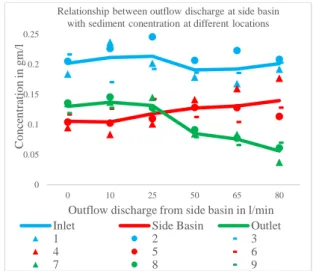
Fig. 5 Sediment concentration at 9 sampling points with varying outflow discharge from side basin
Secondly the outflow discharges of side basin were varied from 0 - 64% of inflow. With increase in outflow discharge towards side basin, sediment deposition increases in side basin and decreases in river bed (Fig. 5). The solid line in Fig. 5 denotes the average of corresponding sampling points such as inlet (1-2-3), side basin (4-5-6) and outlet (7-8-9).
Finally by adjusting speed of sediment feeder, different input conditions of sediment were supplied with outflow discharge at side basin as in Case 2. Within the range of 0 – 0.7 mg/l, the proportion of distribution of sediment towards side basin to outlet is almost same in the range of 1.4 – 1.6 (Fig. 6).
Fig. 6. Sediment concentration at side basin and outlet Vs sediment concentration at inlet
3. Conclusion
The present experimental work investigated the suspended sediment transport and deposition at side basin representing tidal basin. A steady inflow scenario was tested with fixed bed condition. From the experimental study it can be concluded that deposition of suspended sediment mainly depends upon the direction of flow and magnitude of discharge flowing towards it.
Side basin in current study represents only the entrance of tidal basin. Moreover it has other limitations like fixed bed, no tidal effect, constant inflow discharge, no lateral widening of side basin, shape and size of side basin. It has to be expanded in the next experiment with larger size of side basin, availability of facility to address tidal effect and varying size of link canal joining flume and side basin. The next stage experiment is currently in progress.
Next step will be to develop and verify numerical model which would enable to estimate deposition of suspended sediment in side basin taking consideration of tidal effects also.
References
Institute of Water Modelling (IWM), “Monitoring of Hydrological and Hydraulic Parameters on Tidal River Management under KJDRP Area,” Dhaka, Bangladesh, 2005.
Khadim, F.K., et al. 2013, Integrated water resources management (IWRM) impacts in south west coastal zone of Bangladesh and fact finding on tidal river management (TRM), Journal of Water Resource and Protection, 5.
Zhou, J., Lin, B.L. and Lin, B.N. 2003, Rational basis for suspended sediment modeling, International Journal of Sediment Research, Vol. 18, No. 3.
0 0.05 0.1 0.15 0.2 0.25 0 10 25 50 65 80 C o n ce n tr at io n i n g m/ l
Outflow discharge from side basin in l/min
Relationship between outflow discharge at side basin with sediment conentration at different locations
Inlet Side Basin Outlet
1 2 3 4 5 6 7 8 9 0 0.1 0.2 0.3 0.4 0.5 0 0.1 0.2 0.3 0.4 0.5 0.6 0.7 0.8 C o n ce n tr at io n i n g m/ l concentration in gm/l at inlet Relationship between sediment concentration at
inlet and side basin & outlet
Side Basin Outlet