Effect of the WISH-type Hip Brace on Postural Control
in Patients with Osteoarthritis of the Hip:
Evaluation using the Cross Test
Ena Sato , Takehiko Yamaji , Takahisa Sato , Makoto Hasegawa , Kenji Shirakura ,
Takashi Yanagawa and Hideomi Watanabe
1 Division of Rehabilitation Medicine, Gunma University Hospital, 3-39-15 Showa-machi, Maebashi, Gunma 371-8511, Japan
2 Department of Rehabilitation Sciences,Gunma University Graduate School of Health Sciences, 3-39-22 Showa-machi,Maebashi,Gunma 371-8514, Japan
3 Department of Orthopaedic Surgery, Gunma University Graduate School of Health Sciences, 3-39-22 Showa-machi, Maebashi,Gunma 371-8511, Japan
Abstract
Background:The WISH-type S-form brace,a type of hip brace,has been shown to improve hip function,functional mobility and gait biomechanics in patients with osteoarthritis of the hip.
Aims:The effects of the brace on postural control were evaluated. M ethods: The Cross test using a force plate was performed.
Results:The hip brace showed a direct beneficial effect of improving the maximum excursions of the center of pressure in both the medial-lateral and anterior-posterior directions. The performance in the Cross test of patients using the brace improved in the later phase,indicating an indirect effect of the brace. Interestingly,the brace also exerted a direct effect on the muscle strength of the braced leg in both hip flexion and adduction.
Conclusions: Augmentation of the power output of the adductor and flexor muscles by the brace may support the moment required for resistance against the upper body mass leaning on the braced side and backward,which may allow the excursions to be augmented.
Introduction
Symptoms of osteoarthritis (OA) of the hip include joint pain,tenderness,limitation of movement, crepitus, limping, associated with variable degrees of local inflammation,which often cause these patients to face difficulties in performing their normal daily activ-ities and work. Increased joint stiffness, which is related to balance both while standing and walking,is a common clinical sign in patients with OA of the hip. Conservative treatments,consisting of analgesics,phys-ical therapy and bracing,are not curative,and in severe cases, hip arthroplasty cannot be avoided. However, the duration of survival of the joint after primary hip arthroplasty is not long, revision surgery becoming necessary in many patients. Thus,conservative treat-ments play an important role in extending joint sur-vival time especially in younger patients.
Recently,we developed the WISH-type hip brace, and demonstrated a high compliance of OA patients for the use of this brace,with successful hip-functional response of both patients with bilateral and unilateral OA. We evaluated the biomechanical effects of the brace on gait using a force plate to address the mecha-nism by which the brace improves the hip function in OA patients. The results showed a stronger vertical reaction force at the first peak in the early stance,and early switch from backward to forward reaction force
Article Information Key words: hip osteoarthritis, WISH-type, hip brace, Cross test Publication history: Received: January 13, 2016 Revised: April 13, 2016 Accepted: April 15, 2016 Corresponding author: Hideomi Watanabe
Department of Rehabilitation, Graduate School of Health Sciences, Gunma University 3-39-22 Showa-machi, Maebashi, Gunma 371-8514, Japan
Tel:+81-27-220-8945
E-mail: watanabeh@gunma-u.ac.jp
vectors as effects of the hip brace. These findings suggest that patients with OA of the hip have closer to normal gait when using this brace. Furthermore, to evaluate the effects of the brace on the functional mobility, we performed the Timed Up & Go (TUG) test with the right and left turns separately in each subject. In the patients with bilateral OA using the hip brace, the average time to complete the TUG test was significantly shorter than in those not using the brace. In patients with unilateral hip OA,use of the hip brace was associated with a significant improvement in turn-ing of the unbraced leg inside(ULI),but not in turnturn-ing of the braced leg inside(ELI),in the TUG test,suggest-ing that the brace exerted a direct effect on the hip function in the turning phase of the TUG test. On the other hand, significant improvement of the perfor-mance in the TUG test was found at the 3-month follow-up, which was maintained until the 12-month follow-up. This improvement was independent of the use of the brace at the time of the assessment,suggest-ing that mechanical improvements due to daily exercise may provide an indirect, but essential effect of the brace on the performance in the TUG test; however, no direct evidence of improvement of the muscle strength around the hip joint has been obtained yet. This may suggest the prophylactic effect of the brace against the risk of fall.
The Cross test is one of the tools to measure the balance while standing, similar to the Functional Reach Test (FRT). The Cross test allows patients to lean on the force-plate in four directions: forwards, backwards, to the right, and to the left, enabling easy visualization the trajectory of the center of pressure (COP). Judging from the results, it appears that the range and area of the trajectory are useful for evaluat-ing the severity of a patients standevaluat-ing dysfunction and also the effects of therapeutic interventions. Ascer-tainment of how secure a patient with hip OA is while maintaining an upright posture is often important from the viewpoint of evaluating his/her performance in the activities of daily living (ADL). In the present study, we examined the effect of the WISH-type brace on postural control and muscle strength around the hip joint using the Cross test and a handheld dynamometer (HHD), respectively, in patients with OA of the hip.
Subjects and M ethods
Subjects
Between April 2007 and April 2012,patients with unilateral OA of the hip were referred to the outpatient clinic of Gunma University Hospital with complaints of symptoms of OA of the hip. Hip OA was defined according to the clinical criteria of the American College of Rheumatology. Patients in whom the hip pain induced by weight bearing during gait was clearly reduced by manual pressure on the greater trochanter were recruited for this investigation. Subjects who were on a waiting list for hip replacement or had already undergone a hip replacement were excluded.
Subjects in whom a WISH-type hip brace was being used for both hips were also excluded. The radiological grade of OA was estimated according to the grading system proposed by Crowe et al., and patients with radiological grades III and IV were excluded.
The study was conducted with the approval of the local ethics committee (Gunma University, Maebashi, Gunma, Japan), and informed consent for the study was obtained from each individual participating in the study.
WISH-type hip brace
The WISH-type hip brace is a modified version of the Wakayama Medical College-type brace. In origi-nal type of WISH brace, the pelvic portion of the hip brace holds it at the correct position against the pelvis to prevent rotation of the brace, and provides a ful-crum for the lever through a lateral bar. The lateral bar possesses a single joint allowing for hip flexion and extension near the peripheral edge. Another joint allowing hip abduction is located at the peripheral edge,and the combination of these two joints restricts only hip adduction. The peripheral joint provides a fulcrum between the S-form bar as a power point and the greater trochanter pad as a working point. Through a universal joint, the third joint allows the pad face to meet the trochanter correctly, and the pad then pushes the greater trochanter inward when the affected limb is abducted or bears weight.
The present WISH-type hip brace is lighter and more compact than the original hip brace. In this brace, the Thrust Bearing Hip Joint Assembly, Vari-able Abduction (Fillauer LLC, Chattanooga, TN) is utilized as the lateral bar. An upper extended bar is fixed inside the lower hip joint bar. Then,the greater trochanter pad and the universal joint are removed, and the greater trochanter pad is fixed directly to the upper extended bar attached to the lower hip joint bar with a copolymer polypropylene material. Further-more,an S-form bar holding the thigh is replaced with copolymer polypropylene material in continuity with the greater trochanter pad. The WISH-type hip brace weighs around 0.9 kg, and the lateral prominence due to the lateral bar is reduced. Patients using the WISH-type hip brace are required to walk for at least half an hour every day in order to strengthen the muscles around the hip joint required for gait. Cross test
Postural sway was assessed using a force platform (Twin Gravicorder G-6100,Anima,Tokyo). The force platform detected the medial-lateral and anterior-posterior displacement of the COP. The participants were asked to stand on the force platform without shoes, quietly gazing straight ahead, with the feet spaced 15 cm apart and arms by sides. The participants then performed 40 seconds of the double-leg stance test with eyes open. The Cross test movements started with the subject standing for about 4 seconds, followed by
slow incline of the body forward for about 4 seconds with the examiner counting up to eight, and then return to the neutral position in the same way (Fig. 1A).
In continuation, the inclination was repeated in the same way, but backwards (Fig.1B), to the right (Fig.1C), and to the left (Fig.1D), in that order. As shown in Fig.1,throughout the movements,hip move-ment was avoided as much as possible, so that the movements were directly related to the ankle strategy, as in the FRT test. The parameters measured for the
COP analysis included the maximum excursions in the medial-lateral(XD)and anterior-posterior(YD)direc-tions (Fig.2).
M uscle strength assessment around the hip
The muscle strength testing was performed with the patient lying on an examination table,according to the method described by Thouborg et al., using the Power track II Commander (JTECK MEDICAL Midvale, UT). The HHD was calibrated on each test day and all the test procedures were standardized. All
Fig.1 The Cross Test movements started with standing for about 4 seconds,followed by slowly inclining the body forward for about 4 seconds and returning to the neutral position in the same way(A). Continuously, the inclination was repeated in the same way backwards (B), to the right (C), and to the left (D), in this order. Throughout the movement, hip movement was avoided as much as possible, so that the movement was directly related to the ankle strategy.
Fig.2 A representative trajectory of COP. The parameters of COP analysis included maximum excursions of the distance of medial-lateral (XD) and anterior-posterior (YD) directions.
the strength tests were isometric strength tests. Each subject performed hip flexion (FLEX), abduction (ABD), adduction (ADD), and knee extension (K-EXT). These movements were tested in the sitting position for FLEX and K-EXT, and in the supine position for ABD and ADD, corresponding to HF-SIP, HIR-HF-SIP, HABD-SUP and HADD-SUP, respec-tively, in the report of Thouborg et al. The partici-pants were told to stabilize themselves by holding on to the sides of the table with their hands. The examiner applied resistance in a fixed position and the person being tested exerted a 5-second isometric maximum voluntary contraction (MVC) against the dyna-mometer and the examiner. In the present study, the examiners hand was set just ab
ove the knee joint for the hip movements, so that involvement of the knee joint was avoided. For the examination of K-EXT, the resistance was applied at the level of the malleoli. Each individual test was administered three times to reduce a possible learning effect. There was a 30-second rest period between two consecutive trials,being introduced to avoid a decline in strength across trials due to fatigue in patients with spinal cord injury.
Statistical analyses
The Shapiro-Wilk test was performed to deter-mine whether the data were normally distributed. Then,the paired t-test or Wilcoxon matched-pairs test was used to analyze the dependent variables within individuals for normally distributed data and other data, respectively. The unpaired t-test or Mann-Whitney U test was used to analyze the independent variables for normally distributed data and other data, respectively. P values of <0.05 were considered to indicate statistical significance.
Results
Patient characteristics and follow-up
A total of 27 patients (1 male, 26 females) were recruited (Table 1). The patients ranged in age from 32 and 74 years,and the average was 53.9 years(SD,11.5). The period of follow-up ranged from 0 to 12 months, with an average of 7.7 months (SD, 5.1). Eleven patients had right-side involvement and 16 patients had left-sided involvement. In regard to the radiological grades,there were 16 patients with grade I
Table 1 Patient characteristics Patient
number age sex ragiologicalgrade OA hipsite of Evaluation (M o )
1 49 F L 0 1 3 6 12 2 74 F R 12 3 69 F L 6 12 4 32 F L 0 1 3 6 12 5 41 F R 12 6 46 F L 6 12 7 48 M L 0 1 3 6 12 8 68 F R 12 9 66 F L 0 1 3 6 10 41 F R 0 1 3 6 12 11 43 F R 0 1 3 12 59 F R 0 1 3 6 12 13 71 F R 0 1 14 70 F R 0 1 3 6 12 15 52 F L 0 1 3 16 65 F L 0 1 3 17 59 F L 0 1 3 6 12 18 50 F L 0 1 3 6 12 19 59 F L 0 1 3 6 12 20 50 F L 0 1 3 6 12 21 49 F L 0 1 3 6 22 38 F L 0 1 3 23 54 F R 0 1 24 58 F L 0 1 25 51 F R 0 1 26 36 F R 0 27 57 F L 0
OA osteoarthritis, Mo month, M male, F female, R right, L left a Radiological grade was evaluated according to Crowe et al. b Mo indicates month(s) after equipment.
c Muscle strength assessment is performed 2 hours before cross-test in the gray-color region. WISH-type hip brace effect on postural control using Cross test
involvement and 11 patients with grade II involvement. Effect of the WISH-type hip brace on performance in the Cross test
As shown in Fig.3, the overall averages of the maximum excursions of the COP to complete the XD and YD were 14.84±4.1 cm and 12.03±2.62 cm respec-tively, when the WISH-type brace was not used, and 15.4±4.1 and 12.36±2.83 cm,respectively,when it was used. The improvements of Cross test with the use of the WISH-type hip brace were significant for both XD and YD,suggesting that the WISH-type hip brace may have positive effects on the standing balance of patients in both the anterior-posterior and lateral directions.
At the assessment one month later,the effect of the
brace on the Cross test results was found only for XD (Fig.4).
Time-course of improvement of the Cross Test after use of WISH-type hip brace
Significant improvement of the XD was found at the 6-month follow-up assessment (Fig.4A), and sig-nificant improvement of the YD was found at the 12-month follow-up assessment (Fig.4B) in the patients using the WISH-type hip brace (Fig.4A). These findings suggest that the effect of the hip brace on improvement of the excursion distance may not be obtained immediately, but only after some time. Effect of WISH-type hip brace on the muscle strength around the hip
directions in the patients with (white columns)and without (black columns)the hip brace. Bar indicates the standard deviation. Asterisk indicates a significant difference with a p-value less than 0.05 according to Wilcoxon matched-pairs test.
Fig.4 Time course of the maximum excursions of the distance of medial-lateral (A) and anterior-posterior (B) directions in the patients with (white columns)and without (black columns)the hip brace. Bar indicates the standard deviation. Asterisk ( ) indicates a significant difference between the maximum excursion of the distance with the hip brace and without it according to paired t-test. Double asterisks (**) indicate a significant difference from the excursion of the distance at entry stage,that is, month 0, according to Mann-Whitney U test (6 months in A) or unpaired t-test (12 months in B).
To examine whether the beneficial effects of the brace on the Cross test results was related to improved muscle strength,muscle strength testing was performed using the HHD in 11 patients who were recruited to the present study in the later stages (gray region in Table 1).As shown in Table 2,a high intra-class correlation coefficient (ICC) was obtained in the HHD measure-ments in patients with OA of the hip, consistent with the observations reported by other examiners.
Previous reports of a significant improvement of the performance in the TUG at the three-month
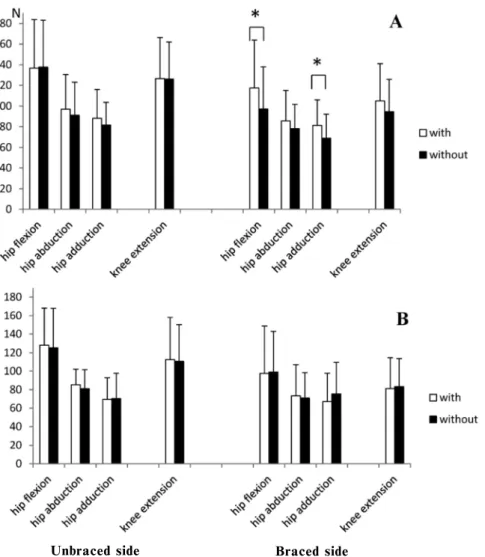
follow-up assessment in patients using a WISH-type brace suggest that muscle power improvement, which might be accentuated with daily exercise,may provide an indirect, but definite effect on the performance in the TUG test. Thus,in the present study,we evaluated the muscle strength separately in the early phase, that is, at 0, 1 and 3 months, and the late phase,that is,at 6 and 12 months. In the early phase, a significant improvement in the muscle strength of the hip flexor and adductor muscles was found on the braced side, but no effects on the unbraced side(Fig.5A). On the
Fig.5 Average of the muscle strength of hip flexion, abduction, adduction, and knee extension in patients with (white columns) and without (black columns) the hip brace. Evaluation was separately performed in the early phase,namely,0,1,and 3 months later(A),and the late phase,namely,6 and 12 months later(B). Bar indicates the standard deviation. Asterisk indicates a significant difference with a p-value less than 0.05 according to paired t-test.
Table 2 ICC (1, 1) for muscle strength mesurements
measurement WISH type hip brace
with without
braced side unbraced side braced side unbraced side
FLEX 0.961 0.935 0.943 0.921
ABD 0.954 0.953 0.959 0.919
ADD 0.96 0.959 0.956 0.908
K-EXT 0.967 0.968 0.92 0.942
FLEX hip flexion, ABD abduction, ADD adduction, and K-EXT knee extension WISH-type hip brace effect on postural control using Cross test
muscle strength were found in any muscles, on either the braced or the unbraced side (Fig.5B).
Discussion
In the present study, the use of a WISH-type hip brace resulted in improvement of the XD and YD in the Cross test,indicating that the WISH-type hip brace had a direct effect of extending the maximum excur-sions of the COP in both the medial-lateral and anterior-posterior directions. In particular, the direct effect of the brace was found in the XD in the earlier phase,that is,at one month. On the other hand,in the patients who continued to use the brace,both XD and YD improved in the later phase,namely,in the XD at 6 months and in the YD at 12 months, indicating indirect effects of the brace on the improved perfor-mance in the Cross test. Interestingly,direct effects of the brace on the muscle strength of the braced leg were observed in the early phase in both hip flexion and adduction.
The mechanisms underlying the direct beneficial effects of the WISH-type hip brace on the maximum excursions of the COP in both the medial-lateral and anterior-posterior directions are unclear at present. The movement patterns adopted to perform the FRT have been classified into three(hip,ankle,and mixed) different strategies to indicate the joint at which the reaching movement primarily occurred. In the Cross test used here,participants were not permitted to bend the hip joint during their inclination,corresponding to the ankle strategy, defined as beginning reaching with ankle dorsiflexion, with a total hip flexion range of smaller than 15 degrees. A higher correlation between the reaching distance and COP displacement was found when subjects adopted the ankle strategy, indicating that the extension of the maximum excur-sions of the COP may be closely related to the increase in the maximum ankle-bending angle, that is, the leaning angle of the body. It should be noted that an increase in the leaning angle with only the ankle strategy requires muscle power around the hip to resist the hip bending power induced by the center of gravity of the upper body. On the other hand, a direct effect of the brace on the muscle strength of the braced leg was observed in the early phase in hip adduction. In addition, a direct effect of the brace on the XD in the Cross test was observed in the early phase. These findings suggest that the adductor muscles being stren-gthened directly by the brace equipment may support the moment required for resistance against the upper body mass leaning to the braced side (Fig.1D) at the hip joint as a pivot point. Furthermore,a direct effect of the brace on the muscle strength was observed in hip flexion. Again, the flexor muscle strengthened by the brace may support the moment required for resistance against the upper body mass leaning backward (Fig. 1B), resulting in the extension of YD.
In the patients who continued to use the brace,
improvements observed in the later phase, namely, in the XD at 6 months and in the YD at 12 months, indicating indirect beneficial effects of the brace on the improvement in the Cross test. It has previously been shown that adoption of the habit of walking daily was significantly associated with the final improvement of the hip function scores at 12 months later. The improvement of the Cross test results may thus be due to the indirect effects of the brace on hip function, which was closely related to a high adherence to daily walking exercise.
The mechanism(s)underlying the augmentation of the power output in the muscles around the hip joint with the use of the WISH-type hip brace are also unclear at present. It has been reported that the femor-al head is displaced upward and outward in normfemor-al females upon weight-bearing, and that the displace-ment is more marked in patients with hip OA, result-ing in shortenresult-ing of the muscles over the hip joint. On the other hand,changes in the muscle length influence the integrated muscle activities and development of torque differently. During maximal isometric contrac-tion, an increase in the integrated electromyographic activity and decrease in torque occurred as the muscle was shortened;the opposite occurred when the muscle was extended. The WISH-type hip brace was devel-oped under the design concept that the brace is to reinforce the hip joint,to permit flexion,extension and abduction, to correct inadequate positioning of the limb, and to prevent upward and outward movement of the femoral head. These findings suggest that augmentation of the power output by the use of the brace may be due to dynamic stabilization of the femoral head against the acetabulum,which keeps the muscle length producing torque power.
The limitations of the present study may be the insufficient approach to the effects of the brace on the muscle strength,especially given the lack of evaluation of the strength of the muscles around the hip in the healthy leg. Careful comparative examination of the time-course of changes in the muscle strength around both the affected and unaffected hip joints would be useful to elucidate the mechanism(s) underlying the beneficial effects of the WISH-type brace on standing balance.
In summary, the beneficial effects of the WISH-type brace on the standing balance, as well as on the functional mobility, gait normalization and hip func-tion,were examined in the present study. Thus,use of the WISH-type hip brace should be considered before the performance of invasive surgery, such as total hip arthroplasty.
Acknowledgements
This work was supported in part by Grant-in-Aid for scientific research (C) 23592156 (H.W.) from the Japan Society for the Promotion of Science.
Conflict of Interest statement
No conflict of Interest is declared by all authors.
References
1. Steultjens MP,Dekker J,van Baar ME,et al. Range of joint motion and disability inpatients with osteoarthritis of the knee or hip. Rheumatology Oxford 2000;39:955-961. 2. Majewski M, Bischoff-Ferrari HA, Gruneberg C, et al.
Improvements in balance after total hip replacement. J Bone Joint Surg Br 2005;87:1337-1343.
3. Kawamura H, Mishima H, Sugaya H, et al. The 21-to 27-year results of the Harris-Galante cementless total hip arthroplasty. J Orthop Sci 2016; Mar 9. pii: S0949-2658 (16) 00022-1. doi:10.1016/j. jos. 2016.02.004.
4. Schmidl S, Jakobs O, Guenther D, et al. Effective preven-tion of recurrent dislocapreven-tion following primary cemented Endo-MarkIII/SP2 total hip arthroplastyusing a posterior lip augmentation device. Arch Orthop Trauma Surg 2016; Mar 5
5. Sato T, Yamaji T, Inose H, et al. Extended application of WISH type S-form hip brace for patients with bilateral painful osteoarthritis of the hip: report of two cases. Prosthet Orthot Int 2009;33:173-178.
6. Sato T, Yamaji T, Inose H, et al. Effect of a modified S-form hip brace, WISH type, for patients with painful osteoarthritis of the hip:a role in daily walking as a hip muscle exercise. Rheumatology 2008;28:419-428. 7. Yamaji T, Usuda S, Sato E, et al. Biomechanical analysis
of gait for patients with painful osteoarthritis of the hip treated with WISH-type hip brace. J Orthop Sci 2009;14: 423-430.
8. Sato E,Sato T,Yamaji T,Watanabe H. Effect of the WISH type hip brace on functional mobility in patients with osteoarthritis of the hip:Evaluation using the Timed Up & Go Test. Prosthet Orthot Int 2012;36:25-32.
9. Duncan PW, Weiner DK, Chandler J, et al. Functional Reach:A new clinical measure of balance. Med Sci 1990; 45:192-197.
10. Ishikawa A, Tanaka S, Fukuyama K, et al. Cross-Test to measure standing ability by voluntary movement. Phys Ther Sci 1992;4:35-44.
11. Shumway-Cook A, Woollacott MH. Motor Control-THIRD EDITION, 2009.
12. Altman R,Alarcon G,Appelrough D,et al. The American College of Rheumatology criteria for the classification and reporting of osteoarthritis of the hip. Arthritis Rheum 1991; 34:505-514.
13. Crowe JF,Mani VJ,Sanawat CS. Total hip replacement in congenital dislocation and dysplasia of the hip. J Bone Joint Surge Am 1979;61:15-23.
14. Kawamura T. Development of the S-form Hip brace of Wakayama Medical College Type for osteoarthritis of the hip. Nippon Seikeiigeka Gakkai Zasshi 1983; 57: 1665-1679. (Japanese with Abstract in English).
15. Liao CF,Lin SI. Effects of different movement strategies on forward reach distance. Gait Posture 2008;28:16-23. 16. Thorborg K, Petersen J, Magnusson SP, et al. Clinical
assessment of hip strength using a hand-held dynamometer is reliable. Scand. J. Med. Sci. Sports 2010;20:493-501. 17. Sisto SA,Dyson-Hudson T. Dynamometry testing in spinal
cord injury. J Rehabil Res Dev 2007;44:123-136. 18. Lunnen JD, Yack J, LeVeau BF. Relationship between
muscle length, muscle activity, and torque of the hamstring muscles. Phys Ther 1981;61:190-195.