INTRODUCTION
Human immunodeficiency virus type 1 (HIV- 1) envelope gly-coprotein (Env) displays a key function in viral life cycle by medi-ating the entry into host cells (1, 2). HIV- 1 Env is synthesized as a single polyprotein gp160 and subsequently cleaved to generate gp120 and gp41. Env acts as a trimer composed of a heterodimer of non - covalently linked gp120 and gp41. Gp120 is a surface pro-tein of virions, and binds to receptor CD4 and coreceptor CCR5 or CXCR4. Depending on the usage of CCR5 or CXCR4 for viral entry, HIV- 1 strains are categorized into R5 - tropic or X4 - tropic viruses, respectively. Gp41 is a transmembrane protein harboring cytoplas-mic tail (CT) region, and works for viral - host membrane fusion. Accumulating evidence suggests that the number of Env trimers required for viral entry is different among HIV- 1 strains (3 - 5). Env has a high capacity of mutation to escape from recognition by host immune system, and is a highly diverse protein in HIV- 1 proteins. This high mutation rate/diversity of Env induces strain - specific changes for viral fitness, neutralizing antibody resistance, and in-hibitor sensitivity, and strongly affects viral phenotypes (6, 7).
HIV- 1 virion assembly mainly proceeds by cooperation of four major domains of Gag polyprotein, matrix (MA), capsid (CA), nu-cleocapsid (NC), and p6. Gag - MA is associated with trafficking of the Gag polyprotein to plasma membrane, main site for virion as-sembly. Gag - CA induces Gag - Gag interaction to assemble viral structural proteins. Gag NC binds to viral genomic RNA, and Gag -p6 is implicated in membrane fission of viral particles and host cells (1, 8). It has been demonstrated that Gag - MA also functions for virion - incorporation of Env through interaction with Env gp41
CT (1, 9). Recent study showed that Gag - MA mutations (62QR and 66SR) rescue defects in virion - incorporation of Env/viral replica-tion caused by Gag - MA mutareplica-tions or by gp41 CT delereplica-tion (10). However, effects of these Gag - MA mutations on virion - incorpora-tion of Env/viral replicaincorpora-tion were examined only for X4 - tropic HIV-1 clone NL4 - 3 but not for the others.
We have been working on construction and characterization of rhesus macaque - tropic 1 ( 1rmt) clones to establish HIV-1/AIDS primate models that would greatly contribute to basic and clinical studies. We have successfully generated HIV- 1rmt clones for the first time that overcome species - specific barriers imposed by host restriction factors, APOBEC3 proteins, TRIM5 proteins, and tetherin (11). Although R5 - tropic HIV- 1rmt is important for clinical studies on AIDS due to its role in viral persistence and transmission in individuals, our R5 - tropic HIV- 1rmt clone desig-nated MN5/LSDQgtu (5gtu) grew more poorly than an X4 - tropic HIV- 1rmt clone designated MN4/LSDQgtu (11, 12). In this study, we investigated effects of Gag - MA mutations (62QR and 66SR) described above on R5 - tropic HIV- 1rmt life cycle (single - cycle in-fectivity, viron production, and multi - cycle replication). Our results here show that the Gag MA 66SR mutation positively acts on single -cycle viral infectivity.
MATERIALS AND METHODS
Plasmid DNAsGeneration and characterization of HIV- 1rmt clones MN4/ LSDQgtu (4gtu) and 5gtu (Fig. 1) have been previously described (11, 12). Introduction of Gag - MA 62QR and 66SR into proviral clones were carried out by the QuickChange site - directed mutage-nesis kit (Agilent Technologies Inc.).
Cells, virus preparation, and reverse transcriptase (RT) assay A reporter cell line TZM- bl carrying a luciferase gene driven by
ORIGINAL
Single-amino acid mutation 66SR in Gag-matrix enhances
viral single-cycle infectivity of R5-tropic HIV-1rmt
Naoya Doi, Yosuke Sakai, Yasuyuki Miyazaki, Akio Adachi, and Masako Nomaguchi
Department of Microbiology, Institute of Biomedical Sciences, Tokushima University Graduate School, Tokushima, Japan
Abstract : We recently constructed two rhesus macaque-tropic human immunodeficiency virus type 1 (HIV -1 rmt) clones with CXCR4 or CCR5 tropism, but a CCR5-tropic HIV -1rmt clone grew more poorly than a CXCR4-topic clone. It has been demonstrated that interaction between viral Gag -matrix (MA) and Env -gp41 cytoplasmic tail is important for virion -incorporation of Env. Concordantly, Gag -MA mutations (62QR and 66SR) that rescue defects in virion -incorporation of Env/viral replication were reported. In this study, we analyzed effects of these Gag MA mutations on R5tropic HIV 1rmt replication potentials. While introduction of 62QR into three HIV -1rmt clones tested reduced their multi -cycle replication ability in rhesus lymphocytes or abolish single-cycle infectivity for luciferase reporter cells, three R5-tropic HIV -1rmt clones carrying 66SR exhibited similar growth kinetics to those of their parental clones. One such clone, 66SR + 5gtu, appeared to induce stronger cytopathic effects than parental clone 5gtu. We therefore investigated effects of 66SR mutation on viral replication in more detail. Single-cycle infectivity of 66SR + 5gtu was enhanced relative to that of 5gtu, but 66SR + 5gtu virion pro-duction was significantly decreased compared to the 5gtu level. Gag -MA 66SR mutation may be useful to im-prove growth potentials of the R5-tropic HIV -1rmt clones. J. Med. Invest. 62 : 228-232, August, 2015
Keywords :HIV-1rmt, Gag-MA, Envelope, R5-tropic
Received for publication May 28, 2015 ; accepted July 10, 2015. Address correspondence and reprint requests to Akio Adachi or Masako Nomaguchi, Tokushima University Graduate School, 3 - 18 - 15 Kuramoto, Tokushima 770 - 8503, Japan and Fax : +81 - 88 - 633 - 7080.
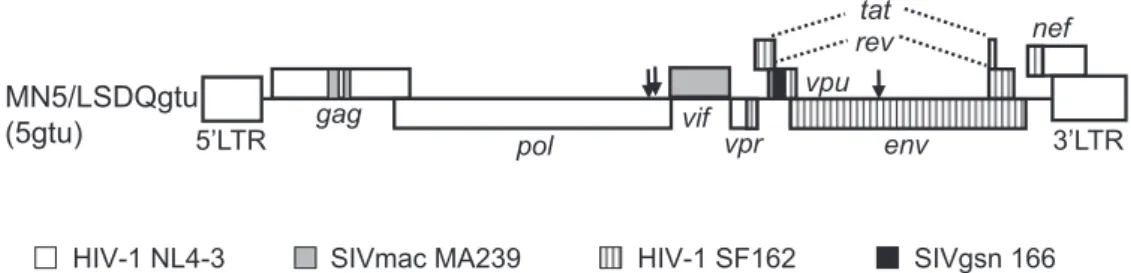
MN5/LSDQgtu
(5gtu)
HIV-1 NL4-3 SIVmac MA239 HIV-1 SF162 SIVgsn 166
gag vif 5’LTR pol vpr env 3’LTR vpu nef tat rev
Env gp160
gp120
gp41
gp41 CT
Gag
MA
CA
NC
p6
SP1 SP2viral long - terminal repeat and a human 293T cell line (13) were maintained in Eagle’s minimal essential containing 10% heat-inactivated fetal bovine serum. A immortalized lymphocyte cell line M1.3S from a rhesus macaque (14) was maintained in RPMI1640 medium containing 10% heat- inactivated fetal bovine serum and 50 units/ml of recombinant human interleukin - 2 (Bio - Rad Labo-ratories Inc.). Virus stocks for infection experiments were prepared from 293T cells transfected with various proviral clones by the calcium phosphate co precipitation method (15), and their virion -associated RT activities were determined as previously described (11, 16).
Viral infection experiments
Multi - cycle replication analysis!M1.3S cells were infected by virus samples with equal RT units, and virus growth was monitored at intervals by RT activity in the culture supernatants. Single - cycle infectivity analysis!Culture supernatants were obtained from the M1.3S infection experiment, and equal RT units (1
"
104to 2"
104) of viruses for each sampling day were inoculated into TZM- bl cells (5"
103). On day 1 post- infection, cell lysates were prepared for luciferase assays (Promega Corporation). Significance relative to 5gtu was calculated by the Student t test.Analysis of virion production
Proviral clones were transfected into 293T cells by the calcium -phosphate co - precipitation method as above. Culture supernatants were collected on day 2 post- transfection, and virion production level was determined by RT assays. Significance relative to 5gtu was calculated by the Student t test.
RESULTS AND DISCUSSION
Mature infectious HIV- 1 virions are generated following appro-priate assembly/cleavage of viral Env and Gag precursors (Fig. 2) in the last viral replication phase. Gag - MA plays a pivotal role for the virion - incorporation of Env, and mutations in the region greatly influence the process. It has been reported that HIV- 1 Gag - MA 62QR and 66SR mutations similarly restore defects in virion - in-corporation of Env/viral replication displayed by Gag - MA mutant viruses (10). However, introduction of 62QR or 66SR into a normal wild - type clone did not affect much the viral growth ability (10). Since these results were obtained from virological analysis of X4 -tropic HIV- 1 NL4 - 3 clone, we examined the amino acid residues at 62 and 66 sites of various R5 - tropic viruses (AD8, JRFL, and YU - 2). Residue 62Q was completely conserved among these viral clones including NL4 - 3, but residue 66A was found only for JRFL clone (Fig. 3). We further investigated amino acid frequencies at these sites within a large HIV- 1 population by the HIV- 1/SIVcpz complete genomes (199 strains) in the HIV- 1 sequence compen-dium 2014 (Los Alamos National Laboratory ; http : //www.hiv. lanl.gov). Again, 62Q was very highly conserved, but 66S was not much shared by viruses (Table 1). It is well - established that interaction between Gag MA and Env gp41 CT is critical for virion -incorporation of Env and viral replication ability (1, 9, 10). We there-fore compared amino acid sequences in gp41 CT region of various HIV - 1 clones (X4 - tropic NL4 - 3, and R5 - tropic SF162, AD8, JRFL, and YU - 2 clones). Amino acid sequences in the region were con-siderably different, and particularly significant sequence character-istics were not noted for NL4 - 3 clone (Fig. 4).
R5 tropic HIV 1rmt 5gtu was generated by modification of gag -CA, vif , and vpu genes, and has an env gene derived from HIV- 1 Figure 1 Proviral genome structure of R5 - tropic HIV - 1rmt MN5/LSDQgtu (5gtu). HIV - 1 NL4 - 3 (15) (GenBank accession number AF324493), SIVmac239 MA239 (19) (GenBank accession number M33262), HIV - 1 SF162 (GenBank accession number M65024), and SIVgsn166 (GenBank accession number AF468659) sequences are indicated by white, gray, stripe, and black areas, respectively. Arrows represent the sites of growth -enhancing adaptive mutations (18). Clone 5gtu carries four single - amino acid mutations around the two gray areas in the Gag - CA region (11, 20).
Figure 2 Precursor structures of HIV - 1 Env and Gag proteins. Upper : Env subunits gp120 and gp41 are presented. Gp41 cytoplasmic tail (CT) is shown by gray area as indicated. Lower : Four domains and spacer peptide (SP) regions of Gag polyprotein are shown. Dotted area indicates Gag - matrix (Gag - MA) region. CA, capsid ; NC, nucleocapsid.
NL4-3 AD8 JRFL YU-2 1 GARASVLSGGELDKWEKIRLRPGGKKQYKLKHIVWASRELERFAVNPGLLETSEGCRQIL 60 1 ...K..R...K... 60 1 ...K...K.R...S... 60 1 ...A...R...D... 60 61 GQLQPSLQTGSEELRSLYNTIAVLYCVHQRIDVKDTKEALDKIEEEQNKSKKKAQQAAAD 120 61 ...K..F..V.T...N...R... 120 61 ...L.A.K...V.T...E...E...A...--E.... 118 61 ...V.T...K.E...E... 120 1 3 1 Y N Q S V Q S N N G T 1 2 1 1 3 1 . . . . . . . S K E A 1 2 1 9 2 1 . . . . . . . S . . . 9 1 1 1 3 1 . . . . . . . S . . . 1 2 1 NL4-3 AD8 JRFL YU-2 NL4-3 AD8 JRFL YU-2 SF162 AD8 JRFL YU2 NL4-3 1 VNRVRQGYSPLSFQTRFPAPRGPDRPEGIEEEGGERDRDRSSPLVHGLLALIWDDLRSLC 60 1 ...HL...D...VR..D.F...F... 60 1 ...LL...GR..N.F...V... 60 1 ...HL..Q...D...G...D.F..I..V... 60 1 ...HL.I...IR..N.S... 60 61 LFSYHRLRDLILIAARIVELLGRRGWEALKYWGNLLQYWIQELKNSAVSLFDAIAIAVAE 120 61 ...L..V...W...S...R...LN.T... 120 61 ...L.TVT...V....W...S...LN.T... 120 61 ...L..VT...GV....W...LN.T... 120 61 ...L..VT...W...S...N.LN.T... 120 121 GTDRIIEVAQRIGRAFLHIPRRIRQGFERALL 152 121 ....V..IV...Y..I....T...L..L.. 152 121 ...AL..TY..I....T...L... 152 121 ....V..IL..AF..V....V...L... 152 121 ....V...L.AAY..IR...L..I.. 152 SF162 AD8 JRFL YU2 NL4-3 SF162 AD8 JRFL YU2 NL4-3
SF162 (Fig. 1). To examine effects of Gag - MA mutations on 5gtu, we introduced 62QR and 66SR into 5gtu to construct HIV- 1rmt clones 62QR+ 5gtu and 66SR+ 5gtu, respectively. Viruses were pre-pared from 293T cells transfected with proviral clones (5gtu, 62QR+ 5gtu, and 66SR+ 5gtu), and inoculated into rhesus lymphocyte M1.3S cells. As shown in Fig. 5, while 62QR+ 5gtu grew signifi-cantly more poorly than 5gtu, 66SR+ 5gtu exhibited slightly more retarded growth kinetics relative to 5gtu. To see if this result is applicable to the other R5 - tropic viruses, and to confirm a gener-alization of above observation, we generated two other R5 - tropic HIV- 1rmt clones carrying an env gene from a simian immunode-ficiency virus/HIV- 1 chimeric virus clone (SHIVAD8 - EH) (17) or from an HIV- 1 clinical isolate. We then performed the M1.3S in-fection experiments as above. Introduction of 62QR into these two viral clones eliminated the viral replication ability, but that of 66SR did not show a significant effect on their growth potentials relative to parental clones (data not shown). Totally, 62QR mutation was detrimental to R5 - tropic viruses but not 66SR. In agreement with the previous data for X4 - tropic NL4 - 3 (10), the 62QR mutation severely impeded viral single cycle infectivity of our there R5 -tropic viruses tested here for TZM- bl cells (data not shown). This result is consistent with the conserved nature of Gag - MA 62Q in Figure 3 Amino acid sequence alignment of Gag - MA proteins from various HIV - 1 strains. Sequences were aligned by Genetyx Ver. 11. Gag start residue M (Met) is removed from the sequences, and second residue G (Gly) is presented at amino acid position 1. Arrows show the amino acid positions 62 and 66.
Table 1 Amino acid frequency at positions 62 and 66 in Gag - MAa
Positions Amino acid No. %
62 Q 197 99.0 H 1 0.5 K 1 0.5 66 S 69 34.7 A 101 50.8 T 26 13.1 D 1 0.5 N 1 0.5 Xb 1 0.5
aData are from 199 sequences of HIV - 1/SIVcpz complete genomes in the HIV Sequence Compendium, 2014 (Los Alamos National Laboratory ; http : //www.hiv.lanl.gov).
bUnidentified amino acid
Figure 4 Amino acid sequence alignment of gp41 CT from various HIV - 1 strains. Sequences were aligned by Genetyx Ver. 11. The gp41 CT se-quence of 5gtu is identical to that of HIV - 1 SF162.
an HIV- 1 population (Fig. 3 and Table 1).
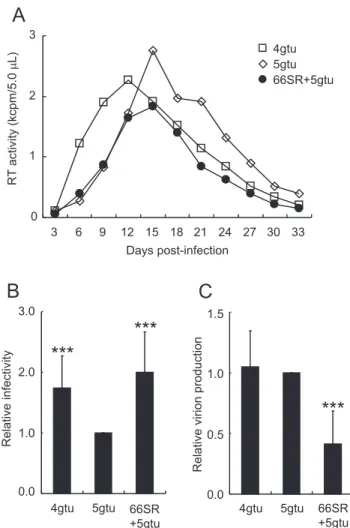
We noticed that 66SR+ 5gtu appeared to induce stronger cyto-pathic effects than 5gtu despite their considerably similar growth kinetics in M1.3S cells. To further examine biological properties of 5gtu and 66SR+ 5gtu, we first determined multi - cycle growth kinetics in M1.3S cells of three HIV- 1rmt clones (X4 - tropic 4gtu, R5 - tropic 5gtu, and R5 - tropic 66SR+ 5gtu). Major difference be-tween 4gtu and 5gtu is their env sequences : 4gtu env from HIV- 1 NL4 - 3 and 5gtu env from SF162, respectively, and both have some growth- enhancing mutations in the env gene (11, 12). Input viruses obtained from transfected 293T cells were inoculated into M1.3 cells, and virus replication was periodically monitored. As shown in Fig. 6A, 4gtu grew better than 5gtu (note the peak day for RT production), consistent with a previous report (12). Virus growth kinetics of 5gtu and 66SR+ 5gtu were similar, but virion production levels on the peak day (day 15 post- infection) and thereafter, as judged by RT activity, of 66SR+ 5gtu were lower than those of 5gtu. We were interested in determining the efficiency of early and late replication phases of the three HIV- 1rmt clones. To this end, viral single - cycle infectivity for TZM-bl cells (early) of progeny virions produced from infected M1.3S cells and progeny virion level (late) upon transfection into 293T cells were determined. Culture super-natants were collected from infected M1.3S cells (Fig. 6A), and equal RT units of viruses from each sampling day were inoculated into TZM- bl cells. On day 1 post- infection, cell lysates were pre-pared for luciferase assays. Single - cycle viral infectivity was calcu-lated as relative luciferase activity to that of 5gtu. In Fig. 6B, rela-tive infectivity was presented as the average of infectivity for each day (from day 6 to 33). Viral infectivity of 4gtu and 66SR+ 5gtu was higher than that of 5gtu, and 66SR+ 5gtu showed comparable in-fectivity to 4gtu. We next examined virion production level of the three HIV- 1rmt clones in transfected 293T cells. In fragile ma-caque M1.3S cells, it is very difficult to obtain constant and repro-ducible results by transfection. As shown in Fig. 6C, while progeny virions of 4gtu and 5gtu were at similar levels, 66SR+ 5gtu produced those at a level reduced to around 40% to that of 5gtu. Gag - MA is demonstrated to fulfill its function at various steps in the HIV- 1 assembly process (1, 8, 9). It is therefore conceivable that 66SR mutation in Gag - MA may negatively affect this stage. Collectively, our results on the 66SR mutant virus showed that introduction of
66SR into 5gtu gives an affirmative effect on early replication phase (single - cycle viral infectivity in Fig. 6B) but a contradictious result on late phase (virion production level in Fig. 6C), generating simi-lar growth kinetics in multi - cycle infection experiments (Figs. 5 and 6A). Lower virus level observed for 66SR+ 5gtu relative to that for parental 5gtu (Figs. 5 and 6A) may be explained by its feeble ability to produce progeny virions (Fig. 6C), and also, at least in part, by its cytopathogenic property described above. Quite differ-ent from our results, positive effects of the 66SR mutation on viral single - cycle infectivity were not observed for HIV- 1 NL4 - 3 clone (10). This may be attributable to differences in gp41 CT amino acid Figure 5 Growth kinetics in rhesus macaque M1.3S cells of various
HIV - 1rmt clones. Input viruses were prepared from 293T cells transfected with proviral clones indicated, and inoculated into M1.3S cells. For in-fection, 2.0
!
105M1.3S cells were inoculated with equal viral RT units (1.0!
106). Virus growth was monitored at intervals by RT activity in the culture supernatants.Figure 6 Replication properties of various HIV 1rmt clones. (A) Multi -cycle replication kinetics in rhesus lymphocyte M1.3S cells. Input viruses were prepared from 293T cells transfected with proviral clones indicated, and inoculated into M1.3S cells. For infection, 1.0
!
106M1.3S cells were inoculated with equal viral RT units (6.6!
105). Virus growth was moni-tored at intervals by RT activity in the culture supernatants. (B) Viral single - cycle infectivity. Culture supernatants obtained from the M1.3S infection experiment in (A) were used for determination of viral infec-tivity here. Equal RT units of virus samples from each day (from day 6 to 33 in A) were inoculated into TZM - bl cells, and on day 1 post - inocu-lation, cell lysates were prepared for luciferase assays. Infectivity is cal-culated as luciferase activity relative to that exhibited by 5gtu for each sampling day. Mean values of relative infectivity obtained from samples of day 6 to 33 are shown with the standard deviations (SD). Significance relative to 5gtu as calculated by the Student t test is shown (***, P!0.01). (C) Virion production. Proviral clones indicated were transfected into 293T cells, and on day 2 post - transfection, progeny virus production was measured by RT activity in the culture supernatants. RT activity relative to that produced by 5gtu is presented. Mean values"SD from at least five independent experiments are shown. Significance relative to 5gtu as calculated by the Student t test is shown (***, P!0.01).sequences (Fig. 4). It would be plausible to assume that Gag - MA 66SR have appreciable impacts on viral clones carrying some spe-cific Env sequences.
In conclusion, we demonstrate here that Gag - MA 66SR muta-tion increases the single - cycle infectivity of R5 - tropic HIV- 1rmt 5tgu but impedes the virion production efficiency. Because muta-tions in Gag - MA affect much the virion assembly process as de-scribed above, this defect may be restored by combinations of the other Gag - MA mutations previously reported (10). Improvement of HIV- 1rmt clones carrying 66SR in the virion production level may lead to generation of new viral clones with better growth po-tentials. In this regard, we already gained a number of growth-enhanced viral clones by long - term cultures of virus- infected cells (18). Adaptation of 66SR+ 5gtu to M1.3S cells in a similar way is in progress. These experimental studies would provide technically useful information to improve growth potentials of R5 - tropic HIV-1rmt clones, and contribute to the establishment of HIV- 1/AIDS primate models. Obtaining R5 - tropic HIV- 1rmt clones pathogenic for rhesus macaques represents the cornerstone of AIDS models, and may help the development of clinical approaches aimed at bet-ter treatments of infected individuals.
ACKNOWLEDGEMENTS
We thank Kazuko Yoshida for editorial assistance. We are in-debted to Drs. Masashi Shingai and Malcolm A. Martin (NIAID, NIH, USA.) for their generous gift of pSHIVAD8 - EHproviral clone. TZM- bl cells were obtained from the NIH AIDS Reagent Program. This research was supported in part by a grant from Japan Agency for Medical Research and Development, AMED.
CONFLICT OF INTEREST
The authors declare that no competing interests exist.
REFERENCES
1. Checkley MA, Luttge BG, Freed EO : HIV- 1 envelope gly-coprotein biosynthesis, trafficking, and incorporation. J Mol Biol 410 : 582 - 608, 2011
2. Wilen CB, Tilton JC, Doms RW : HIV : cell binding and entry. Cold Spring Harb Perspect Med 2 : 8, 2012
3. Brandenberg OF, Magnus C, Rusert P, Regoes RR, Trkola A : Different infectivity of HIV- 1 strains is linked to number of envelope trimers required for entry. PLoS Pathog 11 : e1004595, 2015
4. Klasse PJ : Modeling how many envelope glycoprotein trim-ers per virion participate in human immunodeficiency virus infectivity and its neutralization by antibody. Virology 369 : 245 -262, 2007
5. Magnus C, Rusert P, Bonhoeffer S, Trkola A, Regoes RR : Es-timating the stoichiometry of human immunodeficiency virus entry. J Virol 83 : 1523 - 1531, 2009
6. Araújo LA, Almeida SE : HIV- 1 diversity in the envelope gly-coproteins : implications for viral entry inhibition. Viruses 5 :
595 - 604, 2013
7. Burton DR, Mascola JR : Antibody responses to envelope gly-coproteins in HIV- 1 infection. Nat Immunol 16 : 571 - 576, 2015 8. Sundquist WI, Kräusslich HG : HIV- 1 assembly, budding, and maturation. Cold Spring Harb Perspect Med 2 : a006924, 2012 9. Tedbury PR, Freed EO : The role of matrix in HIV- 1 envelope glycoprotein incorporation. Trends Microbiol 22 : 372 - 378, 2014
10. Tedbury PR, Ablan SD, Freed EO : Global rescue of defects in HIV- 1 envelope glycoprotein incorporation : implications for matrix structure. PLoS Pathog 9 : e1003739, 2013
11. Nomaguchi M, Yokoyama M, Kono K, Nakayama EE, Shioda T, Doi N, Fujiwara S, Saito A, Akari H, Miyakawa K, Ryo A, Ode H, Iwatani Y, Miura T, Igarashi T, Sato H, Adachi A : Generation of rhesus macaque - tropic HIV- 1 clones that are resistant to major anti - HIV- 1 restriction factors. J Virol 87 : 11447 - 11461, 2013
12. Doi N, Okubo A, Yamane M, Sakai Y, Adachi A, Nomaguchi M : Growth potentials of CCR5 - tropic/CXCR4 - tropic HIV- 1mt clones in macaque cells. Front Microbiol 4 : 218, 2013 13. Lebkowski JS, Clancy S, Calos MP : Simian virus 40
replica-tion in adenovirus- transformed human cells antagonizes gene expression. Nature 317 : 169 - 171, 1985.
14. Doi N, Fujiwara S, Adachi A, Nomaguchi M : Rhesus M1.3S cells suitable for biological evaluation of macaque - tropic HIV/ SIV clones. Front Microbiol 2 : 115, 2011
15. Adachi A, Gendelman HE, Koenig S, Folks T, Willey R, Rabson A, Martin MA : Production of acquired immunodefi-ciency syndrome - associated retrovirus in human and nonhu-man cells transfected with an infectious molecular clone. J Virol 59 : 184 - 291, 1986
16. Willey RL, Smith DH, Lasky LA, Theodore TS, Earl PL, Moss B, Capon DJ, Martin MA : In vitro mutagenesis identifies a region within the envelope gene of the human immunodefi-ciency virus that is critical for infectivity. J Virol 62 : 139 - 147, 1988
17. Shingai M, Donau OK, Schmidt SD, Gautam R, Plishka RJ, Buckler - White A, Sadjadpour R, Lee WR, LaBranche CC, Montefiori DC, Mascola JR, Nishimura Y, Martin MA : Most rhesus macaques infected with the CCR5 - tropic SHIV(AD8) generate cross- reactive antibodies that neutralize multiple HIV- 1 strains. Proc Natl Acad Sci U S A 109 : 19769 - 19774, 2012
18. Nomaguchi M, Doi N, Fujiwara S, Saito A, Akari H, Nakayama EE, Shioda T, Yokoyama M, Sato H, Adachi A : Systemic biological analysis of the mutations in two distinct HIV- 1mt genomes occurred during replication in macaque cells. Mi-crobes Infect 15 : 319 - 328, 2013
19. Shibata R, Kawamura M, Sakai H, Hayami M, Ishimoto A, Adachi A : Generation of a chimeric human and simian immu-nodeficiency virus infectious to monkey peripheral blood mononuclear cells. J Virol 65 : 3514 - 3520, 1991
20. Nomaguchi M, Yokoyama M, Kono K, Nakayama EE, Shioda T, Saito A, Akari H, Yasutomi Y, Matano T, Sato H, Adachi A : Gag - CA Q110D mutation elicits TRIM5 - independent enhance-ment of HIV- 1mt replication in macaque cells. Microbes Infect 15 : 56 - 65, 2013