INTRODUCTION
The prevalence of allergic conditions has increased greatly in most countries (1-3). In Japan, the National Research on Allergy that took place in 1992 reported over 33% of males and 36% of females had self-reported allergy symptoms, which represents about 1/3 of the population (4). This is encompassed with increasing
number of school-children experiencing difficulty at school because of allergy, and school absenteeism was found significantly higher among allergic school children (5). This increase took place in a relatively short time for any genetic change as a causative factor, and most studies have focused on the environmental factors to explain why the number of affected individuals has increased to the present levels. Several studies reported a positive correlation between overweight and asthma. Luder et al. found that overweight was associated with asthma in 2 to 18 year-old black and Hispanic children (6). Huang et al. reported a positive association between school-age girls in the highest quintile of body mass
ORIGINAL
Overweight is associated with allergy in school children of
Taiwan and Vietnam but not Japan
Amalia Veronica Irei
1, Yuki Sato
2, Tzu-Li Lin
3, Ming-Fu Wang
4, Yin-Ching Chan
4,
Nguyen Thi Kim Hung
5, Daisuke Kunii
2, Tohru Sakai
2, Masayo Kaneda
6, and
Shigeru Yamamoto
2 1Department of Food Sciences and Nutrition, Graduate School of Human Culture, Nara Women’s University, Nara, Japan ;2
Department of International Public Health Nutrition, Institute of Health Biosciences, The University of Tokushima Graduate School, Tokushima, Japan ;3
Csmu Department of Nursing, Chung Shan Medical University, Taichung, Taiwan ;4
Department of Food and Nutrition, Providence University, Taichung Hsien, Taiwan ;5
Nutrition Center of Ho Chi Minh City, Ho Chi Minh, Vietnam ; and6
Ministry of Education, Sports, Science, Culture and Technology, Tokyo, Japan
Abstract : We collected information concerning diagnosed allergy from 2027 school children in Japan, Taiwan and Vietnam. Children were classified according to the age and sex-specific body mass index (BMI) per-age as indicator of weight status. Logistic regression was performed to examine the relationship between percentiles of BMI-per-age and allergy. Compared with children at the lowest percentile group Taiwanese children at>85thpercentile group showed
a tendency toward higher risk of allergy (OR=1.79, 95% CI 0.98 to 3.27 ; p=0.060). When children with rhino-conjunctivitis were excluded from the analysis the association reached statistical significance (OR=2.89, 95% CI 1.08 to 7.75 ; p = 0.035). Vietnamese children at>85thpercentile group
showed a significantly higher risk of allergy (OR = 2.34, 95% CI 1.06 to 5.17 ; p=0.035). This association was not observed when children with atopic dermatitis or food allergy were excluded from the analysis, although a tendency toward increased risk of allergy at BMI-per-age>85thpercentile
remained. Our study sample of Japanese school children showed no association between being overweight and allergy. J. Med. Invest. 52 : 33-40, February, 2005
Keywords : allergy, body mass index, school children, overweight.
Received for publication July 1, 2004 ; accepted October 8, 2004. Address correspondence and reprint requests to Shigeru Yamamoto, Ph.D., Professor, Department of International Public Health Nutrition, Institute of Health Biosciences, The University of Tokushima Graduate School, 3 Kuramoto-cho, Tokushima 770-8503, Japan and Fax : +81-88-633-9427.
The Journal of Medical Investigation Vol. 52 2005
index (BMI) and the risk of asthma symptoms, atopy and rhinitis (7). Camargo et al. reported an increased risk of developing asthma at increased levels of BMI in a 4-year longitudinal study (8). Chen et al. evaluated the two-year incidence of asthma in adult Canadians and found that a baseline BMI>30kg/m2
was a sig-nificant predictor of asthma in women (9).
In the present study we examined the relationship between overweight and IgE mediated allergic con-ditions including bronchial asthma, allergic rhino-conjunctivitis, atopic dermatitis and food allergy in school children in Japan, Taiwan and Vietnam.
METHODOLOGY
Study population: Study subject were school chil-dren from 9 to 13 years old (n=2027) from Japan, Tai-wan and Vietnam. In Japan and TaiTai-wan, participants were recruited from 2 schools in Tokushima Prefecture (n=584) and 4 schools in a central district of Taiwan (n=802). Children from Vietnam were randomly se-lected from those who referred to a Child Nutrition Center of Ho Chi Minh City for reasons other than al-lergy (n=641). Parents of all participants gave written informed consent before being included in the study. The study was approved by the Ethical Committee of Tokushima University for Human Studies and was in accordance with the ethical procedure of each study center.
Prevalence of allergy: A written, self-completed questionnaire modified from the ISAAC core question-naire concerning symptoms of allergy (10) as well as physician-diagnosed allergy was addressed to all par-ticipants. Bronchial asthma symptom was defined as a positive answer to the question“Have you ever had wheezing or whistling in the chest at breathing ?”. Atopic dermatitis symptom was defined as a positive answer to the question“Have you ever had itchy rash in the skin ?”. Allergic rhino-conjunctivitis symptoms was defined as a positive answer to either one or both of the next question“Have you ever had snot and blocked nose without having a cold ?”and“Have you ever had red, swollen and watery eyes ?”. Food allergy symptoms was defined as a positive answer to the questions“Have you ever had rush in the skin and sickness within an hour of eating some food ?”and“Were these symptoms repeated each time the same food was eaten ?”. Preva-lence of bronchial asthma, allergic rhinitis, allergic con-junctivitis, atopic dermatitis, and food allergy were defined as an answer of yes to the question“Was your allergy diagnosed by a physician ?”. The original study
protocol did not include food allergy in Taiwan, where was added a posteriori. As a consequence, the number of children from Taiwan to whom food allergy was evaluated was reduced to 448 children. Children were defined as having allergy if allergy diagnosed by a physician was reported. Children with no physician-diagnosed allergy or allergic symptoms were included as control group. Data of passive smoking (Is there anyone who often smokes around you?), industrial dust emission in the neighborhood (Is there any factory that discard much smoke or smell in your neighbor-hood?), current pet ownership (Do you have pets at home?) and use of matting as flooring (Do you use rug or matting as flooring at home?) were collected as potential confounders.
Anthropometry: Body weight was measured to the nearest 0.1 kg with an electronic scale, with the child dressed in light clothing. Height was measured to the nearest 0.5 cm with a wall-mounted stadiometer. Body weight and height were measured in all children by trained health personnel following standard procedures. Body mass index (BMI), defined as the weight (kg) of the individual divided by the square of the height (m), was determined in all children and assigned to one of three categories according to age-and sex-specific BMI-per-age (<15th
, 15th
to 85th
and>85th
percentile groups). The BMI-per-age cut-off points used were based on WHO standard reference (11).
Statistical Analysis: Analysis of variances (ANOVA) was used to evaluate differences in continuous variables between children with physician-diagnosed allergy, children with allergic symptoms but no physician diag-nosed allergy, and children without allergy or allergic symptoms. Body weight was transformed to decimal logarithm and normalized for statistical analysis. Chi-square test was used to evaluate differences in cate-gorical variables between groups. Logistic regression analysis was performed to examine the relationship between BMI-per-age and allergy. Other variables in-cluded in the model were age, sex, parental history of allergy, passive smoking, industrial dust emission in the neighborhood, current pet ownership, and use of matting as flooring as potential confounders. All out-comes with p<0.05 were considered statistically sig-nificant. Data processing and statistical analysis were conducted using the SPSS version 10.0 software pack-age (SPSS Inc, Chicago).
RESULTS
The study originally included 2403 children aged
A.V. Irei et al. Overweight and allergy in children
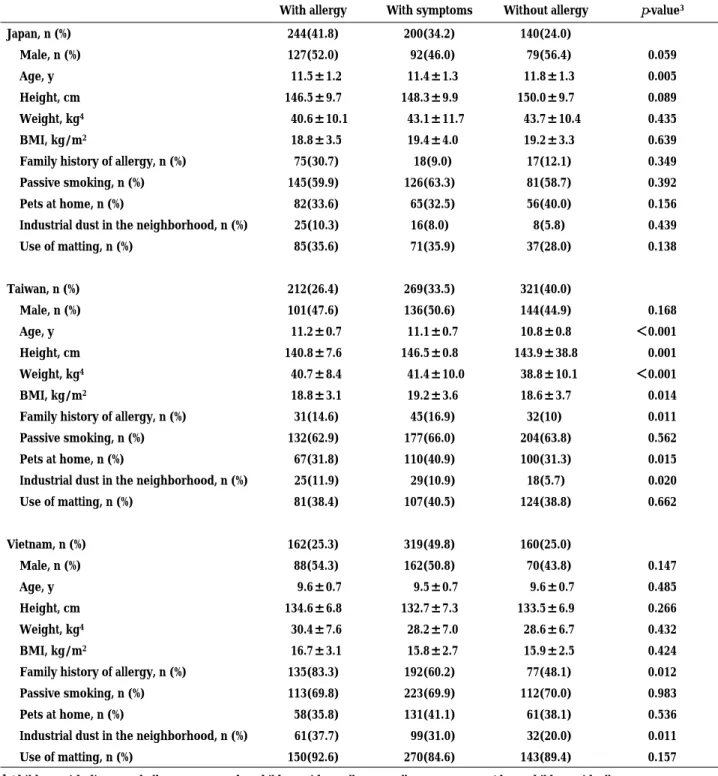
7 to 13 years old from Japan, Taiwan and Vietnam. The current analysis was limited to the 2027 children (84.4%) in the age-rank of 9 to 13 for whom BMI-per-age group-ing was available based on WHO references (11). General characteristics of the study population are shown in Table 1. Reported passive smoking was significantly
higher among Vietnamese children (69.9%, n=448) than Japanese (60.3%, n=352) and Taiwanese (64.0%, n=513) children (p=0.003). Reported current pet ownership was slightly higher among Vietnamese children (39.0%, n=250) than Japanese (34.8%, n=203) and Taiwanese (34.5%, n=277) children. Yearly used of matting as
Table 1. General characteristics of the study population1,2
With allergy With symptoms Without allergy p-value3
Japan, n (%) 244(41.8) 200(34.2) 140(24.0) Male, n (%) 127(52.0) 92(46.0) 79(56.4) 0.059 Age, y 11.5±1.2 11.4±1.3 11.8±1.3 0.005 Height, cm 146.5±9.7 148.3±9.9 150.0±9.7 0.089 Weight, kg4 40.6±10.1 43.1±11.7 43.7±10.4 0.435 BMI, kg/m2 18.8±3.5 19.4±4.0 19.2±3.3 0.639
Family history of allergy, n (%) 75(30.7) 18(9.0) 17(12.1) 0.349
Passive smoking, n (%) 145(59.9) 126(63.3) 81(58.7) 0.392
Pets at home, n (%) 82(33.6) 65(32.5) 56(40.0) 0.156
Industrial dust in the neighborhood, n (%) 25(10.3) 16(8.0) 8(5.8) 0.439
Use of matting, n (%) 85(35.6) 71(35.9) 37(28.0) 0.138 Taiwan, n (%) 212(26.4) 269(33.5) 321(40.0) Male, n (%) 101(47.6) 136(50.6) 144(44.9) 0.168 Age, y 11.2±0.7 11.1±0.7 10.8±0.8 <0.001 Height, cm 140.8±7.6 146.5±0.8 143.9±38.8 0.001 Weight, kg4 40.7±8.4 41.4±10.0 38.8±10.1 <0.001 BMI, kg/m2 18.8±3.1 19.2±3.6 18.6±3.7 0.014
Family history of allergy, n (%) 31(14.6) 45(16.9) 32(10) 0.011
Passive smoking, n (%) 132(62.9) 177(66.0) 204(63.8) 0.562
Pets at home, n (%) 67(31.8) 110(40.9) 100(31.3) 0.015
Industrial dust in the neighborhood, n (%) 25(11.9) 29(10.9) 18(5.7) 0.020
Use of matting, n (%) 81(38.4) 107(40.5) 124(38.8) 0.662 Vietnam, n (%) 162(25.3) 319(49.8) 160(25.0) Male, n (%) 88(54.3) 162(50.8) 70(43.8) 0.147 Age, y 9.6±0.7 9.5±0.7 9.6±0.7 0.485 Height, cm 134.6±6.8 132.7±7.3 133.5±6.9 0.266 Weight, kg4 30.4±7.6 28.2±7.0 28.6±6.7 0.432 BMI, kg/m2 16.7±3.1 15.8±2.7 15.9±2.5 0.424
Family history of allergy, n (%) 135(83.3) 192(60.2) 77(48.1) 0.012
Passive smoking, n (%) 113(69.8) 223(69.9) 112(70.0) 0.983
Pets at home, n (%) 58(35.8) 131(41.1) 61(38.1) 0.536
Industrial dust in the neighborhood, n (%) 61(37.7) 99(31.0) 32(20.0) 0.011
Use of matting, n (%) 150(92.6) 270(84.6) 143(89.4) 0.157
1Children with diagnosed allergy compared to children with no allergy or allergy symptoms (those children with allergy symptoms were
excluded from the control group.
2Participants with no answer in questions regarding environmental characteristics and family history of allergy were treated as missing
values in the analysis.
3ANOVA with post-hoc Bonferroni (values are mean±SD), Chi-square for categorical variables 4Weight was log-transformed for statistical analysis
flooring was significantly higher among Vietnamese children (87.8%, n=563) than Japanese (33.0%, n=193) and Taiwanese (38.9%, n=312) children (p<0.001). Simi-larly, industrial dust emission in the neighborhood was significantly higher among Vietnamese children (30.0%, n=192) than Japanese (8.4%, n=49) and Taiwanese (9.0%, n=72%) children (p<0.001). Prevalence of allergy was higher in Japan (n=244, 41.8%) than in Taiwan (n= 212, 26.4%) and Vietnam (n=162, 25.3%). Allergic rhino-conjunctivitis was the most prevalent allergy among Japanese (n=172, 29.5%) and Taiwanese (n=142, 17.7%) children. In Vietnam, atopic dermatitis was the most prevalent allergic disease (n=94, 14.7%). There was no gender difference in the prevalence of allergy. In uni-variate analysis, allergy was positively associated with age among Japanese children, with age, current pet ownership, industrial dust emission in the neighborhood and parental history of allergy among Taiwanese children, and industrial dust emission in the neighborhood and
parental history of allergy among Vietnamese children. Surprisingly, we observed no association between allergy and parental history of allergy in the Japanese group. Japanese and Taiwanese children showed increasing prevalence of allergy at higher percentile groups (in the Japanese group, 27.5%, 34.7% and 37.3% in the < 15th
, 15th
to 85th
and>85th
percentile groups, respec-tively ; in the Taiwanese group, 29.8%, 32.1% and 39, 3% in the <15th
, 15th
to 85th
and>85th
percentile groups, respectively). Prevalence of allergy among Vietnamese children was similar in all percentile groups (52.2%, 50.5% and 57.9% in the <15th
, 15th
to 85th
and>85th
per-centile groups, respectively).
To evaluate the association between BMI-per-age and allergy we performed logistic regression analysis, unadjusted and adjusted by sex, age, industrial dust emission in the neighborhood, current pet ownership, yearly use of matting as flooring and parental history of allergy (Table 2). We observed no association
be-Table 2. Unadjusted and adjusted odds ratios (OR) and 95% confidence intervals (CI) of allergies in relation to BMI-per-age in Japanese, Taiwanese and Vietnemese children1
<15 th 15th-85thpercentile >85thpercentile
percentile OR(95% CI) p-value OR(95% CI) p-value
Japan
Unadjusted 1.00 0.73(0.40, 1.35) 0.316 0.83(0.40, 1.73) 0.620
Adjusted 1.00 0.86(0.43, 1.71) 0.659 0.82(0.37, 1.84) 0.629
Bronchial asthma excluded 1.00 0.88(0.42, 1.84) 0.740 0.87(0.37, 2.06) 0.751
A. dermatitis excluded 1.00 0.86(0.42, 1.74) 0.669 0.82(0.36, 1.88) 0.645
Rhino-conjunctivitis excluded 1.00 0.49(0.21, 1.16) 0.103 0.72(0.27, 1.93) 0.514
Food allergy excluded 1.00 0.93(0.45, 1.90) 0.836 0.96(0.42, 2.20) 0.930
Taiwan
Unadjusted 1.00 1.17(0.72, 1.89) 0.529 1.37(0.79, 2.40) 0.264
Adjusted 1.00 1.32(0.79, 2.21) 0.289 1.79(0.98, 3.27) 0.060
Bronchial asthma excluded 1.00 1.15(0.66, 1.98) 0.623 1.39(0.72, 2.67) 0.324
A. dermatitis excluded 1.00 1.04(0.60, 1.83) 0.884 1.52(0.78, 2.93) 0.216
Rhino-conjunctivitis excluded 1.00 1.89(0.78, 4.58) 0.189 2.89(1.08, 7.75) 0.035
Food allergy excluded 1.00 1.19(0.55, 2.61) 0.657 1.93(0.80, 4.67) 0.144
Vietnam
Unadjusted 1.00 1.19(0.74, 1.91) 0.479 2.60(1.29, 5.26) 0.008
Adjusted 1.00 1.25(0.74, 2.12) 0.398 2.34(1.06, 5.17) 0.035
Bronchial asthma excluded 1.00 1.45(0.82, 2.58) 0.203 2.43(1.03, 5.72) 0.043
A. dermatitis excluded 1.00 1.05(0.52, 2.10) 0.899 2.67(1.00, 7.18) 0.051
Rhino-conjunctivitis excluded 1.00 1.05(0.59, 1.89) 0.861 2.36(1.01, 5.52) 0.048
Food allergy excluded 1.00 1.24(0.72, 2.12) 0.433 2.17(0.96, 4.92) 0.062
1Odds ratios were estimated for all allergies compared with the lowest percentile group, unadjusted and adjusted for potential confounders.
The adjusted model included sex, age, parental history of allergy, passive smoking, current pet ownership, industrial dust in the neighborhood and use of matting as flooring as potential confounders. Adjusted odds ratios were further estimated excluding one type of allergy at a time to evaluated its effect compared to the risk of all allergies.
A.V. Irei et al. Overweight and allergy in children
tween BMI-per-age and allergy among Japanese chil-dren, even after adjusting for possible confounders. Among Taiwanese children, those in the highest per-centile of BMI-per-age showed a tendency toward an increased risk of allergy after adjustment for potential confounders (OR=1.79, 95% CI 0.98 to 3.27; p=0.060). Among Vietnamese children, unadjusted odds of re-porting physician diagnosed allergy was significantly higher at the highest percentile of BMI-per-age (OR= 2.60, 95% CI 1.29 to 5.26 ; p=0.008). This association remained even after adjustment for potential con-founders (OR=2.34, 95% CI 1.06 to 5.17 ; p=0.035).
In order to evaluate the effect of BMI-per-age in specific allergic diseases, we repeated the analysis excluding children with a specific allergic disease at a time to observe the variation in the association between BMI-per-age and allergy. We performed this analysis to be able to evaluate the effect of BMI-per age on specific allergies without reducing the number of allergy cases in the statistical analysis. We observed no association between BMI-per-age and allergies among Japanese children (Table 2). Among Taiwanese children, the association between BMI-per-age and allergies was strengthen when children with rhino-conjunctivitis were excluded from the analysis, reaching statistical significance (OR=2.89, 95% CI 1.08 to 7.75 ; p =0.035) suggesting that BMI-per-age was not associated with rhino-conjunctivitis among Taiwanese children. No association was observed when other allergy cases were excluded from the analysis. When we performed this procedure in the Vietnamese group, the association between BMI-per-age and allergies persisted when we excluded children with bronchial asthma (OR=2.43, 95% CI 1.03 to 5.72 ; p=0.043) or rhino-conjunctivitis (OR=2.36, 95% CI 1.01 to 5.52 ; p=0.048). We observed a not significant tendency towards an increased risk of allergies in the highest percentile of BMI-per-age when children with atopic dermatitis (p=0.051) or food allergy (p=0.062) were excluded from the analysis. These results suggest that BMI-per-age was positively asso-ciated with a risk of all allergies and this association was strongest for atopic dermatitis and food allergy among Vietnamese children.
DISCUSSION
In the present study we observed two different pat-terns in the relation between BMI and allergies. BMI-per-age was not associated with allergy in Japanese school children. However, our results from Taiwanese and Vietnamese children suggest that being overweight
increased the risk of allergy to about 1.8 to 2.3 times the risk observed at the lowest percentile group. We repeated the logistic regression analysis excluding one type of allergy case at a time to evaluate which allergies were more likely to be associated with BMI-per-age. In Taiwanese children, the exclusion of cases with bronchial asthma, atopic dermatitis or food allergy ap-proached the odds ratio to unity, while the exclusion of cases with rhino-conjunctivitis strengthened the association between BMI-per-age and allergies. These results suggest that in our Taiwanese study sample the risk of having bronchial asthma, atopic dermatitis or food allergy, but not rhino-conjunctivitis, increases 2.9 times in children at the>85th
percentile group compared to those in the lowest percentile group, while the risk of having allergic rhino-conjunctivitis seems unrelated to increases in BMI-per-age. On the other hand, in Vietnamese children the exclusion of cases with bronchial asthma or allergic rhino-conjunctivitis did not modify the association between BMI-per-age and all allergies, while the exclusion of atopic dermatitis or food allergy reduced the strength of the association (p=0.051 and p=0.062, respectively) although the ten-dency towards increased risk of allergy in the highest percentile group remained. These results may indicate that the association between BMI-per-age and bronchial asthma or allergic rhino-conjunctivitis is low compared to that observed with atopic dermatitis or food allergy among Vietnamese children. The lack of association observed when cases of atopic dermatitis were excluded from the analysis might also be attributed to a reduced number of allergy cases, as atopic dermatitis was the main type of allergy among Vietnamese children and the tendency toward an increased risk of allergies at the highest percentile group remained (OR=2.67, p= 0.051).
Previous studies on overweight and allergy in children reported conflicting results. Somerville and colleagues found that overweight in 5 to 11 year old children, as determined by skinfold thickness and/or weight for height, was positively associated to wheezing and other respiratory symptoms but negatively associated to others (12). Schwartz and colleagues reported a significant association of skinfold thickness as well as BMI to asthma symptoms but not to diagnosed asthma (13). Gold and colleagues reported a positive association between asthma and BMI in school children (14). Luder and colleagues found a significant association between BMI and asthma in a 2 to 18 year-old children sample (6). A survey carried out in 13 to 15 year-old students of Taiwan found a positive association between BMI and atopy and allergic symptoms in girls but not in boyss (7).
Chinn and Rona reported that the odds ratio for trends in asthma varied in less than 0.01 adjusted or unadjusted by BMI and concluded that overweight could not explain the increases in the prevalence of asthma (15). A more recent longitudinal study reported an increased asthma incidence in overweight and obese 7 to 18 year-old chil-dren and adolescents (16). Such controversial results suggest that, if there is an association between BMI and allergy, several mechanisms might be involved. Even though most studies on overweight and allergy focus on asthma and rhino-conjunctivitis, the results of our study suggest that overweight is associated with an increased risk of bronchial asthma, atopic dermatitis and food allergy in school children of Taiwan but not with allergic rhino-conjunctivitis, while in school chil-dren of Vietnam, the risk of all allergies seemed to be increased at higher BMI levels.
Due to the cross-sectional design of our study we cannot determine whether overweight preceded the diagnosis of allergy. It was suggested that the relation-ship between asthma and obesity might be due to a reduced physical activity in asthmatic children after the diagnosis (17). However, this issue was clearly ad-dressed by Gilliland et al. In a 5-year longitudinal study, Gilliland and colleagues found an increased risk of newly diagnosed asthma in overweight school children (16). These works clearly addressed the issue of direc-tionality, that is, obesity is a risk factor for developing asthma in the future. Moreover, in our study being overweight was associated with allergies other than bronchial asthma where a reduction in physical activity after diagnosis is not expected, and consequently our results are not consistent with the hypothesis of over-weight after diagnosis due to lifestyle changes after diagnosis.
It was also suggested that the association between overweight and asthma might be caused by a reduction in the respiratory tract due to local deposition of fatty tissue, as well as an over-diagnosed asthma in obese subjects (18). However, this hypothesis can only be applied for bronchial asthma and the obstruction of the respiratory tract is more likely to occur at extreme obesity, while there was no extreme obesity in our study sample.
A suggested plausible mechanism by which obesity might influence in the development of allergy is the role of hormones that are influenced by obesity, such as estrogen (7). This hypothesis is in accordance with the more consistent association between BMI and allergy in female subjects after puberty (7, 9). Unluckily, pubertal status was not evaluated in our study. However, this hypothesis alone cannot explain the association
observed between overweight and allergy before pu-berty (19). Another hormone related to fatty tissues, leptin, was recently associated to a number of immune-related responses (20), with a protective effect against allergy. Consequently, obese subjects with a deficit in leptin levels might tend to develop allergy. Varner purposed that an overproduction of ciclooxigenase (COX) 2 found in human adipose tissue and leptin-deficient obese mice might be related to the increased risk of allergy in obese subjects. COX-2 dependent prostanglandin E-2 (PGE-2) is associated to an in-creased Th2 type cytokine production and enhance allergic responses in predisposed overweight subjects (21-25).
We were unable to find an association between BMI-per-age and physician diagnosed allergy in our Japanese sample. A possible explanation for our result is that the association between BMI-per-age and allergy might rely on the percentage of body fat, and a lack of asso-ciation between BMI and the percentage of body fat among Japanese children might be involved. It was previously reported that BMI had a poor correlation with the percentage of body fat in Japanese population (27-28). There are increasing numbers of Japanese adolescents with weight concern even at normal or low body weight (29). We hypothesize that inadequate dietary pattern in order to lose weight, accompanied with poor physical activity might lead to low BMI levels without reducing the percentage of body fat, lessen the effectiveness of BMI as a predictor of body fat com-position in this population. We are currently addressing this issue to test our hypothesis.
The major limitation of our study is the lack of an objective measure to test the reported diagnosed allergy. We based our questionnaire in physician-diagnosed allergy and included generally accepted symptoms of allergy to avoid possible under-diagnosis. Although we believe that this procedure has strengthened our results, we might have excluded positive cases that have not been diagnosed by a physician, and several non-diagnosed allergies (especially those that do not require medical treatment) might have been excluded as well. On the other hand, it would have been desirable to evaluate the individual effect of BMI-per-age in each type of allergy in a higher sample. However, we per-formed the exclusion method in order to evaluate its effect compared with the effect of BMI-per-age in all allergies to be able to weight the role of each type of allergy by comparing its effect with that observed for all allergies.
In summary, our results suggest that a BMI-per-age> 85th
percentile was associated to an increased risk of
A.V. Irei et al. Overweight and allergy in children
allergy in school children from Taiwan and Vietnam. No association was observed between BMI-per-age and allergies among Japanese school children.
ACKNOWLEDGMENT
The authors would like to thank the field workers of the three study centers for their help in the data collection.
REFERENCES
1. Aberg N, Hesselmar B, Aberg B, Eriksson B : Increase of asthma, allergic rhinitis and eczema in Swedish schoolchildren between 1979 and 1991. Clin Exp Allergy 25 : 815 -9, 1995
2. Lai C. K, Douglass C, Ho S S, Chan J, Lau J, Wong G, Leung R : Asthma epidemiology in the Far East. Clin Exp Allergy 26 : 5 -12, 1996
3. Emanuel M B : Hay fever, a post industrial revolu-tion epidemic : a history of its growth during the 19 th century. Clin Allergy 18 : 295 -304, 1988 4. Ministry of Health Labor and Welfare, Statistics
and Information Department : Daily life and allergy symptoms trends analysis in Public Health, 1992 5. Sakai K, Takishita J, Yoshino K, Yamamoto S, Manabe S, Mizunuma T, Ueda N : Survey for non-attendance by allergic and some other diseases in primary and junior high school. Arerugi Rinsho 20 : 586-590, 2000
6. Luder E, Melnik T A, DiMaio M : Association of being overweight with greater asthma symptoms in inner city black and Hispanic children. J Pediatr 132 : 699 -703, 1998
7. Huang S L, Shiao G, Chou P:Association between body mass index and allergy in teenage girls in Taiwan. Clin Exp Allergy 29 : 323 - 9, 1999 8. Camargo C A Jr, Weiss S T, Zhang S, Willett W C,
Speizer F E : Prospective study of body mass index, weight change, and risk of adult-onset asthma in women. Arch Intern Med 159 : 2582-8, 1999 9. Chen Y, Dales R, Tang M, Krewski D : Obesity
may increase the incidence of asthma in women but not in men : longitudinal observations from the Canadian National Population Health Surveys. Am J Epidemiol 155 : 191-7, 2002
10. The International Study of Asthma and Allergies in Childhood (ISAAC) Steering Committee : World-wide variation in prevalence of symptoms of asthma, allergic rhinoconjunctivitis, and atopic eczema:
ISAAC. Lancet 351 : 1225 -32, 1998
11. WHO Expert Committee on Physical Status : the Use and Interpretation of Anthropometry. Physical status : the use and interpretation of anthropome-try : report of a WHO Expert Committee. Geneva : World Health Organization, 1995
12. Somerville S M, Rona R J, Chinn S : Obesity and respiratory symptoms in primary school. Arch Dis Child 59 : 940-4, 1984
13. Schwartz J, Gold D, Dockery D W, Weiss S T, Speizer F E : Predictors of asthma and persistent wheeze in a national sample of children in the United States. Association with social class, perinatal events, and race. Am Rev Respir Dis 142 : 555 - 62, 1990 14. Gold D R, Rotnitzky A, Damokosh A I, Ware J H,
Speizer F E, Ferris B G Jr, Dockery D W : Race and gender differences in respiratory illness preva-lence and their relationship to environmental ex-posures in children 7 to 14 years of age. Am Rev Respir Dis 148 : 10-8, 1993
15. Chinn S, Rona R J : Can the increase in body mass index explain the rising trend in asthma in children ? Thorax 56 : 845 - 50, 2001
16. Gilliland F D, Berhane K, Islam T, McConnell R, Gauderman W J, Gilliland S S, Avol E, Peters J M : Obesity and the risk of newly diagnosed asthma in school-age children. Am J Epidemiol 158 : 406-15, 2003
17. Gennuso J, Epstein L H, Paluch R A, Cerny F : The relationship between asthma and obesity in urban minority children and adolescents. Arch Pediatr Adolesc Med 152 : 1197-200, 1998 18. Sin D D, Jones R L, Man S F : Obesity is a risk factor
for dyspnea but not for airflow obstruction. Arch Intern Med 162 : 1477- 81, 2002
19. von Kries R, Hermann M, Grunert V P, von Mutius E : Is obesity a risk factor for childhood asthma? Allergy 56 : 318 -22, 2001
20. Matarese G : Leptin and the immune system : how nutritional status influences the immune response. Eur Cytokine Netw 11 : 7-14, 2000 21. Varner A E : An immunologic mechanism for the
association between obesity and asthma. Arch Intern Med 160 : 2395 - 6, 2000
22. Hotamisligil G S, Arner P, Caro J F, Atkinson R L, Spiegelman B M : Increased adipose tissue ex-pression of tumor necrosis factor-alpha in human obesity and insulin resistance. J Clin Invest 95 : 2409-15, 1995
23. Xu H, Uysal K T, Becherer J D, Arner P, Hotamisligil G S : Altered tumor necrosis factor-alpha (TNF-alpha) processing in adipocytes and increased
expression of transmembrane TNF-alpha in obe-sity. Diabetes 51 : 1876 - 83, 2002
24. Yamagishi H, Kitano T, Kuchiki T, Okazaki H, Shibata S : Association between body composition and body mass index in young Japanese women. J Nutr Sci Vitaminol (Tokyo) 48 : 201- 6, 2002 25. Ministry of Health and Welfare : A report from
the“Sukoyaka Family 21”Planning Committee. Japan, 2000. http : //www. mhlw.go.jp. Accessed Nov. 2003
26. Trocki O, Shepherd R W : Change in body mass index does not predict change in body composition in adolescent girls with anorexia nervosa. J Am
Diet Assoc 100 : 457-60, 2000
27. Yamagishi H, Kitano T, Kuchiki T, Okazaki H, Shibata S : Association between body composition and body mass index in young Japanese women. J Nutr Sci Vitaminol (Tokyo) 48 : 201-6, 2002 28. The Examination Committee of Criteria for Obesity
Disease in Japan : New criteria for‘obesity disease’ in Japan. Circ J 66 : 987- 92, 2002
29. Wong Y, Bennink M R, Wang M F, Yamamoto S : Overconcern about thinness in 10-to 14-year-old schoolgirls in Taiwan. J Am Diet Assoc 100 : 234-7, 2000
A.V. Irei et al. Overweight and allergy in children