Abstract
Extensive reading (ER) can play an important role in learners language education, and as a consequence, ER should be a practical option for reading pedagogy in the foreign language curriculum. This paper discusses the current reading context for second lan-guage (L2) learners at secondary level education. Traditional and popular methodolo-gies will be reviewed, in particular, the grammar-translation approach, comprehension questions and language work, skills and strategies, intensive and extensive reading skills. The discussion will survey the main principles of extensive reading, and the transfer of reading skills between the first language (L1) and L2 will be addressed.
Aim of Paper
In this paper I will discuss the viability of introducing an extensive reading (ER) programme into the English language curriculum in Japanese secondary level education. I will focus in particular on the characteristics of an ER programme, and suggest how the programme can improve and stimulate the learning environment while increasing learners confidence. Under the assumption that the school curriculum implements an ER programme, I propose that learners would discover a renewed sense of enjoyment and motivation while studying English.
In this paper I will also attempt to explore the current role of the assistant English teacher (AET), who is employed on the Japanese English
The Role of Extensive Reading in the
Development of Second Language
Proficiency in Secondary Level
Educa-tion
Teaching, JET1 programme (CLAIR, 2009). The AET is colloquially referred to as a communicative language assistant, this paper will refer to the AET as a JET. The JET has the potential to contribute more effectively as a language resource than the current situation allows. In addition, I will make the further assumption that providing the JET is fully integrated into the English language curriculum, she can significantly contribute to the improvement in learners English language competency.
Why Choose Extensive Reading?
Why is ER significant for English language teaching (ELT)? ER improves language fluency as learners develop active and passive (sight) vocabulary proficiency. ER pedagogy teaches learners to become more conscious of written mistakes and develop a comprehensive awareness of grammatical structures (Davis, 1995). Moreover, if an intensive reading (IR) programme is implemented, learners can practice and apply the IR skills learnt in the classroom during their ER activities. IR focuses learners on reading for accuracy, learners are taught specific skills such as skimming and scanning, and language points are analyzed in detail. On the other hand, ER gives learners the opportunity to improve their language level in a comfortable environment, in other words outside the classroom. An ER programme encourages learners to self-select appealing graded readers without the pressures of text analysis inherent to their academic studies.
An academic reading class syllabus often requires learners to get to grips with complicated syntax and lexicon. In contrast, ER graded readers are available in non-fiction and fiction series, whereby learners choose from a variety of non-academic texts, for example detective stories or biographies. Publishers produce a simplified ‘abridged’ (Hedge, 1985: 40) version of the original story. The abridged text contains simplified syntax and lexicon. Vocabulary density and complexity is reduced according to the level of the graded reader series, hence the term graded reader. The ER programme
encourages learners to read texts at a lower level than their academic reading requirements or competence. This leads to the question, why are learners discouraged from choosing higher level graded-readers? Initially, while learners read at a lower level they realize they can read fluently in the L2, in contrast to their academic classroom experiences. As a result, learners feel encouraged and experience pleasure at L2 reading for the first time.
The ER programme also improves learners confidence which is reflected in the classroom. As a consequence, learners motivation improves as they read a growing number of texts. During the ER process, learners are exposed to a variety of texts, their socio-cultural knowledge increases and learners develop a comprehensive schemata database (Nuttall, 1996). These skills are important for developing reading fluency. The ER programme allows learners to read at their own pace, which encourages the skill of individualized reading, without the habitual dependency on a dictionary to translate every other word. That is to say, learners apply IR skills and strategies learnt in the classroom. Hedge (1985) proposes that ER develops the autonomous learner, and Hedge further argues that this independent language skill is the important path to successful L2 learning.
Traditional Reading Approaches
Traditional reading class syllabi are typically restrictive in learners choice of reading material. Theorists and researchers support the view that learning to read is divided into two main approaches: the bottom-up approach and the top-down approach. Hudson (1998) proposes that learners transfer reading skills from their L1 to their L2. Learners L1 literacy should be included as part of the process of L2 reading. I will now briefly discuss the two approaches.
The bottom-up approach is a detailed skills and strategy approach to reading. The text is analyzed and discussed in detail and learners must interpret the text precisely. A reader will cognitively process a text by
assessing words, phrases and sentences at text level. The bottom-up approach requires the reader to depend on her ability to process a text from a grammatical and structural level, thus providing the learner with a comprehensive syntactical analysis of the text. The bottom-up process is independent of context or discourse features, that is to say, socio-cultural background and schemata are redundant. According to Hudson (1998) poor readers rely heavily on context strategy in order to interpret a text.
In contrast, during the top-down approach a reader approaches the text as a whole, drawing on her schemata and background knowledge in order to make predictions and interpret meaning. Nuttall describes the top-down approach succinctly as analysis with an ‘eagle’s eye view of text’ (1996: 17). On the other hand, Hudson (1998) further argues that the top-down approach is a slower process because the reader must draw heavily on her sociolinguistic knowledge, in addition to interpretation of text meaning.
In this case, in order to interpret a text successfully it would be efficient to simultaneously employ both approaches to reading. Learners should approach a text conscious of the schemata and also develop knowledge of its’ lexis and syntax. As a result, the top-down approach is useful for analysis of advanced academic texts, whereby learners partially rely on schemata in order to interpret global meaning of text. If the learner is unable to retrieve a framework from personal schemata, the next step should be a detailed analysis of the syntaxical structure of text, employing skills from the bottom-up approach.
Role of Schemata
Learning to read is a complicated process, not only do learners need reference to a large sight vocabulary, syntax and structural competence, but learners also need to have schemata awareness. A schema is a ‘mental structure’ (Nuttall, 1996: 7) that I will otherwise classify as world knowledge. Our schemata is constantly adjusting and developing according to life
experience. In order to exploit a text, learners need access to a store of schemata while interpreting the text. On the other hand, when a learner is unable to make reference to the context due to a lack of knowledge or experience, the unavailability of the relevant schema will significantly impair comprehension of text (Nuttall, 1996).
The Grammar-Translation Approach
The grammar-translation approach is particularly significant to the ER programme proposal for Japanese secondary level education, since it has been a popular approach for a significant period. The grammar-translation approach has close associations with the bottom-up approach to reading, whereby meaning of text is derived from analysis of the syntax at sentence level (Bamford and Day, 1998). English pedagogy in secondary level education is restricted to academic requirements in response to tertiary level entrance examinations.
‘Grammar-translation continues to be widely used in some parts of the world today where it reflects local educational practice and cultural values. The aim of both language learning and character building…the goal of preparing students for national or other examinations that include transla-tion’ (Richards and Rodgers in Bamford and Day, 1998: 126).
Traditionally, receptive English skills, reading and listening were considered more practical and desirable than productive skills, speaking and writing. Comprehension Questions and Language Work
A second common approach to teaching reading is comprehension questions and language work. The general principle behind this approach supposes learners study short texts that teachers explicitly teach ‘word-by-word’ (Bamford and Day, 1998: 125). The text is introduced to the class and unfamiliar words are highlighted, learners are asked to read the text and
answer comprehension questions for homework. In the succeeding class the teacher elicits answers and introduces follow-up language exercises, for example grammar and lexis explanation. Some authors argue that the comprehension questions and language work approach to reading is similar to the bottom-down approach of grammar-translation, which is typically prevalent in EFL classrooms (Bamford and Day, 1998).
Skills and Strategies Approach
Skills and strategies is the third approach to reading, which reflects the top-down approach. The third approach requires learners to recall background knowledge and schemata as the teacher prompts learners to produce the relevant background knowledge to help answer comprehension questions. Learners answer questions in groups and work on tasks which provide the teacher with evidence that learners have developed a global understanding of the text (Bamford and Day, 1998). Wallace (1992) proposes that reading across a variety of languages requires the use of the same reading strategies. Reading is viewed as a ‘unitary process’ (Wallace, 1992: 42) in other words, reading ability does not develop through a set of reading skills that claim to produce effective readers, but effective readers use a number of strategies, such as prediction, reflection, context, purpose and text-type analysis, in order to successfully interpret a text.
ELT Reading Class Syllabus
ELT reading classes usually cover the four main reading approaches: grammar-translation, comprehension questions and language work, skills and strategies and intensive reading (Bamford and Day, 1998). The language teacher at secondary level education is confined by the required educational syllabus for her choice of material. The material is usually limited to the recommended course syllabus textbook, which in most cases is an academic text that learners find difficult to process. Learners who once
had pleasurable reading experiences in their L1 are quickly disappointed when they realize L2 reading classes do not mirror their previous L1 reading expectations. Nonetheless, the goal of ER is to reinstate the pleasure derived from reading in the L2.
Transference Between L1 and L2
As Krashen stated L1 vocabulary acquisition develops in ‘small increments’ (1989: 446). Other researchers propose that L1 reading habits are cognitively similar to L2 reading (Alderson and Urquhart, 1984, Wallace, 1992). Krashen (1989) argues that learners learn new words in gradual chunks. During this process, learners are exposed to a great number of texts, the learner continuously acquires new vocabulary as they encounter unfamiliar words.
‘The Clockwork Orange’ study (Krashen, 1989: 446) supports the theory that extensive reading increases our lexis knowledge. This particular study required L1 readers to read ‘The Clockwork Orange’ in a couple of days. The respondents were later tested on the text’s Russian slang nadsat, which they had no prior knowledge of. The results showed that respondents successfully internalized the text’s lexis in one complete reading, moreover; they were able to recognize nadsat from a particular context. The study is conclusive evidence that extensive reading increases readers’ sight vocabulary and improves the rate of readers’ schemata acquisition. This skill is useful for comprehension of dense texts in the L2. Fluent L1 readers have a fully developed sight vocabulary that enables them to automatically recognize words, thus as Bamford and Day (1998) comment, freeing up the mind to concentrate on text meaning.
It is not necessary for learners to compulsively learn and comprehend complete lexis in a text, but it is necessary for learners to acquire competence in the skill of automatic lexis recognition. In other words, learners should recognize lexis from a particular syntax, discourse framework or schemata.
After the learner has repeatedly encountered a lexical item, it begins to feel familiar. This process allows learners to develop a broad sight vocabulary. Extensive reading provides learners with the ideal opportunity to increase their sight vocabulary competence. Krashen’s input hypothesis (IH) theory argues that reading is the means to achieve language competence:
‘We acquire language by understanding messages…. more precisely com-prehensible input is the essential environmental ingredient…to language ac-quisition, the best hypothesis is that competence in spelling and vocabulary is most efficiently attained by comprehensible input in the form of reading’ (Krashen, 1989: 440).
The IH theory further supports the argument that extensive reading improves all-round L2 proficiency.
Extensive Reading in Japan
English is learnt in Japan as a compulsory foreign language education. Learners take an entrance examination during their secondary education career, in order to enter tertiary education. As a result, it is not surprising that less emphasis is placed on oral production of the language due to the environmental circumstances. However, this defies the basic premise of language learning that language is a constant dynamic state, it is constantly changing according to its’ culture and environment. One of the most effective ways to gain language competence is to live in the L2 country; however, this is not attainable for the majority of L2 learners. As a consequence, reading extensively in the L2 is the effective solution (Smith, 1983).
Availability of Texts
English texts are available in central locations and from city retailers, however, local resources are unreliable, nonetheless, with the proliferation of
the Internet and delivery services English texts are attainable. Care should be taken when the motivated L2 learner is searching for ER texts from large retailers. The choice may be overwhelming and paradoxically, the learner may become de-motivated if she chooses an unsuitable text. Brown (2000) comments that learners may have the misconceived belief that when they are reading for pleasure, texts should be classics, however, classics are used as academic texts. Reading above the learner’s level defeats the object of ER, which is reading for pleasure at a lower level than learner’s L2 competence. Unfortunately, classroom reading material is generally restricted to the school curriculum and reading classes follow a prescribed text. School libraries which lack a variety of extensive reading texts, negatively impact the L2 reading experience for learners. Learners are unable to choose their appropriate level or personal interest text. These learners are missing out on the natural motivational aspects derived from pleasurable reading. Low-level learners have a small vocabulary competence, they are often conscious of their weaker language competence, and as a result, they have low expectations of reading a whole text in the L2. In contrast, when a learner is given a graded-reader within their vocabulary level i. e. a lower level text, the learner derives a sense of achievement and enjoyment when they realize they can comprehend a whole text in the L2 (West, 1950).
Attitudes to Reading in the Classroom
Learners are accustomed to intensive reading pedagogy in the classroom, whereby grammatical form is the focus. By the time secondary learners leave school and continue to tertiary education, their attitude to the experience of reading can be negative. Some learners associate L2 reading with difficulty and boredom. Japanese learners of English lack motivation and few have the opportunity to develop L2 reading for pleasure during their school career. It would therefore be beneficial for learners if the Ministry of Education considered the implementation of an ER programme
within the English language curriculum in secondary level education.
According to Nobuyuki Hino (Brown, 2000) the grammar-translation approach used in secondary school English reading classes is inadequate. He proposes that the negative implications for learners, influences their willingness to embrace extensive reading for pleasure. Learners experience of reading is a grueling analysis of text, and the repetitive translation techniques learnt are seldom successful at interpreting a text’s meaning. Such negative experiences compound the positive implications for successful implementation of an ER programme. The ER literature in Japan is mainly relevant to learners at tertiary level education, whereby educators have the opportunity to introduce and implement successful ER programmes. Instructors encourage learners to make regular use of their personal ER libraries or from departmental collections, with successful results. Reading classes often centre on teaching intensive reading skills, and in some cases a class reader is included as part of the syllabus (Brown, 2000, Mason, 1997, Rosszell, 2000).
Extensive Reading and the JET Programme
The Japan English Teaching (JET) programme is an ideal resource primed to help with the implementation of an ER wide programme across secondary level education. The JET is usually a native English speaker, who is sent to a junior or secondary high school on a yearly contract basis. In this case, problems associated with continuity of an ER programme would not be a concern, since each successor can maintain an established ER programme. As a former JET, I view this proposal as an ideal opportunity to fill the present gap in the system. The JET role has the potential to embrace and manage an ER programme; in addition, the JET lesson is an ideal resource to support English teachers during IR classes. The JET can assist learners with their socio-cultural and background knowledge relevant to each text. The present JET programme usually requires a JET to teach
the same syllabus across the school timetable irregularly. Her classroom visits are erratic, and thus it is feasible that she would have sufficient time to take responsibility for an ER programme. I propose that the JET should be in charge of a small area of the school library reserved for ER texts. For example, during an ER programme pilot stage a small box of books could be managed by the JET, or a library corner could be dedicated to a collection of ER texts. Moreover, she could allocate whole JET lessons to recycling and consolidating intensive reading skills and techniques.
Benefits of the JET’s Role
Preparation time for initiating and maintaining an ER programme can be very time consuming, the initial implementation requires great patience and enthusiasm from the teacher, which would place restraints on full-time English teachers:
‘The idea of developing a set of work cards is an ambitious one and the tasks itself is very demanding on teachers. It may take several years to build up a full set, but…work cards provide valuable opportunities for individual-izing reading which create confidence and pleasure’ (Hedge, 1985: 96).
The JET has no responsibilities, in contrast to the English teacher’s heavy commitments. As a consequence, the JET can contribute to the development of a comprehensive ER library system, for example she can write work cards summarizing the background and contents of a text. Providing the JET’s school duties are altered in order to include responsibility for an ER programme, the burden on full-time English teachers would be lifted. Moreover, the JET is usually a young graduate direct from university, one whom is enthusiastic and committed, which are the essential skills for managing a successful ER programme.
The foreign texts Japanese learners read may have unfamiliar cultural topics; as a result it is the teacher’s responsibility to explain unfamiliar
socio-cultural issues. In this case, the JET is a good resource to help learners comprehend issues related to the JET’s specific culture. In the present communicative learning environment a JET is frequently asked to speak ad-hoc for 5 minutes. It would be more beneficial if these 5-minute speeches were focused on pre-prepared material relevant to a particular socio-cultural issue:
‘Where learners are far-removed from any English-speaking culture …… the teacher is under pressure to make a story meaningful by explaining the background and providing cross-cultural references’ (Hedge, 1985: 48).
In this instance, the JET has the potential to act as a pseudo cultural educator on an ER programme.
Implementation of an ER Programme at Secondary Education
Hill (2001) argues that in order to maximize the benefits of an ER programme the ideal circumstance is an institute which introduces an extensive reading course in corporation with the school library, and furthermore allows a class to use a class-reader. An extensive reading course states that learners read 80 books within the duration of a course, the course has 8 levels and learners are required to read 10 texts at different levels. When the learner finishes a text, she answers questions on a work card (Hill, 2001). The course length of a full ER course could cover the whole period of secondary education in Japan, which is three years at state schools. The school library should consist of a comprehensive collection of graded-readers, including a range of text for different learner levels and personal interest. Learners self-select readers, therefore, it is important that the librarian chooses texts carefully. Texts should match the interests and reading competence of the learners in order for learners to see an improvement in their L2 competence (Nuttall, 1996). Nuttall has suggested a clever acronym to consider while selecting readers from publishers.
‘“SAVE” Short. Books can be finished quickly, therefore avoids boredom and discouragement.
Appealing.
Varied wide choice suitable for various needs.
Easy. The level must be easier than that of the current target language’ (Nuttall, 1996: 131)
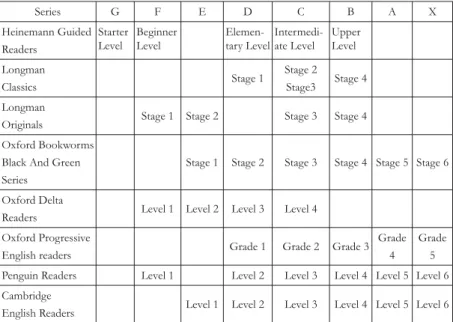
Extensive reading texts available from publishers range from pre-beginner (starter) to upper level. The Edinburgh Project in Extensive Reading, EPER (IALS, 2008) has coordinated the graded reader learner levels with the Cambridge, TOEFL and TOEIC appropriate testing requirements (Hill in Ronan, 2000: 12) (see Appendix 1). This is a convenient resource for the busy English teacher.
Limitations of an ER Programme
The research paradoxically states that reading classes are usually the last place learners practice reading skills for language development (Hedge, 1985). In light of this, an ER programme would give learners abundant opportunity to devote time to extensive reading outside the classroom. Ironically however, the main resistance to implementation of ER programmes comes from teachers, whom are afraid of losing valuable class time when class time is devoted to individual silent reading. Furthermore, some teachers may feel uncomfortable due to their temporary redundancy. Discipline may also be an issue for large classrooms. In Britain during the late 1970’s, this issue arose in L1 classrooms. As a result, teachers were hesitant to spend time on silent reading, and learners had few opportunities to read during class time. However, it is not uncommon today for L1 learners to be given silent reading time (Lunzer and Gardner, 1977). In addition, permission for independent reading time may be difficult to obtain from the school principle. Japanese secondary education is principally focused on the goal of preparing learners for entrance examinations as previously discussed, as
a result, the local Board of Education may view an ER programme as an inappropriate distraction to the learner’s academic studies.
As discussed by Davis (1995) the initial costs of setting up an ER programme can be expensive. Hill (2000) recommends a comprehensive ER programme has an average of 160 graded readers at a cost of 5 English pounds sterling2, if a published work card is included, the total cost is 800 pounds sterling (Hill, 2000). This initial expense is a short-coming of the ER programme. Davis (1995) argues that not only the financial burdens involved during the initial set-up period, but the potential lack of commitment from involved teachers during this stage are limitations of the programme. Davis (1995) raises the issue that an English course should schedule curriculum time for independent reading on an ER programme. This point is relevant to the proposal that a JET be involved in the implementation of an ER programme.
Proposal for a Graded Reader
A JET visits a class sporadically and the class rarely follows a consistent syllabus. Classes are mainly one-off lessons that focus on communicative language learning. The use of a graded-reader in the JET classroom would infuse a sense of continuity to the present arbitrary system. Moreover, a graded-reader would give both learners and JET a continuous goal to focus on, since the reader would act as a kernel to the JET lesson.
Prior to the selection of a class reader, it is important to gain a global understanding of learners preferences (Hedge, 1985). There are numerous ways to elicit learner feedback: questionnaires, Q&A sessions or informal interviews. It is also possible to provide learners with sample graded-reader material. Graded-readers give learners an opportunity to read fluently about different cultures and learn about other young people’s activities and experiences. Many publishers write graded-readers concerning issues global to teenagers making it is easier for learners to relate to the characters in the
text. In a mixed ability class it is advisable to choose a text from the upper-lower level of the class average in order to avoid losing low-level learner’s interest. It is particularly important that the correct level of graded-reader is chosen because the aim of graded-readers is to read fluently without heavy dependence on a dictionary, although some publishers include a glossary at the back of graded-readers. In a mixed level class it is expected that there will be lower or higher proficiencies than the class average. However, using a graded-reader in the JET lesson would be advantageous since the ratio of teacher to learner increases. A JET can devote individual attention to the weaker learner, or prepare supplementary materials for bored stronger learner.
Teachers can choose from many publishers, who offer a variety of texts appropriate for first grade at secondary school. One example, ‘the Chemical Secret’ (Vicary, 1991) is an interesting thriller suitable for both sexes. The proposed reader has 1000 headwords3 that are aimed at intermediate readers. Some graded-reader series supply teaching material and resources, such as the Oxford Bookworm Series (OUP, 2009). The graded-reader lesson promotes class discussion on relevant topics raised from the text. Rosszell (2000) suggests that classroom follow-up activities consolidate a universal appreciation and understanding of the text. In future JET lessons, the class can continue to work through the text, meanwhile building up knowledge of key language points. Learners gradually develop a greater sight vocabulary and an increased sensitivity to grammatical errors in their written and oral work.
Conclusion
Despite the inconclusive presentation of the ER literature in this paper, there is a role for ER in the L2 secondary level Education in Japan. L2 learners can benefit from the pleasurable experience of reading texts without the pressure of reading for academic purposes. If learners are
not enjoying ER texts, or if the text is higher than the learner expected, the learners can stop reading, in contrast to reading academic texts. At the time this paper was originally written (2001), the situation showed that the proposal for an ER programme in Japanese secondary level education was already overdue. Learners had a poor image of English, and reading was viewed as another teacher-centered lesson focusing on grammar-translation, in order to pass university entrance examinations. At present, it is an area waiting for further, comprehensive quantitative research.
The introduction of the JET programme in the early 1980’s was viewed as an innovative resource that aimed to rejuvenate ELT in Japan. However, the presence of a native speaker in the classroom has its’ limitations, moreover, the communicative teaching methodology employed on the JET programme quickly becomes redundant. In addition, the ad-hoc communicative teaching methodology is uninspiring for the JET, who has aspirations of teaching more than pure imitation of a pseudo Brady bunch character, or giving a Anne of Green Gables impersonation. An ER programme could be the suitable solution, whereby the JET lesson is ideally prepped to implement and maintain an ER programme. I am not suggesting that the programme is without limitations as the discussion highlighted, and the local Board of Education would need to make feasibility and financial assessments for each school proposal. Nevertheless, an opportunity exists for the introduction of ER programmes within the Japanese secondary level environment, at least in a rudimentary format.
The brief discussion of successful ER programmes at tertiary level education demonstrates that providing secondary level learners have the opportunity to access ER programmes, they would be rewarded with a renewed sense of enjoyment from reading in their L2. Moreover, learners and teachers would witness the benefits of an ER programme due to improved L2 competency.
Notes
1 JET Programme was established in 1987 to promote cross-cultural understanding between Japan and 38 other countries.
2 Prices circa year 2001.
3 Each graded-reader level has a vocabulary set with an appropriate level of vocabu-lary that the learner should be familiar within her level.
References
Alderson, J. C., and Urquhart, A. H. (eds.) 1984. Reading in a Foreign Language. London:
Longman.
Bamford, J. and Day, R. R. 1998. Teaching reading. Annual Review of Applied Linguistics
18: 124―41.
Brown, R. V. 2000. Extensive Reading in Action. Seinan University, Fukuoka, Japan. Council of Local Authorities for International Relations (CLAIR) (2009) JET
Pro-gramme The Japan Exchange and Teaching ProPro-gramme [online]. CLAIR, Tokyo, Japan.
Available from http://www.jetprogramme.org/e/introduction/index.html [Ac-cessed 1st September 2009].
Davis, C. 1995. Extensive reading: an expensive extravagance? ELT Journal 49/4: 329―
36.
Day, R. R and Bamford, J. 1998. Extensive Reading in the Second Language Classroom. Cam-bridge: Cambridge University Press.
Greenwood, J. 1988. Class Readers. Oxford: Oxford University Press. Hedge, T. 1985. Using Readers in Language Teaching. London: Macmillan.
Hill, D. R. 1997. Teaching guides for class readers: chemical secret. EPER. University
of Edinburgh.
Hill, D. R. 2000. Extract from Survey Review of Graded Readers. IALS, University of
Edinburgh.
Hill, D. R. 2001. Extensive Reading in English in Japan. EPER: University of
Edin-burgh.
Hudson, T. 1998. Theoretical perspectives on reading. Annual Review of Applied
Linguis-tics 18: 43―60.
IALS, University of Edinburgh. 2008. The Edinburgh Project on Extensive Reading (EPER)
[online]. Edinburgh, The University of Edinburgh. Available from http://www.ials. ed.ac.uk/postgraduate/research/EPER.html [Accessed 3rd September 2009].
for the input hypothesis. The Modern Language Journal 73/4 440―464.
Lunzer, E. A and Gardner W. K. (eds.) 1979. The Effective Use of Reading. Schools Council Project. London: Heinemann.
Mason, B. 1997. Tadoku program at International Buddhist University, Osaka. The
Lan-guage Teacher 21/5: 27―30.
Nuttall, C. 1996. Teaching Reading Skills in a foreign language. Oxford: Heinemann. Oxford University Press. 2009. Oxford University Press Japan Graded Readers Website FAQ
[online]. Oxford University Press, Japan. Available from http://www.oup-readers. jp/students/faq/ [Accessed 4th September 2009].
Paran, A. 1996. Reading in EFL: Facts and fictions. ELT Journal 50/1: 25―34.
Rosszell, R. 2000. Developing a graded reader syllabus. Paper presented at JALT-Tokyo
Chapter Meeting. Sophia University, Tokyo, 30 September 2000.
Smith, F. 1983. Essays into Literacy. New York: Holt Rinehart and Winston. Vicary, T. 1991. Chemical Secret. Oxford: Oxford University Press.
Wallace, C. 1992. Reading. Oxford: Oxford University Press. West, M. 1950. Simplified and abridged. ELT Journal 4/2.
Bibliography
Carrell, P. L, Devine, J. and Eskey, D. E. (eds.) 1988. Interactive Approaches to Second
Language Reading. Cambridge: Cambridge University Press.
Krashen, S. D. 1993. The Power of Reading: Insights from the Research. Englewood, CO:
Li-braries Unlimited.
Moran, C. and Williams, E. 1993. Survey review: recent materials for the teaching of
reading at intermediate level and above. ELT Journal 47/1: 64―84.
Appendix 1
Reading Level Average Vocab. (head-words) Average Length (running words) StudentLevel Cambridge TOEFL TOEIC
E 600 3500 Inter-Mediate 1 ― 350 150 D 900 8000 Inter-mediate 2 KET 400 300 C 1400 14000 Inter-mediate 3 PET 450 450 B 1900 18000 Advanced 1 FCE 480 530 A 2600 25000 Advanced 2 CAE 520 650 X 3500 35000 Advanced 3 CPE 550 730
Figure 2. Levels for Language Learner Literature
(Brown, R. V. 2000: 90) Series G F E D C B A X Heinemann Guided Readers Starter Level Beginner Level Elemen-tary Level Intermedi-ate Level Upper Level Longman Classics Stage 1 Stage 2 Stage3 Stage 4 Longman
Originals Stage 1 Stage 2 Stage 3 Stage 4 Oxford Bookworms
Black And Green Series
Stage 1 Stage 2 Stage 3 Stage 4 Stage 5 Stage 6
Oxford Delta
Readers Level 1 Level 2 Level 3 Level 4 Oxford Progressive
English readers Grade 1 Grade 2 Grade 3 Grade
4
Grade 5 Penguin Readers Level 1 Level 2 Level 3 Level 4 Level 5 Level 6 Cambridge
English Readers Level 1 Level 2 Level 3 Level 4 Level 5 Level 6 Figure 1. Language Learner Literature Series by Level