Microflora of the Sea to the East of Japan in
the Pacific Ocean
著者
TANABE Ikunosuke
journal or
publication title
Memoirs of the Faculty of Agriculture,
Kagoshima University
volume
7
number
1
page range
55-64
Microflora
of the
Sea
to the
East
of Japan
in the
Pacific
Ocean
Ikunosuke TANABE
(Laboratory of Applied Microbiology)
Introduction
The composition of the bacterial population in the frozen Indian and Antarctic surface-sea-water-samples was determined by means of viable counts by each colony model based on the colony appearance on the agar plate. The colony appearances of the heterotro-phic bacteria on the agar plate were substantially related to their species, and the viable
counts by each colony model based on the colony appearance were available for the determination of the composition of the bacterial population in various sample materials , especially in sample materials of ecologically uncomplicated microfloral 1), 2), 3), 4), 5).
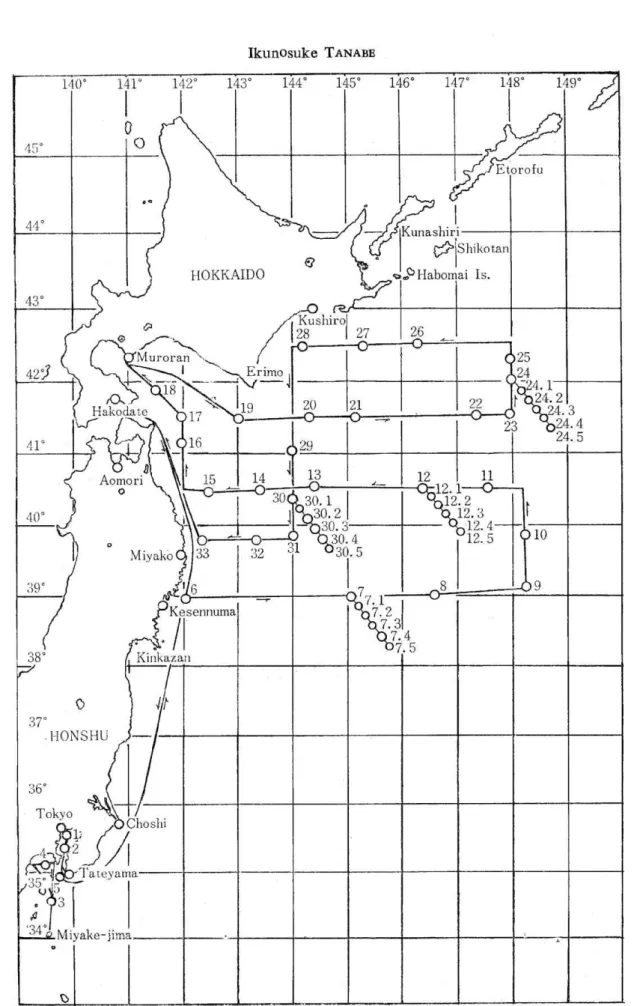
An opportunity of microbiological survey-on-board in the sea to the east of Japan in the Pacific Ocean from 6th to 29th of September in 1962 was favorably given by the Japan Meteorological Agency. As this is a boundary area between the Kuroshio and Oyashio waters, where such bio-resources as fish and planktons exist in abundance , a se-rious interest has been taken of the microbiological studies of this area . This report describes the determination of the microflora of this area made by means of the viable counts by each colony model on the agar plate.
Methods and Materials
The sampling stations were located on the Ryofu's survey route from 6th to 29th of September in 1962 as shown in Fig. 1. The surface-sea-water samples were collected by means of a sterile surface water sampler for measurement of temperatures operated on the bridge by the starboard, while sailing slowly , at 33 stations. The sea water samples from various depths were collected by means of sterile J-Z bacteriological water samp-lers 6), 7), 8) at 4 stations, Station 7 (Sept. 12, 9: 00) , Station 12 (Sept. 13, 21 : 00), Station 24
(Sept. 20, 18 : 00), and Station 30 (Sept. 22, 15 : 00), from such depths as shown in Table 1 b).
Isolation was carried out by means of the smeared sea water agar plate 2), 3), 4), 5) and of the minimal dilution method on the Ryofu Maru . The minimal dilution method was as follows : 0.1 ml of sea water sample was inoculated into 9.9 ml of the sea water medium,
1 ml of sea water sample into 9 ml of the sea water medium, and 10 ml of sea water sample into 3 ml of the condensed medium. The condensed medium consisted of yeast extract, 1.3 g, polypepton, 6.5 g, glucose , 1.5 g, and distilled water, 300 ml. When they became tubid, more than 10 microorganisms occurred in 1 ml of sea-water-sample , more
55
than 1 microorganism occurred in 1 ml of sea-water-sample, and more than 1 microor-ganism occurred in 10 ml of sea-water-sample, respectively. For the isolation of microor- ganisms from turbid test tubes, a loopful of culture in a test tube was serially streaked
on the three sea water agar plates, and incubated for 1 to 2 weeks at 25°C. Colonies which were discernible as individual colonies on the plates, were distinguished into cul-tural groups in accordance with their colony appearances, and each of the representative
colonies of cultural groups was isolated for determination. The smeared sea water agar plate method was as follows : 0.1 ml of sea water sample and 0.1 ml of one tenth dilution of sea water sample were smeared by a glass stick on the sea water agar plates, respec-tively. After incubation at room temperature, viable counts by each colony model based on the colony appearance on the agar plate were enumerated on such plates as viable counts amounted to 10 to 100 per one plate. Two representatives of each cultural group by each station were isolated. The number of the isolates was reduced into 64 strains which were representatives of the 9 cultural groups, or others, by means of grouping in respect to cell morphology, nitrate reduction, and growth in the fresh water broth.
Results and Discussion
Temperatures of the sea water. A slight decrease was caused in the temperature of the surface-sea-water in the boundary area between the Kuroshio and Oyashio waters on account of the increase in latitude, ranging from 23.1°C (Station 7) to 16.2°C (Station 25). The temperature of sea water of the depths decreased rapidly according to the depth till it reached a depth of 100 m, where a slight fluctuation occurred about 3°C (Table 1).
Distribution of heterotrophic bacteria in the surface sea water. The viable counts of aerobic heterotrophic bacteria in the surface-sea-water attained the levels of 102 to more than 106 per ml in Tokyo Bay, those of less than 102 per ml halfway between Miyake-jima and Tateyama, those of 102 per ml in the middle of Sagami Bay, and those of 10 to 104 in the boundary area between the Kuroshio and the Oyashio waters, as shown in Table 1. Achromobacter spp. were numerically predominant bacteria in the surface-sea-water, appro-ximately 30 % of the isolates belonging to the species Achromobacter aquamarinus. In addi-tion to Achr. aquamarinus, the following species were determined to be predominant in the surface-sea-water in the boundary area between the Kuroshio and the Oyashio waters : Achr. cycloclastes and its variety, Achr. guttatus, Flavobacterium aestumarina, Fl. solare, Pseudomonas marinoglutinosa and its variety, Vibrio hyphalus, and Sarcina lutea.
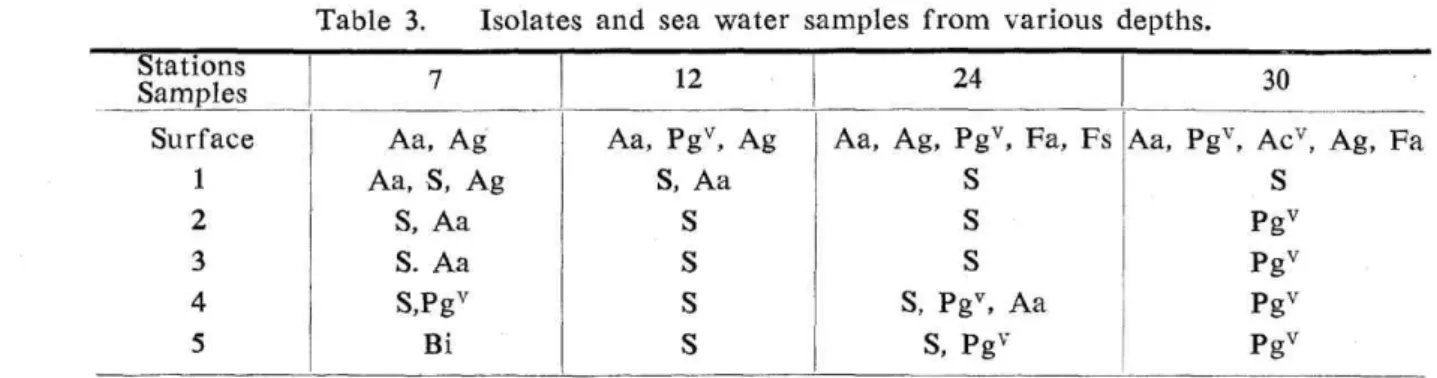
Vertical distribution of heterotrophic bacteria. The vertical distribution of heterotrophic bacteria in the boundary area between the Kuroshio and the Oyashio waters were as shown in Table 1 and Table 3. The number of bacteria was much smaller in the depths than that of bacteria in the surface layers in this area, decreasing from the surface layers to the depths according to the drop of water temperature. This may not apply to the case among the surface sea waters. Sarcina lutea was the most widely distributed species. This was asssumed to have happened not because low temperature in the depths favored the propagation of S. lutea, but because the drop of water temperature contributed to the disappearance of other species. The following species were found in the deep waters in thi sarea : Achr. aquamarinus, Achr. guttatus, Brevibacterium iodininofaciens, Ps. marinoglu-tinosa, Sarcina lutea, Po-32, and Po-40, 41.
Determination of the isolates. 64 strains representative of 9 cultural groups, or others served for the determination. Almost all of them were aerobic with regard to oxygen requirements and showed high optimum temperatures and wide temperature ranges , though these were unexpected. A correlation between microflora and oceanographical data and such a fact as a certain species plays a role of an index to a particular water mass were not ascertained. Viable counts by each colony model that was based on colony appearance were available for the determination of the microflora in the boundary area between Kuroshio and Oyashio waters, for such a correlation as in the former reports 1), 2), 3), 4), 5) was observed between colony model and species. Determinative studies of the isolates were carried out mainly according to Bergey's Manual of Determinative Bacteriology 9) , and ZoBell aud Upham's list of new species of marine bacteria 10) and Brisou's description of marine bacteria 11) were also referred to (Table 2).
Table 1.
a) Surface
Microflora of the sea to the east of Japan, in the Ocean, by the minimal dilution method.
sea water samples.
b) Sea water samples from various depths.
Achromobacter aquamarinus. Strains Po-6, 7, 12, 15, 16, 17, 18, 22, 27, 28, 29, 30, 49, 50, 51, 52, 53, 54, 55, 56, and 57 were identical to Achr. aquamarinus, except optimum
temperature. Their optimum temperature and temperature range for growth are as follows : 37°C optimum and 20° to 42°C, respectively. As low optimum temperatures are prevailing among the marine forms of bacteria, they may be a form adapting to the marine environ-ments, coming from terrestrials, because of their high optimum temperature. They show scanty or retarded growth in a nutrient broth prepared with fresh water. Some of them also differ in sugar utilization from the properties of Achr. aquamarinus. However, these strains were identified with this species, because of their agreement with this species in the other properties. (Fig. 2a and 2b).
Achromobacter cycloclastes and its variety. Strain Po-1 differs only in starch hydrolysis from Achr. cycloclastes and falls into the category of this species. Strains Po-4, 5, 10, 11 and 59 are close to Achr. cycloclastes, Achr. pestifer, and Alcaligenes faecalis, but they differ from Achr. cycloclastes and Achr. pestifer in nitrate reduction and from Ale. faecalis in urea hydrolysis, nitrate reduction and reaction in milk. Besides, they are of scanty or retarded growth in a nutrient broth prepared with fresh water. All properties considered, they were regarded as a variety of Achr. cycloclastes.
Achromobacter guttatus. Strains Po-2, 3, 8, and 9 were identified with Achr. guttatus, though differing in hydrogen sulfide production and temperature range. Their temperature range is 5° to 42°C. (Fig. 2c and 2d).
Flavobacterium aestumarina. Strains Po-46, 47, 64, and 48 were identified with Fl. aes-tumarina. Strain Po-48 is more or less close to Fl. marinotypicum.
Table 2. Microflora of the by means of the
sea to the east of smeared sea water
Japan, in the agar plate.
Pacific Ocean,
* dilutions 1 and 2 correspond to
Table 3. Isolates and sea water samples from various depths.
Aa : Achromobacter aquamarinus. Ag : Achr. guttatus. Acv : A variety of Achr. cycloclastes. Bi : Brevibaclerinm iodininofaciens Fa : Flavobacterium aestumarina. Fs : F!. solare. Pgv : A variety of Pseudomonas marinoglutinosa. S: Sarcina lutea.
Pseudomonas marinoglutinosa and its variety. Strain Po-14 was identified with Ps. mari-noglutinosa. Strains Po-19, 20, 21, 25, and 58 are also considered to belong to the species
Ps. marinoglutinosa, but in respect to colony appearances, morphological properties and
starch hydrolysis, they are distinguished from the strain Po-14, a typical strain, of which one-cell cultures varied in starch hydrolysis. This fact suggests instability of starch hyd-rolysis in this species. Their morphological properties seemed to be rather closer to the genus Vibrio than to the genus Pseudomonas, and their colony appearances are as follows : Circular, entire, smooth, convex, translucent to transparent, no color. Accordingly, they were regarded as a variety of Ps. marinoglutinosa.
Sarcina lutea. Strains Po-42, 43, 44, 45, 62, and 63 were identified with Sarcina lutea. This species appeared in a small number in the surface-sea-waters and in the deep-sea-waters in this area. (Fig. 2h).
Vibrio hyphalus. Strain Po-23 were identified with Vibrio hyphalus. (Fig. 2e)
Strains Po-40 and 41. Strains Po-40 and 41 are Gram-negative ellipticals, non-motile, fermentative in glucose utilization, nitrates not reduced, indole not produced, gelatin not
liquefied starch hydrolysed, acetylmethylcarbinol a little produced, no change in milk,
inorganic nitrogen not utilized as a sole source of nitrogen, of no growth in a nutrient
broth prepared with fresh water, pale yellow non-soluble pigment produced. They seem
to belong to the genus Aerobacter in every respect, but their determination is a problem
upon which there is much controversy, because of their having no ability of nitrate
reduction.
Others. Strain Po-34 was identified with Nocardia erythropolis. This strain resembled
Mycobacterium marinum in respect of every property other than morphology and milk
reaction. However, there were important differences in morphology. This strain has initial mycelium, fully developed, well branching, partially septated, without visible aerial
mycel-ium, vegetative mycelium white to cream-colored, 0.4 to 0.5 ƒÊ wide. It is the genus
Nocardia that these properties characterize. Its other properties are as follows : Inactive in sugar utilization, utilizing inorganic nitrogen as a sole source of nitrogen, aerobic to facultative, nitrate not reduced, indole not produced, gelatin not liquefied,
acetylmethyl-carbinol not produced, starch not hydrolysed, no change in milk, litmus reduced. The
result indicates that this strain should rather belong to the genus Nocardia than to the genus Mycobacterium, and it seems to be the closest to the species Nocardia erythropolis
among the species of the genus Nocardia, though there are differences in cultural properties . (Fig. 2 f). Strains Po 35 and 36 were regarded as a new species Brevibacterium iodinino-faciens, differing, in iodinin produc tion and acid formation from sugars, from Breviba-cterium stationis. These strains were isolated only from deep sea water sample 7.5 that was collected from a depth of 99 m at the station 7. Iodinin productions are now under study in detail, and the presentation of this result is reserved for another occasion . (Fig. 2g). Po-31 and 32 are close to the species Pseudomonas ambigua and to the species Aero-bacter cloacae, except nitrate reduction, respectively. As there are some questions about the determination of Po-13, 24, 26, and 33 as well as Po-31 and 32, more data and stra ins are needed on their determination.
Acknowledgements. The auther is indebted to Prof. Dr. H. Iizuka of the Institute of Applied Microbiology, the University of Tokyo, for his interest and encouragement , to Assist. Prof. Dr. N. Taga of the Ocean Research Institute , the University of Tokyo, for his kindly offering of J-Z bacteriological water samplers and valuable advice , to Mr. H. Fujita of the Institute of Applied Microbiology, the University of Tokyo , for his assis-tances for research, and to the members of the Marine Division, Japan Meteorological Agency and to the officers and crew of the Ryofu Maru, Japan Meteorological Agency, for their offering of facilities for research, during the course of this work .
Summary
Microbiological investigations of marine environments were carried out on board in the sea to the east of Japan in the Pacific Ocean from 6th to 29th of September in 1962 . Viable counts amounted to 10 to 104 per ml of the surface sea waters in the boundary area between the Kuroshio and the Oyashio waters, where the prevailing species were as follows : Achromobacter aquamarinus, Achr. cycloclastes and its variety , Achr. guttatus, Flavo-bacterium aestumarina, Fl. solare, Pseudomonas marinoglutinosa and its variety , Vibrio hyphalus, and Sarcina lutea. Less than 1 to 102 per ml were counted in the deep sea waters in this area. It is Sarcina lutea and Ps. marinoglutinosa that were widely distributed in the depths in this area.
REFERENCES
1) IIZUKA, H., TANABE, I., FURUYA, H., and MEGURO, H.: Symposium on the Microbial Ecology, Association of Microbial Ecology, Sendai (1961). Abstracts , p. 1-28.
2) IIZUKA, H., TANABE, I., and WATANUKI, K.: presented at the Annual Meeting of the Agricultural
Chemical Society of Japan in 1963. Abstracts, p. 67.
3) TANABE, I. "Microbiologial Studies on the Surface Sea Water of the Antarctic Ocean and the Indian Ocean", Doctor thesis at the University of Tokyo (1963) .
4) IIZUKA, H., and TANABE, I.: Symposium on the Antarctic Biology , Japan (1964). Abstracts, p. 1. 5) IIZUKA, H., TANABE, I., and MEGURO, H.: J. Gen. Appl. Microbiol ., 12, 101-102 (1966).
6) ZOBELL, C. E.: J. Mar. Res., 4, 173-188 (1941).
7) ZOBELL, C. E.: "Marine Microbiology". Chronica Botanica Co., Waltham, Mass., 240 pp . (1946). 8) TAGA, N., and SEKI, F.: the Oceanographical Magazine, 13, 143-147 (1962).
9) BREED, R. S.: Bergey's Manual of Determinative Bacteriology, 7th ed., the Williams and Wilkins Co., Baltimore (1957).
10) 11) ZOBELL, Calif., 5 BRISOU,J. C. E. and UPHAM, H. C.: (2), 239-292 (1944). : Microbiologie du Milieu Bulletin Marin,
of the Scripps Institution of Oceanography Editions Medicales Flammarion (1955).
of Univ. Fig. 2a b c d e f g h
Peritrichous flagellation of Achromobacter aquamarinus Po-7. Peritrichous flagellation of Achr. aquamarinus Po-16.
Peritrichous flagellation of Achr. guttatus Po-2. Cells of Achr. guttatus Po-9.
Cells of Vibrio hyphalus Po-23.
Initial mycelium of Nocardia erythropolis Po-34. Cells of Brevibacterium iodininofaciens Po-35. Packets of Sarcina lutea Po-44.