共鳴管内に形成される非対称な音響流
Takeru Yano
Division
$ofM\epsilon chanical$
and
Space
Engin
$e\epsilon r\dot{m}g$
.
HHokkaklo
University.
Sappom.
m-X28, Japan
ARut
$\mathrm{A}\omega \mathrm{u}\mathrm{s}0\mathrm{c}\mathrm{s}\mathrm{O}\mathrm{o}\mathrm{e}\mathrm{m}\mathrm{i}\mathrm{n}\mathrm{g}\mathrm{c}\mathrm{n}\mathrm{l}\mathrm{M}$by
a
me
amplitude
$\iota^{\mathfrak{l}}\propto \mathrm{m}\mathrm{a}\mathrm{n}\mathrm{t}\propto \mathrm{c}\mathrm{P}1\alpha \mathrm{i}\mathrm{o}\mathrm{n}$of
an
i&al
$\mathfrak{B}$
in
a
$\mathrm{t}\mathrm{l}\lambda[] \mathrm{d}\dot{\mathrm{u}}$ensional
$\iota^{\mathfrak{l}}\propto\infty \mathrm{a}\mathrm{t}\propto$is
$\mathrm{n}\mathrm{l}\mathrm{m}\alpha \mathrm{i}\mathrm{c}\mathrm{a}\mathrm{l}\mathrm{l}\mathrm{y}$studied by
solving
tk
system
of
Navicr-Stoks
quanons
wiffi
a
$\mathrm{f}\mathrm{l}\dot{\mathrm{m}}oe\triangleleft \mathrm{i}\mathrm{f}\mathrm{f}\mathrm{e}\mathrm{r}\mathrm{m}\infty$methd,
without
the
assmflion
of
symmeay
of
tk flow field.
Ihe sound
field incluAng shoek
waves
is praeisely
detennind,
and
then, the
sueaning veloeity
neld
is
evaluatd
in
$\mathrm{t}\alpha \mathrm{n}\mathrm{r}$of
a
$\mathrm{t}\dot{\mathrm{i}}\triangleright \mathrm{a}\mathrm{v}\alpha \mathrm{a}\mathrm{g}\mathrm{d}$mass
flux
density vector. We
shall
$\mathrm{d}\mathrm{e}\mathrm{m}\mathrm{n}\mathrm{s}\mathrm{t}\mathrm{r}\mathrm{a}\infty$thag
in
me
case
$\mathrm{w}\mathrm{h}\alpha \mathrm{e}$tk
amplitude
of
gas
oscmuon
is
$\mathrm{n}\mathrm{l}\omega\alpha \mathrm{a}\mathrm{t}\mathrm{e}\mathrm{l}\mathrm{y}1\mathrm{a}\iota \mathrm{g}e$
,
an
asymmeffic
quasi-soedy
saoeming
is
establisM
aflr
$\mathrm{m}\alpha \mathrm{e}$ffian
a
tousand of
$\mathrm{o}\mathrm{s}\mathrm{c}\mathrm{i}\mathrm{l}\mathrm{l}\mathrm{a}\iota \mathrm{i}\mathrm{o}\mathrm{n}\mathrm{s}$of sound
somce.
&ywords:
Numuical study,
$\mathrm{A}\infty \mathrm{u}\mathrm{s}\mathrm{u}\mathrm{c}$sutaming,
Resonance,
Shock
wave
PACS: 43.
$25.\mathrm{N}\mathrm{m},43.25.\mathrm{G}\mathrm{f},$
$43.\mathit{2}5.\mathrm{C}\mathrm{b}$INTRODUCTION
$\mathrm{S}\mathrm{t}\iota \mathrm{e}\mathrm{a}\mathrm{m}\mathrm{i}\mathrm{n}\mathrm{g}$
motions induced by
acousuc
standing
waves aoe
classical
topics in
physics
[1,
2,
3].
TUay,
ie
acuve
conffol
of
soeaming
in
resonators
$\mathrm{b}\propto \mathrm{o}\mathrm{m}\mathrm{e}\mathrm{s}$an
important
subject
in various
applications,
in
parucular
in
thermoacousuc devices
(see,
e.g.,
[4]
and
Fig.
1).
Some
auffiors have oecently
camied out accurate measurements
for slow
$\mathrm{s}\mathrm{f}\mathrm{f}\mathrm{e}\mathrm{a}\iota\dot{\mathrm{m}}\mathrm{n}\mathrm{g}$
motions
[5]
in
a
oesonator.
However,
its
khavior in ffie
case
of large Reynolds
number
oemains unoesolved.
FIGURE
1.
$\mathrm{E}\mathrm{x}\mathrm{a}_{\mathfrak{M}^{1\mathrm{C}}}$of
$\mathrm{a}\mathrm{s}\mathrm{y}\mathrm{m}\mathrm{m}\mathrm{e}\mathrm{u}\mathrm{i}\mathrm{c}\mathrm{a}\infty \mathrm{u}\mathrm{s}\mathrm{u}\mathrm{c}$saeaming
in
a
standing-wavc
$\Psi$
]
$\approx\ovalbox{\tt\small REJECT} \mathrm{s}\mathrm{t}\mathrm{i}\mathrm{c}\mathrm{e}\mathrm{n}\dot{\mathrm{g}}\mathrm{n}\mathrm{c}$.
$\mathrm{m}\infty \mathrm{g}\iota_{\Psi^{\mathrm{h}\mathrm{c}\mathrm{o}\mathrm{u}\mathrm{r}\infty \mathrm{s}\mathrm{y}}}$
of T.
$\mathrm{Y}\mathrm{a}\mathrm{z}\mathrm{f}\mathrm{l}\mathrm{k}\dot{\mathrm{L}}$Recendy,
the
poesent auffior has
$\mathrm{n}\mathrm{u}\mathrm{m}\mathrm{e}\dot{\mathrm{n}}\mathrm{c}\mathrm{a}\mathbb{I}\mathrm{y}$studied ffie
oesonant
gas
oscillauon wiffi
a
peridic shock
wave
in
a
closed
tube by
solving
ie
system of
compressible
Navier-Stokes equations
[6].
The oesult has suggested
$\mathrm{f}\mathrm{f}\mathrm{i}\mathrm{e}\propto \mathrm{c}\mathrm{u}\mathrm{r}\mathrm{r}\mathrm{e}\mathrm{n}\mathrm{c}\mathrm{e}$of
$\mathrm{t}\mathrm{u}\iota \mathrm{b}\mathrm{u}\mathrm{l}\mathrm{e}\mathrm{n}\mathrm{t}$acoustic
$\mathrm{s}\mathrm{f}\mathrm{f}\mathrm{e}\mathrm{a}\mathrm{m}\dot{\mathrm{i}}\mathrm{g}$when
a
$\mathrm{s}\ovalbox{\tt\small REJECT} \mathrm{g}$Reynolds numkr
is
sufficiently large. This
is ffie first
numerical evidence
for ffie
$\mathrm{p}\infty \mathrm{d}\mathrm{i}\mathrm{c}\mathrm{U}\mathrm{o}\mathrm{n}$based
on
the
$\mathrm{e}\mathrm{x}\mu \mathrm{r}\mathrm{i}n\Re \mathrm{n}\mathrm{t}[3]$.
Numerical
$\mathrm{s}\mathrm{M}\mathrm{i}\mathrm{e}\mathrm{s}$of
sPeamin
$\mathrm{g}$motion wii
large
Reynolds
numkr
have
als
$\mathit{0}$been canied
out
by Alexeev
and
Gutfinger
[7],
$\mathrm{M}\mathrm{o}\alpha \mathrm{i}\mathrm{s}$et
al.
[8],
and
Aktas
and Farouk
[9].
Punhermore,
$\mathrm{d}\mathrm{e}\infty \mathrm{l}\mathrm{e}\mathrm{d}$gas
motions
in
a
vicinity
of
a
stack plate
in
the
themloacousbc
device have ken computed
by
Besnoin
and Knio
[10]
and Marx and
Blanc-Benon
[11].
Nevertheless, the
diroet
numerical
$\mathrm{s}\mathrm{i}\mathrm{m}\mathrm{u}\mathrm{l}\mathrm{a}\dot{\mathrm{u}}\mathrm{o}\mathrm{n}$of viscous compressible
flow
is
an
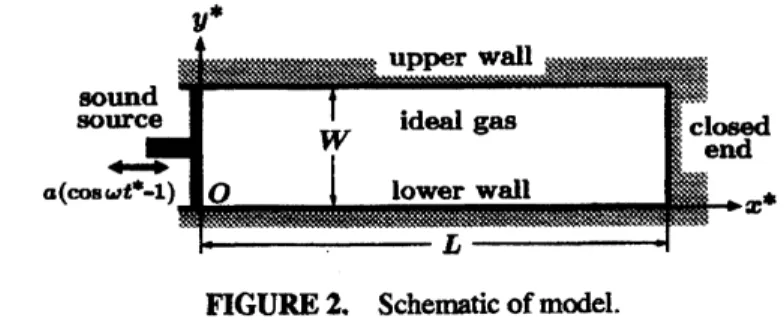
FIGURE 2.
Schematic
of model.
tries
to resolve
all phenomena
ffom
an
imitial
state
of
uniform and
at
re
$s\mathrm{t}$to
an
almost
steady
oscilation
state
throughout
the
entire
flow
field
including ffie boundary layer.
Therefore,
our
knowledge of streaming
with large
Reynolds number is still limited.
In
previous
papers
[12,
13,
14],
we
have adopted a simple model
based
on
the
linear
standing
wave
solution and
a
boundary layer analysis.
This model
employs
the
incompressible
Navier-Stokes equations
as
the
goveming
equation
$s$
for
ffie
sffeaming
velocity. As
a
result,
we
have numerically
demonstrated
the
$\mathrm{b}\mathrm{i}\mathrm{f}\mathrm{i}\iota \mathrm{r}\mathrm{c}\mathrm{a}\mathrm{t}\mathrm{i}\mathrm{o}\mathrm{n}$and
multiple
existence of steady
state
solutions for
a
region of
mtrerately large
Reynolds number
in
a
two-dimensional rectangular box. In the present
paper,
we
shall
investigate
the
problem
of
bifurcation of steady
sreaming, which is
expected
to
occur
before
the
$\mathrm{r}\mathrm{t}\mathrm{S}\mathrm{i}\mathrm{n}o\mathrm{n}$to
turbulent
motions, not by
utilizing
the
incompressible
model,
but by
the
direct simulation
of compressible
Navier-Stokes
system.
We
treat the large
Reynolds number acoustic
sreaming,
but the
Reynolds number
is
not
so
large that the turbulent
streamming
occurs.
PROBLEM
We shall consider the
$\mathrm{s}\mathrm{o}\mathrm{e}\mathrm{a}\mathrm{m}\dot{\mathrm{i}}\mathrm{g}$motion induced
by
resonant
gas
oscillations
in
a
two-dimensional rectangular box
filled
with
an
ideal
gas
(see
Fig.
2).
The
box,
whose
lengffi
is
$L$
and width
is
$W$
,
is closed
at
one
end by
a
solid
plate and the
other
by
a
piston
(sound
source)
oscillating
harmonically with
an
amplitude
$a$
and angular frequency
$\omega$.
We
assume
that
the sound
excitation
is moderately
weak,
ffie thickness of the
bound-ary
layer
is
sufficiently
thin compared with
ffie
width of the
box,
and
the wavelength of
the
excited
sound
is comparable
with the
width of
the
box,
$M= \frac{M}{\infty}\ll 1$
,
$\epsilon=\frac{\sqrt{\nu_{0}\omega}}{Q)}\ll w$
,
$w= \frac{W\omega}{\alpha}=O(1)$
,
(1)
where
$M$
is
the
acoustic Mach number
at
the sound
source
(
$\infty$
is the
speed of sound
in
the
imitial
undisturkd
state),
$\epsilon$is
a
measure
of the
ratio
of
the
thickness
of
acoustic
boundary layer to the wavelength
$\lambda=2\pi \mathrm{q}/\omega$
,
and
$w$
is
the
normahzed
width of the box.
Furthermore,
we
assume
the second-mode resonance,
which is
prescribed
by
$b=2\pi$
,
(2)
where
$b=L\omega/\mathrm{q}$
is the
normalized
box
length. The
wave
motion
in
the
bulk
of the
gas
Governing
equations,
initial
and boundary
conditions
We obtain
the
wave
and
streaming
motions by
solving
the initial and
boundary
value
problem for the system of
compressible
$\mathrm{N}\mathrm{a}\mathrm{v}\mathrm{i}\mathrm{e}\mathrm{r}-\mathrm{S}\mathrm{t}o\mathrm{k}\mathrm{e}\mathrm{s}$equations,
$\frac{\partial\rho}{\partial t}+\frac{\partial\rho u_{j}}{\partial x_{\mathrm{j}}}=0$
,
(3)
$\frac{\partial\rho \mathrm{u}_{i}}{\partial t}+\frac{\partial p\delta:\mathrm{j}+\rho \mathrm{u};u_{j}}{\partial x_{j}}=\epsilon^{2}\frac{\partial\sigma_{ij}}{\partial x_{j}}$
,
$\sigma:j=\mu(\frac{\partial \mathrm{u}_{i}}{\partial x_{j}}+\frac{\partial u_{j}}{\partial x:}-\frac{2}{3}\frac{\partial u_{k}}{\partial x_{k}}\delta:\mathrm{j})$,
(4)
$\frac{\partial E}{\partial t}+\frac{\partial(E+p)u_{j}}{\partial x_{j}}=\epsilon^{2}(\frac{\partial\sigma:jui}{\partial x_{j}}+\frac{\partial q;}{\partial x_{j}})$
,
$E= \frac{1}{2}\rho u^{2}.\cdot+\frac{p}{\gamma-1}$
,
$q_{j}= \frac{\mu\partial T}{(\gamma-1)Pr\partial x_{\dot{f}}}$
,
(5)
where
$x:=x_{i}^{*}\omega/\mathrm{q}$
and
$t=\omega t^{*}$
are
the
nondimensional
space
$\mathrm{c}\mathrm{o}\mathrm{o}\mathrm{r}\mathrm{d}\dot{\mathrm{i}}$aates
and
time;
$\rho=\rho^{*}/n$
and
$p=p^{*}/(n4)$
are
the nondimensionalized
gas
density
and
pressure;
$u_{i}=u|./\mathrm{Q}$
is
the
nondimensional
gas
velocity;
$E$
is
the
nondimensional total
gas energy
per
unit
volume;
$\sigma_{ij}$and
$q$
:
are
the nondimensional
viscous
tensor
and
heat
flux
vector;
$\mu=\mu/\mu_{\mathrm{O}}$
is the
nondimensional viscosity
coefficient;
$\gamma$is
the
ratio of
specific
heats;
$P\mathrm{r}$is
the Prandtl
number. The
equation
of state for ideal
gas
$\gamma p=\rho T$
is
used to close
the system.
The
imitial condition is given
as
$u:=0$
,
$p=\gamma^{-1}$
,
$\rho=1$
,
$T=1$
.
(6)
The boundary
conditions
on
the
oscillating
piston face
are
$u=-M\sin t$
,
$v=0$
,
$T=1$
at
$x=M(\cos t-1)$
and
$0\leqq y\leqq w$
,
(7)
and
ffie boundary condition except
for the
piston
face
are
$u=v=0$
,
$T=1$
,
(8)
where
$x=x_{1},$ $y=x_{2},$ $u=u_{1},$ $v=u_{2}$
.
and
ffie
isothermal condition is
imposed
on
the
gas
temperatue
on
the
wall.
The
viscosity coefficient is assumed
to
obey
the
Sutherland’s
law and ffie
Prandtl
number
$Pr$
to
be
a
constant
(0.7).
The results
presented in
the following
are
the
cases
where the
acoustic
Mach number
at
the
sound
$\mathrm{s}\mathrm{o}\mathrm{u}\iota \mathrm{c}\mathrm{e}M=0.01$
and
0.001, ffie
$\mathrm{n}\mathrm{o}\ovalbox{\tt\small REJECT} \mathrm{d}$box
widffi
$w=2\pi/5$
and
$\pi/5$
,
and the
ratio
of the boundary layer thickness
to
the
wavelength
$\epsilon=0.00316$
,
which
corresponds
to
$\omega/(2\pi)=12.5\mathrm{k}\mathrm{H}\mathrm{z}$
in
ffie
air in the
$\mathrm{s}\mathrm{t}\mathrm{t}\mathrm{d}\mathrm{a}\iota \mathrm{d}$state.
The
initial
and
boundary value problem
(3)
$-(8)$
is Iolved with he high-resolution
up-wind
finite-difference TVD
scheme
[16].
The method
has
been used for
various
non-linear
acoustics problems
by
the present
author
(e.g.,
see
[6, 17]),
and the
detail
$s$
aoe
We
shall remark
that in
the present
computation
we
don’t
assume
any
symmeby
of
flow pattem
of
acoustic streaming,
and therefore
we
solve the
entire
field
in the
box
$0\leqq x\leqq b$
and
$0\leqq y\leqq w$
.
The
entire
field
is
subdivided into
a
boundary-fitted
$700\cross 300$
nonuniform
mesh,
where the mech
points
are
clustered
near
the
boundary.
The
minimum
grid
size
is
0.0002
in
the vicinlity of the
wall
and this
is
so
small compared
with
$\epsilon=0.00316$
ffiat
we
can
resolve the
acoustic
boundary layer. The
resolution of
$\mathrm{b}\mathrm{o}\mathrm{u}\mathrm{n}\mathrm{d}_{\Psi}$
layer
is
crucially important because the
acoustic
saeamin
$\mathrm{g}$in the bulk of
the
gas
is mainly
induced
by the sffeamin
$\mathrm{g}$motion in the
boundary layer
or
ffie
so-called
limiting velocity of the
inner streaming.
The
time
step
is
$2\pi/50000$
,
and
the
CFL
number
is
about
0.5.
The
CPU
time
for
$\mathrm{c}\mathrm{o}\mathrm{m}\mathrm{p}\mathrm{u}\mathrm{t}\mathrm{a}\dot{\mathrm{u}}\mathrm{o}\mathrm{n}$
of
one
oscillation cycle
of
piston
is
about
4.4
hours
on a
$s$
tate-of-ffie-art PC
(dual-cpu
machine).
The
streaming
velocity
$u_{S}$
is evaluated
by the
time-averaged
mass
flux
vector,
$\mathrm{u}_{\mathrm{S}}==\int_{t}^{\mathrm{r}+2\pi}dt$
.
(9)
We
shall further remark that
we
don
$\mathrm{t}$give
any
artificial seed
of asymmetry
in
the
computation.
The
numerical
code
is
written
$s\mathrm{y}\mathrm{m}\mathrm{m}\mathrm{e}\theta \mathrm{i}\mathrm{c}\mathrm{a}\mathrm{l}\mathrm{l}\mathrm{y}$in he algebraic
sense.
The
asymmetry inherent in the numerical
operations
of
finite figures
spontaneously
grows
due
to
the
instability
of
the
system concerned.
RESULTS
Evolution of
resonant gas
oscilation
At the imitial
instant
$t=0$
,
the
gas
in
the box is uniform and at rest. After the
beginming
of
oscillation
of the
piston,
the
wave
amplitude
grows
in
propomon
to
$Mt$
.
At
$t=O(1/\sqrt{M})$
,
the
wave
amplitude
reaches the
maximum
value of
$O(\sqrt{M})$
,
where
two
shock
waves are
formed
since
the
excitation
at
the sound
source
is
the
second
mode.
Figure
3
shows
the
temporal
evolution of
pressure
amplitude
at
ffie
$\mathrm{c}1\mathit{0}$sed end. At almost
$t/(2\pi)=15$
,
the
wave
amplitude reaches its
maximum
value,
and thereafter
a
quasi-steady
oscilation
state
continues.
$\mathrm{o}\epsilon \mathrm{c}\mathrm{u}\iota \mathrm{a}\iota\iota \mathrm{o}\mathrm{n}$
cyclG
$(\iota/‘\pi’$
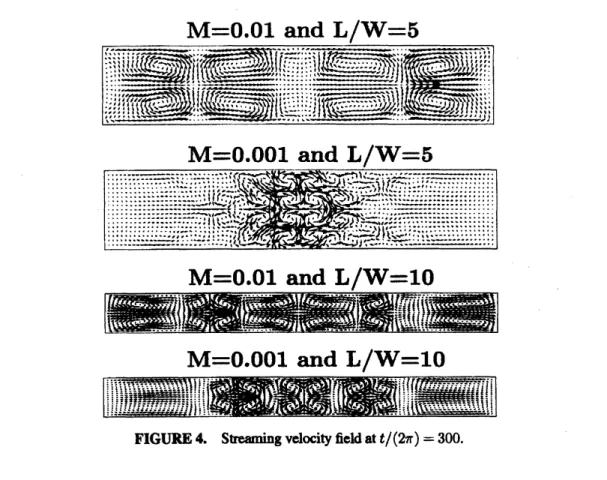
FIGURE4.
$\mathrm{S}\mathrm{b}\mathrm{e}\mathrm{a}\mathrm{m}\mathrm{i}\mathrm{n}\mathrm{g}\mathrm{v}\mathrm{d}\propto \mathrm{i}\mathrm{t}\mathrm{y}\mathrm{f}\mathrm{i}\mathrm{e}\mathrm{l}\mathrm{d}\mathrm{a}\mathrm{t}t/(2\pi)=300$.
Development
of
acoustic
streaming
Figure
4
shows the soeaming velocity fields
at
$t/(2\pi)=300$
.
Except
for
he
case
of
$M=0.01$
and
$L/W=5$,
the
streaming
patterns
are
considerably different from that
of
the classical
Rayleigh streaming, which consists
of the regular arrangement of four
vortex
pairs
and the flow pattern
is
symmetric with
respect to
$x=b/2$
and
$y=w/2$
.
Although
the flow pattem for
$M=0.01$
and
$L/W=5$
is apparently
similar
to
that
of Rayleigh soeaning, the flow directions
of
its
major
vortexes
are
opposite
to
those
of
Rayleigh
sreamin
$\mathrm{g}$.
This
has been reported by Alexeev and Gutfinger
[7],
although their
computation
assumes
the
symmetry of
flow
field
with respect
to
$y^{*}=W/2$
and they
have
$\alpha \mathrm{u}\mathrm{n}\mathrm{c}\mathrm{a}\mathrm{o}\mathrm{e}\mathrm{d}$
the
computations
at
one
hundred cycles.
The streaming velocity
fields
at
$t/(2\pi)=500$
are
shown
in Fig.
5.
An
origin
of
asymmetry
appears nearx
$=0\mathrm{t}\mathrm{d}y=w/2\mathrm{i}\mathrm{n}\mathrm{t}\mathrm{h}\mathrm{e}\mathrm{c}\mathrm{a}\mathrm{s}\mathrm{e}\mathrm{o}\mathrm{f}M=0.0\mathrm{l}\mathrm{t}\mathrm{d}L/W=5$
.
The
flow
pattems
in
the other
cases
constantly change
from ffiose
shown in Fig.
4.
This
clearly
means
that
computations
for
a
few
hundreds of
cycles
are
insufficient
for the
analysis
of high
Reynolds
number acoustic streaming.
We therefore continue
the
computations for
ffie
two
cases
of
$L/W=5$
over a
thousand
of
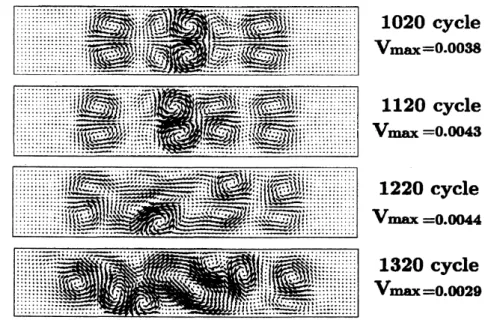
cycles. Figure
6
shows the development
of
asymmetric
stoeaning
pattem for the
case
of
$M=0.01$
and
$L/W=5$
,
and
Fig. 7
shows ffie
case
of
$M=0.001$
and
$L/W=5$
.
The
time
from
the
beginning
of oscillation
and the
maximum
of
$\mathrm{s}\mathrm{t}\infty \mathrm{a}\mathrm{m}\dot{\mathrm{m}}\mathrm{g}$velocity
$U_{\mathrm{m}\mathrm{l}\mathrm{X}}$are
shown in
each
plot in Fig.
6.
Note
that,
as can
be
seen
$\theta \mathrm{o}\mathrm{m}$Figs.
6
and 7,
the
maaximum
velocity
$U_{\mathrm{m}1\mathrm{x}}$is of the order of
$M$
,
because
the
maximum
wave
amplitude is of
$O(\sqrt{M})$
FIGURE5.
$\mathrm{S}\mathrm{n}\mathrm{e}\mathrm{a}\mathrm{m}\mathrm{i}\mathrm{n}\mathrm{g}\mathrm{v}\mathrm{e}\mathrm{l}\mathrm{o}\mathrm{e}\mathrm{i}\mathrm{t}\mathrm{y}\mathrm{f}\mathrm{l}\mathrm{e}\mathrm{l}\mathrm{d}\mathrm{a}\mathrm{t}t/(2\pi)=500$.
and
the
streaming
motion is
a
second-order
nonhnear
phenomenon.
The top figure
in
Fig.
6
shows
that
the
streaming
velocity field
is fully
asymmeffic
at
860th
cycle.
From
the comparison
of the
streaning
pattern
at
1160th
cycle
and
that
at
1260th
cycle,
we
may
conclude
that
an
asymmemc
streaming
almost
reaches
a
quasi-steady state.
On
the offier
hand,
the symmetry
of
sreaming
velocity
field
for the
case
of
$M=0.\mathrm{O}\mathrm{O}1$
and
$L/W=5$
is hardly destroyed
up
to
1020th
cycle,
as
shown
in
the top
figure
in Fig.
7.
Nevertheless,
an
origin
of asymmetry
appears
at
around
the
center
of the
resonator at
1120th
cycle,
and
then the asymmetry
grows
and
prevails
in
the
entire
field
at
1320th
cycle.
At
this
stage,
however,
we
cannot
conclude
that the
streaming
$\mathrm{v}\mathrm{e}\mathrm{l}\mathrm{t}\kappa \mathrm{i}\mathrm{t}\mathrm{y}$field for the
case
of
$M=0.\mathrm{O}\mathrm{O}1$
and
$L/W=5$
reaches
a
quasi-steady
state.
Here,
we
shall
comment
on
the
streaming
Reynolds
number. The
$\mathrm{s}\ovalbox{\tt\small REJECT} \mathrm{g}$Reynolds
number
Rs
may
be
defined
by
$\mathrm{R}\mathrm{s}=\frac{U_{\mathrm{S}}L_{\mathrm{S}}}{\nu_{0}}$
.
(10)
From
the
bottom figure in
Fig.
6,
we
take the characteristic speed
of
streaming
$U_{S}=$
$0.007\mathrm{q}$
.
The charactenistic
length
of sbeaming
$L_{S}$
may
be taken
as
$W=(2\pi \mathrm{q})/(5\omega)$
FIGURE
$\propto$Devclopmcnt
of
asymmetric
$\mathrm{s}\mathrm{n}\infty \mathrm{m}\mathrm{i}\mathrm{n}\mathrm{g}$
pattern
for
$M=0.\mathrm{O}1$
and
$L/W=5$
.
CONCLUSIONS
We have demonstrated that acoustic
$\mathrm{s}\ovalbox{\tt\small REJECT} \mathrm{g}$in
a
resonator
develops
into
an
asymmet-ric quasi-steady flow.
${\rm Re}$
previous
authors
$[7, 9]$
assumed
ffie symmetry
with
respect
to
the
centerline of
resonator
in their computations, and
therefore,
they couldn
$\mathrm{t}$find the
asymmeffic solutions.
Furthermore,
they truncated the
computation
at
100 or200
cycles
from the
beginning of
sound
$\mathrm{e}\mathrm{x}\mathrm{c}\mathrm{i}\mathrm{t}\mathrm{a}\dot{0}\mathrm{o}\mathrm{n}$,
which
is
clearly
insufficient for the
talysis of
$\mathrm{s}\ovalbox{\tt\small REJECT} \mathrm{g}$
motion
of moderately large Reynolds
number,
unless
the strong
nonlinearity
rapidly
excites
a
turbulent
streaming motion
as
shown
in
[6].
The
existence
of the steady
asymmeric flow regime prior to the
transition
to
turbu-lent
motions
is
important
for
understanding of
acoustic streaming
with large Reynolds
number
in
resonators.
REFERENCES
1.
$\mathrm{L}\alpha \mathrm{d}\mathrm{R}\mathrm{a}\mathrm{y}\mathrm{l}\dot{\alpha}\mathrm{g},$$l\mathrm{h}\epsilon \mathrm{I}\mathrm{k}o\eta\phi Solmd$
Dovex,
New
YOrk,
lu5.
2.
E.
N.
da
C.
Andrade,
On
the
cioeukuom
caused by
the
vibration of air in
a
tube,
Proc. R
Soc.
A,
1S4,
445-470
(1931).
3.
P.
Maldi
and
H. Ihonmn,
$[] \mathrm{m}\mathrm{s}\mathrm{i}\mathrm{n}\mathrm{o}\mathrm{n}$$\mathrm{I}$to
$\mathrm{t}[] \mathrm{u}\mathrm{h}\mathrm{l}\mathrm{l}\mathrm{e}\mathrm{n}oe$in oscillating
$\mathrm{P}^{\mathrm{i}}\triangleright$
flow,
J.
Fhid
Mech.,
68,
567-575
(1975).
4.
G.
W
Swift,
$\mathrm{R}\alpha \mathrm{m}\mathrm{r}\mathrm{u}\mathrm{s}0\mathrm{c}\mathrm{e}\mathrm{n}\mathrm{g}\dot{\mathrm{o}}$eess
and
refrigeraters, Phys.
rm.
$\alpha,$
$\ovalbox{\tt\small REJECT}$
Kutute of
Physics,
New
Yodc,
1995,
pp.22-28.
1020
cycle
$\mathrm{V}_{\max=0.00\theta 8}$
1320
cycle
$\mathrm{v}_{\max=0.\alpha 129}$
FIGURE 7.
Development of
asymmetric streaming
pattea for
M
$=0.001$
and
$L/W=5$
.
5.
M.
W.
Ilxxopson
and A. A. Atchley,
Simultaoeous
measurement
ofacoustic and
sbeaming
velocitics
in
a
standing
wave
using laser
Dappler
anemomby,
J.
Acoust.
Soc.
Am.,
117,
1828-1838
(2005).
6.
T.
Yano,
$\mathrm{n}\mathrm{u}\mathrm{h}\mathrm{l}\epsilon \mathrm{n}\mathrm{t}$acoustic streaming excited by resonant
gas
oscnla0r
with periodic
shock
waves
in
a
closed
tube,
J.
Acoust
Soc.
Ans.,
106,
L7-L12
(1999).
7.
A.
Alexeev and
C.
$\mathrm{G}\mathrm{u}\mathrm{m}_{\mathrm{g}}\varpi$, Resonance
gas
$\propto \mathrm{c}\mathrm{i}\mathrm{l}\mathrm{l}\mathrm{a}\mathrm{n}\mathrm{o}\mathrm{n}\mathrm{s}$in closed tubes: Numerical
snry
and
experiments,
Phys.
$Fl\dot{u}d_{l},$
15,
3397-3408
(203).
8.
P. J.
Marris,
S.
Boluniaan,
and
C.
M.
Shieh,
Numerical simulation of
minor
losses due
to
a
sudden
contraction and
expansion
in high
$\mathrm{a}\mathrm{l}\Psi^{[\mathrm{i}\mathfrak{n}\mathrm{r}\mathrm{e}}$acoustic
resonators,
Acta
Acust.
$Unit\epsilon dAc.,\mathfrak{R}$
,
393-409
(2004).
9.
M.
K.
$\mathrm{A}\mathrm{k}\iota \mathrm{a}\mathrm{e}$and
B. Farouk,
Numerical simulation of
acoustic
sbeaming generated by
finitc-$\mathrm{a}\mathrm{n}\varphi \mathrm{A}\mathrm{n}\mathrm{l}\$